How we know · the LEGO seizure · the April record
Twenty-four hours in April
On April 29, 2025, the corporate representative who had seized the Keizer store and a listed BAM franchise seller spent seventy-six minutes on the phone with the collectors’ show Collecting Weekly answering questions about Bryan Mansell’s consignment. The next morning, the franchisor’s written statement reached the show again from Provo, a defamation warning alongside it. Corporate’s position was fixed before the operators spoke. One organization. Two channels, one unguarded, one drafted. Twenty-four hours. Both are now public. The record answers them line by line, and most of it is their own. In September 2026 one of the two callers went over the same ground on another recorded call, published by its maker. His later words sit beside his earlier ones below.
April 29, 2025, on the call
“Yeah, there’s no stickers. Do you see any stickers on any of those sets?”
Josh Johnson, 18:09 Primary source
December 2025, his own texts
“We have been holding on to what had stickers on them. We put them in the back.”
Josh Johnson, in the published police file (page 15) Primary source
The same speaker, seven months apart. Everything below reads the same way.
What the dispute is about
Bryan Mansell placed a collection of LEGO sets with the Bricks & Minifigs store in Keizer, Oregon, under an agreement, signed the year before, saying they remained his until they sold. The franchisor seized the store on November 14, 2024. In December 2025, Josh Johnson, a listed BAM franchise seller, wrote in his own texts that the sets with stickers on them were being held in the back, and offered their return against a signed release, a formal apology, and the removal of negative comments. In September 2026, on a recorded call published by the YouTuber who made it, Johnson said he was shown the sets in a cupboard when the store changed hands, and that the sets left in the store were ones he “was personally responsible for.” Marion County’s prosecutor has reviewed the file twice, and twice deemed the matter civil. Confirmed
Who is on the line
Not two strangers. The company’s own people.
Every line below comes from their own words on the recording, from public filings, or from a later recording one of them gave.
Brandon Best
His own words on the call: he “went in” as “a representative,” and “corporate sent me in to seize the store.” BAM’s disclosures list him as franchisee of both Oregon stores, the one that was seized and the Eugene store that later listed the same set models. The company that received the seized store was e-filed at its address the morning after. That afternoon, BAM’s chief operating officer gave him full control of the store’s Facebook Page, its messages included.
Josh Johnson
A listed BAM franchise seller in the company’s own disclosures, 2024 through 2026, at corporate’s Provo address alongside the McNeffs, both before the seizure and at the time of this call. In May 2026 he verified, with the chief executive, the complaint BAM filed against Reckless Ben. In September 2026 he spent an hour on a recorded call with a YouTuber, published the same night, going over this store again. His later words are below, beside these.
On the call, Johnson’s role was never disclosed, and Best’s came out only after the line dropped and he was alone. And the written statement, in Collecting Weekly’s hands before the call and delivered to the show again the next morning with a defamation warning, came from the franchisor’s Director of Marketing & Project Management, in Provo. The spoken channel and the written channel were one organization. This is not an interview with bystanders. It is the enterprise answering questions about its own seizure, in its own voices, on tape.
Before there was anything to manage
Why this call carries more than the statements
One thing about the call colors everything below it. It is the earliest of these voices, and the least managed. It was recorded in April 2025, to a collectors’ show with a small audience, close to a year before any of this became a public investigation: no statement had yet been quietly rewritten, no outside PR firm engaged, no racketeering suit filed against a critic, no police file reopened. The apparatus that later shaped what the company said in public was not running. The two operators simply talked, at length, to a stranger, because there was no reason yet to expect the recording would be published in full, or that anyone would one day have cause to read it line by line against a record that did not, in April 2025, publicly exist. Reckless Ben, whose public reporting on the company came later, is not named on the call itself; the person the operators complain about, the one they say is “writing things all over the internet,” is the consignor himself. The company would later sue that consignor for extortion, then apologize to him and agree to pay.
That is the weight of it. Everything else the company said about this was prepared: the statement it sent the next morning, the versions it edited later, the remarks it walked its franchisees through at the town hall. The call was not. The same denials the company would later put into managed form are here in their unmanaged one, given freely because it did not yet seem to matter. And they do not soften even under challenge: made to a host who was reading their own tape back to them as they spoke, they are the same statements their own later record catches, below, “no stickers,” “no possibility,” “we do not do consignment,” each answered by the speaker’s own words or the company’s own filings. An unguarded record shows not the account a company gives when it expects to be checked, but the one it gives by habit. Inference as to what the speakers expected; Confirmed as to the call’s date and audience, and that the later record had not yet been made.
How to read this
Every claim is tagged with where it came from. Three records tell this story:
And every finding wears its confidence:
Primary source: quoted from the recording, the letter, a filed document as published, or the store Facebook Page’s own access history. Confirmed: a fact checked against those records. Contradicted: the speaker’s own later words, or the same organization’s, say otherwise. Refuted: a document on the record disproves the line as given.
Where a claim has its own entry in the running census of the company’s self-contradictions, it carries a fact checkconfirmed mark: the entry’s own census grade, opening that entry, with its sources, in a new tab.
The speakers identify themselves on the recording: Brandon Best opens the call by name and introduces his partner Josh Johnson; after a mid-call disconnect Collecting Weekly confirms who returned to the line. Attributions below rest on the recording itself. Quotations from the letter are verbatim from the email as the show published it; see the sourcing note at the foot.
What they knew, and when
The dates are the argument
Every denial on the call has a date. So does everything their own side said, signed, or filed, before it and after it. Set them in order and the denials land between facts their own record had already fixed.
The knowledge ladder
EACH DENIAL, SET AGAINST WHAT ITS OWN SIDE PUT ON THE RECORD, BEFORE AND AFTER
What their own side put on the recordWhat they said
November 14, 2024, 7:10 PM. On the seizure-night call, in the police file’s transcription of the store’s Ring video, BAM’s Director of Operations, Ki McAllister (identified as the speaker on page 22), hands the store to Best by name: “Brandon is taking on the business and takes on all that consignment.” Corporate’s own operations chief, naming the consignment at hour zero.
November 15, 2024. The morning after the seizure, Best’s Salem-Baker Bricks Inc is e-filed at the store’s own address. At 3:54 that afternoon, the store’s Facebook Page, as the show put it on screen, records Matthew McNeff, BAM’s chief operating officer, adding Best with “Community Activity, Messages, Insights, Ads, Content, Permissions”: “Brandon Best was given full control.” On November 19 he gives the same to Gabriel McNeff, of the corporate crew that files the company’s store entities.
December 23 and 24, 2024. The same set models the family consigned are listed used at the Eugene store, the other store BAM’s disclosure assigns to Best.
December 30, 2024. Best to police, per the report: no knowledge of the consignment, and Mansell’s products “no longer in the store.”fact checkprimary source
March 31, 2025. BAM’s 2025 disclosure document is issued. Through the 2024 edition, Item 1 had told buyers a franchisee “may also offer” consignment services; the 2025 edition strikes the words, in red, in the marked copy BAM filed with Minnesota (the document). The franchise agreement inside it still lists them.
April 11 to 15, 2025. Collecting Weekly writes to the franchisor through its website form on April 11. On April 14 corporate answers twice: “we are not authorized to share that information,” then a form reply about buy offers. On April 15 it sends the written statement, which the show holds by the call and forwards to the operators mid-call. All of it is in the thread and the form exchange as the show published them.
April 29, 2025, this call. “Yeah, there’s no stickers.” “There’s no possibility. No way.” “We do not do consignment.” And of the show’s messages to the store’s Page: “the first time any of us saw the messages,” sent to “Crystal’s account that I just happened to be able to log into.” Made five and a half months after the notice on their own tape and the grant on the Page, and four months after both the same models listed used in Eugene and their own no-knowledge story to police.
April 30, 2025. The morning after the call, the franchisor’s email to Collecting Weekly includes “our statement,” with “As policy states, Bricks & Minifigs does not enter into consignment agreements,” and carries a defamation warning and a prosecution menu. The franchise agreement BAM itself filed in court lists “consignment services” among approved services.
May and June 2025. Weeks after “no possibility,” the file’s first supplement records Johnson telling police he does not want to give the items to Mansell and does not feel he needs to, “since the store’s inventory became his once he took it over.”
October 8, 2025. The store Page’s next recorded access change: “Gabriel McNeff’s full control was removed.” Six months after April 1, the date the operators give for their own ownership.
December 3 to 5, 2025. Johnson’s texts: “We have been holding on to what had stickers on them. We put them in the back.” Return is offered against a signed release, removal of negative comments, and a formal apology. “Do you want it? Yes or no?” Seven months after “there’s no stickers,” in his own writing.
February 2026. The reopened review. Best, interviewed by the detective: “did not observe any obvious markings, stickers, or tags.” And in the detective’s synopsis of recorded phone calls between Johnson and Reckless Ben, reviewed in the same file, Johnson: “he has 10 to 15 sets sitting there.” A denial of the marks and an admission of the holding, side by side.
February 10, 2026. The detective’s paraphrase of the Chief Operating Officer’s recorded statement, labeled as such in the file: even if there were items sitting in that store, “they don’t belong to Mansell anymore.”
March 5, 2026. The detective’s written conclusion: the company and Best “were informed of and aware” of the consignment.
April 8, 2026. The 2026 disclosure document strikes “and consignment services” from Item 11, the sentence promising BAM’s own “specifications for programs we have developed” (the marked copy). The franchise agreement in the same document still reads “Franchisee may also offer: consignment services.”
May 27, 2026, to the court. The complaint BAM filed against Reckless Ben, verified by Johnson and by the chief executive, pleads that the operators told police they “did not knowingly possess any of his alleged property,” and that the cupboard sets were located “In late 2025,” with “stickers not previously recognized.” Six months after his own texts about holding what had stickers on them.
September 25, 2026. Johnson, on a recorded call with the YouTuber Matty AppleSeed, published that night: “once Brandon had showed me the Legos in the cupboard, and we took over the store.” And: “At the end of the day, there was those sets that were left in the store that I was personally responsible for.” Seventeen months after “no possibility,” and four months after the complaint that pleaded “late 2025.”
September 26, 2026. The sets BAM still had had reached the consignor’s lawyer’s office under the settlement on September 2, about thirty by his first count. On September 26 he sorts them on camera: about 35, seven of them never his, none of the valuable ones. “No yellow dots.” “Some of them even have residue where the yellow stickers were.” BAM’s own register, as reconciled on the Keizer page, marks 403 of his copies still unsold the night it took the store.
October 1 and 9, 2026. Reckless Ben’s lawyers put 27 of Johnson’s lines from the call before the federal judge and file the recordings with the clerk (the motion, ECF 43). Eight days later BAM stipulates that it will not oppose their addition (the stipulation, ECF 48).
Every rung is on the record: the police file’s transcriptions, texts, and interview summaries, the court-filed agreement, the Oregon Secretary of State’s record, the store Facebook Page’s own access history, the Eugene store’s own catalog, the franchisor’s April 30 email, the marked disclosure documents BAM filed with Minnesota, the complaint as filed, the September call as its maker published it, the consignor’s own streams, the federal docket, and the recording itself. The April denials, the December texts and the September account share an author: Johnson answered “no stickers” in April, wrote “holding on to what had stickers” in December, and said “showed me the Legos in the cupboard” the following September. Confirmed as to each statement’s date and text. What any speaker believed is not something a document can prove. The same file holds both the officer’s supplement warning that the described conduct could constitute aggravated theft in the first degree, and the bottom line that stays in frame: Marion County’s prosecutor reviewed the matter twice and twice deemed it civil.
Five minutes
At 37:04, Collecting Weekly puts it to them: “you’re saying there is a possibility that some of those sets are his, to be clear.” The answer, at 37:08 on the published upload:
“There’s no possibility. No way.”Josh Johnson, on the call, 37:08 Primary source
“If anything is in that, was in that store when we took over, it was probably some of the minifigs.”Brandon Best, his business partner, the same call, five minutes later, 42:20 Primary source
These are the store’s two operators, on one call, five minutes apart: one says never, the other says probably. A prepared answer comes in one version. This came in two. The record adds a third. The company’s own court-filed inventory exhibit marks consigned sets unsold as of the takeover, including two Cloud City sets priced in the thousands, analyzed here. On the call, Best recalled the consignor’s visit to the store: “he kept asking us specifically, where are the Cloud Cities? I’m like, there’s no Cloud Cities here, dude” (58:43). Seventeen months later, asked on a recorded call whether his partner might have walked away with the best sets, Johnson: “There’s no Cloud City.” The ledger BAM filed lists two. The consignor, sorting the returned boxes on camera the next day: “There’s definitely no UCS Cloud City or Death Stars or any of those sets in here.” And the published police file’s synopsis of recorded phone calls between Johnson and Reckless Ben, reviewed in the reopened file, has Johnson saying: “he has 10 to 15 sets sitting there,” present tense, with return conditioned on the family first winning a judgment.fact checkconfirmed
One question, three answers
WERE HIS SETS STILL IN THE STORE? EVERY ANSWER IS THEIRS
The first two answers are five minutes apart on one call. The third is the same speaker as the first, on a recorded phone call summarized in the police file. Confirmed as to each statement.
Hold the three positions together. Between one recording and one police file, the same enterprise says nothing was left, that it was probably some of the minifigs, and that ten to fifteen sets are sitting there, present tense. Every statement in the set is theirs, Confirmed as to what was said. Which of them held at which date, the record leaves to them.
The fork was heard in real time. Near the end of the call, Collecting Weekly placed the concession on Best’s partner, telling Best: “I was kind of shocked when your partner was saying some of the inventory may be his. It’s like, even if there’s like a 1% chance, like pull that off the floor, man.” The voice that made it at 42:20 refers to “Josh” in the third person in the same breath; it is Best’s own, and he did not correct the attribution. His answer, at 1:10:39: “I think that’s what he was trying to say when he was saying like, yeah, here, come take the, like take the stuff.” Primary source
What “no possibility” rests on
“No possibility, no way” was not a guess. Johnson gave the reasoning under it, and the reasoning is its own admission.
“Bricks and Minifigs goes through eight to 12 turns a year. So potentially that entire inventory in that store has turned over.”Josh Johnson, on the call, 32:02 Primary source
The claim that none of the consigned sets are in the store rests on the claim that all of them sold. He said it plainly: “It was probably sold over and over and over and over again” (32:42). Hold that against the agreement, signed the year before, which entitled Mansell to a written report and his percentage with every sale. If the collection sold through the store’s registers, the money was owed to him on each sale. That it all sold is not a defense to the claim. It describes it.
Two facts on the same recording sit against the turnover story. Five minutes later, Best allowed that not all of it sold: “it was probably some of the minifigs” (42:22). And the sales that would show the turnover, the register records from before the takeover, are the one thing they said they could not produce. Collecting Weekly: “you have no POS records from essentially 11/15 and before.” The answer: “Correct. No, we don’t. That’s not ours” (36:28). The turnover offered as proof the goods are gone would live in the records they say are not theirs to give. Confirmed as to each statement; which account is right, the record leaves to them.
The turnover story has a later date. In September 2026, on a recorded call, Johnson said of the same collection: “every piece in that collection has now been accounted for. And there’s nothing missing. … We didn’t sell anything. It’s all been accounted for.” Between the two accounts sits his own text to the consignor, December 5, 2025, in the police file (page 15): “There were a couple of sets she had on layaway we sold.” Sold over and over, in April; nothing sold and nothing missing, in September; a couple of sets, in his own writing between. Confirmed as to each statement and its date.
The stickers, April and December
The consigned sets were marked: yellow stickers on boxes, white tags on minifigures. On the call, Johnson answers the sticker question twice.
“Yeah, there’s no stickers. Do you see any stickers on any of those sets?”Josh Johnson, on the call, 18:09 Primary source
The host asks the follow-up straight: were the stickers removed after the transition, or were the sets never stickered to begin with? Johnson, at 18:24: “Yeah, there’s no stickers.”
Seven months later, in his own text messages preserved in the police file (page 15): “We have been holding on to what had stickers on them. We put them in the back.” And again: “Anything that had a sticker on it we put in the back.”
The same file carries two former employees’ accounts of the marked sets in the store after the takeover, and they counted: one describes twenty-five to thirty-five stickered boxes on three shelves and roughly a hundred white-tagged minifigures later kept in the safe. The other describes about sixty stickered boxes and about twenty tagged minifigures, and adds that some of the yellow stickers were removed from sets immediately after Best took over. Beside them sits Best’s own later statement to the detective that he “did not observe any obvious markings, stickers, or tags.” April on tape, December in writing. Both are the operators’ own.fact checkprimary source
Now read the two statements together, because they fit. The showroom he gestured at could honestly show no stickers, because per his own texts the stickered ones were in the back. The answer was true of the floor, and the reason it was true is the thing the texts describe. And the sorting rule in those texts, “if it had a sticker on it, it can be from your agreement. We set those aside,” is the exact distinction the call said could not be made: “there’s no way to distinguish what’s his, what’s not his.” Primary source
The stickers got a third date, a fourth, and a last one. The complaint BAM filed in May 2026, which Johnson verified, says the cupboard sets were located “In late 2025,” with “stickers not previously recognized.” On the phone in September 2026, Johnson put the cupboard at the start: “once Brandon had showed me the Legos in the cupboard, and we took over the store.” And of his partner, in his own account: “Brandon obviously knew a lot more about it than I did, right? … And obviously now we know Brandon knew about it but didn’t tell me.” On September 26, 2026, the consignor sorted the boxes BAM had sent back on camera: “No yellow dots.” “Some of them even have residue where the yellow stickers were.” April, December, May, September, and the boxes themselves. Confirmed as to each statement’s date and text.
One denial, three channels, twenty-four hours
“We do not do consignment. It’s never been a part of Bricks and Minifigs.”Josh Johnson, on the call, 27:58 Primary source
“As policy states, Bricks & Minifigs does not enter into consignment agreements.”The franchisor’s written statement to the show, delivered the morning after the call Primary source
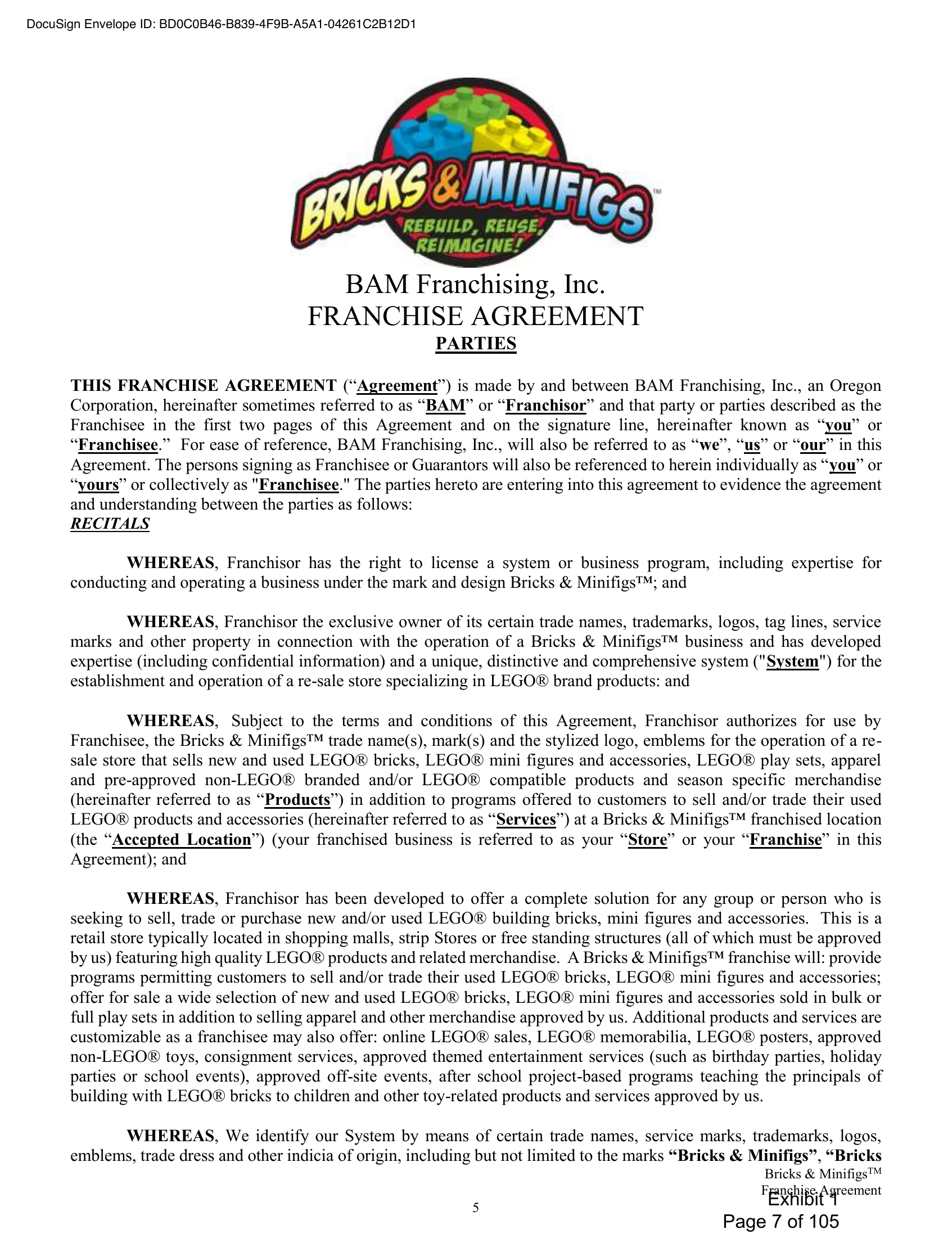
Read the second sentence precisely. It says corporate does not enter into consignment agreements. The dispute is about a store’s consignment agreement, and the franchise agreement that BAM itself filed as a court exhibit in Clackamas County lists “consignment services” among a store’s approved services and treats consignment arrangements as auditable business records. A sentence about the corporate entity, given in answer to a question about a store.
The company’s own disclosure document had said what the agreement says, until the month before the call. Through the 2024 edition, Item 1 told buyers a franchisee “may also offer” consignment services. The 2025 edition, issued March 31, 2025, struck the words; the marked copy BAM filed with Minnesota shows the strike in red (the document). The 2026 edition struck them again, from Item 11, and left them in the franchise agreement inside the same document: “Franchisee may also offer: consignment services” (the 2026 marked copy). Twenty-nine days after the first strike, on the call: “We do not do consignment. It’s never been a part of Bricks and Minifigs.” Confirmed as to both strikes, their dates, and the agreement’s line.
On the night of the takeover itself, in the police file’s own transcription of the Ring video, the outgoing owner explains that the receipts she is printing are for consigned sets “he has not been paid his percentage yet.” BAM’s Director of Operations, Ki McAllister, answers: “Brandon is taking on the business and takes on all that consignment.” On the call, Collecting Weekly reads that sentence to them at 27:16. What follows is the consignment denial, at 27:58. Seconds later, at 28:15: “Not in a million years would anybody think that there’s a consignment list.” The store’s prior operator told the original officer corporate had given consignment “the green light.” And by Best’s own account on the call, the prior owner’s printing of receipts on the takeover night “caused flags to go off,” and not only in his head: “it was in the corporate side” (16:32).fact checkconfirmed
So the denial ran in every channel the enterprise had, and in this order: a written corporate statement sat in Collecting Weekly’s hands before the call; the store’s spoken voice gave the same answer on April 29; and the morning after, corporate’s email to the show carried the same denial in writing, with a defamation warning. By their own account, the operators had not seen the show’s messages until that day and met corporate’s statement only when Collecting Weekly forwarded it mid-call. The Page those messages went to had listed Best with full control, its messages included, since the afternoon after the seizure, by the chief operating officer’s grant. The unguarded version and the drafted version still told the same story. All of it runs against the company’s own filed contract, its own night-one tape, and its own night-one flags. That the three channels moved together is a reading Inference. That each statement was made, and that each document says what it says, is Confirmed.fact checkprimary source
The documents
“A new business that came into it”
“We are a new business that came into it.”Brandon Best, on the call, 58:04, alone on the line after the disconnect Primary source
The same answer assigns the consignment to the prior owner’s business in words that set the paper aside: “her business was the one that signed it, regardless of what it says on the documents.” Later on the same recording, at 1:03:03, he describes how it got there: “corporate sent me in to seize the store,” with instructions to make sure the prior owner “was removed from operations.”
Where in the call these words sit matters. At about 46:45 the line drops; Best calls back; Johnson never rejoins. The recording’s plainest facts almost all come from that second half, from Best alone: the “new business” framing and “regardless of what it says on the documents,” “corporate sent me in to seize the store,” the $25,000 whole-store figure, and, at the end, that he was “not technically allowed to” give a statement without corporate. With two voices on the line, the answers were absolute. With one, they got specific. Confirmed as to the sequence and each statement; the pattern is left to the reader.
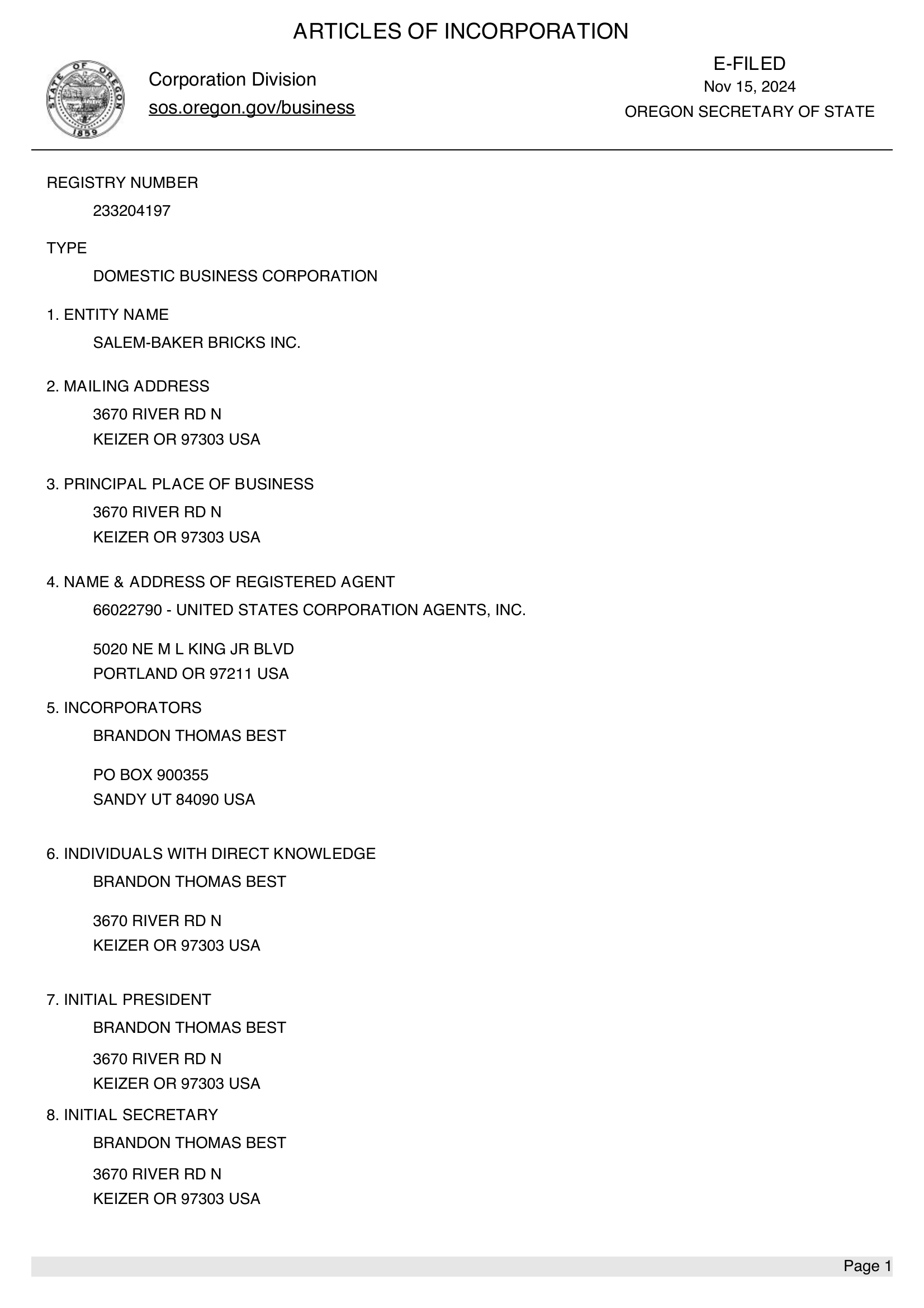
The paper is shorter still. The company’s federal disclosure lists Best as franchisee of both Oregon stores. The Oregon Secretary of State shows Salem-Baker Bricks Inc registered on November 15, 2024, the day after the takeover, at the store’s own address, Best as incorporator and president. BAM’s own disclosures, 2024 through 2026, list Josh Johnson among the company’s franchise sellers, on one roster with Ammon McNeff and Matthew McNeff, at corporate’s Provo address. And weeks after the takeover, the same set models the family had consigned were listed used at the Eugene store Corroborated: same models, consignment tie, and timing are established; that any listed copy was a specific consigned copy is not claimed.fact checkconfirmed
The paper says one man operates both Oregon stores. A year after the takeover, the store’s own counter said it on camera: an employee called the man with the truck outside “the owner,” who “owns the Eugene one” and this one too and “lives in Utah,” on a day the owner put himself “at Eugene earlier today” and a rented truck billed two round trips between the two stores. The “independent” store, describing its Utah owner and the road to the other one, in its own staff’s voice. Confirmed
The documents
The window
“Took over” means two different dates, depending on the question
Listen for one move on this call. It carries almost every answer.
The store was seized on November 14, 2024. Best and Johnson say they became owners on April 1, 2025. In between, on their account, “it was Bricks and Minifigs corporate” (26:43). So there is a window, November to April. Who ran the store inside it? By his own words on this call, Best did: “I was the one that went in,” as “a representative,” and “corporate sent me in to seize the store.” To the detective, per the police file, he described himself as management staff on behalf of the franchise in that period. The published night-one bodycam shows Best in the store. Johnson, a listed BAM franchise seller, answers for that same store as one of its two operators on this call. The window had their names on it.fact checkconfirmed
So did the store’s Facebook Page, and the Page kept its own record of whose hand put them there. The show had written to the store twice, on Facebook Messenger; “those messages were read and not answered,” Collecting Weekly says on the tape (9:42). Johnson: it was “the first time any of us saw the messages” (9:54). Best: “Crystal had access to that.” The Page was the old one; Crystal “obviously didn’t give us any of the passwords to any of the social medias”; the show had written to “the wrong social media” (10:36). Near the end of the call: “technically Crystal’s Facebook” (1:18:37).
April 29, 2025, on the call
“And what it is, it’s Crystal’s account that I just happened to be able to log into.”
Brandon Best, 10:17 Primary source
November 15, 2024, 3:54 PM, the Page’s access history
“Brandon Best was given full control.”
Matthew McNeff, BAM’s chief operating officer, the afternoon after the seizure, adding Best with “Community Activity, Messages, Insights, Ads, Content, Permissions” Primary source
His account of the Page, and the Page’s record of him. The show puts the Page’s history on screen before the call, at 1:55 of its video.
Four days after Best, on November 19, 2024, Matthew McNeff gave the same full control to Gabriel McNeff, one of the three names, all at the franchisor’s Provo suite, that sign the company’s new store entities in state after state. The history’s next entry is October 8, 2025: “Gabriel McNeff’s full control was removed.” That is six months past April 1, the date the operators give for their own ownership. Later on the call, Best described “looking through the accounts” and finding one of the prior owner’s old posts (55:56). The history records who was given control of the Page and its inbox, and when; it does not record who opened which message. Primary source as to each entry; Confirmed as to their dates against the seizure, the call, and April 1.fact checkconfirmed
Now watch the date slide.
When the question is what they knew
“We didn’t know the consignment even existed until two weeks after we took it over.” (15:14)
Two weeks after November 14 is the start of December. “Took over” means November.
When the question is who answers for it
“The new owner was responsible. It wasn’t me at that time. I was there to help facilitate the transition.” (26:28)
Owners, they say, from April 1. “Took over” means April.
Same phrase, two dates. The date moves with the question.
Every hard fact in this story sits inside that window. The marked sets went to the back and the safe, per the employee accounts in the police file, and per Johnson’s own later texts describing it: “We were told that if it had a sticker on it, it can be from your agreement. We set those aside.” Best told police in December there was no knowledge and nothing in the store. The same set models were listed used in Eugene in December. Asked whether any pre-takeover sales records exist, the answer came twice: “Correct. No, we don’t. That’s not ours” (36:28), and “Yeah, we do not have that” (36:34). On the call, all of it is answered with the April date: not us, that was corporate. And corporate’s written channel answers the same months with: each store is “independently owned and operated.” Two shields, each pointing at the other. Inside the window, both shields were held by the same people.fact checkconfirmed
The distance was performed on the call, too. “I’m not privy to all the ways that Crystal broke the franchise agreement” (25:47). “We’re not, we’re not privy to that” (25:53). “I’m not sure how much more I can divulge about that” (1:01:27). A corporate representative and a listed corporate franchise seller, not privy to corporate’s decision. Asking how they got the store, Collecting Weekly says on the tape that it is “still unclear on that” (25:12). The show asks how the inventory was valued. Neither question gets a number or a mechanism.
And once, the costume slips. Offered the innocent frame, your first franchise, Best corrects it upward: “this is our first one we’ve taken over like this” (27:06). Like this. A category, not an accident, and at this store the category is on the public record: the store seized November 14, the receiving company Salem-Baker Bricks e-filed at the store’s own address November 15, the same corporate representative signing both ends. The day-after incorporation is a filed fact; “like this” is the category Best used; the filings show the practice. Four weeks after Salem, Best and Johnson incorporated Wesley Chapel Baker Bricks Inc. in Florida on December 12, 2024, the date on BAM’s termination letter to that store’s franchisee, a letter copied from the one BAM’s lawyers had sent the Messers a year earlier, carrying the offer they had made in Salem four weeks before. Confirmed The company’s own tables book eight takeovers in six years, on the page where a former franchise family reports being told by BAM’s development chief: “Corporate taking over is the last resort. The absolute last resort. We never do that.” Sixteen months after this call, the CEO described to his franchisees a “structured system” for moving stores from “struggling” owners to “system compliant” ones, its plans “already underway.”fact checkconfirmed
Either way
The April 1 defense assigns everything to the franchisor
Follow the window defense to where it goes. If Best and Johnson answer only from April 1, then the seizure, the months the marked sets sat in the back, the December police denial, the December Eugene listings, and the store’s Facebook Page, which its chief operating officer put in Best’s hands the afternoon after the seizure, all belong to “Bricks and Minifigs corporate,” staffed by its own representative and its own listed seller. The defense does not make the events innocent. It names their owner.
And if the window defense fails, the people who ran the store answer for the window they ran.
Both readings end at one organization. That is why the “independently owned and operated” sentence and the “it was Bricks and Minifigs corporate” sentence cannot both do the work they are asked to do. Each shield only works if the other one is down. That is a reading Inference; every statement inside it is on the record Confirmed.
One accusation, walked back on the same call
On this call, the consignor is a man rallying people to break into the store. In the police record, he is a man who telephoned it and left a Facebook comment.
The accusation comes early and comes back. Best, at 29:08: “Trying to rally troops to come break in.” Johnson, on top of him: “Trying to get people to break in.” Collecting Weekly: “I don’t know anything about a break in.” At 46:13, moments before the line drops, Best says: “he was rallying people to go break into our store. That’s the day that we had to call the police.”
Alone on the line, Best fills it in, and the accusation changes shape as he talks. “People have broken into that store a lot” (54:17). Related to this, or in general? The answer comes from the handover: “one of the debriefings that we got when we went into the store was like, hey, you’re going to have to increase the security, because it’s been broken into four times in the last year” (55:40). Four burglaries, under the prior owner, before either of them arrived. Among the things taken, by Best’s own account of what the consignor told him: some of the consignor’s own sets. And the one break-in warning Best can date came from the franchisor, three weeks before the call: “some of the corporate guys have said that they were the ones that triggered the, hey, there’s somebody that’s planning to break into your store tonight, that you may want to inform law enforcement” (57:23). The man accused of inciting a break-in had been, on this account, a burglary victim at the same store. The tip that sent the store to the police came from Provo.
The day they “had to call the police” left a record, and the record is published. It is a telephonic-harassment report under ORS 166.090, event date April 11, 2025. The listed victim is the business. The listed suspect is the consignor. The conduct it describes is phone calls and a Facebook comment. He was told to stop calling the business line. No break-in, no plan for one, no rally, appears in it. Confirmed as to each statement on the recording and the report as published.
Then the other Facebook story on the call, and what happened to it. The host lays out his dated account: the week of April 22, the store “started getting one-star reviews. Seems like Brandon and Megan, which I think is your partner, and perhaps some of the employees started leaving five-star reviews.” The partner is Megan Best, Brandon Best’s wife. And the night before the call, “your partner tried to join our Facebook group,” the show’s private group. The host tells Best what he made of it: “I thought it was kind of silly… do you think we’re that dumb?” Best, at 52:18: “if you can keep Megan out of it.” Collecting Weekly: “I’ll take that out. We were going to put it, but I’ll take it out.” Best: “I think she was just trying to help me. I don’t do Facebook very well.” Forty seconds later, at 54:01, he is back on the consignor’s “Facebook groups that he’s been a part of where he’s incited people to, you know, break into the store as well.” At the end of the call Collecting Weekly confirms the favor: “I will, I will take your wife’s, uh, information out of the, the slides for tonight,” and adds, of his own group, “there’s not like a go leave a one-star review thing.”
Two Facebook accounts of conduct were put on this call. The one about the store’s own side, five-star reviews from Brandon Best, Megan Best, and employees during the one-star week, and an attempt to get inside the show’s group, is Collecting Weekly’s dated account on the tape, hedged on the tape as “seems like,” and Best did not dispute it; he asked for it to be kept out, and it was. The one about the consignor’s side, inciting break-ins, was pressed three times and is absent from the police report the store itself generated. The request granted on the call was the one about his own family’s Facebook conduct. The accusation Collecting Weekly declined was the one about the consignor’s. Corroborated as to the reviews and the group, on Collecting Weekly’s account; Confirmed as to every quoted exchange.
The next morning’s letter carried the accusation forward in the general case, in a menu that begins with “calling for or inciting violence against person or property” and continues, in the same sentence, to the “making of false police reports.” Both items in that sentence have a record on this page. The keep-out request is not the only one on the call: at 1:05:49, about to give the store’s inventory figure, Best asks Collecting Weekly to keep that out too, “whatever you need to do.” Twice, on one recording, the store’s side asked what the show would leave out. What the show could not leave out is above.
The next morning’s letter
On the call, Collecting Weekly already has the franchisor’s written statement and says so: “we did get a statement from Brooke Norman,” her title Director of Marketing and Project Management. He forwards it to the operators mid-call. A further email from the same director reached the show on April 30, the morning after the call, carrying the franchisor’s statement and a defamation warning. Near the end of the call the night before, Best had told Collecting Weekly he still wanted to get a statement out but did not know he would that night. He was “not technically allowed to” on his own, needing to “circle around with corporate.” What arrived was corporate’s, and it argues with itself. The show says the store’s Page messaged it the day after the call to say a corporate representative would send a formal response; the host reads that message at 4:36 of the video. Confirmedfact checkconfirmed
It carries the statement, and the threats. The statement block arrives introduced as “I’ve included our statement,” the wording of a standing document Collecting Weekly already held. Around it: a liability warning to the platform, notice that the claimant is represented and cannot be spoken to, and a closing menu of “legal action and criminal prosecution.”
The statement
From Brooke Norman, the franchisor’s Director of Marketing & Project Management. In Collecting Weekly’s hands before the call, per the recording, and included again in the April 30 email, where this text appears. Primary source
The franchisor’s statement as sent, with five sentences marked. The findings follow the paragraphs they come from; mark 5 is read with marks 1 and 2, and the last finding returns to mark 2.
Bricks & Minifigs holds its franchisees to the highest standards of professionalism and integrity. We are committed to fostering trust within the communities we serve and insist on honest, transparent dealings in every aspect of our business. When a franchisee engages in inappropriate conduct, operates in bad faith, or steals from customers, they are in clear violation of our core values and are unwelcome to continue operating a Bricks & Minifigs store location.
BAM Franchising, Inc. does not tolerate theft or deception, and we remain steadfast in helping resolve matters when claims are made and verifiable documentation is provided. In fact, throughout our history as a franchise system, both BAM Corporate and our franchise owners have frequently worked hand-in-hand with local collectors, law enforcement, and other businesses to recover stolen goods and reunite valuable collections with their rightful owners. Our network has supported numerous community-led recoveries over the years, all handled respectfully, legally, and professionally.
We understand how important each person’s LEGO collection is to them, it’s more than just bricks; it’s memories, creativity, and passion. In tough situations where Bricks & Minifigs Corporate must take over the operations of a store1, we encourage any community members who have experienced mishandled LEGO trades under prior ownership to contact us directly at [email address withheld]. You can submit a claim to our corporate team, and we will work with you to identify and restore your lost LEGO sets2.
As policy states, Bricks & Minifigs does not enter into consignment agreements3. If you have been misled by a former franchisee4 and parted with your valuable LEGO sets without payment, we are here to help recover your losses as best we can. To expedite the recovery of missing LEGO sets, verifiable documentation of ownership can be submitted to [email address withheld].
We are committed to protecting the trust of our customers and are standing by to help any impacted individual or community. We know that when an individual store owner violates the trust of a customer and their prized LEGO collections, it can be hard to know what to do, who can help, and how to be made whole again. While we understand the desire to use public platforms to express frustrations, especially when they involve individuals who are no longer part of the Bricks & Minifigs franchise system. It is important to remember that each store is independently owned and operated5, and not all franchisee actions reflect the standards or values of our company. Rather than that, we encourage impacted parties to contact our team and resolve the issues.
While instances are rare, Bricks & Minifigs takes all claims of misdealings by current and former franchisees very seriously and encourages those impacted to utilize our established channels and processes to achieve the outcome they desire.
We appreciate our fans, customers, and community members for their understanding and continued support as we work to ensure fairness and accountability across all of our stores.
For further inquiries or to provide documentation to assist in a review of any item(s) in question, please contact our office directly through our corporate contact channels.
It declines to comment, at length.same letter “As standard policy, we do not publicly comment on ongoing cases of this nature,” followed by more than six hundred words of public comment.fact checkconfirmed
It answers a document request with a warning. The letter tells the show that “any further public misrepresentation of this situation” will “be considered defamatory,” and follows with a paragraph promising “all appropriate legal action and criminal prosecution” across a menu that runs from false police reports to “repeated unwanted contact with parties.” What the letter does not contain is any specific fact about the situation it addresses: no mention of the consignment agreement, the stickers, the operators, the Eugene store, or the takeover-night inventory count that the company’s own executives later told a detective was made that night and that nothing in the police file shows was ever produced. The one document that would settle the matter is absent; the liability warning is not.
It invites what it had already received. The letter asks for “verifiable documentation of ownership.” By the thread as the show published it, corporate had answered the show’s outreach on April 15, the consignor “submitted the documentation of his claim to corporate as instructed” on April 20, and the show’s follow-ups on April 22 and 25 drew no reply. The operators split on the same point mid-call. Johnson, at 30:12: “we haven’t talked to corporate about it.” Best, alone on the line at 56:51: “we have communication, and I’m not sure why Josh was saying that we haven’t talked to corporate about it… We had submitted all that information.” Confirmed as to the dates, from the thread as the show published it; Confirmed as to each quoted statement.
The letter, in full
Brooke Norman, Director of Marketing & Project Management, BAM Franchising, Inc., to the show’s host, April 30, 2025. The franchisor’s own long dashes are rendered as commas; the corporate email address is withheld, as it is in the show’s published copy; no other word is changed. Primary source
Read the letter in full, as sent
Dear Zack,
While we understand your desire to champion collectors and share their experiences, it is imperative that we clarify several legal and factual points to ensure your platform avoids mischaracterization and potential liability moving forward.
It is important to note that in the situation you are referencing, we have been contacted by legal counsel, who let us know that they represent the referenced party, therefore we cannot communicate directly with said party. Our own legal counsel has reciprocated communication to the party’s legal representative, and it is currently in their hands.
As standard policy, we do not publicly comment on ongoing cases of this nature. To assist in understanding our position, I’ve included our statement regarding this circumstance:
The statement, as included (shown in full above)
Bricks & Minifigs holds its franchisees to the highest standards of professionalism and integrity. We are committed to fostering trust within the communities we serve and insist on honest, transparent dealings in every aspect of our business. When a franchisee engages in inappropriate conduct, operates in bad faith, or steals from customers, they are in clear violation of our core values and are unwelcome to continue operating a Bricks & Minifigs store location.
BAM Franchising, Inc. does not tolerate theft or deception, and we remain steadfast in helping resolve matters when claims are made and verifiable documentation is provided. In fact, throughout our history as a franchise system, both BAM Corporate and our franchise owners have frequently worked hand-in-hand with local collectors, law enforcement, and other businesses to recover stolen goods and reunite valuable collections with their rightful owners. Our network has supported numerous community-led recoveries over the years, all handled respectfully, legally, and professionally.
We understand how important each person’s LEGO collection is to them, it’s more than just bricks; it’s memories, creativity, and passion. In tough situations where Bricks & Minifigs Corporate must take over the operations of a store, we encourage any community members who have experienced mishandled LEGO trades under prior ownership to contact us directly at [email address withheld]. You can submit a claim to our corporate team, and we will work with you to identify and restore your lost LEGO sets.
As policy states, Bricks & Minifigs does not enter into consignment agreements. If you have been misled by a former franchisee and parted with your valuable LEGO sets without payment, we are here to help recover your losses as best we can. To expedite the recovery of missing LEGO sets, verifiable documentation of ownership can be submitted to [email address withheld].
We are committed to protecting the trust of our customers and are standing by to help any impacted individual or community. We know that when an individual store owner violates the trust of a customer and their prized LEGO collections, it can be hard to know what to do, who can help, and how to be made whole again. While we understand the desire to use public platforms to express frustrations, especially when they involve individuals who are no longer part of the Bricks & Minifigs franchise system. It is important to remember that each store is independently owned and operated, and not all franchisee actions reflect the standards or values of our company. Rather than that, we encourage impacted parties to contact our team and resolve the issues.
While instances are rare, Bricks & Minifigs takes all claims of misdealings by current and former franchisees very seriously and encourages those impacted to utilize our established channels and processes to achieve the outcome they desire.
We appreciate our fans, customers, and community members for their understanding and continued support as we work to ensure fairness and accountability across all of our stores.
For further inquiries or to provide documentation to assist in a review of any item(s) in question, please contact our office directly through our corporate contact channels.
To be clear: we are always willing to help, including assisting individuals in recovering their property and pursuing rightful legal action against the proper parties.
It must be stated unequivocally: any further public misrepresentation of this situation, particularly those made without full context, factual verification, or legal basis, will be considered defamatory.
Also, it must unequivocally stated that any actions, behavior, statements, publications, and communications calling for or inciting violence against person or property, making of false police reports, stalking, repeated unwanted contact with parties, and any other unlawful conduct of any individual or organization will be pursued with all appropriate legal action and criminal prosecution. We expect the highest of standards of ourselves, staff, and franchisees, and we expect the same of all those wishing to amicably resolve any outstanding issues.
Kind regards,
Bricks & Minifigs
Brooke Norman
Director of Marketing & Project Management
Bricks and Minifigs Franchising Inc. Headquarters, Provo, UT
After April 30, no further statement from corporate to the show is on this record. Its positions moved instead through the police file: the absorption position surfaces in the file’s May and June 2025 supplements; the Chief Operating Officer’s “they don’t belong to Mansell anymore” is February 10, 2026; the detective’s “informed of and aware” conclusion is March 5, 2026. In May 2026 the position went into a court filing BAM verified: on November 14, 2024, it “assumed possession of the premises and all assets located within the store.” The company that wrote “as standard policy, we do not publicly comment” commented, warned of legal action, and then let the record move in the one channel it could not manage. Corroborated
The ownership story, in dates
Five positions on who owns, or answers for, the consigned collection appear in the record, in order.
November and December 2024, to the police. Best “claimed to have no knowledge of it and insisted that Mr. Mansell’s products were no longer in the store” (the December 30 report, in the published file). Nobody says the goods became the company’s; the position is that they are not there.
April 29, 2025, this call. Johnson, 25:35: everything in the store “became property of corporate.” Best, alone on the line later, states the mechanism conditionally, and about his own side of it: “if I’m not adhering to that franchise agreement, I am forfeiting my rights to the store and all the inventory in it” (1:04:23). The becoming-ours position, in its first dated appearance anywhere in the record, is Johnson’s.fact checkprimary source
In between, a former employee told the detective she was aware corporate had declined to return the sets and offered a monetary settlement instead; the consignor, per her account, wanted the items themselves.
February 10, 2026, corporate to the detective. “He said that even if there were items sitting in that store, they don’t belong to Mansell anymore” (the detective’s rendering of the Chief Operating Officer’s recorded statement, labeled as such, in the same file).
May 27, 2026, to the court. The complaint BAM filed against Reckless Ben, verified by Johnson and the chief executive, gives the position in BAM’s own words: on November 14, 2024 BAM “assumed possession of the premises and all assets located within the store.” It asks the court to declare that the plaintiffs have no “contractual duty or obligation regarding” the consignment agreement.
September 25, 2026, on the phone. Johnson, on a recorded call published by the YouTuber who made it: “At the end of the day, there was those sets that were left in the store that I was personally responsible for.”
And who held the store while the positions changed, in the callers’ own words: corporate, from November 14 to April 1 (“everything in the store became property of corporate,” 25:34; “between November and April, it was Bricks and Minifigs corporate,” 26:41; to the detective, Best described himself as management staff on behalf of the franchise at the time). Best and Johnson say they became owners on April 1, four weeks before the call; by February 2026, Best told the detective, the store had been transferred back to corporate. So on their own account, the custodian of record for the entire window in which the marked sets moved to the back and the same models began listing in Eugene was the franchisor. BAM’s own balance sheets carry a line for it, “BAMF Salem - Corporate Store Costs”: $13,163.32 on March 31, 2025, four days after the purchase agreement, in the 2025 edition’s balance sheet, and $78,081.94 on May 31, 2026, in the document BAM amended in September (read against the complaint).
How the store passed from the franchisor to them has three tellings, each theirs. The complaint Johnson verified: an “arm’s-length and legitimate corporate sale” to “bona fide third-party purchasers,” after Best, “engaged as a contracted inventory inspector for BAM,” had “completed the inventory.” Johnson to an American Fork police officer, March 8, 2026, on the body camera: “Ammon, the CEO, was like, hey, go rescue the Salem store. And, and you can have it for the price of whatever you recover it for. I’m like, sweet.” Johnson on the phone, September 25, 2026: “So we got Salem for free, right?” Asked whether the chief executive had just given them Salem for free: “Yeah.” And of his own standing when the store changed hands: “I was still an employee, right?” Confirmed as to each statement; which one describes the sale, the record leaves to them.
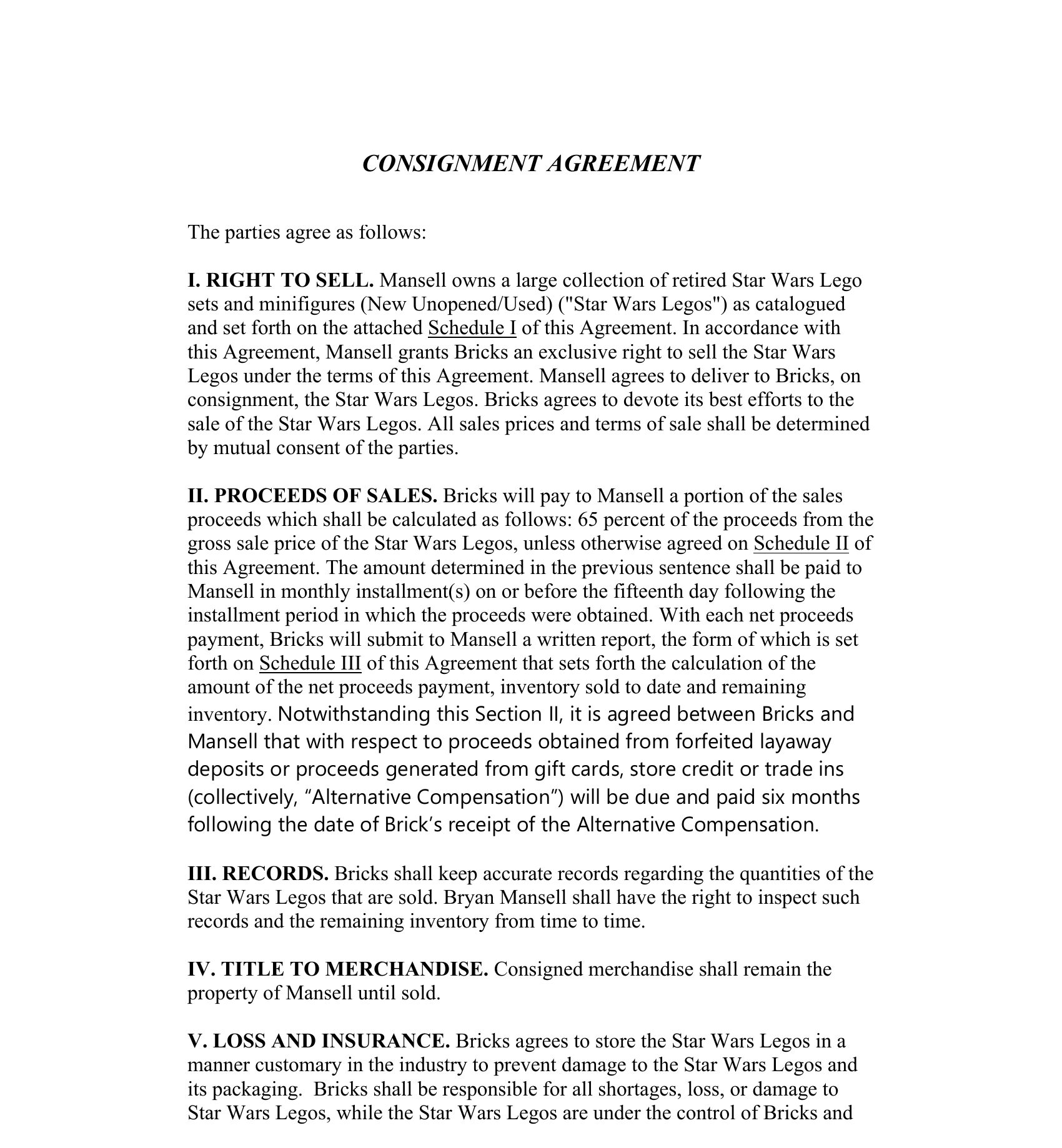
The taking was November 14, 2024. The first record of anyone saying the goods had become the company’s is this call, five and a half months later. And the agreement from the year before had already said who owns consigned merchandise until it sells: “Consigned merchandise shall remain the property of Mansell until sold.” Confirmed each position is dated in the linked records; the sequence is the record’s own
The company’s own disclosure documents give that year two different books. The 2025 edition records one franchisor reacquisition in Oregon for fiscal 2024, the year of the seizure. The current 2026 edition restates the same fiscal year with none, and records one in fiscal 2025 instead. Fiscal 2023 is identical in both editions. Confirmed Item 20, Table 3, statewide counts, the two editions’ own pages read against each otherfact checkprimary source
The chain, in their own words
Beside the questions the law of conversion asks
Row by row: what the law asks, and what they said. The questions are Oregon’s: conversion as Mustola v. Toddy, 253 Or. 658 (1969), states it, adopting Restatement (Second) of Torts §222A, set out beside the consignment agreement here and element by element on the law page.
The left column is what Oregon law asks before it calls a taking conversion. The right is their words. Whether the words answer the questions is a court’s call, and only a court’s.
One more fact belongs beside the chain, and Collecting Weekly said it on the recording: “it’s a senior citizen paying for his kids, grandkids college.” Oregon law adds treble damages and attorney fees when property is wrongfully taken from a person 65 or older, ORS 124.100 to 124.140 (read here). Whether that statute reaches these facts is for courts. The age and the chain sit in the same record.
Each denial, answered by the record
Most of it in their own other words
Eight statements on this record, each set beside what the record holds against it. Some fall to the same speaker’s own later words; some to the company’s own filings; some to what they did.
| What they said | What the record holds | |
|---|---|---|
| “Yeah, there’s no stickers.”Josh Johnson, on the call, 18:09 and 18:24 | Seven months later, in his own texts: “we have been holding on to what had stickers on them.” Two former employees told the detective the stickered sets were in the store after the takeover, one of them that some yellow stickers were removed immediately after Best took over. And on the boxes BAM sent back in September 2026, on camera: “Some of them even have residue where the yellow stickers were.”the police file · the return · fact checkprimary source | CONTRADICTED |
| “There’s no possibility. No way.”Josh Johnson, on the call, 37:08, asked whether some of the sets could be the consignor’s | His partner, five minutes later on the same call (42:22): “probably some of the minifigs.” Johnson, on a recorded call summarized in the police file, present tense: “he has 10 to 15 sets sitting there.” Johnson, September 2026: “there was those sets that were left in the store that I was personally responsible for.” BAM returned about 35 sets under the settlement; its own register marks 403 copies still unsold.the police file · the call against the complaint · fact checkconfirmed | CONTRADICTED |
| “We do not do consignment. It’s never been a part of Bricks and Minifigs.”Josh Johnson, on the call, 27:58 | The franchise agreement BAM filed as a court exhibit lists “consignment services” among a store’s approved services. BAM’s Director of Operations, Ki McAllister (identified on page 22), on the night-one Ring tape: “Brandon is taking on the business and takes on all that consignment.” Twenty-nine days before the call, BAM’s 2025 disclosure document struck “consignment services” from the list of what a franchisee may offer, and the agreement inside the current edition still carries the words.the Clackamas exhibit · the Ring line, as filed in federal court · fact checkprimary source | REFUTED |
| “We didn’t know the consignment even existed until two weeks after we took it over.”Josh Johnson, on the call, 15:14 | The night-one Ring tape, hour zero, November 14: Best is told, on the record, that he “takes on all that consignment.” The detective’s written conclusion: the company and Best “were informed of and aware,” with Johnson’s own recorded statements that he was aware noted in the next sentence. Johnson, September 2026: “once Brandon had showed me the Legos in the cupboard, and we took over the store.”the police file · the call against the complaint | REFUTED |
| “Nobody knows what, whose is whose.”Josh Johnson, on the call, 19:37 | Their own sorting rule, in Johnson’s texts: “if it had a sticker on it, it can be from your agreement. We set those aside.” And Johnson, September 2026: “every piece in that collection has now been accounted for. And there’s nothing missing.”the police file · the call | CONTRADICTED |
| “And what it is, it’s Crystal’s account that I just happened to be able to log into.” / “the wrong social media”Brandon Best, on the call, 10:36, on where the show’s unanswered messages had gone | The store Facebook Page’s own access history, at 3:54 PM on November 15, 2024, the afternoon after the seizure, in the name of Matthew McNeff, BAM’s chief operating officer: “Added Brandon Best to the Page,” with “Community Activity, Messages, Insights, Ads, Content, Permissions,” and “Brandon Best was given full control.” Four days later, the same for Gabriel McNeff, of the corporate crew that files the company’s store entities. Best had held the inbox the show wrote to for five and a half months before the call.the window · fact checkconfirmed | CONTRADICTED |
| “We are a new business that came into it.” / “each store is independently owned and operated.”Brandon Best, on the call, 58:04; the franchisor’s letter, April 30, 2025 | On the same call: “corporate sent me in to seize the store” (1:03:03), “everything in the store became property of corporate” (25:34). The receiving company, registered at the store’s address the day after the seizure. Johnson, September 2026, on how they got the store: “So we got Salem for free, right?” On himself at the time: “I was still an employee, right?” BAM’s own balance sheets carry “BAMF Salem - Corporate Store Costs” into May 2026. And on the store’s own Facebook Page, Gabriel McNeff, of the corporate crew that files the company’s store entities, held full control from November 19, 2024 until October 8, 2025, through the day the letter was sent.the call against the complaint · fact checkconfirmed | CONTRADICTED |
| “As standard policy, we do not publicly comment on ongoing cases of this nature.”The franchisor’s written statement, April 30, 2025 | Followed in the same letter by more than six hundred words of comment. The letter is quoted in full above. | CONTRADICTED |
Eight statements from the call and the letter, each beside what the record holds against it. REFUTED: a document on the record disproves the line as given. CONTRADICTED: the speaker’s own later words, or the same organization’s, say otherwise. Every quoted statement is Primary source; each date and document is Confirmed.
Read them together and each one is true in some narrow sense, and each was given to a broader question. That the narrowness is one technique rather than a run of coincidences is a reading Inference; each statement, and each question it met, is on the record Confirmed.
What would settle it
A count of that room was made the night of the takeover, by the company’s own account, in the police file (page 22). Producing it would end the argument. Nothing in the published file shows it produced, to the family or to the detective. Across the call and the police file, the store’s contents are described from memory five different ways; the count itself is never offered. The letter the next morning does not mention it either. The complaint BAM filed in May 2026, verified by Johnson, describes the count as “an informal and video inventory” by “BAM’s representative, Brandon,” and gives its result: residual inventory “less than $38,000,” and “Less than $5,000 worth of Star Wars LEGO product” found in the store. The count itself is not public. The closest thing to one came in September 2026, from the other side of the counter: about 35 sets returned under the settlement, seven of them never his, by the consignor’s count on camera, against the 403 copies BAM’s own register marks still unsold the night it took the store.
The duties run to the store, under the agreement the store signed the year before. Who held the store between November 14 and April 1 is answered above, in the callers’ own words. Confirmed as to the agreement’s text and each quoted answer.
The numbers that do exist are memory. $17,000, $32,000, $40,000, and $20,000 in the police file (page 22, page 19), and “somewhere around $25,000” on the call, where, just before giving that figure, Best breaks off to ask Collecting Weekly to keep something out, “whatever you need to do” (1:05:49; an earlier $25,000 sits at 1:01:05). Five figures for one room, beside Best’s own statement to police that a typical store carries “$150,000 to $200,000 in cost value.”fact checkprimary source
One store, priced five ways
THE SAME STORE AND COLLECTION, IN THEIR OWN NUMBERS. SCALE TO $200,000
Best put the whole store at twenty-five to thirty-two thousand dollars; the complaint Johnson verified in May 2026 puts it under thirty-eight. BAM’s own court exhibit prices just the consigned sets that had not sold at $31,339 to $49,633, the top of it above all three. And by Best’s own account to police, a store like this should carry six to eight times what he said was there. Confirmed as to each figure and its source; the reading is left to the reader.
The value is not idle arithmetic. In the police file, the detective’s summary of the chief operating officer’s recorded interview puts the seizure on exactly this scale: if the store’s assets had exceeded what the franchisee owed, the difference would be paid back, and here, the summary says, “the value of the fixtures and inventory was not even close to the amount owed.” The accounting balances only if the collection is worth almost nothing. Their own filed exhibit prices just the consigned sets that had not sold at $31,339 to $49,633, before the two Cloud City sets. Confirmed as to the summary and the exhibit.fact checkprimary sourcefact checkprimary source
Oregon has a rule for a document like that. Oregon courtrooms carry a disputable presumption that evidence willfully suppressed would be adverse to the party suppressing it (ORS 40.135). The count exists, by their own word. Nothing in the published file shows it was ever produced. Whether a court draws that presumption here is a court’s to draw. Inference
One organization, one day
Two channels answered in twenty-four hours. On the call, everything in the store “became property of corporate.” In the letter the next morning, the loss belonged to “a former franchisee.” Both denied the consignment; BAM’s own form agreement, filed as its exhibit in another Oregon case, lists it among a store’s services.
One sentence, signed the year before the seizure, had already answered the question the whole day was spent on: “Consigned merchandise shall remain the property of Mansell until sold.” That sentence has not changed since. Confirmed
Sixteen months later, to the franchisees
How the company told its own stores this ended
The call and the letter were the enterprise answering the public. There is a later audience, and a smaller one. In August 2026, at its quarterly franchise town hall, the company told its own store owners how the Mansell matter had closed: a mediated settlement with the family, and, two days after that meeting, a joint motion asking the court to dismiss every claim against him, with prejudice. This is how the resolution was narrated to the room.
“Let’s get resolution. That’s I think the number one thing people wanted. So resolution has been met with at least one of the parties.”Katelyn Fagan, BAM marketing lead, at the Q3 franchise town hall Primary source
The resolution the marketing lead put first was the Mansell settlement, the party the company said resolution had been “met with.” She told the room the company was “sharing that good news on socials.” The settlement narrated to the stores as good news is the one this page began in: an 83-year-old’s consigned collection, seized, and answered for in the two channels above. On August 19 the company said the family had been “made whole”; what the settlement sent back arrived in September, about 35 sets, seven of them never his, and he says the fight “pretty much cost that in legal fees.”
The call had already predicted the ending. Johnson, at 23:00, on why the consignor had not sued: “he doesn’t have a case. There’s, there’s no way that you can hold somebody, I can’t hold you liable for my liabilities, can I?” Thirteen months later the company sued him for extortion; three months after that it apologized and agreed to pay, and asked the court to dismiss every claim against him, with prejudice. Confirmed as to each statement and filing.
The chief executive gave the room the same shape, and a reason not to expect more.
What the town hall was told
“You weren’t in the rooms where responses were being determined.”
The CEO, to the franchisees, about the dispute. In the same passage: “You didn’t make the decisions that led to it.” The passage is published in full. Primary source
What this page is
A recording from one of those rooms.
April 29, 2025: a corporate representative and a listed franchise seller, determining what the store’s public answer would be. Someone made the decisions. Their words are above.
The franchisees weren’t in the room. But the room was recorded.
At the same meeting, the CEO defined what the stores should expect to be told, and named the exception in the same breath. Transparency, he said, means giving them “the relevant facts about the things that materially affect your business.” Clarity means “not simply dumping every unfinished discussion, legal negotiation, personnel issue” into view. The Mansell matter is the legal negotiation. What the room got was that it had been won. What this page holds is what was inside it. The company’s own definition of transparency reserved that decision to itself. Confirmed as to each statement; the pairing is the record’s own chronology.
Seventeen months later, on the phone
The same voice, to another stranger, on another recording
The town hall was August. On September 25, 2026, Josh Johnson spent an hour on the phone with Matty AppleSeed, a YouTuber who covers the company, who told him at the start: “I’m just recording for quality and training purposes.” Johnson did not know him: “So you’re just a random guy?” Below is what he said about this store, beside what he said about it in April, and beside the complaint he had verified four months earlier. The call and the complaint read against it are reported in full on their own pages.
April 29, 2025, on the call
“There’s no possibility. No way.”
Josh Johnson, 37:08, asked whether some of the sets in the store could be the consignor’s Primary source
September 25, 2026, on the phone
“… once Brandon had showed me the Legos in the cupboard, and we took over the store.”
Josh Johnson, 35:24 on the recording as published Primary source
The same speaker, seventeen months apart.
Four months before the call, Johnson had verified, with the chief executive, the complaint BAM filed against Reckless Ben. Four of its sentences about this store are set out below, beside what he said four months later.
| The complaint he verified, May 27, 2026 | On the phone, September 25, 2026 | |
|---|---|---|
| The cupboard sets were located “In late 2025,” with “stickers not previously recognized.” (¶ 82) | “once Brandon had showed me the Legos in the cupboard, and we took over the store.” The police file has them set aside by May 2025.35:24 on Patreon · 8:41 on YouTube · fact checkconfirmed | REFUTED |
| The plaintiffs have no “contractual duty or obligation regarding” the consignment agreement. (¶ 212) | “At the end of the day, there was those sets that were left in the store that I was personally responsible for.”63:44 on Patreon · 23:41 on YouTube · fact checkprimary source | CONTRADICTED |
| The store was sold to “bona fide third-party purchasers” in “an arm’s-length and legitimate corporate sale.” (¶ 47) | “So we got Salem for free, right?” Asked whether the chief executive had just given them Salem for free: “Yeah.”40:54 on Patreon · 15:16 on YouTube · fact checkconfirmed | CONTRADICTED |
| It is a lie that the chief executive “took the LEGOs.” (¶ 135(e)) | “And then Ammon didn’t want to give Bryan his Legos back.” Asked why not: “Dude, I don’t know.” Asked later why Best had said no: “Brandon never said no.” Then: “Matt and Ammon.”35:16 and 52:15 on Patreon · 8:31 on YouTube · fact checkcorroborated | CONTRADICTED |
The complaint’s words, as filed, beside his, as recorded; times are on the 65-minute recording as its maker published it, and the linked times open the 25-minute cut. Grades as on the linked report: REFUTED, the record disproves the line; CONTRADICTED, the man who verified it says otherwise. The fourth row is his account of others, and stands with two entries in the police file: the December terms, a document “from our legal team,” and the Chief Operating Officer’s February statement Corroborated.
In April the store was “a new business that came into it,” and the letter the next morning said each store is “independently owned and operated.” To the American Fork officer in March 2026: “I work at the corporate headquarters as well.” On the phone in September: “I was still an employee, right?” And the disclosure document BAM filed that same month lists him, still, among the people who sell its franchises, at its Provo headquarters. Confirmed as to each statement and the filing.
Early in the September call Johnson said he was glad “we were able to give him all his Legos back and pay him, you know, what he wanted.” The next day the consignor sorted what the settlement had sent back, on camera, about 35 sets: “Seven of them are” … “not original sets to our collection.” “There’s definitely no UCS Cloud City or Death Stars or any of those sets in here.” Hearing Johnson’s line played back: “I’m looking at the 30 out of 780 sets around me right now.” fact checkprimary source Confirmed as to each statement; the counts are the consignor’s, made on camera.
The call did not stay on YouTube. On October 1, Reckless Ben’s lawyers put 27 of Johnson’s lines before the federal judge hearing BAM’s case and filed the recordings with the clerk as exhibits (the motion; ECF 43). On October 9, BAM stipulated that it would not oppose their addition (the stipulation; ECF 48). The night-one Ring line, “takes on all that consignment,” was already in the file, reproduced in the anti-SLAPP motion of September 18. Confirmed as to each filing.
In April, twice, the store’s side asked the show what it would leave out. In September, at the end of the hour, Johnson asked for all of it: “Don’t put the call on there. Just don’t.” It was posted that night, and the report on it quotes it with its times. Primary source
To be fair, and it matters
Marion County’s prosecutor has twice reviewed the Keizer file, once after the detective’s conclusion, and twice deemed the matter civil; the company is entitled to cite that, and we print it as prominently as anything here. On the call, the operators repeatedly say they want the family to get its property back; in the police record Johnson describes saying early on that they could honor the agreement and pay; and the letter shows corporate engaging counsel-to-counsel rather than refusing engagement outright. The call predates the detective’s review by months, and the letter predates it by more; neither speaker had the file in front of him. The September 2026 call is a phone call with a YouTuber, not testimony; Johnson was told at its start that it was recorded and asked at its end that it not be posted. Where it lays the refusal on others, it is his account, printed beside the two entries in the police file that point the same way. And people speak loosely on live calls; no single phrasing here is treated as proof of anything. The store Page’s access history records who was given control and when, not who opened which message; that the show’s messages were read is Collecting Weekly’s account, on the tape; and how Matthew McNeff came to hold the Page, the entries quoted here do not say. The findings rest on the match between what was said and what the speakers’ own records show, not on any turn of phrase. Nobody in this story has been charged with anything arising from this store, and the operators, the franchisor, and everyone else named here are presumed innocent.
Related on this site
Where this record meets the rest
As of October 14, 2026, the April 2025 call and letter are public, and each page below can be read against them.
- The seizure. Who actually took over the store, Best’s voice on the recordings from inside it that night, and the police file in full, the detective’s “informed of and aware” conclusion.
- The marks, and the goods. The identifying stickers, removed on an order, and the company’s own inventory exhibit, its unsold column.
- Where the collection went. The storage units, the U-Haul that ran two round trips between the two stores and a corporate officer’s two more in other states, and the Eugene sale of the same set models.
- The story, as it moved. One sentence, four versions of the consignment claim, the Salem statements edited after publishing, and three accounts of why BAM kept the collection.
- The man. He called to ask if his LEGO was still in the store; the police warned him; and Oregon’s elder-abuse statute, read for a man his age.
- The settlement. BAM said he was made whole; its own chief operating officer confirmed the money was not paid; and it moved to erase every claim against him; it had sued him for extortion first, and he signed no NDA.
- The pattern, and the frame. The eight-step sequence the franchisees pleaded, “the absolute last resort” beside eight takeovers, the structured system for moving stores, the company’s definition of transparency, and the running census of its contradictions.
- What came back. The sets BAM still had reach the consignor’s lawyer, and his count on camera: about 35, seven never his, no yellow stickers.
- The words, struck. “Consignment services,” crossed out of BAM’s disclosure document in 2025 and again in 2026, and left in the agreement a franchisee signs.
- In court. The anti-SLAPP motion that filed the Ring line; Johnson’s words filed against the complaint he verified; BAM’s stipulation to let them in; and the September disclosure amendment.
- The other store. Best and Johnson’s Florida takeover corporation, formed the day of a termination letter BAM’s lawyers reused from the Messers’ case, with the offer made in Salem four weeks before.
- The seller, seventeen months on. Johnson’s hour on a recorded call: the store came free, “Ammon didn’t want to give Bryan his Legos back,” the cupboard at the takeover; the same call, read against the complaint he verified; and his texts about the bird that was in the store the night it was taken.
- “Independent.” The prohibition BAM cites lives in documents only BAM holds; one login runs every store’s site; stores are required to buy from corporate; the “independent” stores were handed a script about the settlement; and the disclosure, the regulatory lane.
Sources: the Collecting Weekly recording of the April 29, 2025 call, published at youtube.com/watch?v=_h-Mavaya6A on October 14, 2026 (the call’s date: the show’s Tuesday broadcast, its April 25 deadline of “Tuesday the 29th,” and the franchisor’s email of the morning after, all in the thread the show published), quotations verbatim from that public recording, each position given on the published upload’s own clock (the call begins about seven minutes in, after the show’s introduction); the franchisor’s April 30, 2025 email to the show’s host, quoted in full above, and the show’s own published copy of the thread (Email exchanges with corporate 2025, with the April 11 to 14 form exchange, both in the show’s public Bryan Mansell folder); the Keizer police file (the PDF, cited above by page) (the December texts, the employee accounts, Best’s recorded interview, the detective’s March 5, 2026 conclusion, and both declinations); BAM’s inventory exhibit (Exhibit B); the Clackamas County franchise-agreement exhibit (23CV36974, reported here); the consignment agreement’s title clause and sections II, III and V; the Oregon Secretary of State record for Salem-Baker Bricks Inc; the store Facebook Page’s own access history, its entries of November 15 and 19, 2024 and October 8, 2025, quoted verbatim; the BAM Franchising FDDs, Exhibit F, the Exhibit K seller rosters, and the Item 20 outlet tables, 2024 through 2026 editions (the rendered page is the 2026 receipt); Oregon’s financial elder-abuse statute, ORS 124.100 to 124.140, ORS 40.135 and ORS 166.090, cited as law and not as a finding; Mustola v. Toddy, 253 Or. 658 (1969), as set out at the consignment page; the company’s statements to its franchisees at its Q3 town hall, quoted in the town-hall section and sourced at the linked reports; Josh Johnson’s September 25, 2026 call with Matty AppleSeed, as Matty AppleSeed published it, a 65-minute version on Patreon that night and a 25-minute cut on YouTube the next day, quoted with its times as given in the report on the call and the report reading it against the complaint; BAM Franchising, Inc. v. Schneider, verified complaint filed May 27, 2026, Utah Fourth District No. 260402353, removed to D. Utah No. 2:26-cv-00593 (the complaint as filed, cited above by page), ¶¶ 27, 29, 41, 47, 52, 82, 135(e) and 212, as quoted there, and ¶ 40 as quoted in the October 9 report; the anti-SLAPP motion of September 18, 2026 (ECF 37), the motion to supplement of October 1 (ECF 43) and the stipulation of October 9 (ECF 48), as reported on September 18, October 1 and October 9; BAM’s marked disclosure documents for 2025 and 2026, filed with the Minnesota Department of Commerce (2025, 2026), and the September 2026 amendment; Bryan Mansell on Sheldon Norcross’s streams of September 2 and September 26, 2026, quoted with their times; the American Fork Police Department body camera of March 8, 2026, as published on the bodycam page; the Eugene resale; and the full Keizer investigation.