The disclosure document, read against itself: all 23 Items, five editions
Confirmed Documentary analysis of BAM Franchising, Inc.'s Franchise Disclosure Document, read Item by Item and shown in its own pages beside the documents that answer it. Nothing is transcribed.
A Franchise Disclosure Document is the one filing a franchisor must give every prospective buyer before they spend their savings, and federal rule 16 CFR 436 prescribes what each of its twenty-three Items must contain. Below, each Item is shown as a screenshot of the actual page. Where a claim stands unchanged across the editions held (2012 through 2025), a year selector lets you confirm it in any one of them. Where the document contradicts itself, or an outside record answers it, both are shown at once, and every page can be opened in full. Grades are stated both ways; the matters are unadjudicated and everyone named is presumed to have acted lawfully.
Where the document contradicts itself most plainly. Five Items carry a contradiction visible on the four corners of the company's own paper, shown in full at the top of each. Start here, or read the whole document below.
Item 1. The Franchisor and Any Parents, Predecessors, and Affiliates
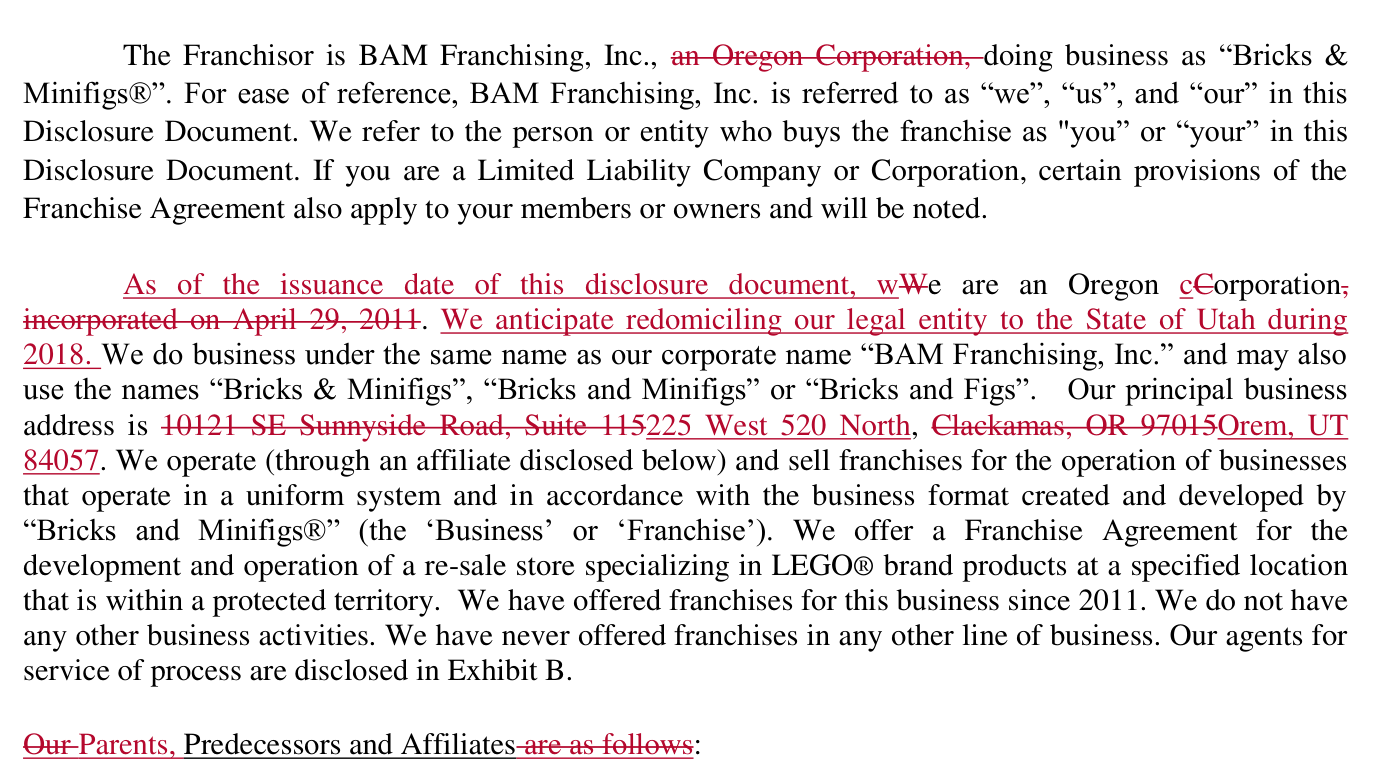
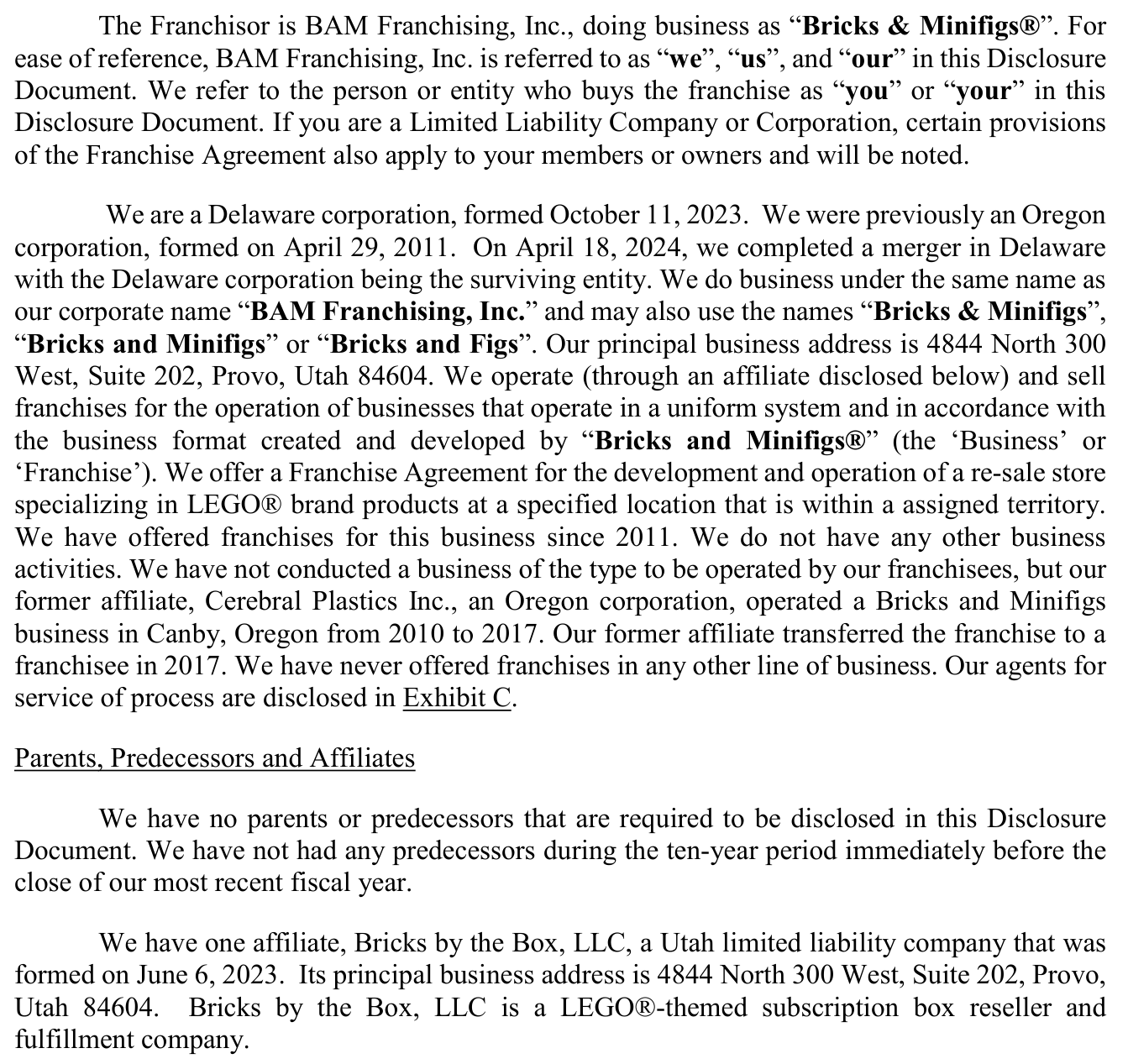
Confirmed Franchisor identity and state of incorporation: the redomicile trajectory (Oregon to announced-Utah to Delaware)
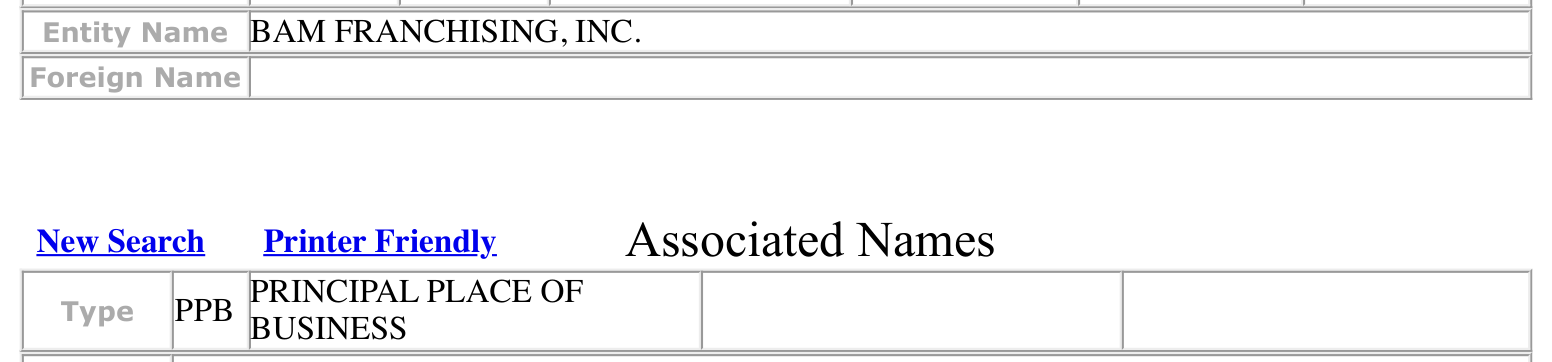
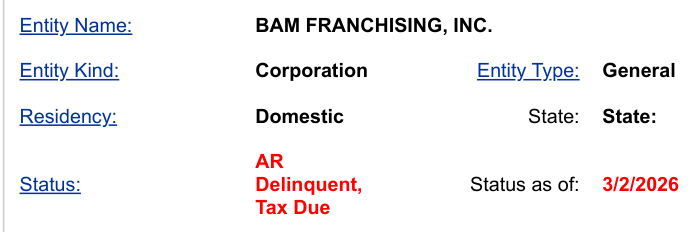
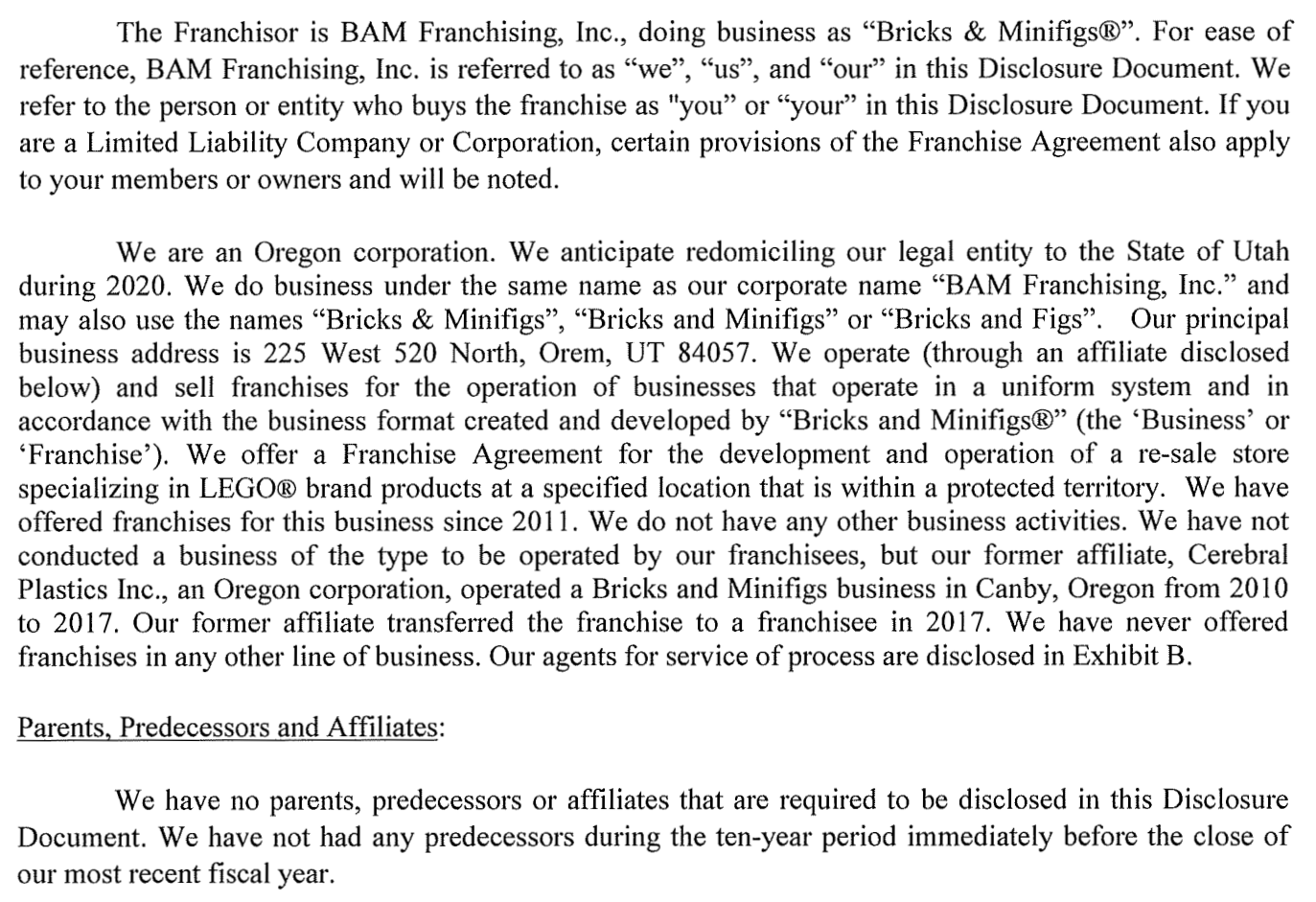
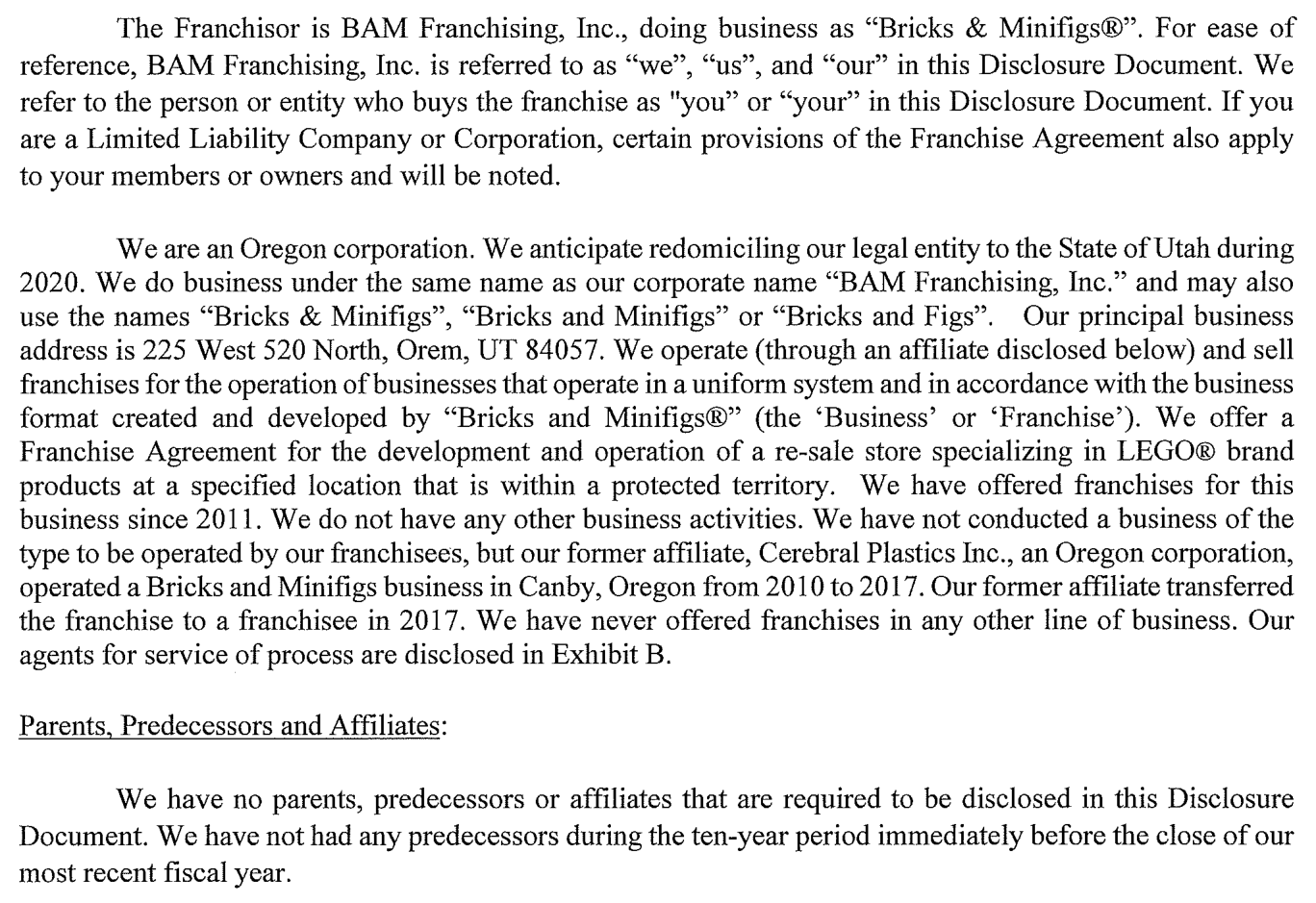
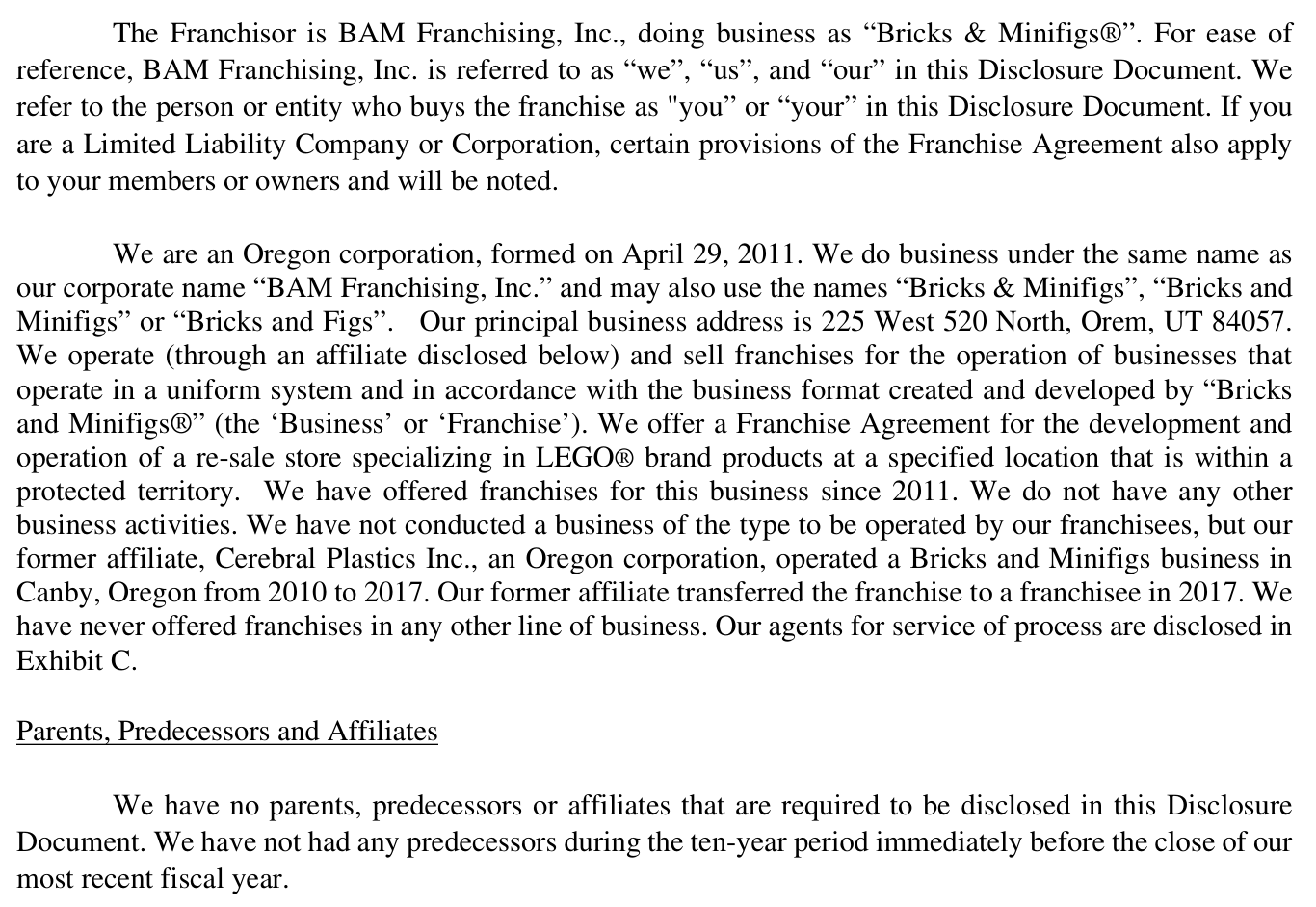
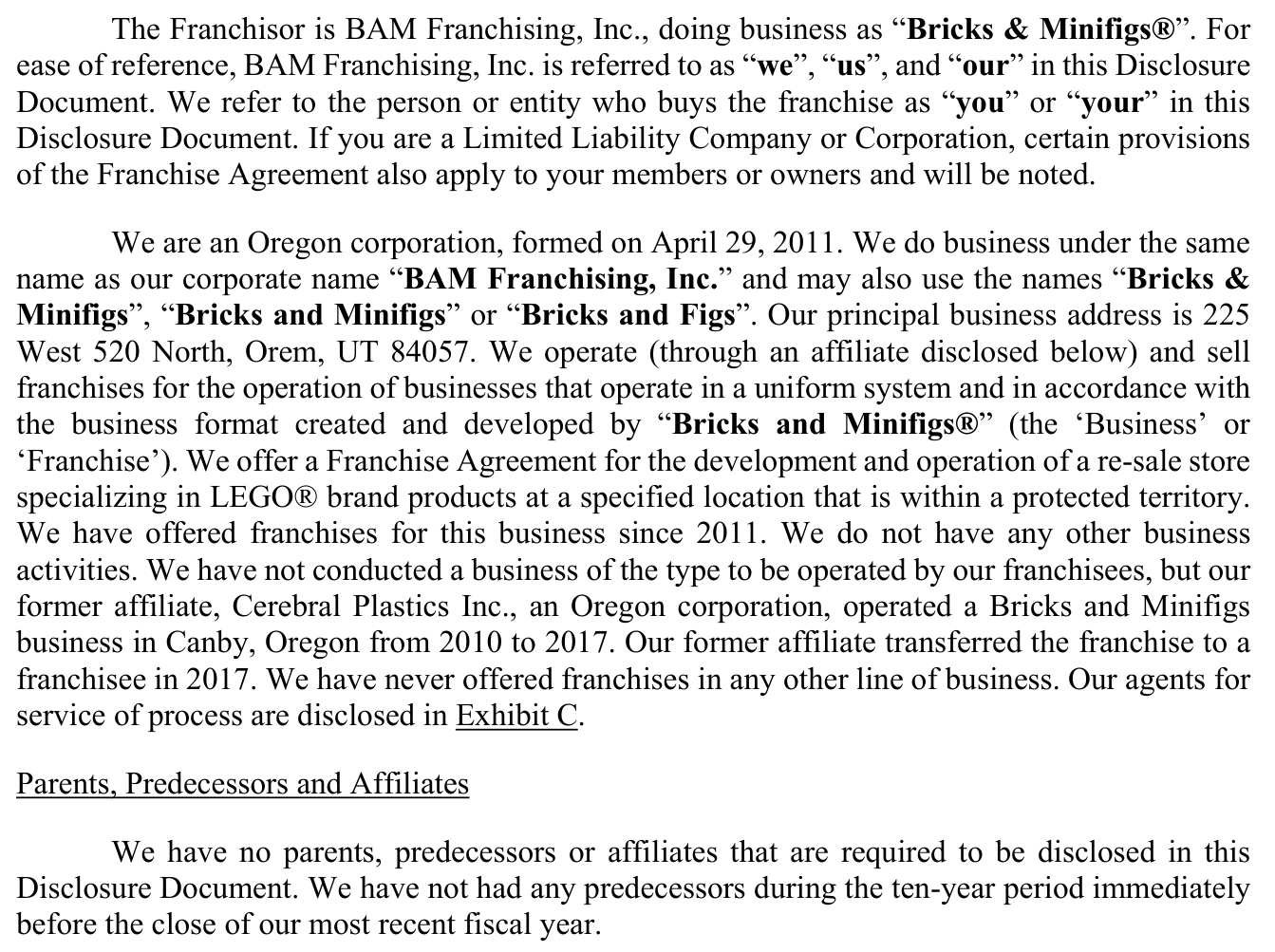
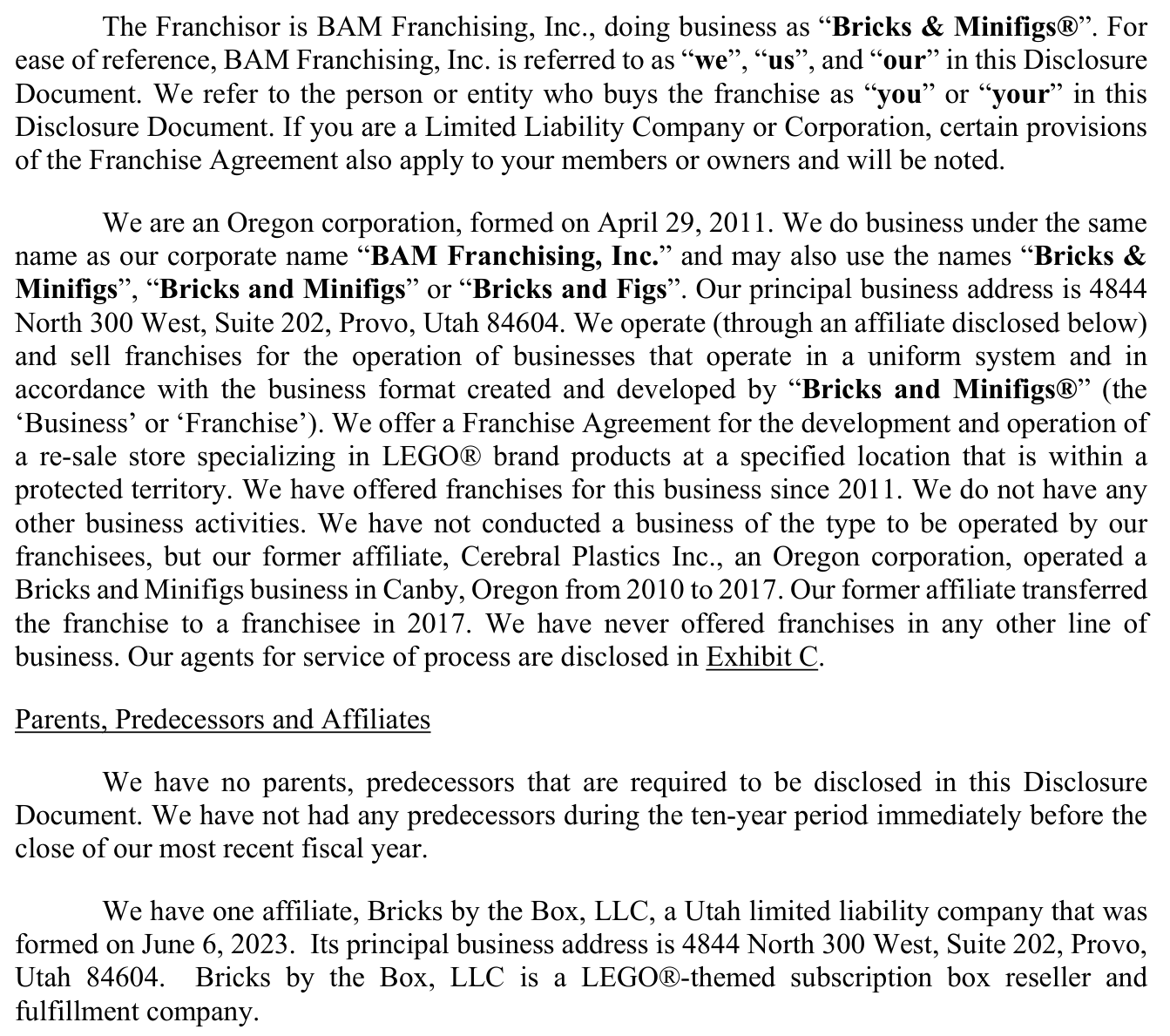
Across every edition the franchisor is BAM Franchising, Inc., doing business as Bricks & Minifigs. The state of incorporation is the moving part. The 2018 edition described an Oregon corporation that anticipated "redomiciling our legal entity to the State of Utah during 2018." No later edition records that Utah redomicile as completed. The 2022 and 2024 editions continue to state an Oregon corporation formed April 29, 2011, a date the Oregon Secretary of State registration (No. 76881896) matches to the day. The 2025 edition discloses a different domicile: a Delaware corporation formed October 11, 2023, with a merger completed April 18, 2024 and the Delaware corporation surviving. The Delaware Division of Corporations file (No. 2482543) independently records the same October 11, 2023 formation and an April 18, 2024 "Merger [Survivor]" entry, which is consistent with a reincorporation-by-merger. The documentary sequence is Oregon in 2011, an announced but unrecorded Utah move in 2018, and a completed Delaware redomestication effective in 2024. Presented as a documentary observation only; the matter is unadjudicated.
The state of incorporation changed to Delaware, and the Utah move the FDD announced never records as completed.
 Open the full page →
 Open the full page →
 Open the full page →
 Open the full page →
The page in every edition held. Choose a year.
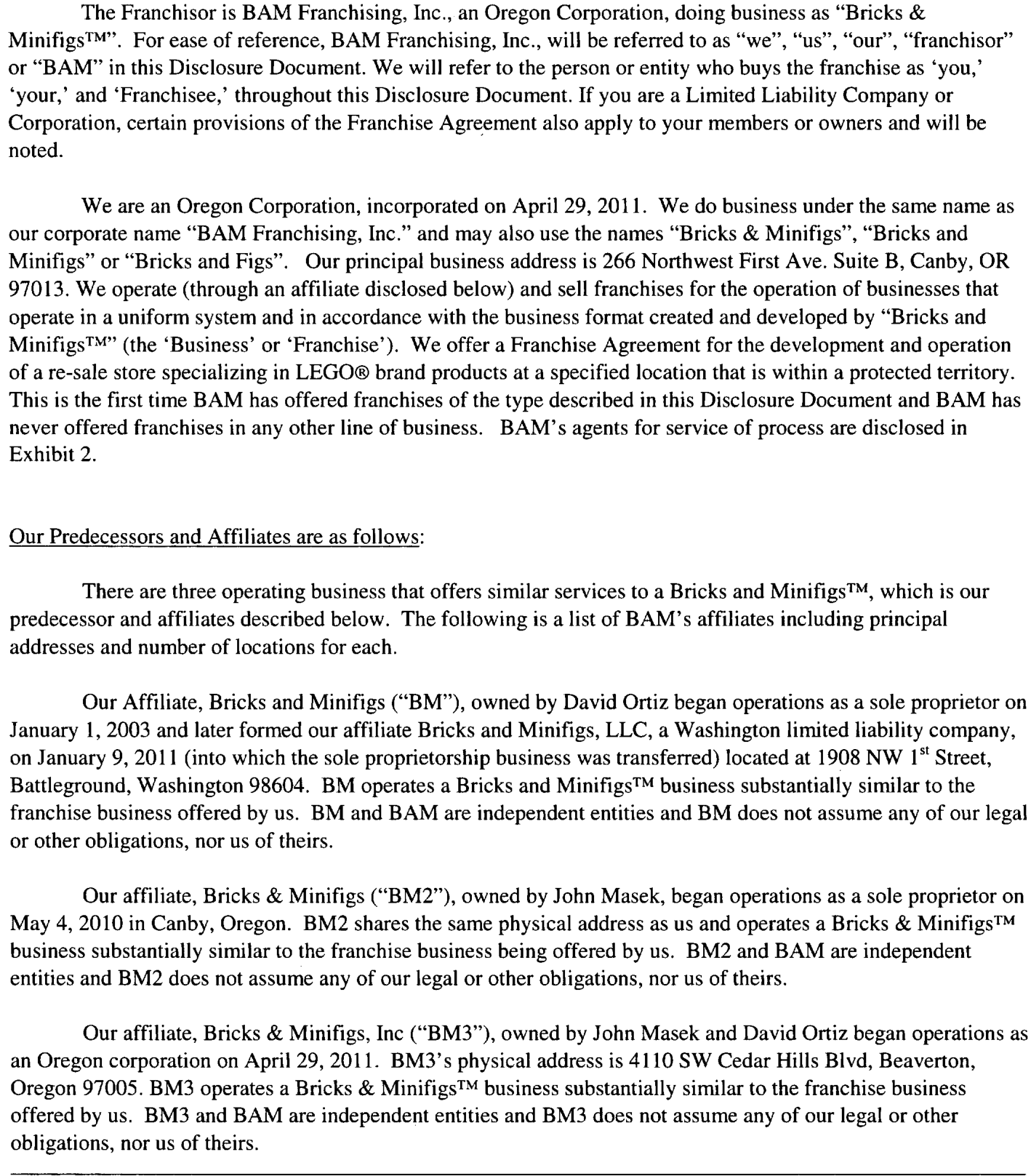 Open the full page →
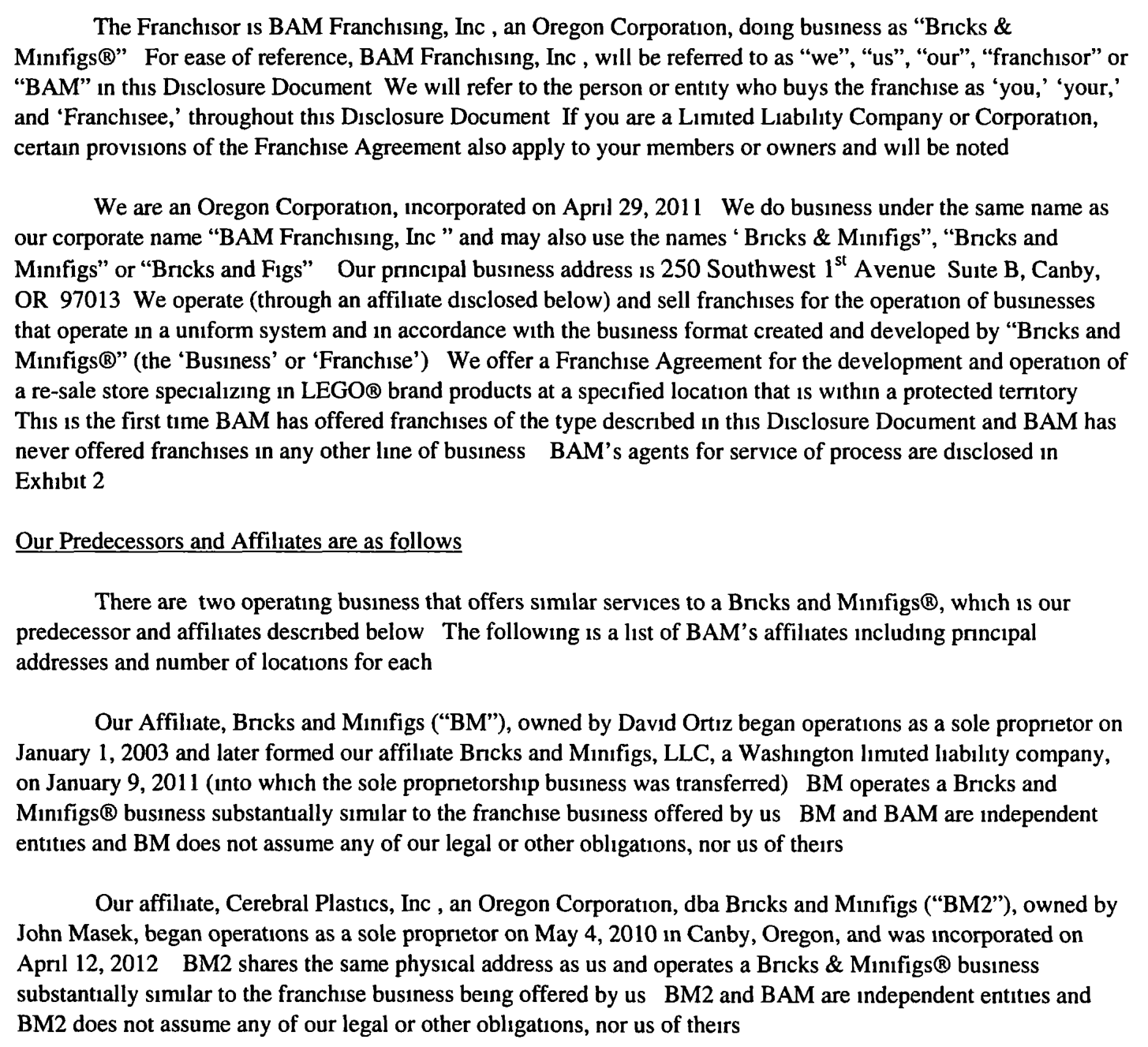 Open the full page →
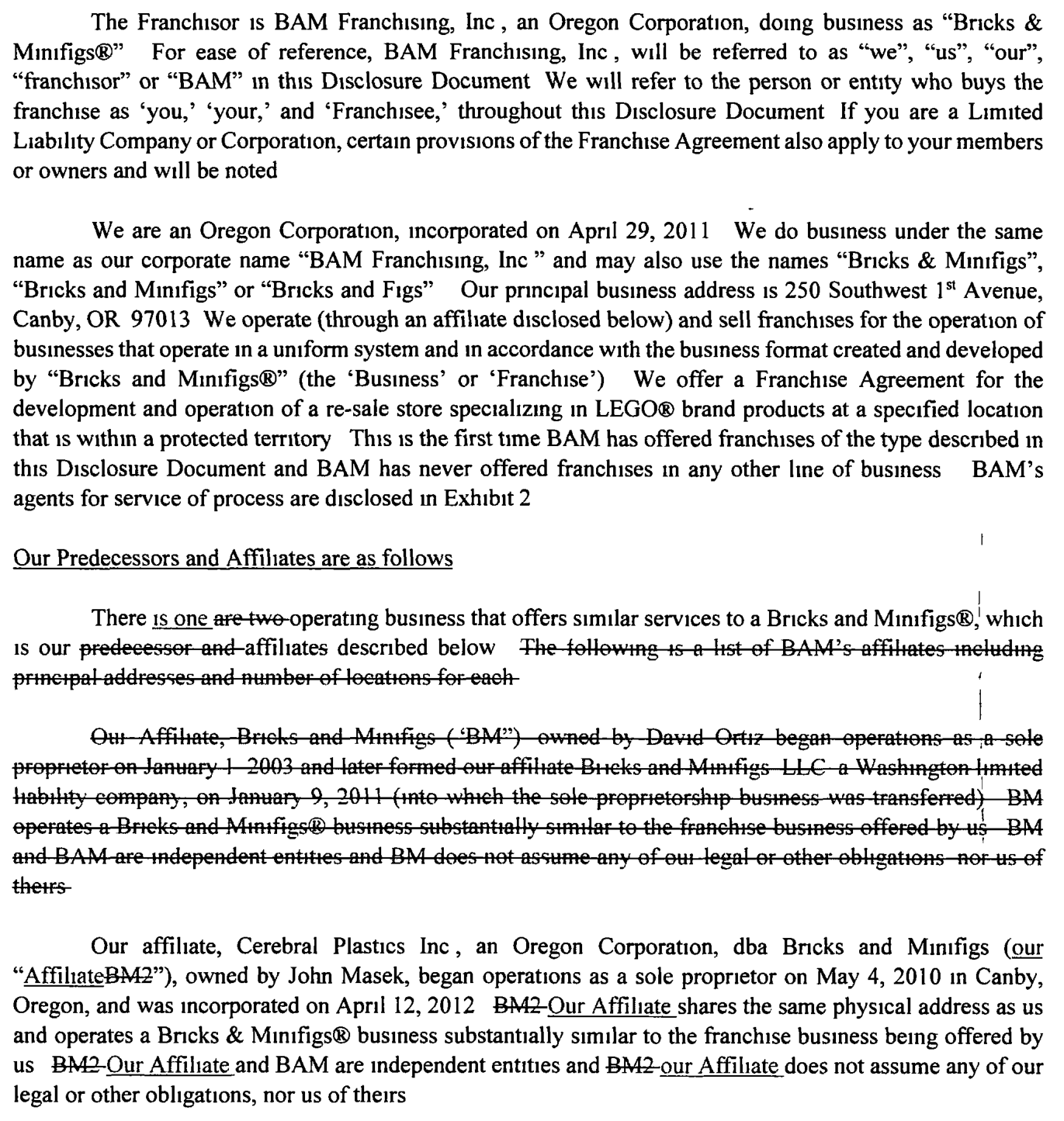 Open the full page →Open the full page →
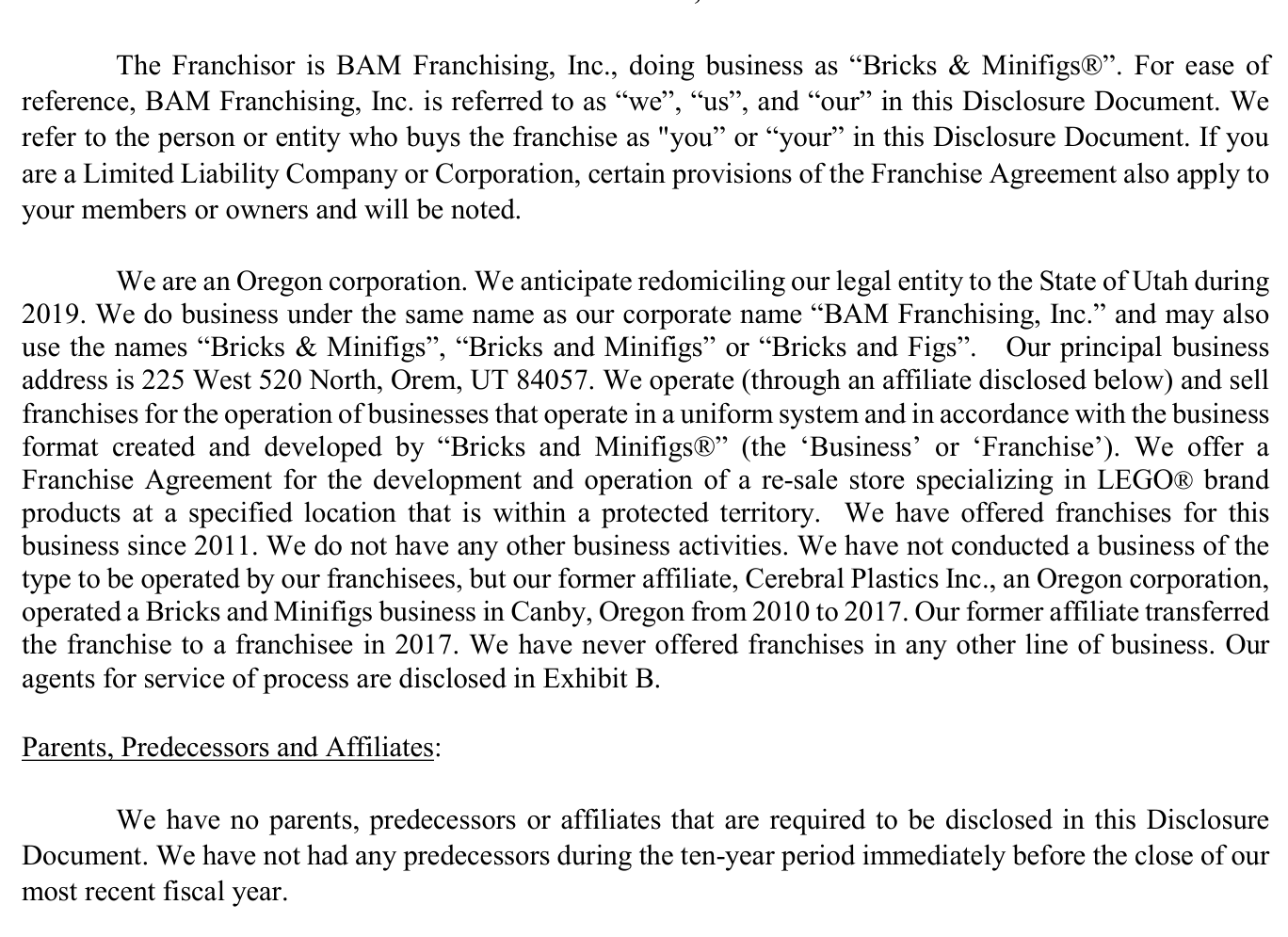 Open the full page →
 Open the full page →
 Open the full page →
 Open the full page →
 Open the full page →
 Open the full page →Open the full page →
Inference Predecessors: uniform denial, with a 2025 juxtaposition against the merged-out Oregon entity
Every edition denies any predecessor required to be disclosed, and from 2022 forward each adds that there was no predecessor during the ten-year look-back window. On its own that line is unremarkable and stable. The 2025 edition is where a reader may pause, because the same Item 1 both states "We have no parents or predecessors that are required to be disclosed" and states "We were previously an Oregon corporation, formed on April 29, 2011" that was merged into the Delaware survivor on April 18, 2024. Whether a prior same-name corporation absorbed by merger is a "predecessor" for disclosure purposes is a definitional question under the franchise-disclosure rule that is not resolved here. The observation is limited to the face of the document: the 2025 Item 1 denies predecessors in one sentence and describes a merged-out prior corporate self in another. Presented as a documentary juxtaposition, unadjudicated, with no inference of intent.
Confirmed Affiliates and the brand/marks holder: Cerebral Plastics, Bricks by the Box, and the undisclosed BAM IP Holdings
The affiliate disclosure grows edition to edition. The 2018 edition contains a face-of-document tension: the operative paragraph says the franchisor operates "through an affiliate disclosed below," yet the affiliates heading discloses none. From 2022 the former affiliate Cerebral Plastics Inc. is named as having run the Canby, Oregon store from 2010 to 2017, and from 2024 a current affiliate, Bricks by the Box, LLC, a Utah company formed June 6, 2023, appears. On the brand, the franchise documents keep the marks in the franchisor entity: Item 13 of the 2025 edition recites federal registration of the Bricks & Minifigs word mark and grants franchisees a nonexclusive license, naming no affiliate as owner. BAM IP Holdings, LLC, a Utah limited liability company managed by the same principals as the franchisor, was organized July 16, 2025 per the Utah registry, which is after the April 2025 disclosure document issued. It therefore appears in no edition's Item 1. Whether the registered marks were ever assigned to that new holding entity is not documented in the materials reviewed. Presented as a documentary observation, unadjudicated.
Confirmed Parents: 2025 Item 1 denies any parent while 2025 Item 2 references "the Franchisor's Parent"
The 2025 edition contains a self-contradiction on the parent question. Item 1 states that the franchisor has no parents required to be disclosed. Item 2, describing the chief financial officer, states that he has held that office "of the Franchisor and the Franchisor’s Parent since June 2016." The 2025 Item 2 therefore asserts that a parent exists, while the 2025 Item 1 discloses none. The reference is specific to 2025: the 2024 edition described the same officer simply as chief financial officer of the franchisor "since June 2016," with no parent mentioned, and the 2018 and 2022 editions likewise contain no parent reference. The observation is confined to the face of the document, where one item names a parent and another denies one. It is presented as a documentary inconsistency within a single-author instrument, unadjudicated, and carries no inference of intent.
Item 2. Business Experience
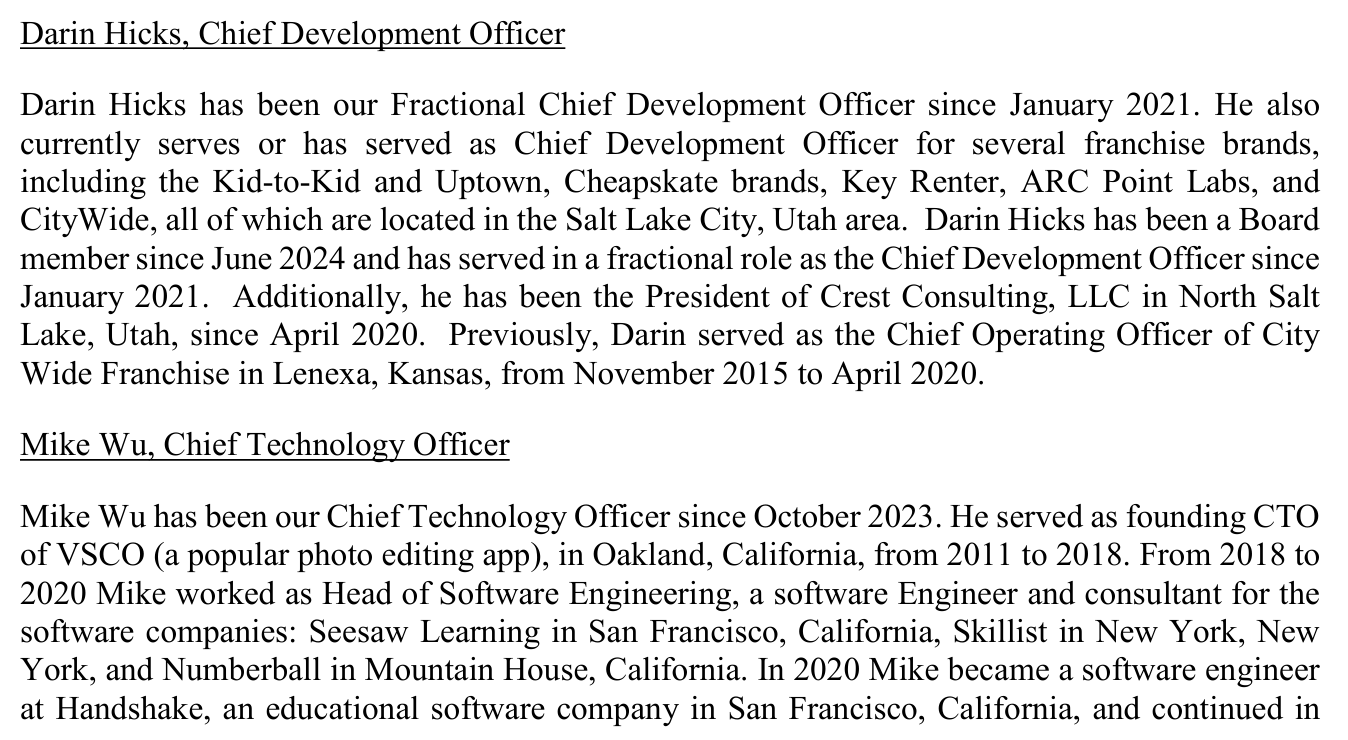
Confirmed Item 2 Business Experience: management roster across editions
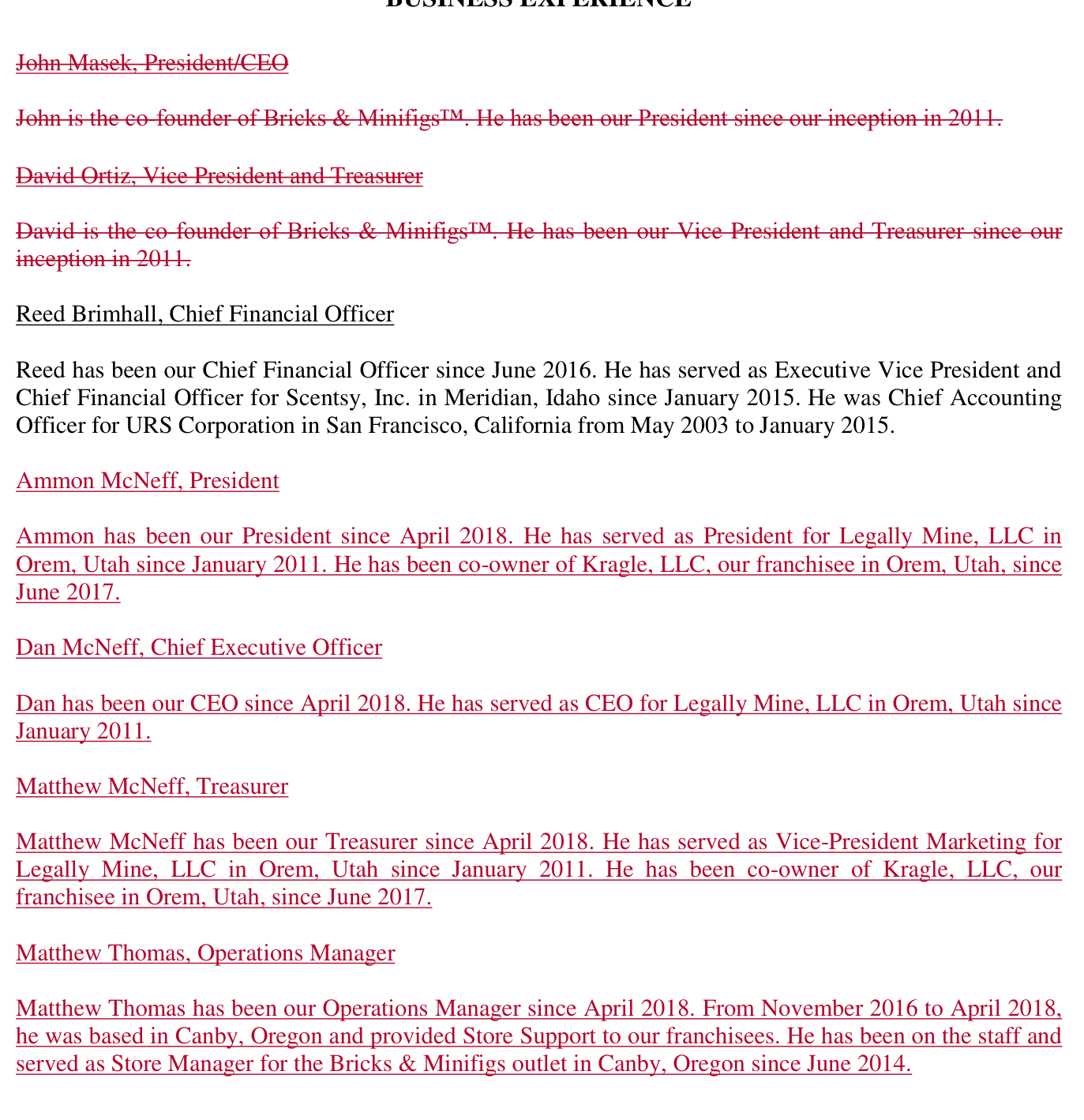
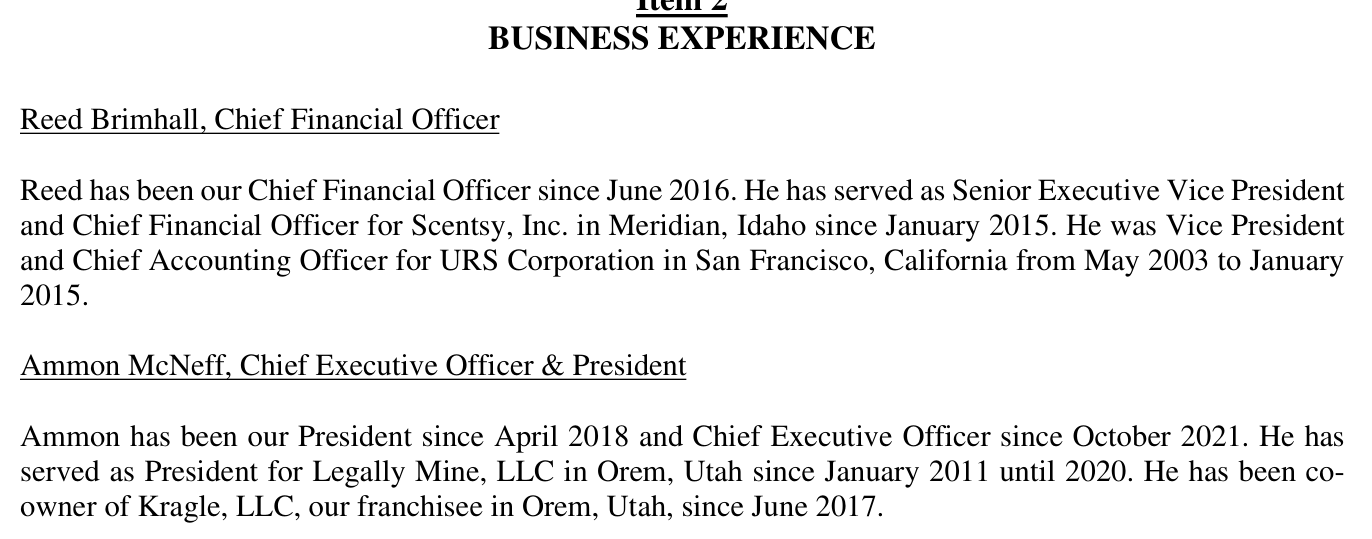
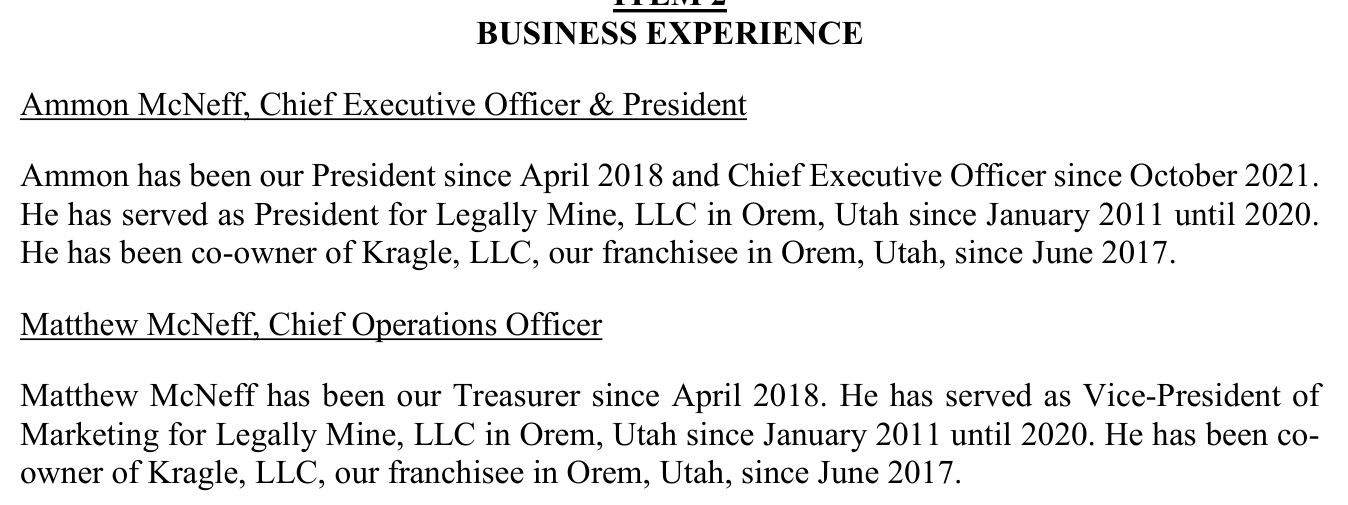
Item 2 (Business Experience) lists the franchisor's management and their prior roles, and the roster is not stable across editions. The 2018 edition names five officers: Reed Brimhall (Chief Financial Officer), Ammon McNeff (President), Dan McNeff (Chief Executive Officer), Matthew McNeff (Treasurer), and Matthew Thomas (Operations Manager). By the 2022 edition Dan McNeff no longer appears in Item 2, and Ammon McNeff is retitled 'Chief Executive Officer & President,' the text stating he has been President since April 2018 and Chief Executive Officer since October 2021. The 2022 and 2023 editions add a kinship sentence absent in 2018: 'Ammon and Matthew McNeff are brothers and Dan McNeff is their father.' That sentence is dropped again in 2024 and 2025. The 2024 edition expands the roster to six (adding Adam Brimhall, Darin Hicks, and Mike Wu); the 2025 edition drops Adam Brimhall, returning to five. Each officer's disclosed tenure at Legally Mine, LLC changes from open-ended in 2018 to closed ('until 2020') from 2022 on. In 2024 and 2025 the Matthew McNeff entry is headed 'Chief Operations Officer' while its biography still reads 'Treasurer.' Presumption of innocence applies; these are disclosure-content changes, not adjudicated findings.
The page in every edition held. Choose a year.
 Open the full page →
 Open the full page →
 Open the full page →
 Open the full page →
 Open the full page →
 Open the full page →
 Open the full page →
 Open the full page →
 Open the full page →
 Open the full page →
 Open the full page →
Confirmed Franchise sellers list (receipt pages) and the 2024/2025 two-copy discrepancy
Each edition's receipt pages name the franchisor's 'franchise sellers,' a list broader than and distinct from the Item 2 officer roster. In 2018 the sellers are the five officers: Ammon McNeff, Matthew McNeff, Daniel McNeff, Matthew Thomas, and Reed Brimhall, at the Orem, Utah address. In 2022 Daniel McNeff drops off and two non-officers appear, Carson Bird and David Ortiz. By 2024 and 2025 the list carries eleven names, adding Darin Hicks, Ashley Wells, Josh Johnson, Kiou Amini, and Ernesto Olaza, and the business address moves from Orem to 4844 North 300 West, Suite 202, Provo, Utah. Several of these sellers (Carson Bird, David Ortiz, Ashley Wells, Josh Johnson, Kiou Amini, Ernesto Olaza) never appear in the Item 2 management roster. The 2024 and 2025 editions each contain two non-identical seller receipts: one lists all eleven names, while a second omits Matthew Thomas and Reed Brimhall, leaving a doubled-comma gap reading 'Matthew McNeff, ,, Carson Bird.' Presumption of innocence applies; the divergence is a documentary inconsistency between two receipt copies bound in the same disclosure document.
Confirmed Reed Brimhall entry and the referenced 1992 SEC order (second author held)
Reed Brimhall appears in Item 2 of every edition reviewed, always with a positive-only career narrative. The 2018 and 2022 editions describe him as Chief Financial Officer since June 2016, as Senior Executive Vice President and Chief Financial Officer of Scentsy, Inc. in Meridian, Idaho since January 2015, and as former Chief Accounting Officer of URS Corporation in San Francisco from May 2003 to January 2015. The URS Corporation history is dropped from the 2024 and 2025 editions, and 2024 misspells the employer as 'Sentsy, Inc.' The 2025 edition adds that he is Chief Financial Officer 'of the Franchisor and the Franchisor's Parent,' the first Item 2 reference to a parent entity. Item 2 discloses no regulatory or disciplinary history for any officer, which the Item does not require. The record referenced as second author, a 1992 SEC action styled Order 34-30978 concerning a Reed Brimhall, is not present in the provided evidence vault, and the identity between that respondent and BAM's Chief Financial Officer cannot be confirmed from the sources reviewed. Presumption of innocence applies, and the second-author point is held pending the primary document.
The second author. The 1992 Securities and Exchange Commission order that Item 2's positive-only narrative omits is a degraded scan and is hosted in full here, and examined at the July 8 update. It was a censure, the least severe formal sanction, the practice suspensions fell on the engagement partner, and it is thirty-four years old; the documentary point is only that the disclosure does not mention it.
Item 3. Litigation
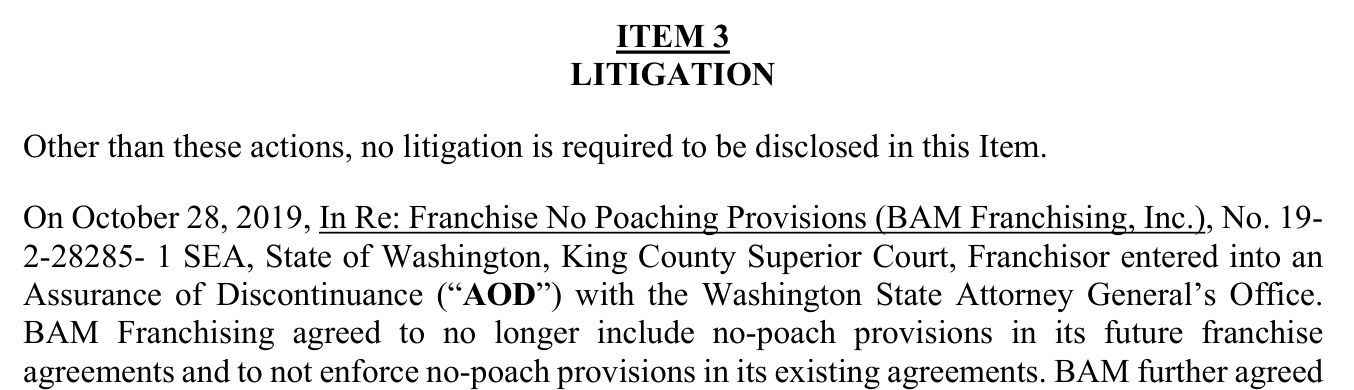
Confirmed Item 3 (Litigation)
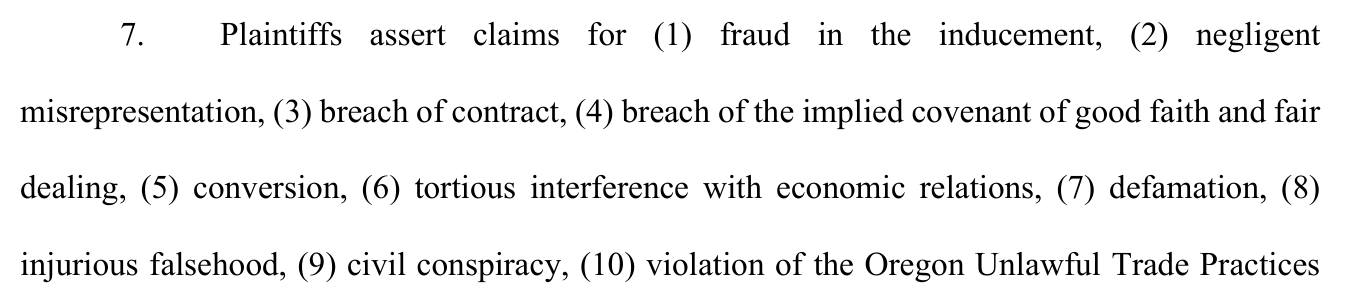
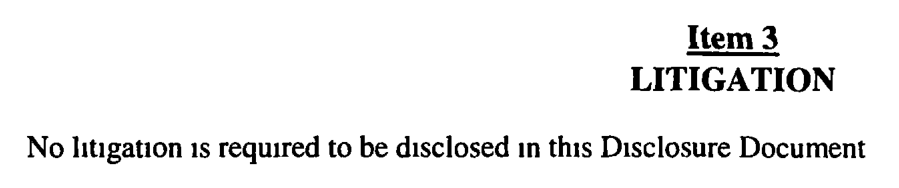
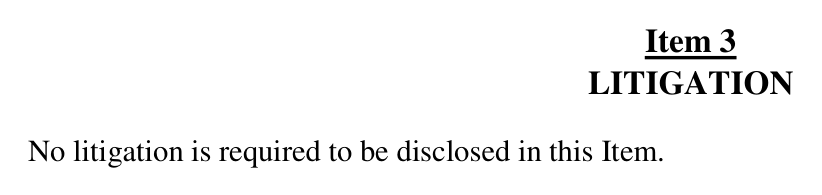
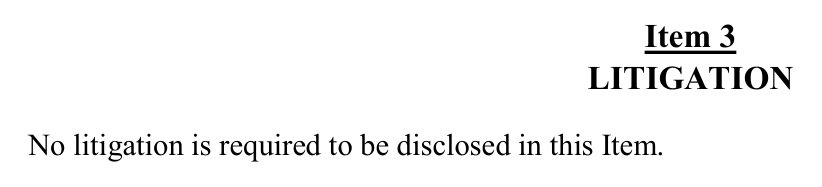
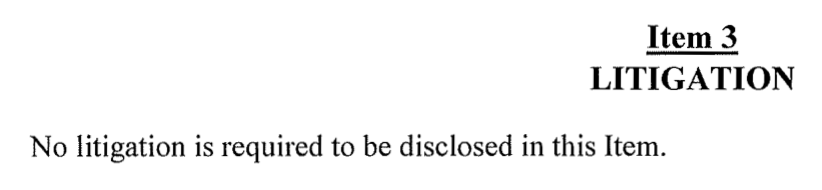
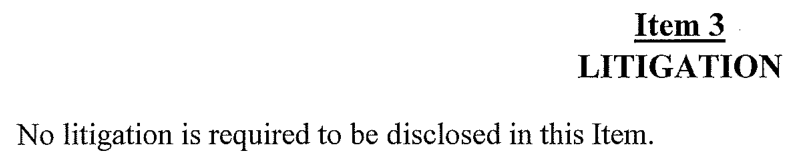
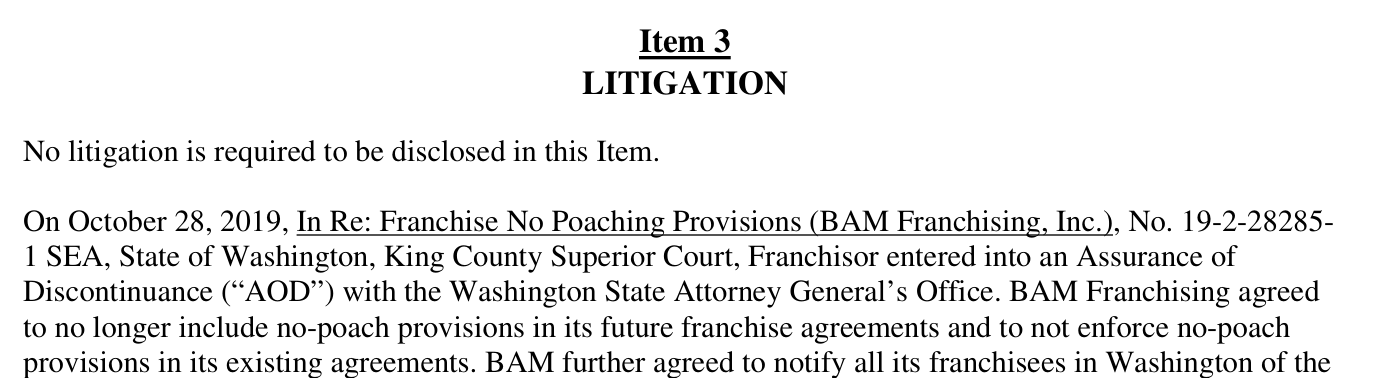
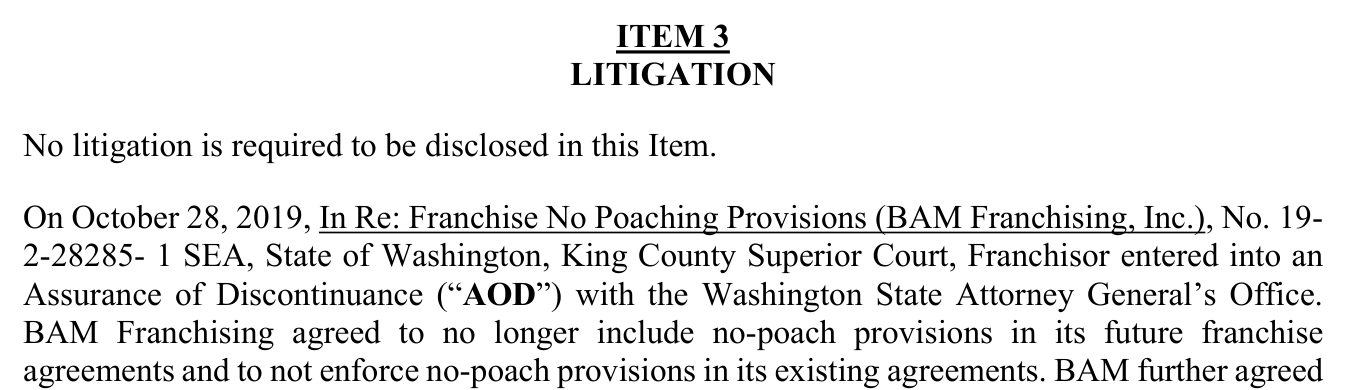
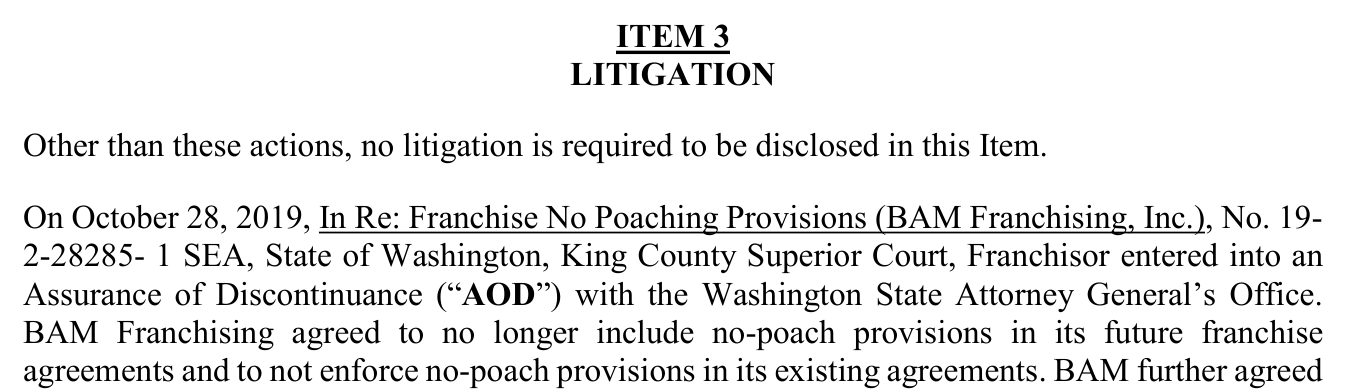
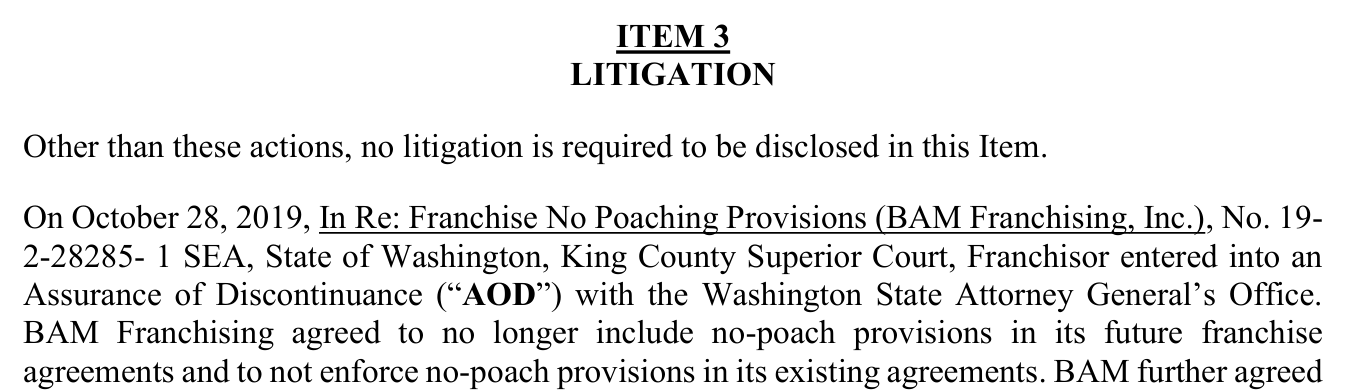
Item 3 governs litigation disclosure. The 2018 edition, issued April 16, 2018, states in full: "No litigation is required to be disclosed in this Item." That edition predates the matter later disclosed. The 2022 and 2023 editions retain that same sentence and then, within the same Item, describe the October 28, 2019 Washington Assurance of Discontinuance concerning no-poach provisions. The disclaimer sentence and the disclosed action sit in facial tension, because the sentence asserting that no litigation is required to be disclosed was not revised when the action was added. The 2024 and 2025 editions revise the opening to "Other than these actions, no litigation is required to be disclosed in this Item," yet the only action described remains the single 2019 Assurance, and Item 3 lists no other matter at either the March 31, 2024 or March 31, 2025 issuance. The Clackamas County action captioned Plastic Palette LLC and Cooper v. BAM, No. 24CV06902, was filed February 7, 2024, and alleges fraud and elder financial abuse, allegations that remain unadjudicated. It predates the 2024 issuance and was pending at the 2025 issuance. Neither edition's Item 3 references it. The later Law and Gorman action, No. 260200029, filed March 27, 2026, postdates every edition in this roster.
Item 3 says no litigation is required to be disclosed beyond a 2019 settlement. Fraud suits were pending.
 Open the full page →
 Open the full page →
The page in every edition held. Choose a year.
 Open the full page →
 Open the full page →
 Open the full page →
 Open the full page →
 Open the full page →
 Open the full page →
 Open the full page →
 Open the full page →
 Open the full page →Open the full page →
 Open the full page →
 Open the full page →
The second author. The Cooper matter, Christina Cooper and Plastic Palette LLC v. BAM Franchising, is Clackamas County Circuit Court No. 24CV06902 (filed February 7, 2024, fraud and elder financial abuse, pending); it is cited by docket number, the plaintiff’s records are not reproduced.
Item 4. Bankruptcy
Read, nothing notable Item 4 - Bankruptcy
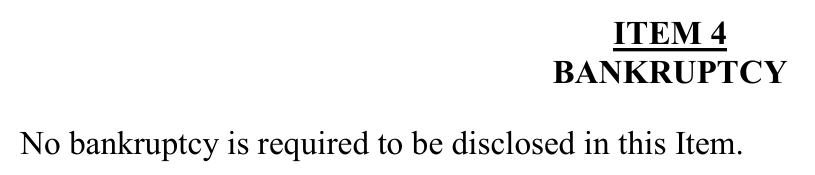
Item 4 (Bankruptcy) reads identically across the editions reviewed. The 2018 edition and the 2025 edition each carry the single line, "No bankruptcy is required to be disclosed in this Item," and neither lists any predecessor, affiliate, officer, or general-partner filing. Nothing on the face of the co-authored documentary record reviewed contradicts that representation. The item is unremarkable and consistent across all five editions.
The page:
 Open the full page →
Item 5. Initial Fees
Confirmed Item 5 - Initial Fees
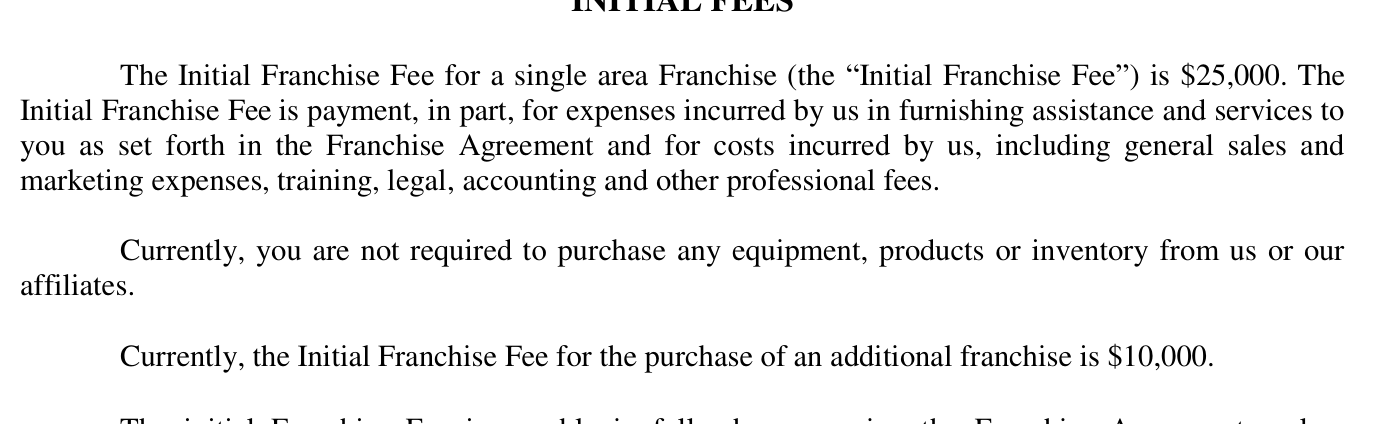
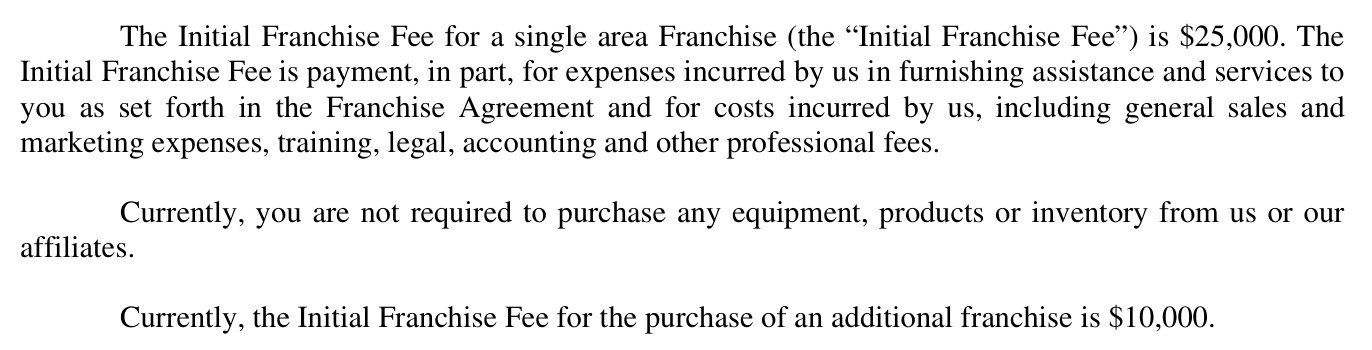
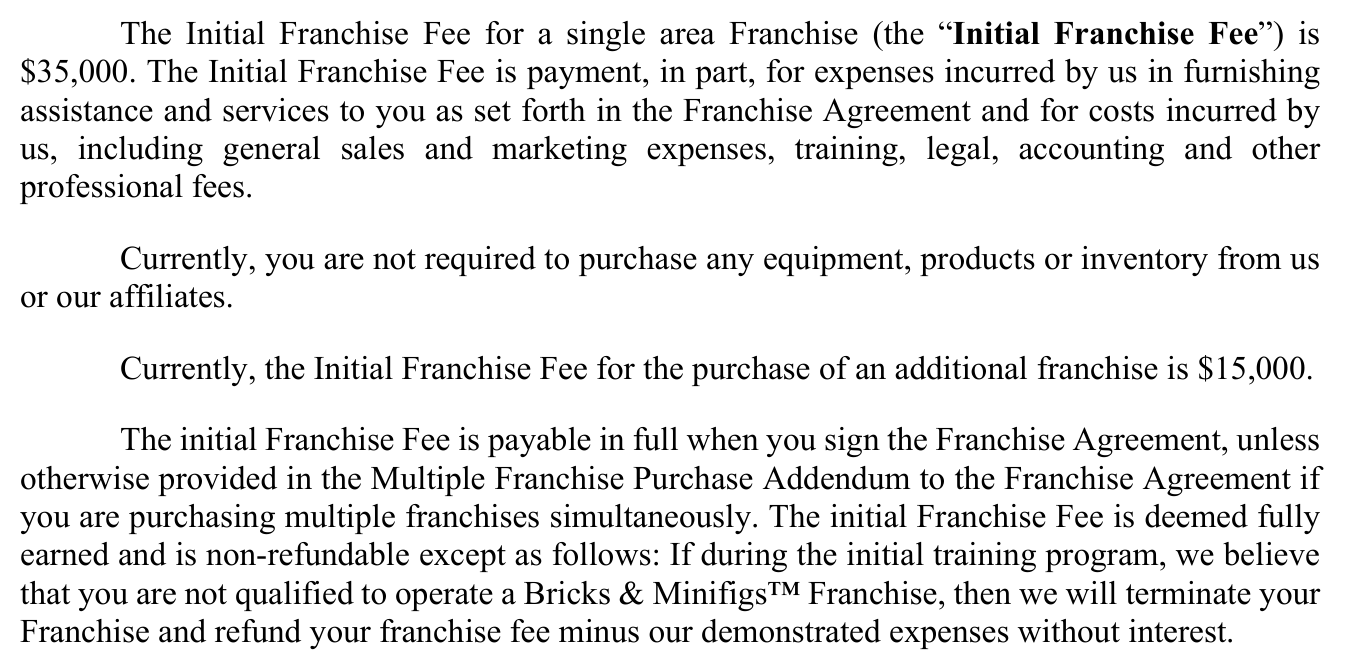
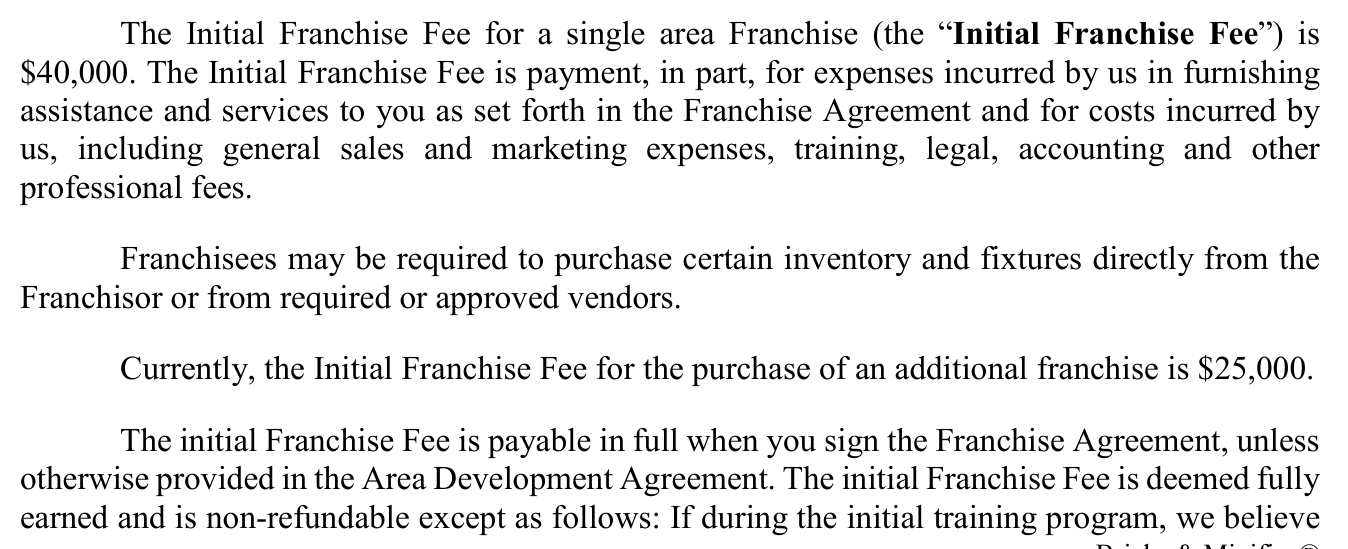
The Initial Franchise Fee for a single franchise is stated at $25,000 in the 2018 and 2022 editions, $35,000 in the 2023 Minnesota edition, and $40,000 in the 2024 and 2025 editions, a rise of 60 percent across the period. The additional-franchise fee moved from $10,000 to $15,000 to $25,000. The transfer fee charged when a buyer purchases an existing franchisee's store rose from $5,000 (2018, 2022) to $15,000 (2023, 2024) and to $30,000 in 2025, where the 2025 edition adds a separate $10,000 mandatory training fee for the transferee. The Area Development Agreement development fee, first disclosed at $5,000 in 2022, rose to $7,500 (2023, 2024) and to $25,000 (2025). Every edition states the Initial Franchise Fee is deemed fully earned and non-refundable except during initial training if the franchisor concludes the buyer is not qualified. The escalation appears entirely within the franchisor's own successive registered disclosures. The increases are lawful on their face and no adjudicated finding addresses the fee levels; the record here is documentary only.
The page in every edition held. Choose a year.
 Open the full page →
 Open the full page →
 Open the full page →
 Open the full page →
 Open the full page →
Item 6. Other Fees
Confirmed Item 6 - Other Fees
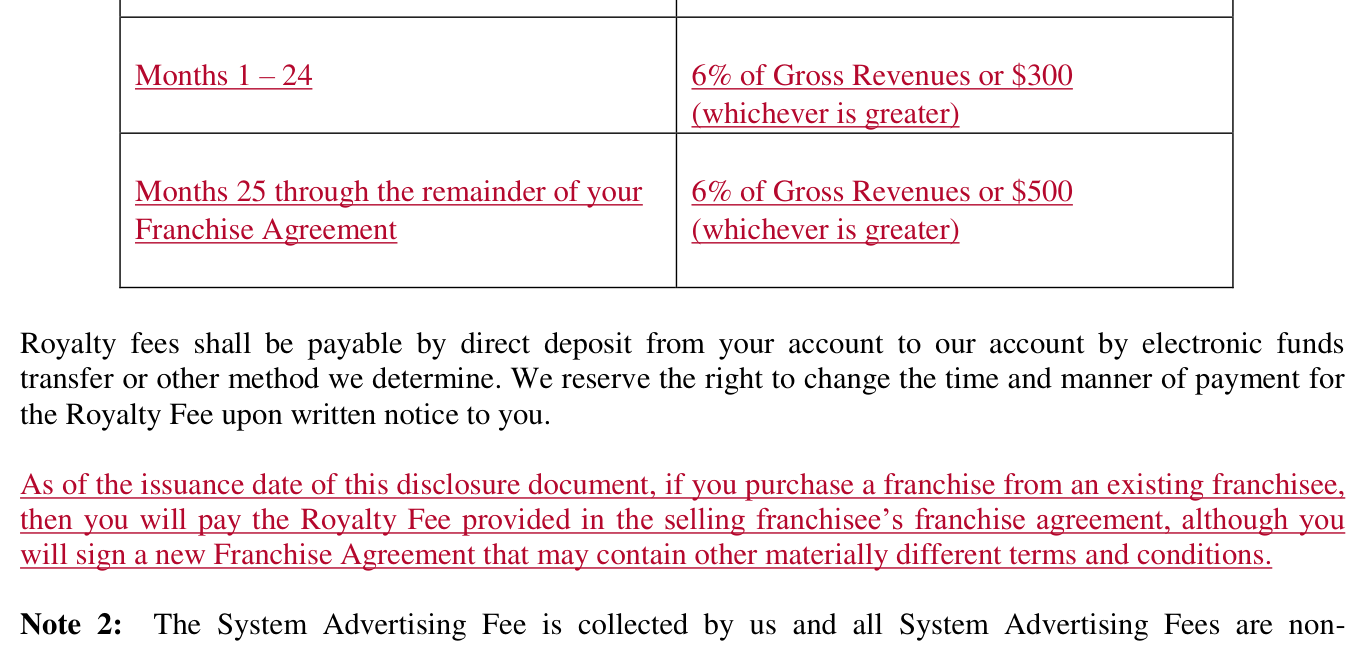
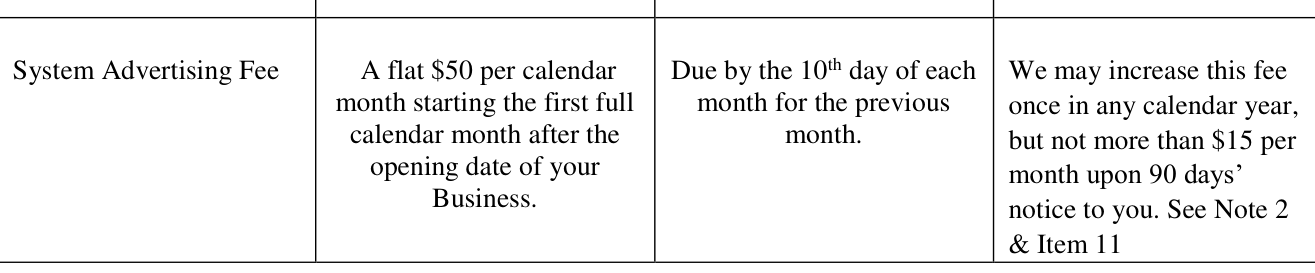
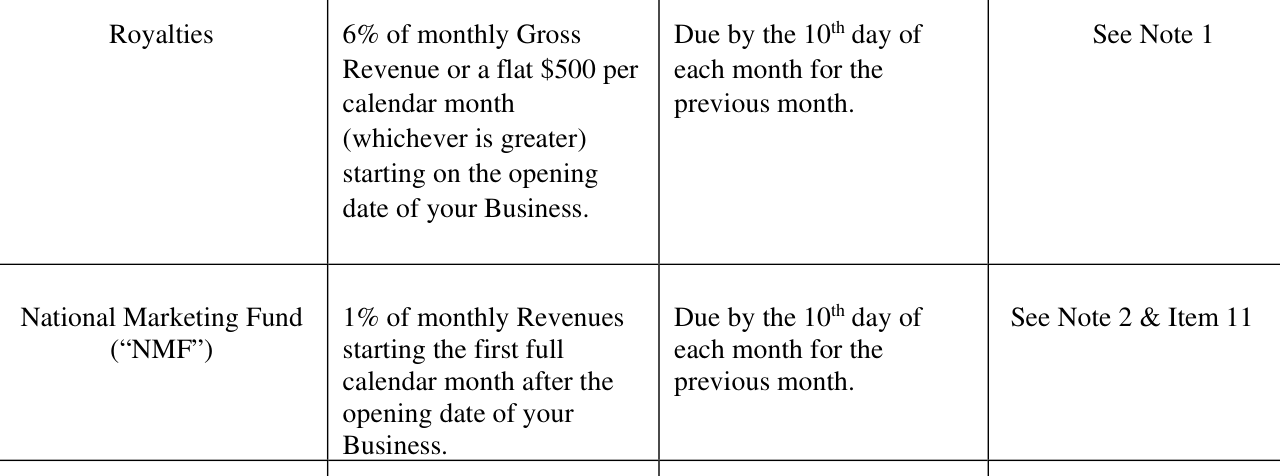
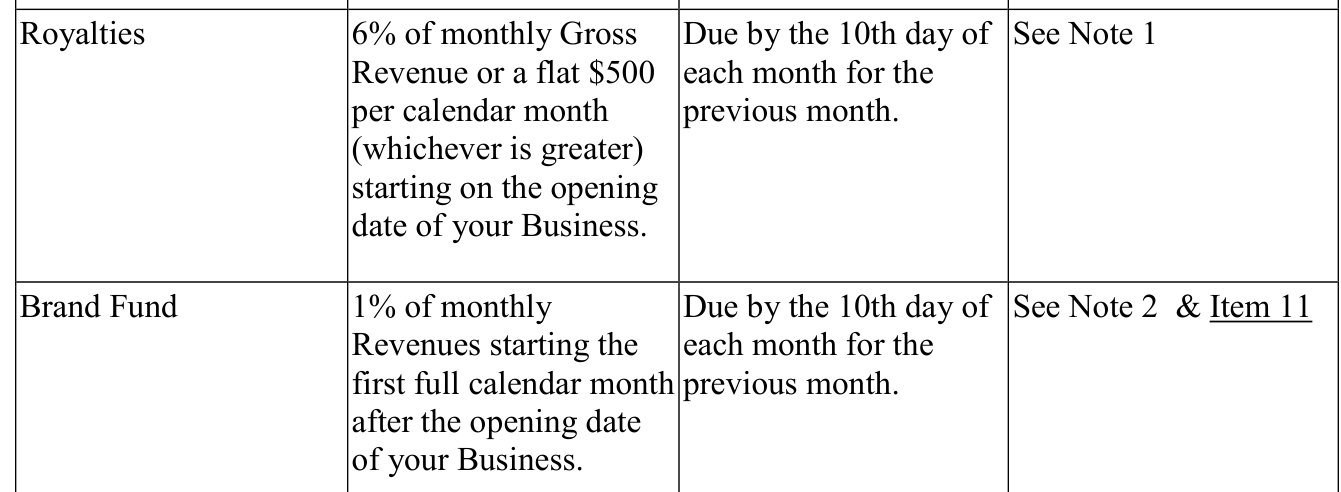
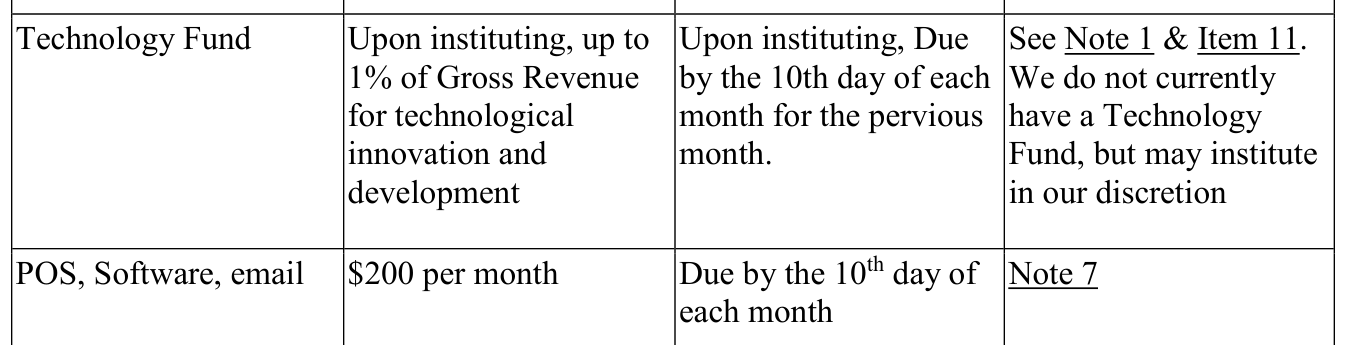
The royalty is 6 percent of monthly gross revenue in every edition, but the flat monthly minimum changed: the 2018 edition sets a tiered minimum of $300 for months one through twenty-four and $500 thereafter, while the 2022 through 2025 editions set a single $500 monthly minimum from opening. The advertising structure was rebuilt repeatedly. The 2018 edition charges a flat $50-per-month System Advertising Fee plus 4 percent local advertising. The 2022 edition replaces the flat fee with a National Marketing Fund of 1 percent of revenue and keeps local marketing at 4 percent. The 2023 and 2024 editions keep the 1 percent fund and lower required local marketing to 3 percent. The 2025 edition renames the fund the Brand Fund, adds a new Technology Fund of up to 1 percent of gross revenue that it states is not yet instituted, and adds a new recurring charge of $200 per month for point-of-sale, software, and email services. The renewal fee rose from $2,000 (2018 through 2023) to $5,000 (2024, 2025). All editions title this item OTHER ITEMS rather than the FTC template heading OTHER FEES. The changes are documentary and unadjudicated.
The page:
 Open the full page →
 Open the full page →
 Open the full page →
 Open the full page →
 Open the full page →
Item 7. Estimated Initial Investment
Confirmed Item 7 - Estimated Initial Investment
The total estimated initial investment is disclosed as $108,500 to $276,400 (2018), $99,120 to $225,075 (2022), a redlined $120,120 to $282,575 (2023 Minnesota edition), $147,500 to $304,100 (2024 single-unit table), and $241,000 to $570,000 (2025). Between the 2022 and 2025 editions the low end rose about 143 percent and the high end about 153 percent, roughly a doubling at both ends. The line items driving the 2025 increase include inventory ($40,000 to $100,000), leasehold improvements ($50,000 to $120,000), and additional funds for three months ($45,000 to $135,000). The documentary tension arises from the franchisor's own audited consolidated statements filed as Item 21 exhibits in these same editions. Total stockholders' equity, positive at $129,513 for fiscal 2021, is reported in deficit thereafter: ($181,935) at December 31, 2022, ($276,860) at December 31, 2023, and ($492,495) at December 31, 2024. Current liabilities exceed current assets in each of those years, a negative working capital that widens to roughly $1.3 million at fiscal 2024, while deferred revenue and gift-card payable together grow to about $3.0 million. The same editions raised the price of entry over the identical window in which the audited equity moved deeper into deficit. Auditor Gilbert & Stewart issued its report over the statements. The juxtaposition is documentary and no legal conclusion is drawn.
The page in every edition held. Choose a year.
 Open the full page →
 Open the full page →
 Open the full page →
 Open the full page →
 Open the full page →
Item 8. Restrictions on Sources of Products and Services
Inference Item 8 - Restrictions on Sources of Products and Services
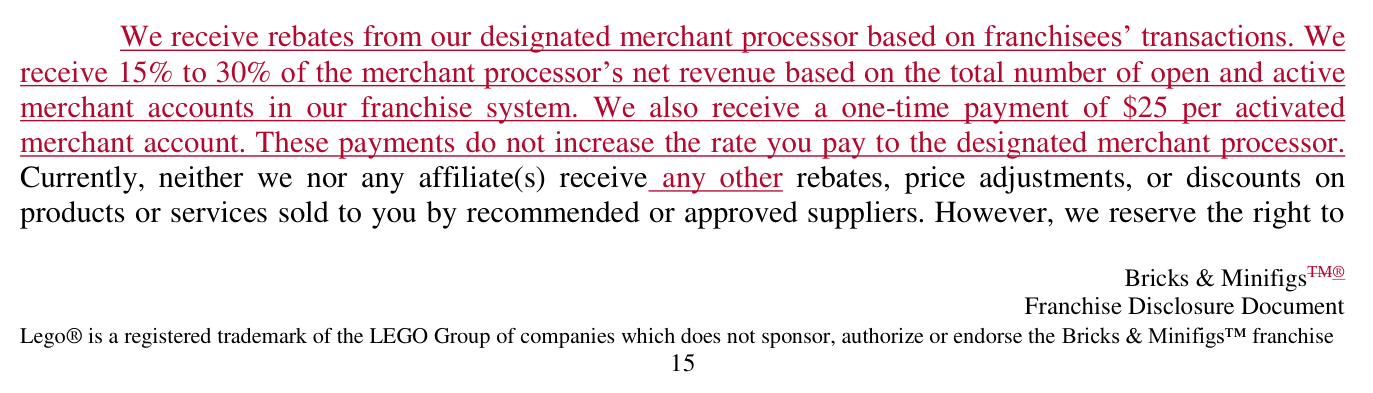
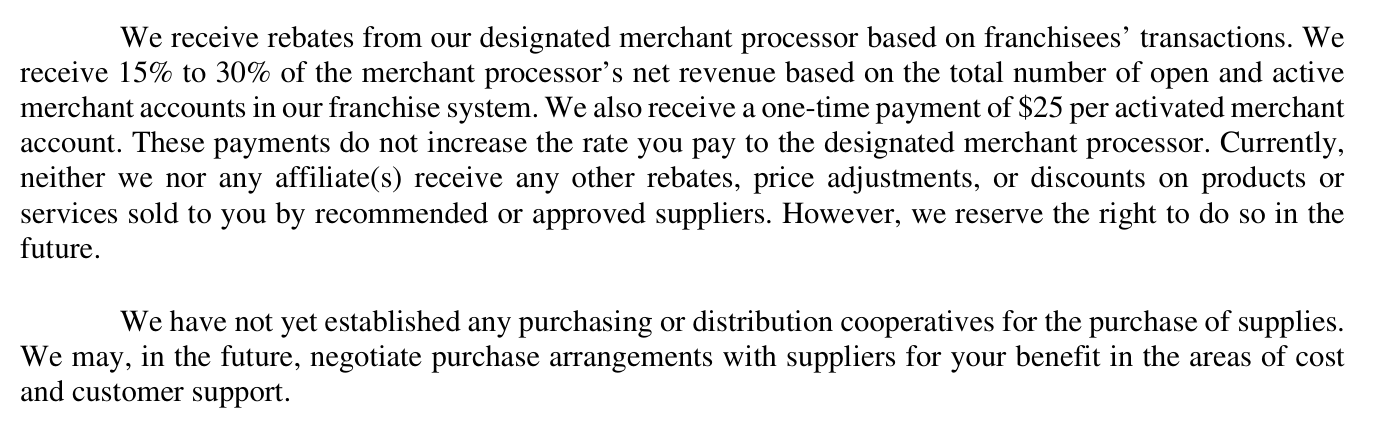
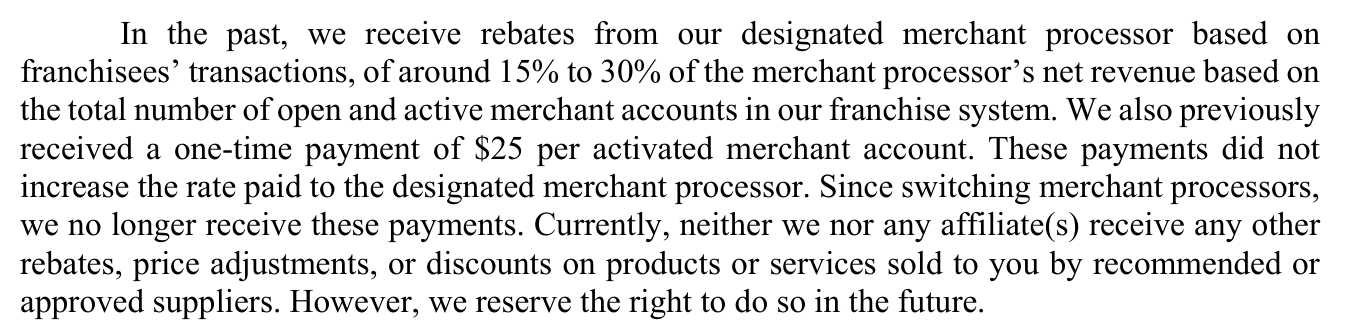
Item 8 (Restrictions on Sources) is materially stable in structure across every edition reviewed: the franchisee must use the franchisor-designated POS system, merchant-services processor, and gift-card processor, and may add outside vendors only through the franchisor's written approval protocol. One element changed. The 2018 and 2022 editions disclosed a supplier-side payment to the franchisor, "We receive rebates from our designated merchant processor based on franchisees' transactions," quantified as 15% to 30% of the processor's net revenue plus a $25-per-activated-account payment. The 2023 edition disclosed that the arrangement had ended: "Since switching merchant processors, we no longer receive these payments." The 2024 and 2025 editions omit the rebate and state that no affiliate of BAM derived revenue, rebates, or other material consideration based on required purchases. The lifecycle is therefore disclosed by the franchisor itself and is not a concealed contradiction. It is recorded here because sourcing rebates were the flagged candidate and the trail is verifiable, but the record self-discloses the change.
The page in every edition held. Choose a year.
 Open the full page →
 Open the full page →
 Open the full page →
 Open the full page →
 Open the full page →
Item 9. Franchisee's Obligations
Read, nothing notable Item 9 - Franchisee's Obligations
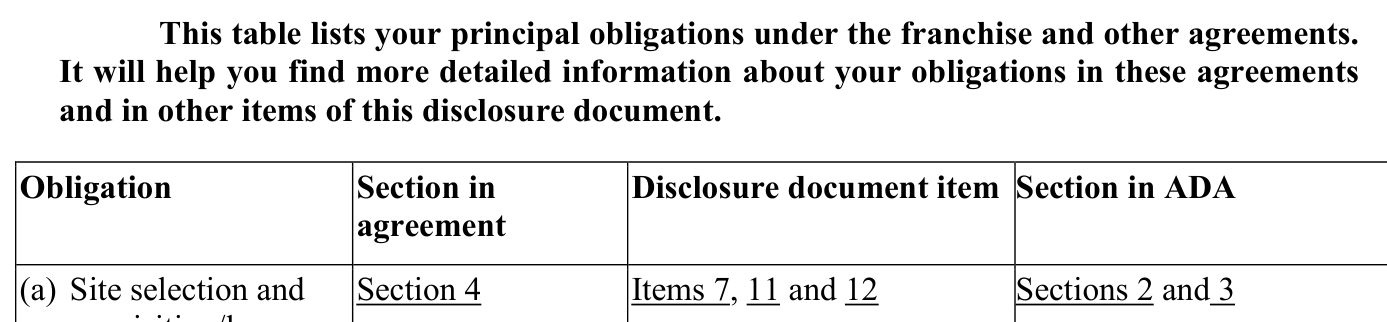
Item 9 (Franchisee's Obligations) is the standard cross-reference index of principal obligations. The obligation rows run the same set (a) through (y) in the 2018 and 2025 editions, and no obligation is added or dropped. The only structural change is that the 2025 edition adds a third column, "Section in ADA," keyed to the Area Development Agreement, and the franchise-agreement section citations are renumbered to track the revised agreement. The item is unremarkable.
The page:
 Open the full page →
Item 10. Financing
Confirmed Financing
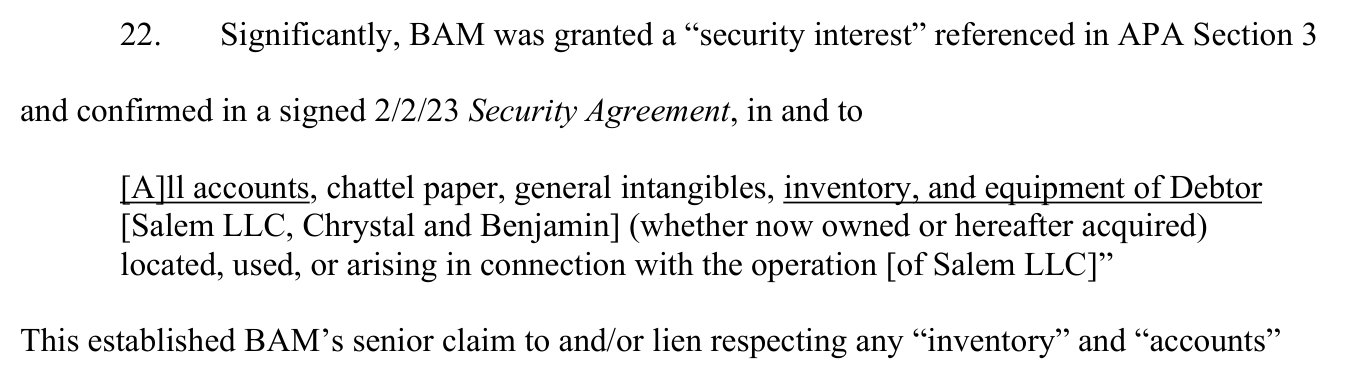
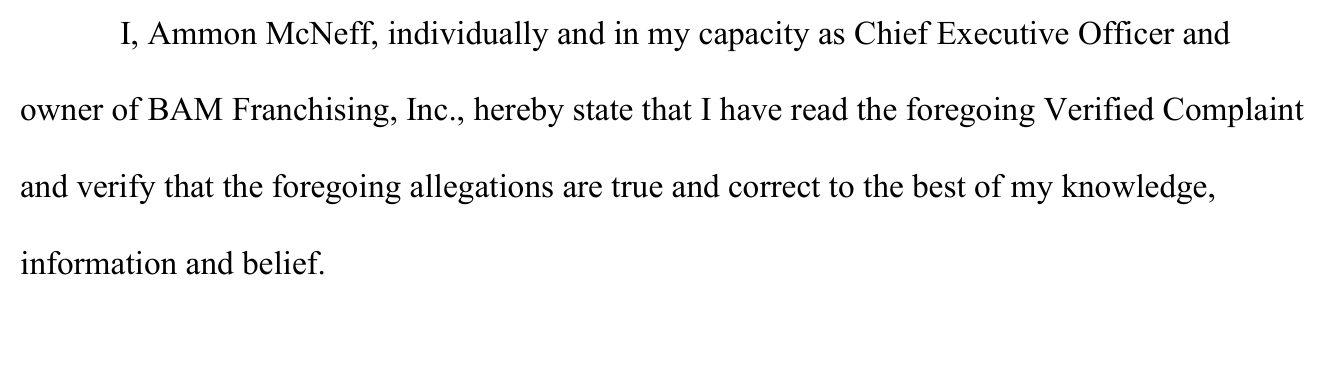
Item 10 of every Bricks and Minifigs Franchise Disclosure Document from 2018 through 2025 states, without qualification, that the franchisor provides no direct or indirect financing and guarantees no notes or financial obligations. The same corporate record supplies the counter-fact. Note 8 to the audited financial statements bound into the 2024 edition reports that on February 2, 2023 the company sold the BAMF Salem store to an outside party for $65,000 and that the sale was financed by a note receivable of $45,000 carried on the balance sheet at year end. BAM's own verified complaint, sworn by Ammon McNeff, recites a signed February 2, 2023 Security Agreement placing the franchisor in the position of secured party over the buyer's accounts, inventory, and equipment. The consolidated balance sheet carries notes receivable of $103,837 at December 31, 2022 and $130,502 at December 31, 2023. The 2023 edition, which repeats the no-financing representation, was issued March 31, 2023, fifty-seven days after the dated financing instrument. The claims and figures are unadjudicated, and the record is documentary and internal to the disclosure.
Every edition says the franchisor offers no financing. The company's own sworn complaint describes the financing.
 Open the full page →
 Open the full page →
 Open the full page →
The page in every edition held. Choose a year.
 Open the full page →
 Open the full page →
 Open the full page →
 Open the full page →
 Open the full page →
 Open the full page →
 Open the full page →
 Open the full page →
 Open the full page →Open the full page →
 Open the full page →
Item 11. Franchisor's Assistance, Advertising, Computer Systems, and Training
Confirmed Item 11 , Franchisor's Assistance, Advertising, Computer Systems & Training
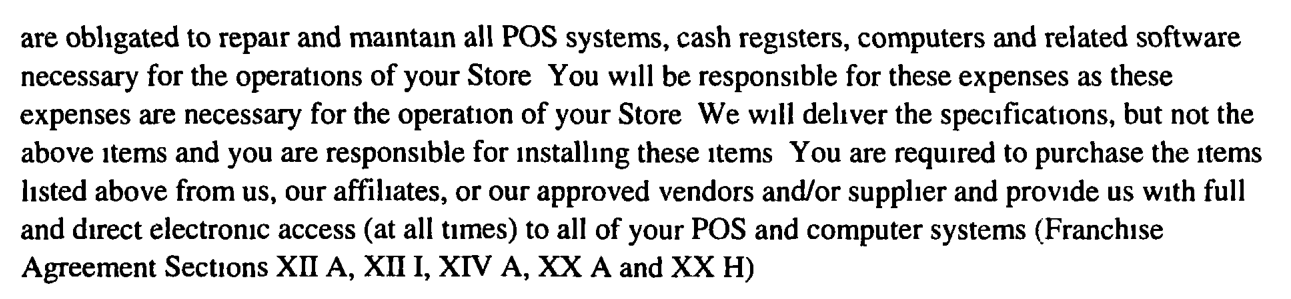
Item 11, titled Franchisor's Assistance, Advertising, Computer Systems and Training, requires the franchisee to buy a third-party point-of-sale system, computers, software, and a camera and security system, described as used for communications, accounting, record keeping, and store security, at a cost the disclosure places between $3,200 and $6,500 by reference to Item 7. In each edition examined, from 2018 through 2025, the franchisor describes any proprietary software as a future possibility rather than a present requirement, stating that it will provide update and upgrade specifications only if it develops such software. Buy, sell, and trade activity and consignment are addressed as programs for which the franchisor supplies specifications, and inventory tracking appears only as a training topic. The 2024 and 2025 editions add one sentence reserving the right to require point-of-sale and computer-system upgrades to franchisor specifications. On July 10, 2026, the franchisor publicly stated that it had implemented immediate changes across all locations, including more rigorous record-keeping and inventory management and transparency in the buy, sell, and trade process. A change the speaker describes as newly implemented across all locations is, on its face, one that was not previously in force under the disclosed Item 11 regime. The matter is unadjudicated and the presumption of innocence applies.
The page:
 Open the full page →
 Open the full page →
 Open the full page →
Item 12. Territory
Read, nothing notable Item 12 - Territory
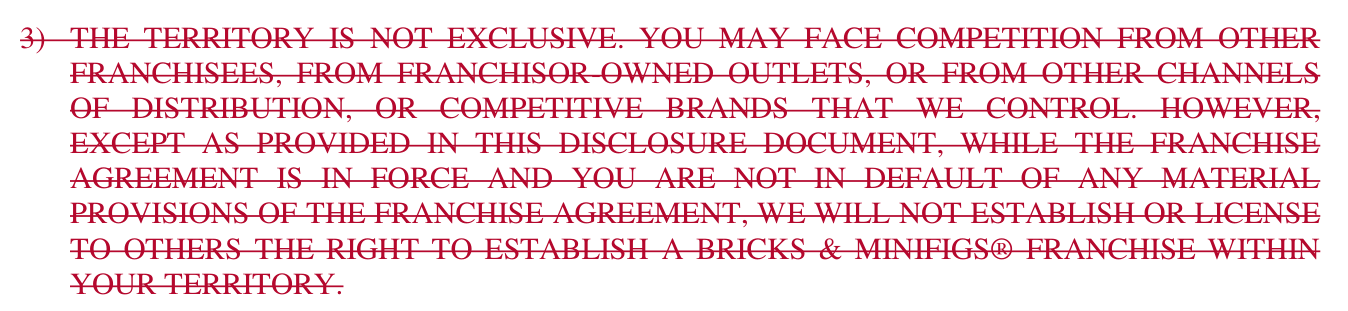
Item 12 (Territory) is substantively stable across editions, with one terminology shift worth recording. The 2018 edition's Item 12 body calls the grant a "protected territory," while the non-exclusivity disclosure sits on the state cover page as Risk Factor 3, "THE TERRITORY IS NOT EXCLUSIVE." The 2025 edition relabels the grant an "assigned territory," moves the non-exclusivity statement into the Item 12 body ("You will not receive an exclusive Territory"), and adds "There is no minimum size for the Territory." The core anti-encroachment protection is preserved and slightly broadened: the 2018 carve-out barred the franchisor from establishing another Bricks & Minifigs franchise in the territory, whereas the 2025 carve-out bars another bricks-and-mortar outlet, franchised or company-owned. The net effect increases candor and protection rather than reducing it. No adverse contradiction is present.
The page:
 Open the full page →
 Open the full page →
 Open the full page →
 Open the full page →
Item 13. Trademarks
Confirmed Item 13: Trademarks (the LEGO 'authorized retailer of the LEGO brand' hinge)
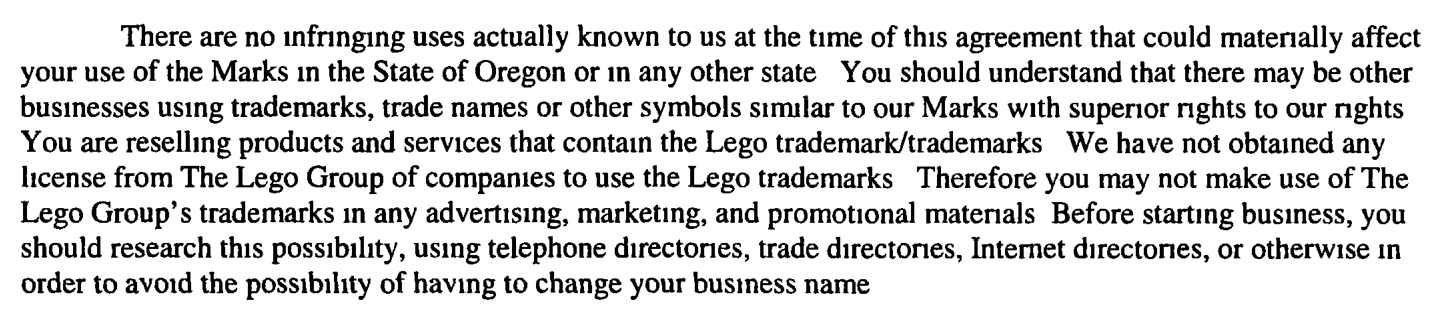
Item 13 (Trademarks) carries the only franchisor statement in Items 13 and 14 about the LEGO relationship, and that statement was rewritten between the 2023 and 2024 editions. Through 2018, 2022, and 2023 the sentence following the resale disclosure stated that the franchisor had not obtained any license from The Lego Group to use the LEGO trademarks. Beginning with 2024 and continued in 2025, the same sentence position instead states that the franchisor is an authorized retailer of the LEGO brand, and the prior no-license disclaimer no longer appears. The running footer on every page of each edition, including 2024 and 2025, states that The LEGO Group does not sponsor, authorize or endorse the franchise. The 2024 and 2025 disclosure therefore asserts authorized-retailer status in its Item 13 body while denying LEGO authorization in its own page footer, and it discloses no license within Items 13 or 14 to bridge the two. A benign reading is that the stores resell genuine secondary-market product and the phrase reflects loose drafting. The tension between the body claim and the footer disclaimer is nonetheless internal to the same document. Unadjudicated; presumption of innocence.
Through 2023 the FDD disclosed no LEGO license. In 2024 the same sentence became 'authorized retailer of the LEGO brand.'
 Open the full page →
 Open the full page →
The page in every edition held. Choose a year.
 Open the full page →
 Open the full page →
 Open the full page →
 Open the full page →
 Open the full page →
 Open the full page →
 Open the full page →Open the full page →Open the full page →
 Open the full page →
 Open the full page →
Item 14. Patents, Copyrights, and Proprietary Information
Read, nothing notable Item 14: Patents, Copyrights and Proprietary Information
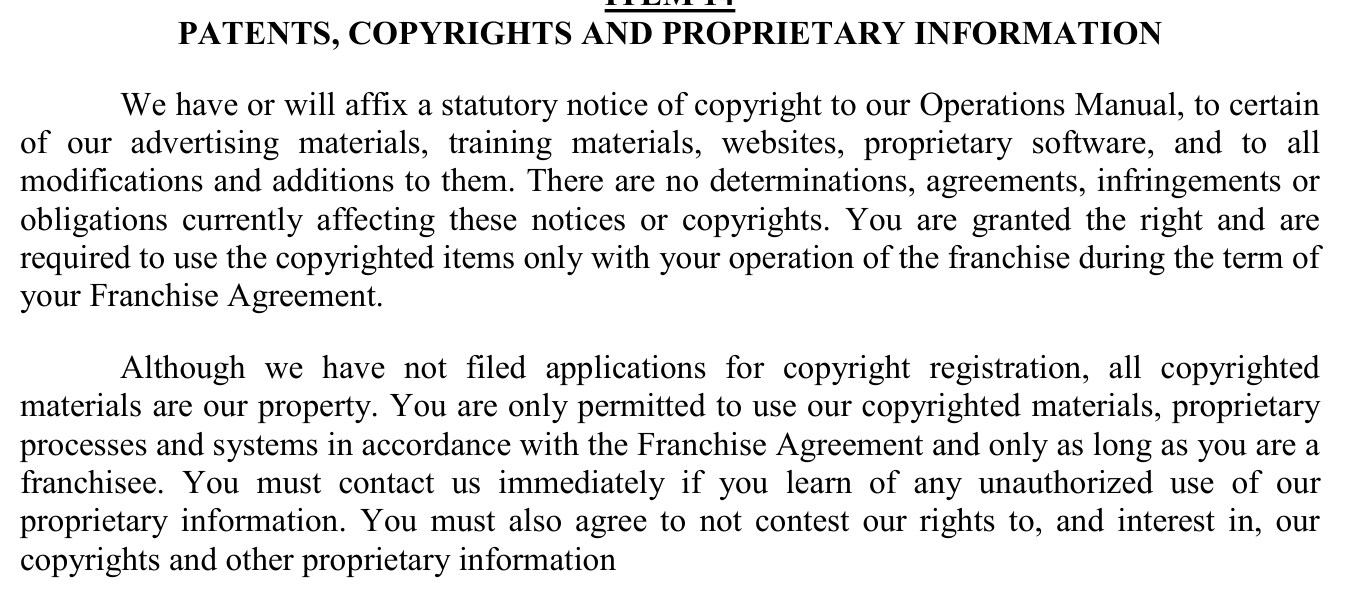
Item 14 (Patents, Copyrights and Proprietary Information) is ordinary franchise boilerplate and is stable across all five editions. Every edition discloses that the franchisor has no patents material to the franchise, has not filed applications for copyright registration, and claims common-law copyright and trade-secret rights in its manuals and materials. The LEGO-related language and the authorized-retailer claim sit in Item 13, not Item 14. Nothing in Item 14 contradicts the record.
The page:
 Open the full page →
Item 15. Obligation to Participate in the Actual Operation of the Franchise Business
Read, nothing notable Obligation to Participate in the Actual Operation of the Franchise Business
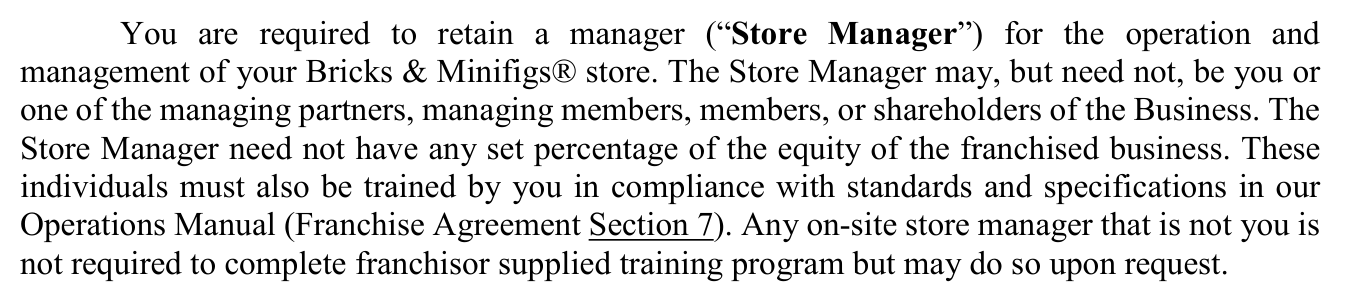
Item 15 is unremarkable after reading. Across the 2018 and 2025 editions the participation obligation is materially the same: the franchisee must retain a Store Manager who may but need not be an owner and who carries no minimum equity requirement, and every owner must personally sign the Franchise Agreement or the Schedule 5 Personal Guaranty. The only editorial movement is a renumbered Franchise Agreement cross-reference (Section 12.6 in 2018 to Section 7 in 2025) and one added 2025 sentence clarifying that a non-owner on-site manager is not required to complete the franchisor training program. Graded NOTHING_NOTABLE.
The page:
 Open the full page →
Item 16. Restrictions on What the Franchisee May Sell
Read, nothing notable Restrictions on What the Franchisee May Sell
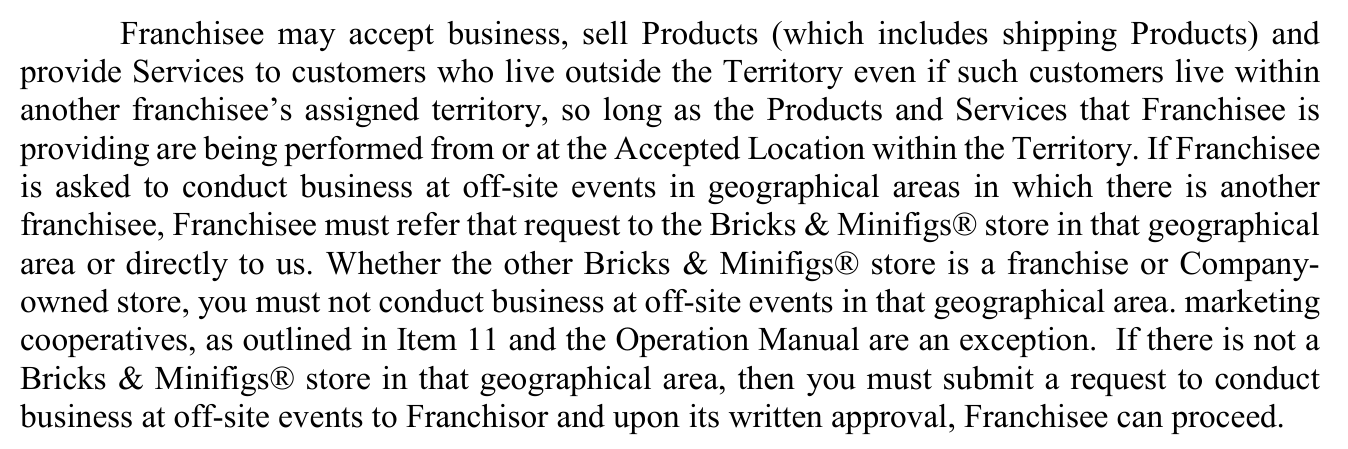
Item 16 is unremarkable as a standalone contradiction. Both editions establish an approval-gated product line: the franchisee may sell only what the franchisor approves, with the 2025 text broadening the approval channel to include the Operations Manual and adding territory, off-site-event referral, and vendor eCommerce language absent from the terse 2018 version. The approval-in-writing regime is the same hook under which the Franchise Agreement permits consignment services only as "approved by us," but Item 16 does not itself mention consignment. Graded NOTHING_NOTABLE.
The page in every edition held. Choose a year.
 Open the full page →
 Open the full page →
 Open the full page →
Item 17. Renewal, Termination, Transfer, and Dispute Resolution
Confirmed Renewal, Termination, Transfer and Dispute Resolution
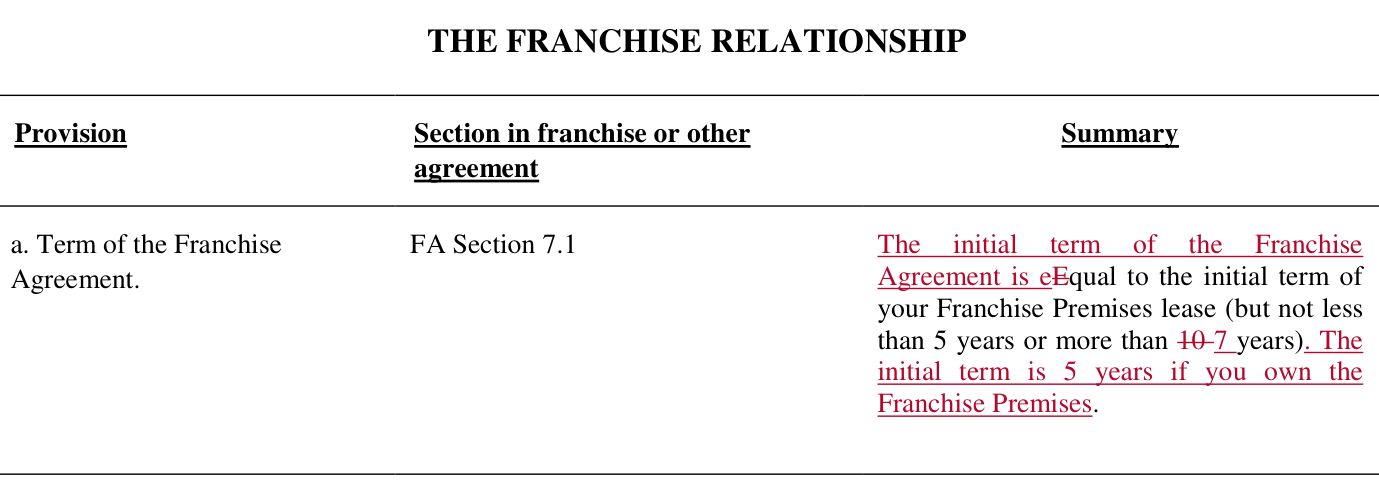
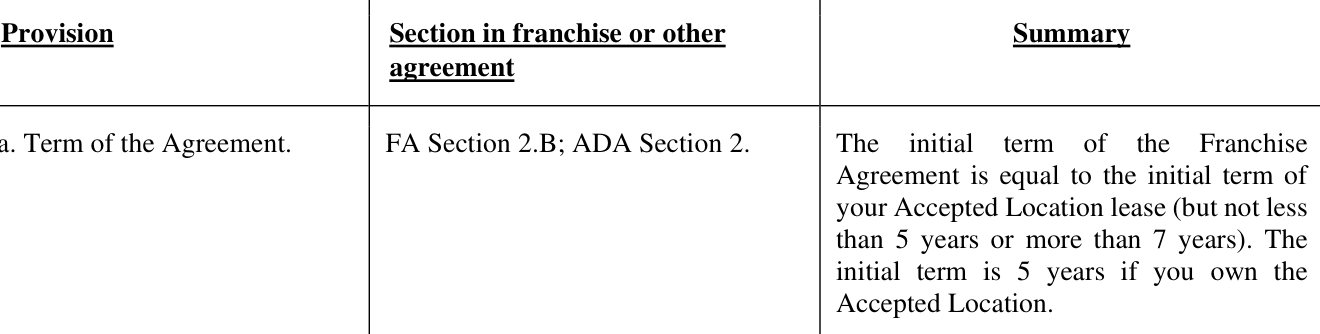
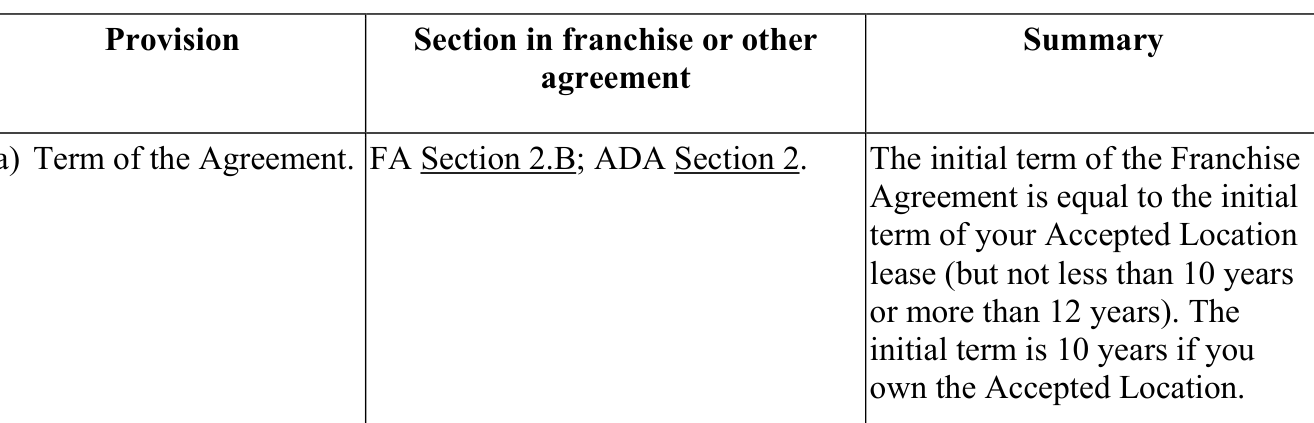
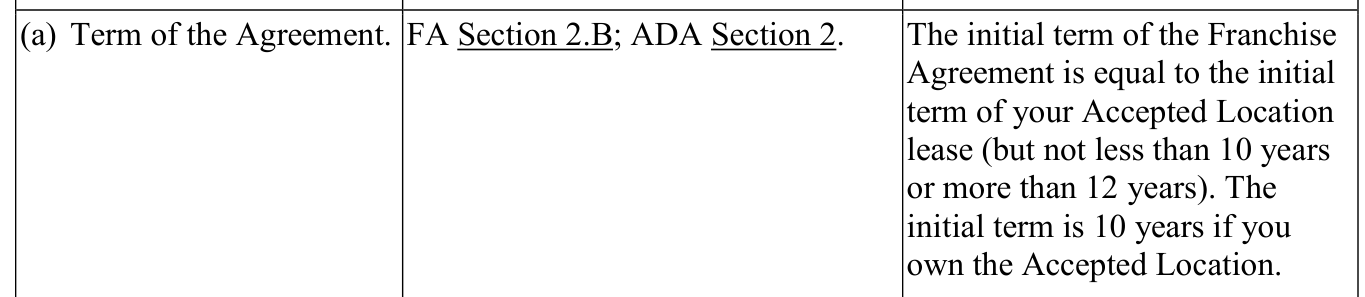
Item 17 is the one substantive row in this sweep. The franchise relationship table records that the initial and renewal term was extended from "not less than 5 years or more than 7 years" in the 2018 edition to "not less than 10 years or more than 12 years" by 2025, a doubling of the minimum lock-in. The 2023 marked disclosure document preserves the amendment as a visible redline, rendering the bounds as "510" and "712" where the old figures are struck and the new inserted. Over the same span the franchisee-side termination provision moved from an explicit remedy ("If we have materially failed to comply with terms of the FA after 90 days’ notice") to a referral to whatever "individual state laws" permit, removing the stated contractual exit. Renewal, transfer, right of first refusal, and post-term non-competition covenants are otherwise carried forward. Dispute resolution is fixed throughout to arbitration and litigation in Utah County, Utah, under Utah law, subject to state-law carve-outs, a venue the Franchise Agreement itself confirms. Graded CONFIRMED as a documentary comparison of the same item across editions.
The page in every edition held. Choose a year.
 Open the full page →
 Open the full page →
 Open the full page →
 Open the full page →
Item 18. Public Figures
Read, nothing notable Public Figures
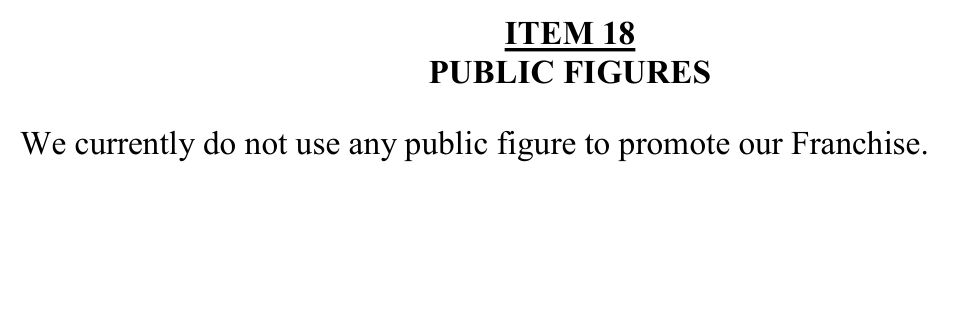
Item 18 is unremarkable. Every edition read carries the identical one-sentence disclosure that the franchisor uses no public figure to promote the franchise. Graded NOTHING_NOTABLE.
The page:
 Open the full page →
Item 19. Financial Performance Representations
Confirmed Item 19 (Financial Performance Representations) , 2018 edition
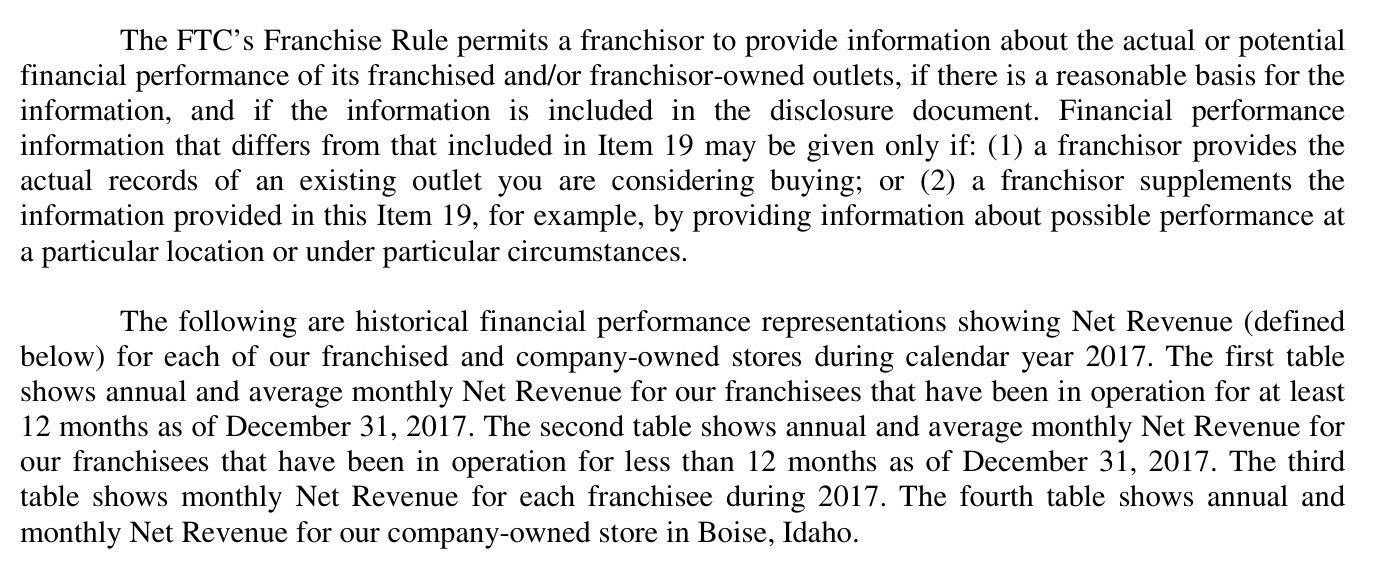
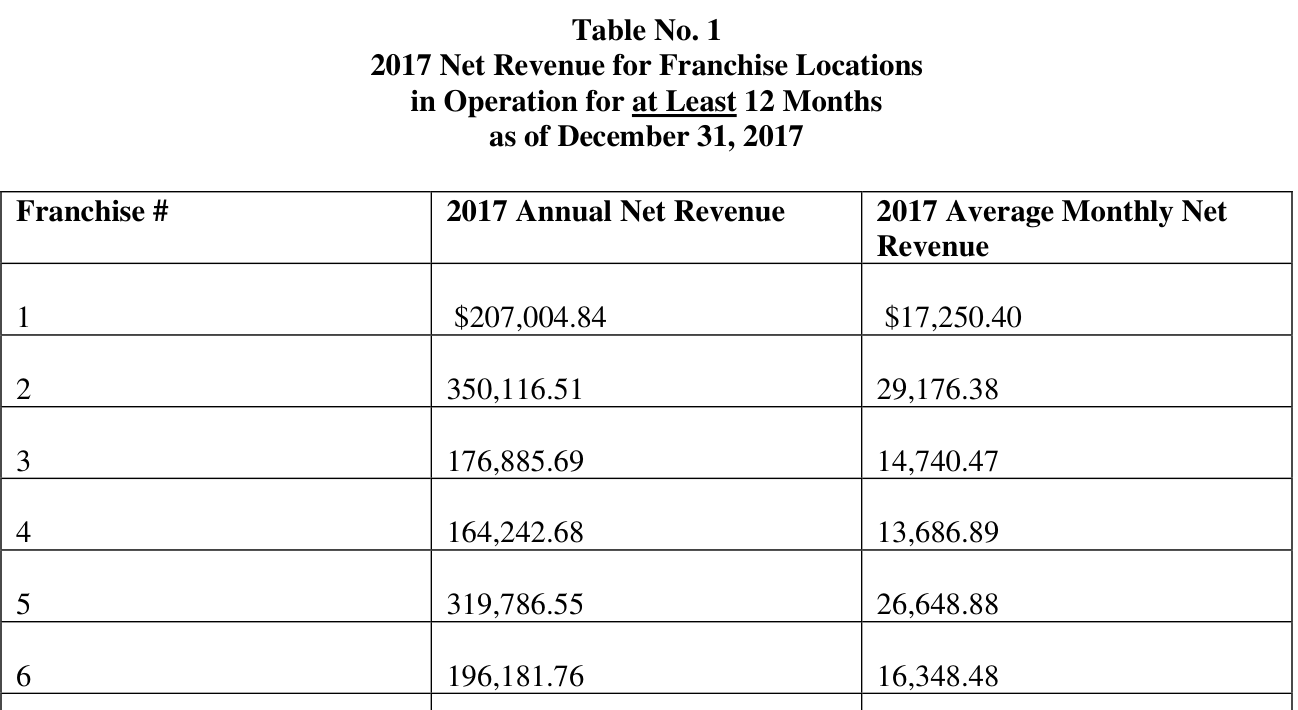
The 2018 edition makes a full Item 19 financial performance representation. It discloses historical Net Revenue for every franchised and company-owned store for calendar year 2017 across four tables, including per-store monthly figures. The representation is a top-line revenue measure only: Net Revenue is defined as gross revenue minus adjustments, discounts, credits, returns, and sales taxes, and Note 2 states the figures do not reflect costs of sales, operating expenses, or other costs deducted to reach net income or profit. The disclosed overall average for franchisees operating at least twelve months was $248,440.99 annually and $20,703.42 monthly. Table 4 reports the single company-owned Boise, Idaho store at $300,547.11 and states that store became company-owned in July 2016 when Reed Brimhall became an owner and Chief Financial Officer. As a documentary matter the FPR is robust and store-level, and it makes no franchisee-profit or franchisor-solvency claim. This is an unadjudicated documentary description, and the presumption of innocence applies.
The page in every edition held. Choose a year.
 Open the full page →
 Open the full page →
 Open the full page →
 Open the full page →
 Open the full page →
 Open the full page →
 Open the full page →
 Open the full page →
 Open the full page →
 Open the full page →
Held Item 19 (Financial Performance Representations) , 2022 edition
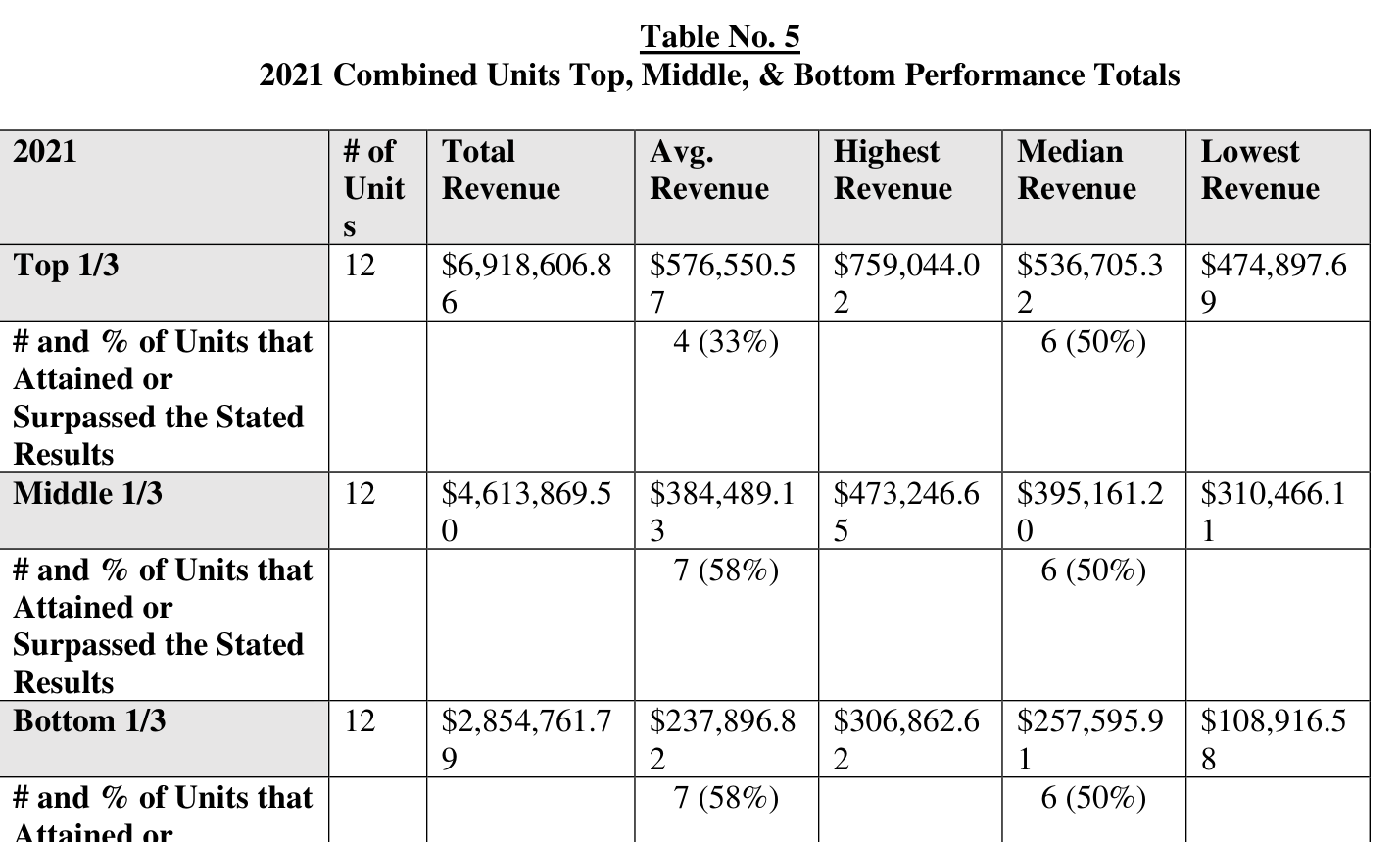
The 2022 edition makes an Item 19 financial performance representation, restructured from the 2018 per-store format into aggregate totals broken into top, middle, and bottom thirds, with the metric renamed from Net Revenue to Total Revenue under the identical definition of gross revenue minus adjustments, discounts, credits, returns, and sales taxes, and the same caveat that the figures do not reflect costs of sales or operating expenses. The specific dollar figures in the 2022 table are held pending a clean regulator copy, because the copy available this pass was unreadable. What is confirmed is the format change and the continued revenue-only basis, which is silent on franchisee net profit.
Confirmed Item 19 (Financial Performance Representations) , 2023 edition (MN)
The 2023 Minnesota edition, issued March 31, 2023, makes an Item 19 representation for the 2022 calendar year in the same aggregate totals-and-thirds format. Its confirmed documentary point is a new exclusive-representation closing, absent from 2018 and 2022, stating that other than the preceding representation the franchisor does not make any financial performance representations, alongside the retained caveat that the figures do not reflect costs of sales or operating expenses. The current-year dollar figures in this edition are read from the marked redline copy, where struck and inserted digits sit adjacent, and are held pending confirmation against a clean copy. The representation stays revenue-only.
Confirmed Item 19 (Financial Performance Representations) , 2024 edition
The 2024 edition makes an Item 19 representation for the entire 2023 calendar year. Table 1 reports 49 qualifying franchised units, total revenue $28,412,780.97, and average revenue $579,852.67; combined tables reach $30,636,031.77 across 54 units. Total Revenue keeps the standard definition. A documentary change appears in the notes: the explicit caveat carried in 2018, 2022, and 2023, that the figures do not reflect costs of sales, operating expenses, or other costs deducted to obtain net income or profit, is dropped. The retained profit-related note reads only that some outlets have earned the amount, individual results may differ, and there is no assurance the reader will earn this much. The exclusive-representation sentence added in 2023 does not appear in this clean edition. Against this rising top-line disclosure, the same document’s Item 21 audited statements show a franchisor stockholders’ equity deficit of ($276,860) at year-end 2023 and a working-capital deficit, under an unqualified Gilbert & Stewart opinion with no going-concern emphasis paragraph. This is an unadjudicated documentary description, and the presumption of innocence applies.
Confirmed Item 19 (Financial Performance Representations) , 2025 edition
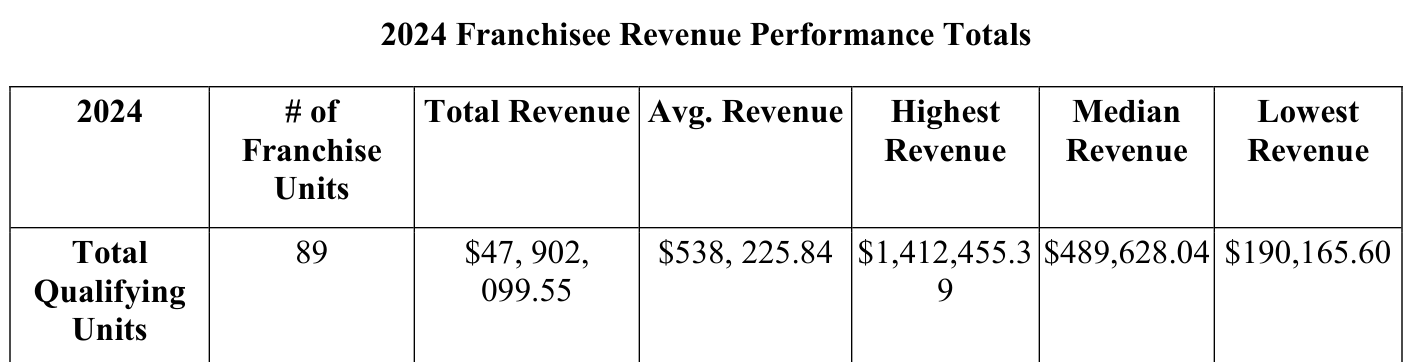
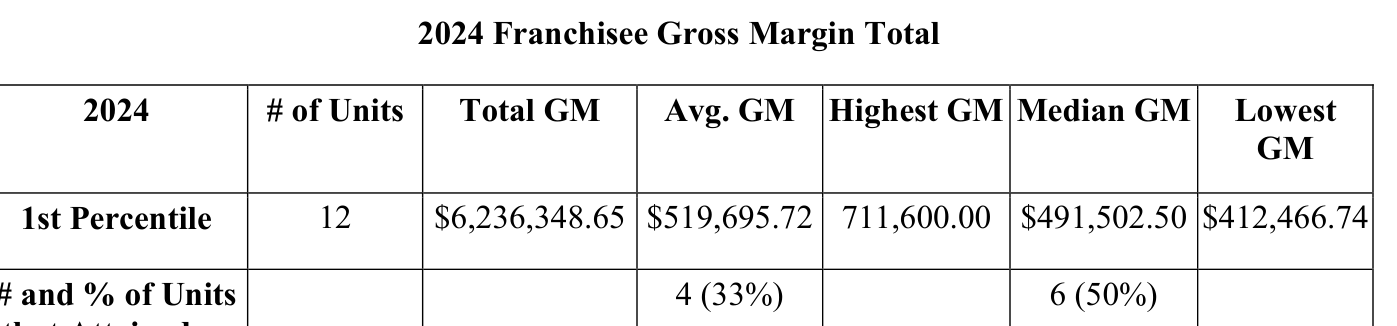
The 2025 edition makes the most extensive Item 19 representation, for the entire 2024 calendar year. Revenue Table 1 reports 89 qualifying franchised units, total revenue $47,902,099.55, and average revenue $538,225.84; combined tables reach $49,718,056.74 across 93 units. For the first time the edition adds gross-margin tables, titled 2024 Franchisee Gross Margin Total, 2024 Franchisee Gross Margin Percentage, and 2024 Corporate Unit Gross Margin Total, introducing a cost-of-goods dimension. Even so, the representation still discloses no operating expenses and no net income or profit, and the pre-2024 cost caveat remains absent. The profit-related note again states only that some outlets earned the amount, with no assurance others will. Against this rising and now margin-inclusive disclosure, the same document’s Item 21 audited statements show a franchisor stockholders’ equity deficit of ($492,495) at year-end 2024 and a working-capital deficit of roughly $1.31 million, under an unqualified Gilbert & Stewart opinion with no going-concern emphasis paragraph. This is an unadjudicated documentary description, and the presumption of innocence applies.
Item 20. Outlets and Franchisee Information
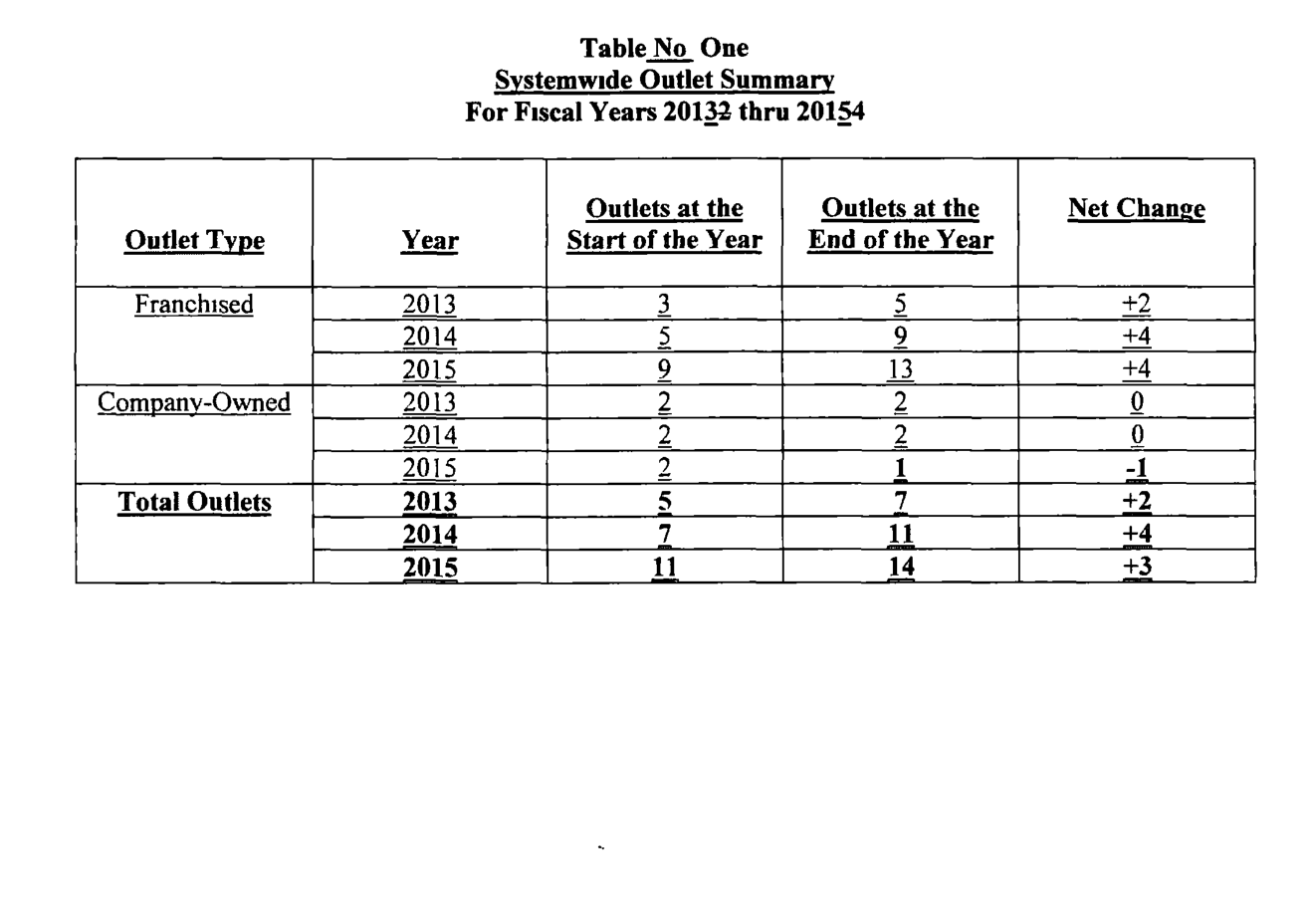
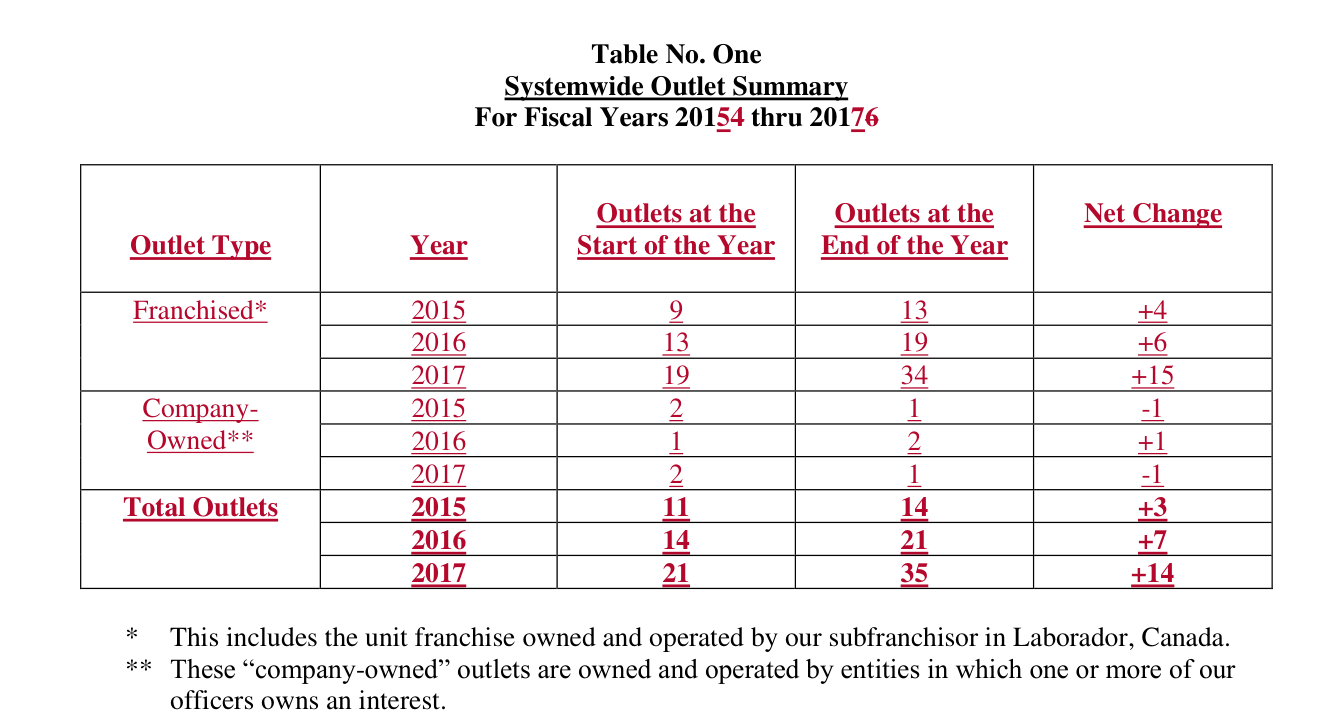
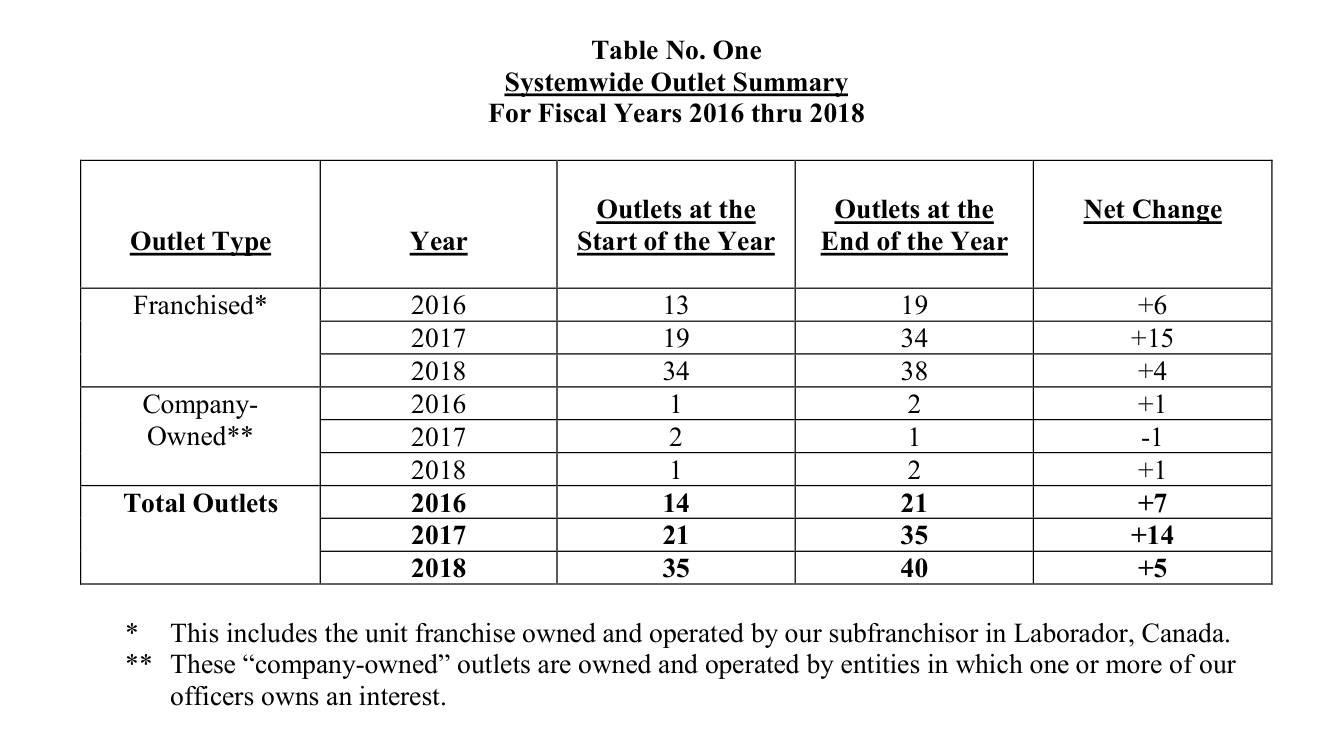
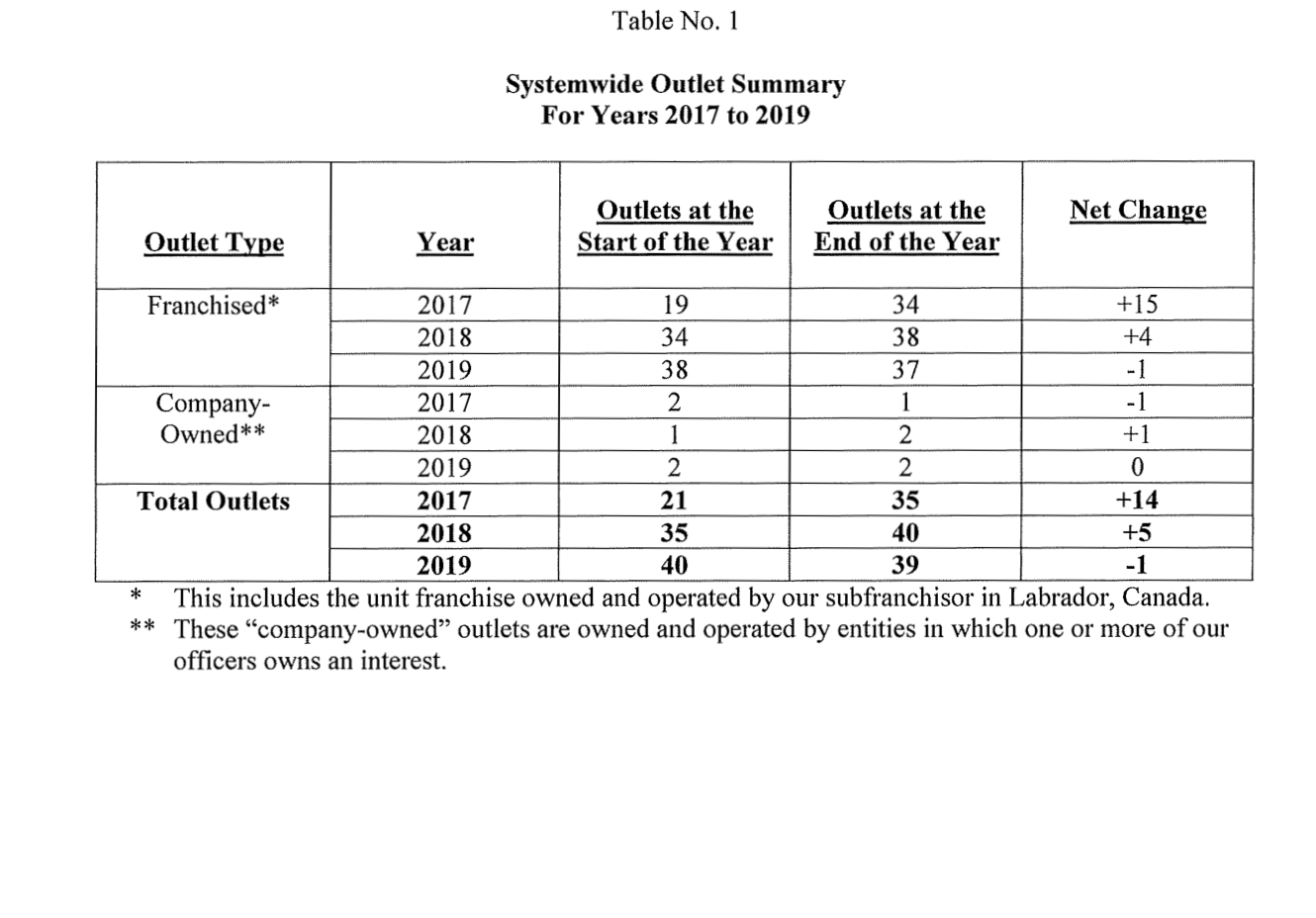
Confirmed Table No. 1 Systemwide Outlet Summary, and the silent cross-edition restatement of prior-year outlet counts
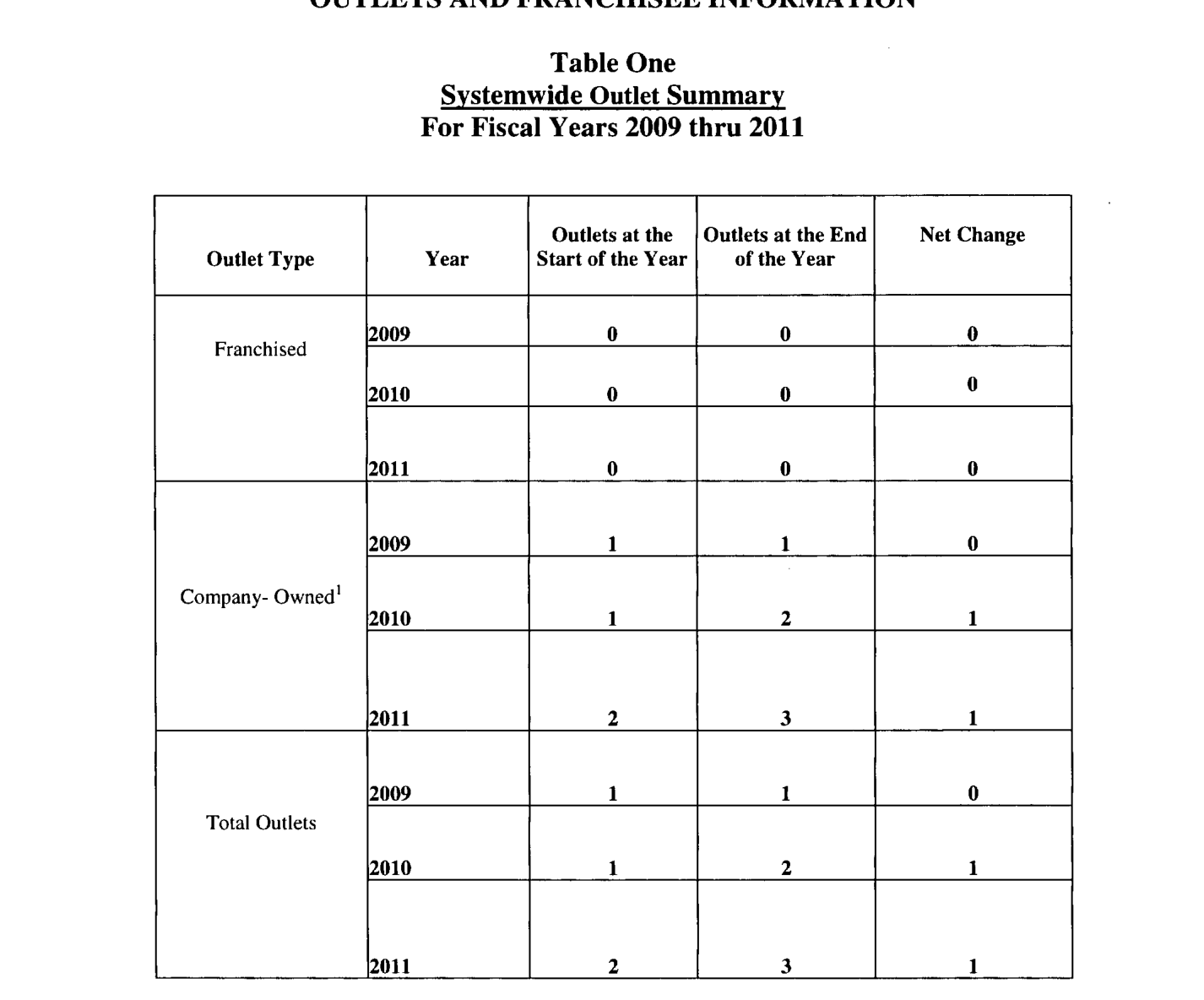
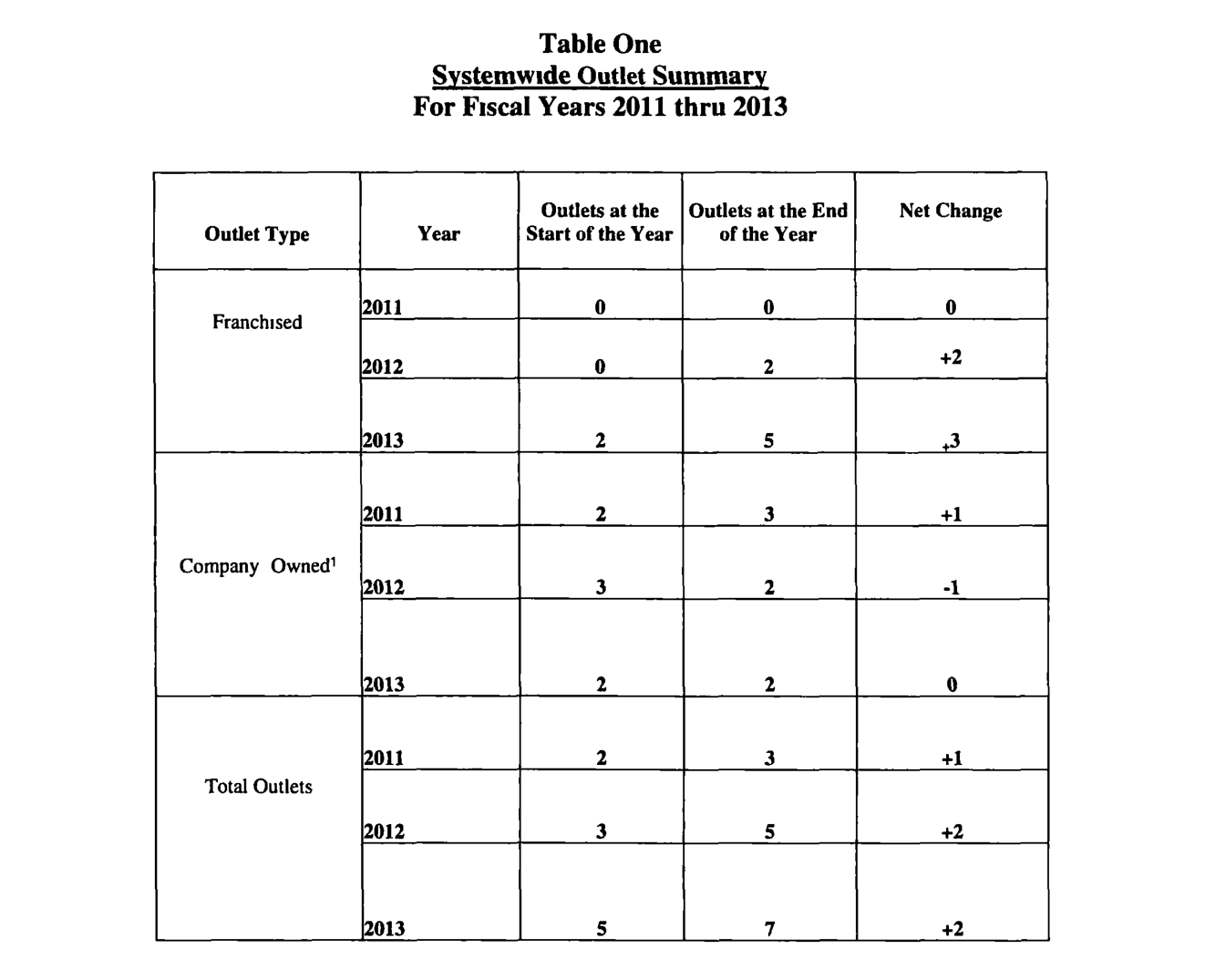
Item 20 Table No. 1 is the systemwide outlet summary. Read across the five editions, the same closed fiscal years do not hold still. The 2022 disclosure document reports fiscal 2021 franchised year-end outlets at 37 and total outlets at 42. The 2024 disclosure document, covering the identical fiscal 2021, reports 34 franchised and 39 total. The intervening 2023 filing shows the migration in progress, with fiscal 2021 franchised marked from 37 to 35. Fiscal 2020 franchised likewise moves from 33 to 31, and fiscal 2022 company-owned from a 6-to-5 year to a 5-to-4 year. None of the tables carry a restatement footnote. Within the 2025 edition there is also an unreconciled split: Table No. 1 lists franchised year-end 82 for fiscal 2023 while Table No. 3 totals the same year at 83, a direction the Labrador subfranchisor footnote does not explain. The document remains unadjudicated; the register here is only that prior published counts were revised downward without disclosure of the revision.
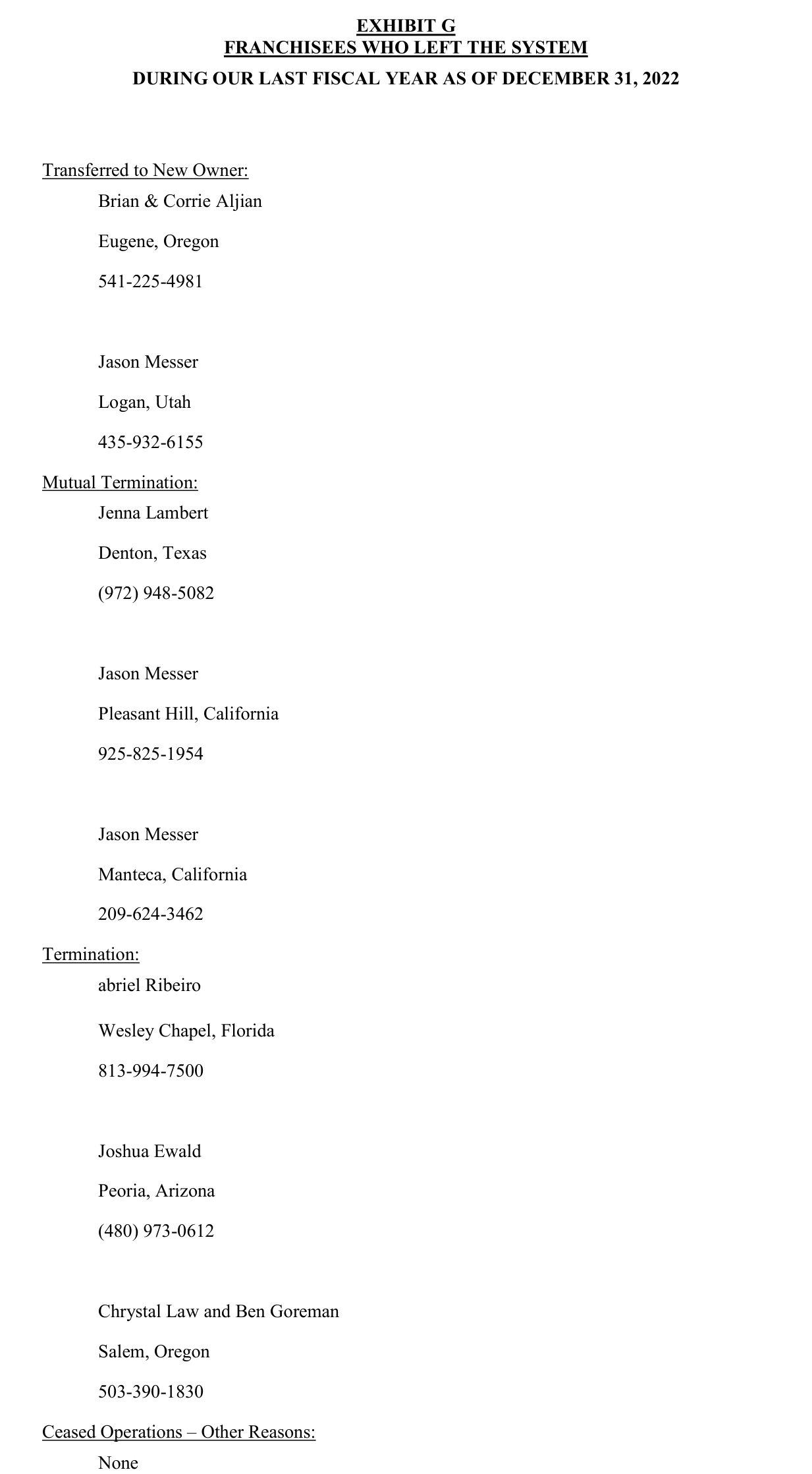
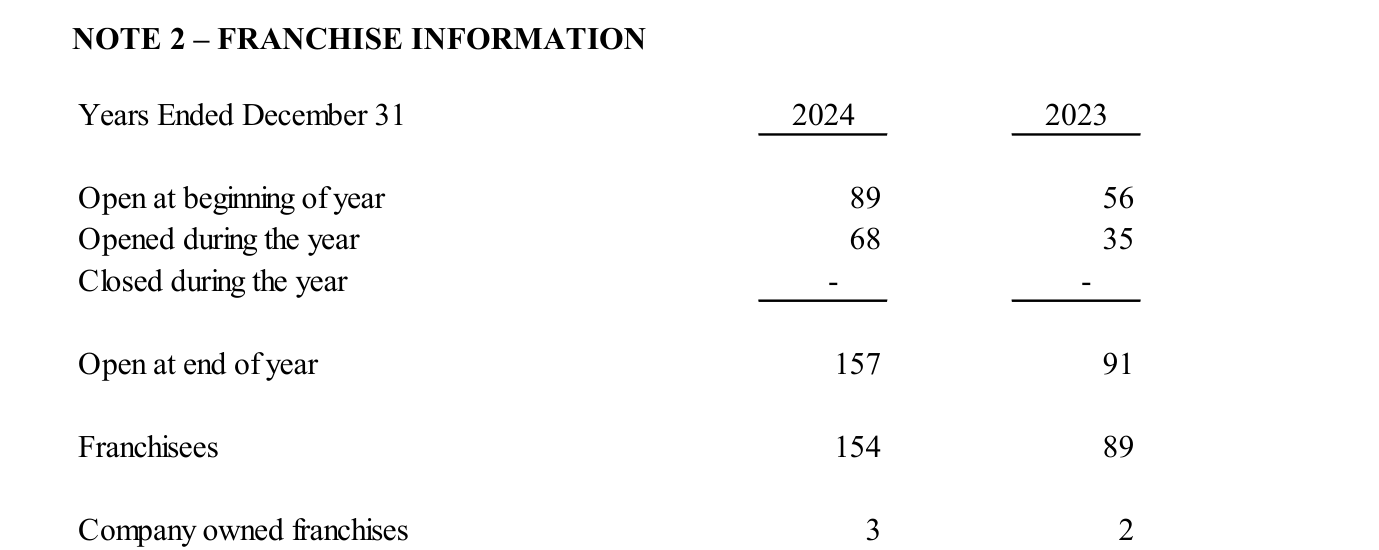
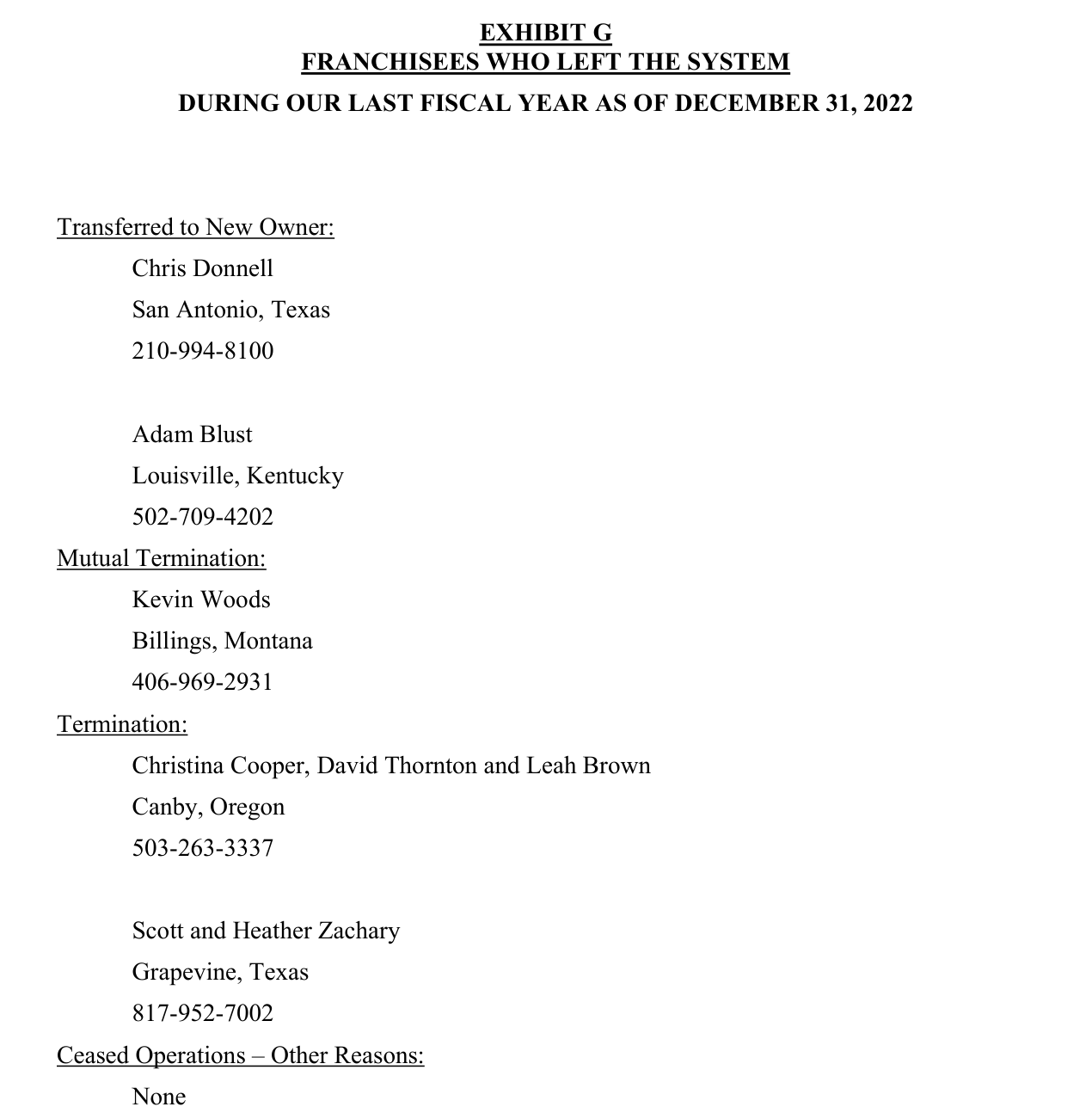
Exhibit G names franchisees who were terminated. The same document's audited note reports zero closures.
 Open the full page →
 Open the full page →
The page in every edition held. Choose a year.
 Open the full page →
 Open the full page →
 Open the full page →
 Open the full page →
 Open the full page →
 Open the full page →
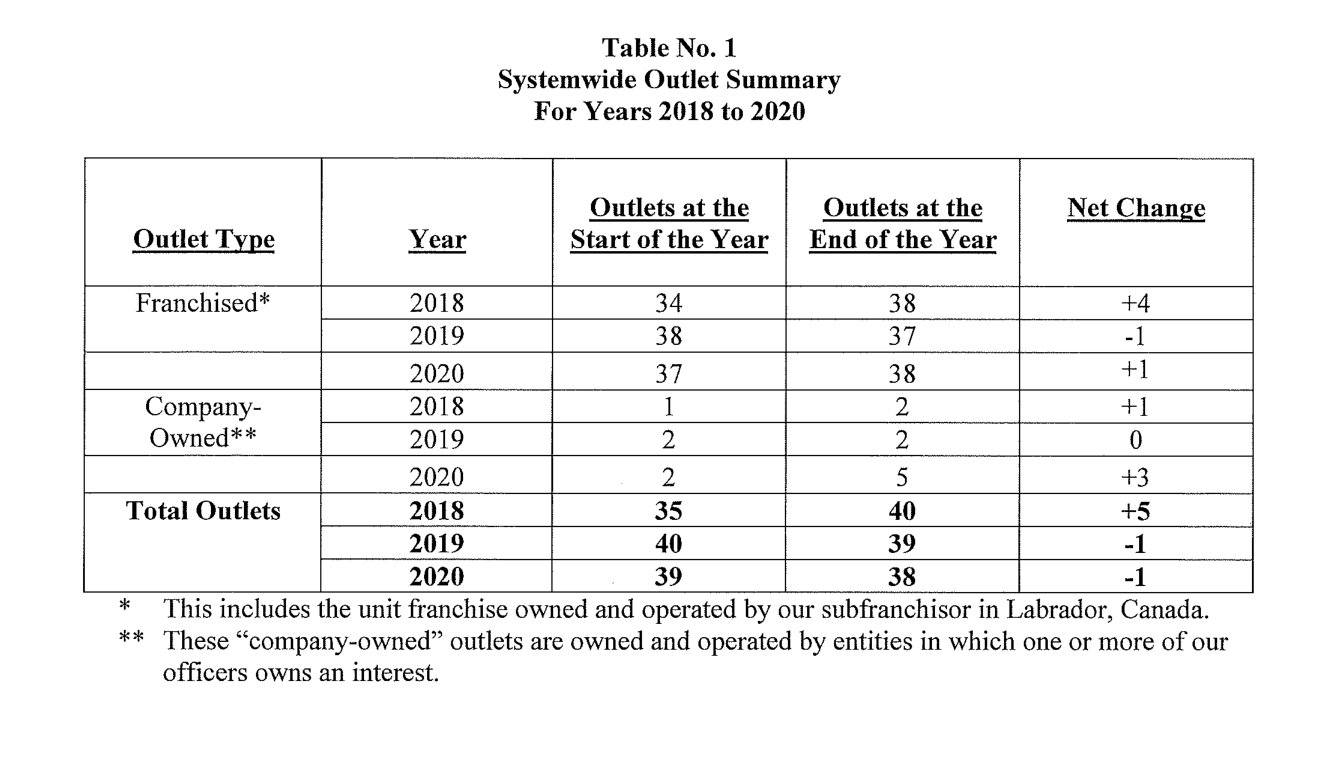 Open the full page →
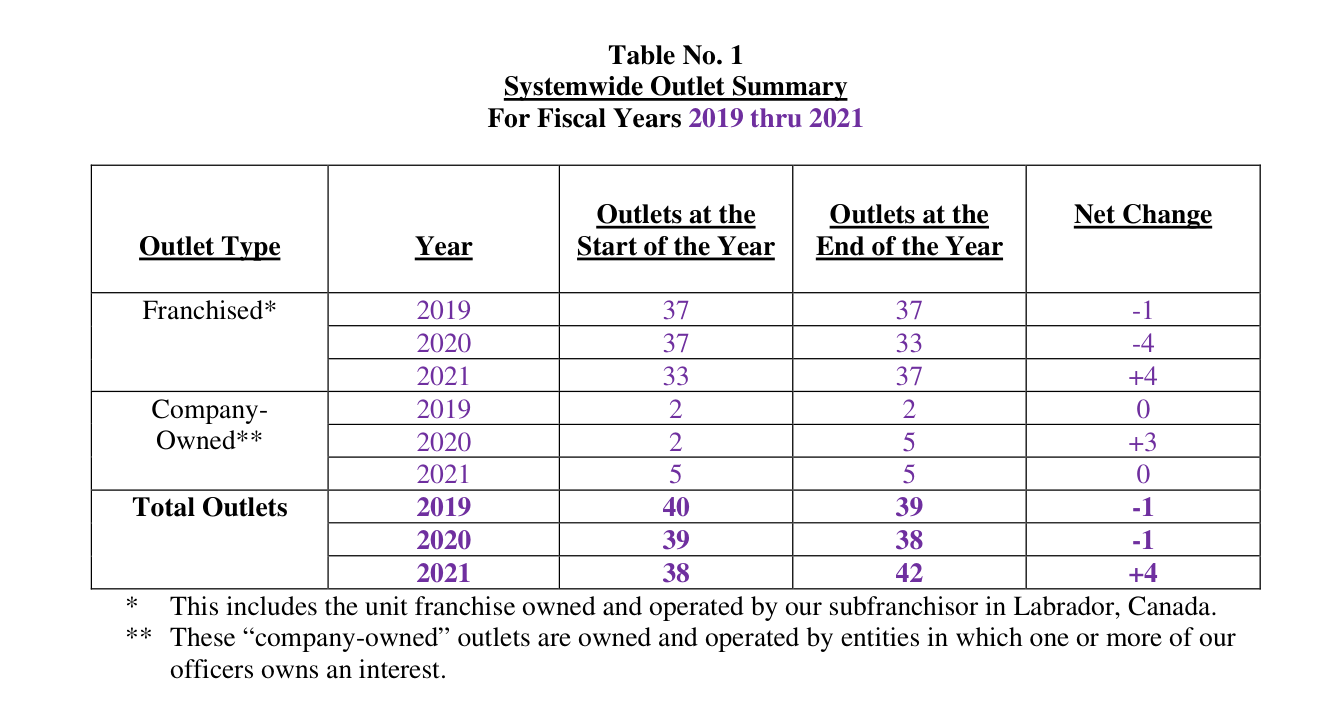 Open the full page →
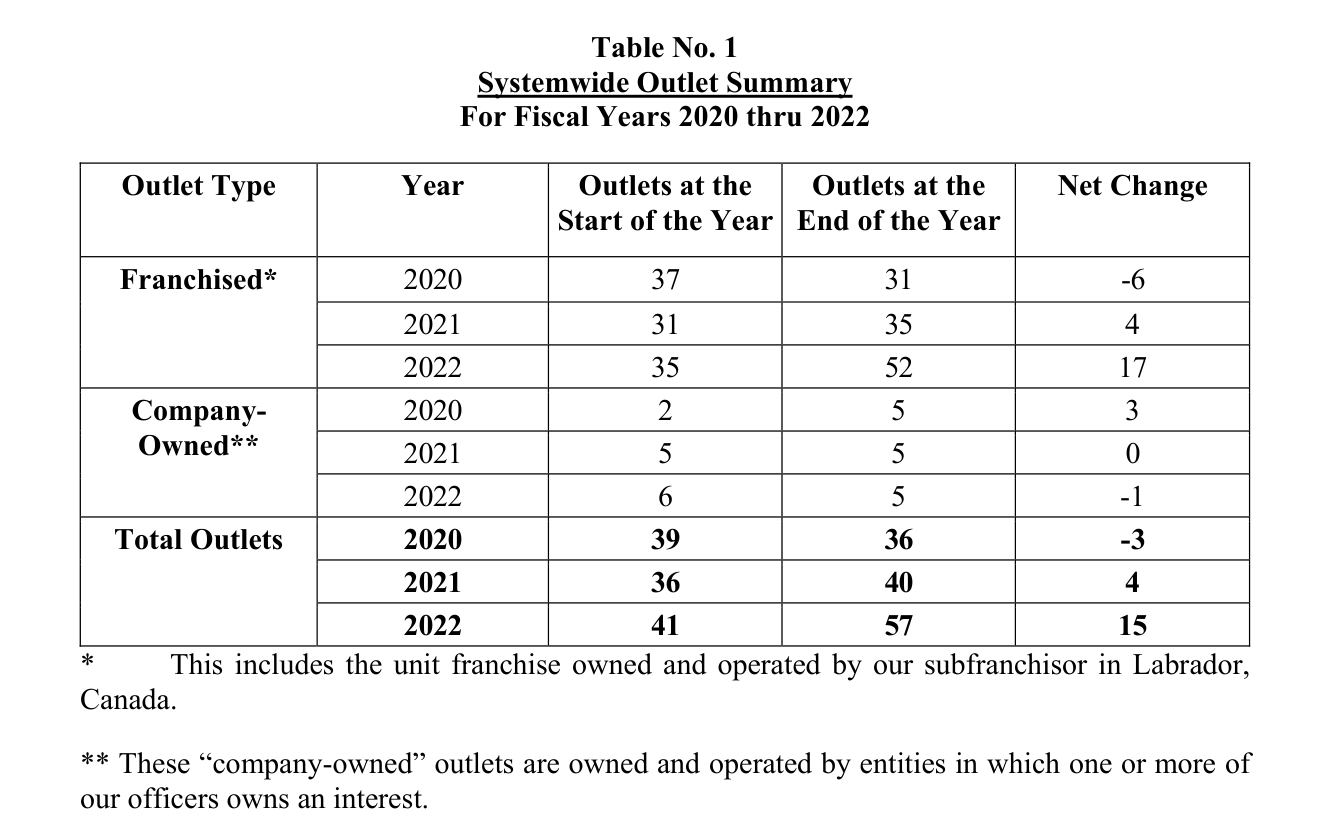 Open the full page →
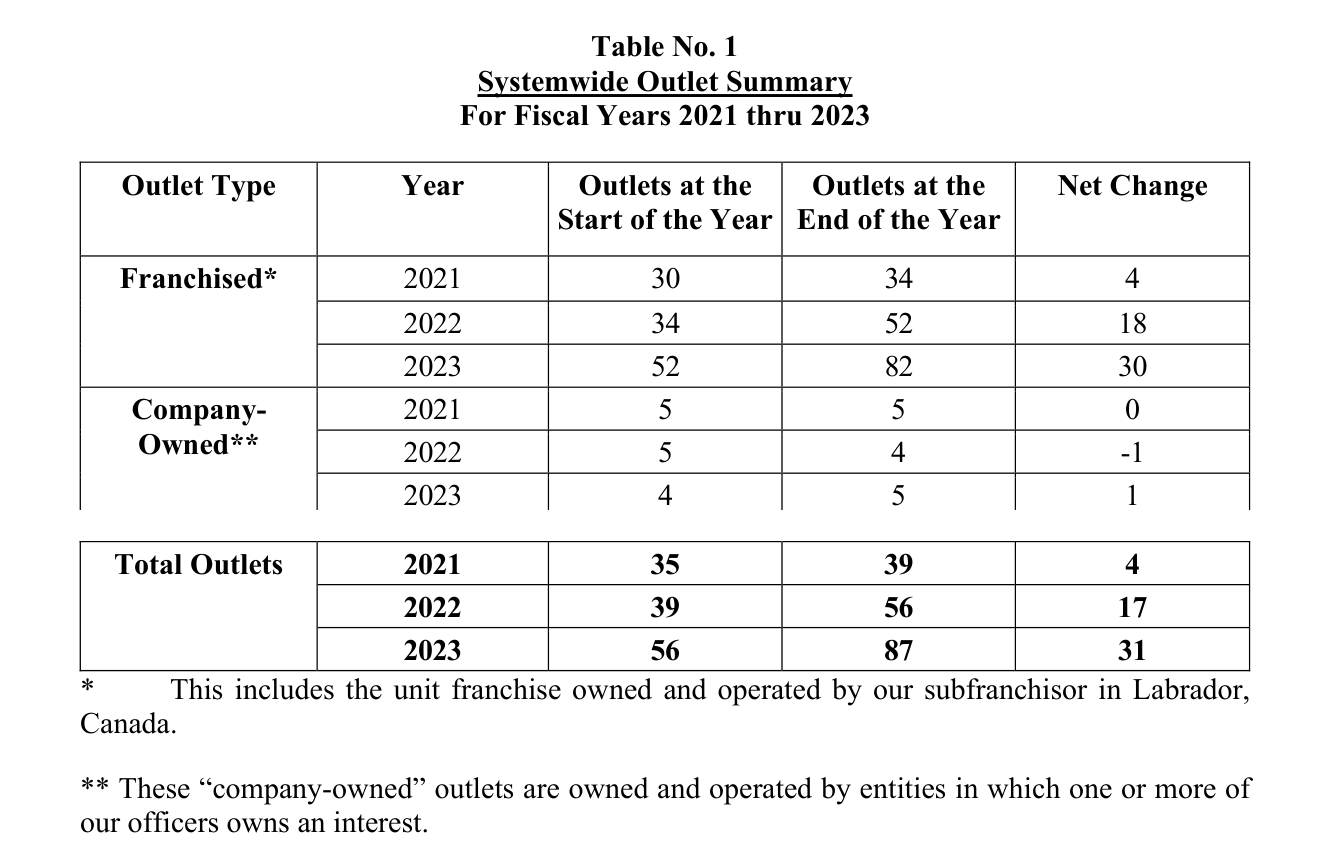 Open the full page →
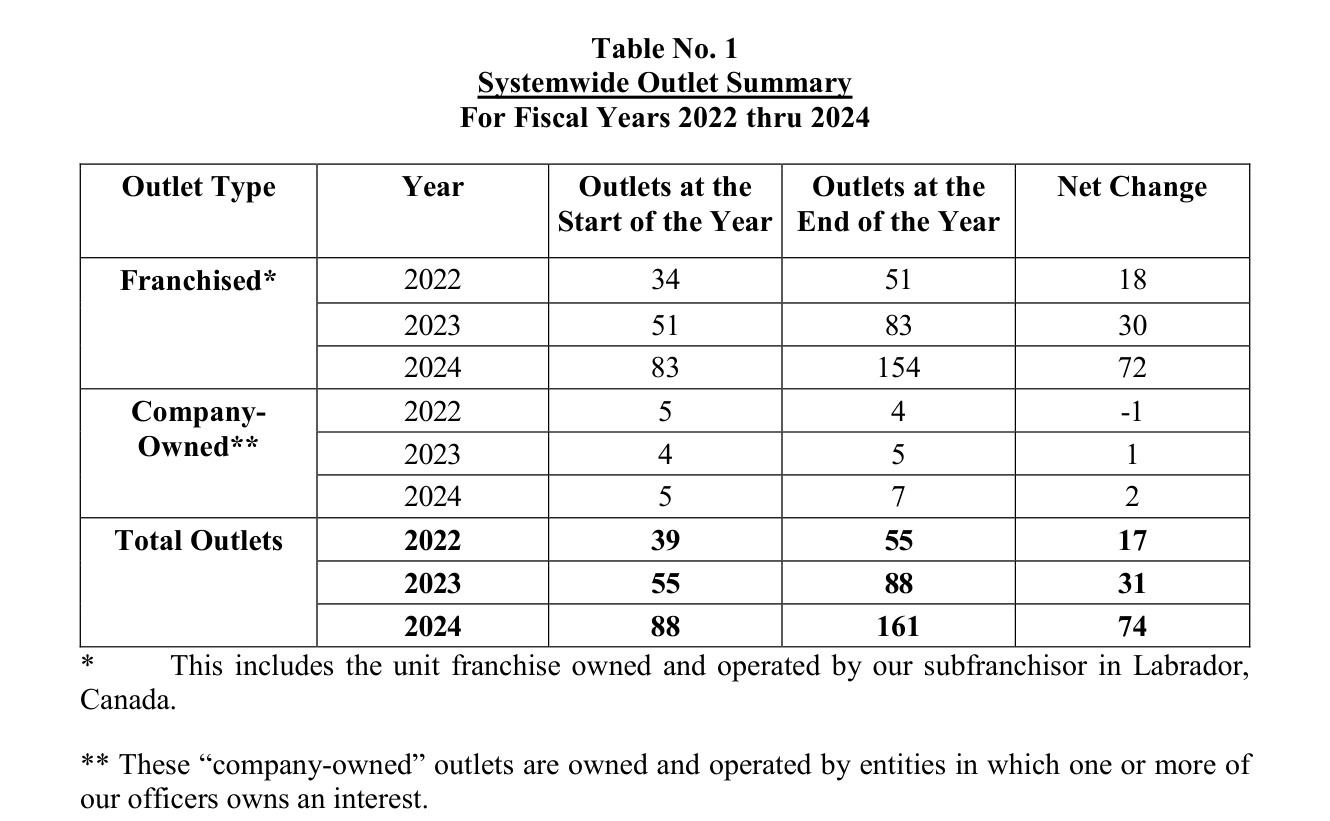 Open the full page →
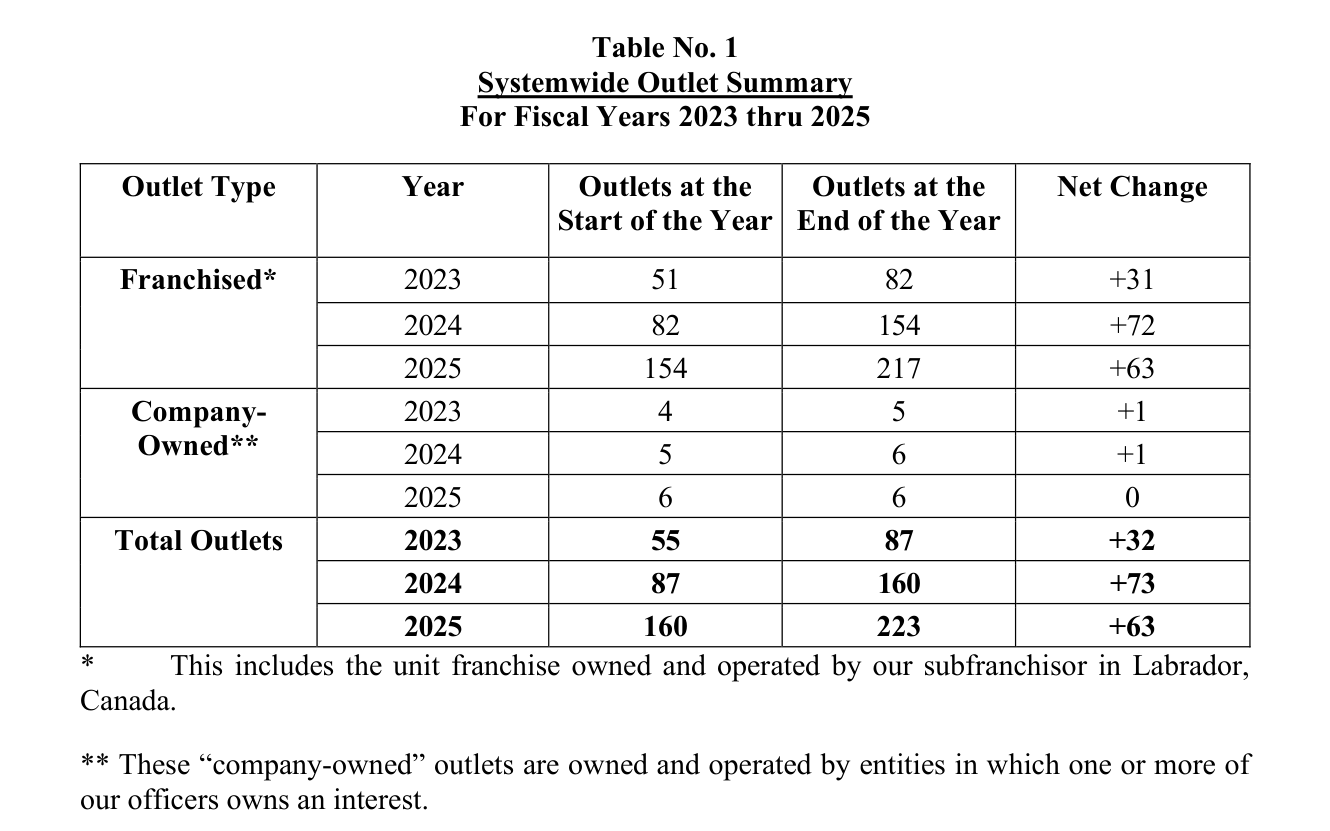 Open the full page →
 Open the full page →
 Open the full page →Open the full page →Open the full page →
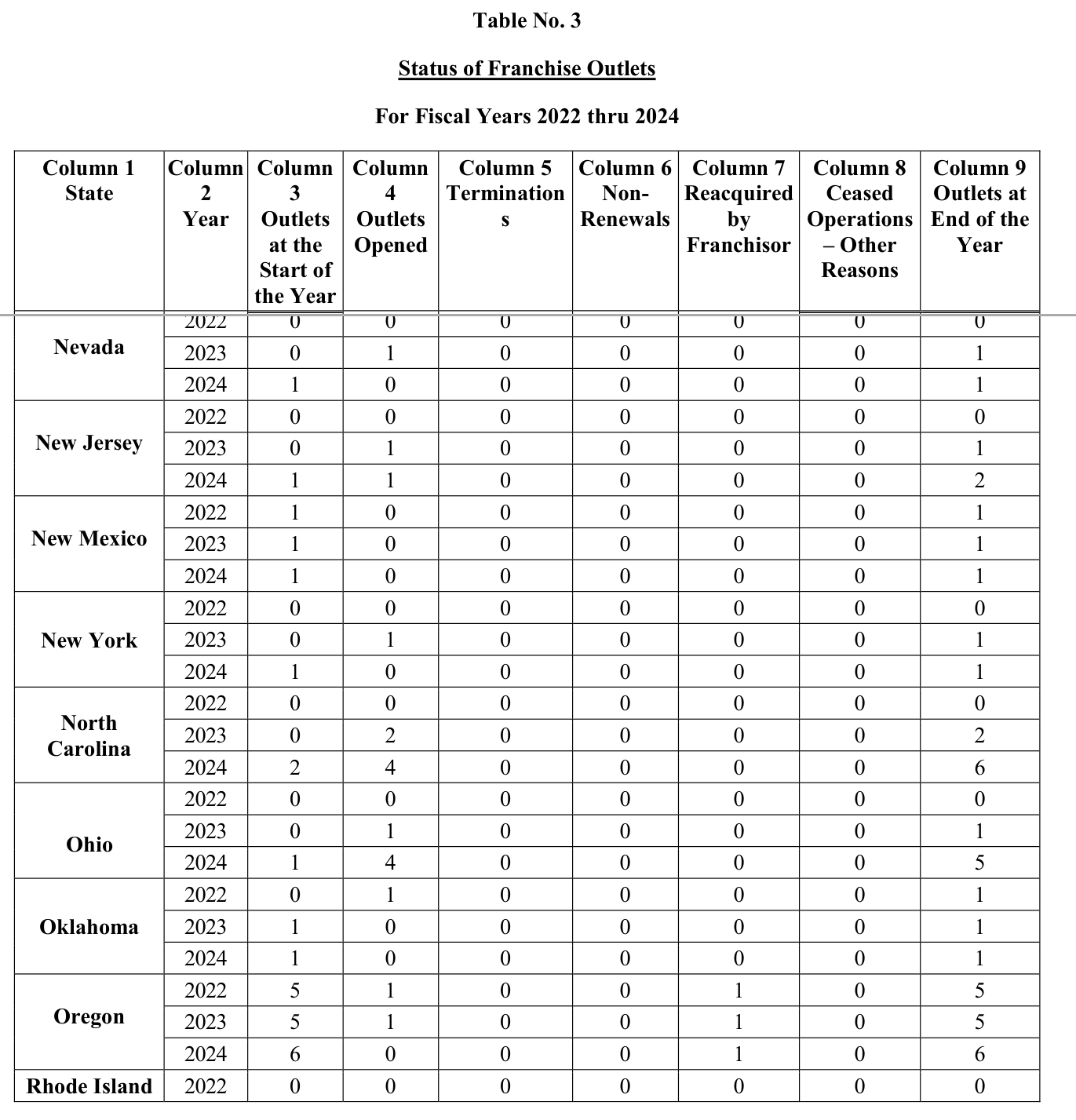
Confirmed Tables 2-4 departure counts: zero terminations and zero ceased-operations systemwide in the recent editions
The status tables are where a franchisor records how outlets leave. In the two most recent editions the answer is that, systemwide, none were terminated and none ceased operations for other reasons across fiscal 2021 through 2024. Every Column 5 and Column 8 cell reads zero. The only recorded franchised departures are two California non-renewals in fiscal 2023 and a short list of reacquisitions in Oregon and Montana. Earlier editions were not so uniform: the 2018 book recorded a fiscal 2015 Hawaii closure and a Kentucky relocation, and the 2022 and 2023 books recorded three fiscal 2019-2020 ceased-operations outlets, two of them in Texas. The recent zero-attrition picture is the representation to test against the franchisor's own Exhibit G and against the pending Cooper and Law matters. A minor drafting defect also appears: the 2024 Table No. 2 totals row is labeled 2020, 2021 and 2022 for a table headed fiscal years 2021 through 2023.
Confirmed Exhibit G “Franchisees Who Left the System” names terminated franchisees the tables report as zero, and both recent editions freeze the same stale header
Exhibit G is BAM's own list of departed franchisees, and it does not match its own tables. The 2024 exhibit places two outlets under the heading Termination, and the 2025 exhibit places three more, yet Table No. 3 in each of those same documents reports zero terminations in every state and every year. The named operators are consequential. The 2024 exhibit lists Christina Cooper of Canby, Oregon as terminated; Christina Cooper is the plaintiff, from Clackamas County, in a pending elder financial abuse action against BAM. The 2025 exhibit lists Chrystal Law and Ben Goreman [sic] of Salem, Oregon as terminated; that Salem operator is the plaintiff in the 2026 fraud in inducement suit. Compounding the mismatch, both recent editions bear the frozen caption as of December 31, 2022 while listing different people, so the exhibit is stale against the fiscal year it is meant to report. The presumption of innocence attaches to the unadjudicated suits; the documentary point is narrower, that the franchisor's terminations table reads zero while its departures exhibit names terminations.
Confirmed Exhibit H Note 2 audited franchise-information note reports “Closed during the year” as zero, contradicting Exhibit G and failing to reconcile with Table No. 1
The audited financial statements carry their own outlet census in Note 2, and it says the system closed nothing. For fiscal 2022, 2023 and 2024 the Closed during the year line is a dash in every column. That representation sits in the same bound document as an Exhibit G that names terminated and mutually terminated franchisees, and it does not reconcile with the Item 20 tables a few dozen pages earlier: Note 2 counts 157 outlets open at the end of fiscal 2024 where Table No. 1 totals 161, and 91 at the end of fiscal 2023 where Table No. 1 totals 87. The franchisee-versus-company split diverges too. The zero-closure representation is also new. The 2022 edition's audited note reported three closures in fiscal 2019. The auditor, Gilbert & Stewart, issued a clean opinion over the statements containing these notes, a fact recorded here without attributing fault. The narrow documentary finding is that three internal accounts of the same fiscal years, the outlet tables, the departures exhibit, and the audited franchise note, do not agree on whether or how outlets left.
Confirmed Store-census tie: the Oregon transfer and termination in Exhibit G resolve to a single operator (Best) who holds both the Keizer consign-in and Eugene resale-out stores
The Oregon lines in Item 20 do not read as loss so much as reassignment. Exhibit G in the 2025 filing marks the Eugene outlet as transferred to a new owner and the Salem outlet as terminated, and Table No. 3 books an Oregon reacquisition in each recent year. The 2026 Exhibit F, enumerated in the held store census, resolves both Oregon stores to a single operator, Brandon Best, and it does so at the same Eugene telephone number, 541-225-4981, that Exhibit G had attached to the transferred Eugene outlet. The Keizer store Best holds is the Salem location whose address matches the Law operator's Feb-2023 BAM security agreement. The documentary tie is therefore concrete rather than inferred: the outlet the departures exhibit calls transferred and the outlet it calls terminated end up under common ownership in the franchisor's next annual list. Characterization of that pattern as a strip or takeover is developed in other work and is not adjudicated here.
Read, nothing notable Table No. Five Projected New Franchised Outlets
Table No. Five is the projections table, listing franchise agreements signed but not yet opened and expected openings by state. The figures climb edition over edition, from a total of seven in 2018 to seventy signed-but-unopened and ninety-four projected franchised openings in 2025. Nothing in the table conflicts with the other Item 20 tables or with the exhibits, and projections of this kind are a standard component of the item. It is recorded here as read and unremarkable.
Item 21. Financial Statements
Confirmed Item 21 (Financial Statements)
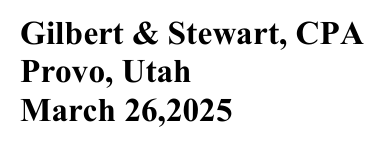
Item 21 attaches audited consolidated financial statements of BAM Franchising, Inc. and subsidiaries. Across the 2022, 2024, and 2025 editions the auditor is Gilbert & Stewart, CPA of Provo, Utah, and each report expresses an unqualified opinion, stating the statements present fairly, in all material respects, the financial position of the company in conformity with United States generally accepted accounting principles. The 2022 edition, covering fiscal year 2021, records a change of auditor: its report notes the prior consolidated statements were audited by other auditors, marking the first Gilbert & Stewart engagement. The audited balance sheets show total stockholders' equity turning negative at December 31, 2022 and widening through December 31, 2024, alongside a current-liability excess, that is negative working capital, over the same span, while the statements of operations report a net loss in each of those years. Goodwill, first recorded at $140,200 for fiscal year 2023 and $226,600 for fiscal year 2024, carries no impairment charge, and the note addressing impairment speaks only to trademarks. Deferred franchise revenue and gift-card liabilities grow into the millions. The reports contain the standard going-concern responsibility language associated with AU-C 570, yet include no separate substantial-doubt paragraph. Figures were verified against the source exhibits, and several carry evident transcription errors, noted below.
The page:
 Open the full page →
 Open the full page →
Item 22. Contracts
Confirmed Item 22 (Contracts): the attached Franchise Agreement, its approval-conditioned consignment clause, and mandatory binding arbitration
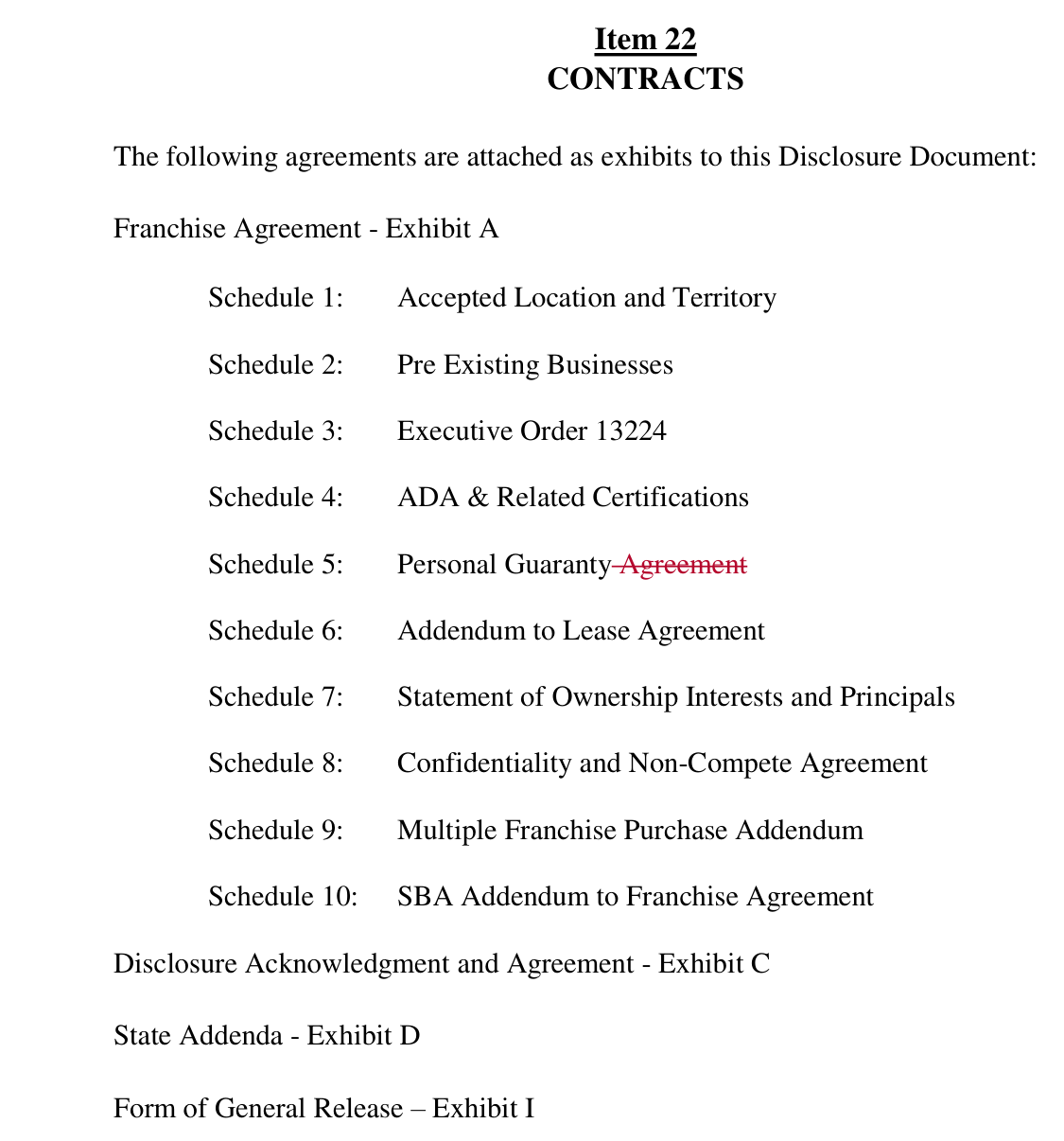
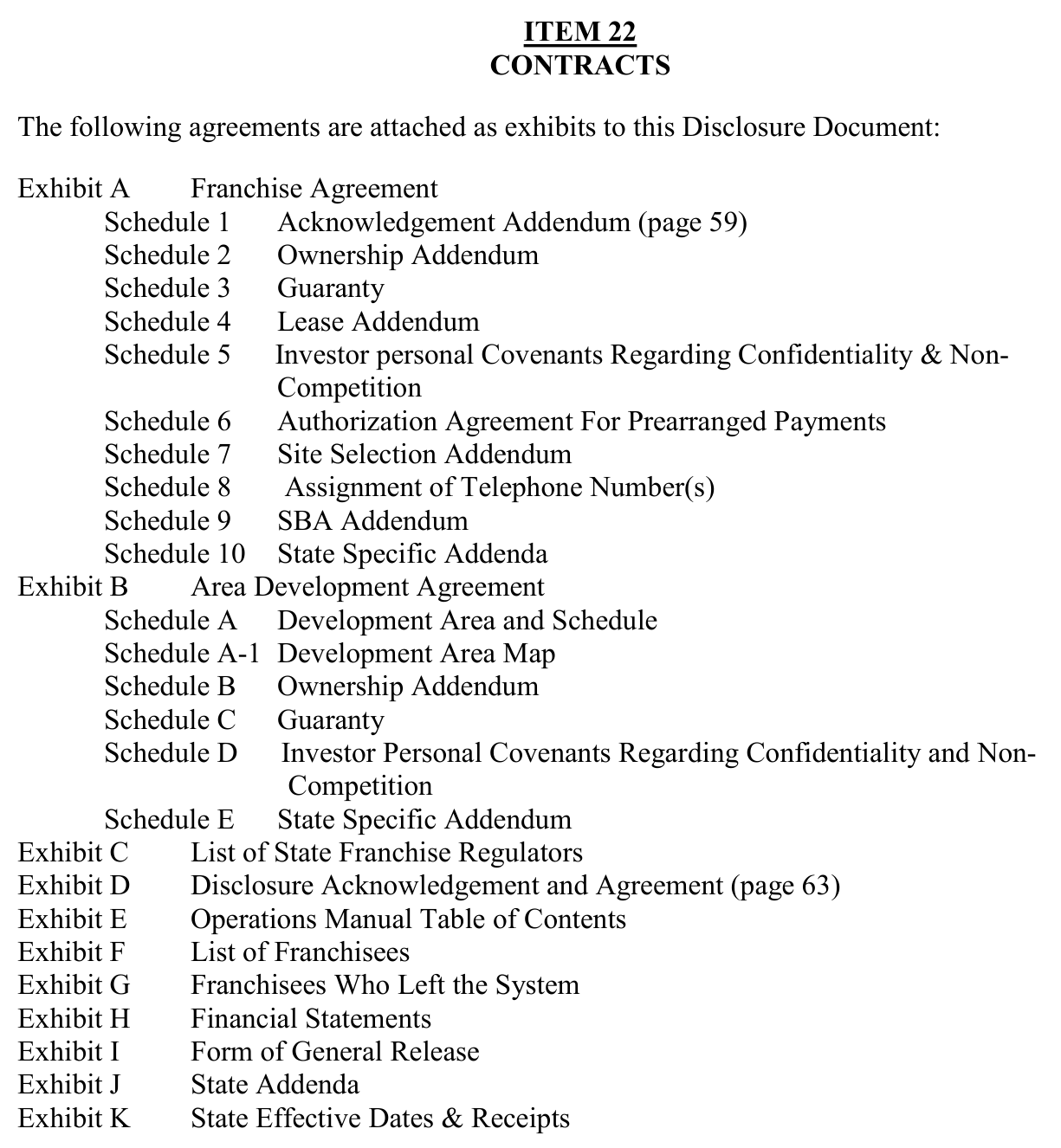
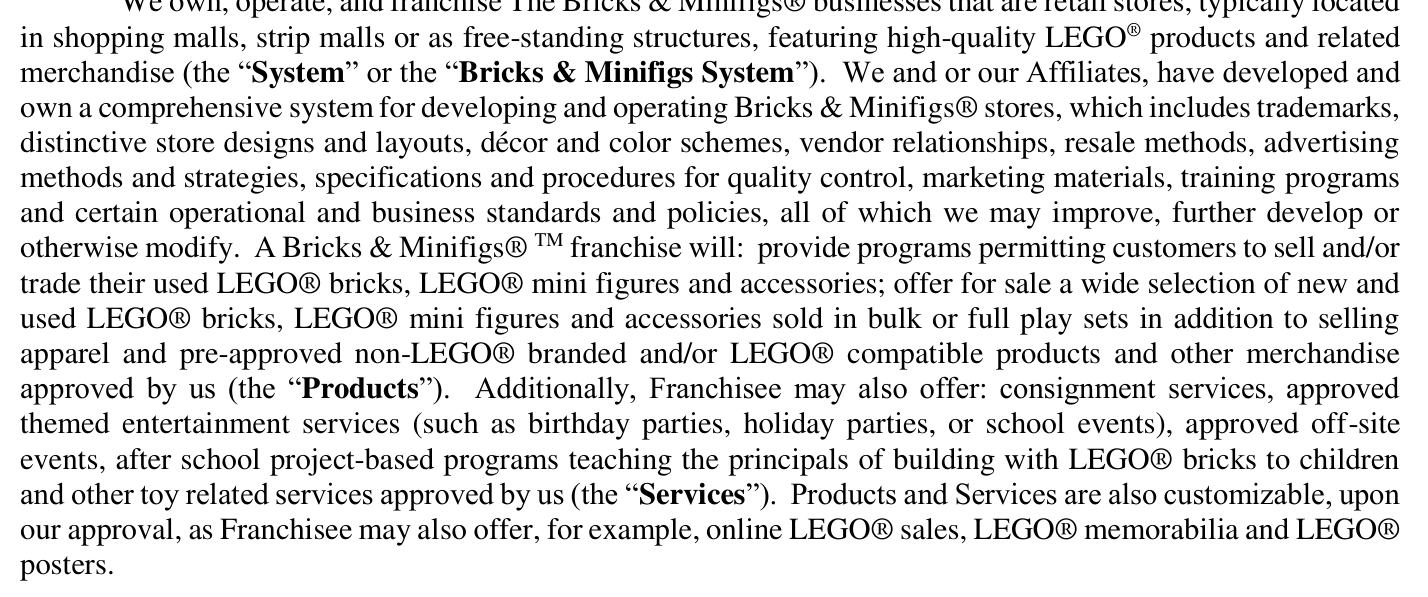
Item 22 (Contracts) is a bare index of the agreements bound into the disclosure document, and every edition read opens with the same sentence: "The following agreements are attached as exhibits to this Disclosure Document:". The 2018 edition attaches the Franchise Agreement as Exhibit A with Schedules 1 through 10, among them a "Confidentiality and Non-Compete Agreement", a "Multiple Franchise Purchase Addendum", and an "SBA Addendum to Franchise Agreement", followed by a "Disclosure Acknowledgment and Agreement - Exhibit C", "State Addenda - Exhibit D", and a "Form of General Release". Beginning with the 2022 edition the package expands: a separate "Area Development Agreement" enters as Exhibit B, and the Franchise Agreement schedules are renumbered to add an "Authorization Agreement For Prearranged Payments", a Site Selection Addendum, and an Assignment of Telephone Numbers. The 2024 and 2025 editions carry the identical arrangement. The operative instrument each edition attaches is the Franchise Agreement itself. The executed 2022 form of that agreement, filed as Exhibit B in Law/Gorman 260200029, provides at its introduction that "Franchisee may also offer: consignment services" among "other toy related services approved by us", and at Section 17 imposes "Mediation and Mandatory Binding Arbitration, Waiver of Right to Trial by Jury, Etc." seated "in Utah County, Utah". The contract disclosed under Item 22 therefore authorizes approval-conditioned consignment. The co-authored record places that text against the franchisor's public characterization of consignment as "expressly prohibited under our franchise agreements", a statement the version ledger records as filed as Exhibit G to the 2026-05-27 Verified Complaint. The matter is unadjudicated and the presumption of innocence applies.
The page in every edition held. Choose a year.
 Open the full page →
 Open the full page →
The second author, the document that answers it:
 Open the full page →
Item 23. Receipts
Confirmed Receipts
Item 23 performs as expected and carries two documentary details worth recording. The receipt names the franchisor’s designated franchise sellers, a roster led in every edition by Ammon McNeff, who the same disclosure document identifies on its cover page as President and in Item 2 as Chief Executive Officer and President, and who verifies BAM’s 2026 complaint as Chief Executive Officer and owner. The roster is not static: it lists five sellers in 2018, including Daniel McNeff, and eleven in 2025, from which Daniel McNeff is absent, while the receipt address migrates from Orem to Provo. One internal inconsistency appears within the 2025 edition itself, where the Franchisor copy of the receipt renders the seller list with an empty ",," gap that silently omits the Matthew Thomas and Reed Brimhall names carried by the matching Franchisee copy two pages later. Graded CONFIRMED as verbatim documentary content, with the seller-roster change and the intra-edition copy discrepancy noted.
The page in every edition held. Choose a year.
 Open the full page →
 Open the full page →
 Open the full page →
 Open the full page →
Sources, every image is a page from one of these: BAM Franchising, Inc. Franchise Disclosure Documents, editions 2012 through 2026, on file with state franchise regulators; the company’s verified complaint in Utah case 260402353; the Franchise Agreement filed as Exhibit B in Utah case 260200029; the Law and Gorman complaint in that case; and the Oregon, Utah, and Delaware business registries. The 1992 SEC order and the Cooper docket are cited by link and number rather than reproduced. Every page shown can be opened in full at the link beneath it.