Bryan Mansell’s damages, calculated from Bricks & Minifigs’ own spreadsheet
PRIMARY SOURCEthe sales ledger Bricks & Minifigs filed in court, published here in fullCONFIRMEDthe ledger’s own completed sales land on its High Value column, 45 percent of them to the centCONFIRMEDthe ledger’s final sale is dated November 12, 2024, two days before the takeover; it records nothing afterCONFIRMEDsummed, BAM’s own numbers put the collection at $110,455 to $122,455, and what remained at the takeover at $57,633 to $69,633CORROBORATEDan independent BrickLink market pull for every item lands in the same range, and the store sold above it
A companion to the Bryan Mansell fact-check. Call it his damages, calculated: built from a single document, the sales spreadsheet Bricks & Minifigs filed in its own lawsuit. Read on its own terms, it does two things its filer probably did not intend. It prices the collection at the store BAM seized, in BAM’s own numbers, at six figures. It timestamps the day BAM’s accounting of it ended, the day it took the store. And set against the payout rule in BAM’s own operations manual, it shows the family was paid about a quarter of what the store resold their property for.
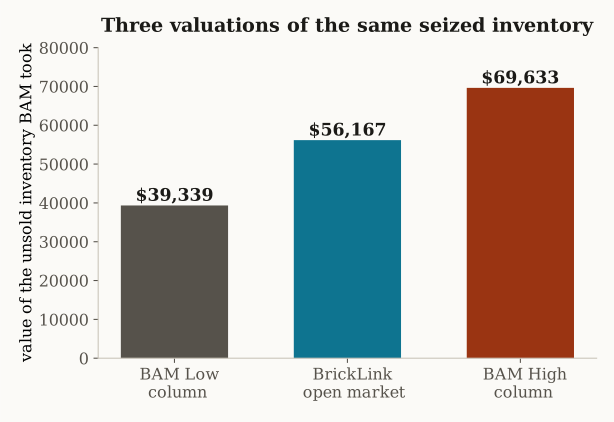
When BAM seized the Keizer store it inherited the unsold half of the Mansell collection. It later filed a spreadsheet of that inventory as Exhibit B in its Utah case. For every item that had not sold, the ledger carries two numbers: a Low Value and a High Value. Add the columns up across the whole unsold list and they are far apart: the Low column totals $31,339, the High column $49,633. Same goods, same spreadsheet, two answers eighteen thousand dollars apart. And those totals do not yet include the ledger’s two most valuable rows, which its own formatting broke out of the columns; they come later. So which one is the real price?
The ledger answers its own question
The same spreadsheet also records every item that did sell, and for those it prints both the value band and the actual sale price. That turns the document into its own answer key. The ledger records 630 sales in all; 174 of them also carry a Low and High value band, and those are the ones that can be checked against a price. We took each of those 174 and compared what it fetched to its own High column.
The result is not close. The median sale came in at 98 cents on the dollar of its High Value. In 81 of the 174 sales, 47 percent of them, the item sold at the High Value to the cent, and half of all sales landed within a nickel on the dollar of it. The “High Value” column is not an aspiration or a retail fantasy. It is the price tag, and the store’s own register proves it.
Pick rows at random and watch it happen. Three, straight from the filed pages, that anyone can check against the PDF above:
| Item in the ledger | Its Low–High band | What it sold for | When |
|---|---|---|---|
| Clone Turbo Tank | $300 – $500 | $499.99 | September 21, 2024 |
| Jedi Scout Fighter | $100 – $200 | $199.99 | August 5, 2024 |
| General Grievous Wheel Bike | $130 – $150 | $149.99 | April 27, 2024 |
| Set | Item | Low | High | Sold for | Date |
|---|---|---|---|---|---|
| 8098 | Clone Turbo Tank | $300 | $500 | $549.99 | Oct 31, 2023 |
| 8098 | Clone Turbo Tank | $300 | $500 | $499.99 | Sep 21, 2024 |
| 8098 | Clone Turbo Tank | $300 | $500 | unsold | — |
Which settles the eighteen-thousand-dollar question. Valued at the column the store’s own sales actually realize, the unsold Mansell inventory BAM took is worth about $49,633, at BAM’s own prices, in BAM’s own filing, before its two most valuable rows are counted at all. The Low column is the number you would reach for if you wanted the collection to sound small.
The ledger’s own calendar
The spreadsheet also keeps time, and its clock may be the most damning thing in it. The first sale it records is dated September 22, 2023, the opening day of Rose City Comic Con, where the family’s trial batch debuted. From there it runs continuously for almost fourteen months: 630 dated, ticketed sales, $52,822 in all. The last row is dated November 12, 2024.
Two days later the company seized the store, and the ledger goes silent. Not one sale of the family’s items appears in it after that date. Yet the items kept selling: over the following year they resurfaced at the same operator’s Eugene store, booked into that register as anonymous walk-in trades. So the document BAM filed does something it probably did not intend. It fixes the exact date its own accounting of this family’s property stopped: the day it took the store. Everything sold before that day is itemized to the ticket number. Everything after it happened off this ledger.
The two most valuable rows
| Set | Item | Low | High | Status |
|---|---|---|---|---|
| 10123 | Cloud City | $4,000 | $10,000 | unsold · layaway |
| 10123 | Cloud City | $4,000 | $10,000 | unsold |
| 10188 | Death Star UCS | $800 | $1,000 | sold $1,000.00, the ledger’s single largest ticket |
Two lines in the ledger sit far above the rest. Both are the same set, the 2003 Cloud City, and BAM values each one at $4,000 to $10,000 in its own High-and-Low columns. Because the file’s own formatting burst those cells, they sit outside the column totals above: whatever the collection was worth, it was $49,633 plus these. One of the two is flagged, in the spreadsheet, as a layaway: a purchase a customer was still paying off when the record stops. When Bryan told the Keizer police chief the store had kept a set “worth over 10 grand,” he was not guessing. He was reading BAM’s own number back to them.
The bottom line, in their numbers
Since the High column is the price and the ledger is the record, the arithmetic can be finished. Every figure below comes from the one document BAM filed.
| What | BAM’s own figure | Grade |
|---|---|---|
| Sold through the store’s register, September 2023 to November 12, 2024 | $52,822 realized | CONFIRMED their dated, ticketed rows; a floor |
| Still unsold when BAM took the store, at the High column its sales realize | $49,633 | CONFIRMED the column their own sales prove out |
| The two Cloud City sets, at BAM’s own bands | $8,000 – $20,000 | ASSERTED their bands; no sale that size to calibrate |
| The collection, through BAM’s own ledger | $110,455 – $122,455 | arithmetic on the rows above |
| In the building the day BAM seized it | $57,633 – $69,633 | arithmetic on the rows above |
That is the point of this page. Not a collector’s appraisal, not the family’s estimate, not a YouTube title: the defendant’s own filed spreadsheet, priced at the column the defendant’s own sales prove out, sums a six-figure collection, with fifty-seven to sixty-nine thousand dollars of it in the building on the day of the takeover, and its own record of those goods ending that same day. Every future argument about what this collection was worth starts from this document, and the side that filed it is the side that took the goods.
Put the three findings together and the document reads itself: the High column is the price; the goods it prices came to about $49,633 plus the two Cloud City sets on top; and the accounting for all of it ended the day the company took it. BAM filed this spreadsheet as evidence. It is.
The independent check, and who the premium belongs to
BAM’s numbers are BAM’s, so this site checked them against an outside yardstick: the current BrickLink price guide, the standard collector-market reference, pulled for every set and every minifigure in the ledger, the six-month average of what each actually sells for peer to peer. It confirms the collection is real, six-figure property, and it says something sharper about who was owed what. Priced against the open market, the sales converge with what the store realized: on the 618 sold items with a market price, the store took in $52,822 against $55,144 of open-market value, within four percent, two independent measures of the same goods landing in the same place. By count, 73 percent sold for a little more than their individual market value; a handful of big-ticket sets sold at or below, which is why the dollars come out even. You can watch it on the timeline above: red is above market, blue below.
The unsold inventory BAM took tells the same story from the other side. At open market those goods come to about $32,836, which is essentially BAM’s own Low column, $31,339. BAM’s High column, the $49,633 it tagged them at, is the retail markup this site documented set by set, and its own sales prove the store commanded it. Whichever column you trust, the family’s 65 percent runs against a real, independently-confirmed number.
On the genuine grails the market runs higher still than BAM. The two first-issue Cloud City sets BAM valued at ten thousand dollars each sell new on the open market for $11,665 apiece, above the company’s own ceiling. Put the ordinary items at their marked-up store prices and the grails at open market and the unsold half alone lands near $54,872, inside the range BAM’s own columns give. Two methods that share no assumptions, the defendant’s filed spreadsheet and a live collector index, arrive at the same six-figure collection, with the store’s premium sitting on top.
Even by BAM’s own house rules
Bricks & Minifigs tells its franchisees, in its own operations manual, how to pay someone for their LEGO: “we typically pay up to a percentage of what we can sell items for.” The payout is pegged to resale. The manual leaves the exact percentage for each store to set, so we will not put a number in BAM’s mouth, but the shape of the rule is the company’s own: a seller gets a fraction of what the store resells the goods for.
Hold Mansell’s consignment against that rule. His contract set the fraction at 65 percent. The store’s own ledger shows it resold $52,822 of his family’s items, which at 65 percent is $34,334 owed. He received about $13,800, which is roughly 26 percent of what the store sold his property for. That is less than half of his contract, and it is thin even against the fraction-of-resale figure a store would pay a stranger who walked in off the street. By the company’s own model of what a seller is due, the number does not come close.
What we are not doing
A note on method, because the grain matters. The unit of everything on this page is a single row of BAM’s spreadsheet: one item, its two values, and, if it sold, the price and the date, every one of them entered on the store’s side of the counter. We do three things with those rows and nothing else: compare a sale to its own High value, add up columns, and take the latest date. The one inferential step on the page is pricing the unsold rows at the High column, and the document calibrates that step itself: a median of 98 cents on the dollar, and 83 cents dollar-weighted, for everything under a thousand dollars. Above that line, the two Cloud City sets and their peers, we quote the live collector market rather than extrapolate. We quote BAM’s own bands and mark them as theirs.
The core of this page is BAM’s own number, from the ledger BAM filed; the collector-market figures above are a separate, clearly-labeled independent check, not a substitute for it. The calibration covers the items that actually sold, all of them under a thousand dollars; the handful of high-value sets, the Cloud Citys included, have no completed sale to measure against, so we hold them at the company’s own bands and claim nothing more. The sale count is exact: 630 dated sales, counted line by line across the ledger’s 48 pages, summing to $52,821.74, alongside the roughly 626 unsold items that make up the rest of the document. And the split of what the family was ultimately paid, the one open question, is treated in the fact-check, not here. The pending claims are unproven and every person is presumed innocent. This is general information about a public court document, not legal advice.
Sources. The two value columns, the completed-sale prices, and the Cloud City rows are all in Bricks & Minifigs’ Exhibit B (store sales ledger, filed in Utah case 260402353), published here in full. The consignment terms are in its Exhibit A (home address redacted). Related on this site: the Bryan Mansell fact-check, the account of the takeover, and where the inventory resurfaced. Related: the average that sold the store, the same arithmetic across every band of stores.
The BAM Map is independent reporting on matters of public concern. Nothing here is a finding of any person’s guilt; the criminal charges referenced are unadjudicated and every defendant is presumed innocent. Sources are linked so readers can check the record. · Home · Map · The law · Bodycam