


The grounds, element by element
The legal scaffolding behind the case, laid out the way a brief would: 42 grounds (27 defense, 15 offense). The graded element-by-element tables are below, up front; the full per-ground reasoning sits one click away in the expandable boxes beneath them. The posture pills mark legal strength (how supportable the argument is today), a different axis from the eight-grade fact ladder used elsewhere on this site. New to the terminology? Read the plain-English guide to every legal term →
The defense, element by element
Anti-SLAPP leads. These are the defendant’s grounds, walked against their elements with candor, adverse authority disclosed as adverse. The anti-SLAPP window-forfeiture is a lost accelerant, not a lost defense; Mackey is disclosed as adverse on abuse-of-process; the “$200,000” quantum is REFUTED (~$10–20K, Chrystal/Salem not BAM corporate); the 3/11 raid is the AFPD-vs-Schneider stalking matter, a same-day coincidence. Predicate acts NOT-ESTABLISHED; every defendant presumed innocent.
The anti-SLAPP special motion, element by element (Utah UPEPA, § 78B-25-101 et seq.)
Utah’s Uniform Public Expression Protection Act lets a defendant sued over public-expression speech move to dismiss on an expedited, burden-shifting record before discovery, with mandatory fees to a prevailing movant and dismissal with prejudice. The statutory machinery below is confirmed against enrolled S.B. 18; whether each speech clause is covered and whether BAM can carry its prima-facie burden are the contestable merits questions, graded separately. Honest lead limit, stated once: no special motion appears to have been filed and the 60-day window appears forfeited, that is a lost accelerant (the stay + the motion fee-shift), not a lost defense; the First-Amendment merits and the tort counterclaims survive in any posture. The records are confirmed facts; coverage and outcome stay inference, held beside the private-vendetta reading.
| Element | Posture | The record fact, the rule, and the honest line |
|---|---|---|
| (1) Vehicle applies, public-expression speech | CONFIRMED statute; ASSERTED coverage | The movant invokes coverage; the videos/commentary on the consignment dispute and franchise practices are public-expression speech under Utah Code 78B-25-102 (UPEPA), UT ST 78B-25-102, (1)(a),(2)(c)✓. UPEPA, not the repealed CPGA, governs this post-May-3-2023 suit (Utah Code 78B-25-113 (UPEPA transitional), UT ST 78B-25-113, -113,-114✓). The TRO that triggered this is BAM v. Schneider-Mansell, No. 260402353; the suit is Verified Compl., BAM v. Schneider-Mansell, No. 260402353.How this is establishedRule → record → file. 102(1)(a) carves journalistic/literary/artistic work out of “goods or services”; the speech is consumer/franchise commentary on a ~1.3M-view platform (TRO preamble, BAM v. Schneider-Mansell, No. 260402353). Coverage is decided BEFORE the merits. Graded ASSERTED because no Utah holding yet applies UPEPA to this exact speech. Source: enrolled S.B. 18; THE_CASE_STATE §1, §8. |
| (1)(c)(i) BAM’s prima-facie burden | CONFIRMED rule; INFERENCE it fails | Once coverage attaches, the responding party (BAM) must establish a prima-facie case with competent evidence on each essential element (Utah Code 78B-25-107 (UPEPA), UT ST 78B-25-107, (1)(c)(i)✓); the prima-facie inquiry is reviewed for correctness (Mackey v. Krause, 2025 UT 37, 575 P.3d 1162, 34-38✓; Mathews v. McCown, 2025 UT 34, 575 P.3d 1114, 6, 98, 130✓).How this is establishedRule → record → file. Mackey is Utah’s first UPEPA decision, it REVERSED a denial and found public concern met. The burden flips to BAM to prove falsity/fault/damage; that it fails is INFERENCE, not adjudicated. Mackey is DISTINCT from Mathews v. McCown (cite both). Source: legal_arguments.json (upepa); Mackey/Mathews confirmed. |
| (1)(c)(ii) Merits prong (12(b)(6) / Rule 56) | CONFIRMED rule | Even if BAM clears prima facie, the movant prevails by showing failure to state a claim or no genuine issue of material fact (Utah Code 78B-25-106 (UPEPA), UT ST 78B-25-106, -106✓; Utah Code 78B-25-107 (UPEPA), UT ST 78B-25-107, (1)(c)(ii)✓). The court-as-gatekeeper posture (capable-of-defamatory-meaning is a question of law, West v. Thomson Newspapers, 872 P.2d 999, 1007-08 (Utah 1994)✓) does the work here.How this is establishedRule → record → file. 106 imports the summary-judgment record; the two-track merits prong is the same gate West applies (defamatory meaning + opinion = law for the court). CONFIRMED rule. Source: enrolled S.B. 18. |
| Self-executing stay | CONFIRMED rule; REFUTED if window forfeited | Filing stays the proceeding and discovery (Utah Code 78B-25-104 (UPEPA), UT ST 78B-25-104, (1)(a),(3)✓); hearing ≤60 days (Utah Code 78B-25-105 (UPEPA), UT ST 78B-25-105, -105✓); ruling ≤60 days (Utah Code 78B-25-108 (UPEPA), UT ST 78B-25-108, -108✓); denial appealable as of right (Utah Code 78B-25-109 (UPEPA), UT ST 78B-25-109, (1)✓).How this is establishedRule → record → file. This is the lost ACCELERANT: the stay is the value forfeited if the 60-day filing window (Utah Code 78B-25-103 (UPEPA), UT ST 78B-25-103, -103✓) lapsed, but good-cause late filing is preserved. The REFUTED pill flags the apparent forfeiture, not the rule. Source: THE_CASE_STATE §8. |
| Mandatory fees (motion-related only) | CONFIRMED rule | A prevailing movant SHALL be awarded costs, reasonable attorney fees, and expenses related to the motion (Utah Code 78B-25-110 (UPEPA), UT ST 78B-25-110, -110✓); fees are limited to work to prosecute the special motion (Aston v. Chronicle-Progress LLC, 2026 UT 7, 587 P.3d 981, 18-25✓).How this is establishedRule → record → file. Aston is first-impression: it REVERSED a ~$394K whole-case award and remanded for apportionment. UPEPA awards no damages, any punitive recovery rides a separate tort. CONFIRMED rule. Source: legal_arguments.json (upepa); Aston confirmed. |
| Coverage of the UPUAA count, predicate-by-predicate | INFERENCE (sliced) | The speech-built predicates (communications fraud, theft-by-deception) are covered and dismissible part-by-part; the non-expressive predicates (forgery, criminal simulation, deceptive-business, obstruction, extortion) are not (United States v. O'Brien, 391 U.S. 367, 376 (1968)✓; UHS of Provo Canyon, Inc. v. Bliss, 2024 WL 4279243 (D. Utah Sept. 24, 2024)✓). The seven pleaded predicates are itemized in Verified Compl., BAM v. Schneider-Mansell, No. 260402353.How this is establishedRule → record → file. A plaintiff cannot escape UPEPA by relabeling defamation as racketeering, but coverage is sliced communication-by-communication; UHS v. Bliss granted-in-part on exactly this line. INFERENCE, no Utah holding yet applies UPEPA to a racketeering count. Source: Verified Compl., BAM v. Schneider-Mansell, No. 260402353 items b–l. |
| Public-concern element | ASSERTED strong-but-contestable | Coverage turns on a content/form/context whole-record test (Snyder v. Phelps, 562 U.S. 443, 453 (2011)✓, adopted by Mackey); the consumer/franchise commentary is a strong candidate, but individual-directed crime-accusations risk the “purely private significance” boundary (Dun & Bradstreet, Inc. v. Greenmoss Builders, 472 U.S. 749, 761-63 (1985)✓; Shanley v. Hutchings, 716 F. Supp. 3d 1179, 1190-93 (D. Utah 2024)✓).How this is establishedRule → record → file. Shanley is ADVERSE/on-point: accusations against a named private party are personal attacks, not public concern. Held statement-by-statement; if a statement is private, Dun & Bradstreet opens presumed/punitive damages. ASSERTED. Source: legal_arguments.json (upepa). |
| Forum: removed to federal court | CONFIRMED removed 2026-06-26; UNRESOLVED whether Utah UPEPA applies in federal diversity | In Utah state court the special-motion/stay/fee features apply in full; Los Lobos Renewable Power, LLC v. Americulture, Inc., 885 F.3d 659, 668-73 (10th Cir. 2018)✓‘s Erie bar is inapposite (it expressly distinguished burden-shifting statutes, which UPEPA is). If removed, the interlocutory-appeal feature is the most firmly unavailable (Coomer v. Make Your Life Epic LLC, No. 23-1109 (10th Cir. Apr. 23, 2024)✓).How this is establishedRule → record → file. Los Lobos carved out burden-shifting statutes, UPEPA’s 107 shift fits, so federal availability is OPEN, not foreclosed; the bar does not arise in Utah state court at all. UNRESOLVED is contingent on a forum shift. Source: legal_arguments.json (upepa). |
The ex parte takedown order, element by element (prior-restraint doctrine + the gag)
A judicial order that forbids speech in advance and compels removal of already-published, lawfully-gathered material is the paradigm prior restraint, it bears a heavy presumption against constitutional validity, and the heavy burden of justification rests on the order’s proponent. This is the strongest, merits-independent move: it does not depend on disproving the racketeering allegations or on the UPEPA window. The order’s own text is a confirmed record fact. The challenge is scoped to the severable speech clauses 5(j)/(k) only, the conduct clauses 5(a)-(i) are conceded severable and likely to survive.
| Element | Posture | The record fact, the rule, and the honest line |
|---|---|---|
| A judicial order forbidding/compelling speech | CONFIRMED | Clause 5(j) forward-bars publishing “any false, misleading, harassing, interfering, defamatory or unlawful … content, respecting Plaintiffs”; clause 5(k) compels the published videos “be immediately removed and/or taken down.” That is a “classic example” of a prior restraint (Alexander v. United States, 509 U.S. 544, 549-51 (1993)⌖, cited only to DEFINE one). The order: BAM v. Schneider-Mansell, No. 260402353.How this is establishedRule → record → file. Alexander‘s holding REJECTED the prior-restraint claim, so it is cited for the definition only, never as pro-restraint authority. The clause text is verbatim in BAM v. Schneider-Mansell, No. 260402353 (cl. 5(j),(k)). CONFIRMED record fact. Source: TRO text; legal_arguments.json (prior_restraint). |
| Heavy presumption + heavy burden on proponent | CONFIRMED rule | Any system of prior restraint comes “bearing a heavy presumption against its constitutional validity” (Bantam Books, Inc. v. Sullivan, 372 U.S. 58, 70 (1963)✓); injunctions against publication are “the least tolerable” infringement (Near v. Minnesota ex rel. Olson, 283 U.S. 697, 713-20 (1931)✓; Nebraska Press Ass'n v. Stuart, 427 U.S. 539, 559, 570 (1976)✓).How this is establishedRule → record → file. Near‘s four narrow exceptions do not reach consumer/business criticism; the burden sits on BAM as the order’s proponent, it never made the showing. CONFIRMED rule. Source: legal_arguments.json (prior_restraint). |
| Closest factual analog, criticism of a business | CONFIRMED rule | An injunction against distributing material that criticizes a target’s business practices is an impermissible prior restraint carrying the heavy burden; fear of reputational/commercial harm does not justify it (Org. for a Better Austin v. Keefe, 402 U.S. 415, 418-19 (1971)✓).How this is establishedRule → record → file. Keefe is the on-point analog (leaflets criticizing a realtor’s business practices). The BAM order restrains exactly that consumer/business criticism. CONFIRMED. Source: legal_arguments.json (prior_restraint). |
| No falsity adjudication (pre-adjudication content bar) | CONFIRMED fact; INFERENCE fatal | The order recites only a “substantially likely to prevail” finding (para 4), no statement is adjudicated false. A speech injunction is tolerable, if at all, only after a falsity adjudication (Lothschuetz v. Carpenter, 898 F.2d 1200, 1208-09 (6th Cir. 1990)✓); Tory v. Cochran, 544 U.S. 734, 738 (2005)✓ reserved only the post-judgment question, which this ex parte TRO categorically lacks. Order: BAM v. Schneider-Mansell, No. 260402353.How this is establishedRule → record → file. The three-part defamation-injunction rule is Lothschuetz‘s controlling rationale; Tory‘s reservation reinforces, not refutes. INFERENCE that this is fatal (the strong court-decided read). Source: para 4 of BAM v. Schneider-Mansell, No. 260402353. |
| Binding Utah overlay, no notice/hearing | CONFIRMED rule | Utah requires the heavy presumption + heavy burden on the proponent, and an order restraining speech entered without notice and a hearing is invalid and was vacated (KUTV, Inc. v. Conder, 668 P.2d 513, 517-25 (Utah 1983)✓); art. I §15 is at least as protective as the First Amendment.How this is establishedRule → record → file. KUTV is the binding Utah authority for both the standard and the procedural defect; the order issued on Plaintiffs’ “Ex Parte Motion” (BAM v. Schneider-Mansell, No. 260402353; BAM v. Schneider-Mansell, No. 260402353). CONFIRMED rule. Source: legal_arguments.json (prior_restraint). |
| Ex parte posture (no impossibility-of-notice showing) | CONFIRMED fact; ASSERTED dooms 5(j)/(k) | Within First-Amendment freedoms there is no place for ex parte restraints absent a showing it was impossible to notify the opposing party (Carroll v. President & Comm'rs of Princess Anne, 393 U.S. 175, 180-81 (1968)✓); the order made no impossibility finding and issued with no bond (para 6). BAM v. Schneider-Mansell, No. 260402353.How this is establishedRule → record → file. Carroll‘s carve-out does not save this order because no impossibility showing was made; the content-removal terms are now being dissolved by joint stipulation rather than tested at a contested PI hearing. Scoped to 5(j)/(k). Source: paras 1-4, 6 of BAM v. Schneider-Mansell, No. 260402353. |
| Overbreadth / vagueness as written | ASSERTED | 5(j) sweeps non-actionable categories (“misleading,” “interfering”) and identifies zero adjudicated-false statement; 5(k) reaches any publication that “in any way relate[s]” to the dispute. Any order touching speech must be in the “narrowest terms” (Carroll v. President & Comm'rs of Princess Anne, 393 U.S. 175, 183-84 (1968)✓; David v. Textor, 189 So. 3d 871 (Fla. Dist. Ct. App. 2016)✓; Same Condition, LLC v. Codal, Inc., 2021 IL App (1st) 201187, 187 N.E.3d 1147✓).How this is establishedRule → record → file. The remedy is dissolution OR modification, do not claim the whole order is void (that invites wholesale denial). David v. Textor‘s communications-ABOUT vs. -TO line condemns 5(k). ASSERTED. Source: cl. 5(j),(k) of BAM v. Schneider-Mansell, No. 260402353. |
| Conduct/Giboney counter fails on circularity | INFERENCE (anticipatory) | The content-neutral-conduct exception (Madsen v. Women's Health Center, Inc., 512 U.S. 753, 763-64 (1994)✓; Schenck v. Pro-Choice Network, 519 U.S. 357, 374-80 (1997)✓) reaches physical place/manner, not content-defined gags; the speech-integral-to-conduct exception (Giboney v. Empire Storage & Ice Co., 336 U.S. 490, 498 (1949)✓) requires a SEPARATE non-speech offense and cannot be bootstrapped by defining the speech itself as the RICO predicate.How this is establishedRule → record → file. Para 1 of the complaint (Verified Compl., BAM v. Schneider-Mansell, No. 260402353) defines the “pattern of unlawful activity” to INCLUDE “the publication of false, defamatory … content”, the circularity Giboney forbids. Anticipatory (INFERENCE). Source: legal_arguments.json (prior_restraint). |
The defamation defense, element by element (Utah law + the First Amendment overlay)
In a defamation suit BAM bears the burden on every element, and the court is the gatekeeper: whether a statement is capable of a defamatory meaning, whether it is protected opinion, and whether a privilege applies are questions of law resolvable before trial. The defenses below are per-statement, not categorical. The firewall, held once: the quantified “$200,000 stolen” charge is the actionable core these defenses do not sweep away; it is stated as alleged and contestable (gross ~$107K not $200K, real gap ~$10–20K, routing principally to Chrystal Law / the Salem-Keizer franchise, never BAM corporate), and never as adjudicated.
| Element | Posture | The record fact, the rule, and the honest line |
|---|---|---|
| Elements (BAM’s burden; meaning = law for the court) | CONFIRMED rule | BAM must show a published, false, defamatory, unprivileged statement, made with the requisite fault, causing damage (West v. Thomson Newspapers, 872 P.2d 999, 1007-08 (Utah 1994)✓); capable-of-defamatory-meaning is a question of law (O'Connor v. Burningham, 2007 UT 58, 165 P.3d 1214, 1220-23✓; Hogan v. Winder, 762 F.3d 1096, 1102, 1104-06 (10th Cir. 2014)✓). Libel/slander: Utah Code Ann. § 45-2-2, UT ST § 45-2-2⌖.How this is establishedRule → record → file. O’Connor frames “no favorable inferences” at summary judgment; Hogan applies the same independent meaning assessment at 12(b)(6) and AFFIRMED dismissal. CONFIRMED rule. Source: legal_arguments.json (defamation). |
| Substantial truth (conversion sting only) | ASSERTED jury Q; REFUTED as to $200K | Truth is an absolute defense; the gist/sting need only be substantially true (Brehany v. Nordstrom, Inc., 812 P.2d 49, 57 (Utah 1991)✓; Hogan v. Winder, 762 F.3d 1096, 1108-09 (10th Cir. 2014)✓); falsity is BAM’s to prove (West v. Thomson Newspapers, 872 P.2d 999, 1007-09 (Utah 1994)✓). It defends the conversion “sting” (title stays with the consignor, Consignment Agreement §IV, BAM v. Schneider-Mansell, No. 260402353) as a jury question.How this is establishedRule → record → file. Substantial truth defends imprecision around a TRUE gist; it cannot launder a false quantified gist. The “$200,000 stolen” charge is false in amount and actor, and BAM’s own Verified Compl., BAM v. Schneider-Mansell, No. 260402353 ¶110 concedes no court/law-enforcement finding established a theft. REFUTED applies only to the $200K quantum. Source: DAMAGES_AUDIT_LEDGER §2, §4(f). |
| Opinion / rhetorical hyperbole | ASSERTED (epithets); REFUTED (quantified) | No blanket opinion privilege; protection flows from the provable-falsity requirement (Milkovich v. Lorain Journal Co., 497 U.S. 1, 18-21 (1990)✓; Utah’s totality test, West v. Thomson Newspapers, 872 P.2d 999, 1014-19 (Utah 1994)✓; Ollman v. Evans, 750 F.2d 970, 979 (D.C. Cir. 1984)⌖). Protects “We Steal From Old People,” “thief” standing alone (Keisel v. Westbrook, 2023 UT App 163, 542 P.3d 536, 31-36✓).How this is establishedRule → record → file. RainFocus Inc. v. Cvent Inc., 2023 UT App 32, 528 P.3d 1221, 26-34✓ is ADVERSE: fact-based wrongdoing accusations in a commercial-tarnishment setting are actionable, and repeating lawsuit allegations does not inoculate them, so the quantified theft/fraud accusations carry provably-false connotations the privilege does NOT protect (REFUTED for those). Source: legal_arguments.json (defamation). |
| Public concern | ASSERTED (commentary); UNRESOLVED (named-individual) | The bona-fide consumer/franchise commentary occupies the highest First-Amendment rung (Snyder v. Phelps, 562 U.S. 443, 451-53 (2011)✓; Spacecon Specialty Contractors, LLC v. Bensinger, 713 F.3d 1028, 1037-38 (10th Cir. 2013)✓), but accusations against named private individuals risk the private-attack zone.How this is establishedRule → record → file. Shanley v. Hutchings, 716 F. Supp. 3d 1179, 1190-93 (D. Utah 2024)✓ is ADVERSE/on-point. If a statement is private-concern, Dun & Bradstreet, Inc. v. Greenmoss Builders, Inc., 472 U.S. 749, 761-63 (1985)✓ opens presumed/punitive damages. Won statement-by-statement. Source: legal_arguments.json (defamation). |
| Public-figure status → actual malice | ASSERTED (BAM corporate); INFERENCE (malice wedge) | BAM (a national ~400-store franchisor) is arguably a limited-purpose public figure as to the controversy, triggering the actual-malice standard (Gertz v. Robert Welch, Inc., 418 U.S. 323, 345, 351-52 (1974)✓; Wayment v. Clear Channel Broadcasting, Inc., 2005 UT 25, 116 P.3d 271, 283-84✓; World Wide Ass'n of Specialty Programs v. Pure, Inc., 450 F.3d 1132, 1137-40 (10th Cir. 2006)✓).How this is establishedRule → record → file. Status is contested on bootstrapping, Wayment requires the controversy to PRE-exist the speech, and Hutchinson v. Proxmire, 443 U.S. 111, 135 (1979)✓ bars manufacturing-then-invoking. The narrow malice wedge is the contested “$200,000 stolen” charge restated on 5/23 AFTER BAM’s 5/21 correction (St. Amant v. Thompson, 390 U.S. 727, 731 (1968)⌖). Source: legal_arguments.json (defamation). |
| Fair-report privilege (statutory) | ASSERTED (official-action); INFERENCE (defeasible) | Utah Code Ann. § 45-2-3(4), UT ST § 45-2-3, (4)✓ privileges a fair, true, malice-free report of an official proceeding (Russell v. Thomson Newspapers, Inc., 842 P.2d 896, 902-04 (Utah 1992)✓); confined to matters “buttressed by official action.”How this is establishedRule → record → file. Conditional and defeasible, lost when the speaker asserts allegations as true (Quigley v. Rosenthal, 327 F.3d 1044, 1067-68 (10th Cir. 2003)✓; Seegmiller v. KSL, Inc., 626 P.2d 968, 977 (Utah 1981)✓). Anchor to the official-action items: the bench warrant American-Fork-Police-Warrant-3352981-Search-Warrant and the 6/2/2026 TRO BAM v. Schneider-Mansell, No. 260402353. Source: legal_arguments.json (defamation). |
| Fair-comment privilege (common law) | INFERENCE (trial backstop) | A qualified privilege protects opinion on a public-concern matter, based on true/privileged facts (Russell v. Thomson Newspapers, Inc., 842 P.2d 896, 902 (Utah 1992)✓; West v. Thomson Newspapers, 872 P.2d 999, 1019-20 (Utah 1994)✓).How this is establishedRule → record → file. Secondary/burden-bearing: both Utah anchors REJECTED the privilege on their facts, and Mathews v. McCown, 2025 UT 34, 575 P.3d 1114✓ holds it an affirmative defense not resolvable on the pleadings (distinct from Mackey v. Krause, 2025 UT 37). It never reaches the “$200,000” core. INFERENCE. Source: legal_arguments.json (defamation). |
The retaliation-tort counterclaims, element by element (Utah WUCP, abuse of process, interference)
These are the defendant’s affirmative counterclaims, the legal answer to a suit brought to silence. Candor controls: where the controlling authority is adverse it is disclosed as adverse. The honest posture, held once: the malicious-prosecution analog (WUCP) is sound in theory but not yet ripe, favorable termination is unmet while BAM’s suit is pending; abuse of process ripens now but is merits-exposed; tortious interference is the assertable-now claim. The record facts are confirmed; baselessness and ulterior purpose stay inference held beside the colorable-claim reading. Every defendant is presumed innocent and the suit is presumed brought in good faith unless shown otherwise.
| Element | Posture | The record fact, the rule, and the honest line |
|---|---|---|
| WUCP, favorable termination (the gating element) | UNRESOLVED not ripe | Wrongful use of civil proceedings requires (except when ex parte) that the prior proceeding terminated in favor of the defendant (Gilbert v. Ince, 1999 UT 65, 981 P.2d 841, para 19✓; Hatch v. Davis (Ct. App.), 2004 UT App 378, 102 P.3d 774, para 29✓; Puttuck v. Gendron, 2008 UT App 362, 199 P.3d 971, paras 8-10✓). BAM’s PUAA suit (Verified Compl., BAM v. Schneider-Mansell, No. 260402353) was filed 2026-05-27 and remains pending.How this is establishedRule → record → file. A jurisdictional dismissal or a settlement does not qualify; a discovery-violation dismissal can (Nielsen v. Spencer, 2008 UT App 375, 196 P.3d 616, 623-24✓). UNRESOLVED/not-ripe: file after a favorable termination (e.g., a UPEPA dismissal with prejudice). Source: Verified Compl., BAM v. Schneider-Mansell, No. 260402353 filing date. |
| WUCP, want of objective probable cause | INFERENCE contested | Probable cause is OBJECTIVE, a reasonable belief in the facts and that the claim may be valid (Gilbert v. Ince, 1999 UT 65, 981 P.2d 841, § 675✓).How this is establishedRule → record → file. Contested: BAM pleads seven enumerated PUAA predicates (Verified Compl., BAM v. Schneider-Mansell, No. 260402353) and the ex parte TRO (BAM v. Schneider-Mansell, No. 260402353) evidences some likelihood of success. Eskamani v. Auto-Owners Ins. Co., 2020 UT App 137, 476 P.3d 542, paras 18-22✓ supports (by analogy) that a partial showing does not establish probable cause for all claims, argument, not holding. INFERENCE. Source: legal_arguments.json (malpros). |
| Abuse of process, ripeness | CONFIRMED rule | Abuse of process does NOT require favorable termination or want of probable cause; it is available now, without a favorable termination, on the MISUSE of the ex parte TRO (clause 5(k)) AFTER it issued, for the PRIMARY purpose of silencing (Smith v. Vuicich, 699 P.2d 763 (Utah 1985)✓; Anderson Development Co. v. Tobias, 2005 UT 36, 116 P.3d 323, paras 65-66✓; see also Keller v. Ray, Quinney & Nebeker, 896 F. Supp. 1563, 1570-71 (D. Utah 1995)✓ (dicta, and the plaintiff there lost)).How this is establishedRule → record → file. Vuicich leads: abuse of process ripens on the post-issuance misuse of process, no favorable termination needed; Anderson held the district court erred in dismissing merely because the underlying action had not terminated, so the ripeness limb is SOUND. The merits, not ripeness, expose the claim. Source: legal_arguments.json (malpros). |
| Abuse of process, the willful act (MERITS-EXPOSED; Mackey is ADVERSE) | INFERENCE exposed | The willful act must be a perversion OF a legal process, corroborated by conduct independent of the process (Hatch v. Davis (Utah Sup. Ct.), 2006 UT 44, 147 P.3d 383, paras 36, 37, 39✓; Templeton Feed & Grain v. Ralston Purina Co., 69 Cal. 2d 461, 446 P.2d 152, 155 (1968)✓).How this is establishedRule → record → file (candor). Mackey v. Krause, 2025 UT 37, 575 P.3d 1162, paras 94-103✓ is DIRECTLY ADVERSE, it HELD the abuse-of-process claim failed and rejected the materially identical retaliation-motivated, third-party-directed theory; a platform-takedown demand is weaker than the police report Mackey rejected. So obtaining the TRO (BAM v. Schneider-Mansell, No. 260402353) is ordinary process and cannot BE the willful act. INFERENCE/exposed, disclosed, not buried. Source: Mackey holding confirmed. |
| Tortious interference (assertable now), improper means | INFERENCE contested | The tort requires intentional interference by IMPROPER MEANS causing injury, improper PURPOSE alone is abrogated (Eldridge v. Johndrow, 2015 UT 21, 345 P.3d 553, paras 14, 42-64✓; improper-means list restated in SCO Group v. IBM, 879 F.3d 1062, 1074 (10th Cir. 2018)✓).How this is establishedRule → record → file. Eldridge, not SCO Group, is the abrogating authority. Injury is anchored off the non-DMCA conduct (the suit Verified Compl., BAM v. Schneider-Mansell, No. 260402353, the TRO BAM v. Schneider-Mansell, No. 260402353); lost donations/subscription revenue are cognizable (Nunes v. Rushton, 299 F. Supp. 3d 1216 (D. Utah 2018)✓). 512(f) may preempt a DMCA-notice-only theory, unsettled. INFERENCE/contested. Source: legal_arguments.json (malpros). |
| Plaintiff’s anticipated Noerr-Pennington / sham defense | INFERENCE (high bar) | BAM would invoke Petition-Clause immunity; the sham exception needs the suit to be objectively baseless (Professional Real Estate Investors v. Columbia Pictures, 508 U.S. 49, 60-62 (1993)✓; adopted in Utah, Anderson Development Co. v. Tobias, 2005 UT 36, 116 P.3d 323✓; Searle v. Johnson, 646 P.2d 682 (Utah 1982)✓).How this is establishedRule → record → file. Probable cause is an absolute defense to the sham exception, rarely cleared at the pleading stage (Allergy Research Group v. Rez Candles, 2022 WL 1004214 (D. Utah Apr. 4, 2022)✓). The strongest counter: demands to PRIVATE crowdfunding/subscription platforms are not petitioning of a government body. INFERENCE (high bar). Source: legal_arguments.json (malpros). |
The March-11 raid, element by element (Fourth Amendment + § 1983)
Record / authentication caveat (binding on every row): this analysis rests on the dossier’s own bodycam investigation, the search warrant, its return, the co-occupant arrests, and a frame-by-frame redaction diff, all of which are the dossier’s analysis of leaked and public records that require authentication and are stated as allegations to be confirmed, not adjudicated findings. The 3/11/2026 raid is the AFPD stalking matter against the critic Schneider, a separate matter that merely shares a calendar day with the unrelated McNeff reconveyance; the “executed on the raid day” framing is retired. All allegations are unproven and every person is presumed innocent.
| Element | Posture | The record fact, the rule, and the honest line |
|---|---|---|
| Facial nexus failure (the strongest, evidence-independent ground) | ASSERTED | A warrant must establish a nexus between the items seized and the crime charged (United States v. Mora, 989 F.3d 794 (10th Cir. 2021)✓; Cassady v. Goering, 567 F.3d 628 (10th Cir. 2009)✓). Stalking (Utah Code 76-5-106.5) is a course-of-conduct fear offense with no theft/possession element, yet the warrant authorized seizing “any stolen merchandise, specifically Lego merchandise.” American-Fork-Police-Warrant-3352981-Search-Warrant.How this is establishedRule → record → file. A stalking charge cannot supply a nexus to stolen-goods seizure, a categorical failure (Mink v. Knox, 613 F.3d 995 (10th Cir. 2010)✓). The “no items seized” return corroborates the absent nexus. ASSERTED (warrant text requires authentication). Source: warrant American-Fork-Police-Warrant-3352981-Search-Warrant; THE_CASE_STATE §2. |
| Arrest-purpose defect | ASSERTED | The affidavit’s own stated purpose, “in order to affect the arrest of Benjamin Schneider”, describes a misuse: a search warrant finds evidence in a place; it is not a vehicle to effect an arrest (Zurcher v. Stanford Daily, 436 U.S. 547, 558-60 (1978)✓). American-Fork-Police-Warrant-3352981-Search-Warrant.How this is establishedRule → record → file. Zurcher: the conclusions justifying a search warrant go to the items’ connection with crime and location, not to effecting an arrest. ASSERTED (affidavit requires authentication). Source: warrant affidavit American-Fork-Police-Warrant-3352981-Search-Warrant. |
| Franks, deliberate/reckless falsehood or material omission | ASSERTED | A substantial preliminary showing that the affiant made a knowing/reckless false statement or material omission, and that a corrected affidavit would not establish probable cause, voids the warrant (Franks v. Delaware, 438 U.S. 154, 155-56, 171-72 (1978)✓; Santistevan v. City of Colorado Springs, 983 F.Supp.2d 1295 (D. Colo. 2013)✓).How this is establishedRule → record → file. Three hooks: (1) the affidavit is internally self-contradicting on date; (2) the complainant’s sworn “no court cases” assurance was false, Gorman/Mansell (Compl., No. 260200029) and BAM’s RICO suit (Verified Compl., BAM v. Schneider-Mansell, No. 260402353) were pending; (3) the MDT log indicates the footage came from the complainant’s business partner, not the credited “cooperative homeowner.” ASSERTED. Source: American-Fork-Police-Warrant-3352981-Search-Warrant, American-Fork-Police-26AF02033-Stalking-Harassment-Incident-Report. |
| Leon good-faith, foreclosed | INFERENCE | The good-faith exception is unavailable where the affidavit is so lacking in indicia of probable cause that reliance is unreasonable, or where the magistrate was misled by a Franks falsehood (United States v. Leon, 468 U.S. 897, 922-23 (1984)✓).How this is establishedRule → record → file. The “no items seized” return and the recovered “send a message” audio bear on both Leon prongs. INFERENCE, depends on the Franks showing landing. Source: bodycam redaction audit AFPD bodycam redaction audit (redacted release vs unredacted leak). |
| Co-occupants’ false arrest (cleanest, most damages-viable) | ASSERTED | A warrant to search a place does not authorize arresting persons found there; “mere propinquity” does not establish probable cause (Ybarra v. Illinois, 444 U.S. 85, 91 (1979)✓).How this is establishedRule → record → file. If the co-occupants were arrested on presence/proximity alone, that is a per-se false-arrest theory with concrete liberty-deprivation damages. The recovered ~94 min of muted audio (“letting them go cannot be an option … send a message”) is the discretion evidence. ASSERTED (audio requires authentication). Source: AFPD bodycam redaction audit (redacted release vs unredacted leak). |
| Arrest as fruit of the poisonous tree | INFERENCE | Evidence/seizure obtained by exploiting an illegality is suppressible (Wong Sun v. United States, 371 U.S. 471 (1963)✓).How this is establishedRule → record → file. The Strieff attenuation rule does not help the State (no pre-existing independent arrest warrant). Schneider’s standing turns on his overnight basement-rental status, the unproduced Airbnb reservation would settle it. INFERENCE, contingent on the warrant falling. Source: legal_arguments.json (fourth_amendment). |
| §1983 private-state joint action | ASSERTED | A private complainant who is a willful participant in joint action with the State acts under color of law (Dennis v. Sparks, 449 U.S. 24 (1980)✓); a complaining witness who actively instigates is not shielded by absolute immunity (Nielander v. Board of County Comm'rs, 582 F.3d 1155 (10th Cir. 2009)✓).How this is establishedRule → record → file. A bare crime report is not enough, but a concerted plan that substitutes the complainant’s judgment for the police’s is; the complainant is the franchisor-enterprise’s own employee, and the “send a message” audio supplies the shared object. Closest analog: Zorn v. City of Marion, 774 F.Supp.3d 1279 (D. Kan. 2025)✓. ASSERTED. Source: AFPD bodycam redaction audit (redacted release vs unredacted leak). |
| §1983 retaliatory arrest / prosecution (First Amendment) | ASSERTED | A retaliatory-prosecution or retaliatory-arrest claim requires the absence of probable cause, and the state action a private party joins under color of law (Hartman v. Moore, 547 U.S. 250 (2006)⌖ (no-probable-cause element; footnote 9 reserves pure-investigation, so pin the theory to the charging decisions); Nieves v. Bartlett, 587 U.S. 391 (2019)⌖ (retaliatory arrest requires state action + no probable cause)). Record. The empty-return warrant (#3352981, “arrested, no items seized” on a warrant to seize stolen LEGO against a no-theft stalking charge) speaks to the no-probable-cause showing; the theory is pled against Johnson and McNeff as co-conspirators acting under color of law.How this is establishedRule → record → file. Pin Hartman to the charging decisions (ftnt 9) and use Nieves for the state-action + no-PC frame; the empty warrant return (#3352981) is the no-PC record. Johnson + McNeff are pled as co-conspirators under color of law, additive to the joint-action and Ybarra rows above. ASSERTED. Source: warrant return American-Fork-Police-Warrant-3352981-Search-Warrant; AFPD bodycam redaction audit (redacted release vs unredacted leak). |
| Privacy Protection Act (claim to evaluate, suspect-exception gated) | UNRESOLVED | Privacy Protection Act, 42 U.S.C. 2000aa, 42 U.S.C. 2000aa, (a)-(b)✓ bars government search/seizure of work-product/documentary materials held for public dissemination.How this is establishedRule → record → file. The gate is the suspect exception, 2000aa(a)(1)/(b)(1): protection is stripped where there is probable cause the holder committed the related offense, and Schneider is the stalking investigation’s subject. A claim to EVALUATE, not a settled winner. UNRESOLVED. Source: legal_arguments.json (fourth_amendment). |
| Monell municipal liability (selective bodycam transparency) | INFERENCE low-probability | Municipal liability needs a policy/custom, or a final-policymaker decision / deliberate-indifference failure, that caused the injury; no respondeat superior (Monell v. Dep't of Soc. Servs., 436 U.S. 658, 690-94 (1978)✓).How this is establishedRule → record → file. The circumstantial hook is the redaction diff: ~3 hrs video blacked, 11 clips withheld, ~94 min audio muted, via the department’s own Dropbox leak (AFPD bodycam redaction audit (redacted release vs unredacted leak)). Honest limits: a single episode is not a “custom,” a records officer is not a “final policymaker,” and over-redaction may reflect ordinary records management. Low-probability absent a documented custom. INFERENCE. Source: AFPD bodycam redaction audit (redacted release vs unredacted leak). |
The fraudulent-transfer badges, element by element (Utah UVTA § 25-6-202)
Utah’s voidable-transactions statute lets a factfinder infer actual intent to hinder creditors from a confluence of these “badges of fraud”, the badge cluster is the proof, not a single smoking-gun document. The records below are confirmed facts; the badge characterization and the underlying intent stay an inference, held beside the innocent estate-planning reading. No summed dollar figure is asserted; the documented losses stay modest and itemized.
| Badge (§ 25-6-202(2)) | Posture | The record fact, and the honest line |
|---|---|---|
| (a) transfer to an insider | ADMITTED admission; Provable now | Insider-recipient is a confirmed record fact; the characterization is now the strongest UVTA lane, an insider-preference the sons themselves admit. In a note executed 1/26/2021, the obligation incurred and perfected by UCC-1 #210216749881-3 on 2/12/2021, Daniel and Legally Mine pledged 21% of Legally Mine plus operating assets to sons Ammon and Matthew securing a $1,728,000 note that appears in four court pleadings. In their Second Amended Verified Answer, sworn under criminal penalty on 2026-05-29 in the related fee suit, the sons admit the installments were processed and then payment was stopped, which defeats the no-payments-flowed reading and lets each installment be avoided as an insider preference under Utah Code 25-6-203(2) beside the 25-6-202(2)(a) insider badge. Sumsion Business Law LLC v. McNeff, Utah 4th Dist. No. 250402162✓ |
| (b) debtor retained control | CONFIRMED rename; INFERENCE intent | The same-minute 2026 OLDCO rename + Centra DBA brand handoff is a confirmed event; that control was retained is an inference, not a proven strip. Filing History LM OLDCO LLC, Reg. No. 7228976 Filing History Centra Wealth Solutions LLC, Utah business registry, entity No. 14681035 |
| (c) transfer concealed | CONFIRMED apparatus; prima facie | Captive registered agent + a non-disclosure forum + litigation timing are confirmed facts that make concealment-by-design a prima-facie read (THE_CASE_STATE), no longer merely asserted; the transfer-IN to Wize Grizzly / Centra is NOT ESTABLISHED pending subpoena. Filing History LM OLDCO LLC, Reg. No. 7228976 |
| (d) before/after being sued or threatened | CONFIRMED (tight gaps) | The two consecutive-entry property batches (2021-01-12 entries 5830-5833 ~10 days before the sons' suit; 2023-02-26 entries 11822-11824) + the OLDCO/Centra timing are confirmed; broad clustering is a moderate inference. Utah County Recorder, 2021-01-12 batch transfers to Evelyn McNeff (entries 5830-5833) Utah County Recorder, 2023-02-26 batch transfers from Evelyn McNeff (entries 11822-11824) |
| (e) substantially all assets | CONFIRMED unity; CORROBORATED char. | The chain-9 cross-debtor sweep (six entities + Daniel pledging 'all assets' at one address) is a clean unity proof; as a transfer it sits in the §25-6-304 new-value safe harbor. Utah UCC - Detail |
| (f) debtor absconded | UNRESOLVED | Not supported on this record (a single stray process-server note). Stays open. |
| (g) removed/concealed assets | CONFIRMED apparatus; CONFIRMED zero-consideration | The husk-rename + lock-up clauses are record facts; and the badge does not need a hidden infusion, the provable-NULL is itself the badge: zero value was recorded into Centra / LM OLDCO on the brand handoff, assets moved to a new husk for no recorded consideration. Whether value moved INTO the new vessels stays NOT ESTABLISHED pending subpoena (badge (c)). Filing History LM OLDCO LLC, Reg. No. 7228976 |
| (h) value not reasonably equivalent | CONFIRMED figures; INFERENCE badge (sharpened) | The dollar figures are confirmed; without appraisals the not-equivalent characterization stays an inference, but a sharpened one, a strong-inference civil-pleading grade held beside the innocent reading: it draws on the adverse inference from the unproduced 3/27/2025 Baker APA (a below-value insider resale of the repossessed Salem store) and the provable-NULL of zero value recorded into Centra / LM OLDCO. No appraisal exists, so the ultimate figure is triable. The Peterson piece is adjudicated as a §549 avoidance, not a fraud finding. BAM v. Schneider-Mansell, No. 260402353 Peterson v. Legally Mine |
| (i) insolvent / soon after | CONFIRMED | Two separate confirmed facts: BAM's FY2022 balance-sheet insolvency deepening to FY2025, audited figures that meet the objective going-concern test under a clean, unqualified opinion; and the IRS distress signal, $891,502.75 across 8 federal tax liens (FY2016-2019, all released). BAM Franchise Disclosure Document (2026) |
| (j) shortly before/after substantial debt | CONFIRMED | The cleanest survivor: the $1.728M note + acquisition notes + the MCA stack, each contemporaneous with the debt. McNeff v. McNeff, No. 2:21-cv-00048 (D. Utah)✓ Swiss Fund v. Legally Mine (CT) Docket Case History |
| (k) essential assets to a lienor then insider | INFERENCE (not fired) | The vessel exists (BAM IP Holdings, formed 7/16/2025) but the BAM mark is still registered to BAM Franchising; no USPTO assignment into the holdco has been recorded. Not yet fired. Utah business registry, entity No. 14333873 (BAM IP Holdings) Certificate of Organization BAM IP Holdings LLC, Reg. No. 5227635 |
The affirmative case, element by element
Read this as analysis, not accusation. Federal RICO and the Utah PUAA are graded NOT VIABLE, $0 racketeering dollars (fraudulent transfer is not a §1961/Utah predicate; Anza/Holmes/Hemi defeat directness); they are the mirror-image hypothetical, not a live offensive count. This grade is scoped to the FRANCHISE arena; it does not reach the PPP false-certification, platform-takedown, and concealment-money-laundering predicates the unified association-in-fact enterprise carries on The Enterprise thread. The durable engines are conversion and the UVTA. Records are CONFIRMED facts; predicate criminal acts are NOT ESTABLISHED, stated plainly; intent is an inference; damages stay modest and itemized, never a summed total. It is not that the McNeffs are racketeers, it is that they built the structure the statute was written to examine. Every defendant is presumed innocent.
Federal civil RICO § 1962(c), element by element, the mirror-image hypothetical that does NOT close
A civil RICO claim under 18 U.S.C. § 1962(c), 18 U.S.C. § 1962, (c)✓ requires (1) conduct (2) of an enterprise (3) through a pattern (4) of racketeering activity (Sedima, S.P.R.L. v. Imrex Co., 473 U.S. 479, 496 (1985)✓), plus §1964(c) standing, injury to “business or property” by reason of the violation (Holmes v. Securities Investor Protection Corp., 503 U.S. 258, 268 (1992)✓). This is analysis, not accusation, and it runs the other way from the live case, in BAM v. Schneider it is BAM that pleads the racketeering count against the critic; this table tests whether the facts the investigation actually holds could ever support an offensive federal RICO theory. The answer is no, and the answer is stated plainly: the enterprise and continuity-of-structure elements are documented, but there is no established §1961 predicate act, the only candidate dollars die on proximate cause, and fraudulent transfer is not a §1961 predicate, so the federal count is $0 racketeering dollars. Scope this table with care: it tests only the FRANCHISE-arena facts (the consigned-collection conversion, the FDD self-contradiction, the merchant-cash suits, and the property renames). On those facts alone, no closed §1961 predicate is established. It does NOT reach the enterprise’s other predicates, the PPP no-delinquency false certification, the platform-takedown wires, and the concealment money-laundering counts, which are analyzed as one association-in-fact enterprise on The Enterprise thread. Read together, those facts would support a pleadable civil-RICO theory; this franchise-only table is the narrowest slice, not the whole picture. The documented facts are CONFIRMED; the criminal characterization and intent stay an inference held beside the innocent reading; the claim is not that the McNeffs are racketeers. Every defendant is presumed innocent; no dollar figure is summed.
| Element | Posture | The record fact, the rule, and the honest line |
|---|---|---|
| (1) Enterprise, an “enterprise” (entity or association-in-fact) | CONFIRMED structure … Framing | Rule. An association-in-fact enterprise needs a purpose, relationships among the associates, and longevity to pursue the purpose (Boyle v. United States, 556 U.S. 938, 946 (2009)✓), an ongoing organization and continuing unit (United States v. Turkette, 452 U.S. 576, 583 (1981)✓). Record. Six commonly-controlled entities plus Daniel McNeff pledge “all assets” under one blanket lien at a single Orem address Utah UCC - Detail; the captive registered agent (LMRA Services) and the Tolkien-named property shells form the continuing unit Utah County Recorder, 2021-01-12 batch transfers to Evelyn McNeff (entries 5830-5833) Utah County Recorder, 2023-02-26 batch transfers from Evelyn McNeff (entries 11822-11824). Honest line. Structure and continuity-of-personnel are documented; whether this group is a RICO “enterprise” is a frame, not a finding, and a §1962(c) “person” distinct from the enterprise must still be pleaded (Cedric Kushner Promotions, Ltd. v. King, 533 U.S. 158, 163 (2001)⌖).How this is establishedRule → record → file. Boyle/Turkette set the three-part association-in-fact test; the blanket chain-9 lien Utah UCC - Detail supplies the common purpose + continuing unit. Graded structure-CONFIRMED, enterprise-status FRAME because no court has found one here. Source: THE_CASE_STATE §3. |
| (2) Conduct, operation or management | Framing … INFERENCE | Rule. A defendant must have participated in the operation or management of the enterprise itself, the operation-or-management test (Reves v. Ernst & Young, 507 U.S. 170, 185 (1993)✓). Record. Daniel J. McNeff is the credentialed architect/presenter of the marketed structure, and the 2021-02-12 21% Legally Mine pledge to the sons evidences financial control Utah UCC - Detail. As to Ammon McNeff, the operation-or-management showing is stronger still: on the ClutchPower interview he is introduced as “the CEO of BAM” and does not correct it (an adoptive admission of control, FRE 801(d)(2)) and says the franchise Operations Manual is modifiable “in our sole discretion” Reves v. Ernst & Young, 507 U.S. 170, 185 (1993)✓; he also signed BAM’s Delaware certificate of merger as president. That is direction of the enterprise’s affairs, not service to it. Legally Mine is a separate axis: Daniel owns and ran it, and Ammon is not claimed to have run the asset-protection firm. Honest line. Operation/management is arguable for Daniel as architect and is a straightforward showing for Ammon on his own on-tape control admission; each binds on his own axis, and neither brother’s scienter stands in for the other’s. Outside-advisor status is insufficient under Reves, which is exactly why the on-camera control language matters.How this is establishedRule → record → file. Reves requires a hand in directing the enterprise’s affairs; Daniel’s architect role + the 21% pledge Utah UCC - Detail are one hook, and Ammon’s on-tape “CEO of BAM” / “sole discretion” admission + the DE-merger signature are the stronger one. INFERENCE for Daniel, on-tape control admission for Ammon; still not a finding of an enterprise here. Source: THE_CASE_STATE §3. |
| (3a) Pattern, relatedness | Needs facts | Rule. Predicates are “related” if they share purposes, results, participants, victims, or methods (H.J. Inc. v. Nw. Bell Tel. Co., 492 U.S. 229, 240 (1989)✓). Record. A research pass treats the consumer arbitrations, the Ohio UPL matter, the father-sons war, the MCA suits, the property rotation and the renames as one related pattern, on the theory that engineered separateness is itself evidence of relatedness. Honest line. Relatedness is SUPPORTABLE-NOW on the pattern prong; the engineered separateness is itself evidence of the pattern.How this is establishedRule → record → file. Under H.J. Inc., the related matters plead as one pattern. NEEDS-FACTS. |
| (3b) Pattern, continuity | REFUTED open-ended … Framing | Rule. A pattern needs continuity, a closed period of repeated conduct or an open-ended threat (H.J. Inc. v. Nw. Bell Tel. Co., 492 U.S. 229, 241-42 (1989)✓). Record. The candidate matters resolved serially and pre-merits: Swiss withdrawn, Castle discontinued with prejudice, DIB settled, the SBA/PPP suit voluntarily dismissed. Honest line. On the MCA-only slice the same serial-resolution fact that zeroes the MCA dollars actively undercuts open-ended continuity; continuity is the weakest prong there, not a strength, and stays REFUTED for that slice. Scope matters: under the unified frame, continuity is carried by the multi-victim franchisee class and anchors on H.J. Inc. v. Nw. Bell Tel. Co., 492 U.S. 229 (1989)✓, Torwest DBC, Inc. v. Dick, 810 F.2d 925 (10th Cir. 1987)✓, and United States v. Bergrin, 650 F.3d 257 (3d Cir. 2011)✓, with the single-target continuity bars distinguished (see The Enterprise thread).How this is establishedRule → record → file. Serial pre-merits resolution (DAMAGES_AUDIT_LEDGER §3) is the opposite of a continuing threat on the MCA-only slice; open-ended continuity REFUTED there. Under the unified multi-victim frame it anchors on H.J. Inc. + Torwest + Bergrin. Source: DAMAGES_AUDIT_LEDGER_2026-06-20 §3. |
| (4) Racketeering activity, the predicate acts | UNRESOLVED, NOT ESTABLISHED | Rule. “Racketeering activity” is the closed §1961(1) enumeration (18 U.S.C. § 1961, 18 U.S.C. § 1961, (1)✓); fraudulent transfer is not on the list. Candidate predicates, each graded. Wire/mail fraud (the FDD Item 3 litigation contradiction, BAM Franchise Disclosure Document (2026)): transmission CONFIRMED, but scienter unproven and no completed reliance/loss, NOT ESTABLISHED. Money laundering / the husk-shed (the same-minute OLDCO rename + Centra DBA handoff Filing History LM OLDCO LLC, Reg. No. 7228976 Filing History Centra Wealth Solutions LLC, Utah business registry, entity No. 14681035): apparatus CONFIRMED, but no proven specified-unlawful-activity proceeds moved , NOT ESTABLISHED. Extortion (the pleaded demand): pleaded against non-defendants on a colorable claim-of-right, NOT ESTABLISHED. Honest line. Zero adjudicated predicate acts exist. This is the element the offensive federal theory fails on; stated plainly, not hedged.How this is establishedRule → record → file. §1961(1) is a closed list; none of the candidate acts has the scienter + completed-harm a charge needs. Transmission/apparatus are CONFIRMED (BAM Franchise Disclosure Document (2026) Filing History LM OLDCO LLC, Reg. No. 7228976 Filing History Centra Wealth Solutions LLC, Utah business registry, entity No. 14681035); the crimes are NOT ESTABLISHED. Source: THE_CASE_STATE §5A. |
| (5) Proximate cause, §1964(c) “by reason of” | REFUTED, the defeater | Rule. RICO standing requires a direct relation between injury and violation, Holmes first-step directness (Holmes v. Securities Investor Protection Corp., 503 U.S. 258, 268-70 (1992)✓); intervening business decisions break the chain (Anza v. Ideal Steel Supply Corp., 547 U.S. 451, 457-61 (2006)✓); attenuated multi-step causation fails (Hemi Group, LLC v. City of New York, 559 U.S. 1, 9-11 (2010)✓). Record. Every live injury traces to a facially lawful act, the Article-9 repossession, the contract termination, not to a predicate act. Honest line. Even if a predicate existed, Anza/Holmes/Hemi defeat directness; the consignment/contract injuries are state-law harms, not RICO injuries.How this is establishedRule → record → file. The injuries route through lawful Article-9 self-help, not a predicate, the Anza intervening-decision bar. Directness REFUTED. Source: DAMAGES_AUDIT_LEDGER §4(d). |
| (6) §1964(c) standing / injury to business or property | CONFIRMED small state-law injury; $0 RICO | Rule. Standing needs concrete injury to “business or property” (18 U.S.C. § 1964, 18 U.S.C. § 1964, (c)✓); a recent decision confirms business/property injury flowing from a personal injury can qualify (Medical Marijuana, Inc. v. Horn, 604 U.S. 593 (2025)⌖). Record. Documented injury is modest and itemized: Mansell conversion ~$10–20K net (gross collection ~$107K, never $200K) BAM v. Schneider-Mansell, No. 260402353 Verified Compl., BAM v. Schneider-Mansell, No. 260402353, plus a contested proceeds-owed line running principally to Chrystal Law / Salem-Keizer. Honest line. Damages exist but are state-law and small; fraudulent transfer contributes $0 RICO dollars; the adjudicated victim dollars (Peterson $7,800, satisfied; FTC/iMall $4M, 1999, different enterprise) are stated individually, never summed. Separately, and outside this franchise-only mirror table, one ripe fixed-dollar franchisee injury exists as the co-plaintiff standing hook for the enterprise frame: LIPT Oak Grove POC 13-1 in In re Klima, Bankr. E.D. Tex. No. 20-40192, a $181,154.81 personal-guaranty claim. That supplies a different direct-injury plaintiff (a franchisee, not the journalist), and it does not cure this table’s directness bar; Klima is excluded from the serial-gag-litigation continuity list (adjudicated good-faith on the litigation axis) and is used only for the ripe-guaranty injury.How this is establishedRule → record → file. The “$200,000” is REFUTED (2023 in-store promo valuation); the real gap is ~$10–20K net BAM v. Schneider-Mansell, No. 260402353, part routing to Chrystal/Salem not BAM corporate. The ripe Klima guaranty ($181,154.81, In re Klima 20-40192) is a separate franchisee co-plaintiff hook for the enterprise frame, not a cure for the journalist’s directness, and is kept off the continuity list. Stated itemized, never summed. Source: DAMAGES_AUDIT_LEDGER §2, §2A. |
Utah PUAA (Title 76, Ch. 17), element by element, the state-RICO parallel, recodified
Utah’s Pattern of Unlawful Activity Act is the state-RICO twin, recodified effective May 7, 2025 from the old §§76-10-16xx into Title 76, Chapter 17 (Utah Code § 76-17-401 (formerly 76-10-1602), UT ST 76-17-401, (formerly 76-10-1602)✓). It tracks federal RICO and Utah courts apply federal precedent to it. Records are CONFIRMED; predicate criminal acts are NOT ESTABLISHED and marked as such; intent is an inference. The PUAA is broader than federal RICO on injury but does not rescue the missing predicate. No dollar is summed.
| Element | Posture | The record fact, the rule, and the honest line |
|---|---|---|
| Enterprise | CONFIRMED structure … Framing | Rule. PUAA “enterprise” tracks Turkette; Utah requires the same association-in-fact showing (State v. Hutchings, 950 P.2d 425, 428-30 (Utah Ct. App. 1997)✓). Record. Same chain-9 unity + captive-agent infrastructure as the federal table Utah UCC - Detail Utah County Recorder, 2021-01-12 batch transfers to Evelyn McNeff (entries 5830-5833). Honest line. Documented as structure; “enterprise” status is a frame.How this is establishedRule → record → file. Utah adopts the federal association-in-fact test (Hutchings); the chain-9 lien Utah UCC - Detail is the record. Structure-CONFIRMED, status-FRAME. Source: THE_CASE_STATE §3. |
| Conduct + person/enterprise distinctness | Framing | Rule. Under the conduct theory the “person” must be distinct from the “enterprise” (State v. Hutchings, 950 P.2d 425, 428-30 (Utah Ct. App. 1997)✓; Roberts v. C.R. England, Inc., 318 F.R.D. 457, 488-90 (D. Utah 2017)✓); distinctness is not required under (2)(a)/(b). Record. Multiple distinct entities + Daniel as conductor Utah UCC - Detail. Honest line. A multi-actor association ordinarily satisfies distinctness at the pleading stage; the corporate-family/alter-ego distinctness question is unsettled in the Tenth Circuit.How this is establishedRule → record → file. The distinctness rule (Hutchings/Roberts) applies only to the conduct theory; the family-alter-ego variant is first-impression. FRAME. Source: legal_arguments.json (rico). |
| Pattern, relatedness + 5-year window | Needs facts | Rule. PUAA relatedness mirrors H.J. Inc.; acts must be related within 5 years (Utah Code § 76-17-401, UT ST 76-17-401, (2)✓; H.J. Inc. v. Nw. Bell Tel. Co., 492 U.S. 229, 240 (1989)✓). Record. Same engineered-separateness research thread. Honest line. SUPPORTABLE-NOW on relatedness (the pattern prong).How this is establishedRule → record → file. Same relatedness theory as the federal table; the statute is freshly recodified to Title 76, Chapter 17. NEEDS-FACTS. |
| Continuity | Framing · weak | Rule. Pattern requires more than an isolated incident (Holbrook v. Master Protection Corp., 883 P.2d 295, 302 (Utah Ct. App. 1994)✓). Record. Serial pre-merits resolutions. Honest line. Same continuity weakness as federal RICO on the MCA-only slice; under the unified frame continuity is carried by the multi-victim franchisee class (H.J. Inc. + Torwest + Bergrin), analyzed on The Enterprise thread.How this is establishedRule → record → file. The MCA suits resolved pre-merits (DAMAGES_AUDIT_LEDGER §3), no continuing course proven on that slice; the unified multi-victim frame carries continuity elsewhere. FRAME/weak. Source: DAMAGES_AUDIT_LEDGER §3. |
| Unlawful-activity predicate (enumerated, particularity) | UNRESOLVED, NOT ESTABLISHED | Rule. “Unlawful activity” is a closed Utah enumeration (Utah Code § 76-17-401, UT ST 76-17-401, (4)✓); defamation/harassment/interference are not predicates (Walker v. Beaumont Indep. Sch. Dist., 938 F.3d 724, 735 (5th Cir. 2019)✓); the elements “shall be stated with particularity against each defendant” (Utah Code § 76-17-403, UT ST 76-17-403, (7)✓). Record. The same FDD/husk-shed/demand candidates, transmission/apparatus confirmed, scienter and completed harm unproven BAM Franchise Disclosure Document (2026) Filing History LM OLDCO LLC, Reg. No. 7228976. Honest line. No enumerated predicate is established; this is where the offensive PUAA theory fails, stated plainly.How this is establishedRule → record → file. The closed Utah list excludes speech torts; the candidate acts lack scienter + harm. NOT ESTABLISHED. Source: THE_CASE_STATE §5A; legal_arguments.json (rico). |
| Standing / injury (76-17-403(1)(a)) | CONFIRMED small; $0 racketeering | Rule. PUAA reaches injury to “person, business, or property”, broader than §1964(c) (Utah Code § 76-17-403, UT ST 76-17-403, (1)(a)✓). Record. Same modest itemized injury BAM v. Schneider-Mansell, No. 260402353 Verified Compl., BAM v. Schneider-Mansell, No. 260402353. Honest line. Broader injury text does not cure the missing predicate; damages stay modest, itemized, never summed; fraudulent transfer is not a PUAA predicate either.How this is establishedRule → record → file. The wider injury clause still needs an enumerated predicate, which is NOT established; damages itemized BAM v. Schneider-Mansell, No. 260402353, never summed. Source: DAMAGES_AUDIT_LEDGER §2. |
“Who gets sued more than anybody else? Well, the people who have the most financial success, that's who gets sued. Why? Because that's where the money is at. No trial attorney wants to sue somebody who doesn't have any money.”
▾
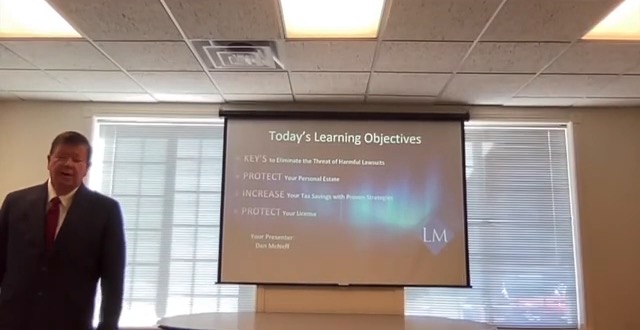
“Your Presenter, Dan McNeff”, the seminar’s own 00:09 intro slide, beside the Legally Mine logo, is the attribution: a source-context identification, not a biometric match. “Garrett Soelberg” is only the channel that uploaded the video, not the presenter. Quoted accurately; this is the product as sold, in the principal’s own words, not an admission of any crime.
“If you walk into a plaintiff's attorney and you can show them that there's no motivation to sue you, that may very well end the lawsuit where it stands.”
▾
“Your Presenter, Dan McNeff”, the seminar’s own 00:09 intro slide, beside the Legally Mine logo, is the attribution: a source-context identification, not a biometric match. “Garrett Soelberg” is only the channel that uploaded the video, not the presenter. Quoted accurately; this is the product as sold, in the principal’s own words, not an admission of any crime.
Conversion of the consigned collection, element by element, Mansell's title against the converter
Conversion is the strongest affirmative franchise-arena claim because it is conduct-anchored and largely speech-independent. Utah (and parallel Oregon) law lets the owner of goods recover when another exercises dominion inconsistent with the owner’s rights, with no requirement of intent to permanently deprive (Alta Indus. Ltd. v. Hurst, 846 P.2d 1282 (Utah 1993)✓). The consignment expressly keeps title with the consignor, so the unsold sets stayed Mansell’s. Damages are modest and itemized , never the refuted “$200,000.” A genuine split runs through the case: title and the physical repossession point at BAM/Baker, but the proceeds-accounting shortfall routes principally to Chrystal Law / the Salem-Keizer franchise, not BAM corporate, the Chrystal-vs-BAM split is held identically on both sides. Every defendant is presumed innocent; the claim is ALLEGED, not adjudicated.
| Element | Posture | The record fact, the rule, and the honest line |
|---|---|---|
| (1) Ownership / right to possession | CONFIRMED title; ASSERTED claim | Rule. Title to consigned goods stays with the consignor; a consignment is a secured transaction in which the consignor holds a PMSI (Utah Code § 70A-9a-102, UT ST 70A-9a-102, (a)(20)✓). Record. Consignment Agreement §IV (verified verbatim): “Consigned merchandise shall remain the property of Mansell until sold” BAM v. Schneider-Mansell, No. 260402353; the agreement is Oregon-governed (§XVI), so Oregon’s parallel Article 9 (ORS § 79.0319, OR ST 79.0319✓) is the on-point overlay. Honest line. Title is CONFIRMED on the face of the contract; Mansell is the proper plaintiff for the unsold sets.How this is establishedRule → record → file. §IV of the verified Consignment Agreement BAM v. Schneider-Mansell, No. 260402353 keeps title with Mansell; Oregon Article 9 governs by §XVI. Title-CONFIRMED. Source: BAM v. Schneider-Mansell, No. 260402353; DAMAGES_AUDIT_LEDGER §2. |
| (2) Wrongful exercise of dominion | ASSERTED w/ documented non-return | Rule. Any dominion inconsistent with the owner’s rights converts, even without intent to keep (Alta Indus. Ltd. v. Hurst, 846 P.2d 1282 (Utah 1993)✓); demand-and-refusal completes a bailment conversion (Christensen v. Pugh, 84 Utah 440, 36 P.2d 100 (1934)✓). Record. §XI required return of all unsold sets within 10 days of the certified 11/22/2024 termination; the return did not occur and the C&D was ignored Verified Compl., BAM v. Schneider-Mansell, No. 260402353; BAM’s own ¶82 admits locking ~20 identified sets in a back-office cupboard “pending ownership proof” BAM v. Schneider-Mansell, No. 260402353. Honest line. ALLEGED-with-documented-non-return; the senior-secured-creditor / BFP-without-notice defense turns on unlitigated fact.How this is establishedRule → record → file. Alta needs no intent-to-keep; the non-return + the ¶82 retention admission BAM v. Schneider-Mansell, No. 260402353 Verified Compl., BAM v. Schneider-Mansell, No. 260402353 are the dominion. ASSERTED. Source: Verified Compl., BAM v. Schneider-Mansell, No. 260402353 ¶82; THE_CASE_STATE §4. |
| (3) Damages (+ punitive) | INFERENCE size; REFUTED “$200K” | Rule. Conversion damages plus punitive on clear-and-convincing proof of willful/malicious conduct (Utah Code § 78B-8-201, UT ST 78B-8-201, (1)(a)✓); no general civil treble reaches these goods; 3-year SOL (Utah Code § 78B-2-305, UT ST 78B-2-305✓; OR parallel ORS § 12.080, OR ST 12.080✓). Record. Converted/retained value ~$10–20K net; gross collection ~$107K, never $200K BAM v. Schneider-Mansell, No. 260402353. Honest line. The “$200,000” is REFUTED (2023 in-store promo valuation); size is an estimate-band; punitive is contingent on willfulness, not assumed.How this is establishedRule → record → file. The $200K traces to a 2023 store promo, not an appraisal; the real net gap is ~$10–20K BAM v. Schneider-Mansell, No. 260402353. REFUTED as to $200K. Source: DAMAGES_AUDIT_LEDGER §2; SUPERSESSION_LEDGER (valuation guard). |
| (4) The Chrystal-vs-BAM split | CORROBORATED routing | Rule. A converter is liable; the remittance/accounting duty runs from the consignee. Record. Exhibit A is signed “by Chrystal Law, Owner” BAM v. Schneider-Mansell, No. 260402353; the physical repossession is BAM/Baker, but the ~$35–38K proceeds-owed accounting line runs to Chrystal Law / Salem-Keizer. Honest line. Title + physical taking → aim at BAM/Baker as actual converter; proceeds/remittance shortfall → principally a Chrystal/Salem accounting-breach claim. The split is stated identically on offense and defense.How this is establishedRule → record → file. Exhibit A’s “Chrystal Law, Owner” signature BAM v. Schneider-Mansell, No. 260402353 splits the claim: taking vs. accounting. CORROBORATED routing. Source: BAM v. Schneider-Mansell, No. 260402353; DAMAGES_AUDIT_LEDGER §2A. |
“Give them a two percent ownership and then make them a limited partner with 98% ownership, guess what, the only thing that could be taken in the lawsuit would be the two percent. Unless your name is Bill Gates or Warren Buffett, who's going to sue you for two percent of your assets?”
▾
“Your Presenter, Dan McNeff”, the seminar’s own 00:09 intro slide, beside the Legally Mine logo, is the attribution: a source-context identification, not a biometric match. “Garrett Soelberg” is only the channel that uploaded the video, not the presenter. Quoted accurately; this is the product as sold, in the principal’s own words, not an admission of any crime.
The actual-intent badge engine, element by element (Utah UVTA § 25-6-202(2)), APEX: Daniel / Legally Mine
Utah’s voidable-transactions statute is built so the badges are the proof: a transfer is voidable if made “with actual intent to hinder, delay, or defraud” a creditor, and §25-6-202(2) lists eleven non-exhaustive “badges of fraud” (Utah Code § 25-6-202, UT ST 25-6-202, (1)(a), (2)✓). Actual intent is rarely shown directly; a confluence of badges permits the factfinder to infer it and shifts the burden of production to the debtor (Territorial Sav. & Loan Ass'n v. Baird, 781 P.2d 452, 461-62 (Utah Ct. App. 1989)⌖; Tolle v. Fenley, 2006 UT App 78, 132 P.3d 63✓). State the mechanism with care: this is a permissive inference + production shift, not a presumption shifting the ultimate burden of persuasion. The records are confirmed facts; the badge characterization and the underlying intent stay an inference, held beside the innocent estate-planning reading. The intent master key that sharpens that inference is the defective-then-cured home-deed sequence in badge (d): four home deeds recorded defective through the IRS-levy window, then re-perfected identically once the levy cleared, signed by the family’s own notary and timed to the litigation calendar. It sharpens the badged inference; it does not convert it into adjudicated fact. Every load-bearing badge sits at the APEX (Daniel / Legally Mine). No summed dollar figure is asserted; the documented losses stay modest and itemized; this is not a finding that anyone is a fraudster.
| Element | Posture | The record fact, the rule, and the honest line |
|---|---|---|
| (a) transfer to an INSIDER | ADMITTED admission; Provable now | Rule. §202(2)(a): a transfer to an insider is a badge, and §25-6-203(2) makes an insider preference voidable on insolvency alone, without any reasonably-equivalent-value showing. Record. The note was executed 1/26/2021, the obligation incurred and perfected by UCC-1 #210216749881-3 on 02/12/2021: Daniel + Legally Mine pledge 21% of LM membership + operating assets to sons Ammon and Matthew securing a $1,728,000 note Utah UCC - Detail. In their Second Amended Verified Answer, sworn under criminal penalty on 2026-05-29, the sons admit the installments were processed and then payment was stopped Sumsion Business Law LLC v. McNeff, Utah 4th Dist. No. 250402162✓. Honest line. This is now the strongest UVTA lane, not the weakest: the sons’ own sworn admission that payments flowed and then stopped defeats the no-payments-flowed reading and lets each installment be avoided as an insider preference under §25-6-203(2), the clawback anchor. It is “insider-preference + retained-control + adverse inference,” not “collusion/undocumented.”How this is establishedRule → record → file. The UCC pledge to the sons Utah UCC - Detail is the insider transfer; the sons’ verified Sumsion admission (250402162, sworn 2026-05-29) that installments were paid then stopped supplies the insider-preference clawback under §25-6-203(2). Plead the note on ACTUAL intent (§25-6-202(1)(a)) and freeze via §25-6-303, not constructive. ADMITTED / provable now. Source: Utah UCC - Detail; THE_CASE_STATE §3. |
| (b) debtor RETAINED control | CONFIRMED rename; INFERENCE intent | Rule. §202(2)(b). Record. Same-minute (5/21/2026, 04:49 PM) LM→“LM OLDCO” rename Filing History LM OLDCO LLC, Reg. No. 7228976 while Centra Wealth registered the “Legally Mine” DBAs days later Filing History Centra Wealth Solutions LLC, Utah business registry, entity No. 14681035, same brand, same control, new shell. Honest line. The event is CONFIRMED; that control was retained is an inference, not a proven strip.How this is establishedRule → record → file. The same-minute OLDCO rename Filing History LM OLDCO LLC, Reg. No. 7228976 + the +days Centra DBA Filing History Centra Wealth Solutions LLC, Utah business registry, entity No. 14681035 are the record; retained control is the read, graded INFERENCE. Source: Filing History LM OLDCO LLC, Reg. No. 7228976 Filing History Centra Wealth Solutions LLC, Utah business registry, entity No. 14681035; THE_CASE_STATE §3. |
| (c) transfer CONCEALED | CONFIRMED apparatus; prima facie | Rule. §202(2)(c). Record. Captive registered agent (LMRA) + a non-disclosure forum (the Alaska Wize Grizzly vessel) + litigation timing + one-sided OR→DE recording make concealment-by-design a prima-facie read. Honest line. Concealment-by-design is prima facie; the value transfer-IN to Wize Grizzly / Centra is NOT ESTABLISHED pending subpoena; “undisclosed parent” is REFUTED (routine DGCL redomestication).How this is establishedRule → record → file. The captive-agent + Alaska vessel + timing are confirmed apparatus; the actual value movement is subpoena-gated (NOT ESTABLISHED). Source: THE_CASE_STATE §3. |
| (d) before/after being SUED or threatened | CONFIRMED tight gaps | Rule. §202(2)(d). Record. Two consecutive-entry same-day property batches, 2021-01-12 entries 5830–5833 (four AP-LLCs → Evelyn, ~10 days before the sons’ federal suit) Utah County Recorder, 2021-01-12 batch transfers to Evelyn McNeff (entries 5830-5833) and 2023-02-26 entries 11822–11824 (Evelyn → three new shells) Utah County Recorder, 2023-02-26 batch transfers from Evelyn McNeff (entries 11822-11824), plus the OLDCO/Centra timing. The intent sharpener is the defective-then-cured sequence: those same four January deeds were recorded defective on their face, held defective through the IRS-levy window, then re-perfected 08/13/2021 (entries 141977–141980) once the levy cleared, an identical defect-and-cure across all four, signed by the family’s own notary (commission #702080), timed to the litigation calendar. Honest line. The enumerated tight gaps are CONFIRMED; the defect-and-cure pattern would support the intent inference (it sharpens the badge, it does not convert it to adjudicated fact, and a defective acknowledgment is a recording defect, not a crime); broad clustering is a moderate inference; the “84/67% population-scale” headline is CUT/REFUTED (honest figure ~50% over 26 datable events). Where the two-notary clustering is quantified, the Fisher-exact two-sided p is on the order of the source figure (~1e-20), used as computed and not inflated.How this is establishedRule → record → file. The two consecutive-entry recorder batches Utah County Recorder, 2021-01-12 batch transfers to Evelyn McNeff (entries 5830-5833) Utah County Recorder, 2023-02-26 batch transfers from Evelyn McNeff (entries 11822-11824) are the tight gaps; the identical defect-and-cure across the four January deeds (re-perfected 08/13/2021, entries 141977–141980, commission #702080) sharpens intent; the population-scale clustering claim is REFUTED. Source: Utah County Recorder, 2021-01-12 batch transfers to Evelyn McNeff (entries 5830-5833) Utah County Recorder, 2023-02-26 batch transfers from Evelyn McNeff (entries 11822-11824); THE_CASE_STATE §2. |
| (e) substantially ALL assets | CONFIRMED unity; CORROBORATED char. | Rule. §202(2)(e). Record. Chain-9 UCC #20251112783-2 (filed 01/03/2025): six entities + Daniel pledge “all assets now owned or hereafter acquired” at one address Utah UCC - Detail. Honest line. A clean unity-of-enterprise proof; as a transfer it sits in the §25-6-304 new-value safe harbor (it secures contemporaneous MCA advances), its primary force is alter-ego, not standalone avoidance.How this is establishedRule → record → file. The chain-9 “all assets” lien Utah UCC - Detail is the unity proof; but §304’s REV safe harbor means its force is alter-ego, not standalone avoidance. Source: Utah UCC - Detail; THE_CASE_STATE §3. |
| (f) debtor ABSCONDED | UNRESOLVED | Rule. §202(2)(f). Record. A single stray process-server note. Honest line. Not supported; stays open.How this is establishedRule → record → file. One stray note is not absconding. UNRESOLVED/open. Source: THE_CASE_STATE §3. |
| (g) REMOVED/concealed assets | CONFIRMED apparatus; CONFIRMED zero-consideration | Rule. §202(2)(g). Record. The husk-rename + anti-encumbrance lock-up clauses are record facts Filing History LM OLDCO LLC, Reg. No. 7228976; and zero value was recorded into Centra / LM OLDCO on the brand handoff. Honest line. The badge does not require a proven value-IN, the provable-NULL is itself the badge: assets moved to a new husk for no recorded consideration. Whether value moved into the new vessels stays NOT ESTABLISHED pending subpoena (badge (c)).How this is establishedRule → record → file. The rename + lock-up Filing History LM OLDCO LLC, Reg. No. 7228976 are confirmed apparatus and the zero recorded consideration is the badge; a hidden value-IN is NOT asserted, it is subpoena-gated. Source: Filing History LM OLDCO LLC, Reg. No. 7228976; THE_CASE_STATE §3. |
| (h) value NOT reasonably equivalent | CONFIRMED figures; INFERENCE badge (sharpened) | Rule. §202(2)(h). Record. Dollar figures confirmed; no appraisals. Honest line. Not-equivalent stays an inference, but a strong-inference, civil-pleading grade, held beside the innocent reading: it is sharpened by (1) the adverse inference from the unproduced 3/27/2025 Baker APA (a below-value insider resale of the repossessed Salem store, the discipline-table Article-9 carve-out row) and (2) the provable-NULL of zero value recorded into Centra / LM OLDCO. No appraisal exists, so the ultimate figure is triable. The Peterson piece is adjudicated as a §549 avoidance, not a fraud finding Compl., Peterson v. Legally Mine Peterson v. Legally Mine Peterson v. Legally Mine.How this is establishedRule → record → file. Figures confirmed but no appraisal → not-equivalent is INFERENCE, sharpened by the Baker APA adverse inference + the Centra provable-NULL (see the §304(5)(b) Article-9 row); Peterson is a §549 avoidance Compl., Peterson v. Legally Mine Peterson v. Legally Mine Peterson v. Legally Mine, not a fraud finding. Source: DAMAGES_AUDIT_LEDGER. |
| (i) INSOLVENT / soon after | CONFIRMED | Rule. §202(2)(i). Record. Two separate confirmed facts: BAM’s FY2022 balance-sheet insolvency (($181,935)) deepening to FY2025 (($621,091)), audited figures that meet the objective going-concern test under a clean, unqualified opinion BAM Franchise Disclosure Document (2026); and the APEX IRS distress signal, $891,502.75 across 8 NFTLs (FY2016–2019, all released). Honest line. The IRS figure is a pre-transfer-era distress signal, not transfer-time insolvency, and must not be conflated; it is an encumbrance, never a damages dollar.How this is establishedRule → record → file. The audited negative equity BAM Franchise Disclosure Document (2026) is the transfer-time insolvency; the IRS $891K (all 8 NFTLs released) is a separate, earlier distress signal, an encumbrance, never damages. Source: BAM Franchise Disclosure Document (2026); THE_CASE_STATE §5A. |
| (j) shortly before/after SUBSTANTIAL DEBT | CONFIRMED | Rule. §202(2)(j). Record. The $1,728,000 note + $310,500/$140,000 acquisition notes + the MCA stack, each contemporaneous with the debt Utah UCC - Detail. Honest line. The cleanest survivor.How this is establishedRule → record → file. Each pledge is contemporaneous with a substantial debt Utah UCC - Detail, the badge that survives cleanest. CONFIRMED. Source: Utah UCC - Detail. |
| (k) essential assets → LIENOR → insider | INFERENCE, not fired | Rule. §202(2)(k). Record. BAM IP Holdings LLC exists (formed 7/16/2025, Ammon+Matthew managers) Utah business registry, entity No. 14333873 (BAM IP Holdings) Certificate of Organization BAM IP Holdings LLC, Reg. No. 5227635, but the BAM mark is still registered to BAM Franchising and no USPTO assignment has recorded. Honest line. The vessel is built, not fired.How this is establishedRule → record → file. The IP-holdco vessel Utah business registry, entity No. 14333873 (BAM IP Holdings) Certificate of Organization BAM IP Holdings LLC, Reg. No. 5227635 is built but no assignment recorded, badge (k) is INFERENCE/not-fired. Source: Utah business registry, entity No. 14333873 (BAM IP Holdings); THE_CASE_STATE §3. |
“The charging order actually gives more protection to both the family limited partnership, and it's the only protection available in the LLC, it's what protects the LLC.”
▾
“Your Presenter, Dan McNeff”, the seminar’s own 00:09 intro slide, beside the Legally Mine logo, is the attribution: a source-context identification, not a biometric match. “Garrett Soelberg” is only the channel that uploaded the video, not the presenter. Quoted accurately; this is the product as sold, in the principal’s own words, not an admission of any crime.
“There's nothing to take from our clients, that's why.”
▾
“Your Presenter, Dan McNeff”, the seminar’s own 00:09 intro slide, beside the Legally Mine logo, is the attribution: a source-context identification, not a biometric match. “Garrett Soelberg” is only the channel that uploaded the video, not the presenter. Quoted accurately; this is the product as sold, in the principal’s own words, not an admission of any crime.
The UVTA discipline, element by element, the § 304 safe harbors, the adverse authority, the constructive fallback, the remedy, and reaching the franchise defendants
The badge engine is only as good as the targeting discipline around it. This table carries the four things that keep both UVTA theories from being defeated by the defense’s best authority, plus the constructive fallback and the remedy prayer. The throughline: aim the avoidance claim at a debtor’s below-value insider conveyance, never at the secured MCA liens or the BAM Article-9 repossession, which the statute independently immunizes. Records are CONFIRMED; the franchise-reach leg is honestly flagged as an unsettled reverse/horizontal veil-pierce; damages stay modest and never summed.
| Element | Posture | The record fact, the rule, and the honest line |
|---|---|---|
| §304 new-value / good-faith safe harbor | CONFIRMED insulation | Rule. A transfer is not voidable against a good-faith transferee for reasonably equivalent value (Utah Code § 25-6-304, UT ST 25-6-304, (1)✓). Record. The MCA cross-collateral liens secured roughly contemporaneous new advances Utah UCC - Detail. Honest line. The MCA liens are NOT viable avoidance targets, they invoke the REV safe harbor; their force is alter-ego/unity, not standalone fraudulent transfer.How this is establishedRule → record → file. §304(1) immunizes REV-for-value transfers; the MCA liens Utah UCC - Detail are value-secured, so they are off the avoidance target. Source: Utah UCC - Detail; THE_CASE_STATE §3. |
| §304(5)(b) Article-9 carve-out + §104(2) foreclosure = REV | CONFIRMED insulation | Rule. Enforcement of a security interest in compliance with Article 9 is not a voidable transfer (Utah Code § 25-6-304, UT ST 25-6-304, (5)(b)✓); a regularly conducted noncollusive foreclosure is deemed REV (Utah Code § 25-6-104, UT ST 25-6-104, (2)✓). Record. The BAM repossession of the Salem store is secured-creditor self-help. Honest line. The Article-9 repossession is off the avoidance target; the viable target is a below-value insider resale of the repossessed store (the Baker APA path), contingent on the unproduced 3/27/2025 APA.How this is establishedRule → record → file. §304(5)(b)/§104(2) deem a compliant foreclosure REV; aim instead at the below-value insider resale (Baker APA), which is subpoena-gated. Source: THE_CASE_STATE §4. |
| Controlling adverse authority (distinguish, don’t cabin) | Provable now | Rule. The recent binding-circuit REV construction affirmed summary judgment for the transferee on a $750K guaranty supported by offsetting consideration, adopting the In re R.M.L. no-hindsight “chance of success at inception” test (White v. Wardley (In re White), 144 F.4th 1216 (10th Cir. 2025)✓). Honest line. White is confronted on its facts (arm’s-length, substantial offsetting value, non-trivial chance of success) and distinguished from an insider conveyance below value by an already-insolvent transferor; Judge Hartz’s “no financial skin in the game” partial dissent affirmatively helps the moving party. Do not let its good-faith findings bleed into the §202 badge analysis.How this is establishedRule → record → file. White is binding but distinguishable (arm’s-length + offsetting value); confront it, don’t cabin it. PROVABLE-NOW. Source: WESTLAW_RELATEDNESS_RESULT (controlling-authority audit). |
| Constructive fallback, §25-6-203 (no actual intent needed) | Needs facts | Rule. A pre-transfer creditor may avoid a transfer made for less than REV while insolvent (Utah Code § 25-6-203, UT ST 25-6-203, (1)(a)✓); the insider-preference branch needs no REV showing, only insolvency + the insider’s reasonable cause to believe it. Insolvency = balance-sheet test (Tolle v. Fenley, 2006 UT App 78, 132 P.3d 63✓). Record. Same insolvency facts as badge (i) BAM Franchise Disclosure Document (2026). Honest line. Triable, not “satisfied”; governed by White on REV; the §104(2)/§304(5)(b) insulators apply. Sequencing (the $1,728,000 note). For the note specifically, plead avoidance on ACTUAL intent under §25-6-202(1)(a) and freeze via §25-6-303, with the discovery-rule extension, not constructive: a constructive or preference-only theory walks into the 4-year SOL (Utah Code § 25-6-10, UT ST 25-6-10✓, the obligation incurred 2/12/2021, ran ~Feb 2025). Keep §203 as the constructive fallback for the OTHER transfers, and use the In re White sequencing insight (avoid the note, then claw back the payments) framed on actual intent.How this is establishedRule → record → file. §203 needs only insolvency + below-REV; the balance-sheet test (Tolle) is met BAM Franchise Disclosure Document (2026), but it is triable, not satisfied. For the note, plead ACTUAL intent (§25-6-202(1)(a)) + §25-6-303 freeze to clear the 4-year constructive SOL (§25-6-10, ran ~Feb 2025). NEEDS-FACTS. Source: BAM Franchise Disclosure Document (2026). |
| Remedy / prayer (§§301–303) | Provable now | Rule. Avoidance to the extent necessary to satisfy the claim, attachment, injunction/receiver (Utah Code § 25-6-301, UT ST 25-6-301, (1)(a)-(c)✓); a value judgment against the first transferee or beneficiary (Utah Code § 25-6-302, UT ST 25-6-302, (2)✓); and a pre-judgment freeze that routes through §25-6-303 (Utah Code § 25-6-303, UT ST 25-6-303✓, the Grupo Mexicano equitable-claim exception; private 1964(a) equitable relief is open in the 10th Circuit). Record. The insider recipients (Ammon, Matthew) are the §302 beneficiaries Utah UCC - Detail. Honest line. Avoidance operates on the transfer and the asset, it unwinds the conveyance rather than leaving the creditor behind the charging-order wall; that is why actual-intent avoidance, not a post-judgment charging order, is the relief to pray for, with the §25-6-303 freeze holding the assets in place pending judgment. Relief is prayed-for on a prima-facie/triable posture, not adjudicated.How this is establishedRule → record → file. §§301–302 unwind the transfer + reach the §302 beneficiaries (the sons, Utah UCC - Detail); §25-6-303 supplies the pre-judgment freeze (Grupo Mexicano exception); that’s why avoidance beats a charging order. PROVABLE-NOW. Source: Utah UCC - Detail. |
| Reaching the franchise defendants (the bridge) | Framing, unsettled | Rule. Reverse veil-piercing is recognized in Utah but withheld as a last resort and is individual-to-entity (M.J. v. Wisan, 2016 UT 13, 371 P.3d 21✓); entity-to-affiliate horizontal reach is an unsettled extension (Cascade Energy & Metals Corp. v. Banks, 896 F.2d 1557, 1576-78 (10th Cir. 1990)✓). Record. The franchise↔AP bridge is CONFIRMED personnel/address overlap (Josh Johnson’s tri-employment; shared Orem nexus), not a proven commercial funnel BAM Franchise Disclosure Document (2026). Honest line. Every load-bearing badge is APEX; reaching the franchise defendants needs the unsettled reverse/horizontal veil-pierce, flagged as a frame, not settled law. The cleanest fraudulent-conveyance fact runs against Daniel/Legally Mine, not the franchise defendants.How this is establishedRule → record → file. Utah reverse-pierce (Wisan) is individual-to-entity; horizontal reach (Cascade) is unsettled; the bridge is overlap BAM Franchise Disclosure Document (2026), not a proven funnel. FRAME. Source: BAM Franchise Disclosure Document (2026); THE_CASE_STATE §3. |
The grounds, in full (42)
The complete per-ground reasoning behind the tables above, each group is collapsed; click to read the full walkthrough.
Anti-SLAPP, the published lead2
The Public Expression Protection Act special motion: the vehicle that puts the burden on the party that sued. This is the front of the published posture.
UPEPA special motion; the anti-SLAPP vehicle, three-step burden, self-executing stay, dismissal with prejudice and motion-limited fees; the 60-day window appears forfeited (a lost accelerant, not a lost defense)
DefenseProvable nowBen’s side could move under Utah’s Uniform Public Expression Protection Act (UPEPA), Utah Code 78B-25-101 et seq. (eff. May 3, 2023; it replaced the repealed Citizen Participation in Government Act), for expedited dismissal of the speech-based causes of action; the defamation family and the speech-predicate slice of the PUAA count. The mechanics are statutory and clean. The motion runs the three-step burden-shifting of 78B-25-107(1): (1)(a) the movant shows UPEPA applies (invoking 102(2)); (1)(b) the responding party (BAM) bears the burden to establish under 102(3) that the chapter does not apply (i.e., that an exemption operates); (1)(c)(i) the responding party must then establish a prima facie case with some competent evidence on each essential element; and (1)(c)(ii) the movant may still prevail by showing failure to state a claim or no genuine issue of material fact. The motion is decided on a Rule 56-type record (78B-25-106). Filing is self-executing in two ways the defense could press: under 78B-25-104(1)(a) it stays the proceedings and discovery between the moving and responding parties (an all-party stay attaches only on appeal under 104(3), and 104(1) excepts subsections (4)-(7), including limited discovery and a 104(7)(b) public-health/safety carve-out). The court must hear the motion within 60 days (78B-25-105), rule within 60 days (78B-25-108), and a denial in whole or part is appealable as of right (78B-25-109). If granted, 78B-25-107 requires dismissal WITH PREJUDICE. On remedies, 78B-25-110 provides the court SHALL award court costs, reasonable attorney fees, and litigation expenses RELATED TO THE MOTION to a prevailing movant (and to a prevailing responding party only if the motion was frivolous or filed solely to delay); Aston v. Chronicle-Progress LLC, 2026 UT 7, 587 P.3d 981, 18-25✓ v. Chronicle-Progress confirms, as a matter of first impression, that those fees are limited to work reasonably necessary to prosecute the special motion and not the whole case (it reversed a roughly $394K whole-case award). UPEPA awards no damages of any kind; so any punitive recovery would have to ride on a separate tort, not the special motion. Mackey v. Mackey v. Krause, 2025 UT 37, 575 P.3d 1162, 34-38 (Utah Aug. 28, 2025)✓ is pro-defense on the applicability gate and frames the result honestly: Utah’s first UPEPA decision, the Utah Supreme Court REVERSED the district court’s denial, held UPEPA applied and the public-concern element was met (defined broadly), and produced a PARTIAL result (it dismissed IIED and abuse of process but remanded defamation and tortious interference); so a UPEPA motion here could dismiss the speech counts while the conduct torts (trespass, stalking, nuisance, impersonation) survive. The most consequential practical limit, stated once: no UPEPA special motion appears to have been filed, and the 78B-25-103 60-day-from-service window appears forfeited for this pro-se, email-served, out-of-state defendant. That is a lost ACCELERANT; the discovery stay and the expedited motion-related fee-shift; not a lost defense: the First Amendment merits (the prior-restraint track, public concern, opinion, truth) and the tort counterclaims survive in any posture, and Ben’s side could preserve a ‘good cause’ late-filing argument under 78B-25-103.
Authorities
- Utah Code 78B-25-103 to -110 (UPEPA), Utah Code 78B-25-103, -104, -105, -106, -107, -108, -109, -110, -103 (60-day filing window + good cause); -104(1)(a),(3),(4)-(7) (self-executing stay between moving/responding parties, all-party only on appeal, exceptions); -105 (<=60-day hearing); -106 (Rule 56 record); -107(1)(a)-(c) (three-step burden; dismissal WITH PREJUDICE); -108 (<=60-day ruling); -109(1) (appeal as of right); -110 (mandatory fees RELATED TO THE MOTION)✓, Single verified statutory map of the special-motion machinery, confirmed verbatim against enrolled S.B. 18: 60-day motion window; self-executing stay limited to the moving/responding parties (104(1)(a)) with all-party stay only on appeal (104(3)) and exceptions at 104(4)-(7); Rule 56 record (106); the 107(1) three-step burden (applicability / responding party defeats coverage under 102(3) / prima facie on each element / 12(b)(6)-or-Rule-56 merits prong); dismissal WITH PREJUDICE (107); hearing and ruling clocks (105, 108); appeal as of right (109); and fees limited to costs/fees/expenses RELATED TO THE MOTION for a prevailing movant (110).
- Mackey v. Krause, 2025 UT 37, 575 P.3d 1162, 34-38 (Utah Aug. 28, 2025)✓, Utah’s FIRST UPEPA decision and the workhorse on the applicability gate: the Utah Supreme Court REVERSED the district court’s denial of the special motion, applied UPEPA, and found the public-concern element met (defined broadly), reaching public-concern critic speech (statements that a person harmed others); the prima-facie determination is reviewed for correctness with facts and reasonable inferences viewed most favorably to the nonmovant. The outcome was PARTIAL; IIED and abuse of process dismissed, defamation and tortious interference remanded; confirming partial not total dismissal. DUAL-VALENCE FLAG: the SAME opinion is directly ADVERSE on abuse of process (it dismissed that claim and rejected the retaliation-motivated/third-party-directed willful-act theory); see malpros-abuse; a brief citing Mackey as a friend on UPEPA must simultaneously distinguish it as a foe on abuse of process. Distinct from Mathews v. McCown, 2025 UT 34.
- Aston v. Chronicle-Progress LLC, 2026 UT 7, 587 P.3d 981, 18-25✓, First-impression holding that UPEPA 78B-25-110 ‘reasonable attorney fees’ are limited to work reasonably necessary to prosecute the special motion, NOT the entire litigation (reversed a roughly $394K whole-case award; remanded for apportionment).
- Mathews v. McCown, 2025 UT 34, 575 P.3d 1114, 6, 98, 130✓, Originating holding for the burden allocation Mackey applies: once the affirmative defense of privilege is raised, the plaintiff bears the ultimate burden (130); and on the constitutional questions of defamatory meaning and fact-vs-opinion the court does NOT draw inferences in the plaintiff’s favor (6, 98); the carve-out that qualifies the ‘view inferences for the nonmovant’ rule on the special motion. DISTINCT decision from Mackey v. Krause, 2025 UT 37 (recurring confusion trap; always cite both with parallel reporters and the ‘distinct decision’ note).
- Pentecost v. Harward, 699 P.2d 696, (Utah 1985)⊕, A verified complaint meeting Rule 56 standards is the equivalent of an affidavit on summary judgment.
- Ream v. Ream, 2025 UT App 105, 575 P.3d 1221⊕, Sworn statements are judicial admissions; a party cannot then offer evidence contradicting them.
- Knitter v. Corvias Military Living, LLC, 758 F.3d 1214, (10th Cir. 2014)⊕, Three-factor test for disregarding a contradictory sham affidavit.
- Franks v. Nimmo, 796 F.2d 1230, (10th Cir. 1986)⊕, Foundational 10th Cir. sham-affidavit rule (carry the Hakki overruling-risk parenthetical: VA-employment only).
- Lantec, Inc. v. Novell, Inc., 306 F.3d 1003, (10th Cir. 2002)⊕, A court may treat a verified complaint as an affidavit when it meets Rule 56(c)(4).
UPEPA coverage of the speech: public concern (Mackey/Snyder) is a strong but contestable candidate; the 102(3)(c) commercial-speech exemption does not strip the journalistic/consumer work (102(1)(a) carve-out); coverage of the UPUAA count is predicate-by-predicate
DefenseFramingThe defense could establish coverage in three steps, each decided before the merits. (1) GOVERNING REGIME: as a clean choice-of-statute point, UPEPA (not the repealed CPGA) supplies the vehicle for this post-May-3-2023 Utah state-court suit; 78B-25-113 applies UPEPA to causes asserted on or after May 3, 2023, and 78B-25-114 saves the CPGA only for pre-cutoff causes; the repeal is conclusively established by the enrolled bill itself (Laws of Utah 2023, ch. 488 (S.B. 18) sec. 16), so it does not depend on any holding. (2) PUBLIC CONCERN: the videos and commentary on the consignment dispute and franchise practices are a strong but contestable candidate for ‘matter of public concern’ coverage under 78B-25-102(2)(c). Coverage is a content/form/context inquiry decided BEFORE the merits, so the unproven posture and BAM’s truth defenses do not defeat it; Mackey adopts Snyder v. Snyder v. Phelps, 562 U.S. 443, 453 (2011)✓’s whole-record test and REVERSED a trial court that had found no public concern. The public-concern texture is anchored in franchise-wide consumer practices, alleged business-model misconduct, and consumer-warning commentary on a public-facing platform. The honest counterargument the report should confront is the private-dispute characterization; Mackey’s own limit (merely referencing a public institution is not enough), the Wilbanks/Snyder/Dun & Bradstreet, Inc. v. Greenmoss Builders, 472 U.S. 749, 761-63 (1985)✓ & Bradstreet ‘purely private significance’ boundary, and the risk a court reads a campaign built around a private consignment grievance (the merchandise site, the ‘tracked down the thief’ video, signage over-pasting, impersonation) as a private vendetta. Lichfield v. Lichfield v. Kubler, 2025 WL 2772468, * (D. Utah Sept. 29, 2025)✓ is suggestive (a for-profit facility’s business model and treatment of vulnerable populations are public concern) but should be cited WITH its limits (unpublished, persuasive-only, controversy pre-existing via a Netflix documentary the LEGO dispute lacks), not elevated. (3) NO CLAIM-TYPE OR COMMERCIAL ESCAPE: the 102(3)(c) commercial-speech exemption does not strip protection from the journalistic/consumer commentary, because 102(1)(a) excludes from ‘goods or services’ the creation, dissemination, or promotion of a journalistic/literary/artistic work; and earning ad/sponsorship revenue on the work does not change that (Burstyn; UPEPA Comment 13: protected works are not goods/services ‘even if sold for profit’). Burden allocation cuts the right way: under 78B-25-107(1)(b) (read with 102(3)), the RESPONDING party (BAM) must establish that an exemption applies. The candid limit is that the exemption is applied communication-by-communication, not as a speaker-status shield: under the Castleman v. Internet Money Ltd., 546 S.W.3d 684, 688-92 (Tex. 2018)⌖ four-element framing (defendant primarily a seller; statement in seller capacity; arising from a transaction in the kind of goods sold; audience = the defendant’s own customers), a discrete statement Ben made as a seller about his OWN separate products (e.g., merchandise at westealfromoldpeople.com, a course or paid membership) could fall within (3)(c). Likewise, a plaintiff cannot escape UPEPA by relabeling a defamation-type grievance as racketeering (the Act’s definitional focus is the defendant’s activity, not the plaintiff’s label UPEPA Official Comments (ULC) to secs. 2 and 7 (quoting Navellier v. Sletten, 52 P.3d 703), Unif. Pub. Expression Prot. Act secs. 2, 7 cmt., sec. 2 cmt.; sec. 7 cmt. 2 (ULC 2020)⌖), so the speech-predicate slice of the UPUAA count is covered and dismissible part-by-part under 78B-25-107(1); but coverage is predicate-by-predicate, not wholesale; the speech-built predicates (communications fraud 76-6-525; theft-by-deception 76-6-405) are covered, while the non-expressive predicates (forgery 76-6-501, criminal simulation 76-6-518, deceptive business practices 76-6-507, obstruction 76-8-306, impersonation, and theft-by-extortion 76-6-406 demand conduct) are not (UPEPA Comment 6 quoting United States v. United States v. O’Brien, 391 U.S. 367, 376 (1968)✓; UHS of Provo Canyon v. UHS of Provo Canyon, Inc. v. Bliss, No. 2:24-cv-00163, 2024 WL 4279243, * (D. Utah Sept. 24, 2024)✓, denying UPEPA as to conduct counts). No Utah or 10th-Circuit decision yet applies UPEPA to a racketeering count or to a content creator’s commercial-exemption question, so these proceed on text + uniform-act gravamen principle + persuasive authority, not on-point holding. NOTE (Erie, if the forum shifts): so long as the case stays in Utah state court the procedure applies in full (Los Lobos Renewable Power, LLC v. Americulture, Inc., 885 F.3d 659, 668-73 (10th Cir. 2018)✓ Lobos’s Erie bar is inapposite, and Los Lobos expressly distinguished statutes that shift substantive burdens as UPEPA does); but if removed to or filed in federal court the special-motion/stay/interlocutory-appeal features may be unavailable, with the interlocutory-appeal feature the most firmly so (Coomer v. Coomer v. Make Your Life Epic LLC, No. 23-1109, collateral-order holding (10th Cir. Apr. 23, 2024)✓: anti-SLAPP denials not immediately appealable under the collateral-order doctrine).
Authorities
- Utah Code 78B-25-102 (coverage definitions + exemption), -107(1)(b), -111, -112, Utah Code 78B-25-102(1)(a), (2)(c), (3)(c); -107(1)(b); -111; -112, 102(2)(c) (matter of public concern); 102(1)(a) (journalistic/literary/artistic-work carve-out from 'goods or services'); 102(3)(c) (commercial-speech exemption); 107(1)(b) (responding party's burden to defeat coverage under 102(3)); 111 (broad construction); 112 (uniformity)✓, Verbatim coverage architecture confirmed against enrolled S.B. 18: 102(2)(c) supplies public-concern coverage; 102(1)(a) excludes the creation/dissemination/promotion of a journalistic/literary/artistic work from ‘goods or services’; 102(3)(c) is the commercial-speech exemption; 107(1)(b) read with 102(3) places the burden to establish an exemption on the RESPONDING party (BAM); 111 broad construction + 112 uniformity make uniform-act and sister-state authority persuasive and support the label-does-not-control gravamen principle.
- Utah Code 78B-25-113 (transitional), -114 (savings); Laws of Utah 2023, ch. 488 (S.B. 18) sec. 16 (repealer), Utah Code 78B-25-113, -114; Laws of Utah 2023, ch. 488, sec. 16, -113 (applies on/after May 3, 2023); -114 (CPGA saved only for pre-cutoff causes); ch. 488 sec. 16 (repeals CPGA 78B-6-1401 to -1405)✓, Governing-regime/savings result, confirmed verbatim against enrolled S.B. 18: UPEPA is the operative anti-SLAPP regime for BAM’s 2026 suit and the repealed CPGA survives only as a narrow pre-cutoff carve-out; conclusively established by the enrolled bill, independent of any holding.
- Snyder v. Phelps, 562 U.S. 443, 453 (2011)✓, Source of the public-concern definition (relating to any political, social, or other concern to the community / a legitimate news interest) and the content/form/context whole-record test that Mackey adopts; also supplies the ‘purely private significance’ boundary BAM would press.
- Lichfield v. Kubler, 2025 WL 2772468, * (D. Utah Sept. 29, 2025)✓, Persuasive-only analogy: a for-profit facility’s business model, tactics, and treatment of vulnerable populations are matters of public concern; analogous to commentary on BAM’s business model/consumer treatment. Cite WITH its limits (unpublished; the controversy was pre-existing and documentary-backed, which the LEGO-store dispute lacks), not elevated.
- World Wide Ass’n of Specialty Programs v. Pure, Inc., 450 F.3d 1132, 1137 (10th Cir. 2006)✓, 10th-Circuit ‘business practices’ public-interest line that Lichfield tracks; adds 10th-Cir./Utah-federal weight; note its public-concern finding rested on a genuinely pre-existing, independently-scrutinized controversy.
- Dun & Bradstreet, Inc. v. Greenmoss Builders, 472 U.S. 749, 761-63 (1985)✓, Speech of ‘purely private significance’ is not public concern; the boundary BAM would press for the individual-directed accusations (and carries the presumed/punitive-damages downside if the speech is found private).
- UPEPA Official Comments (ULC) to secs. 2 and 7 (quoting Navellier v. Sletten, 52 P.3d 703), Unif. Pub. Expression Prot. Act secs. 2, 7 cmt., sec. 2 cmt.; sec. 7 cmt. 2 (ULC 2020)⊕, The Act’s definitional focus is the defendant’s activity, not the plaintiff’s label; a court must look past how the plaintiff characterizes the conduct (the real support for label-does-not-control, in place of the overread Diamond Ranch). Exact ULC comment text not independently pulled; confirm comment numbering before filing.
- UPEPA Official Comments (ULC), Comments 12-13, Unif. Pub. Expression Prot. Act sec. 2 cmt. 12-13, cmt. 12-13 (ULC 2020)⊕, Cmt. 13: the commercial exemption does not apply to journalistic/artistic works ‘even if sold for profit’; Cmt. 12: the carve-out terms are construed broadly to include internet/electronic media, reaching online video/commentary. Comment numbering/text not independently pulled; confirm before filing.
- United States v. O’Brien, 391 U.S. 367, 376 (1968)✓, Quoted in UPEPA Comment 6: not all conduct can be labeled ‘speech’ merely because the actor intends to express an idea; the doctrinal basis for excluding the non-expressive UPUAA predicates (forgery/simulation/deceptive-business-practices/obstruction/impersonation/extortion) from coverage.
- UHS of Provo Canyon, Inc. v. Bliss, No. 2:24-cv-00163, 2024 WL 4279243, * (D. Utah Sept. 24, 2024)✓, Limiting authority: a UPEPA motion granted in part / denied in part; UPEPA does NOT shield the conduct counts even where related speech is protected; the predicate-by-predicate boundary. Case, docket, date, and partial disposition confirmed; the precise count-by-count breakdown not independently pulled.
- Castleman v. Internet Money Ltd., 546 S.W.3d 684, 688-92 (Tex. 2018)⊕, Four-element commercial-speech-exemption test (seller capacity; own goods; own customers) showing the (3)(c) analysis is communication-specific, and construing the exemption narrowly against the invoking party (favors the creator). Persuasive only (Texas TCPA).
- Joseph Burstyn, Inc. v. Wilson, 343 U.S. 495, 501-02 (1952)⊕, Expression sold for profit (motion pictures) remains protected speech; the constitutional basis for Comment 13’s ‘even if sold for profit’ rule supporting the 102(1)(a) work carve-out.
- Verified Complaint, BAM v. Schneider, No. 260402353, items b-l (76-6-405, -406, -525, -518, -507, -501; 76-8-306) (Utah 4th Dist. May 27, 2026)✓, Primary source confirming the SEVEN enumerated PUAA predicates pleaded as items b through l (theft-by-deception 76-6-405; theft-by-extortion 76-6-406; communications fraud 76-6-525; criminal simulation 76-6-518; deceptive business practices 76-6-507; forgery 76-6-501; obstruction 76-8-306); verified verbatim; establishes that coverage must be sliced predicate-by-predicate (the speech predicates in; the conduct/extortion predicates out).
- Los Lobos Renewable Power, LLC v. Americulture, Inc., 885 F.3d 659, 668-73 (10th Cir. 2018)✓, Erie note (only if the forum shifts): a state anti-SLAPP statute was inapplicable in federal diversity on the substantive/procedural line, BUT the court expressly distinguished statutes that shift substantive burdens; and UPEPA’s 107 burden-shift does; so federal availability of the special motion is genuinely OPEN, not foreclosed; the bar does not arise in Utah state court.
- Coomer v. Make Your Life Epic LLC, No. 23-1109, collateral-order holding (10th Cir. Apr. 23, 2024)✓, Erie note (only if the forum shifts): anti-SLAPP denials are NOT immediately appealable under the collateral-order doctrine, a federal-jurisdiction rationale making the 109 interlocutory-appeal feature the most firmly unavailable in federal court. Docket/date/holding confirmed; confirm the F.4th reporter pincite before filing.
- Mackey v. Krause, 2025 UT 37, 575 P.3d 1162⊕, First controlling Utah UPEPA construction: the plaintiff must show ’some competent evidence on every element’ (a Rule 56 floor, not notice pleading).
- Aston v. Chronicle-Progress LLC, 2026 UT 7, 587 P.3d 981⊕, Mandatory UPEPA fees are limited to those reasonably necessary to prosecute the special motion (plus fees-on-fees).
- Utah Code § 78B-25-102(1)(a), UT ST 78B-25-102, (1)(a)⊕, Journalistic/literary/artistic work is excluded from the ’goods or services’ carve-out -- defeats a commercial-speech dodge.
- State v. Squires, 2019 UT App 113, 446 P.3d 581⊕, A single scheme, short time, few victims, one injury type does NOT establish a PUAA pattern.
- David v. Midway City, 2021 WL 6930939, (D. Utah 2021)⊕, Failure to specify which defendant committed which predicate is fatal to a PUAA claim.
- Koch v. Koch Indus., Inc., 996 F. Supp. 1273, (D. Kan. 1998)⊕, COUNTER: Rule 8 permits pleading alternative theories -- but not two mutually exclusive sworn accounts of one historical event.
Prior restraint, the gag order6
Why the ex parte TRO's speech clauses 5(j)/(k), a forward gag and a takedown of already-published, 1.3M-view video, bear the heavy presumption against prior restraints.
Motion to dissolve the ex parte TRO’s speech clauses 5(j)/(k) as a presumptively unconstitutional prior restraint (the strongest, merits-independent move)
DefenseProvable nowThe defense could move under Utah R. Civ. P. 65A, Utah R. Civ. P. 65A(b),, (b),(e) (e)⌖ to dissolve the two speech-restricting clauses of the TRO and Notice of PI Hearing, BAM v. Schneider, No. 260402353, preamble; paras 4, 5(j)-(k), 6, 7 (Utah 4th Dist. June 2, 2026)✓ entered June 2, 2026 as a classic prior restraint. Clause 5(j) forward-bars ‘creating, posting, publishing and disseminating (or any republication thereof) any false, misleading, harassing, interfering, defamatory or unlawful images or content, respecting Plaintiffs,’ and clause 5(k) compels that the already-published ‘Publications’ (the videos, ~1.3M+ views) ‘be immediately removed and/or taken down from any online streaming platform.’ A judicial order forbidding communications in advance of publication, and compelling takedown of already-published, lawfully-gathered material, is the paradigm prior restraint that bears a heavy presumption against constitutional validity, with the heavy burden of justification on the order’s proponent (Near v. Minnesota ex rel. Olson, 283 U.S. 697, 713-20 (1931)✓; Nebraska Press Ass’n v. Stuart, 427 U.S. 539, 559, 570 (1976)✓ Press; Bantam Books, Inc. v. Sullivan, 372 U.S. 58, 70 (1963)✓). An injunction against criticism of a business’s practices is the closest factual analog and carries that same heavy burden (Org. for a Better Austin v. Keefe, 402 U.S. 415, 418-19 (1971)✓). Decisive for this posture: the order recites that it was entered on Plaintiffs’ ‘Ex Parte Motion’ (preamble) on nothing more than a ‘substantially likely to prevail’ finding (para 4), with no adjudication that any statement is false. A speech injunction is constitutionally tolerable, if at all, only after a falsity adjudication, so a pre-adjudication content-bar is a prior restraint, not a remedy for proven defamation (Tory v. Tory v. Cochran, 544 U.S. 734, 738 (2005)✓ reserved only the post-judgment permanent-injunction question and therefore does not reach, and does not save, an ex parte pre-adjudication TRO). The Utah hook supplies both the standard and the procedural defect: the proponent bears a heavy burden and an order restraining speech entered without notice and a hearing is invalid and was vacated (KUTV v. KUTV, Inc. v. Conder, 668 P.2d 513, 517-25 (Utah 1983)✓). BAM could respond that the order is a narrowly tailored injunction against ongoing tortious conduct (threats, doxxing, impersonation) rather than a content-based restraint; that response is strongest as to the conduct clauses 5(a)-(i), which are severable and likely survive, and weakest as to 5(j)/(k), which restrain pure speech with no falsity finding. Scope discipline: the motion challenges only the severable speech terms 5(j)/(k), not the whole TRO (arguing the whole order is void invites wholesale denial). Honest limits: this is a timing/procedural defect, not a permanent speech shield; after a falsity adjudication a narrowly-tailored, repeat-only injunction directed at adjudicated-false statements could become permissible, so the equity tradition that courts will not enjoin a libel functions here as a reinforcing theme on this pre-falsity posture rather than as an independent common-law bar. Alexander v. United States, 509 U.S. 544, 549-51 (1993)✓ is cited only to define what a prior restraint is (its holding rejected the prior-restraint claim on RICO obscenity-forfeiture facts, where the forfeiture ‘imposes no legal impediment to -- no prior restraint on’ future expression), so the holding-versus-dicta point cannot be sprung. The motion does not depend on disproving the PUAA allegations or on the UPEPA window.
Authorities
- Near v. Minnesota ex rel. Olson, 283 U.S. 697, 713-20 (1931)✓, Foundational prior-restraint doctrine; prior restraints on publication bear a heavy presumption of unconstitutionality, and injunctions against publication are the least tolerable infringement; the four narrow exceptions (national security, obscenity, incitement, interference with judicial functions) do not reach consumer/business criticism.
- Nebraska Press Ass’n v. Stuart, 427 U.S. 539, 559, 570 (1976)✓, A prior restraint is one of the most serious and least tolerable infringements on First Amendment rights and an immediate, irreversible sanction that freezes speech; the presumption against its use remains intact, especially as to public-concern speech.
- Bantam Books, Inc. v. Sullivan, 372 U.S. 58, 70 (1963)✓, Origin of the rule that any system of prior restraint comes bearing a heavy presumption against its constitutional validity; reaches compelled suppression of already-published protected material.
- Org. for a Better Austin v. Keefe, 402 U.S. 415, 418-19 (1971)✓, Closest factual analog: vacated an injunction against distribution of leaflets criticizing a target’s business practices as an impermissible prior restraint carrying a heavy burden of justification; fear of reputational/commercial harm does not justify it.
- KUTV, Inc. v. Conder, 668 P.2d 513, 517-25 (Utah 1983)✓, Binding Utah authority: heavy presumption plus heavy burden on the proponent; an order restraining speech entered without notice and a hearing (an after-the-fact in-chambers conference does not cure it) is invalid and was vacated. Lead the Utah overlay here.
- Tory v. Cochran, 544 U.S. 734, 738 (2005)✓, Post-adjudication-only limit: SCOTUS reserved only whether the First Amendment categorically bars POST-judgment permanent injunctions against repeating adjudicated-false statements; that reservation requires a merits falsity finding the ex parte TRO categorically lacks, so it reinforces rather than refutes the challenge.
- Alexander v. United States, 509 U.S. 544, 549-51 (1993)✓, Cited only to DEFINE a prior restraint (administrative/judicial orders forbidding communications in advance; TROs and injunctions forbidding speech are ‘classic examples’); its HOLDING REJECTED the prior-restraint claim because the RICO forfeiture, at 550-51, ‘imposes no legal impediment to -- no prior restraint on’ future expression; boundary-defining dicta, not pro-restraint authority.
- CBS Inc. v. Davis, 510 U.S. 1315, 1317-18 (1994)⊕, Presumption against prior restraint is at its zenith when enjoining publication of already-gathered material; reputational/competitive harm does not justify it. Single-Justice (Blackmun, Circuit Justice) in-chambers opinion, persuasive only, not in the report corpus; do not lead with it.
- Lothschuetz v. Carpenter, 898 F.2d 1200, 1208-09 (6th Cir. 1990)✓, Source of the three-part defamation-injunction rule (Wellford, J., concurring in part and dissenting in part; the controlling rationale on the injunction issue): an injunction against defamation is permissible only as to statements found false and libelous after adjudication, narrowly tailored, against a continuing course of repetitive speech; an ex parte TRO entered with no falsity finding is therefore a prior restraint. (Same-surname collision with Auburn Police Union v. Carpenter, a different, non-defamation case.)
- Utah R. Civ. P. 65A, Utah R. Civ. P. 65A(b),, (b),(e) (e)⊕, Procedural vehicle: motion to dissolve or modify a TRO; ex parte TRO requirements; the movant bears the burden at the hearing. The ‘independent of UPEPA’ hook; a facially unconstitutional prior restraint is the court’s to police regardless of any default or stay.
- TRO and Notice of PI Hearing, BAM v. Schneider, No. 260402353, preamble; paras 4, 5(j)-(k), 6, 7 (Utah 4th Dist. June 2, 2026)✓, Primary source, verified verbatim: entered on Plaintiffs’ ‘Ex Parte Motion’ (preamble); only a ‘substantially likely to prevail’ finding (para 4) with no falsity adjudication; clause 5(k) immediate-takedown; clause 5(j) forward gag; no bond (para 6); PI hearing June 22, 2026 (para 7).
- Lothamer Tax Resolution, Inc. v. Kimmel, 2025 WL 2490380, (W.D. Mich. 2025)⊕, An injunction requiring removal of online speech is a prior restraint (it halts an ongoing, continuous communication).
- Williams v. Rigg, 458 F. Supp. 3d 468, (S.D. W. Va. 2020)⊕, A takedown injunction entered without a finding of falsity is an unconstitutional prior restraint.
- Sindi v. El-Moslimany, 896 F.3d 1, (1st Cir. 2018)⊕, Even a post-trial injunction against speech is a prior restraint subject to strict scrutiny.
- Kinney v. Barnes, 443 S.W.3d 87, (Tex. 2014)⊕, The Supreme Court has never approved a prior restraint in a defamation case.
Threshold kill: the ex parte TRO expired by operation of law (URCP 65A(b)(2) 14-day cap, no reasoned extension) and removal did not revive it (Granny Goose / sec 1450); a merits-independent vehicle that never reaches the First Amendment
DefenseFramingBefore the First Amendment merits, there is a cleaner and merits-independent kill: the speech-restricting order has already expired by operation of law, and removal did not revive it. Utah R. Civ. P. 65A, Utah R. Civ. P. 65A(b)(2), (b)(2)⌖ commands that a restraining order issued without notice expire by its terms within the time the court fixes, not to exceed 14 days, and may be extended only once for good cause with the reasons for the extension entered of record. The June 2, 2026 ex parte order was re-entered June 9, 2026 with open-ended language stating it ‘remains in effect until the Court enters its ruling on Plaintiffs’ Motion for Preliminary Injunction,’ a duration untethered to the 14-day ceiling and unsupported by any good-cause reasons in the record. A court cannot bypass the rule’s time limit by writing an open-ended expiration date onto an ex parte order; absent a timely and reasoned extension, the order expired by its own terms. Removal does not rescue it. 28 U.S.C. § 1450, 28 U.S.C. § 1450✓ preserves a state-court order after removal only ‘until dissolved or modified’ by the district court and does not enlarge the order’s lawful life. The Supreme Court held in Granny Goose Foods, Inc. v. Bhd. of Teamsters, 415 U.S. 423, 439-40 (1974)✓ that an ex parte state restraining order in force at removal remains effective afterward no longer than it would have remained under state law, and in no event longer than the time limits of Fed. R. Civ. P. 65, Fed. R. Civ. P. 65(b)(2), (b)(2)✓ allow. Because Utah Rule 65A(b)(2) required expiry within 14 days absent a reasoned extension, and the removed state record contains no such extension order, the speech clauses were spent before they reached the federal docket and cannot be enforced without a new order satisfying Rule 65’s particularity and findings requirements. Two tactical advantages over the prior-restraint merits lead (PR-LEAD): this vehicle dissolves 5(j)/(k) without asking the court to reach the First Amendment at all, and it answers the plaintiffs’ likeliest mootness response, because an unsigned joint stipulation and proposed preliminary injunction have no operative effect until a judge signs them and the state court expressly declined to sign the analogous modification (State Doc. 83). The single factual predicate is the state record’s silence on any good-cause extension, confirmable from the removed record docketed at ECF 1-4. A third-party audience member has independently pressed the identical expiry theory from the listener side, invoking the right to receive willing speech under Virginia State Bd. of Pharmacy v. Virginia Citizens Consumer Council, 425 U.S. 748, 756-57 (1976)✓ and the Tenth Circuit’s recognition of impaired-listener standing and strict limits on speech-restraining orders in Journal Publishing Co. v. Mechem, 801 F.2d 1233, 1235-37 (10th Cir. 1986)⌖; the defense need not adopt that standing theory but gains a second mover pressing the same threshold defect.
Authorities
- Granny Goose Foods, Inc. v. Bhd. of Teamsters, 415 U.S. 423, 439-40 (1974)✓, A dissolved-or-not ex parte state TRO in force at removal remains effective after removal no longer than it would have under state law, and in no event longer than Fed. R. Civ. P. 65(b)'s time limits permit; sec 1450 does not enlarge its life. The controlling authority that the June 9 TRO cannot outlive its 14-day state-law term on the federal docket.
- 28 U.S.C. § 1450, 28 U.S.C. § 1450✓, After removal, all state-court orders remain in force 'until dissolved or modified by the district court'; the statute preserves but does not extend a state order's lawful life. Read with Granny Goose it caps, not revives, the TRO.
- Utah R. Civ. P. 65A, Utah R. Civ. P. 65A(b)(2), (b)(2)⊕, An ex parte TRO expires by its terms within the time the court fixes, not to exceed 14 days, and may be extended only once for good cause with the reasons for the extension entered of record. The open-ended 'until PI ruling' duration violates this cap. EXACT TEXT TO VERIFY against the rule (Belmont quotes it; tracks Fed. R. Civ. P. 65(b)(2)).
- Fed. R. Civ. P. 65, Fed. R. Civ. P. 65(b)(2), (b)(2)✓, Federal 14-day ceiling on TROs issued without notice, extendable for a like period on good cause; the outer bound Granny Goose imports as the post-removal limit on any surviving state TRO.
- Virginia State Bd. of Pharmacy v. Virginia Citizens Consumer Council, 425 U.S. 748, 756-57 (1976)✓, First Amendment protects the audience-side right to receive information from willing speakers; the basis for a non-party listener (Belmont) to challenge the speech restraints independently of the defendants.
- Journal Publishing Co. v. Mechem, 801 F.2d 1233, 1235-37 (10th Cir. 1986)⊕, Tenth Circuit recognizes standing in non-parties whose access to information is impaired by judicial speech restrictions, and applies strict limits (clear and imminent danger, narrow tailoring, less-restrictive alternatives) to orders restraining protected expression. Belmont's anchor; PINCITE/HOLDING TO VERIFY.
The ex parte posture independently dooms the speech clauses 5(j)/(k) absent a showing that notice was impossible
DefenseNeeds factsSchneider’s side can argue that, within the area of First Amendment freedoms, there is no place for ex parte restraining orders absent a showing that it was impossible to serve or notify the opposing parties and give them an opportunity to participate; the order must be couched in the narrowest terms with both sides’ participation, and a post-issuance hearing does not automatically cure the interim defect. The factual antecedent is satisfied on this record: the order was granted on Plaintiffs’ ‘Ex Parte Motion,’ signed June 2, 2026, on a verified-complaint-only basis with no bond (para 6), and the recited findings (paras 1-4) make no finding that notice was impossible or even attempted. Carroll v. President & Comm’rs of Princess Anne, 393 U.S. 175, 180-81 (1968)✓’s internal carve-out; that the Court ‘need not ... decide’ an ex parte order for a minimum period could never be justified by the unavailability of adverse parties; does not save this order because no impossibility showing was made. Two honest limits keep the argument precise: (a) SCOPE; the ex parte defect reaches only the speech clauses 5(j)/(k), not the conduct restraints (threats, doxxing, the 1,000-yard buffer, impersonation, evidence-hold), which are not Carroll-protected expression and are severable; and (b) REMEDY; the speech terms are vulnerable and dissolvable on motion or at the scheduled June 22, 2026 PI hearing rather than automatically void ab initio. Whether the scheduled adversary PI hearing is itself the cure Carroll contemplates for the go-forward restraint is contestable; present ‘a post-issuance hearing does not cure the interim defect’ as the strong-but-contested position rather than as settled. (Org. for a Better Austin v. Keefe, 402 U.S. 415, 419 (1971)✓, the close analog in the lead card, supports the post-hearing-does-not-cure sub-point.)
Authorities
- Carroll v. President & Comm’rs of Princess Anne, 393 U.S. 175, 180-81 (1968)✓, On point for ex parte First Amendment restraints (unanimous merits, decided under capable-of-repetition): no place for such orders absent an impossibility-of-notice showing; orders must be narrowly tailored with both sides’ participation; includes the express carve-out the defense must address (the Court ‘need not ... decide’ an ex parte order for a minimum period could never be justified).
- Org. for a Better Austin v. Keefe, 402 U.S. 415, 419 (1971)✓, Reinforces that a post-issuance evidentiary hearing did not save the speech injunction there; supports the ‘hearing does not cure’ sub-point as the strong-but-contestable position. (Primary heavy-presumption/heavy-burden statement is in the lead card.)
The speech clauses 5(j)/(k) are unconstitutionally overbroad and impermissibly vague as written; an independent ground to dissolve or modify
DefenseProvable nowSchneider’s side can argue that any order touching First Amendment rights must be couched in the narrowest terms that will accomplish the pin-pointed objective, and that 5(j)/(k) flunk that command on the face of the verbatim order. Clause 5(j) enjoins ‘any false, misleading, harassing, interfering, defamatory or unlawful ... content, respecting Plaintiffs’; content-based, sweeping in non-actionable categories (‘misleading,’ ‘interfering’), and identifying zero adjudicated-false statement (nothing is adjudicated at the TRO stage). Clause 5(k) compels takedown of ‘the Publications’ AND any other publication that ‘in any way relate[s] to the private legal dispute ... and the assertions of wrongdoing’; a standardless sweep into protected commentary that leaves the speaker unable to know what is permitted. Because nothing has been adjudicated false, the order cannot satisfy any adjudicated-false-specificity requirement, and overbreadth/vagueness bite hardest in this pre-adjudication posture. The honest framing of the remedy is dissolution OR modification: the orthodox response to overbreadth is to sever/modify/narrow, and the defense can argue these provisions are so standardless they cannot be narrowed by the speaker and must be stricken; while conceding the conduct provisions 5(a)-(i) are severable and largely survive (do not claim the whole order is void, which invites wholesale denial). (Tory, in the lead card, supplies the narrow-tailoring requirement and expressly declined to decide categorical voidness, so it is cited for tailoring only, not for categorical invalidity.)
Authorities
- Carroll v. President & Comm’rs of Princess Anne, 393 U.S. 175, 183-84 (1968)✓, Controlling SCOTUS source of the ‘narrowest terms that will accomplish the pin-pointed objective’ standard for any order in the area of First Amendment rights.
- Metropolitan Opera Ass’n v. Local 100, 239 F.3d 172 (2d Cir. 2001)✓, 2d Cir. VACATED a defamation/harassment injunction on Rule 65(d) specificity/vagueness and EXPRESSLY DECLINED to reach the First Amendment prior-restraint merits; cite precisely as a vagueness/specificity holding supporting remand-for-narrowing, persuasive only (not binding in Utah), NOT as authority that a commentary gag is categorically void.
- Same Condition, LLC v. Codal, Inc., 2021 IL App (1st) 201187, 187 N.E.3d 1147✓, Vacated a pretrial order barring online posts about a business’s practices as an unconstitutional prior restraint. Factually on point; persuasive (Ill.).
- David v. Textor, 189 So. 3d 871 (Fla. Dist. Ct. App. 2016)✓, Reversed a TRO against online postings about a business owner as a prior restraint even if the speech was defamatory; the communications-ABOUT vs. communications-TO line directly condemns clause 5(k). Persuasive (Fla.).
The Madsen/Schenck content-neutral-conduct exception does not save 5(j)/(k); the RICO/Giboney ‘speech-integral-to-conduct’ counter fails on the circularity bar (conduct clauses 5(a)-(i) conceded)
DefenseProvable nowAnticipating BAM’s likely defense, Schneider’s side can argue that the content-neutral-injunction exception is confined to incidental burdens on the place/manner of expression and does not reach content-defined gags. In Madsen v. Women’s Health Center, Inc., 512 U.S. 753, 763-64 (1994)✓ and Schenck v. Pro-Choice Network, 519 U.S. 357, 374-80 (1997)✓ the injunctions regulated physical protest activity (buffer zones, noise limits) and were upheld because issued for prior unlawful CONDUCT, not content; here clause 5(j) (‘false, misleading, harassing, interfering, defamatory ... content, respecting Plaintiffs’) and clause 5(k) (compelled takedown of a published video) are content-defined on their face and turn entirely on the message, so full prior-restraint scrutiny governs. The defense should concede that the conduct clauses 5(a)-(i) (true threats, doxxing, the 1,000-yard buffer, impersonation, evidence-hold) are exactly the kind of conduct-anchored restraints Madsen/Schenck permit and are severable and likely to survive; the exception just does not extend to the speech clauses. The genuinely dangerous counter is not Madsen but the Giboney v. Empire Storage & Ice Co., 336 U.S. 490, 498 (1949)✓ ‘speech integral to criminal/tortious conduct’ exception, wired through the RICO framing in para 1 (the ‘pattern of unlawful activity’ is defined to INCLUDE ‘the publication of false, defamatory ... content’). That argument fails on the circularity bar courts enforce: the exception requires speech integral to a SEPARATE offense that does not itself consist of speech, and a plaintiff cannot bootstrap by declaring the speech itself the predicate. The defense can convert BAM’s strongest sword into a shield with Alexander (in the lead card): a full criminal RICO conviction permitted reaching speech only as subsequent punishment for already-adjudicated-obscene material and ‘imposed no legal impediment to’ future expression, whereas this ex parte TRO bars future speech (5(j)) and compels removal of unadjudicated speech (5(k)); the inverse on every axis. Madsen rested on findings of actual prior unlawful conduct after proceedings; nothing has been adjudicated unlawful here, so there is no ‘prior unlawful conduct’ predicate to invoke the carve-out.
Authorities
- Madsen v. Women’s Health Center, Inc., 512 U.S. 753, 763-64 (1994)✓, ADVERSE/distinguishable: the injunction was issued not because of the content of expression but because of prior unlawful CONDUCT, and ‘not all injunctions which may incidentally affect expression are prior restraints’; confined to physical place/manner (buffer zones), so it does not reach a content-based video-takedown.
- Schenck v. Pro-Choice Network, 519 U.S. 357, 374-80 (1997)✓, ADVERSE/distinguishable on the same basis (buffer-zone conduct injunction); reinforces that the conduct-injunction exception does not reach content-defined publication bars.
- Giboney v. Empire Storage & Ice Co., 336 U.S. 490, 498 (1949)✓, Source of the speech-integral-to-unlawful-conduct exception (immunity does not extend to speech ‘used as an integral part of conduct in violation of a valid criminal statute’); cite to PRE-EMPT BAM’s best counter; the exception requires a SEPARATE, non-speech offense and cannot be bootstrapped by defining the speech itself as the RICO predicate (circularity bar).
Independent Utah grounds: the PUAA cannot authorize a content-based prior restraint (76-17-403(10)(d)(i) is obscenity/CSAM-tethered), and Utah Const. art. I sec. 15 is an independent, co-extensive ground to dissolve 5(j)/(k)
DefenseFramingSchneider’s side can argue two independent Utah-law grounds that converge on the same result. STATUTORY: Section 76-17-403(10)(b)(i) (formerly 76-10-1605) authorizes pre-liability restraining orders and injunctions generally, but that authorization cannot override the First Amendment or art. I sec. 15; statutory authorization cannot defeat a constitutional ceiling. Section 76-17-403(10)(d)(i) bars any order amounting to a prior restraint, but only where the pattern predicate is an enumerated obscenity/CSAM offense (Chapter 5c: 76-5c-202 to -206, -305); none of which is alleged here (BAM pleads defamation/extortion/fraud predicates). The defense should present that provision strictly as CONFIRMATORY a fortiori support for the constitutional bar; legislative recognition that PUAA injunctions can be prior restraints; and pre-empt the expressio unius counter (that confining the statutory bar to obscenity implies non-obscenity speech injunctions ARE authorized) by stressing that the constitutional ceiling overrides any such negative implication. The load-bearing proposition is constitutional, not statutory: the court must police a facially unconstitutional prior restraint, and the 5(k) takedown of already-published material before any falsity adjudication is the textbook defect; mere probable cause to believe a legal violation occurred is not adequate to suppress speech. STATE-CONSTITUTIONAL: the prior-restraint defect is independently grounded in art. I sec. 15 (‘No law shall be passed to abridge or restrain the freedom of speech or of the press’), which the Utah Supreme Court has held is at least as protective as the First Amendment. Frame this as an INDEPENDENT and CO-EXTENSIVE alternative ground, not as ‘potentially stronger’: no Utah case holds art. I sec. 15 MORE protective against prior restraints, and the interpretive method recognizes the clause ‘may be broader or narrower’ and in at least one domain has yielded LESS protection. The practical value is belt-and-suspenders; the decisive point remains the court-policed structural prior-restraint defect that holds regardless of posture. Plaintiffs may argue the ‘No LAW shall be passed’ text addresses legislation, not a court’s TRO; the response is that Utah courts have applied the clause to judicial restraints in the press context. (KUTV, Inc. v. Conder, 668 P.2d 513, 521 (Utah 1983)✓, in the lead card, is the on-point Utah authority for both the heavy-presumption standard and the ‘at least as protective’ state-clause holding.)
Authorities
- Utah Code Ann. sec. 76-17-403 (formerly sec. 76-10-1605), UT ST sec. 76-17-403, (10)(b)(i), (10)(d)(i)✓, Renumbering (eff. 5/7/2025; amended 2026 Laws Ch. 255 (S.B. 72), eff. 5/6/2026) and pre-liability injunction authority verified; the prior-restraint bar in (10)(d)(i) is limited to enumerated Chapter 5c obscenity/CSAM offenses and does not, by its terms, reach the defamation/commentary predicate at issue. Supports the a fortiori ARGUMENT, not a statutory prohibition on these facts. Uses Utah 76-17-403, not federal 1964(c).
- Alsworth v. Seybert, 323 P.3d 47 (Alaska 2014)✓, Pro-defense: held a speech-restricting injunction an impermissible prior restraint and, quoting Fort Wayne Books v. Indiana, 489 U.S. 46, 66, that ‘mere probable cause ... is not adequate’ to suppress speech. Persuasive (Alaska).
- KUTV, Inc. v. Conder, 668 P.2d 513, 521 (Utah 1983)✓, Utah Supreme Court: art. I sec. 15 is ‘at least as protective’ as the First Amendment; reversed a media gag as a prior restraint; the co-extensive floor (not ‘more protective’) and the on-point state-constitutional lead. (Heavy-presumption statement is in the lead card.)
- American Bush v. City of South Salt Lake, 2006 UT 40, 140 P.3d 1235✓, Leading modern method case: art. I sec. 15’s scope ‘may be broader OR narrower’ under a text/history/tradition method (held narrower than the First Amendment for nude dancing); cited honestly to cabin the ‘stronger’ framing, not as support for greater protection.
- Mood For A Day, Inc. v. Salt Lake County, 953 F. Supp. 1252 (D. Utah 1995)✓, D. Utah Erie-prediction that Utah’s clause is ‘at least as protective’; persuasive only (federal prediction of state law).
Defamation defenses7
Truth, opinion/hyperbole, public-concern and public-figure protections for bona fide consumer criticism.
Defamation elements under Utah law; defamatory meaning is a question of law for the court
DefenseProvable nowThe defense could frame the controlling elements BAM (the plaintiff) must establish, and the points the defense will attack: under West v. West v. Thomson Newspapers, 872 P.2d 999, 1007-08 (Utah 1994)✓, a defamation plaintiff must show the defendant published statements concerning the plaintiff, that the statements were false, defamatory, and not subject to any privilege, that they were published with the requisite degree of fault, and that publication resulted in damage. Whether a statement is capable of sustaining a defamatory meaning is a question of law decided by the court, not a jury question. Because the First Amendment travels with every defamation claim, the court conducts a context-driven, independent assessment of the statement’s susceptibility to a defamatory interpretation and does not indulge a favorable interpretation of meaning in the plaintiff’s favor (O’Connor v. O’Connor v. Burningham, 2007 UT 58, 165 P.3d 1214, 1220-23 (¶¶24-27)✓ frames this ‘no favorable inferences’ rule at summary judgment; Hogan v. Hogan v. Winder, 762 F.3d 1096, 1102, 1104-06 (10th Cir. 2014)✓ applies the same independent context-driven meaning assessment at the Rule 12(b)(6) stage and affirmed dismissal, so the point holds on whichever dispositive vehicle is used). The libel/slander definitions are codified at Utah Code Ann. § 45-2-2, UT ST § 45-2-2⌖. This court-as-gatekeeper posture is the defense’s structural advantage: capable-of-defamatory-meaning, protected-opinion, and privilege questions can be resolved as matters of law before trial, and the defense could use this to test BAM’s counts statement-by-statement at the outset.
Authorities
- West v. Thomson Newspapers, 872 P.2d 999, 1007-08 (Utah 1994)✓, States the Utah defamation elements (publication of a false, defamatory, unprivileged statement, with the requisite fault, causing damage); defamatory meaning is a question of law reviewed for correctness.
- O’Connor v. Burningham, 2007 UT 58, 165 P.3d 1214, 1220-23 (¶¶24-27)✓, The First Amendment denies the nonmoving party a favorable interpretation of factual inferences on the defamatory-meaning question (framed at summary judgment).
- Hogan v. Winder, 762 F.3d 1096, 1102, 1104-06 (10th Cir. 2014)✓, Recites the West formulation and conducts an independent, context-driven defamatory-meaning assessment at Rule 12(b)(6); affirmed dismissal.
- Computerized Thermal Imaging, Inc. v. Bloomberg, L.P., 312 F.3d 1292, 1297-98 (10th Cir. 2002)✓, Recites the Utah formulation and affirmed dismissal of a libel claim.
- Utah Code Ann. § 45-2-2, UT ST § 45-2-2⊕, Statutory definitions of libel and slander.
Substantial truth; confined to the conversion/consignment ‘sting’ (a jury question), and not a defense to the quantified ‘$200,000 stolen’ charge
DefenseFramingThe defense could argue that truth is an absolute defense and that a defendant need not justify every word; it is enough that the substance, gist, or sting of the matter is substantially true (Brehany v. Brehany v. Nordstrom, Inc., 812 P.2d 49, 57 (Utah 1991)✓ is the lead Utah authority; Hogan v. Hogan v. Winder, 762 F.3d 1096, 1108-09 (10th Cir. 2014)✓ supplies the Utah-law gist/sting formulation). Falsity is in any event an element BAM must prove (West v. Thomson Newspapers, 872 P.2d 999, 1007-09, 1018 (Utah 1994)✓ v. Thomson; Jacob v. Bezzant), without any media/non-media distinction (Obsidian Finance Group v. Cox, referenced in the argument), which moots any need to establish ‘media-defendant’ status. The defense’s reach is statement-specific. As to the consignment/conversion ‘sting’; that BAM/the store wrongfully took or withheld Mansell’s consigned LEGO collection in which it had no ownership interest; substantial truth is a genuine jury question subject to proof (the Consignment Agreement keeps title with the consignor until sale, per § IV of the 11/22/2023 agreement; corroborated by BAM’s 6/4/2026 capitulation), not a matter-of-law defense. THE SINGLE TREATMENT OF THE ‘$200,000 STOLEN’ CHARGE (stated once here): substantial truth does NOT defend the quantified accusation that ‘these defendants stole $200,000.’ That charge is contestable in both amount and actor: (a) AMOUNT; the genuinely unexplained accounting gap is alleged to be approximately $10,000-$20,000, not $200,000, and the $200,000 figure traces to a 2023 store promotional valuation, never an appraisal of converted goods; and (b) ACTOR; the gap re-points to a private, store-level proceeds/accounting dispute among the Salem LLC franchise location and the local parties Chrystal Law / Bryan (Benjamin) Gorman, not a corporate bulk theft by BAM. The Verified Complaint itself concedes (¶110) that no court or law-enforcement finding has established that BAM stole or wrongfully converted any property, and frames the matter as a private store-level consignment dispute at an independently owned franchise (Salem LLC). Substantial truth defends imprecision around a true gist; it cannot launder a false quantified gist. The defense could therefore argue substantial truth as to the conversion sting (subject to proof) and rely instead on opinion/hyperbole for the untethered epithets. All dollar figures stated as alleged/contestable, not adjudicated.
Authorities
- Brehany v. Nordstrom, Inc., 812 P.2d 49, 57 (Utah 1991)✓, Lead Utah authority: truth is an absolute defense; substantial truth (true ‘in substance’; insignificant inaccuracies do not defeat) is the test.
- Hogan v. Winder, 762 F.3d 1096, 1108-09 (10th Cir. 2014)✓, Utah-law gist/sting formulation for defamation-by-implication; substantial truth is measured by the gist, not the literal meaning.
- West v. Thomson Newspapers, 872 P.2d 999, 1007-09, 1018 (Utah 1994)✓, Falsity is an element BAM must establish (no media/non-media distinction needed), so the defense need not invoke the Hepps media-defendant rule.
- Gomba v. McLaughlin, 180 Colo. 232, 504 P.2d 337, 339 (1972)✓, Colorado origin of the gist/sting language; cite as a ‘see also’ origin only, not Utah primary authority.
- Philadelphia Newspapers, Inc. v. Hepps, 475 U.S. 767, (1986)⊕, On public-concern speech the plaintiff bears the burden of proving falsity.
Opinion / rhetorical-hyperbole privilege (Milkovich + Utah Art. I §§ 1, 15 + West/Ollman totality test); protects the untethered epithets, not the verifiable quantified accusation
DefenseFramingThe defense could argue that a slice of the speech is non-actionable opinion or rhetorical hyperbole. There is no separate blanket opinion privilege; protection flows from Milkovich v. Lorain Journal Co., 497 U.S. 1, 18-21 (1990)✓’s three mechanisms; the provable-falsity requirement, the protection for statements not reasonably interpreted as stating actual facts (rhetorical hyperbole, loose figurative language), and the NYT-Gertz fault rules; and from Utah’s independent protection under Art. I §§ 1, 15, which West v. Thomson Newspapers, 872 P.2d 999, 1014-19 (Utah 1994)✓ applies through the four-factor Ollman v. Evans, 750 F.2d 970, 979 (D.C. Cir. 1984)⌖ totality test (common usage; verifiability; full context; broader genre/setting). The defense’s strong subset is the untethered, inherently subjective material: epithets and slogans like ‘We Steal From Old People,’ ‘life ruined,’ and ‘thief’ standing alone, which a reasonable viewer in the online consumer-advocacy genre could read as the speaker’s indignation rather than a discrete verifiable factual claim (cf. Keisel v. Keisel v. Westbrook, 2023 UT App 163, 542 P.3d 536, ¶¶31-36✓, where ‘I think it’s racial’ is non-actionable because inherently unverifiable; West, protecting a public official’s non-verifiable motive). The defense cannot, however, sweep the quantified, fact-laden accusations into the privilege. Milkovich is the controlling adverse limit: labeling something ‘opinion’ or ‘hyperbole’ does not immunize a statement that implies a provably false assertion of fact, such as a specific, verifiable accusation of crime. The most recent Utah appellate application of the same Ollman totality test, RainFocus Inc. v. Cvent Inc., 2023 UT App 32, 528 P.3d 1221, ¶¶26-34✓ v. Cvent, is ADVERSE; it reversed a dismissal, holding that fact-based accusations of wrongdoing in a private commercial-tarnishment setting are actionable, not protected opinion, and that repeating lawsuit allegations does not inoculate them. West is distinguishable on its facts: it protected editorial columns about a public official’s non-verifiable motivations, not a checkable crime-accusation against a private commercial target. Pierson v. National Institute for Labor Relations Pierson v. Nat’l Inst. for Labor Relations Research, 319 F. Supp. 3d 1100, 1110-12 (N.D. Ind. 2018)✓ is non-binding and actually denied the hyperbole defense (an online ‘flat-out lying’ accusation survived dismissal); useful only to state the framework, not as favorable authority. Applied here, the quantified theft/fraud/elder-exploitation accusations carry provably-false factual connotations (and the contestable ‘$200,000 stolen’ charge is the actionable core addressed under substantial truth), so they are the material the privilege does not protect. The privilege is a per-statement question of law that narrows the count; it is not a defense to the quantified theft/fraud charge.
Authorities
- Milkovich v. Lorain Journal Co., 497 U.S. 1, 18-21 (1990)✓, No blanket opinion privilege; labeling a statement ‘opinion’ does not immunize a provably false factual implication (the controlling adverse limit); but pure hyperbole with no provably false connotation is protected.
- West v. Thomson Newspapers, 872 P.2d 999, 1014-19 (Utah 1994)✓, Adopts the Ollman four-factor totality test under Utah Const. Art. I §§ 1, 15; held editorial commentary about a public official’s non-verifiable motive protected; distinguishable from a verifiable crime-accusation against a private target.
- Keisel v. Westbrook, 2023 UT App 163, 542 P.3d 536, ¶¶31-36✓, Pure opinion that is inherently unverifiable (‘I think it’s racial’) is non-actionable; distinguishable from ‘stole $X’ / ‘committed fraud,’ which are verifiable.
- RainFocus Inc. v. Cvent Inc., 2023 UT App 32, 528 P.3d 1221, ¶¶26-34✓, ADVERSE: most recent Utah Ct. App. application of the Ollman totality test; reversed dismissal; fact-based wrongdoing accusations in a private commercial-tarnishment setting are actionable, not protected opinion; lawsuit-allegation repetition is not inoculated.
- Pierson v. Nat’l Inst. for Labor Relations Research, 319 F. Supp. 3d 1100, 1110-12 (N.D. Ind. 2018)✓, Non-binding; denied the opinion/hyperbole defense (online ‘lying’ accusation actionable); framework only, not favorable authority.
- Ollman v. Evans, 750 F.2d 970, 979 (D.C. Cir. 1984)⊕, Origin of the four-factor fact/opinion totality test as adopted into Utah law by West.
Speech on a matter of public concern; protects the bona fide consumer/franchise commentary, contested as to crime-accusations against named individuals
DefenseFramingThe defense could argue that the bona fide consumer- and franchise-commentary subset of the speech occupies the highest rung of First Amendment values. Under Snyder v. Snyder v. Phelps, 562 U.S. 443, 451-53 (2011)✓, speech is of public concern when it can fairly be considered to relate to any political, social, or other community concern or is of legitimate news interest, judged by content, form, and context across the whole record, with the controversial character of the speech irrelevant. A franchisor’s treatment of a franchisee, undelivered-raffle-product consumer warnings, and a franchisor’s adhesion-arbitration and litigation tactics plausibly engage genuine consumer/community interest (by analogy to Spacecon v. Spacecon Specialty Contractors, LLC v. Bensinger, 713 F.3d 1028, 1037-38 (10th Cir. 2013)✓, which treated statements about a contractor’s labor practices as public concern). But the characterization is statement-by-statement, not categorical, and the defense should not assume the whole campaign is public concern or assert that ‘consumer disputes = public concern’ as to the counts BAM actually sues on. The most on-point Utah authority is adverse: Shanley v. Shanley v. Hutchings, 716 F. Supp. 3d 1179, 1190-93 (D. Utah 2024)✓ held that social-media posts accusing a specific private party of reprehensible/illegal conduct are NOT public concern because their content shows they are personal attacks, not general comment on a matter of public debate, and ‘simply posting on publicly viewable social media cannot transform the content of speech into that of public import.’ That maps onto the per-se accusations BAM sues on (that named individuals committed theft, fraud, elder abuse). Spacecon is persuasive-only (it applied Colorado law) and preserves the limiting principle that speech made for the sole purpose of ruining a target, or a personal attack on a private party, is not public concern. If any statement is held private-concern, Dun & Bradstreet v. Dun & Bradstreet, Inc. v. Greenmoss Builders, Inc., 472 U.S. 749, 761-63 (1985)✓ bites: presumed and punitive damages become available without proof of actual malice; the precise downside the public-concern argument is meant to avoid. So the defense could argue the consumer/franchise subset is protected public-concern speech while acknowledging the crime-accusations against named individuals are contested and may fall in the private-attack zone; the issue must be won statement-by-statement.
Authorities
- Snyder v. Phelps, 562 U.S. 443, 451-53 (2011)✓, Public-concern speech occupies the highest rung of First Amendment values; judged by content/form/context across the whole record; controversial character is irrelevant.
- Shanley v. Hutchings, 716 F. Supp. 3d 1179, 1190-93 (D. Utah 2024)✓, ADVERSE and on-point: accusations against a named private party are personal attacks, not public concern; posting publicly cannot transform private-attack content into public import.
- Dun & Bradstreet, Inc. v. Greenmoss Builders, Inc., 472 U.S. 749, 761-63 (1985)✓, If speech is NOT a matter of public concern, presumed and punitive damages are available without proof of actual malice (the downside).
- Spacecon Specialty Contractors, LLC v. Bensinger, 713 F.3d 1028, 1037-38 (10th Cir. 2013)✓, Distinguishable (applied Colorado law): statements about a contractor’s labor practices were public concern; PRESERVES the limit that speech for the sole purpose of ruining a target / a personal attack on a private party is not public concern.
- Computerized Thermal Imaging, Inc. v. Bloomberg, L.P., 312 F.3d 1292, (10th Cir. 2002)⊕, Special damages for corporate defamation must be specific, actual, and non-speculative.
- Sunward Corp. v. Dun & Bradstreet, Inc., 811 F.2d 511, (10th Cir. 1987)⊕, A plaintiff relying on presumed damages may not use a general sales/profit decline to imply causation and special damage.
Limited-purpose public-figure status of BAM and its principals (→ actual-malice requirement); contested on timing/bootstrapping, with a narrow actual-malice wedge
DefenseNeeds factsThe defense could argue that BAM (a national, ~400-store franchisor) is a limited-purpose public figure as to the controversy over its franchise/consignment practices, so the actual-malice standard applies. The two-step test (Gertz v. Robert Welch, Inc., 418 U.S. 323, 345, 351-52 (1974)✓, as applied in Utah by Wayment v. Clear Channel Broadcasting, Inc., 2005 UT 25, 116 P.3d 271, 283-84✓ v. Clear Channel and by the Tenth Circuit in World Wide v. World Wide Ass’n of Specialty Programs v. Pure, Inc., 450 F.3d 1132, 1137-40 (10th Cir. 2006)✓) requires the court to (1) isolate a real, pre-existing public controversy related to the defamatory remarks and (2) determine whether the plaintiff voluntarily thrust itself to the forefront to influence the controversy’s resolution; status is a question of law reviewed de novo. World Wide found a corporation to be a limited-purpose public figure; but on a genuinely pre-existing, independently-scrutinized controversy into which the company had voluntarily injected itself over time, not on a rule that giving interviews alone confers status. The defense’s threshold problem is timing and bootstrapping: the controlling Utah case, Wayment, found the plaintiff NOT a public figure and stresses that the controversy must pre-exist the speech and that media access/involvement is insufficient; Gertz makes public-figure status the exception and Hutchinson v. Hutchinson v. Proxmire, 443 U.S. 111, 135 (1979)✓ bars a defendant from manufacturing the controversy and then invoking the target’s responsive participation. The defense could argue the franchise/consignment-practices controversy was genuine and public; the opposing side could argue it originated with the critic’s own viral campaign and that BAM’s public statements (its 5/21 corporate note, subsequent interviews and releases) were reactive, defeating voluntary forefront injection. The theory differentiates per plaintiff: BAM corporate has the strongest claim; the individual principals are intermediate (bolstered only by any separate pre-existing public dimension); a non-public store manager dragged in is likely a private figure, triggering only a negligence standard. Even if public-figure status attaches, the realistic malice wedge is narrow but real: the contested, quantified ‘$200,000 stolen by these defendants’ charge, restated on 5/23 after BAM’s published 5/21 correction, is a recognized reckless-disregard pathway (St. Amant v. St. Amant v. Thompson, 390 U.S. 727, 731 (1968)⌖). The framing should be measured, not ‘nearly impossible.’
Authorities
- Gertz v. Robert Welch, Inc., 418 U.S. 323, 345, 351-52 (1974)✓, Source of the limited-purpose-public-figure test; status is the exception; anti-bootstrapping (voluntary injection into a particular public controversy).
- Wayment v. Clear Channel Broadcasting, Inc., 2005 UT 25, 116 P.3d 271, 283-84✓, Controlling Utah authority; found the plaintiff NOT a public figure; the controversy must pre-exist the speech and the plaintiff must voluntarily thrust itself to the forefront; media access/visibility is insufficient (adverse).
- World Wide Ass’n of Specialty Programs v. Pure, Inc., 450 F.3d 1132, 1137-40 (10th Cir. 2006)✓, Corporation found a limited-purpose public figure on a genuinely PRE-EXISTING, independently-scrutinized controversy into which it voluntarily injected itself; distinguishable; do not overread as ‘gives interviews = public figure’; actual malice by clear and convincing evidence.
- Hutchinson v. Proxmire, 443 U.S. 111, 135 (1979)✓, A plaintiff thrust into a controversy by the defendant’s conduct, or who merely responds to attention, is not thereby a public figure; bars manufacturing-then-invoking.
- St. Amant v. Thompson, 390 U.S. 727, 731 (1968)⊕, Reckless disregard requires a high degree of awareness of probable falsity; the pathway for the narrow malice wedge on the quantified charge restated after the 5/21 correction.
- Dun & Bradstreet, Inc. v. Greenmoss Builders, Inc., 472 U.S. 749, (1985)⊕, COUNTER: where speech is NOT of public concern, a private-figure plaintiff may recover presumed/punitive damages without actual malice.
- Spacecon Specialty Contractors, LLC v. Bensinger, 713 F.3d 1028, (10th Cir. 2013)⊕, Commentary on a company’s labor/business practices is public concern; bias is not actual malice.
Fair-report privilege (statutory, Utah Code § 45-2-3(4)); a conditional, defeasible defense confined to matters buttressed by official action
DefenseNeeds factsThe defense could invoke Utah Code Ann. § 45-2-3(4), UT ST § 45-2-3, (4)✓(4), which privileges a fair and true report, made without malice, of a judicial/legislative/official proceeding (or of a charge or complaint upon which a warrant issued or an arrest was made); the report need only accurately reflect the proceeding, not prove the underlying statements true (Russell v. Thomson Newspapers, Inc., 842 P.2d 896, 902-04 (Utah 1992)✓ v. Thomson, which also extends the privilege to administrative-agency proceedings). The accurate framing is a substantial but conditional, defeasible privilege that turns on per-statement accuracy and absence of malice; not a categorical shield. Russell itself reversed summary judgment for the media defendant because a disputed quote raised a fact question, so the privilege does not necessarily dispose of a case as a matter of law. It is limited to matters ‘buttressed by official action’: reporting raw civil-complaint allegations before any judicial action is contested (Russell, distinguishing Seegmiller v. Seegmiller v. KSL, Inc., 626 P.2d 968, 977 (Utah 1981)✓; and Quigley v. Quigley v. Rosenthal, 327 F.3d 1044, 1067-68 (10th Cir. 2003)✓, invoking Restatement (Second) of Torts § 611 cmt. e / Meeker v. Post Printing, that publishing a complaint before judicial action is not within the rule). The privilege is also lost when the speaker asserts the allegations as true or adds his own facts (Quigley). The defense’s favorable use should be anchored to the items actually buttressed by official action in this matter (criminal Informations, a bench warrant, a pretrial protective order, and the 6/2/2026 civil TRO/PI), while carving out (a) bare pre-action complaint allegations, (b) statements where the commentator asserts allegations as true or adds his own valuation/‘savings’ facts (forfeiting the privilege under Quigley/Russell), and (c) the non-defamation counts the privilege does not reach. RainFocus Inc. v. Cvent Inc., 2023 UT App 32, 528 P.3d 1221, ¶¶20, 27-34✓ v. Cvent is NOT support: it construes the judicial-proceeding (litigation) privilege as it attaches to a litigant who republishes its OWN allegations, and it reversed the dismissal on the ground that the statements were fact-based (susceptible to a defamatory meaning) and that repeating lawsuit allegations does not inoculate them; contrary/inapposite to the § 45-2-3(4) press fair-report privilege at issue here. Note Utah now also has § 45-2-11 (renumbered from former 76-9-504) alongside § 45-2-3(4); § 45-2-3(4) remains the operative civil-libel fair-report privilege.
Authorities
- Russell v. Thomson Newspapers, Inc., 842 P.2d 896, 902-04 (Utah 1992)✓, Conditional fair-report privilege limited to matters ‘buttressed by official action’ (distinguishing Seegmiller); REVERSED summary judgment for the media defendant on a disputed quote.
- Seegmiller v. KSL, Inc., 626 P.2d 968, 977 (Utah 1981)✓, Reports of private-citizen complaints ‘not buttressed by official action’ are not privileged.
- Quigley v. Rosenthal, 327 F.3d 1044, 1067-68 (10th Cir. 2003)✓, Privilege lost where the speaker asserts allegations as fact / goes beyond reporting; publishing a complaint before judicial action is not within the rule (Restatement § 611 cmt. e / Meeker).
- RainFocus Inc. v. Cvent Inc., 2023 UT App 32, 528 P.3d 1221, ¶¶20, 27-34✓, Inapposite/contrary: addresses the judicial-proceeding (litigation) privilege as it attaches to a litigant republishing its own allegations, NOT the § 45-2-3(4) press fair-report privilege; reversed dismissal because the statements were fact-based (defamatory meaning) and lawsuit-repetition does not inoculate.
- Utah Code Ann. § 45-2-3(4), UT ST § 45-2-3, (4)✓, Statutory fair-report privilege for accurate reports of public/official proceedings (read with the renumbered § 45-2-11).
- Utah Code § 45-2-3(4), UT ST 45-2-3, (4)⊕, Statutory fair-report privilege for reports of public/official proceedings.
- Mathews v. McCown, 2025 UT 34, 575 P.3d 1114⊕, Public-interest, fair-report, and fair-comment privileges are questions of law.
Fair-comment privilege (common law); a secondary, burden-bearing trial backstop, not a reliable early exit
DefenseNeeds factsThe defense could plead the common-law fair-comment privilege for the opinion subset: a qualified privilege protects a statement that (1) involves a matter of public concern, (2) is based on true or privileged facts, (3) represents the speaker’s actual opinion, and (4) is not made for the sole purpose of causing harm; applicability is a question of law (Russell v. Thomson Newspapers, Inc., 842 P.2d 896, 902 (Utah 1992)✓ v. Thomson states the four-element test; West v. Thomson Newspapers, 872 P.2d 999, 1019-20 (Utah 1994)✓ restates it). The honest posture is that this is a secondary, burden-bearing defense, not a reliable early exit, for three reasons. First, in both Utah anchor cases the privilege was held INAPPLICABLE on the facts; West found the change-of-position implication a factual assertion, not opinion, and Russell held the challenged quote a false statement of fact outside the privilege; so they supply the rule, not a favorable application. Second, under Mathews v. Mathews v. McCown, 2025 UT 34, 575 P.3d 1114✓ (2025 UT 34), the privilege is an affirmative defense the defendant must plead and prove and is not resolvable on a motion to dismiss / judgment on the pleadings; on the current early-stage vehicles it cannot dispose of any count now, and fraud/forgery-type accusations were held capable of defamatory meaning and not constitutionally protected opinion. Third, it never reaches the load-bearing quantified ‘$200,000 stolen’ factual charge; West and Russell place provably-false factual assertions outside the privilege; and for the opinion-register statements it would protect, the constitutional Milkovich/West rhetorical-hyperbole doctrine already does the work, making fair comment partly redundant. The speaker also bears the burden of proving the underlying facts true and the statement his actual opinion. Its realistic role is a merits/trial-stage layer behind the constitutional defenses. (Mathews v. McCown, 2025 UT 34, is a DISTINCT decision from Mackey v. Krause, 2025 UT 37; do not let one be a typo for the other.)
Authorities
- Mathews v. McCown, 2025 UT 34, 575 P.3d 1114✓, Fair-comment privilege is an affirmative defense the defendant must plead and prove; reversed dismissals because privilege is NOT resolvable on a motion to dismiss; fraud/forgery accusations capable of defamatory meaning and not protected opinion. A distinct decision from Mackey v. Krause (2025 UT 37).
- Russell v. Thomson Newspapers, Inc., 842 P.2d 896, 902 (Utah 1992)✓, States the four-element fair-comment test; held the challenged quote a false statement of fact OUTSIDE the privilege.
- West v. Thomson Newspapers, 872 P.2d 999, 1019-20 (Utah 1994)✓, Restates the fair-comment test; held it inapplicable where the implication was a factual assertion, not opinion.
The racketeering (PUAA) defense, element by element5
Why BAM's Pattern-of-Unlawful-Activity count is contestable: non-enumerated predicates, particularity, claim-of-right, distinctness, and directness. Defensive analysis, not a finding. The NOT-VIABLE reading here is scoped to the franchise arena; the unified association-in-fact enterprise is analyzed on The Enterprise thread.
Fraud-sounding PUAA predicates must be pleaded with particularity against each defendant
DefenseProvable nowThe defense could argue that BAM’s fraud-sounding predicates (communications fraud 76-6-525, theft by deception 76-6-405, criminal simulation 76-6-518, deceptive business practices 76-6-507, forgery 76-6-501) must be pleaded with particularity. The spine is statutory and essentially unassailable: the PUAA requires that ‘the elements of each claim or cause of action shall be stated with particularity against each defendant’ (Utah Code 76-17-403(7), recodified from 76-10-1605(7)), reinforced by Holbrook v. Master Protection Corp., 883 P.2d 295, 302 (Utah Ct. App. 1994)✓ (pattern ‘as opposed to an isolated incident’). Where predicates sound in fraud, Rule 9(b)/its Utah equivalent requires the who/what/when/where/how and consequences (Gaddy v. Corp. of the President of the Church of Jesus Christ of Latter-Day Saints, 665 F. Supp. 3d 1263, 1296-1300 (D. Utah 2023)✓; Nunag-Tanedo v. East Baton Rouge Parish Sch. Bd., 790 F. Supp. 2d 1134, 1146-48 (C.D. Cal. 2011)✓). The defense could press defendant-by-defendant particularity given multiple named actors (Schneider, Reckless Ben LLC, Mansell, Nguyen, DOEs); e.g., the para 90 extortion sentence (the $300,000 ‘damaging-videos’ demand) is attributed to the non-defendants Chrystal Law and Benjamin Gorman, not to Schneider. Honest limits: this is a pleading-stage attack that, against a verified complaint with dated threat communications and named speakers, more realistically TRIMS the weakest fraud-sounding predicates than defeats the count wholesale, and particularity dismissals are typically without prejudice (leave to amend). The defense’s own authority cuts both ways; Segment Consulting Mgmt., Ltd. v. Streamline Mfg., LLC, No. 2:19-cv-00933 (D. Utah Feb. 25, 2020)✓ Consulting denied dismissal of a UPUA claim on communications-fraud predicates, holding Utah law does not require pleading every factual detail (a lenient bar BAM will invoke). Gaddy’s dismissal rested primarily on First Amendment church-autonomy and is cited here only for the 9(b) standard, not as a predictor of outcome.
Authorities
- Utah Code Ann. sec. 76-17-403(7), UT ST sec. 76-17-403, (7) (recodified from sec. 76-10-1605(7))✓, Elements of each PUAA claim must be stated with particularity against each defendant; the statutory spine of the ground.
- Holbrook v. Master Protection Corp., 883 P.2d 295, 302 (Utah Ct. App. 1994)✓, Two-element PUAA test; pattern ‘as opposed to an isolated incident’; the controlling Utah case for the particularity/pattern requirement.
- Gaddy v. Corp. of the President of the Church of Jesus Christ of Latter-Day Saints, 665 F. Supp. 3d 1263, 1296-1300 (D. Utah 2023)✓, Fraud-sounding RICO predicates require Rule 9(b) who/what/when/where/how + reliance. Cite for the standard only; its dismissal rested primarily on First Amendment church-autonomy and will not transfer to a secular case.
- Segment Consulting Mgmt., Ltd. v. Streamline Mfg., LLC, No. 2:19-cv-00933 (D. Utah Feb. 25, 2020)✓, Double-edged: states the who/what/when/where particularity standard but DENIED dismissal of the UPUA claim, holding Utah law does not require pleading every factual detail; a lenient bar.
- Nunag-Tanedo v. East Baton Rouge Parish Sch. Bd., 790 F. Supp. 2d 1134, 1146-48 (C.D. Cal. 2011)✓, Rule 9(b) applies to mail/wire-fraud RICO predicates; generic allegations insufficient. Out-of-circuit persuasive only.
Strike the non-enumerated ‘predicates’ (defamation/disparagement/false light, harassment, nuisance, interference) under 76-17-401(4)
DefenseProvable nowThe defense could attack BAM’s predicate list in two steps, the way Walker v. Beaumont Indep. Sch. Dist., 938 F.3d 724, 735 (5th Cir. 2019)✓ itself proceeds. Step one: strike the non-enumerated items BAM lists as ‘predicates’ in para 135(a) and elsewhere; defamation, disparagement, false light, harassment/nuisance, and tortious interference; because the PUAA’s ‘unlawful activity’ definition (Utah Code 76-17-401(4)) is a closed enumeration that does not include defamation, injurious falsehood, trade disparagement, harassment, nuisance, or tortious interference. Walker holds verbatim that ‘neither defamation, intentional interference, nor online harassment qualifies as a RICO predicate act,’ and proceeds predicate-by-predicate. Step two: because BAM does NOT rest the count on those items; it pleads seven enumerated predicates (76-6-525, -518, -501, -507, -405, -406; 76-8-306); the surviving enumerated fraud/extortion predicates must be attacked on their own terms (particularity, claim-of-right, distinctness, directness; see the companion grounds). Honest limits: Walker is also the limiting authority; it affirmed only because every predicate independently failed, so it is not authority that pleading defamation poisons an otherwise-enumerated claim. The PUAA at 76-17-401(4) also imports the federal 18 U.S.C. 1961(1)(B)-(D) offenses by reference, so the ‘exhaustive Utah list’ framing is itself incomplete. This is a narrowing/trimming argument, not the case-dispositive ‘speech can’t be a predicate’ knockout.
Authorities
- Walker v. Beaumont Indep. Sch. Dist., 938 F.3d 724, 735 (5th Cir. 2019)✓, Verbatim: defamation, intentional interference, and online harassment do not qualify as racketeering predicates. Also the limiting authority; the analysis is predicate-by-predicate, not categorical.
- Utah Code Ann. sec. 76-17-401(4), UT ST sec. 76-17-401, (4) (formerly sec. 76-10-1602)✓, Closed enumeration of ‘unlawful activity’; defamation/disparagement/harassment/nuisance/interference are absent, while BAM’s seven pleaded predicates appear; subsection also imports federal sec. 1961(1)(B)-(D).
- 18 U.S.C. sec. 1961(1), 18 USCA sec. 1961, (1)✓, Federal RICO predicate enumeration; defamation/harassment not listed (relevant only to BAM’s pleaded alternative-federal framing).
- Hourani v. Mirtchev, 796 F.3d 1, 10 n.3 (D.C. Cir. 2015)✓, See also: passing footnote that defamation/conspiracy-to-defame are not RICO predicates. Demoted; its holding rests on extraterritoriality/lack of domestic injury, not non-enumeration.
Communications-fraud and extortion predicates: claim-of-right and no-property-loss attack (not ‘criticism isn’t a money scheme’)
DefenseNeeds factsThe defense could argue, as to the enumerated fraud/extortion predicates, that BAM has dressed a defamation/business dispute in racketeering clothing; but the argument must be precise and as-applied, not categorical. The recasting authorities hold only that PURE reputational-harm publication cannot be a fraud predicate (Navient Solutions, LLC v. Law Offices of Jeffrey Lohman, No. 1:19-cv-461 (E.D. Va. 2020)✓; but note that language is from the dismissal of the GST counterclaim, while Navient’s own RICO claim survived; Rajaratnam v. Motley Rice, LLC, 449 F. Supp. 3d 45, 70-72 (E.D.N.Y. 2020)✓; ). They do not reach a complaint that pleads explicit money demands and document-fabrication crimes: BAM alleges a $300,000 ‘damaging-videos’ demand (para 90), a $200,000 corporate-office demand with a ‘very bad’ threat (para 86), a $40,000 forged-contract demand (para 71), and forgery/criminal-simulation/obstruction acts (the fake Guinness certificate, counterfeit raffle tickets, alleged forged court papers) that have no reputational-harm character at all. So ‘criticism is not a scheme to obtain money or property’ is refutable on the face of the pleading and should not be asserted as a defeater. The defensible as-applied points: (a) claim-of-right; the $300K demand (para 90) is pleaded against the non-defendants Chrystal Law/Benjamin Gorman as their own asserted franchise/consignment claim, and the $200K demand (para 86, attributed to Schneider) is framed against the backdrop of that same underlying contractual dispute, arguably negating a wrongful taking of BAM’s property for theft-by-extortion (76-6-406); (b) for communications fraud (76-6-525), BAM never parted with property in reliance; (c) the ‘end-run’ principle; wire/communications fraud cannot be a defamation claim merely repackaged (Teltschik v. Williams & Jensen, PLLC, 748 F.3d 1285, 1288 (D.C. Cir. 2014)✓). Honest limit: with several non-speech enumerated predicates pleaded, the count likely survives a bare motion to dismiss on predicate-existence, so this is a trimming/merits argument, not a facial knockout.
Authorities
- Navient Solutions, LLC v. Law Offices of Jeffrey Lohman, No. 1:19-cv-461 (E.D. Va. 2020)✓, Defamation ‘thinly clothed’ as wire fraud is not a predicate; but framed precisely: this is the dismissal of the GST COUNTERCLAIM; Navient’s own RICO claim survived.
- Rajaratnam v. Motley Rice, LLC, 449 F. Supp. 3d 45, 70-72 (E.D.N.Y. 2020)✓, Reputational harm alone cannot support mail/wire fraud; courts reject recasting defamation as fraud; but the same opinion notes bribery/malicious-prosecution-based fraud CAN be a predicate.
- Teltschik v. Williams & Jensen, PLLC, 748 F.3d 1285, 1288 (D.C. Cir. 2014)✓, True source of the D.C. Circuit ‘cannot end-run the requirements for a defamation claim’ language (mis-attributed to CIS v. Cohen in the original).
- Center for Immigration Studies v. Cohen, 410 F. Supp. 3d 183, 191 (D.D.C. 2019)✓, Dismissed RICO where plaintiff tried to shoehorn defamation into the RICO framework. NOT a D.C. Circuit decision (district court); the ‘end-run’ quote it repeats is Teltschik’s.
- Albano v. DiggDejected, No. 1:19-cv-03048 (E.D.N.Y.)⊕, RICO dismissed where the sole predicate was publication of defamatory statements about plaintiff’s business.
- Resolute Forest Prods., Inc. v. Greenpeace Int'l, 302 F. Supp. 3d 1005, (N.D. Cal. 2017)⊕, Federal RICO dismissed and state defamation/tortious-interference struck under anti-SLAPP where the claims arose from speech about a company’s business practices.
Person/enterprise distinctness; reaches only the 76-17-407(2)(c) count
DefenseFramingThe defense could argue that, under 76-17-407(2)(c) (the conduct theory pleaded at para 137, the Utah twin of 18 U.S.C. 1962(c)), the defendant ‘person’ must be separate and distinct from the ‘enterprise’ (State v. Hutchings, 950 P.2d 425, 428-430 (Utah Ct. App. 1997)✓; Roberts v. C.R. England, Inc., 318 F.R.D. 457, 488-490 (D. Utah 2017)✓). But this must be framed narrowly and is fact-dependent. First, distinctness is NOT required under 76-17-407(2)(a)/(b), and BAM also pleads (2)(a) (para 138) and (2)(d)-conspiracy to violate (a)/(b)/(c) (para 139); so even a total distinctness win kills only the (2)(c) count, not the cause of action. Second, the complaint does not plead a ‘lone critic = person = enterprise’ structure: it names multiple distinct defendants (Schneider dba Reckless Ben, Reckless Ben LLC, Mansell, Nguyen, DOEs) and an association-in-fact ‘Schneider Group.’ Under Cedric Kushner Promotions, Ltd. v. King, 533 U.S. 158, 163-166 (2001)⌖ Kushner, an individual is a ‘person’ distinct from the corporation he owns, so the simplest individual-vs-his-LLC distinctness attack fails at the pleading stage. The live, fact-dependent argument is the Roberts/Hutchings angle: distinctness fails only if the pleaded enterprise is coextensive with the defendants or a single alter-ego/corporate-consciousness; the defense could argue the ‘Schneider Group’ is merely Schneider plus his own LLC carrying on his regular affairs (Hutchings dismissed a one-man sole-proprietorship ‘enterprise’). Honest limit: Roberts labels the corporate-family/alter-ego distinctness question an issue of first impression in the Tenth Circuit, so the law is unsettled, and on a motion to dismiss a pleaded multi-actor association-in-fact ordinarily satisfies distinctness.
Authorities
- State v. Hutchings, 950 P.2d 425, 428-430 (Utah Ct. App. 1997)✓, Under the PUAA (2)(c) equivalent, person and enterprise must be separate and distinct; distinctness NOT required under (2)(a)/(b); dismissed a one-man sole-proprietorship ‘enterprise.’
- Roberts v. C.R. England, Inc., 318 F.R.D. 457, 488-490 (D. Utah 2017)✓, UPUAA distinctness requirement is nearly identical to RICO; alter-ego entities not distinct; corporate-family/alter-ego distinctness is an ‘issue of first impression in the Tenth Circuit’ (unsettled).
- Cedric Kushner Promotions, Ltd. v. King, 533 U.S. 158, 163-166 (2001)⊕, An individual is a ‘person’ distinct from the corporation he owns/operates; defeats the lone-defendant-equals-his-own-LLC distinctness attack.
Directness / proximate cause under Holmes-Anza (imported via Hill); not ‘reputational harm non-cognizable’
DefenseFramingThe defense could argue that BAM’s pleaded goodwill/business-value injury fails the directness requirement, but only as a fact-bound proximate-cause argument under the governing Utah statute; NOT the federal ‘reputational harm is non-cognizable’ theory. That theory is foreclosed here: the claim is Utah PUAA, and 76-17-403(1)(a) authorizes recovery for injury to ‘the person’s PERSON, business, or property’; Utah expressly included personal injury, so the federal ‘business or property’ omission has no textual hook, and 76-17-403(1)(a)(i) (‘regardless of whether the injury is separate or distinct’) cuts against the attenuation theory. The federal antecedent-personal-injury bar (Nunes/Bast) was also independently abrogated by Medical Marijuana, Inc. v. Medical Marijuana, Inc. v. Horn, 604 U.S. 593 (2025)⌖ (2025), so the defense should cite Horn defensively to pre-empt BAM rather than rely on Nunes. What the defense CAN argue is the surviving Holmes v. Securities Investor Protection Corp., 503 U.S. 258, 268-269 (1992)✓/Anza v. Ideal Steel Supply Corp., 547 U.S. 451, 457-461 (2006)✓ directness limb: a Utah court borrows federal RICO methodology (Hill v. Estate of Allred, 2009 UT 28, 216 P.3d 929✓ adopts H.J. Inc.), and lost-goodwill-from-publicity flows from protected speech through intervening independent third-party decisions (viewers’ choices; franchisees who separately sued BAM), arguably failing the ‘first step’ test. Honest limits: directness is an as-applied, fact-bound inquiry, not a categorical standing bar, and it does not reach the property-type predicates (forgery, the $200K/$300K demands) whose alleged injury is not purely reputational; BAM also pleads paradigmatic business injury (lost profits, franchise goodwill, business interruption, para 140).
Authorities
- Utah Code Ann. sec. 76-17-403(1)(a), UT ST sec. 76-17-403, (1)(a) and (1)(a)(i) (formerly sec. 76-10-1605)✓, Governing statute reaches injury to ‘the person’s PERSON, business, or property’ (broader than federal sec. 1964(c)); ‘(a)(i)’ allows recovery regardless of whether the injury is separate/distinct; defeats the ‘reputation non-cognizable’ and attenuation sub-arguments.
- Holmes v. Securities Investor Protection Corp., 503 U.S. 258, 268-269 (1992)✓, Proximate cause requires ‘some direct relation’; the law does not go ‘beyond the first step’; the surviving directness framework.
- Anza v. Ideal Steel Supply Corp., 547 U.S. 451, 457-461 (2006)✓, Directness requirement; cannot circumvent proximate cause by alleging intent to gain competitive advantage; attenuated/speculative damages disfavored.
- Hill v. Estate of Allred, 2009 UT 28, 216 P.3d 929✓, Utah adopts H.J. Inc. RICO methodology; the vehicle for importing Holmes/Anza directness into the PUAA.
- Medical Marijuana, Inc. v. Horn, 604 U.S. 593 (2025)⊕, Abrogated the antecedent-personal-injury bar; business/property loss is recoverable even when it flows from a personal injury; cite defensively to bury the federal Nunes/Bast theory.
- Hemi Group, LLC v. City of New York, 559 U.S. 1 (2010)⊕, Proximate cause demands a direct relation; remote/derivative injuries fail.
Malicious prosecution & abuse of process4
The affirmative theories against a suit aimed at speech, assertable now in part, ripe later in part.
Tortious interference is assertable now on the broad course of conduct (suit + TRO + non-DMCA demands); fix the SCO ‘overruled’ error (Eldridge is the abrogating authority); anchor injury off the non-DMCA conduct
DefenseNeeds factsBen’s side could assert tortious interference with economic relations now, because the improper means and the resulting injury are completed acts that do not require prior termination of BAM’s suit. Eldridge v. Eldridge v. Johndrow, 2015 UT 21, 345 P.3d 553, paras 14, 42-64, 70✓ states the controlling Utah elements: (1) intentional interference with existing or potential economic relations; (2) by IMPROPER MEANS; and (3) causing injury. Eldridge abrogated the improper-PURPOSE alternative of Leigh Furniture & Carpet Co. v. Isom, so Ben’s side cannot rest on bad motive; it must identify and prove an improper means. The improper-means list (violence, threats/intimidation, deceit/misrepresentation, bribery, UNFOUNDED LITIGATION, defamation, disparaging falsehood) traces to Leigh Furniture and Anderson Development Co. v. Tobias, and is restated in SCO Group v. SCO Group v. IBM, 879 F.3d 1062, 1074 (10th Cir. 2018)✓ applying Eldridge. The candidate improper means here are (i) the PUAA suit itself, IF objectively baseless (‘unfounded litigation’), and (ii) any takedown demands to the crowdfunding and subscription platforms that contained knowing misrepresentations (‘deceit or misrepresentation’); both pleaded as allegations and unproven. Ben’s side could plead the broad course of conduct; the suit, the ex parte TRO/PI (clauses (j) gag and (k) takedown-and-removal of the Publications), and any non-DMCA demands; and could allege lost donations and subscription revenue as cognizable injury (Nunes v. Nunes v. Rushton, 299 F. Supp. 3d 1216 (D. Utah 2018)✓ recognizes online fundraising as economic relations). Two limits trim the claim. (1) Section 512(f) preemption: where a tortious-interference claim rests EXCLUSIVELY on DMCA takedown notices, several courts have held it preempted by the DMCA’s false-notice scheme (Copy Me That v. ; caveat), although the question is unsettled (MFB Fertility, Inc. v. Action Care Mobile Veterinary Clinic, 730 F. Supp. 3d 740 (N.D. Ill. 2024)✓, declining preemption where the notice operated as a threat to sue the marketplace). Ben’s side could mitigate by anchoring the donations/subscription injury in the non-DMCA conduct (the suit, the TRO, and any deceitful non-DMCA platform demands) and segregating any DMCA-notice theory. (2) The ‘unfounded litigation’ means and Noerr-Pennington genuineness require the suit to be objectively baseless; a contested premise given the seven enumerated PUAA predicates and explicit money demands BAM pleads; so Ben’s side would have to affirmatively allege objective baselessness, which plaintiffs would dispute as a pleading hurdle.
Authorities
- Eldridge v. Johndrow, 2015 UT 21, 345 P.3d 553, paras 14, 42-64, 70✓, Controlling Utah Supreme Court statement of the tort: improper-means-only (improper-purpose-alone abrogated, overruling Leigh Furniture & Carpet Co. v. Isom in part); recognizes abuse of judicial process as a potential improper means. THIS is the abrogating authority for the improper-purpose prong of the Leigh Furniture/Anderson Development line. Confirmed.
- SCO Group v. IBM, 879 F.3d 1062, 1074 (10th Cir. 2018)✓, Applies Eldridge and restates the improper-means list including ‘unfounded litigation,’ defamation, and disparaging falsehood. Cited FOR THE IMPROPER-MEANS LIST ONLY; a Tenth Circuit panel does NOT and cannot ‘overrule’ Anderson Development or Leigh Furniture (Utah Supreme Court cases); Eldridge did the abrogating.
- JIVE Commerce v. Wine Racks America, 2018 WL 3873675 (D. Utah Aug. 15, 2018)✓, Confirms the Eldridge improper-means list. Persuasive-only (unreported D. Utah).
- Nunes v. Rushton, 299 F. Supp. 3d 1216 (D. Utah 2018)✓, Recognizes online fundraising as cognizable economic relations; but the interference claim there was PREEMPTED by the Copyright Act on its facts; cited for the economic-relations point with that limitation noted.
- Art Akiane, LLC v. Art & Soulworks LLC, 2026 WL 893344 (N.D. Ill. 2026)✓, Persuasive out-of-circuit caveat that interference claims premised exclusively on DMCA takedown notices may be preempted by 17 U.S.C. 512(f).
- Copy Me That, LLC v. This Old Gal, LLC, 2021 WL 1648972 (N.D. Cal. 2021)✓, Persuasive out-of-circuit authority holding 17 U.S.C. 512(f) PREEMPTS a state tortious-interference claim premised exclusively on DMCA takedown notices. Confirmed; supports the preemption caveat alongside Art Akiane.
- MFB Fertility, Inc. v. Action Care Mobile Veterinary Clinic, 730 F. Supp. 3d 740 (N.D. Ill. 2024)✓, Contrary/unsettled authority: a state interference claim premised on a DMCA-takedown-as-threat-to-sue is not necessarily preempted by the DMCA and may proceed. Confirmed; carries the contrary preemption line.
- Trump v. Trump, 79 Misc. 3d 866, (N.Y. Sup. Ct. 2023)⊕, Newsgathering and reporting on matters of public interest is justification as a matter of law -- a defense to tortious interference.
- Mauck v. Athens Pride, Inc., 922 S.E.2d 870, (Ga. Ct. App. 2025)⊕, Reporting on public-interest matters is justification as a matter of law (tortious-interference defense).
WUCP is sound in theory but not yet ripe; favorable termination is unmet while BAM’s PUAA suit is pending; fix the PRE/I overread; address the ex parte carve-out and the Baird dictum
DefenseNeeds factsBen’s side could preserve a wrongful-use-of-civil-proceedings (WUCP) claim; the Utah analog to malicious prosecution; but it is not yet ripe. Gilbert v. Gilbert v. Ince, 1999 UT 65, 981 P.2d 841, para 19 (section 674 elements); adopting section 675 (objective probable cause)✓ adopts Restatement (Second) of Torts section 674: WUCP requires (1) that the actor initiated or maintained the prior civil proceeding without probable cause and primarily for a purpose other than securing proper adjudication, and (2) except when ex parte, that the proceedings terminated in favor of the person against whom they were brought. Probable cause is OBJECTIVE under Restatement section 675 (reasonable belief in the facts and that the claim may be valid under applicable law). The favorable-termination element is the gating obstacle here: Utah courts require a termination that reflects or is on the merits (Rusakiewicz v. Lowe, 556 F.3d 1095, 1103 (10th Cir. 2009)✓; Puttuck v. Gendron, 2008 UT App 362, 199 P.3d 971, paras 8-10, 21✓, quoting Gilbert and Hatch v. Davis (Ct. App.), 2004 UT App 378, 102 P.3d 774, para 29✓), and a dismissal for lack of jurisdiction (Hatch (Ct. App.)) or a settlement (Puttuck) does not qualify, while a dismissal for discovery violations may (Nielsen v. Spencer, 2008 UT App 375, 196 P.3d 616, 623-24✓). Because BAM’s PUAA action was filed 2026-05-27 and remains pending (no merits termination), the WUCP claim cannot yet ripen; Ben’s side could preserve it as a contingent/alternative counterclaim or file separately after a favorable termination (e.g., a UPEPA dismissal with prejudice). Two refinements strengthen the ‘not ripe’ bottom line rather than weaken it: (a) the report should acknowledge the EX PARTE carve-out in Restatement section 674(b)/Puttuck; relevant because BAM proceeded ex parte to obtain the TRO; while noting it does not rescue an attack on the suit as a whole; and (b) it should affirmatively distinguish the Baird ‘most unusual circumstances’ dictum (never applied in Utah), noting Gilbert/Hatch/Puttuck require merits-favorable termination. On probable cause, Ben’s side could argue (not conclude) that a racketeering claim built on a consignment dispute and online criticism lacks objective probable cause; but that is a contested premise, because BAM pleads seven enumerated PUAA predicates plus explicit money demands, and plaintiffs could argue any colorable predicate-act theory defeats objective baselessness and that the ex parte TRO evidences some likelihood of success. Eskamani v. Auto-Owners Ins. Co., 2020 UT App 137, 476 P.3d 542, paras 18-22✓ supports the narrower argument (by analogy) that an ex parte/partial showing does not establish probable cause as a matter of law for all claims; but that is reasonable argument, not holding.
Authorities
- Gilbert v. Ince, 1999 UT 65, 981 P.2d 841, para 19 (section 674 elements); adopting section 675 (objective probable cause)✓, Controlling Utah Supreme Court source for the WUCP elements and the objective probable-cause definition.
- Rusakiewicz v. Lowe, 556 F.3d 1095, 1103 (10th Cir. 2009)✓, Confirms the WUCP elements and disfavored status; favorable termination must reflect or be on the merits. AFFIRMED dismissal of both WUCP and abuse-of-process claims; adverse-leaning.
- Anderson Development Co. v. Tobias, 2005 UT 36, 116 P.3d 323, para 64✓, Reaffirms WUCP elements and the disfavored/narrowly-construed status. (Its interference framework was later abrogated by Eldridge, NOT by SCO Group; drop any ‘overruled by SCO’ note.)
- Puttuck v. Gendron, 2008 UT App 362, 199 P.3d 971, paras 8-10, 21✓, Settlement does not qualify as favorable termination; lists the three favorable-termination routes (Restatement section 674 cmt. j); notes the ex parte carve-out.
- Hatch v. Davis (Ct. App.), 2004 UT App 378, 102 P.3d 774, para 29✓, Dismissal for lack of jurisdiction is NOT a favorable termination; termination must reflect on the merits.
- Nielsen v. Spencer, 2008 UT App 375, 196 P.3d 616, 623-24✓, Dismissal for discovery violations CAN qualify as a merits-reflecting favorable termination; probable cause is a jury question when facts are disputed.
- Frazier v. Eagle Air Med Corp., 2024 WL 3961808 (D. Utah Aug. 27, 2024)✓, Denied summary judgment on WUCP where the owner could not articulate legitimate reasons for filing; probable cause is a jury question when facts are disputed. Persuasive-only (unreported).
- Eskamani v. Auto-Owners Ins. Co., 2020 UT App 137, 476 P.3d 542, paras 18-22✓, Denial of a partial-SJ motion that did not challenge all elements does not establish probable cause as a matter of law for all claims. Supports the ex parte-TRO-by-analogy ARGUMENT, not as holding.
- Soundvision Techs. v. Templeton Group, 929 F. Supp. 2d 1174, 1193 (D. Utah 2013)✓, Adverse: no WUCP liability absent evidence the suit was brought for a purpose other than proper adjudication.
- Maleti v. Wickers, 82 Cal.App.5th 181 (2022)⊕, Anti-SLAPP applies to malicious-prosecution claims (protected petitioning); plaintiff must show probability of prevailing (no probable cause + malice).
- Siam v. Kizilbash, 130 Cal.App.4th 1563 (2005)⊕, Anti-SLAPP exposure for malicious-prosecution/false-report claims.
- Booker v. Rountree, 155 Cal.App.4th 1366 (2007)⊕, Anti-SLAPP vs malicious prosecution; lack of probable cause is the key showing.
Noerr-Pennington / sham-litigation is plaintiffs’ anticipated defense; add the controlling Utah hook (Anderson/Searle); keep the private-platform-takedown carve-out as the strongest counter
DefenseFramingPlaintiffs would invoke Noerr-Pennington / Petition-Clause immunity as a defense to all three counterclaims: petitioning activity, including filing a lawsuit, is immune unless the suit falls within the sham exception. Professional Real Estate Investors v. Professional Real Estate Investors v. Columbia Pictures, 508 U.S. 49, 60-62 (1993)✓ supplies the two-part sham test; (1) the suit is objectively baseless (no reasonable litigant could realistically expect success on the merits), and only then (2) the court examines whether it conceals an attempt to interfere directly with business relationships through governmental process as a weapon; and holds that the existence of probable cause is an absolute defense to the sham exception. To reach the sham exception, Ben’s side would have to plead specific facts showing the PUAA claims are objectively baseless; a contested premise given the seven enumerated predicates and money demands BAM pleads. Two framing corrections. First, the report should add the controlling Utah authority it omitted: Anderson Development Co. v. Anderson Development Co. v. Tobias, 2005 UT 36, 116 P.3d 323✓ and Searle v. Searle v. Johnson, 646 P.2d 682 (Utah 1982)✓, which adopt Noerr-Pennington as a defense to a Utah STATE-LAW tortious-interference claim; confirming the doctrine applies in Utah state court; and which carry a subjective ‘genuinely designed to achieve a governmental result’ gloss alongside PRE’s objective prong (more petitioner-protective than a clean PRE recitation implies); Searle also recognizes a limit (a secondary boycott forcing an uninvolved third party is not protected). Second, against the WUCP and abuse-of-process counterclaims, the Noerr sham/probable-cause inquiry substantially overlaps those counterclaims’ own probable-cause element, so probable cause is an independent complete bar and Noerr is somewhat redundant there. Ben’s side’s strongest counter is the private-platform carve-out: demands to PRIVATE crowdfunding and subscription platforms are not petitioning of a governmental body and fall outside Noerr-Pennington immunity; a point that should be developed, not merely asserted in a rebuttal bullet. CSMN Investments v. Cordillera Metro. Dist., 956 F.3d 1276, 1282-86 (10th Cir. 2020)✓, CVB, Inc. v. Corsicana Mattress Co., 604 F. Supp. 3d 1264, 1280-83 (D. Utah 2022)✓, and Allergy Research Group v. Rez Candles, 2022 WL 1004214, *4-5 (D. Utah Apr. 4, 2022)✓ show how rarely the sham exception is satisfied at the pleading stage and are the realistic adverse templates.
Authorities
- Professional Real Estate Investors v. Columbia Pictures, 508 U.S. 49, 60-62 (1993)✓, Two-part sham-litigation exception (objective baselessness first, then subjective intent) and probable-cause-as-absolute-defense. This is the PROPER use of PRE/I; as the sham standard, not as the WUCP element.
- Anderson Development Co. v. Tobias, 2005 UT 36, 116 P.3d 323✓, Utah adopts Noerr-Pennington as a defense to state-law tortious interference; the sham analysis carries a subjective ‘genuinely designed to achieve a governmental result’ gloss. The controlling Utah hook the report omitted.
- Searle v. Johnson, 646 P.2d 682 (Utah 1982)✓, Utah Supreme Court applies Noerr-Pennington-type petitioning immunity in a state-law tortious-interference context; confirms the doctrine genuinely applies in Utah state court; while recognizing a limit: a secondary boycott forcing an uninvolved third party to participate is not protected. Confirmed as a real Utah Supreme Court decision.
- CVB, Inc. v. Corsicana Mattress Co., 604 F. Supp. 3d 1264, 1280-83 (D. Utah 2022)✓, Applies Petition-Clause immunity in a Utah tortious-interference context. Persuasive (D. Utah); adverse to Ben.
- CSMN Investments v. Cordillera Metro. Dist., 956 F.3d 1276, 1282-86 (10th Cir. 2020)✓, Tenth Circuit applies the sham framework and found the petitioning objectively reasonable. Illustrates the high sham bar; adverse-leaning. (Note: a classic government-petitioning case, not a Utah-state-law application.)
- Allergy Research Group v. Rez Candles, 2022 WL 1004214, *4-5 (D. Utah Apr. 4, 2022)✓, Applied the sham analysis directly to WUCP/abuse-of-process counterclaims in Utah and dismissed for failure to plausibly allege objective baselessness; the realistic adverse template.
Abuse of process ripens pre-termination but is exposed on the merits: Mackey/Hatch reject ‘bad-motive TRO’ and ‘extrajudicial takedown demand’ as the willful act; disclose Mackey as ADVERSE and reframe the willful act as a perversion OF a legal process
DefenseNeeds factsBen’s side could assert abuse of process as a compulsory counterclaim now (Utah R. Civ. P. 13(a)), and its ripeness/procedural limb is sound: the claim does not require favorable termination or lack of probable cause and ripens when the willful act occurs (Anderson Development Co. v. Tobias, 2005 UT 36, 116 P.3d 323, paras 65-66✓ Development; Keller v. Ray, Quinney & Nebeker, 896 F. Supp. 1563, 1570-71 (D. Utah 1995)✓). The controlling two-part test is Hatch v. Hatch v. Davis (Utah Sup. Ct.), 2006 UT 44, 147 P.3d 383, paras 36, 37, 39✓: (1) an ulterior purpose, and (2) a willful act in the use of the process not proper in the regular conduct of the proceedings, where the willful act must be conduct INDEPENDENT of the legal process that CORROBORATES the improper purpose; ‘legal process with a bad motive is not enough’ (Eskamani v. Auto-Owners Ins. Co., 2020 UT App 137, 476 P.3d 542, abuse-of-process section (quoting Hatch para 39)✓). The merits exposure is the central problem, and the original framing inverted the controlling authority. Mackey v. Mackey v. Krause, 2025 UT 37, 575 P.3d 1162, paras 94-103✓ (Aug. 2025) is DIRECTLY ADVERSE and must be disclosed as such, not cited as support: the Utah Supreme Court held the abuse-of-process claim FAILED to state a prima facie case (requiring dismissal) and rejected the materially identical theory; that retaliation-motivated, third-party-directed conduct (a police report, a DCFS report, board-meeting statements) is a qualifying willful act, declining to distinguish it from the conduct found lacking in Hatch. The Templeton Feed & Grain v. Ralston Purina Co., 69 Cal. 2d 461, 446 P.2d 152, 155 (1968)✓ ‘Thanksgiving turkey’ paradigm makes the structure clear: the willful act was the in-process WRIT SEIZURE of the turkeys; the extrajudicial payment demands only CORROBORATED the perverse character of the proceedings and were ‘not integral to the proceeding.’ So a platform-takedown demand cannot itself BE the willful act (it is not a legal process at all), and a TRO obtained with a bad motive is foreclosed by Hatch’s holding that linking a bad motive to an event with the hallmarks of legal process is insufficient. Rusakiewicz v. Lowe, 556 F.3d 1095 (10th Cir. 2009)✓ independently bars the suit/settlement-as-aims theory. To have a defensible form, Ben’s side would need to identify a perversion OF a legal process itself; a process used to extort a collateral objective unrelated to the suit’s merits (the Templeton structure); with the extrajudicial takedown demands offered ONLY as corroborating evidence of ulterior purpose, never as the willful act; and even then it must anticipate a UPEPA special motion and address prima-facie proof, proximate cause (the third-party platforms as intervening actors), and standing. The TRO/PI’s clause (k) (takedown-and-removal) and clause (j) (gag) could be characterized as corroborating an ulterior purpose, but obtaining the TRO is ordinary process and cannot be the willful act.
Authorities
- Hatch v. Davis (Utah Sup. Ct.), 2006 UT 44, 147 P.3d 383, paras 36, 37, 39✓, Controlling two-part test; the willful act must be a USE/perversion of legal process corroborated by independent conduct; not merely any independent bad act; para 37 forecloses the bad-motive-TRO theory (linking a bad motive to an event bearing the hallmarks of legal process is insufficient); para 39 gives the Templeton turkey example. Confirmed.
- Mackey v. Krause, 2025 UT 37, 575 P.3d 1162, paras 94-103✓, DIRECTLY ADVERSE controlling authority: the Utah Supreme Court held the abuse-of-process claim FAILED to state a prima facie case (requiring dismissal); retaliation-motivated third-party-directed conduct (police report, DCFS report, board statements) is NOT a qualifying willful act and could not be distinguished from Hatch. A platform-takedown demand is weaker than a police report. Holding confirmed.
- Anderson Development Co. v. Tobias, 2005 UT 36, 116 P.3d 323, paras 65-66✓, Abuse of process ripens PRE-termination; the district court erred in dismissing the counterclaim merely because the underlying action had not terminated; it can seek punitive damages under former section 78-18-1. Retained for the narrow ripeness/punitive point only.
- Keller v. Ray, Quinney & Nebeker, 896 F. Supp. 1563, 1570-71 (D. Utah 1995)✓, Abuse of process may be a counterclaim before termination of the underlying action.
- Eskamani v. Auto-Owners Ins. Co., 2020 UT App 137, 476 P.3d 542, abuse-of-process section (quoting Hatch para 39)✓, The willful act must be a corroborating act other than legal process; bad motive is insufficient.
- Rusakiewicz v. Lowe, 556 F.3d 1095 (10th Cir. 2009)✓, Adverse: filing suit and ordinary litigation acts are not abuse of process even with nefarious goals; a settlement offer consistent with the suit’s aims is not a willful act; allegations that the plaintiff knew statements were truthful are insufficient.
- Puttuck v. Gendron, 2008 UT App 362, 199 P.3d 971, para 21✓, Adverse: improper litigation tactics alone do not rise to abuse of process (Rule 11/discovery sanctions are the remedy).
- Templeton Feed & Grain v. Ralston Purina Co., 69 Cal. 2d 461, 446 P.2d 152, 155 (1968)✓, The Thanksgiving-turkey paradigm cited in Hatch and Mackey: the willful act was the in-process writ seizure; the extrajudicial payment demands only corroborated. Persuasive/illustrative.
- Flores v. Emerich & Fike, 416 F.Supp.2d 885 (E.D. Cal. 2006)⊕, Abuse-of-process elements: ulterior motive + a willful act in the use of process not proper in the regular conduct of the proceeding.
The Fourth Amendment / the raid2
Warrant-suppression and municipal-liability theories arising from the search warrant and the selectively redacted bodycam.
Warrant-suppression spine (facial nexus failure + arrest-purpose + Franks + Leon), the co-occupants’ Ybarra false-arrest claim, and the Section 1983 private-state coordination theory (Fourth Amendment / Section 1983; contingent on authentication of the warrant, return, and bodycam diff)
DefenseNeeds factsRECORD / AUTHENTICATION CAVEAT: This theory rests on the dossier’s own record; specifically the bodycam investigation; not on the supplied legal-research corpus. The dossier records (a) Warrant No. 3352981, signed by Judge Griffin, charging stalking with a LEGO-merchandise seizure add-on, which returned ‘no items seized’; (b) the arrest of co-occupants present at the searched premises; and (c) a frame-by-frame diff of the official 56-clip bodycam release against a leaked unredacted copy of the same clips, showing roughly three hours of video blacked, eleven clips withheld entirely, and about ninety-four minutes of audio muted; including the officers’ own on-scene legal assessment, the arrest, and the warrant execution. The leak is described as the department’s own Dropbox misconfiguration, not a hack. These are the dossier’s analysis of leaked and public records; the warrant, the return, the redaction diff, and the recovered audio all require authentication and are stated as allegations to be confirmed, not adjudicated findings. Subject to that, this is litigation analysis of what each side could argue; all allegations are unproven. WARRANT-SUPPRESSION SPINE; THE FACIAL NEXUS FAILURE (the strongest, merits-independent ground, needing no extrinsic evidence): A warrant must establish a nexus between the items to be seized and the crime charged; probable cause that a person committed a crime is not probable cause to search for particular objects unconnected to it (United Wong Sun v. United States, 371 U.S. 471 (1963)✓ v. United States v. Mora, 989 F.3d 794 (10th Cir. 2021)✓). Stalking (Utah Code 76-5-106.5) is a course-of-conduct offense about fear and emotional distress, with no element of theft, receipt, or possession of stolen goods; yet the warrant authorized seizure of ‘any stolen merchandise, specifically Lego merchandise.’ That is a categorical nexus failure, not a thin one (Mink v. Mink v. Knox, 613 F.3d 995 (10th Cir. 2010)✓; Cassady v. Cassady v. Goering, 567 F.3d 628 (10th Cir. 2009)✓). A recent Tenth Circuit decision is consistent with the facial-nexus and particularity spine and is flagged for careful use: Armendariz v. City of Colorado Springs, No. 24-1201 (10th Cir. Mar. 12, 2026)⌖ addresses warrant facial nexus and particularity in the Fourth Amendment and Section 1983 setting. Use it for the Fourth Amendment and Section 1983 claims only, and do not graft it onto any non-1983 theory. Cite the revised opinion issued March 12, 2026, not the withdrawn February 24, 2026 version; the reporter pin ‘169 F.4th 1036’ is UNVERIFIED, so KeyCite the citation and confirm the reporter page before filing. The defect is compounded by the affidavit’s own stated purpose; ‘in order to affect the arrest of Benjamin Schneider’: a search warrant is a tool to find evidence in a place, not a vehicle to effect an arrest, and an affidavit that says so describes a misuse on its face (Zurcher v. Zurcher v. Stanford Daily, 436 U.S. 547, 558-60 (1978)✓). FRANKS; THE COMPOUNDING MISSTATEMENTS: The affidavit is internally self-contradicting on date; it recites a ‘March 3rd’ incident while describing events its own text places on the March 11 execution day; which is stronger than a discrepancy with an external document. Layered on it is the complainant’s affirmative assurance, recorded in the sworn arrest affidavit, that there were ‘no court cases,’ when the Gorman/Mansell action (No. 260200029) and BAM’s own RICO suit (No. 260402353) were pending; a material falsehood a basic court-records check would have caught (Santistevan v. Santistevan v. City of Colorado Springs, 983 F.Supp.2d 1295 (D. Colo. 2013)✓; cf. United States v. Norton). And the in-car-computer (MDT) log indicating the footage came from the complainant’s business partner (Best), not the ‘cooperative homeowner’ the affidavit credits, is an independent misrepresentation about the source and reliability of the warrant’s primary evidence. A corrected affidavit disclosing the live civil litigation would likely negate probable cause for a stalking-predicated search of what is at bottom a commercial consignment dispute (State v. Gonzalez). GOOD FAITH FORECLOSED, AND THE ARREST AS FRUIT: The United States v. Leon, 468 U.S. 897, 922-23 (1984)✓ good-faith exception is unavailable where an affidavit is so lacking in indicia of probable cause that reliance is unreasonable, or where the magistrate was misled by a Franks falsehood; the ‘no items seized’ return and the recovered ‘send a message’ audio bear on both. If the warrant falls, the arrest effectuated during its execution is its fruit (Wong Sun v. United States), and the Strieff attenuation rule does not help the State because there was no pre-existing, independent arrest warrant. Schneider’s own standing to suppress turns on his status as an overnight occupant of the basement rental; which the record supports but the unproduced Airbnb reservation record would settle (Minnesota v. Carter). THE SECTION 1983 COORDINATION DIMENSION (private-state joint action): Beyond suppression, the same facts support a civil-rights theory that the private complainant and the officers were willful participants in joint action; the route by which a private party becomes a state actor (Dennis v. Dennis v. Sparks, 449 U.S. 24 (1980)✓). A bare crime report is not enough, but a concerted plan that substitutes the complainant’s judgment for the police’s is, and the complainant’s standing as the franchisor-enterprise’s own employee, with his business partner supplying the evidence, strengthens that nexus rather than weakening it; the ‘send a message’ audio supplies the shared, speech-suppressing object. A complaining witness who actively instigates, rather than merely answering questions, is not shielded by absolute immunity (Nielander v. Nielander v. Board of County Comm’rs, 582 F.3d 1155 (10th Cir. 2009)✓). The closest analog allowed First Amendment retaliation and direct claims where officials manufactured allegations to procure a warrant against a critic (Zorn v. Zorn v. City of Marion, 774 F.Supp.3d 1279 (D. Kan. 2025)✓). These are theories on a record that still requires authentication, not findings. CLEANEST, MOST DAMAGES-VIABLE CLAIM; THE CO-OCCUPANTS’ YBARRA FALSE-ARREST THEORY: The co-occupants’ side could argue that their arrest violated the Fourth Amendment because a warrant to search a place does not authorize seizing or arresting persons found there; under Ybarra v. Ybarra v. Illinois, 444 U.S. 85, 91 (1979)✓, probable cause must be particularized to each individual, and ‘mere propinquity’ to others independently suspected of criminal activity does not, without more, establish probable cause to arrest a person present at the searched premises. If the co-occupants were arrested on presence or proximity alone; rather than individualized facts tying each of them to the charged stalking course of conduct; that is a per-se false-arrest theory that does not depend on disproving the underlying allegations against the warrant’s primary subject and carries concrete liberty-deprivation damages. The officers’ side would press that the arrests rested on individualized observations or on the warrant’s own probable-cause statement; whether such individualized cause existed as to each co-occupant is the factual question discovery must answer. WARRANT-INTEGRITY SPINE (Franks): Ben’s side could attack the warrant affidavit under Franks v. Franks v. Delaware, 438 U.S. 154, 155-56, 171-72 (1978)✓; a substantial preliminary showing that the affiant deliberately or with reckless disregard for the truth made a false statement or omitted material information, and that a corrected affidavit would not establish probable cause. The ‘no items seized’ return is, at most, one ancillary veracity data point; it is legally insufficient by itself and does not retroactively negate probable cause judged ex ante. The dossier’s redaction diff, particularly the muting of the officers’ own on-scene legal assessment and of the warrant execution, is the kind of material a developed record could marshal toward the recklessness/omission element, but fabrication remains an unproven allegation requiring the underlying affidavit. Because the predicate offense is speech-adjacent (a stalking course-of-conduct charge tethered to Ben’s commentary and documentary activity), Ben’s side could also argue under Mink v. Knox that constitutionally protected speech cannot supply probable cause; a Fourth Amendment probable-cause argument (not a standalone retaliation holding); the officers would distinguish it on the ground that the charge is stalking-as-course-of-conduct, not speech-as-crime. DISCRETION / ANIMUS EVIDENCE (the recovered audio): The ~94 minutes of muted audio recovered from the leaked copy is the discretion evidence. The dossier records an on-scene exchange escalating from ‘letting them go cannot be an option ... send a message’ to ‘you’re under arrest for stalking.’ Ben’s side could argue that this captures a decision to arrest driven by message-sending rather than individualized probable cause; directly probative of the Ybarra co-occupant claim (no particularized cause) and of pretext. BEN’S OWN RETALIATORY-ARREST CLAIM; FLAGGED QUALIFIED-IMMUNITY-HARD: Ben’s side could also assert a First Amendment retaliatory-arrest theory, but it is the hardest of these claims. Under the Nieves/Hartman line, a retaliation plaintiff generally must plead and prove the ABSENCE of probable cause for the underlying action; where a neutral magistrate (Judge Griffin) and a charging decision intervene, that no-probable-cause showing is steep and would have to run through a Franks-type attack on the affidavit or comparative objective evidence of retaliatory motive. This claim is kept as a secondary, qualified-immunity-hard theory, not the lead. PRIVACY PROTECTION ACT; A CLAIM TO EVALUATE, GATED BY THE SUSPECT EXCEPTION: The Privacy Protection Act, 42 U.S.C. 2000aa, 42 U.S.C. 2000aa, (a)-(b)✓ (42 U.S.C. 2000aa) bars government search for or seizure of work-product or documentary materials held by a person with a purpose to disseminate to the public. Ben’s side could evaluate a PPA claim because he was filming and disseminating his own documentary material. The gate is the suspect exception in 42 U.S.C. 2000aa(a)(1)/(b)(1), which strips protection where there is probable cause the materials-holder committed the offense to which the materials relate; and Ben is the subject of the stalking investigation, not a non-suspect third party. The threshold element (specific work-product/documentary materials actually searched-for or seized, and a purpose to disseminate) must also be pleaded; on a ‘no items seized’ return, whether ‘search for’ alone is satisfied is contestable. This is a claim to evaluate, not a settled winner.
Authorities
- Ybarra v. Illinois, 444 U.S. 85, 91 (1979)✓, A warrant to search a place does not authorize seizing/arresting persons found there; probable cause must be particularized to each individual, and ‘mere propinquity’ to others suspected of crime does not establish individualized probable cause; the anchor for the co-occupants’ false-arrest claim.
- Franks v. Delaware, 438 U.S. 154, 155-56, 171-72 (1978)✓, Two-part judicial-deception test (deliberate/reckless falsehood or material omission + corrected-affidavit reassessment) and the substantial-preliminary-showing requirement for a Franks hearing.
- Mink v. Knox, 613 F.3d 995 (10th Cir. 2010)✓, Fourth Amendment holding that constitutionally protected speech (parody/hyperbole) cannot supply probable cause; a probable-cause argument given the speech-adjacent stalking predicate, NOT a standalone First Amendment retaliation holding.
- Privacy Protection Act, 42 U.S.C. 2000aa, 42 U.S.C. 2000aa, (a)-(b)✓, Bars government search/seizure of work-product/documentary materials held for public dissemination, subject to the suspect exception (probable cause the holder committed the related offense); a claim to EVALUATE, gated by that exception because Ben is the investigation’s subject.
- United States v. Mora, 989 F.3d 794 (10th Cir. 2021)✓, Probable cause that a person committed a crime is not probable cause to search for particular items; the nexus between items and crime must be independently established. Anchors the facial nexus-failure ground.
- Cassady v. Goering, 567 F.3d 628 (10th Cir. 2009)✓, A warrant is overly broad in violation of the Fourth Amendment where it lacks particularized language creating a nexus between the suspected crime and the items to be seized.
- Zurcher v. Stanford Daily, 436 U.S. 547, 558-60 (1978)✓, The conclusions justifying a search warrant go to the connection of the items sought with crime and their present location; not to effecting an arrest; the ‘to affect the arrest’ purpose statement is a facial misuse.
- United States v. Leon, 468 U.S. 897, 922-23 (1984)✓, Good-faith exception is unavailable where the affidavit is so lacking in indicia of probable cause as to render reliance unreasonable, or where the magistrate was misled by a Franks falsehood.
- Wong Sun v. United States, 371 U.S. 471 (1963)✓, Evidence obtained by exploitation of an illegality is suppressible as fruit of the poisonous tree; the arrest made during execution of an invalid warrant is its fruit.
- Santistevan v. City of Colorado Springs, 983 F.Supp.2d 1295 (D. Colo. 2013)✓, An affiant who knowingly or recklessly omits information that, if included, would vitiate probable cause violates the Fourth Amendment; supports the ‘no court cases’ material-omission theory.
- Dennis v. Sparks, 449 U.S. 24 (1980)✓, A private party who is a willful participant in joint action with the State acts under color of law for Section 1983; merely resorting to the courts and winning does not, but a corrupt concerted plan does.
- Nielander v. Board of County Comm’rs, 582 F.3d 1155 (10th Cir. 2009)✓, Absolute complaining-witness immunity is reserved for those who merely answer law-enforcement questions; it does not extend to those who actively instigate or encourage the prosecution.
- Zorn v. City of Marion, 774 F.Supp.3d 1279 (D. Kan. 2025)✓, Where officials manufactured allegations to secure a search warrant and executed it in retaliation for protected reporting, First Amendment retaliation and direct claims survived and qualified immunity was overcome; closest analog to the coordinated suppression theory.
- Armendariz v. City of Colorado Springs, No. 24-1201 (10th Cir. Mar. 12, 2026)⊕, Tenth Circuit warrant facial-nexus and particularity authority, consistent with the nexus-failure spine. FLAG: Fourth Amendment and Section 1983 ONLY; do not graft onto any non-1983 ground. Cite-defective: use the March 12, 2026 revised opinion, not the withdrawn February 24, 2026 version; the reporter pin ‘169 F.4th 1036’ is UNVERIFIED, so KeyCite before filing.
Monell municipal liability riding on the selective bodycam transparency (contingent and fact-dependent absent a documented custom)
DefenseNeeds factsRECORD / AUTHENTICATION CAVEAT: Like the related claims, this theory rests on the dossier’s bodycam investigation, not the legal-research corpus. The load-bearing fact is the redaction diff itself: the frame-by-frame comparison of the official 56-clip bodycam release against a leaked unredacted copy of the same clips, showing roughly three hours of video blacked, eleven clips withheld entirely, and about ninety-four minutes of audio muted; concentrated on the officers’ on-scene legal assessment, the arrest, and the warrant execution; with the leak attributed to the department’s own Dropbox misconfiguration. That diff, the warrant, and the return are the dossier’s analysis of leaked and public records and require authentication; they are stated as allegations, not findings. This is litigation analysis; all allegations are unproven. THE MONELL THEORY: Ben’s (or the co-occupants’) side could argue municipal liability under Monell v. Dep’t of Soc. Servs., 436 U.S. 658, 690-94 (1978)✓ v. Department of Social Services, which requires a municipal policy or custom; or a final-policymaker decision or deliberate-indifference failure; that caused the constitutional injury; there is no respondeat superior. The selective bodycam transparency is the circumstantial hook: the argument is that a release engineered to black out precisely the segments that would show the absence of individualized probable cause (the Ybarra problem), the message-sending arrest decision, and the warrant execution reflects a departmental custom or policymaker ratification of the underlying constitutional violation, rather than the act of a single rogue officer. The pattern of redaction across 56 clips, and the withholding of 11 clips entirely, is offered as evidence of a systemic practice rather than an isolated lapse. HONEST LIMITS THE OFFICERS’ SIDE WOULD PRESS: This remains a fact-dependent, comparatively low-probability theory absent a documented policy, custom, internal-affairs file, or prior pattern. A single search or one over-redaction episode is not a ‘custom’; even multiple incidents rarely establish municipal deliberate indifference, and a line detective or records officer is not a ‘final policymaker’ whose decision is itself municipal policy. The municipality would also argue the redactions reflect ordinary records-management or privacy/ongoing-investigation judgments rather than a constitutional custom, and that the diff at most shows over-redaction, not a policy of unconstitutional searches or arrests. The viability of the Monell claim therefore depends on developing the policy/custom/ratification record (who ordered the redactions, under what standard, and whether a final policymaker approved them) through discovery; which the bodycam diff makes a plausible, but not yet proven, line of inquiry. CUSTOM-OF-TOLERANCE AUTHORITY AND THE RECURRENCE RECORD: The custom theory has persuasive support in Buehner v. City of Cleveland, 2025 WL 1756491 (N.D. Ohio June 24, 2025)⌖, which sustained a Monell theory on a custom of tolerating constitutional violations rather than a written policy. Flag for counsel: cite the Westlaw number, the parallel reporter is unverified, and the case is persuasive only, so KeyCite before filing. The recurrence record adds a second prior suit naming the department, Hulse v. American Fork Police Department, No. 2:24-cv-00367, filed before the same judge as Greenland v. Cannon and naming three officers who recur on the roster of the Schneider raid. That suit carries allegations only; it was dismissed for failure to prosecute, produced no findings, and is offered for recurrence and notice value, not as adjudicated misconduct. INDIVIDUAL-CAPACITY VERSUS MONELL, KEPT SEPARATE: that the city records officer personally performed the redactions is HELD and asserted, not adjudicated. That fact, if established, defeats an individual-capacity claim against her, but it is doctrinally irrelevant to Monell: municipal liability rests on the bulk content-redaction custom and on the structural household conflict in the transparency function, independent of any one individual’s act. Plead Monell separately from any individual claim so the household-conflict and custom theories do not rise or fall with one person’s redaction work. RETALIATORY-PROSECUTION ANCHOR: to the extent the same facts support a retaliatory-prosecution theory, anchor it on Hartman v. Moore, 547 U.S. 250 (2006)⌖, which requires the plaintiff to plead and prove the absence of probable cause for the underlying charge, and on Nieves v. Bartlett, 587 U.S. 391 (2019)⌖, which carries that no-probable-cause requirement into the retaliatory-arrest setting subject to its comparative-evidence exception. The Supreme Court then broadened that exception in Gonzalez v. Trevino, 602 U.S. 653 (2024)⌖ (per curiam), holding that a retaliatory-arrest plaintiff invoking the Nieves carve-out need not produce evidence of otherwise-identical arrestees and may use objective comparative evidence that officers typically exercise discretion not to arrest in the plaintiff’s circumstances; this expansion is a Section 1983 First Amendment point and does not travel to the UVTA, section 6700/6701, or RICO theories elsewhere in this record. These are litigation theories on a record that still requires authentication, not findings.
Authorities
- Monell v. Dep’t of Soc. Servs., 436 U.S. 658, 690-94 (1978)✓, Municipal liability under Section 1983 requires a policy or custom (or a final-policymaker decision / deliberate-indifference failure) that caused the injury; no respondeat superior.
- Buehner v. City of Cleveland, 2025 WL 1756491 (N.D. Ohio June 24, 2025)⊕, Sustains a Monell custom-of-tolerance theory (tolerating constitutional violations) rather than a written policy. FLAG: cite the Westlaw number; the parallel reporter is unverified; persuasive only; KeyCite before filing.
- Hulse v. American Fork Police Department, No. 2:24-cv-00367 (D. Utah)✓, Second prior suit naming the department, before the same judge as Greenland v. Cannon and naming three officers who recur on the Schneider raid roster. Allegations only; dismissed for failure to prosecute; no findings. Offered for recurrence and notice value, not as adjudicated misconduct.
- Hartman v. Moore, 547 U.S. 250 (2006)✓, Retaliatory-prosecution plaintiff must plead and prove the absence of probable cause for the underlying charge. Anchor for any retaliatory-prosecution theory riding on these facts.
- Nieves v. Bartlett, 587 U.S. 391 (2019)✓, Carries the no-probable-cause requirement into the retaliatory-arrest setting, subject to the comparative-evidence exception. Pairs with Hartman on the retaliatory-prosecution anchor.
- Gonzalez v. Trevino, 602 U.S. 653 (2024)✓, Per curiam. Broadens the Nieves retaliatory-arrest exception: the plaintiff need not show otherwise-identical arrestees and may rely on objective evidence that officers typically exercise discretion not to arrest in like circumstances. Section 1983 First Amendment retaliatory-arrest only; does not extend to the UVTA, IRC 6700/6701, or RICO theories.
The affirmative case (offense)15
The plaintiff-side grounds: conversion, UPL, franchise-disclosure fraud, successor liability, veil-piercing, and the fraudulent-transfer badge engine. Damages stay MODEST and itemized; intent stays an inference.
Conversion of consigned goods + punitive damages (Utah common law / Oregon parallel; UCC Art. 9)
OffenseNeeds factsConversion is the intent to exercise dominion or control over goods inconsistent with the owner’s rights, with no requirement of intent to permanently deprive (Alta Indus. Ltd. v. Hurst, 846 P.2d 1282 (Utah 1993)✓; alternative damages measures available). Under the 11/22/23 Consignment Agreement (Mansell–Bricks & Minifigs Salem/Keizer), 11/22/23, RICO Exhibit A, RICO Ex. A, § IV (and § XVI Oregon governing law) (2023-11-22)✓, Section IV expressly provides that ‘consigned merchandise shall remain the property of Mansell until sold,’ so title to the unsold retired Star Wars LEGO sets/minifigures stayed with the consignor (Mansell), making him the proper plaintiff. A consignment is a secured transaction in which the consignor is a secured party with a PMSI in inventory (70A-9a-102, -103), and the demand-and-refusal prerequisite for bailment conversion is satisfied or excused for futility (Christensen v. Pugh, 84 Utah 440, 36 P.2d 100 (1934)✓); the Verified Complaint itself records Mansell’s demand and the operators’ refusal. The load-bearing legal point is that non-perfection does not by itself defeat conversion against the actual converter; it governs only priority against the consignee’s creditors. The sharpest limit to confront is 70A-9a-319(a): while a consignment is unperfected, the consignee is deemed to hold the consignor’s title ‘insofar as creditors of the consignee and purchasers for value... are concerned’; so a defendant who qualifies as the franchisee-consignee’s lien creditor or purchaser for value can take good title and defeat conversion as to that defendant. The offense could plead facts showing the franchisor/successors are NOT bona fide purchasers for value or lien creditors of the consignee (they swept the goods without value / outside the ordinary course / on notice of the consignment dispute), leaving conversion to run against them as actual converters. CHOICE-OF-LAW caveat: the Consignment Agreement is governed by Oregon law (Section XVI) and the store/goods are in Salem-Keizer, Oregon, so Oregon conversion law and Oregon’s UCC Article 9 may apply to this count even though the litigation sits in Utah; Utah and Oregon conversion + Article 9 are materially identical (uniform act), so the framework transfers, but the count should be pleaded with the Oregon overlay. Note the accounting cross-current: the genuinely unexplained gap is ~$10-20K not $200K, and part re-points to Law/Salem proceeds; title still favors the consignor, but the dispute is partly over proceeds/accounting, not a bulk theft. SOL is three years (78B-2-305 in Utah; Oregon parallel ORS 12.080). Remedy is conversion damages plus punitive damages on clear-and-convincing proof of willful/malicious or reckless-indifference conduct (78B-8-201); there is no general civil treble-damages statute reaching these goods.
Authorities
- Alta Indus. Ltd. v. Hurst, 846 P.2d 1282 (Utah 1993)✓, Conversion = intent to exercise dominion/control inconsistent with the owner’s rights (no intent-to-permanently-deprive requirement); alternative damages measures. Supports the intent/damages elements only; not a consignment case.
- Christensen v. Pugh, 84 Utah 440, 36 P.2d 100 (1934)✓, Demand-and-refusal is a prerequisite to bailment conversion, excused where demand would be futile or impossible.
- Consignment Agreement (Mansell–Bricks & Minifigs Salem/Keizer), 11/22/23, RICO Exhibit A, RICO Ex. A, § IV (and § XVI Oregon governing law) (2023-11-22)✓, ‘Consigned merchandise shall remain the property of Mansell until sold’; title to the unsold retired Star Wars LEGO collection stayed with the consignor, establishing Mansell as the proper plaintiff. Note § XVI: governed by Oregon law (choice-of-law overlay). (Verified verbatim.)
- Utah Code §§ 70A-9a-102, -103, -319, UT ST 70A-9a-102/103/319, -319(a)✓, Consignment = secured transaction (consignor = secured party, PMSI in inventory); -319 (‘Rights and title of consignee with respect to creditors and purchasers’) deems the unperfected consignee to hold the consignor’s title as to the consignee’s creditors and purchasers for value; the strongest defense for a defendant who is a creditor/BFP, and the carve-out the offense must plead around. Oregon ORS 79.0319 is the uniform parallel.
- Utah Code § 78B-8-201, UT ST § 78B-8-201, (1)(a)✓, Punitive damages on clear-and-convincing proof of willful/malicious or reckless-indifferent conduct; the available enhancement (NOT treble damages).
- Utah Code § 78B-2-305, UT ST § 78B-2-305✓, Three-year limitations period for taking, detaining, or injuring personal property (verified). Oregon parallel: ORS 12.080 (six-year) for conversion/goods; confirm which law governs given the Oregon situs.
- Belmont Int'l, Inc. v. American Int'l Shoe Co., 831 P.2d 15, (Or. 1992)⊕, Absolute ownership of consigned goods stays in the consignor; the consignee never holds title, so a re-sale transfers property that was not the seller’s.
- In re Pettit Oil Co., 917 F.3d 1130, (9th Cir. 2019)⊕, ’Goods’ under UCC 9-319(a) includes the proceeds of a consignee’s resale -- a perfected consignor’s interest follows into proceeds.
- Or. Rev. Stat. § 79A.3190, OR ST 79A.3190⊕, UCC 9-319 consignment: the consignor’s perfected interest takes priority over the consignee’s creditors.
- Or. Rev. Stat. § 95.230, OR ST 95.230, (2)⊕, Oregon UVTA -- actual-intent voidable transfer; the same badge analysis applied to the Oregon-situs transfer.
- Waddoups v. Amalgamated Sugar Co., 54 P.3d 1054, (Utah 2002)⊕, Utah applies the most-significant-relationship choice-of-law test.
- Fuit v. Extreme Prods. Group, L.L.C., 2018 WL 1801914, (D. Utah 2018)⊕, Successor liability is governed by the law of the state where the predecessor-successor relationship is centered (here, Oregon).
- Derma Pen, LLC v. 4EverYoung Ltd., 2015 WL 641618, (D. Utah 2015)⊕, The good-faith-transferee defense is the transferee’s burden; constructive notice of fraudulent intent defeats it.
Gorman/Mansell affirmative liability v. BAM (No. 260200029); breach/good-faith, conversion, fraud-in-the-inducement
OffenseNeeds factsThe Gorman/Mansell side could argue an affirmative-liability case against Gorman/Mansell Complaint v. BAM Franchising, Utah Business & Chancery Court No. 260200029, FA secs. 14.A vs 14.B; BPA conditions precedent; LEGO 2/28/2025 letter (Ex. A)⌖ (Utah Business & Chancery Court No. 260200029) on a conduct-anchored, largely speech-independent spine. (1) Breach of contract / breach of the implied covenant of good faith and fair dealing: the load-bearing question is the construction of Franchise Agreement sec. 14.A (automatic, no-cure termination) versus sec. 14.B (10-day notice-and-cure for payment defaults), where BAM allegedly terminated under 14.A for what were payment defaults belonging in 14.B’s cure track; the theory is reinforced by BAM’s alleged failure to satisfy the BPA conditions precedent (assigning the lease, transferring the store bank account), which the side could argue manufactured the very defaults BAM invoked. (2) Conversion of Mansell’s consigned LEGO collection: title to unsold consigned goods stays with the consignor; the Consignment Agreement (RICO Ex. A), sec. IV, Consignment-Agreement_RICO-Exhibit-A_2023-11-22, sec. IV (Title to Merchandise); sec. XVI (Oregon governing law)✓ sec. IV expressly provides ‘Consigned merchandise shall remain the property of Mansell until sold’; and the merchant-known-to-sell-others’-goods consignment framework supports the consignor’s title position; the side could argue BAM had no ownership or security interest in Mansell’s collection when it seized and resold the store. Note the agreement is governed by Oregon law (sec. XVI), so Oregon’s UCC consignment provisions (e.g., ORS 79.0102) are the on-point analog, with Utah Code 70A-9a-102(a)(20) the materially identical in-forum analog. (3) Fraud in the inducement: the oral ‘authorized LEGO reseller’ representations are refuted by LEGO’s own 2/28/2025 letter (‘Bricks & Minifigs isn’t affiliated with the LEGO Group in any ways’), against the FDD’s own no-sponsorship disclaimer (‘LEGO ... does not sponsor, authorize or endorse’). The side could argue this spine is materially corroborated by BAM’s June 4, 2026 capitulation (closing the Salem store, parting with Best and Johnson, and contacting Mansell ‘regarding restitution’), and by the ~24-hour resale to insiders Johnson (BAM corporate) and Best (BAM’s repossession inspector). Honest weaknesses, framed as litigation realities: BAM could rebut with waiver/arbitration (the sec. 14.A termination was automatic and plaintiffs’ own demand invoked the sec. 17 mediation/arbitration track after the seizure); the accounting figures cut against the cleanest theory; the genuinely unexplained money gap is alleged to be ~$10-20K, not $200K, and part of it re-points toward a proceeds/accounting question against Chrystal Law / Salem LLC rather than a BAM bulk theft (though the legal title question still favors the consignor); the broad ‘pattern of seizing stores’ allegation (Keizer/Canby/$200K Springfield) is uncorroborated/asserted and goes only to scienter/punitive; and BAM Franchising’s balance-sheet insolvency and administrative-dissolution history raise collectibility and capacity wrinkles.
Authorities
- Gorman/Mansell Complaint v. BAM Franchising, Utah Business & Chancery Court No. 260200029, FA secs. 14.A vs 14.B; BPA conditions precedent; LEGO 2/28/2025 letter (Ex. A)⊕, The affirmative pleading: the 14.A-vs-14.B construction dispute, the consignment/conversion of Mansell’s collection, and the ‘authorized LEGO reseller’ inducement rep.
- Consignment Agreement (RICO Ex. A), sec. IV, Consignment-Agreement_RICO-Exhibit-A_2023-11-22, sec. IV (Title to Merchandise); sec. XVI (Oregon governing law)✓, ‘Consigned merchandise shall remain the property of Mansell until sold’; verified verbatim; the jurisdiction-neutral title-retention anchor of the conversion theory.
- Utah Code Ann. sec. 70A-9a-102(a)(20), UT ST sec. 70A-9a-102, (a)(20)✓, Defines ‘consignment’ and the merchant-known-to-sell-others’-goods exception supporting the consignor’s retained title; the in-forum analog (the agreement itself is Oregon-governed, ORS 79.0102).
- Utah Code Ann. secs. 76-6-404, 76-6-408, UT ST secs. 76-6-404 / -408✓, Conversion / theft framework for seizing and reselling property in which the seller had no ownership or security interest.
Unauthorized practice of law; liability strong; new client cause of action and collateral estoppel narrowed
OffenseNeeds factsThe UPL LIABILITY theory is sound: the practice of law is the exercise of professional judgment applying legal principles to another’s individualized needs (Taub v. Weber, 366 F.3d 966 (9th Cir. 2004)✓, applying Oregon law, by sound analogy to a structuring vendor), enforceable by Bar-Board civil action/injunction with no proof of monetary damage. Utah 78A-9-103 supplies criminal tiers, a Bar-Board civil action (disgorgement, up to $10,000 to the client-reimbursement fund, fees), and an express client private right of action with mandatory fees; Oregon ORS 9.160/9.166 supply an OSB injunction with victim restitution and discretionary (‘may recover’) fees. Two caveats narrow the marquee levers. (1) TIMING: the enhanced Utah regime (criminal tiers + the express client private right with mandatory fees) took effect in 2026 via HB 260 with no retroactivity clause; Utah Code 68-3-3 makes statutes prospective absent express language, and ex post facto bars block criminal tiers for pre-enactment conduct; so for largely historical asset-protection conduct, the durable levers are the long-standing Bar-Board civil injunction and the Oregon OSB injunction/restitution, not the new client cause of action or felony tiers. (2) COLLATERAL ESTOPPEL: the on-point predicate is Ohio State Bar Assn. v. Ohio State Bar Assn. v. Legally Mine, L.L.C., 2025-Ohio-539, 177 Ohio St.3d 1441, 252 N.E.3d 155 (table)✓, L.L.C. (2025-Ohio-539); the Ohio Supreme Court’s UPL disposition against Legally Mine and Daniel McNeff; but the docket confirms it is a CONSENT DECREE entered on a Board Final Report with the Respondents’ express ‘Waiver of Notice and Hearing,’ and a consent disposition is generally NOT ‘actually litigated’ and so carries no issue-preclusive effect absent express preclusive intent ( (Second) of Judgments § 27 cmt. e); preclusion is in any event limited to Ohio-conduct UPL and requires identity/privity of the Utah/Oregon defendant. (The decree’s recital that it ‘contains an admission that Respondents’ conduct constitutes [UPL]’ is a litigation admission usable as evidence, but does not convert a consent decree into a litigated, preclusive adjudication.) It is best used as persuasive precedent and regulatory-history, not as a preclusive predicate; In re Newcom, 611 B.R. 134 (Bankr. M.D. Fla. 2019)✓ (a litigated-sanctions case, out-of-jurisdiction) is not a strong lead vehicle.
Authorities
- Taub v. Weber, 366 F.3d 966 (9th Cir. 2004)✓, Practice of law = exercising professional judgment to apply legal principles to another’s individualized needs (Oregon law; petition-preparer case, applied by analogy to a structuring vendor).
- Utah Code § 78A-9-103, UT ST 78A-9-103, (7)(c)✓, Criminal tiers + Bar-Board civil action (disgorgement, up to $10,000 to the client fund, fees) + express client private right with mandatory fees; ‘proof of monetary damages is not necessary for a court to issue an injunction.’ Enhanced regime is prospective only (HB 260, no retroactivity).
- ORS §§ 9.160 / 9.990 / 9.164 / 9.166, OR ST 9.160 et seq., 9.166✓, Prohibition, penalty, OSB investigation, and OSB injunction with mandatory victim restitution; prevailing party MAY recover fees (discretionary). No express standalone client private right (common-law claims available).
- Ohio State Bar Assn. v. Legally Mine, L.L.C., 2025-Ohio-539, 177 Ohio St.3d 1441, 252 N.E.3d 155 (table)✓, The on-point UPL adjudication against Legally Mine and Daniel McNeff (Feb. 20, 2025); CONFIRMED a consent decree on a Board Final Report with the Respondents’ Waiver of Notice and Hearing; anchors the regulatory-history; not ‘actually litigated,’ Ohio-conduct-limited, requiring identity/privity for any preclusive use. (Verified against the docket.)
- In re Newcom, 611 B.R. 134 (Bankr. M.D. Fla. 2019)✓, Generic collateral-estoppel-from-administrative-order proposition only; out-of-jurisdiction, persuasive at best, and a litigated-sanctions case; not a strong lead estoppel vehicle.
- Restatement (Second) of Judgments § 27 cmt. e, Restatement (Second) of Judgments § 27 cmt. e✓, Consent dispositions are not ‘actually litigated’ and carry no issue-preclusive effect absent an express manifestation of preclusive intent; the key limit on using the Ohio consent decree offensively. (Black-letter; the consent-decree character is now record-confirmed.)
- In re Mid-America Living Trust Assocs., Inc., 927 S.W.2d 855, (Mo. 1996)⊕, Trust-marketing UPL; the three-part analysis that a review attorney CANNOT cure UPL (enters too late; arrangement violates the rules; review is inadequate/conflicted).
- Cincinnati Bar Assn. v. Kathman, 92 Ohio St.3d 92, (2001)⊕, Attorney aids UPL by summarily approving non-attorney documents; fee-splitting where attorney kept $200 of a $1,995 fee.
- Cleveland Bar Assn. v. Sharp Estate Serv., Inc., 107 Ohio St.3d 219, (2005)⊕, Review attorney after contract execution does not cure UPL; $1,027,260 civil penalty (468 plans x $2,195).
- Akron Bar Assn. v. Miller, 80 Ohio St.3d 6, (1997)⊕, Scripted non-lawyer sales presentation is UPL and is imputed to the corporation under agency.
- The Florida Bar v. We The People Forms & Serv. Ctr. of Sarasota, Inc., 883 So. 2d 1280, (Fla. 2004)⊕, Hiring a licensed attorney and holding him out as the supervising attorney is ITSELF an act of UPL.
- Doe v. Condon, 341 S.C. 22, (2000)⊕, Compensating a non-lawyer by volume/type of matters violates Rule 5.4; unsupervised legal seminars are UPL.
- In re Deddish, 347 S.C. 614, (2001)⊕, Non-lawyer giving public legal seminars and preparing estate plans is UPL; the attorney’s association is fee-splitting/aiding UPL.
- In re Reynoso, 477 F.3d 1117, (9th Cir. 2007)⊕, Projecting an ’aura of expertise’ and offering personalized (even automated) counsel is UPL.
- Matter of Bright, 171 B.R. 799, (Bankr. E.D. Mich. 1994)⊕, A ’scrivener/paralegal’ disclaimer or no-legal-advice waiver does NOT prevent UPL liability if the non-lawyer in fact practices law.
- Hargis v. JLB Corp., 357 S.W.3d 574, (Mo. 2011)⊕, COUNTER: a passive information-gatherer that gives no advice, charges no document fee, and has no agency over the preparer is not UPL (key test = legal judgment/discretion).
- State v. Despain, 319 S.C. 317, (1995)⊕, COUNTER: selling books/software with blank legal forms is not the practice of law.
- Disciplinary Counsel v. Wheatley, 107 Ohio St.3d 224, (2005)⊕, Six-month suspension for fee-splitting and aiding non-lawyer trust marketing.
- People v. Macy, 789 P.2d 188, (Colo. 1990)⊕, Two-year suspension for an attorney aiding non-lawyer living-trust sales.
- Comm. on Prof'l Ethics & Conduct v. Baker, 492 N.W.2d 695, (Iowa 1992)⊕, Reprimand for participating in a non-lawyer living-trust marketing scheme (aiding UPL, conflict, improper referrals).
- State ex rel. Indiana State Bar Ass'n v. United Financial Systems Corp., 926 N.E.2d 8, (Ind. 2010)⊕, Disgorgement as equitable relief; notice to ALL purchasers, refund on request, joint-and-several liability across principals and affiliated entities.
- Doggart v. Praeger, 87 Misc. 3d 275, (N.Y. Civ. Ct. 2025)⊕, A contract to provide services in violation of the UPL statute is unenforceable as a matter of public policy.
- Bigham v. Southeast Texas Environmental, LLC, 458 S.W.3d 650, (Tex. App. 2015)⊕, Courts will not aid enforcement of a contract made for the illegal practice of law.
- Abbott v. Marker, 295 Wis. 2d 636, (Wis. App. 2006)⊕, A non-lawyer’s fee-referral agreement with an attorney violates public policy and is unenforceable.
- Linder v. Insurance Claims Consultants, Inc., 348 S.C. 477, (2002)⊕, COUNTER: UPL does not automatically void the contract; the non-lawyer is simply entitled to no compensation for the UPL-tainted services.
- Upsolve, Inc. v. James, 155 F.4th 133, (2d Cir. 2025)⊕, COUNTER: UPL statutes are content-neutral regulations under intermediate scrutiny -- but the case is a free, nonprofit service, distinguishable from a for-profit seller.
- Jacoby & Meyers, LLP v. Presiding Justices, 852 F.3d 178, (2d Cir. 2017)⊕, Upholds the prohibition on non-lawyer equity ownership of law firms.
- Cincinnati Bar Assn. v. Jansen, 138 Ohio St.3d 212, (2014)⊕, A consent-decree admission of UPL is binding in subsequent proceedings in the same jurisdiction.
- Coates v. Kelley, 957 F. Supp. 1080, (E.D. Ark. 1997)⊕, A consent decree can support issue preclusion (by inferring findings or by the parties’ agreement to be precluded).
- Garcia v. Comm'n for Lawyer Discipline, 2007 WL 1701822, (Tex. App. 2007)⊕, COUNTER: a consent decree cannot support collateral estoppel if the issue was not fully and fairly litigated.
- 28 U.S.C. § 1738, 28 USCA § 1738⊕, Full faith and credit: federal and sister-state courts give a state judgment the preclusive effect it has in its rendering state.
- Model Rule of Prof'l Conduct 5.4, ABA MRPC 5.4, (a),(d)⊕, Bars sharing legal fees with non-lawyers and non-lawyer ownership/control of a law practice.
- In re Kadlec, 661 B.R. 253 (Bankr. D.N.M. 2024)⊕, UDAP treble damages + fees available, including for willful violations.
IRS promoter penalty and injunction (26 U.S.C. §§ 6700, 7408) and the § 7623 whistleblower submission: the keystone enforcement play
OffenseFramingThe single highest-yield instrument is the federal tax one, because it needs neither a RICO predicate nor a privately and directly injured plaintiff. Under 26 U.S.C. 6700, 26 U.S.C. sec. 6700, sec. 6700⌖ the United States may seek a penalty, and under 26 U.S.C. 7408, 26 U.S.C. sec. 7408, sec. 7408⌖ an injunction, against a person who organizes or sells an abusive tax shelter and makes a statement about its tax benefits that the person knows or has reason to know is false. The scienter is objective: a promoter who holds himself out as an authority has reason to know regardless of what he actually knew (United States v. RaPower-3, 960 F.3d 1240, 1249-50 (10th Cir. 2020)⌖), and the on-camera seminar admission that teaches attendees to claim a research credit for attending the promoter’s own course is a false statement about a tax benefit on its face. The four elements are settled (United States v. Elsass, 978 F. Supp. 2d 901 (S.D. Ohio 2013)⌖; the objective ‘reasonable person in the promoter’s position’ rule traces to United States v. Campbell, 897 F.2d 1317 (5th Cir. 1990)⌖). There is no statute of limitations on the section 6700 assessment (In re MDL-731, In re MDL-731, 989 F.2d 1290 (2d Cir. 1993)⌖), so the examination reaches the full operating history; the section 6502 ten-year collection clock runs only from assessment. The captive tax affiliate exposes a separate 26 U.S.C. 6701, 26 U.S.C. sec. 6701, sec. 6701⌖ penalty for aiding an understatement, assessable per document the preparer signs (IRM 20.1.6.14.4, IRM 20.1.6.14.4, IRM 20.1.6.14.4⌖), so where a preparer signs each partnership return and each Schedule K-1 embedding the positions the penalty counts per return and per K-1; the Service computes and assesses those preparer and promoter penalties through its Frivolous Return Program procedures (IRM 25.25.10.18, IRM 25.25.10.18, IRM 25.25.10.18⌖); section 6700 and section 6701 do not both attach to the same conduct, so the penalties split across the promotion and the returns. Finally, a 26 U.S.C. 7623, 26 U.S.C. sec. 7623, sec. 7623⌖ whistleblower submission (Form 211) is filable now; where the amounts in dispute exceed two million dollars and the taxpayer’s gross income exceeds two hundred thousand dollars, the award is mandatory at fifteen to thirty percent of the proceeds collected. The combination is the keystone: the examination it triggers produces the partnership returns, the Schedule K-1s, and the preparer records that civil discovery cannot reach, and it identifies the preparer behind the captive tax affiliate.
Authorities
- United States v. RaPower-3, LLC, 960 F.3d 1240, 1249-50 (10th Cir. 2020)✓, Section 6700 objective scienter: a promoter who holds himself out as an authority has reason to know regardless of actual knowledge. Affirms 343 F. Supp. 3d 1115 (D. Utah 2018).
- United States v. Elsass, 978 F. Supp. 2d 901 (S.D. Ohio 2013)✓, The four elements of a section 6700(a)(2)(A) abusive-shelter penalty. Aff'd 769 F.3d 390 (6th Cir. 2014).
- United States v. Campbell, 897 F.2d 1317 (5th Cir. 1990)✓, The objective 'reasonable person in the promoter's position' standard the later cases apply.
- In re MDL-731 Tax Refund Litigation, 989 F.2d 1290 (2d Cir. 1993)✓, No statute of limitations on the section 6700 assessment (assessment only; the section 6502 ten-year collection clock runs from assessment).
- 26 U.S.C. sec. 6701, 26 U.S.C. sec. 6701✓, Aiding-and-abetting-understatement penalty, assessable per return; does not attach to the same conduct as section 6700, so the penalties split across the promotion and the returns.
- IRM 20.1.6.14.4, IRM 20.1.6.14.4 (Penalties for Aiding and Abetting an Understatement of Tax Liability, IRC 6701)✓, Internal Revenue Manual subsection on the section 6701 aiding-and-abetting penalty: the penalty is assessed per document the preparer signs or assists, which is the basis for counting it per partnership return and per Schedule K-1 (within IRM 20.1.6, Preparer and Promoter Penalties). Agency guidance, not a court holding.
- IRM 25.25.10.18, IRM 25.25.10.18 (Frivolous Return Program, preparer and promoter penalties)✓, Internal Revenue Manual subsection on proposing, assessing, and closing preparer and promoter penalties through the Frivolous Return Program, including the section 6700 and section 6701 penalties. Supplies the assessment-procedure basis for the per-return split. Agency guidance, not a court holding.
- 26 U.S.C. sec. 7623, 26 U.S.C. sec. 7623(b)✓, Mandatory 15 to 30 percent whistleblower award where amounts in dispute exceed two million dollars and individual gross income exceeds two hundred thousand dollars; the submission triggers the examination.
- 26 U.S.C. 6700, 26 U.S.C. § 6700✓, Penalty for promoting abusive tax shelters; anchors the Form 14242 referral.
- 26 U.S.C. 6701, 26 U.S.C. § 6701✓, Penalty for aiding and abetting understatement of tax liability (per-document).
- 26 U.S.C. 7408, 26 U.S.C. § 7408✓, Action to enjoin conduct related to tax shelters and reportable transactions.
- 26 U.S.C. 7623, 26 U.S.C. § 7623✓, Whistleblower award for reporting underpayments; the Form 211 basis.
- United States v. RaPower-3, United States v. RaPower-3, LLC, 960 F.3d 1240 (10th Cir. 2020)✓, 10th Cir. affirms a sec 6700 promoter penalty + sec 7408 injunction; the closest circuit template.
- In re MDL-731, In re MDL-731, 989 F.2d 1290 (2d Cir. 1993)⊕, Recovered from inline citation markup 2026-06-30; see argument context. Cite to confirm before filing.
FDD / franchise-disclosure liability: the four-corners Item 3 contradiction, enforced through state law (Wis. Stat. 553; ORS 650.020; Utah BODA) with the FTC Rule as duty-definer
OffenseNeeds factsThe strongest FDD theory needs no outside evidence: it is a four-corners contradiction inside one filing. The 2026 FDD (and the 2025 edition) certifies in Item 3 that, apart from a settled 2019 Washington matter, ‘no litigation is required to be disclosed in this Item,’ while Note 10 to the audited financial statements in the same document states that ‘the Company is a defendant in certain legal actions and pending actions.’ FDD Item 3 vs. financials Note 10 A required certification in one section that its own required audited notes contradict is a misstatement of a fact required to be stated, provable from the face of the document, without independent proof that the omitted suits are material. Enforcement, though, is not federal: there is no private right of action under the FTC Franchise Rule or the FTC Act (Freedman v. Meldy’s, Inc., 587 F. Supp. 658 (E.D. Pa. 1984)✓; Robinson v. Wingate Inns Int’l, 2013 WL 6860723 (D.N.J.)✓), so the Rule supplies the duty and the claim runs through state law. In Wisconsin, where BAM’s 2026 filing is pending, the offering circular may be in the form permitted under 16 CFR 436 (Wis. Stat. § 553.27(4), WI ST 553.27✓), so the federal Item 3 requirement defines what is ‘required to be stated’; a false Item 3 is then an untrue statement of a material fact in a required disclosure (Wis. Stat. § 553.41(4), WI ST 553.41✓) that gives a Wisconsin franchisee a private action for damages, with joint-and-several liability reaching the officers and directors who signed it (Wis. Stat. § 553.51, WI ST 553.51✓); statutory rescission runs to a separate violation, untimely delivery of the circular under § 553.27(4), not the content defect here. On the face of § 553.51(2) the reliance burden falls on the defendant, not the franchisee, the same allocation Wisconsin courts read in the state’s parallel securities law (Cuene v. Hilliard, 2008 WI App 85, 312 Wis.2d 506✓), and the limitations period is three years from the sale (§ 553.51(4)). The threshold fact this Wisconsin track needs is whether BAM actually sold a Wisconsin franchise; the four-corners contradiction and the common-law theories do not depend on it. On materiality, the standard is relative to the franchisor’s size and financial condition (16 C.F.R. § 436.5, 16 CFR 436.5, Item 3✓), and it is ‘pure sophistry’ to argue that a reasonable prospective franchisee would not weigh a claim against the franchisor ‘regardless of the actual amount of damages’ (U.S. v. Building Inspector of America, 894 F. Supp. 507 (D. Mass. 1995)✓); the omitted suits stand against a franchisor reporting negative equity. On timing, the Item 3 duty runs to the FDD’s issuance date, not the financial-statement year-end, and § 436.7(b) requires a quarterly amendment for a material change, so a suit filed shortly before an issuance had to be disclosed. In the non-registration states the same Rule supplies the duty element of a common-law fraud or UDAP claim even without a private federal right (Lunt v. Frost Shades Franchising, 2023 WL 3484202 (M.D. Tenn. 2023)✓; DG Gas v. TA Franchise Systems, 2025 WL 814928 (N.D. Ohio 2025)✓), and the Rule does not preempt a state fraudulent-nondisclosure claim (Colorado Coffee Bean v. Peaberry Coffee, 251 P.3d 9 (Colo. App. 2010)✓). ORS 650.020 supplies an Oregon private right (device/scheme or untrue statement/material omission, rescission plus fees, controlling-person and material-aider liability, 3-year SOL) if the franchise was sold or offered in Oregon (the Salem/Keizer store supports the nexus); Utah’s Business Opportunity Disclosure Act gives a defrauded ‘purchaser of a business opportunity’ a private rescission remedy (Utah Code 13-15-6), but its reach to a franchisee is contestable because BODA treats a ‘franchise’ as a separate, filing-only category. Frame ORS 650.020 (clear private right) and Utah BODA (private right exists, reach contestable) as parallel tools. The earlier Item 1 versus Item 2 discrepancy (Item 1: ‘no parents … required to be disclosed’; the Item 2 CFO bio: Reed Brimhall is ‘CFO of the Franchisor and the Franchisor’s Parent since June 2016’) remains a documented building block, but a secondary one: a passive holding parent need not be disclosed under 16 C.F.R. 436.5, and the audited financials consolidate at BAM Franchising as the top entity, so it reads as a contradictory filing rather than a concealed parent. The concrete in-FDD reliance hook is the ‘authorized LEGO reseller’ representation refuted by LEGO’s 2/28/2025 disaffiliation, actionable as an in-document misstatement even where disclaimers bar reliance on representations outside the FDD (Coraud LLC v. Kidville Franchise Co., 109 F. Supp. 3d 615 (S.D.N.Y. 2015)✓; Altruist, LLC v. Medex Patient Transport, 308 F. Supp. 3d 943 (M.D. Tenn. 2018)✓ supports FDD-omission fraud, persuasive only). Procedural caveat: under Buckeye/Prima Paint, a fraud-in-the-inducement-of-the-whole-contract challenge goes to the arbitrator unless the arbitration clause itself is attacked, so a court may never reach the FDD theory absent a clause-specific challenge.
Authorities
- Freedman v. Meldy’s, Inc., 587 F. Supp. 658 (E.D. Pa. 1984)✓, No implied private right of action under the FTC Franchise Rule / FTC Act.
- Brill v. Catfish Shaks of America, 727 F. Supp. 1035 (E.D. La. 1989)✓, Accord; no private right of action under the FTC Act.
- Robinson v. Wingate Inns Int’l, 2013 WL 6860723 (D.N.J.)✓, Dismisses an FTC Rule claim; consistent, non-precedential out-of-circuit.
- Wis. Stat. § 553.27(4), WI ST 553.27, (4)✓, The Wisconsin offering circular may be in the form permitted under 16 CFR 436, so the FTC Rule’s Item 3 requirement defines what is ‘required to be stated’; also imposes 14-day pre-sale delivery. (Verified against the statute.)
- Wis. Stat. § 553.41(4), WI ST 553.41, (4)✓, Prohibits an untrue statement of a material fact, or omission of a material fact, in a statement required to be disclosed under § 553.27; the antifraud hook a false Item 3 violates. (Verified.)
- Wis. Stat. § 553.51, WI ST 553.51✓, Private remedy: rescission for a § 553.27(4) violation (sub (1)); damages for a § 553.41 violation (sub (2)); joint-and-several control-person liability reaching officers and directors (sub (3)); 3-year limitations from the transaction (sub (4)). (Verified.)
- Cuene v. Hilliard, 2008 WI App 85, 312 Wis.2d 506✓, Under Wis. Stat. § 553.51(2) the reliance burden is on the defendant, not the franchisee; Cuene construes the materially identical allocation in Wisconsin’s parallel securities statute (Ch. 551) and applies to the franchise remedy by analogy. (Verified: Cuene is a securities case.)
- U.S. v. Building Inspector of America, 894 F. Supp. 507 (D. Mass. 1995)✓, Item 3 materiality is what a reasonable prospective franchisee would consider important; ‘pure sophistry’ to argue a franchisee would not weigh an FTC-Rule-violation claim against the franchisor ‘regardless of the actual amount of damages.’ (Verified; quote confirmed.)
- Lunt v. Frost Shades Franchising, 2023 WL 3484202 (M.D. Tenn. 2023)✓, The FTC Franchise Rule’s disclosure duty may form part of the foundation of a state fraud claim; omission of pending litigation from an FDD supported likelihood of success on fraudulent inducement. Persuasive, unpublished. (Verified.)
- DG Gas, LLC v. TA Franchise Systems LLC, 2025 WL 814928 (N.D. Ohio 2025)✓, Adopts Lunt; the FTC Rule creates a duty in relation to state common-law claims. Persuasive, unpublished; most recent decision in the line. (Verified.)
- Colorado Coffee Bean, LLC v. Peaberry Coffee Inc., 251 P.3d 9 (Colo. App. 2010)✓, The FTC Franchise Rule does not preempt a state common-law fraudulent-nondisclosure claim; preemption is limited to impossibility of dual compliance. (Verified.)
- ORS § 650.020, OR ST 650.020✓, Private right of action (device/scheme or untrue statement/material omission), rescission + fees, joint-and-several controlling-person/participant liability, 3-yr SOL, ‘knew of untruth’ defense; applies if the franchise was sold/offered in Oregon.
- Utah Code § 13-15-6 (with §§ 13-15-102, 13-15-201), UT ST 13-15-6, (2)✓, Express purchaser private remedy under Utah BODA: rescission + reasonable attorney’s fee and costs + greater of actual damages or $2,000 against a non-complying seller (verified verbatim); contradicts ‘no express private right.’ BUT it runs to a ‘purchaser of a business opportunity’ (13-15-102(7)); ‘franchise’ (13-15-102(3)) is a separate filing-only category (13-15-201), so whether a franchisee can invoke 13-15-6 is the live open question.
- Coraud LLC v. Kidville Franchise Co., 109 F. Supp. 3d 615 (S.D.N.Y. 2015)✓, Disclaimers bar reliance on representations OUTSIDE the FDD but not misstatements WITHIN it; double-edged; tends to bar the oral ‘authorized LEGO reseller’ reliance theory while preserving in-FDD misstatement claims.
- Altruist, LLC v. Medex Patient Transport, 308 F. Supp. 3d 943 (M.D. Tenn. 2018)✓, FDD bankruptcy-history omission supports fraud; integration clause no bar to FDD reliance; out-of-jurisdiction persuasive only.
- BAM Franchise Disclosure Document (2026), Item 1 vs. Item 2 CFO bio, BAM FDD 2026, Item 1; Item 2 (Brimhall bio)✓, Item 1: ‘We have no parents or predecessors that are required to be disclosed’; Item 2 CFO bio: Reed Brimhall has been ‘Chief Financial Officer of the Franchisor and the Franchisor’s Parent since June 2016’; the documented discrepancy (verified verbatim), but actionable only on proof the parent had franchise-related involvement.
- 16 C.F.R. § 436.5 (Item 1), 16 CFR 436.5, Item 1✓, Requires disclosure of a parent only where it offers franchises in any line of business or provides products/services to franchisees; a passive holding parent need not be disclosed, so the ‘no parent required to be disclosed’ line may be literally true. (Verified via eCFR.)
- Clinton v. Security Benefit Life Ins. Co., 63 F.4th 1264, (10th Cir. 2023)⊕, Civil-RICO mail/wire-fraud elements: a scheme to defraud, intent, and use of the mails/wires.
- L-3 Communications Corp. v. Jaxon Eng'g & Maint., Inc., 863 F. Supp. 2d 1066, (D. Colo. 2012)⊕, Mail/wire-fraud RICO predicates must be pleaded with Rule 9(b) particularity.
- Neder v. United States, 527 U.S. 1, (1999)⊕, Materiality is an element of federal mail, wire, and bank fraud.
- Senior Ride Connection v. ITNAmerica, 225 F.Supp.3d 528 (D.S.C. 2016)⊕, No private right under the FTC Franchise Rule; claims run through state franchise statutes.
- A Love of Food I, LLC v. Maoz Vegetarian USA, Inc., 70 F.Supp.3d 376 (D.D.C. 2014)⊕, No private right / no federal-question jurisdiction under the Rule.
- Three M Enterprises, Inc. v. Texas D.A.R. Enterprises, Inc., 368 F.Supp.2d 450 (D. Md. 2005)⊕, State franchise registration/disclosure laws (Maryland) DO create private rights of action.
- Chase Manhattan Bank, N.A. v. Clusiau Sales & Rental, Inc., 308 N.W.2d 490 (Minn. 1981)⊕, Rescission extinguishes the franchise as if it never existed; the remedy for FDD violations.
- LJL Transp., Inc. v. Pilot Air Freight Corp., 599 Pa. 546, 962 A.2d 639 (2009)⊕, Immediate termination without cure only for an incurable breach going to the essence; a manufactured default is not.
- Dunfee v. Baskin-Robbins, Inc., 221 Mont. 447, 720 P.2d 1148 (1986)⊕, Franchisor owes the implied covenant of good faith; self-dealing default-and-resale to insiders breaches it.
Successor liability; narrowed (Utah/Oregon four exceptions; fraudulent-transaction route)
OffenseNeeds factsUtah and Oregon both follow the traditional non-liability rule with four exceptions (express/implied assumption; de facto merger; mere continuation; fraudulent transaction) and both reject the continuity-of-enterprise and product-line exceptions (Tabor v. Metal Ware Corp., 2007 UT 71, 168 P.3d 814✓; Western Helicopter Servs. v. Rogerson Aircraft, 728 F. Supp. 1506 (D. Or. 1990)✓ Helicopter). The mere-continuation argument cannot rest on operational continuity; Utah’s test ‘analyzes not whether the business operations continue, but whether the corporate entity continues’ and requires a common identity of STOCK/OWNERSHIP and only one corporation at completion (Robison v. 7PN, LLC, 569 F. Supp. 3d 1175 (D. Utah 2021)✓ states the standard; it is a Rule 12(b)(6) ‘sufficiently alleged’ survival, not a merits holding). On the record (franchisee Salem LLC to company-owned BAM to Baker Salem/Johnson/Best via the 3/27/25 APA) ownership CHANGED hands for consideration; the Decius v. Action Collection Servs., 2004 UT App 484, 105 P.3d 956✓ pattern that defeats pure mere continuation absent common ownership. The defensible routes are therefore (i) the FRAUDULENT-TRANSACTION exception and (ii) a narrower vertical-continuation theory against the franchisor BAM itself (which ran the store company-owned and is alleged balance-sheet insolvent / administratively dissolved), paired with the alter-ego/veil-piercing material developed separately. Substance-over-form and ‘substantially all assets’ support the framework (ACI Construction, LLC v. United States, 727 F. Supp. 3d 1236 (D. Utah 2024)✓). The claim is best framed as one that could survive dismissal and reach fact-intensive merits, expressly contingent on the still-unproduced 3/27/25 Baker APA establishing non-arm’s-length consideration and ownership identity; not as established liability. Herrod v. Metal Powder Prods., 413 F. App’x 7 (10th Cir. 2010)✓ (SJ for successor absent common identity of directors/officers/stockholders) is the operative obstacle for the buyer-directed version.
Authorities
- Tabor v. Metal Ware Corp., 2007 UT 71, 168 P.3d 814✓, Utah adheres to the traditional rule + four exceptions and expressly declines the continuity-of-enterprise and product-line exceptions, so operational continuity alone is legally insufficient.
- Robison v. 7PN, LLC, 569 F. Supp. 3d 1175 (D. Utah 2021)✓, States the common-identity-of-stock/one-corporation standard; a Rule 12(b)(6) survival where continuation was ‘sufficiently alleged’; pleading-stage, not a merits finding.
- ACI Construction, LLC v. United States, 727 F. Supp. 3d 1236 (D. Utah 2024)✓, Substance controls over form; transfer of substantially-all (not necessarily all) assets suffices for the doctrine to attach.
- Western Helicopter Servs. v. Rogerson Aircraft, 728 F. Supp. 1506 (D. Or. 1990)✓, Oregon’s traditional rule + four exceptions, product-line rejection, and the most-significant-relationship choice-of-law point; the two states’ frameworks align.
- Decius v. Action Collection Servs., 2004 UT App 484, 105 P.3d 956✓, Contrary Utah authority: mere continuation ‘analyzes not whether the business operations continue, but whether the corporate entity continues’; no successor liability where the stock purchase was not consummated and liabilities were expressly not assumed; a sale to a new owner defeats the exception absent common ownership. (Citation corrected from 2004 UT App 433 → 484; verified.)
- Herrod v. Metal Powder Prods., 413 F. App'x 7 (10th Cir. 2010)✓, SJ for the successor where there was no common identity of directors, officers, and stockholders; the principal obstacle to a buyer-directed mere-continuation claim. (Cite verified; substantive successor holding consistent with the Robison/Decius standard; pull the opinion’s successor section before filing.)
- Gonzalez v. Standard Tools & Equip. Co., 348 P.3d 293, (Or. Ct. App. 2015)⊕, Reaffirms Oregon’s four successor-liability exceptions; rejects the product-line exception.
- Svenhard's Swedish Bakery v. United States Bakery, 2022 WL 2341731, (D. Or. 2022)⊕, Mere continuation where a transferor insider sets up the purchaser and assets pass below value to that insider; distinguishes de facto merger.
- Portland Section of Council of Jewish Women v. Sisters of Charity, 266 Or. 448, (1973)⊕, Mere continuation where a technical reincorporation continues the same business uninterrupted and takes all assets.
- Ekotek Site PRP Comm. v. Self, 948 F. Supp. 994, (D. Utah 1996)⊕, Articulates the de facto merger four-factor test (Utah).
- Atchison, Topeka & Santa Fe Ry. v. Brown & Bryant, Inc., 159 F.3d 358, (9th Cir. 1997)⊕, COUNTER (double-edged): no fraudulent-transaction successor where appraised value was paid -- but key employees forming the new purchaser is a ’paradigmatic example’ of collusion.
- Alicki v. Intratec USA, Inc., 769 F. Supp. 336, (D. Or. 1991)⊕, COUNTER: no mere continuation where officers, directors, shareholders, and location differ.
Veil-piercing / alter-ego (Utah two-prong; reverse piercing as an unsettled extension)
OffenseNeeds factsUtah’s alter-ego doctrine is a two-prong remedial theory (Norman v. Murray First Thrift & Loan, 596 P.2d 1028 (Utah 1979)✓): (1) unity of interest and ownership such that separate personalities cease, assessed against the seven Colman v. Colman, 743 P.2d 782 (Utah Ct. App. 1987)✓ formalities factors as non-exhaustive considerations (the eighth factor restates prong two); and (2) observing the corporate form would sanction fraud, promote injustice, or produce an inequitable result. It applies to LLCs (d’Elia v. Rice Development, 2006 UT App 416, 147 P.3d 515✓) and is not an independent cause of action; it requires an underlying liability against the specific entity plus a standing plaintiff. The unity-of-interest prong can be argued from the Colman checklist (same-named not-in-good-standing shells, common family control of the franchisor and the asset-protection firm), and reinforced by independent third-party evidence of that unity: in the 2025 New York MCA collection action the arms-length creditor named eleven commonly-controlled McNeff entities (Legally Mine, DDL Investments, Medisource Marketing, Big Blue Bungalow, Legal Bear, and others) as a single obligor block, with Daniel McNeff personally guaranteeing the group Compl., Castle Funding v. Legally Mine, so outside lenders with no stake in this narrative treated the walled-off entities as one enterprise. But Jones & Trevor Mktg., Inc. v. Lowry, 2012 UT 39, 284 P.3d 630✓ & Trevor is best cited for the totality-of-circumstances framing; it AFFIRMED summary judgment AGAINST the piercing party and held there is ‘no particular formula’ (so ‘a single factor may be conclusive’ should not be asserted as the holding). The injustice prong is addressed to the conscience of the court and applied with great caution; it is not satisfied merely because the corporate form inconveniences a creditor (Transamerica Cash Reserve v. Dixie Power & Water, 789 P.2d 24, 25-26 (Utah 1990)✓), and d’Elia itself refused to pierce where the piercing party was complicit in lax formalities; so frame it as a fact-intensive inquiry requiring the intercompany ledgers, not ‘readily satisfied.’ Reverse piercing is recognized as a viable doctrine in Utah (M.J. v. M.J. v. Wisan, 2016 UT 13, 371 P.3d 21✓ is the better anchor than U.S. v. Badger, 818 F.3d 563, 571-74 (10th Cir. 2016)✓, which is a 10th-Cir Erie prediction), but the recognized doctrine is INDIVIDUAL-to-entity and courts withhold it as a last resort. Entity-to-affiliate ‘horizontal’ reach to ‘the family and its entities’ is therefore an unsettled EXTENSION, not settled law: Cascade Energy & Metals Corp. v. Banks, 896 F.2d 1557, 1576-78 (10th Cir. 1990)✓ refused outside reverse piercing generally (a 1990 Erie prediction since qualified by M.J. v. Wisan on availability) and warned of prejudice to non-culpable corporate stakeholders, which counsels caution before extending alter-ego horizontally to affiliates. The cleanest factor-8 fact (a fraudulent conversion to evade a judgment) runs against Daniel/Legally Mine, not against the franchise defendants the report wants to reach. The reach this report wants, following the rotated family homes through the successive shells, is best pleaded as DEVELOPING law rather than settled doctrine. The traditional two-prong alter-ego test is recognized in Utah and is the secure footing: Colman v. Colman, 743 P.2d 782 (Utah Ct. App. 1987)⌖ supplies the formalities factors for the unity-of-interest prong, and the second prong asks whether observing the corporate form would sanction fraud or produce an inequitable result. The reverse leg, reaching an entity for an insider’s liability to follow assets the insider parked in a shell, rests on a federal prediction that Utah courts recognize reverse piercing: U.S. v. Badger, 818 F.3d 563 (10th Cir. 2016)⌖ is a Tenth Circuit Erie prediction, individual-to-entity, and the recognized Utah anchor is M.J. v. Wisan; entity-to-affiliate horizontal reach remains an unsettled extension. Two further interplays are unsettled and should be flagged, not assumed. First, Utah’s charging-order-exclusive-remedy provision for limited liability companies (Utah Code 48-3a-503) may be argued by the defense as the exclusive route to a member’s LLC interest, and whether that provision bars a reverse pierce of a sham shell is unsettled in Utah. Second, the homestead exemption (Utah Code 78B-5-503) is litigated after avoidance, not before: a successful avoidance or pierce returns the home to the estate, and the homestead claim is then asserted against the recovered asset, so it caps recovery rather than defeating the theory. Flag for counsel: KeyCite Colman and Badger before filing, because the reverse-pierce availability question is the moving edge of this doctrine.
Authorities
- Jones & Trevor Mktg., Inc. v. Lowry, 2012 UT 39, 284 P.3d 630✓, Adopts the first seven Colman factors as non-exhaustive; ‘no particular formula’ / totality-of-circumstances. Affirmed SJ AGAINST the piercing party; cuts against ‘single factor conclusive.’
- Norman v. Murray First Thrift & Loan, 596 P.2d 1028 (Utah 1979)✓, Source of the two-prong test (unity of interest/ownership + fraud/injustice/inequitable-result).
- Colman v. Colman, 743 P.2d 782 (Utah Ct. App. 1987)✓, Eight formalities factors; the eighth restates the fairness prong. Anchor for the recognized two-prong test used to frame the home-rotation reach as developing law. (Flag: KeyCite before filing.)
- d’Elia v. Rice Development, 2006 UT App 416, 147 P.3d 515✓, Alter ego applies to LLCs; injustice prong is addressed to the conscience of the court. Affirmed REFUSAL to pierce where the piercing party was complicit in lax practices; limits ‘readily satisfied.’
- M.J. v. Wisan, 2016 UT 13, 371 P.3d 21✓, Utah Supreme Court recognizes reverse veil-piercing as a viable doctrine (stronger anchor than Badger) but declined to apply it where another remedy (respondeat superior) existed; courts withhold it as a last resort. (Verified.)
- U.S. v. Badger, 818 F.3d 563, 571-74 (10th Cir. 2016)✓, Reverse piercing discussed as a 10th-Cir Erie matter, individual-to-entity only; does not support entity-to-affiliate horizontal reach. (M.J. v. Wisan is the better Utah anchor.) Cited as the federal prediction that Utah recognizes reverse piercing, supporting the developing-law framing of the reach to the rotated homes. (Flag: KeyCite before filing.)
- Cascade Energy & Metals Corp. v. Banks, 896 F.2d 1557, 1576-78 (10th Cir. 1990)✓, Refused OUTSIDE reverse piercing generally (a 1990 Erie prediction that Utah had not adopted it, since qualified by M.J. v. Wisan on availability) and warned of prejudice to non-culpable corporate stakeholders; now persuasive caution against extending alter-ego horizontally to affiliates, not a flat binding bar on affiliated-entity reach. (Verified; characterization corrected.)
- Transamerica Cash Reserve v. Dixie Power & Water, 789 P.2d 24, 25-26 (Utah 1990)✓, Creditor inconvenience in reaching a shareholder’s assets is NOT the ‘injustice’ the second prong requires; the corporation itself must have played a role in the inequitable conduct. (Verified.)
- In re McCauley, 549 B.R. 400, (Bankr. D. Utah 2016)⊕, Reverse piercing available under Utah law to reach an asset-holding affiliate.
- d'Elia v. Rice Development, Inc., 147 P.3d 515, (Utah Ct. App. 2006)⊕, Alter-ego doctrine applies equally to LLCs; articulates the two-prong test.
- Salt Lake City Corp. v. James Constructors, Inc., 761 P.2d 42, (Utah Ct. App. 1988)⊕, Alter-ego is equitable, case-by-case, under the Norman v. Murray First two-prong test.
- Boulder Falcon, LLC v. Brown, 720 F. Supp. 3d 1175, (D. Utah 2024)⊕, Applies Utah’s two-prong alter-ego test; fact disputes precluded SJ on veil-piercing.
- Commercial Club Building LLC v. Global Rescue LLC, 529 P.3d 382, (Utah Ct. App. 2023)⊕, Doctrine available but requires specific factual findings; remanded for insufficient findings.
- Banner Bank v. Smith, 30 F.4th 1232, (10th Cir. 2022)⊕, Abrogates Cascade’s § 78B-5-825 fee-shifting holding (not its reverse-pierce skepticism).
- Sycamore Family LLC v. Earthgrains Baking Cos., 2014 WL 7261769, (D. Utah 2014)⊕, COUNTER (pre-Wisan): denied reverse piercing on those facts.
- Sky Cable, LLC v. DIRECTV, Inc., 886 F.3d 375 (4th Cir. 2018)⊕, Outsider reverse pierce available where the LLC is the sole member’s alter ego; charging-order statute does NOT bar piercing a sham.
- In re Kwok, 663 B.R. 124 (Bankr. D. Conn. 2023)⊕, An LLC whose SOLE purpose is shielding the debtor’s beneficially-owned assets establishes the injustice element BY ITSELF; the paradigm reverse-pierce.
- Blizzard Energy, Inc. v. Schaefers, 71 Cal.App.5th 832 (2021)⊕, Charging-order statute does not preclude reverse pierce when the ends of justice require it.
- Curci Investments, LLC v. Baldwin, 14 Cal.App.5th 214 (2017)⊕, California recognizes outsider reverse veil-piercing.
- McKay v. Longman, 332 Conn. 394, 211 A.3d 20 (2019)⊕, Connecticut recognizes reverse pierce; charging order not exclusive against a sham.
- Manichaean Capital, LLC v. Exela Techs., Inc., 251 A.3d 694 (Del. Ch. 2021)⊕, Delaware reverse pierce on unity + injustice.
- Martin v. Freeman, 272 P.3d 1182 (Colo. App. 2012)⊕, Transferring all of an LLC’s assets to defeat a creditor is sufficient to pierce.
- In re The Heritage Org., L.L.C., 413 B.R. 438 (Bankr. N.D. Tex. 2009)⊕, Two-prong alter-ego; no independent business purpose supports piercing.
- Hanigan v. Trumble, 252 Neb. 376, 562 N.W.2d 526 (1997)⊕, Constructive trust traces property through its mutations; the remedy to follow the homes through the successive shells.
- Sedgwick Properties Dev. Corp. v. Hinds, 456 P.3d 64 (Colo. App. 2019)⊕, ADVERSE/counterweight: pierce denied absent unity; single-member looser formalities are not alone evidence of fraud.
- Gasstop Two, LLC v. Seatwo, LLC, 225 P.3d 1072 (Wyo. 2010)⊕, ADVERSE/counterweight: pierce denied where the four factors were not established.
- Windward Campus Owner, LLC v. Good Night Med. of Ohio, LLC, 363 Ga.App. 177, 871 S.E.2d 36 (2022)⊕, ADVERSE/counterweight: encumbered property under valid prior liens is not an ’asset’ under the UVTA; net the homes against the recorded deeds of trust.
- Utah Code Ann. sec. 48-3a-503 / sec. 78B-5-503, UT ST sec. 48-3a-503; UT ST sec. 78B-5-503✓, Charging-order-exclusive-remedy for LLC interests (48-3a-503) and the homestead exemption (78B-5-503). The charging-order-versus-reverse-pierce interplay is unsettled in Utah and is flagged, not assumed; the homestead exemption is litigated after avoidance and caps recovery against the returned home rather than defeating the theory.
Fraudulent transfer; ACTUAL INTENT, the badge engine (Utah UVTA 25-6-202(2)): a confluence of confirmed badges permits a finding of actual intent and shifts production to the debtor (APEX: Daniel/Legally Mine)
OffenseProvable nowThis is the lead UVTA theory and it does not need a confession; the statute is built so the badges are the proof. Utah Code 25-6-202(1)(a) makes a transfer or obligation voidable as to a creditor (present OR future) if the debtor made it ‘with actual intent to hinder, delay, or defraud’ a creditor; 25-6-202(2) supplies a non-exhaustive list of eleven ‘badges of fraud’ ‘to be considered’ in determining actual intent. The settled UVTA rule, which the moving party should state with care, is that intent is rarely provable by direct evidence and a CONFLUENCE of several badges PERMITS the trier of fact to INFER actual intent; and as a practical matter, once the creditor establishes a cluster of badges the burden of PRODUCTION shifts to the debtor/transferee to come forward with a legitimate, non-fraudulent explanation. State the mechanism precisely: under the Utah/UFTA line this is ‘permits the inference and shifts production,’ NOT a formal evidentiary presumption that shifts the ultimate burden of persuasion (the cleaner Utah formulation runs through Territorial Sav. & Loan Ass’n v. Baird, 781 P.2d 452, 461-62 (Utah Ct. App. 1989)⌖ Sav. and the UFTA-era Tolle v. Fenley, 2006 UT App 78, 132 P.3d 63✓ actual-intent analysis; flag for counsel that the exact label; permissive inference vs. rebuttable presumption; varies by formulation and should be pleaded as the former to stay unimpeachable). On the hardened record, roughly seven of the eleven badges stand as CONFIRMED FACTS at the APEX (Daniel Voluntary Dismissal With Prejudice, McNeff v. McNeff, D. Utah No. 2:21-cv-00048, Doc. 12 (filed Feb. 10, 2021)✓ / Legally Mine, LLC), which on a preponderance standard is not ‘unproven’; it is a prima facie case of actual-intent fraudulent transfer that the McNeffs must come forward to rebut. Mapping the held badges to the statute: (a) 25-6-202(2)(a) transfer/obligation to an INSIDER; CONFIRMED FACT: the 2021-02-12 records Daniel + Legally Mine pledging 21% of LM membership plus operating assets to sons Ammon and Matthew McNeff securing a $1,728,000 note; the insider identity is on a public filing (the voidable-transfer CHARACTERIZATION of this particular pledge is separately weak; see the discipline note and offense-uvta-constructive-fraud; but the insider badge as a fact is uncontestable and the pattern of insider-directed conveyances is the point). (b) 25-6-202(2)(b) debtor RETAINED control after transfer; CONFIRMED as a record event: Legally Mine, LLC renamed to ‘LM OLDCO’ (2026-05-22) while Centra Wealth Solutions registered the DBAs ‘Legally Mine LLC’ and ‘Legally Mine Tax and Accounting LLC’ (2026-05-29); same brand, same goodwill, same control, new shell; reinforced by the FDD officer-interest ‘company-owned’ outlets. (c) 25-6-202(2)(c) transfer CONCEALED; CORROBORATED and properly pleaded as concealment-by-DESIGN (see the adverse-presumption paragraph): the one-sided Delaware-only recording of the OR→DE merger with no Oregon articles of merger/withdrawal and marks never re-recorded; the chain-9/13 anti-further-encumbrance lock-up language; the mid-litigation Alaska vessels (Wize Grizzly, AK #10360899, formed 2026-04-20, Daniel 100%, at the captive-agent LMRA address) standing in a forum that by design requires no disclosure of capital contributions. (d) 25-6-202(2)(d) the transfer occurred or the obligation was incurred when the debtor had been sued or threatened with suit. This is the badge that bifurcates, and the bifurcation is now canonical. Batch A (the 2021-01-12 inbound quitclaims that moved the homes to the non-debtor spouse, Utah County Recorder entries 5830 through 5833, notarized by the network operator Scott A. Anderson) is CONFIRMED on two independent footings: Daniel had actual notice as a named party to the imminent sons’ suit (the McNeff v. McNeff action, D. Utah No. 2:21-cv-00048, whose voluntary dismissal with prejudice was filed two days earlier on 2021-02-10), and the Supreme Court of Ohio unauthorized-practice-of-law proceeding against the Legally Mine operation was then pending. Either footing satisfies the ‘sued or threatened with suit’ predicate on the face of the record; together they make Batch A the strong (d) anchor. Batch B (the 2023-02-26 outbound warranty deeds that moved the same homes from the spouse to the fresh Tolkien-named shells, entries 11822 through 11824, notarized by the McNeff in-law Robin Fernuik) is weaker on the (d) timing badge standing alone, because no specific suit or threat is anchored to that exact 2023 window; Batch B is avoidable on the remaining badges (insider transferee, no or nominal consideration, retained control through the family, and the insider-notary tell), not on (d). Plead (d) at full strength for Batch A and rest Batch B on the other badges. On the insider-notary fifth badge, the in-jurisdiction authority is AAAG-California v. Kisana, 553 F. Supp. 3d 1042 (D. Utah 2021)⌖, where a Utah federal court found actual intent where an insider or registered-agent transferee plus nondisclosure converged with the other badges; that maps directly onto the Anderson and Fernuik insider-notary finding (a confirmed network operator and the family in-law who certifies the Alaska shells attested every intra-family transfer), which is the fifth badge on the face of the deeds. Pin insolvency to the statute and to the BAM FY2022 audited figures below, NOT to Kisana, which is an intent-convergence authority, not an insolvency authority. (e) 25-6-202(2)(e) transfer of SUBSTANTIALLY ALL the debtor’s assets; CONFIRMED as cross-debtor unity metadata: the 2025-01-03 chain-9 places six LM/McNeff entities plus Daniel at a single address (1337 E 750 N, Orem, which recurs 19 times in the chain metadata) pledging ‘all assets now owned or hereafter acquired’ (this datapoint’s primary force is alter-ego/unity-of-enterprise; see offense-veil-piercing-alter-ego; and the constructive/secured-lien analysis is handled in offense-uvta-constructive-fraud; here it is the (e) badge fact). (i) 25-6-202(2)(i) debtor was INSOLVENT or became insolvent shortly after; CONFIRMED on audited figures: BAM Franchising’s audited equity flips negative at FYE 2022 (($181,935)), the one year liabilities ($1.41M) exceeded assets ($1.23M) on the balance-sheet test, deepening to ($621,091) by FY2025 meeting the objective going-concern test under a clean, unqualified opinion every year FY2022+ (FRANCHISE arena); Legally Mine carried serial IRS NFTLs totaling $891,502.75 across 8 NFTLs (FY2016-2019, all released) (APEX arena; note this is a pre-transfer-era distress signal, not transfer-time insolvency, and must not be conflated). (j) 25-6-202(2)(j) transfer shortly before/after a SUBSTANTIAL DEBT was incurred; CONFIRMED via dated instruments: the $1,728,000 settlement note (2021-02-12), the $310,500 and $140,000 acquisition notes, and the MCA stack, each contemporaneous with the debt. That is a confluence of (a)+(b)+(c)+(d)+(e)+(i)+(j); seven badges, (d) at full strength for Batch A; at the apex, which under 25-6-202(2) permits the inference of actual intent and shifts production to the debtor. INVOKE the engine, do not apologize for it: the moving party is not required to produce a ‘smoking-gun transfer document’; the McNeffs must come forward with a legitimate explanation for the insider-directed conveyances, the husk-shed, the empty mid-litigation vessels, and the concealed recording, and the held exculpatory facts they would offer (zero audited shareholder distributions; the $1.728M note runs to the sons; secured-creditor self-help) go to weight, not to defeating the prima facie cluster. Scope discipline and grading: this ground targets a DEBTOR’s below-value/insider conveyance, NOT BAM’s secured MCA liens or the BAM repossession, which 25-6-104(2) and 25-6-304(5)(b) independently immunize (see the controlling-adverse paragraph). REFUTED items stay out: the ‘+21 days reactive’ framing of the 21% pledge is wrong (the controlling anchor is the 2021-02-10 voluntary dismissal WITH PREJUDICE two days earlier, so that pledge is perfection of a settled intra-family claim and its timing badge is WEAK absent an identified third-party creditor; vault 232/233); the ‘67% / 84-event population-scale’ timing metric is excised as an overclaim (honest figure ~50% across 26 datable events); ‘undisclosed parent,’ ‘father owns BAM today,’ and the ‘$200K’ Mansell figure stay REFUTED. APEX vs FRANCHISE stays labeled: every load-bearing badge sits at the APEX (Daniel/Legally Mine); reaching the FRANCHISE defendants requires the alter-ego/unity bridge (offense-veil-piercing-alter-ego) and is honestly an unsettled horizontal/reverse-pierce extension (M.J. v. Wisan caution). ADDITIONAL BADGES (the execution apparatus + the PPP channel + the unity-of-enterprise spine), graded strictly. (a) Insider self-attestation (25-6-202(2)(a),(c),(h)): every inbound shell-to-spouse quitclaim in the McNeff home rotation was self-attested by a captive notary (Scott A. Anderson, Utah commission 702080, employer field “Legally Mine”), image-confirmed at the Utah County recorder, and the outbound 2023 re-shelling deeds were likewise self-attested by a McNeff in-law notary (Robin Fernuik, commission 722669, expiring 01-26-2026), now CONFIRMED by direct image-read of the deed faces (Utah County Recorder entries 11822, 11823, and 11824, all recorded 2023-02-27, each bearing Fernuik’s stamp); that outbound insider-notary attestation is no longer HELD but confirmed on the imaged faces, and the badge is the in-law-notary identity itself, not any ownership claim; on the imaged inbound leg, eight of eight family-to-family value-moving instruments carry the insider notary while zero of four arm’s-length instruments do, and the financing leg ran through a captive title-trustee (United West Title, doc 19244-2022 to Legal Bear LLC), whose closing notary Karen Weeks is herself President of that title company and a member-manager of its captive 1031 accommodator and family holding LLC, so the rotation deeds were executed inside a closing room owned by the transferors’ own service stack rather than by a disinterested third party. Within that confluence, the defective self-attested jurat and its strategic re-perfection is the most probative single badge of intent, and should be pleaded first: the inbound quitclaims were recorded so defectively that they imparted no constructive notice (Utah Code 57-3-102), concealment in the very act of recording (badge (c)), while the suit was live, and then strategically re-perfected in August 2021 (entries 141977/141980-2021, curing the originals 5830 through 5833) once the litigation had passed, which fuses the concealment with the (d) sued-or-threatened timing badge in a single instrument executed by the debtor’s own captive notary. That is intent shown by the debtor’s own recording conduct rather than inferred from a static fact; an estate plan does not record itself broken and cure itself only after the creditor is gone. (b) The same controlling group recurs across nominally separate vehicles: Lindsey Stewart Thompson, the individual the sons allege Daniel McNeff installed to run Legally Mine (McNeff v. McNeff, No. 2:21-cv-00048, paras 31-32 (D. Utah)⌖), is a co-member with Daniel J. McNeff and David Gibb of DDL Investments, LLC (UT #12343181, RA LMRA Services) and sole member of the empty conversion-window shell Berget & Mesh, LLC (UT #11984882); the same trio later appears together on the New York creditor service roster in . (c) The 2020 Paycheck Protection record: the $1,393,440 PPP loan to Legally Mine (approved 04/27/2020, originating lender Altabank / Bank of American Fork, SBA loan #3842137205) is a public-record fact, while the sons’ complaint alleges the proceeds were routed through an undisclosed Altabank account to insiders, including $113,000 and $300,000 to Daniel McNeff, $60,000 to family counsel, and $71,848 to the family bookkeeper (McNeff v. McNeff, No. 2:21-cv-00048, paras 61-76 (D. Utah)⌖); separately, and as an allegation only, the sons plead that the senior Altabank officer who was involved in obtaining the loan is Lindsey’s brother (McNeff v. McNeff, No. 2:21-cv-00048, para 47 (D. Utah)⌖). (d) The concurrent, litigated divorce (Civil No. 204400279, decree final 01-21-2021) is best read as a hardening of the spousal conveyances rather than a neutral marital division. Grading discipline: the inbound insider-attestation (Anderson, eight imaged deeds), captive-title-trustee, DDL/Berget unity, and PPP-loan/Altabank-origination facts are CONFIRMED record facts; the four outbound 2023 deeds are CONFIRMED conveyances and the Fernuik insider-notary attestation on their faces is now CONFIRMED by image-read (entries 11822/11823/11824-2023, recorded 2023-02-27, notary Robin Fernuik #722669) rather than HELD; the divorce-as-hardening characterization is INFERRED (the sealed decree schedule is HELD); the diversion checks, the “not funded” letter, the backdated note, and the brother’s involvement are ALLEGED, not adjudicated (the federal suit was voluntarily dismissed pre-merits), supply badge support only as pleaded, and Daniel McNeff (and Brian D. Thompson, under the appearance-ceiling) retain the presumption of innocence. The Soelberg-branch analog (Chris B. Turner #708453 self-attesting the Soelberg DAPT) is a Mitton-lineage method peer, NOT a McNeff badge, cited for method context only; the unity these facts show is the recurrence of one controlling group across the entities, not any adverse finding against the bank or its officer. Net grade: APEX actual-intent fraudulent transfer = PRIMA FACIE on the held ~7/11 badges (production-shifted), not adjudicated.
Authorities
- Utah Code Ann. § 25-6-202, UT ST § 25-6-202, (1)(a), (2)(a)-(k)✓, Actual-intent fraudulent transfer: (1)(a) voidable as to a present OR future creditor if made with actual intent to hinder, delay, or defraud; (2) the eleven non-exhaustive ‘badges of fraud’ ‘to be considered’ in determining actual intent; including (a) insider, (b) retained control, (c) concealment, (e) substantially-all-assets, (i) insolvency, (j) substantial-debt timing. The statutory engine of the ground.
- Territorial Sav. & Loan Ass’n v. Baird, 781 P.2d 452, 461-62 (Utah Ct. App. 1989)⊕, Utah authority that fraudulent intent is rarely susceptible of direct proof and may be inferred from the badges/circumstances; a confluence of badges permits the inference of actual intent and practically calls on the debtor to explain. Cite for the permissive-inference mechanism. (Confirm the exact pincite and whether the court frames it as inference vs. presumption before filing; pleaded here as a permissive inference + production shift, the unimpeachable formulation.)
- Tolle v. Fenley, 2006 UT App 78, 132 P.3d 63✓, Utah UFTA actual-intent + insolvency case: applies the badges-of-fraud analysis to infer actual intent to hinder/delay/defraud and applies the balance-sheet insolvency test. Supports both the actual-intent badge inference and the (i) insolvency element. (Verified; pincite 2006 UT App 78.)
- UCC #210216749881-3 (Legally Mine 21% pledge to Ammon + Matthew McNeff), Utah UCC filing #210216749881-3, filing pp. 1-6; debtor 1337 E 750 N, Orem (filed 02/12/2021)✓, Primary source, verified on disk: Daniel + Legally Mine pledge 21% of LM membership + operating assets to insiders Ammon and Matthew McNeff securing a $1,728,000 settlement note/obligation. Establishes badge (a) insider as a CONFIRMED FACT. (utah_ucc_legally_mine_llc_detail_2026-06-02.txt:117-142.)
- UCC #20251112783-2 (chain-9 six-entity all-assets pledge), Utah UCC filing #20251112783-2, debtors at 1337 E 750 N, Orem (recurs 19x) (filed 01/03/2025)✓, Primary source, verified on disk: six LM/McNeff entities (Legally Mine, Legal Bear, Legally Mine Tax and Accounting, Procure, Shielld, Team Dentistry) + Daniel at one address pledge ‘all assets now owned or hereafter acquired.’ Establishes badge (e) substantially-all + the alter-ego/unity datapoint. (utah_ucc_legally_mine_llc_detail_2026-06-02.txt:415-438.)
- Voluntary Dismissal With Prejudice, McNeff v. McNeff, D. Utah No. 2:21-cv-00048, Doc. 12 (filed Feb. 10, 2021)✓, The controlling timing anchor that REFUTES the ‘+21 days reactive’ framing of the 21% pledge: the pledge (02/12/2021) post-dates a voluntary dismissal WITH PREJUDICE by two days, so it is perfection of a settled intra-family claim, not a reactive transfer. Kept on the record so the timing badge stays honest. (Vault 232/233.)
- Klein v. Roe, 76 F.4th 1020, (10th Cir. 2023)⊕, UVTA focuses on the TRANSFEROR’s intent, not transferee knowledge; SJ voiding transfers affirmed on the badges.
- Hafen v. Howell, 121 F.4th 1191, (10th Cir. 2024)⊕, Ponzi presumption of actual intent survives the UFTA->UVTA transition; spousal gift of joint title voidable.
- AAAG-California, LLC v. Kisana, 553 F. Supp. 3d 1042✓, In-jurisdiction (D. Utah) anchor for the insider-notary fifth badge: actual intent found where insider or registered-agent transferee status plus nondisclosure converge with the other badges; the transferee bears the ordinary-course burden. Maps onto the Anderson and Fernuik insider-notary finding. Insolvency is pinned to the statute and the BAM FY2022 audit, not to this case.
- JENCO LC v. SJI LLC, 541 P.3d 321, (Utah Ct. App. 2023)⊕, Court weighs all badges toward the ultimate intent question; concealment badge from ~7-yr non-disclosure of an assignment to an affiliate.
- Klein v. Welborn, 2021 WL 2551599, (D. Utah 2021)⊕, SJ on actual-intent voidable transfer based on the badges plus the transferor’s knowledge and purpose.
- City National Bank, N.A. v. Breslin, 175 F. Supp. 3d 1314, (D. Utah 2016)⊕, COUNTER: no SJ where multiple plausible inferences exist on the badges; no single badge is conclusive.
- Mane FL Corp. v. Beckman, 355 So.3d 418 (Fla. 4th DCA 2023)⊕, SJ affirmed on actual-intent fraudulent transfer with seven badges; two or three badges supply clear-and-convincing intent and defeat the good-faith defense.
- Brown v. Borland, 230 Neb. 391, 432 N.W.2d 13 (1988)⊕, A spouse is an insider; assumption of existing joint debt is not consideration; defeats the spouse-transferee good-faith defense.
- Pentagon Fed. Credit Union v. Poorian, 2024 IL App (1st) 221803, 248 N.E.3d 96⊕, Discovery rule runs from discovery of the FRAUDULENT NATURE of the transfer, not the bare transfer; tolls the one-year window through the two-stage shell rotation.
- Schmidt v. HSC, Inc., 131 Hawai'i 497, 319 P.3d 416 (2014)⊕, Same discovery-rule rule, keyed to fraudulent nature.
- In re Tronox Inc., 429 B.R. 73 (Bankr. S.D.N.Y. 2010)⊕, Concurrence of badges supplies clear-and-convincing actual intent.
- In re Jennings, 332 B.R. 465 (Bankr. M.D. Fla. 2005)⊕, Combination of badges proves actual intent.
- Utah Code Ann. § 57-3-102, UT ST § 57-3-102, (1)-(2)✓, A recorded instrument imparts constructive notice only if it is entitled to record; a deed with a defective acknowledgment is not entitled to record and gives no constructive notice. Supports the captive-notary badge: the defective self-attested jurat (Anderson #702080) and its strategic August-2021 re-perfection bear on both the insider-dealing badge (25-6-202(2)) and on notice priority.
- McNeff v. McNeff (PPP-diversion complaint), No. 2:21-cv-00048, paras 46-76 (D. Utah)✓, The sons' federal complaint is the source of the alleged secret-Altabank-account PPP diversion (checks to Daniel McNeff $113k/$300k, family counsel $60k, bookkeeper $71,848; the 05/12/2020 'not funded' letter; a backdated note) and of the para-47 allegation that Lindsey's brother, a senior Altabank officer, was involved in obtaining the loan. ALLEGED only; voluntarily dismissed pre-merits, NOT a verdict; presumption of innocence. Supplies badge support as pleaded, not as adjudicated fact. (The pleading itself is a real filed document; verified=true marks the document's existence, NOT the truth of its allegations, which are graded ALLEGED in this point.)
- McNeff v. McNeff, No. 2:21-cv-00048, para 47 (D. Utah)⊕, Recovered from inline citation markup 2026-06-30; see argument context. Cite to confirm before filing.
- AAAG-California v. Kisana, AAAG-California, LLC v. Kisana, 553 F. Supp. 3d 1042 (D. Utah 2021)⊕, Recovered from inline citation markup 2026-06-30; see argument context. Cite to confirm before filing.
- Castle Funding Corp. v. Legally Mine LLC, No. 158140/2025 (N.Y. Sup. Ct.)⊕, Recovered from inline citation markup 2026-06-30; see argument context. Cite to confirm before filing.
Fraudulent transfer; constructive fraud, present creditor (Utah UVTA 25-6-203); the intent-free FALLBACK to the 25-6-202 actual-intent badge engine
OffenseNeeds factsA creditor whose claim arose before a transfer could argue the transfer is voidable if the debtor did not receive reasonably equivalent value (REV) and was insolvent or rendered insolvent (25-6-203(1)). On the verified record this can be argued only as to a transfer actually made BY the relevant debtor for less than REV; not BAM’s lien enforcement, which 25-6-104(2) (foreclosure = REV) and 25-6-304(5)(b) (enforcement of an Article 9 security interest is not voidable under 202(1)(b)/203) independently insulate. The cleaner statutory variant is 25-6-203(2)’s insider-preference branch, which requires NO REV showing; only that the debtor was insolvent and the insider had reasonable cause to believe insolvency. The defense’s controlling adverse authority is White v. White v. Wardley (In re White), 144 F.4th 1216 (10th Cir. 2025)✓ (In re White), the recent binding-circuit construction of 25-6-203(1)(a): the Tenth Circuit AFFIRMED summary judgment for the transferee, holding REV satisfied for a $750K guaranty via offsetting employment, equity, and incentives despite the venture’s later failure, adopting the In re R.M.L. no-hindsight ‘chance of success at inception’ test, with arm’s-length dealing and good faith as REV-supporting factors. White is best confronted on its facts (arm’s-length, substantial offsetting consideration, non-trivial chance of success at inception) and distinguished from an insider transfer below value by an already-insolvent transferor; Judge Hartz’s partial dissent (debtor had ‘no financial skin in the game’) illustrates that REV can be a genuine fact dispute when an insolvent debtor undertakes an obligation for little or no return. Insolvency is shown by the balance-sheet test (Tolle v. Fenley, 2006 UT App 78, 132 P.3d 63✓). The conclusion is that the prong is, at most, adequately ALLEGED / triable on a contested record; not ‘satisfied.’
Authorities
- Utah Code Ann. § 25-6-203, UT ST § 25-6-203, (1)(a), (2)✓, (1) constructive fraud = no REV + insolvency for a pre-transfer creditor; (2) insider-preference variant requires only insolvency + insider’s reasonable cause to believe insolvency, with no REV element.
- White v. Wardley (In re White), 144 F.4th 1216 (10th Cir. 2025)✓, Binding adverse authority construing 25-6-203(1)(a): AFFIRMED summary judgment for the transferee; REV is ‘approximately/roughly equivalent’ on the In re R.M.L. (92 F.3d 139) no-hindsight standard; arm’s-length + good faith support REV (Red Eagle factors); Hartz, J., partial dissent (‘no financial skin in the game’). To be distinguished on the insider/below-value/insolvent-transferor facts, not cabined. (Verified against the published opinion.)
- Tolle v. Fenley, 2006 UT App 78, 132 P.3d 63✓, Insolvency = nonexempt property insufficient to pay debts (balance-sheet test). Supports the insolvency element ONLY; it is a UFTA actual-intent + insolvency case and does not define REV or hold the constructive-fraud prong. (Verified; correct pincite 2006 UT App 78.)
- Utah Code § 25-6-203, UT ST 25-6-203, (1)-(2)⊕, Present-creditor constructive fraud: transfer without REV while insolvent; (2) insider preference for antecedent debt.
Targeting discipline + controlling adverse authority: distinguish White v. Wardley on REV and respect the 25-6-304 new-value / Article-9 safe harbors (aim at the debtor’s below-value insider conveyance, NOT the secured MCA liens or the BAM repossession)
OffenseProvable nowThis card is the discipline that keeps both UVTA theories (actual-intent 25-6-202 and constructive 25-6-203) from being defeated by the defense’s strongest authority, and it tells the moving party exactly what NOT to sue on. THE NEW-VALUE / SECURED-TRANSACTION SAFE HARBORS: under 25-6-304(1) a transfer is not voidable against a transferee who took in GOOD FAITH and for REASONABLY EQUIVALENT VALUE, and 25-6-304(5)(b) provides that enforcement of a security interest in compliance with Article 9 (other than acceptance of collateral in full or partial satisfaction) is not a voidable transfer; 25-6-104(2) treats a regularly conducted, noncollusive foreclosure as REV. Apply them as targeting constraints: (i) the BAM repossession / Article-9 self-help against the Salem franchisee is NOT a viable avoidance target; it is secured-creditor enforcement insulated by 25-6-304(5)(b)/25-6-104(2); (ii) the MCA cross-collateral liens (Favo/Swiss/Castle/DIB) securing contemporaneous new advances are NOT viable targets; securing roughly contemporaneous new value invokes the 25-6-304(1) REV safe harbor (this is precisely why the chain-9 lien’s force is alter-ego/unity, not a standalone fraudulent transfer; cross-ref offense-uvta-constructive-fraud and offense-uvta-actual-intent-badges). The viable target is a DEBTOR’s conveyance of value to an insider for less than REV while insolvent; e.g., a below-value insider resale of the repossessed Salem store (the Baker APA path), or an insider asset conveyance into the empty vessels if one is shown; NOT the liens or the repossession themselves. A CONCRETE CANDIDATE for that viable target is the 2026 conveyance of the ‘Legally Mine’ and ‘Legally Mine Tax and Accounting’ assumed names from the old operating entity to Centra Wealth Solutions: a transfer of the operation’s most valuable asset, its brand, to an entity controlled by Mark Comer, amid the 2025-26 creditor pressure (Castle Funding, Swiss Fund, DIB). Here the 25-6-304(1) good-faith-for-value shield is contestable rather than automatic, because the transferee is not the innocent arm’s-length buyer the safe harbor protects: Mark Comer is the source of the secret backdated $300,000 note in McNeff’s own federal testimony, is the CONFIRMED 1999 FTC v. iMall defendant FTC v. iMall, Inc., No. 2:99-CV-03650 (C.D. Cal. Apr. 12, 1999)✓ (a federally enjoined business-opportunity-fraud operator), and is the brother of an LMRA-agented Legally Mine client, an embedded associate on notice rather than a stranger. Good faith under 25-6-304(1) turns on the transferee’s notice and lack of complicity, and reasonably equivalent value turns on what Centra actually paid for the brand, which the public record does not yet show. Honest limit: both prongs are fact-intensive and the transfer terms are not yet public, so this is a target to develop, not a satisfied element; but the transferee’s profile makes the good-faith branch genuinely contestable rather than a clean defense. CONTROLLING ADVERSE AUTHORITY TO DISTINGUISH: White v. White v. Wardley (In re White), 144 F.4th 1216 (10th Cir. 2025)✓ (In re White), 144 F.4th 1216 (10th Cir. 2025), is the recent binding-circuit construction of REV under 25-6-203(1)(a) and the case the defense will lead with. It AFFIRMED summary judgment for the transferee, holding a $750K guaranty was supported by REV via offsetting employment, equity, and incentive consideration despite the venture’s later failure, adopting the In re R.M.L. no-hindsight ‘chance of success at inception’ test and treating arm’s-length dealing and good faith as REV-supporting factors. White is confronted on its FACTS, not cabined: it involved an arm’s-length transaction with substantial offsetting consideration and a non-trivial chance of success at inception; the opposite of an INSIDER conveyance below value by an ALREADY-INSOLVENT transferor, which is the only constructive target the moving party should plead. Judge Hartz’s partial dissent (‘no financial skin in the game’) is affirmatively useful: it shows REV is a genuine fact dispute when an insolvent debtor takes on an obligation for little or no return, which is the moving party’s posture. White also matters to the 25-6-202 actual-intent theory only at the margins; it is a REV (constructive) case and does not blunt the badge inference; but the moving party should pre-empt any attempt to import its good-faith/arm’s-length findings into the badge analysis by noting White did not involve an insider-directed cluster. Honest limit: REV and good faith are fact-intensive; on a developed record the safe harbors and White make the secured liens and the repossession off-limits and make even the right target (below-value insider conveyance) triable rather than ‘satisfied.’
Authorities
- White v. Wardley (In re White), 144 F.4th 1216 (10th Cir. 2025)✓, Controlling adverse authority on REV under 25-6-203(1)(a): AFFIRMED summary judgment for the transferee; REV is ‘approximately/roughly equivalent’ on the In re R.M.L. (92 F.3d 139) no-hindsight ‘chance of success at inception’ standard; arm’s-length + good faith are REV-supporting factors; Hartz, J., partial dissent (‘no financial skin in the game’). Distinguish on the insider/below-value/insolvent-transferor facts; do not let its good-faith/arm’s-length findings bleed into the 25-6-202 badge analysis. (Verified against the published opinion.)
- Utah Code Ann. § 25-6-304, UT ST § 25-6-304, (1), (5)(b)✓, Defenses/safe harbors: (1) a good-faith transferee for reasonably equivalent value is protected; (5)(b) enforcement of a security interest in compliance with Article 9 (other than strict foreclosure) is not a voidable transfer. The reason the MCA liens and the Article-9 repossession are NOT avoidance targets.
- Utah Code Ann. § 25-6-104, UT ST § 25-6-104, (2)✓, A regularly conducted, noncollusive foreclosure/enforcement sale is deemed reasonably equivalent value; independently insulates the secured-creditor repossession from the constructive-fraud (no-REV) theory.
- Utah Code § 25-6-304(5), UT ST 25-6-304, (5)(b)⊕, Safe harbor reaches ONLY constructive fraud (§202(1)(b)/§203), NOT §202(1)(a) actual intent; immunizes only the UCC enforcement step.
- Utah Code § 25-6-104(2), UT ST 25-6-104, (2)⊕, REV given via a regularly conducted, noncollusive foreclosure/power-of-sale disposition.
- Utah Code § 25-6-102(18), UT ST 25-6-102, (18)⊕, ’Transfer’ includes creation of a lien; the downstream insider resale is a separate transfer that must independently satisfy REV.
- Utah Code § 70A-9a-610, UT ST 70A-9a-610⊕, Every aspect of an Article 9 disposition must be commercially reasonable.
- In re PA Co-Man, Inc., 644 B.R. 553, (Bankr. W.D. Pa. 2022)⊕, A consensual pre-bankruptcy UCC foreclosure does NOT presumptively generate REV and is not insulated from avoidance as constructive fraud.
- In re Gibson, 675 B.R. 63, (Bankr. D. Colo. 2025)⊕, Lists the lienor-to-insider transfer as badge (k) of the enumerated UVTA/CUFTA badges.
- Gilbert v. Cosco Inc., 989 F.2d 399, (10th Cir. 1993)⊕, Common-law adverse-inference instruction permitted on unexplained failure/refusal to produce evidence in a party’s control; NO bad faith required.
- Hill v. Town of Valley Brook, 2023 WL 4921526, (W.D. Okla. 2023)⊕, Applies the Gilbert four-factor test (exists; control; available to suppressor not seeker; actual suppression).
- Aramburu v. Boeing Co., 112 F.3d 1398, (10th Cir. 1997)⊕, DISTINGUISH: the spoliation-sanction inference requires bad-faith destruction (the separate doctrine, not the missing-evidence inference).
- Cache La Poudre Feeds, LLC v. Land O'Lakes, Inc., 244 F.R.D. 614, (D. Colo. 2007)⊕, DISTINGUISH: no spoliation inference for non-production absent bad-faith destruction.
- In re White, 144 F.4th 1216, (10th Cir. 2025)⊕, CONTROLLING REV framework (value given / in exchange / roughly equivalent); DISTINGUISHED -- it never addresses non-production of the agreement documenting the exchange.
- FTC v. iMall, Inc., No. 2:99-CV-03650 (C.D. Cal. Apr. 12, 1999)✓, Recovered from inline citation markup 2026-06-30; see argument context. Cite to confirm before filing.
Civil conspiracy / concert of action; the meeting-of-minds the asset diffusion is built to hide (APEX cluster; the franchise bridge stays personnel-not-product)
OffenseNeeds factsCivil conspiracy supplies the joint-and-several reach that the badge engine alone does not: it lets a confirmed underlying tort (here the fraudulent-transfer/asset-diffusion scheme) attach to every participant who agreed to it, so the diffusion across entities becomes the evidence of the agreement rather than a shield against it. Utah civil conspiracy requires (1) two or more persons, (2) an object to be accomplished, (3) a meeting of the minds on the object or course of action, (4) one or more unlawful, overt acts, and (5) damages as a proximate result (Israel Pagan Estate v. Cannon, 746 P.2d 785, 790 (Utah Ct. App. 1987)⌖; Pohl, Inc. of America v. Webelhuth, 2008 UT 89, 201 P.3d 944⌖). It is not a standalone tort; it requires an underlying actionable wrong, which the UVTA fraudulent-transfer grounds (offense-uvta-actual-intent-badges) supply. The pleadable theory, honestly graded: the meeting of the minds is rarely provable directly and is ordinarily INFERRED from the concerted pattern, and the pattern here is documented; the same insiders (Daniel as architect; Ammon and Matthew McNeff as recipients of the 2021 21% pledge and managers of the holding vessels; the captive agent LMRA; the recurring 1337 E 750 N nexus) appear across the husk-shed, the chain-9 unity lien, and the empty mid-litigation Alaska vessels, executing the very anti-creditor structure Legally Mine markets in its own handout. That handout (CONFIRMED) plus Daniel’s national-expert role (CONFIRMED, forecloses the ignorance defense) supply the shared object and knowledge; the synchronized conveyances supply the overt acts. GRADING / DISCIPLINE: the agreement is INFERENCE (moderate); strong as method-parallelism among the APEX family entities, not adjudicated, and the held exculpatory facts (lawful asset-protection planning per se; intra-family preference rather than third-party hiding) go to the inference’s weight. The conspiracy reaches the FRANCHISE defendants only if the franchise→AP bridge is more than the CONFIRMED personnel/address overlap (Josh Johnson’s tri-employment; shared Orem nexus); and it is NOT yet a proven commercial funnel (the FDDs designate no AP supplier; Peterson’s clients are not franchisees), so plead the conspiracy as an APEX cluster and flag the franchise reach as contingent on the unsettled veil-pierce (offense-veil-piercing-alter-ego). ‘Manufacture control on paper → redirect → settle before merits’ is pleaded as a CONFIRMED structural parallelism that supports the meeting-of-minds inference, NOT as adjudicated intent. Net grade: ADEQUATELY ALLEGED / triable as an APEX concert-of-action riding the UVTA underlying wrong; not established.
Authorities
- Israel Pagan Estate v. Cannon, 746 P.2d 785, 790 (Utah Ct. App. 1987)⊕, States the Utah five-element civil-conspiracy test (two+ persons; object; meeting of the minds on the object or course of action; unlawful overt act(s); proximate damages) and that conspiracy is not actionable without an underlying wrong. Lead Utah authority for the elements. (Confirm pincite before filing.)
- Pohl, Inc. of America v. Webelhuth, 2008 UT 89, 201 P.3d 944⊕, Utah Supreme Court restates the civil-conspiracy elements and the meeting-of-the-minds requirement; conspiracy requires an underlying actionable tort. Confirms the elements and the dependency on the UVTA underlying wrong. (Confirm pincite before filing.)
- Utah Code Ann. § 25-6-202, UT ST § 25-6-202, (1)(a), (2)✓, The underlying actionable wrong the conspiracy rides: the actual-intent fraudulent-transfer scheme (badge engine). Conspiracy attaches joint-and-several liability for that wrong to each participant who agreed to it.
UVTA remedy / prayer; avoidance, attachment, charging-order-defeating relief, and the prima-facie posture once the badges shift production
OffenseProvable nowThe relief follows the statute and is what makes the badge engine worth invoking. Utah Code 25-6-301 to -304 supply the creditor’s remedies for a transfer voidable under 25-6-202 (actual intent) or 25-6-203 (constructive): under 25-6-301(1)(a) the creditor may obtain AVOIDANCE of the transfer or obligation to the extent necessary to satisfy the claim; under 25-6-301(1)(b) an ATTACHMENT or other provisional remedy against the asset transferred or other property of the transferee as provided by Utah law; and under 25-6-301(1)(c) any of (i) an injunction against further disposition by the debtor or transferee, (ii) appointment of a receiver to take charge of the asset, or (iii) any other relief the circumstances may require. Where the asset has moved on, 25-6-302(2) permits recovery of a judgment for the value of the asset transferred against the first transferee or the person for whose benefit the transfer was made (here the insider recipients); the provision that reaches Ammon and Matthew as the beneficiaries of the 21% pledge and the value diffused through the vessels, subject always to the 25-6-304 good-faith-for-REV defense (offense-uvta-safe-harbor-and-adverse-authority). THE CHARGING-ORDER-DEFEATING ANGLE; the point of the whole exercise: the marketed structure’s defense is that a judgment creditor is relegated to a charging order against a membership interest from which ‘no distribution can be forced’ (the handout’s own words). UVTA avoidance and the 25-6-301(1)(c) receiver/injunction remedies operate on the TRANSFER and the ASSET, not merely on the distribution stream, so a successful avoidance unwinds the conveyance itself rather than leaving the creditor stuck behind the charging-order wall; that is why actual-intent avoidance, not a post-judgment charging order, is the relief to pray for. THE POSTURE TO PLEAD: on the held ~7/11 badges the moving party states a PRIMA FACIE actual-intent case (offense-uvta-actual-intent-badges) that shifts the burden of production to the debtor/transferee, and prays for avoidance + attachment + a receiver/injunction over the diffused assets, with the constructive branch (offense-uvta-constructive-fraud) and the conspiracy claim (offense-civil-conspiracy-concert-of-action) pleaded in the alternative and as joint-and-several reach. Honest limits: avoidance runs only to the extent necessary to satisfy the creditor’s claim (25-6-301(1)(a)); the 25-6-304 safe harbors immunize the secured liens and the Article-9 repossession (so the prayer targets the insider below-value conveyances); and the relief is what is PRAYED FOR on a prima-facie/triable posture, not adjudicated.
Authorities
- Utah Code Ann. § 25-6-301, UT ST § 25-6-301, (1)(a)-(c)✓, Creditor’s remedies for a voidable transfer: (1)(a) avoidance to the extent necessary to satisfy the claim; (1)(b) attachment/provisional remedy against the transferred asset or the transferee’s other property; (1)(c) injunction against further disposition, appointment of a receiver, or any other relief the circumstances require. The operative prayer.
- Utah Code Ann. § 25-6-302, UT ST § 25-6-302, (2)✓, Liability of transferees: a money judgment for the value of the asset transferred may be entered against the first transferee or the person for whose benefit the transfer was made; the reach to the insider recipients/beneficiaries, subject to the 25-6-304 good-faith-for-REV defense.
- Utah Code Ann. § 25-6-304, UT ST § 25-6-304, (1), (5)(b)✓, The defense ceiling on the prayer: good-faith-for-REV transferee protection and the Article-9-enforcement carve-out; confines the avoidance prayer to the insider below-value conveyances and away from the secured liens/repossession. (Cross-ref offense-uvta-safe-harbor-and-adverse-authority.)
Reserve angles (lead-only, not pleaded): securities/Howey on the 99/1 LP interests, money laundering (18 U.S.C. 1956/1957, parasitic on a predicate not yet confirmed), and elder financial abuse (conditional on a confirmed client aged 65 or older)
OffenseFramingRESERVE ONLY, NOT PLEADED COUNTS. The following angles surfaced in the research as lead-only or examination-referral material. They are not pleaded now, and the reasons they are held back are stated plainly. (1) Securities and the Howey test. The question is whether the 99 percent limited-partner interests in the client limited partnerships are investment contracts under SEC v. W.J. Howey Co., 328 U.S. 293 (1946)⌖, that is, an investment of money in a common enterprise with profits expected from the efforts of others. The structure has the shape that invites the question, because the limited partners hold the overwhelming economic interest while the one percent captive general-partner LLC holds discretion over distributions. It is reserve because the product is marketed as an asset-protection and tax structure rather than as a yield instrument, and whether any specific interest was sold with a profit expectation from the promoter’s efforts is unproven on the present record. (2) Money laundering under 18 U.S.C. 1956 and 1957. These offenses are parasitic on a proven specified unlawful activity, so the theory is currently circular: it needs a confirmed fraud or other predicate offense to launder, and no fraud predicate is confirmed. The operating doctrine on this enterprise is that the money is open and for-profit and the assets are hidden, so there is no concealment-of-income laundering layer to charge unless and until a predicate is established. It is reserve for that reason and is not pleaded. (3) Elder financial abuse. Utah and other states provide enhanced civil and criminal exposure where the victim is a vulnerable adult, which Utah defines by age 65 or older among other categories. This angle is conditional on a confirmed client aged 65 or older, which is not established on the present record, so it is held as a lead pending a confirmed qualifying client. Net grade for all three: SPECULATIVE, reserve and lead-only. They are referrals for examination and discovery, not counts to plead now, and they should not be advanced as claims until the stated condition for each is satisfied.
Authorities
- SEC v. W.J. Howey Co., 328 U.S. 293 (1946)✓, The investment-contract test: an investment of money in a common enterprise with profits expected from the efforts of others. Frames the reserve securities question on the 99 percent limited-partner interests; reserve because profit-from-others’-efforts is unproven and the product is marketed as asset protection, not yield.
- 18 U.S.C. sec. 1956 / sec. 1957, 18 U.S.C. sec. 1956; 18 U.S.C. sec. 1957✓, Money-laundering offenses parasitic on a proven specified unlawful activity. Reserve and currently circular: no fraud predicate is confirmed, and the enterprise income is open and for-profit, so there is no concealment-of-income layer to charge absent a predicate.
- Utah Code Ann. sec. 76-5-111 (vulnerable adult), UT ST sec. 76-5-111✓, Enhanced exposure for financial exploitation of a vulnerable adult, which Utah defines to include a person aged 65 or older. Reserve and conditional on a confirmed client aged 65 or older, which is not established on the present record.
Bank fraud / false statement (criminal referral); the Mountain America FCU DOT and the PPP draws
OffenseFramingA separate, government-only track. Where the apex obtained a $300k Mountain America FCU deed of trust and PPP/SBA proceeds, the conduct supports a 18 U.S.C. § 1344, 18 USCA § 1344⌖ bank-fraud and 18 U.S.C. § 1014, 18 USCA § 1014⌖ false-statement referral if the loan file shows a material false statement to a federally insured institution; Loughrin v. United States, 573 U.S. 351, (2014)⌖ construes the § 1344(2) ’by means of’ element and Neder v. United States, 527 U.S. 1, (1999)⌖ supplies materiality. This is referral-grade only; it needs the loan file/title commitment in discovery, and (unlike the UVTA count) carries no private right of action.
Authorities
- 18 U.S.C. § 1344, 18 USCA § 1344⊕, Bank fraud: a knowing scheme to obtain the property of a federally insured institution by false or fraudulent pretenses.
- 18 U.S.C. § 1014, 18 USCA § 1014⊕, Knowingly making a false statement to a federally insured institution to influence its action.
- Loughrin v. United States, 573 U.S. 351, (2014)⊕, Construes the § 1344(2) ’by means of’ element of bank fraud.
- United States v. Fattah, 914 F.3d 112, (3d Cir. 2019)⊕, Defines the § 20 ’financial institution’ element (persuasive, out-of-circuit).
- 18 U.S.C. § 3293(b), 18 USCA § 3293, (b)⊕, Ten-year statute of limitations for bank-fraud offenses.
- 18 U.S.C. §§ 1956-1957, 18 USCA § 1956⊕, Money laundering of criminally derived proceeds (e.g., PPP draws), if traced.
- 15 U.S.C. § 645, 15 USCA § 645⊕, False statements in an SBA/PPP application.
- Neder v. United States, 527 U.S. 1, (1999)⊕, Materiality element of mail, wire, and bank fraud.
Civil RICO against the enterprise (18 U.S.C. § 1962(c)/(d)): referral-grade, not a viable private count on the current record
OffenseFramingCivil RICO against the enterprise is referral-grade, not a viable private count on the present record. There are zero confirmed 18 U.S.C. 1961, 18 U.S.C. sec. 1961, sec. 1961⌖ predicate acts. The strongest candidate is a 18 U.S.C. 1343, 18 U.S.C. sec. 1343, sec. 1343⌖ wire-fraud theory built on the marketing that implies the operation and its people are licensed to practice law, circulated to the physician purchasers, together with the on-camera seminar admission that teaches attendees to claim a research credit for attending the promoter’s own course. That candidate is pleadable but contingent, held at two open elements. First, criminal intent to defraud: the abusive-tax-shelter authorities establish only an objective civil ‘reason to know’ standard (United States v. RaPower-3, 960 F.3d 1240, 1249-50 (10th Cir. 2020)⌖), which is not the specific intent that section 1343 requires, and the civil ruling that an implied-licensure half-truth can be a material misrepresentation rather than puffery (Cohen v. Trump, 200 F. Supp. 3d 1063 (S.D. Cal. 2016)⌖, persuasive only) supplies materiality, not mens rea. Second, loss and reliance: the Ohio matter closed with refunds and a finding of no known harm, an Ohio-only record, while the roughly ten thousand non-refunded clients nationwide are the answerable but, on this record, unproven class. Materiality is satisfied as an element (Neder v. United States, 527 U.S. 1, 25 (1999)⌖). On standing, reframing the defrauded physician purchasers as the direct victims navigates the proximate-cause gate (Anza v. Ideal Steel, 547 U.S. 451, 457-461 (2006)⌖; Bridge v. Phoenix Bond, 553 U.S. 639 (2008)⌖, first-party reliance not required), but it clears standing only, not the intent or loss elements; the derivative franchise victims remain barred because their loss flows through a facially lawful Article-9 repossession (Hemi Group v. City of New York, 559 U.S. 1 (2010)⌖). The association-in-fact enterprise is supported on common purpose, relationships, and longevity (Boyle v. United States, 556 U.S. 938 (2009)⌖), but the 18 U.S.C. 1962(d), 18 U.S.C. sec. 1962(d), sec. 1962(d)⌖ conspiracy count collapses with the absent substantive 1962(c) violation. A criminal 18 U.S.C. 1963, 18 U.S.C. sec. 1963, sec. 1963⌖ referral faces no private-plaintiff proximate-cause bar, but still requires at least two predicates proven beyond a reasonable doubt, which the record does not yet supply. The fraudulent transfers and the dead-agent biennial filing are not themselves section 1961 predicates. The route that needs neither a RICO predicate nor a directly injured private plaintiff is the government one: the IRS promoter examination and injunction under sections 6700 and 7408 and the whistleblower submission under section 7623.
Authorities
- Anza v. Ideal Steel Supply Corp., 547 U.S. 451, 457-461 (2006)✓, RICO proximate cause requires a direct relation. Navigated by framing the defrauded physician purchasers as the direct victims, which clears standing only.
- Bridge v. Phoenix Bond & Indem. Co., 553 U.S. 639 (2008)✓, First-party reliance is not a required element of a civil RICO mail/wire-fraud claim; supports the physician-victim class theory.
- Neder v. United States, 527 U.S. 1, 25 (1999)✓, Materiality is an element of mail/wire fraud; satisfied here as an element.
- United States v. RaPower-3, LLC, 960 F.3d 1240, 1249-50 (10th Cir. 2020)✓, Section 6700 sets an objective 'reason to know' standard, which is not the specific intent to defraud that section 1343 requires, so the tax-promotion scienter does not by itself supply a RICO predicate.
- Cohen v. Trump, 200 F. Supp. 3d 1063 (S.D. Cal. 2016)✓, Persuasive only: an implied-licensure half-truth circulated by wire can be a material misrepresentation surviving a puffery defense; supplies materiality, not criminal mens rea.
- Boyle v. United States, 556 U.S. 938 (2009)✓, An association-in-fact enterprise needs only common purpose, relationships, and longevity; the enterprise element is supported, but the pattern element still requires at least two predicates.
- Hemi Group, LLC v. City of New York, 559 U.S. 1 (2010)✓, RICO proximate cause demands a direct relation; remote or derivative injuries fail.
- 18 U.S.C. 1343, 18 U.S.C. § 1343✓, Wire fraud; the candidate RICO predicate act.
- 18 U.S.C. 1961, 18 U.S.C. § 1961✓, RICO definitions (racketeering activity, enterprise, pattern).
- 18 U.S.C. 1962(d), 18 U.S.C. § 1962(d)✓, RICO conspiracy.
- 18 U.S.C. 1963, 18 U.S.C. § 1963✓, RICO criminal penalties and forfeiture.
- Anza v. Ideal Steel, Anza v. Ideal Steel Supply Corp., 547 U.S. 451 (2006)✓, RICO proximate cause; directness requirement forecloses attenuated injury theories.
- Bridge v. Phoenix Bond, Bridge v. Phoenix Bond & Indem. Co., 553 U.S. 639 (2008)✓, First-party reliance is not required for a RICO mail/wire-fraud predicate.
- Hemi Group v. City of New York, Hemi Grp., LLC v. City of New York, 559 U.S. 1 (2010)✓, RICO proximate cause; the direct-relation requirement between predicate and injury.
- United States v. RaPower-3, United States v. RaPower-3, LLC, 960 F.3d 1240 (10th Cir. 2020)✓, 10th Cir. affirms a sec 6700 promoter penalty + sec 7408 injunction against a tax-shelter promoter; the closest circuit template.
#The way in
After the entities, the liens, and the lawsuits, what is actually proven, what is sealed behind unfiled paper, and which regulators already hold enough to act.
Strip away the noise and a story like this comes down to three columns: what a court has already decided, what the primary documents prove on their face, and what remains an allegation someone still has to win. This article keeps those columns separate. So here, at the end, is the ledger.
#What a court has already decided
One thing is adjudicated. On February 20, 2025, the Ohio Supreme Court entered a final order enjoining Legally Mine and Daniel J. McNeff and imposing a civil penalty. Final Order, Ohio Bar v. Legally Mine Ohio State Bar Assn. v. Legally Mine, L.L.C., 2025-Ohio-539, 177 Ohio St.3d 1441, 252 N.E.3d 155 (table)✓ The Ohio State Bar Association had brought the matter as unauthorized practice of law, the claim that a company selling asset-protection “blueprints” and entity paperwork to dentists and doctors was, in substance, practicing law without a license. Ohio Bar v. Legally Mine The board’s record traces the funnel precisely: an Ohio dentist who sat through a Legally Mine presentation at a Canton dental convention and enrolled in a program promising legal-document work. Ohio Bar v. Legally Mine
That order is real, and it is a finding. But it should be read for exactly what it is. The Ohio docket shows the disposition was a consent decree, entered on a board report with the respondents’ express waiver of notice and hearing. Ohio Bar v. Legally Mine A consent decree is generally not “actually litigated,” so it carries no automatic preclusive weight in another state, and its reach is limited to Ohio conduct. Ohio State Bar Assn. v. Legally Mine, L.L.C., 2025-Ohio-539✓ The decree’s recital that the conduct “constitutes” unauthorized practice is an admission usable as evidence, not a nationwide judgment. The pattern Ohio addressed is the strongest single fact in this whole file; it is also the narrowest.
#What the documents prove on their face
A second tier needs no trial, because the proof is the paper itself.
The franchise disclosure document contradicts itself. BAM’s 2026 Franchise Disclosure Document states in Item 1 that “We have no parents or predecessors that are required to be disclosed,” while Item 2, in the bio of chief financial officer Reed Brimhall, states that he “has been the Chief Financial Officer of the Franchisor and the Franchisor’s Parent since June 2016.” The same document says BAM is a Delaware corporation formed October 11, 2023, that completed a Delaware survivor merger on April 18, 2024, a clean origin story for an entity whose Bricks & Minifigs system has been registered and operating since 2011. BAM Franchise Disclosure Document (2026) BAM Franchising, Reg. No. 76881896 Delaware Certificate of Merger - BAM Franchising (Oregon) into Delaware - File 2482543, Reg. No. 2482543 These are the franchisor’s own sworn disclosures, filed with state franchise regulators. A reader does not need discovery to see that an Item 1 promising no parent cannot live in the same booklet as an Item 2 describing a parent the CFO has run since 2016. BAM Franchise Disclosure Document (2026)
The strongest disclosure contradiction is an absence. BAM’s own complaint says it repossessed the Salem store in November 2024, and that the store passed in March 2025 to Baker, a company owned by BAM’s own repossession inspector and a BAM recruiter. Yet the same year’s FDD reports zero Oregon outlets reacquired by the franchisor in 2024 and zero sold to franchisees in 2025, and it skips the very financial-statement note that should have explained a Salem sale. BAM Franchise Disclosure Document (2026) Verified Compl., BAM v. Schneider-Mansell, No. 260402353 The transaction at the center of this story is the one the regulatory filing leaves out, and a sale to a company a BAM employee co-owns is precisely the related-party deal a disclosure document is meant to spell out. BAM calls the sale arm’s-length, and it may have been, but the two are not opposites: a fair-terms deal between a company and its own employee is still a related-party transaction, and the audited financials a franchise filing requires must set those out, with their terms, in the footnotes. None appears, for Salem or for the Eugene store also sold to Baker, a gap a franchise examiner can act on by requiring corrected financials and holding the registration until they are filed. Eugene Baker Bricks INC OR
The insider resale is on the record. The bankruptcy schedules of franchisee Jace & Ace listed BAM Franchising as the franchise counterparty, and the disclosure statement records BAM agreeing to assume the franchise agreement with a twelve-month extension. Jace & Ace (bankruptcy) 20-40193 doc23 Schedules Original Jace Ace LLC Jace & Ace (bankruptcy) 20-40193 doc29 Disclosure Statement for Small Business When a franchise location failed, the chain ran from the independent franchisee to a company-owned store and onward to new buyers, a structure the legal file ties to a March 27, 2025 asset-purchase agreement moving the Salem store to Baker-affiliated buyers. Bricks & Minifigs Franchise Disclosure Document (2023) That a franchisor took over, then resold, a distressed location is not an accusation; it is a transaction visible in the filings.
The family built a separate box for the intellectual property. BAM IP Holdings LLC is its own Utah entity, managed by Ammon McNeff and Matthew McNeff, at its own Provo address, named for the one asset it exists to hold. Utah business registry, entity No. 14333873 (BAM IP Holdings) Certificate of Organization BAM IP Holdings LLC, Reg. No. 5227635 Meanwhile the operating company, BAM Franchising, pledged its assets to JPMorgan Chase Utah UCC No. Utah UCC - BAM Franchising Detail Secondary Copy and watched Legally Mine pledge 450,000 of its shares to outside lenders. Utah UCC - Detail The marks the franchise is built on still name BAM Franchising as their owner, not the holding company, so the box meant to keep them one entity beyond a creditor’s or a franchisee’s reach is built and waiting, the transfer itself not yet on the public record. USPTO TSDR, BAM (SN 98706031) Utah business registry, entity No. 14333873 (BAM IP Holdings)
And the name itself has been re-homed. “Legally Mine” as a live brand is now an assumed name owned by Centra Wealth Solutions LLC, with BTJD Corporate Services as its registered agent, a fresh wrapper around an old product. Filing History Centra Wealth Solutions LLC, Utah business registry, entity No. 14681035 Centra’s managers of record are Mark Comer and David Johnston. Filing History Centra Wealth Solutions LLC, Utah business registry, entity No. 14681035 On Comer specifically the identification is confirmed, resting on several independent identifiers beyond the shared name and a continuous public-record chain (set out in “The walls,” below): the iMall SEC filing’s stated age places his birth in late 1966, the same 1984 to 1985 BYU window recurs in both records, and the Utah County Assessor shows one unbroken “Comer, Mark R” ownership chain from his 1999 Orem home to his present Highland and Alpine residences, with no competing second Mark R. Comer in the county. The 1999 FTC judgment was a stipulated settlement, not a merits admission.
#What is still only alleged
The third column is the one that disciplines everything above it.
No court has found that the people who bought these asset-protection plans were defrauded into measurable losses. The closest adjudicated event runs the other way: in a Washington bankruptcy, a Chapter 11 debtor’s $7,800 payment to Legally Mine was avoided and a judgment entered against the company in 2019, then fully satisfied months later. Compl., Peterson v. Legally Mine Peterson v. Legally Mine Peterson v. Legally Mine That is a single avoided transfer, paid off, not a finding of a fraud scheme. The fraud-in-the-inducement theory against the franchise disclosures, that franchisees relied on an “authorized LEGO reseller” pitch and the contradictory FDD and lost money, remains a theory; there is no private right of action under the FTC Franchise Rule, and the state-law fraud and rescission claims would have to be pleaded and proven, with a real risk that an arbitration clause sends them to an arbitrator before a court ever reaches them. Coraud LLC v. Kidville Franchise Co., 109 F. Supp. 3d 615 (S.D.N.Y. 2015)✓
The fraudulent-transfer chain is alleged, not established. Utah’s voidable-transactions statute could reach an insider transfer made by an insolvent debtor for less than reasonably equivalent value, but the controlling Tenth Circuit authority makes “reasonably equivalent value” a genuine, fact-bound fight, and the cleanest pleaded transfer points at Daniel McNeff and Legally Mine, not at the franchise buyers. Utah Code Ann. § 25-6-203, UT ST § 25-6-203, (1)(a),(2)✓ White v. Wardley (In re White), 144 F.4th 1216 (10th Cir. 2025)✓ Veil-piercing to “the family and its entities” is an unsettled horizontal extension of a doctrine Utah courts apply with great caution and reserve as a last resort. Jones & Trevor Mktg., Inc. v. Lowry, 2012 UT 39, 284 P.3d 630✓ M.J. v. Wisan, 2016 UT 13, 371 P.3d 21✓
And the criminal charges are unadjudicated. Benjamin Schneider, the critic behind the videos, faces criminal process in Utah, but a charge is not a conviction, and the presumption of innocence is absolute. Reckless-Ben-Utah-Case-261000376-Information-and-Indictment, No. 261000376 The civil RICO-style complaint BAM filed against him pleads extortion and fraud predicates that are contested in both amount and actor: the headline “$200,000 stolen” figure traces to a 2023 store promotional valuation, the genuinely unexplained accounting gap is alleged at closer to $10,000, $20,000, and BAM’s own verified complaint concedes that no court or law-enforcement body has found that BAM stole or converted anything. These are allegations on both sides of a private dispute, sworn but undecided.
#The pattern the law has a name for
There is a word for a business run as an ongoing scheme through a pattern of crimes, and it is worth being precise about it, because precision is what separates a documented argument from a libel. Federal racketeering law, and Utah’s own Pattern of Unlawful Activity Act, do not punish looking guilty. They require four things, and each must be proven: an enterprise; a pattern of predicate acts that are themselves specific, enumerated crimes; continuity and relationship among those acts; and the conduct of the enterprise’s affairs through them. Lay the record against those elements, in the open, and the honest accounting looks like this.
The enterprise is the easiest to see. Utah’s filings show six commonly controlled entities, Legally Mine, Legal Bear, Legally Mine Tax and Accounting, Procure, Shield, and Team Dentistry, pledged together under a single blanket lien, with Daniel McNeff as the lone signatory, all at one Orem address. Utah UCC - Detail The same apparatus, the captive registered agent, the fixed cast of Daniel and Evelyn, the habit of naming each vessel after a fantasy realm, runs through the family’s real estate as readily as its receivables, across roughly seventeen years. That is what the law means by an association-in-fact enterprise: a structure with a purpose, relationships among its parts, and the longevity to pursue the purpose. On the record, it is documented.
The relationship and the continuity are documented too. The method does not vary: an asset is placed in a charging-order LLC, moved to the non-debtor spouse, and moved on again, each step timed to the calendar of a threat. The two consecutive-entry batch transfers, four houses to Evelyn in January 2021 about ten days before the sons sued their father, three deeded back out to fresh shells in 2023, Utah County Recorder, 2021-01-12 batch transfers to Evelyn McNeff (entries 5830-5833) Utah County Recorder, 2023-02-26 batch transfers from Evelyn McNeff (entries 11822-11824) and the corporate husk-shed of 2026 Filing History LM OLDCO LLC, Reg. No. 7228976 are the same maneuver, repeated over years. That is a course of conduct, and it runs independent of any single lawsuit.
The predicate acts are where the honest accounting stops short, and this is the part most worth stating plainly. A fraudulent transfer, moving a house beyond a creditor’s reach, is a civil wrong. It is not, by itself, a racketeering crime. For any of these moves to become a predicate act, a prosecutor would have to show it was carried out through an enumerated offense: a misrepresentation to a federally insured lender, say, or the laundering of money that was itself unlawful. The documents in this file do not establish that. They establish the structure and the timing; they do not establish a predicate crime, because the records that would, the loan files, the bank accounts, the wire instructions, sit behind subpoenas no journalist or private party can issue.
So here is the line, and this article will not cross it. What the documents prove is a structure carrying the hallmarks the law associates with a racketeering enterprise, and a prima-facie civil case that the family’s transfers were made with actual intent to hinder creditors, the badges of fraud Utah’s code enumerates, most of them present on the face of the record. What the documents do not prove is that a crime was committed. Whether this pattern is racketeering or merely the aggressive-but-lawful asset protection its architect sells turns on the one thing no one outside a grand jury has yet seen: where the money went. Daniel McNeff is presumed innocent of every crime unless a court says otherwise, and no court has. The claim here is not that the McNeffs are racketeers. It is narrower, and on this record sturdier: they built, and ran on their own household, the exact machine that the racketeering and fraudulent-transfer laws were written to examine, and the examination has not yet been done. That is also why the sharpest instrument here is not the racketeering one. The federal promoter penalty and injunction reach the seller of an abusive tax shelter without any RICO predicate and without a privately injured plaintiff, and a section 7623 whistleblower submission can open the examination that produces the records civil discovery cannot. 26 U.S.C. 6700, 26 U.S.C. sec. 6700, sec. 6700⌖ 26 U.S.C. 7408, 26 U.S.C. sec. 7408, sec. 7408⌖ United States v. RaPower-3, 960 F.3d 1240, 1249-50 (10th Cir. 2020)✓ Civil RICO stays a referral, not a cause of action a private plaintiff can carry here.
And on this record, that is less an accident than a pattern. Every creditor who has pressed, the lender plaintiffs, the merchant-cash funders, even the sons in their own federal suit, has watched the matter end before a court reached the merits: settled, withdrawn, dismissed with prejudice, discontinued. Compl., Swiss Fund v. Legally Mine No judge in any of them weighed whether a transfer was fraudulent, because none of the cases lasted long enough to ask. That outcome is not incidental to the product; it is the product. Its architect’s own pitch is that a properly built entity makes a judgment creditor’s victory “worthless,” and a victory not worth winning is a case few creditors carry to the end. The documents do not show a man a court has cleared. They show a man a court has not yet weighed, inside a structure built and marketed to keep the weighing from ever being worth a creditor’s while. The losses that are documented in this file stay what the record makes them, modest, itemized, and state-law; nothing here is a summed racketeering total, and none of it is offered as one.
There is a way to run those four elements that this file had, until now, kept in separate drawers, and assembling them in one place is the whole point, because nobody has done it before, which is why the scheme has continued. Read the record as a single enterprise and the picture is not four disputes that happen to share a family name; it is one enterprise, BAM Franchising and the asset-protection machine behind it, run through one pattern, and injuring four distinct classes of victim. The franchisees, sold a false Item 3 across successive cohorts by mail and wire. The lender and the SBA, told on the $1,393,440 PPP application (loan #3842137205) that no federal debt sat delinquent while a live IRS levy, served February 11, 2020 and not released until July 2, 2020, straddled the whole approval, a materiality question the Tenth Circuit measures objectively, not by what a particular banker would have done (United States v. Williams, 865 F.3d 1302 (10th Cir. 2017)✓). The proceeds themselves, run through a concealed Altabank account and a $71,848 check to the tax preparer, alongside the $113,000 and $300,000 diversions the sons pleaded in their own federal suit (2:21-cv-00048). And the journalist, whose roughly 1.3-million-view videos an ex parte TRO ordered removed, with the takedown pressure reaching the platforms behind the reporting, an official request Bricks and Minifigs filed with Patreon that the platform refused. These facts would support the framework element by element; none of it is a finding, and everyone named is presumed innocent.
The move that makes the journalist part of the same racket, rather than a separate free-speech quarrel, is a doctrinal one, and it is not novel. Wire fraud reaches only schemes to obtain money or property, and silencing a critic can look, at first, like neither. But the silencing wires here were aimed at protecting the enterprise’s franchise-sales revenue, and money and a going business are traditional property; a scheme whose object is to preserve that revenue by suppressing the reporting that threatens it satisfies the money-or-property element. That is the Kelly cure, and in this district it has a name attached: United States v. Tuchinsky, No. 2:19-cr-00394 (D. Utah 2023)✓, resting on United States v. Richter, 796 F.3d 1173 (10th Cir. 2015)✓, treats business revenue as the property object a fraudulent scheme is built to obtain. On that reading the one documented takedown request, the one BAM sent to Patreon and whose CEO Jack Conte publicly refused it, is not incidental to the enterprise. It is an act in furtherance of the money-obtaining scheme the rest of the pattern serves. The journalist would sue on that injury.
And that is the second thing assembling the enterprise buys: it answers the standing problem that killed the mirror-image count. The directness rule the Tenth Circuit applies (CGC Holding Co. v. Hutchens, 974 F.3d 1201 (10th Cir. 2020)✓) does not require every plaintiff to trace the same injury; it requires each plaintiff to sue on the predicate that directly injured that plaintiff. So the journalist sues on the silencing wires, the injury that ran straight from the false report to the platform action against his own channel. A defrauded franchisee sues on the Item 3 fraud, the injury that ran straight from the mailed disclosure to the fee she paid in reliance on it. Neither is suing on a fraud aimed at someone else and reaching them second-hand, which is the defect that sank the consignor’s offensive claim. Four victim classes, four direct predicates, one enterprise; each co-plaintiff carries the count that belongs to it, and no one carries a count that does not.
The natural franchisee co-plaintiff is already on the record. Jason and Andrea Klima ran a Bricks & Minifigs store, and when it failed the guaranty behind it did not vanish; the LIPT Oak Grove proof of claim in their bankruptcy, In re Klima, No. 20-40192 (Bankr. E.D. Tex.), fixes the number at $181,154.81 on claim 13-1. That is a ripe, liquidated, franchisee-side loss, the kind of concrete injury the standing cases ask for and the consignor’s swept-up inventory was not. Lay the Klima guaranty next to the false Item 3, the concealed PPP levy, the laundered proceeds, and the silencing wires, and the same four elements the racketeering laws require, an enterprise, a pattern, related and continuous predicate acts, and the conduct of the enterprise’s affairs through them, line up against a real plaintiff for each spoke. These facts would support that framework element by element. Whether they do is for a court that has not yet been asked, which, on this record, is precisely the point.
#The damages paradox
The same machine built to make these entities judgment-proof as defendants (the negative equity, the charging-order shells, the “own nothing” structure) is the machine that disarms BAM as a plaintiff. Its suit against the critic asks a jury to treat the brand as a valuable thing a YouTuber destroyed. But you cannot be, at once, the asset-less company a creditor can’t reach and the valuable brand a critic ruined.
Defamation requires a provably false statement that caused a quantified loss. Truth is an absolute defense: that BAM did not pay Bryan Mansell, if true, is not actionable. Harm from the public reacting to true facts is a boycott on the truth, not the critic’s legal liability. A critic’s opinions are protected. What is left to recover is a thin slice: loss traceable to a specific false statement, proven with reasonable certainty, and for a corporation claiming reputational injury, that ordinarily means special, pecuniary damages (specific, actual, and non-speculative), not presumed ones. Computerized Thermal Imaging, Inc. v. Bloomberg, L.P., 312 F.3d 1292, (10th Cir. 2002)⌖
Then the company’s own paper closes the slice. BAM’s Franchise Disclosure Document, a regulated filing made under penalty for misstatement, reports negative stockholders’ equity deepening across the years (its own figures run from a deficit of $181,935 to one of $621,091), a working-capital deficit reaching $1,681,152, and more than $1.2 million in liabilities, including deferred revenue: unearned fees BAM still owes service on, a liability that deepens the hole rather than filling it. The audit opinions over those figures are clean and unqualified; the numbers themselves meet the objective going-concern test, and the self-authored record never says so. BAM Franchise Disclosure Document (2026) A company cannot publish distress at that depth for years and then tell a jury a critic destroyed a fortune; its damages are capped by its own disclosures. Book equity is not enterprise value, and a franchise’s worth can live in royalty streams a balance sheet doesn’t show, but that is an argument BAM must make against its own sworn filings, by estoppel, uphill.
And the strategy is admitted at the top. Daniel McNeff’s own Legally Mine webinar teaches it out loud: make the company look poor so people are less likely to sue. The plaintiff’s founder, on tape, instructs clients to make a company look worthless to deter litigation; the plaintiff then did exactly that across two decades of filings, and cannot now claim the value it spent twenty years disclaiming. That is the inversion entire: the architecture engineered to defeat their creditors is the architecture that defeats their damages. Under Utah’s Uniform Public Expression Protection Act, where a plaintiff must show a probability of prevailing on every element, damages included, before a public-concern case may proceed, an unprovable and self-capped damages element is exactly where the case ends early. Mackey v. Krause, 2025 UT 37, 575 P.3d 1162⌖
#The timeline of intent
The damages paradox shows the structure cutting against BAM as a plaintiff. Read forward, the same structure builds an affirmative case against the McNeff entities as debtors, and it turns on the hardest thing to prove: intent. A twenty-five-year asset-protection professional, running on his own family enterprise the exact creditor-defeating play he sells nationally, does not stumble into a fractal of perfectly walled-off shells by accident. Each piece survives isolated scrutiny because surviving isolated scrutiny is the product he markets. So the case does not hinge on one smoking-gun transfer; it hinges on design: the same defensive move, executed at the brand, franchise, and registered-agent layers, after a creditor had already arrived. The polish is not the alibi. It is the scienter.
Lay every datable asset move and every creditor or suit on one axis and the moves do not spread evenly across the empire’s life: they bunch after a creditor existed, and the gaps shrink as litigation intensifies. Only the four founding LLCs (2009–2011) genuinely pre-date any claim; essentially every move from 2015 forward is post-creditor. Three artifacts are cleanest: BAM IP Holdings, LLC, a vehicle whose only apparent purpose is to hold the crown-jewel trademarks, organized by Ammon and Matthew McNeff twenty days after Castle Funding sued (a loaded gun never fired: the strip was never executed and the marks still name BAM Franchising Utah business registry, entity No. 14333873 (BAM IP Holdings)); the 2026 husk-shed, in which Legally Mine renamed to “LM OLDCO” and Centra Wealth registered the live “Legally Mine” assumed names two days after BAM filed its own RICO complaint, the brand leaping off the lien-encumbered husk onto a fresh Comer vehicle Filing History Centra Wealth Solutions LLC, Utah business registry, entity No. 14681035; and the 2021 batch of four family homes quitclaimed to Evelyn McNeff in consecutive recorder entries about ten days before the sons’ federal control suit. Stated precisely: the honest overlay is roughly two dozen datable events, about half inside a threat window: a pattern that carries the statutory timing badge, not a population headline.
One badge the figures cannot close on their own, whether the Salem store resold for reasonably equivalent value, BAM closes itself. In its own verified complaint it pleads the resale as a “bona fide acquisition” (¶448), then withholds the single document that would prove it: the March 27, 2025 Baker asset-purchase agreement it controls and has never produced. Bricks & Minifigs Franchise Disclosure Document (2023) A party that puts a fact in issue and then suppresses the only proof invites the inference that the proof is unfavorable: here, that the sale was a below-value insider transfer, the “buyers” being BAM’s own repossession inspector and franchise recruiter, now its co-plaintiffs. A full-value, arm’s-length agreement would exonerate BAM in a page; its suppression is the evidence that it would not.
And the intent is admitted at the top. Daniel McNeff, CEO and sole owner of Legally Mine, teaches the strategy on tape: “my objective here today is to make you homeless … I want you to never own anything of significant value in your name … if you can show [a plaintiff’s attorney] there’s no motivation to sue you, that may very well end the lawsuit where it stands.” He ran that play on his own enterprise. That forecloses the innocent-estate-planning defense (the man who built and markets the machine cannot claim he did not know what it does), and it is what converts a timing pattern into actual intent.
Walked against Utah’s Uniform Voidable Transactions Act (§ 25-6-202), roughly seven of the eleven badges of fraud are satisfied on documented facts: insider transferees, retained control, concealment in the manner of recording, transfers timed to suits and threats, substantially-all-assets liens, insolvency on BAM’s own audited figures (an equity deficit deepening to $621,091 under clean, unqualified opinions BAM Franchise Disclosure Document (2026)), and contemporaneous substantial debt; the reasonably-equivalent-value badge is upgraded toward prima facie by the adverse inference. On the civil standard that is a prima-facie actual-intent case at the apex, Daniel and Legally Mine, that the McNeffs would have to come forward to rebut.
The convolution does what asset-protection convolutions are built to do: it hides the intent behind the shells and, in the same motion, defeats RICO; fraudulent transfer is no federal predicate, every live injury traces to a facially lawful act, and the clean compartmentalization breaks the enterprise prong. So the theory leans not on racketeering but on the federal promoter keystone the same shell-work cannot reach (a section 6700 penalty and a section 7408 injunction against the abusive-shelter seller, opened by a section 7623 submission, none of which needs a predicate or a private plaintiff), on the UVTA actual-intent badges, on alter-ego (the cross-debtor blanket lien, the shared 1337 E 750 N nexus, the shared nominee agents), and on the damages-paradox estoppel. The firewall holds throughout: asset protection done before a creditor exists is lawful, and the defense says so. The case is the after-a-creditor moves and the admitted intent, and beside every inculpatory reading the innocent one is left standing.
#The walls
Three records the public file does not contain, and they matter as much as anything it does.
The Baker asset-purchase agreement is unfiled. The March 27, 2025 document that would show what the Salem store actually sold for, and whether the consideration was arm’s-length, is the hinge of the fraudulent-transfer question, and it is exactly the paper that has not been produced. Bricks & Minifigs Franchise Disclosure Document (2023) Without it, the dollar question, whether the store sold for fair value, stays open. But the rest of the story does not wait on it: the insider resale, the inspector who incorporated the buyer the day after the seizure, the franchisor running the store in between, all of that already sits on the public record, and BAM’s choice not to produce the one document in its own control is itself part of the picture, not merely a gap in it. In a courtroom that point has a name: when a party insists a sale was for fair value but will not produce the agreement that would prove it, the law lets the factfinder infer the document is unfavorable, an inference that can carry the value question without an appraisal. Gilbert v. Cosco, Inc., 989 F.2d 399, (10th Cir. 1993)⌖ The paper is still missing; its absence is no longer neutral.
The franchise filing is internally inconsistent on whether BAM even has a parent. BAM’s own audited financial statements answer it: they consolidate at BAM Franchising, Inc. as the top entity, with only wholly-owned subsidiaries beneath it, so the likeliest reading is a contradictory filing, not a concealed parent. The FDD admits, in the CFO’s own bio, that a “Franchisor’s Parent” exists, while Item 1 declines to name one. BAM Franchise Disclosure Document (2026) The certified Delaware record is now in hand, and it settles the lineage against a hidden parent: the State of Delaware’s Certificate of Merger shows the Oregon “BAM Franchising, Inc.” merged into a same-named Delaware corporation that survived, signed by Ammon McNeff as president, effective for accounting purposes on December 18, 2023 and filed with Delaware on April 18, 2024. Delaware Certificate of Merger - BAM Franchising (Oregon) into Delaware - File 2482543, Reg. No. 2482543 Delaware BAM Franchising Entity Status BAM did not merge up into a parent; it moved its own state of incorporation from Oregon to Delaware. And the absence of a parent sharpens the asset story rather than softening it: the value moved sideways, not up, toward BAM IP Holdings, the sons’ own sister company positioned one entity away from operating-company creditors, even as the marks themselves still name BAM Franchising as owner and the recorded transfer has not yet surfaced. The vehicle exists; the title is clouded; the transfer is not yet public. Utah business registry, entity No. 14333873 (BAM IP Holdings) USPTO TSDR, BAM (SN 98706031)
And the Comer identity is confirmed, and it is worth being exact about how. The link from today’s “Legally Mine” wrapper to the iMall promoter named in the FTC’s 1999 stipulated judgment rests on far more than a shared name: the same middle initial, Richard; an age in iMall’s SEC filing that places his birth in late 1966 and fits the present-day Comer; the same 1984 to 1985 Brigham Young University window in both records; the same Utah County base; the same seminar-program line of work; and a traceable career arc running from iMall through the Synergy direct-sales world to Centra. What had been held back was a single record placing the 1999 iMall Comer and the present Comer in one continuous identity, and the public record now supplies it: iMall’s 1999 SEC proxy carries Comer’s own home in Orem, and the Utah County Assessor shows one unbroken “Comer, Mark R” ownership chain from that Orem home to his present Highland and Alpine residences, with no competing second Mark R. Comer in the county. That closes the gap. A Freedom of Information Act request for the FTC’s own 1999 affidavit (FTC File No. 972-3224; FOIA Case No. FOIA-2026-00892) was filed in June 2026 Order and would add a fourth primary source, but it is no longer necessary to the identification.
#The way in
Here is the point of laying it all out. The people best positioned to act on this file need no further discovery, because the contradictions are already sitting in records they hold.
State franchise examiners and the Federal Trade Commission already possess the self-contradicting FDD. The sharpest contradiction is on litigation itself: Item 3 certifies that, apart from a settled 2019 matter, no litigation is required to be disclosed, while Note 10 to the audited financial statements in the same filing states the company is a defendant in certain legal actions and pending actions, so the document denies in one required section what its own auditors record in another. FDD Item 3 vs. financials Note 10 16 C.F.R. § 436.5, 16 CFR 436.5, Item 3✓ Minnesota registered and later cancelled BAM’s franchise offering; Wisconsin holds a 2026 registration that lists the organizing state as Oregon even as the FDD claims a Delaware identity, and because Wisconsin lets a franchisor use the federal disclosure format, a false Item 3 there is a violation of the state’s own disclosure law, not merely a federal rule with no private remedy. Order Order Franchise Reg - WI Dfi BAM Franchising Registration Detail The Item 1 versus Item 2 parent discrepancy is a further inconsistency on file with the very regulators empowered to demand an amended disclosure or pull the registration. BAM Franchise Disclosure Document (2026)
The SBA’s Office of Inspector General can pull a loan file in an afternoon. The IRS-levy complaint in this record alleges a conflict between Legally Mine’s representations and a federal pandemic-relief certification, an allegation, not a proven loan, and stated here as nothing more. McNeff v. McNeff, No. 2:21-cv-00048 (D. Utah), Dkt. 2 But an inspector general does not need a journalist’s inference; it can retrieve the underlying Paycheck Protection Program application and certification directly and see for itself whether the representations square.
State bar unauthorized-practice authorities have a template. Ohio supplied it through a consent decree and injunction. Final Order, Ohio Bar v. Legally Mine The same conduct, selling legal-document work and entity structuring across state lines, is reachable by the Utah and Oregon bar regulators through their own injunction-and-restitution machinery, on the long-standing civil-enforcement track that does not depend on the newest, non-retroactive statutes. Utah Code § 78A-9-103, UT ST 78A-9-103, (1)(c)✓ ORS 9.160, OR ST 9.160✓ ORS 9.166, OR ST 9.166✓ Ohio’s consent decree is persuasive regulatory history they can build on.
Consumer-protection attorneys general have the marketing in hand. A preserved Legally Mine video teaches the Alaska holding-company strategy 23:33, the charging order, and the “revenge-clause” in the company’s own voice, exactly the kind of cross-border solicitation a state AG examines for deceptive practices, against the backdrop of an out-of-state bar’s UPL finding. Final Order, Ohio Bar v. Legally Mine
“All we've done here at Legally Mine is taken the semantics of these contracts, of your corporations, your LLCs.”
▾
“Your Presenter, Dan McNeff”, the seminar’s own 00:09 intro slide, beside the Legally Mine logo, is the attribution: a source-context identification, not a biometric match. “Garrett Soelberg” is only the channel that uploaded the video, not the presenter. Quoted accurately; this is the product as sold, in the principal’s own words, not an admission of any crime.
One caution governs publication. Benjamin Schneider is under a gag. The ex parte temporary restraining order entered against him on June 2, 2026 includes clauses that forward-bar his speech about the plaintiffs and compel takedown of already-published videos with more than 1.3 million views, a posture that bears the heavy presumption against prior restraints that has stood since the Supreme Court vacated an injunction against publication in 1931. Near v. Minnesota ex rel. Olson, 283 U.S. 697, 713-20 (1931)✓ Org. for a Better Austin v. Keefe, 402 U.S. 415, 418-19 (1971)✓ Whatever the merits of that order, it means the most visible complainant is the one least able to speak. The franchisees and the consignor are no cleaner a workaround: the same order names Chrystal Law and Bryan Mansell by first name, and the former Salem franchisees have had to move to dissolve it on their own account. Counsel walking any of these doors should lean on a voice the order does not reach, a former Legally Mine client, or a regulator, and let the documents, not the gagged man, do the talking.
The gag may also prove a boomerang. Utah’s Public Expression Protection Act, the state’s anti-SLAPP statute, exists for exactly this fact pattern: a lawsuit aimed at punishing speech on a matter of public concern. A special motion under it freezes discovery the instant it is filed, forces the plaintiff to come forward with admissible proof that its case can actually win, dismisses with prejudice what cannot, and shifts the speaker’s legal fees onto the party that sued. Utah Code § 78B-25-101 et seq. (UPEPA), UT ST 78B-25-101, -107✓ Mackey v. Krause, 2025 UT 37, 575 P.3d 1162✓ The timing should be treated as live, not forfeited: the response-date clock matters, but the statute leaves room for a late motion on good cause. A national franchise that sued a YouTuber for racketeering and won a takedown order without a hearing is, on that motion, the party with the most to lose: the exposure runs toward Bricks & Minifigs, not toward its critic. BAM v. Schneider-Mansell, No. 260402353
That is the reason to put this in one place. No single record in this file is a verdict. The Ohio order is narrow. The FDD contradiction is serious but civil. The transfers are alleged. The criminal case is unproven and the man at its center is presumed innocent. But the records align on the structure: the same family, the same Orem and Provo addresses, the same registered agents, the same product re-homed under a new name, the same assets pledged and the same intellectual property held one entity to the side. Utah UCC - Detail Filing History Legally Mine 2026 Entity, Reg. No. 14441858 Utah business registry, entity No. 14333873 (BAM IP Holdings) Spread across a dozen states and as many dockets, each piece looks isolated. Assembled, with every claim marked for what it is, it becomes something a regulator can follow without a single new subpoena.
Reference#The litigation map
Every matter in the record, in one place, sorted by arena. APEX = Daniel McNeff / Legally Mine. FRANCHISE = BAM and the Salem field.
The throughline below is a pattern argument, never a summed recovery: there is no single plaintiff or forum in which an “enterprise total” could be awarded.
The retaliation suit and the speech fight (FRANCHISE)
- BAM v. Schneider / Mansell: Utah 4th Dist. 260402353 (thirteen-count racketeering + ex parte TRO; Judge Tony F. Graf Jr.). Co-plaintiffs: BAM Franchising, Ammon McNeff, Matthew McNeff, Josh Johnson, Brandon Best, Baker Bricks, all sharing one firm. The former Salem franchisees (Chrystal Law / Benjamin Gorman / BAMF Salem 1) have moved under Rule 65A(b)(4) to modify or dissolve the TRO as an unconstitutional prior restraint reaching identified non-parties (Dkt 63, SpencerWillson PLLC; pending). The defense lead is the UPEPA anti-SLAPP special motion and the prior-restraint challenge to clauses 5(j)/(k). Verified Compl., BAM v. Schneider-Mansell, No. 260402353 BAM v. Schneider-Mansell, No. 260402353 (ASSERTED: verified complaint; charges unadjudicated, presumption of innocence.)
- Gorman / Law v. BAM, Utah Business and Chancery Court, No. 260200029 (Judge Rita Cornish): manufactured-default / breach / fraud-in-the-inducement; BAM’s termination demand $97,393.70. Compl., No. 260200029 (ASSERTED: franchisee claims pending in own forum.)
The adjudicated foundation (APEX)
- Ohio State Bar v. Legally Mine, 2025-0037: consent decree enjoining Legally Mine and Daniel McNeff from the unauthorized practice of law; $5,000 penalty; admitted conduct, hearing waived. docket ↗ (ADJUDICATED via consent decree.)
- Peterson v. Legally Mine, Bankr. W.D. Wash., Adv. 2:19-ap-01004: a $7,800 §549 avoidance judgment voided a 2017 transfer to Legally Mine (later satisfied): a trustee has already clawed a transfer back from Legally Mine as voidable. CourtListener ↗ (ADJUDICATED: $7,800; satisfied 5/24/2019; stated individually, never summed.)
- FTC v. iMall, the 1999 stipulated judgment naming Mark R. Comer FTC v. iMall, Inc., No. 2:99-CV-03650 (C.D. Cal. Apr. 12, 1999)✓: $4M redress, a $500K bond, and business-opportunity restraints (per the FTC press release). A different enterprise, carried only as the recidivism edge; identity confirmed (SEC-EDGAR age bridge to a late-1966 birth plus an unbroken Utah County Assessor ownership chain; the 1999 FTC judgment a stipulated settlement, not a merits admission). FTC ↗ (ADJUDICATED: 1999, vs Comer, different enterprise; edge only.)
The creditor siege: all resolved pre-merits (APEX)
All three MCA matters are resolved ($0 adjudicated), and the same serial pre-merits resolution is also what defeats open-ended RICO continuity. Encumbrances and creditor claims are never victim losses and are never summed.
- Swiss Fund v. Legally Mine, Conn. FST-CV-25-6072810-S (funded $175,750; outstanding pleaded $312,500). Withdrawn 7/15/2025. CT docket ↗ (ASSERTED: withdrawn; $0 adjudicated.)
- Castle Funding v. Legally Mine, N.Y. Sup. 158140/2025, eleven defendants (adds DDL Investments, Medisource Marketing, Big Blue Bungalow). Purchased-Amount face $310,000 (not cash funded); pleaded balance $55,428.66. Discontinued with prejudice 2/2/2026. complaint ↗ (CONFIRMED pleaded; discontinued w/prej; $0 adjudicated.)
- DIB Capital v. Legally Mine, N.Y. Sup. 516236/2025 (purchase price $300,000; pleaded balance $501,250). Settled by contract. NYSCEF ↗ (ASSERTED: settled; $0 merits.)
The family and consumer matters (APEX)
- McNeff v. McNeff, D. Utah 2:21-cv-00048: the sons’ federal suit, voluntarily dismissed with prejudice 2/10/2021 (its avoidability runs on insider-preference and actual-intent grounds, treated in the enterprise section, not on reactivity to this dismissal). CourtListener ↗ (CONFIRMED.)
- Eliasieh v. Legally Mine, N.D. Cal. 3:18-cv-03622 ↗ + 3:19-cv-05977 ↗ (consumer arbitration; steered to private arbitration). (CONFIRMED.)
- Property-rotation matters, the Utah County recorder chains (no contested docket): two consecutive-entry same-day batch transfers (2021-01-12 entries 5830–5833; 2023-02-26 entries 11822–11824) moving four AP-LLC homes to Evelyn McNeff and back out to new shells. Coordinated-batch recording is a record fact; fraudulent intent is undecided. (CONFIRMED: recorder-archived; intent stays INFERENCE.)
The civil posture that the badge engine now states (APEX)
The actual-intent UVTA theory and civil conspiracy are filed grounds (offense-uvta-actual-intent-badges + offense-civil-conspiracy-concert-of-action). On the held record they make out a civil prima-facie actual-intent fraudulent-transfer case at the APEX under Utah Code 25-6-202, UT ST 25-6-202, (2)✓: a confluence of roughly seven of the eleven badges permits the factfinder to infer actual intent and shifts the burden of production to the debtor, supported by Territorial Sav. & Loan Ass’n v. Baird, 781 P.2d 452, 461 (Utah Ct. App. 1989)⌖ and Tolle v. Fenley, 2006 UT App 78, 132 P.3d 63✓. The relief prayed for is avoidance plus a receiver/injunction under Utah Code 25-6-301, UT ST 25-6-301, (1)✓, which unwinds the conveyance rather than leaving a creditor behind the charging-order wall. The controlling adverse authority is confronted, not hidden: White v. Wardley (In re White), 144 F.4th 1216 (10th Cir. 2025)✓ construes reasonably-equivalent value and is distinguished on its arm’s-length facts; the Utah Code 25-6-304, UT ST 25-6-304, (5)(b)✓ safe harbor keeps the secured MCA liens and the Article-9 repossession off the avoidance target. (INFERENCE: civil prima-facie at APEX; intent stays a strong inference, not adjudicated.)
The pattern, carefully. The separate-looking matters (the consumer arbitration, the Ohio UPL decree, the father–sons war, the MCA suits, the property rotation, the renames) share purposes, participants, victims, and methods, which H.J. Inc. v. Nw. Bell Tel. Co., 492 U.S. 229, 240 (1989)⌖ treats as a defendant’s regular way of doing business; the engineered separateness is evidence of relatedness, not separateness (United States v. Galati, 853 F. Supp. 152⌖; Cardenas v. Toyota Motor Corp., 418 F. Supp. 3d 1090⌖; United States v. Perholtz, 842 F.2d 343⌖).
The full docket inventory is in the Evidence ledger, and every relationship behind it is on the cast & business index.
- Apr 15, 2026Wisconsin registration detail shows a 2026 effective/uploaded registration while listing organization state as Oregon.
- Sep 9, 2025Granted default judgment, sustained opposition, refused registration to BAM Products, and the current TTABVUE page shows termination/application…
- Aug 5, 2025Filed motion for default judgment after the answer deadline passed in Opposition No. 91299939.
- Feb 20, 2025Final Ohio UPL order enjoined Legally Mine and Daniel McNeff and imposed civil penalty.
- Feb 20, 2025Ohio UPL order/consent-decree finding is a direct legality/credibility anchor for Legally Mine/McNeff conduct.
- Jan 9, 2025Ohio UPL matter docketed/submitted board materials.