‘Independently owned.’ Required to buy from corporate. Still waiting on corporate.
PRIMARY SOURCE BAM’s own Franchise Disclosure Documents, ten editions, 2017 to 2026, as filed with state regulators (Minnesota CARDS; California DOCQNET); state corporate registries; the stores’ own public posts; a published on-the-record witness.
Every Bricks & Minifigs store tells its city it is independently owned. Here is what the disclosure paperwork says the store actually buys, and from whom. The franchisee is restricted to approved suppliers, and the main approved supplier of the product on its shelves is BAM corporate itself. Last year that arrangement paid corporate $1.36 million, forty times what it collected a decade ago. This month, the August LEGO shipment ran late across the network, and the stores posting apologies were the independents. The store owned by the CFO’s own family was photographed fully stocked.
You must buy from us
Item 8 of a franchise disclosure document is where a franchisor must tell the buyer what they will be forced to purchase, and from whom. BAM’s current edition says it in plain contractual English:
“You must purchase the POS system we require from approved or designated suppliers. You must only use the merchant services processor we designate. You must only use the gift card processor and system we designate. You must purchase the storefront signage we require from our designated suppliers, as well as employee apparel, nametags, branded fixtures, and branded supplies.”BAM Franchising 2026 FDD, Item 8. In 2017 that list was one sentence about a POS system. The signage, apparel, nametag, and branded-fixture mandates were added in the 2025 edition. The list grows.
A franchisee who wants to buy from anyone else must run BAM’s approval gauntlet: an official request form, a nondisclosure agreement signed by the would-be vendor, a $100-per-product assessment fee, third-party testing billed to the franchisee, and a decision made in BAM’s own words on its “discretionary determination,” revocable “in our sole discretion.” And read the disclosed approval criteria closely, because one of them is money. BAM says it bases vendor approval on quality, safety, value, and “contributions or other benefits to us and/or any marketing fund.” Whether a supplier gives BAM something is a stated factor in whether the supplier gets approved. That sentence has been in every edition since 2017.
Then the reservation for the future: “We may become approved suppliers or the only approved supplier(s) for other products, supplies and services.” And the reassurance: “None of our officers owns an interests in any supplier” (sic, a grammatical error carried faithfully for a decade). Which is technically true and structurally beside the point, because the supplier collecting the money is not some officer’s side company. It is BAM Franchising itself:
“We will derive revenue from providing products and services directly to our franchisees. In 2025, we received such revenue in the amount of $1,362,791 (which was 9.68% of our total revenue of $13,195,626 as reflected in our most recent audited financial statements).”BAM Franchising 2026 FDD, Item 8. Hold on to those numbers. They do not agree with each other, and we will come back to that.
One more structural fact: in ten years of these documents, Item 8 has never once named a designated vendor. The names leak out anyway, through the exhibits BAM files alongside it. The operations-manual table of contents in the filing names ToyHouse, the LEGO-products distributor. The internal financial statements attached to the 2025 and 2026 filings carry a “Merchandise Sales (Shopify)” line of $599,654.09 and a “HEARTLAND CLEARING” account. Anonymous in the disclosure, identifiable in the attachments.
The money, year by year
WHAT CORPORATE DISCLOSED MAKING BY SELLING PRODUCTS AND SERVICES TO ITS OWN FRANCHISEES (BAM’s own Item 8, each edition)
| Fiscal year | Revenue from franchisees | Disclosed share of total revenue |
|---|---|---|
| 2016 | $33,562 | 5.6% |
| 2017 | $74,295 | 12.6% |
| 2018 | $83,311 | 16% |
| 2019 | $58,614 | 11% |
| 2020 | $54,479 | 9.67% |
| 2021 (struck; see below) | $99,261 | 11.56% |
| 2022 | $394,935 | 20.18% |
| 2023 | $715,083 | 13.92% |
| 2024 | $1,083,471 | 14.47% |
| 2025 | $1,362,791 | 9.68% (their math says 10.33%; see below) |
Three honest notes on that table. First, the dollars run one way: $33,562 to $1,362,791, a forty-fold increase, with a twenty-five-fold jump in just the last five years. Second, the percentage is not climbing; it peaked at 20.18% in 2022 and has fallen since, because BAM’s royalty and franchise-fee revenue grew even faster, and because BAM’s own estimate is that these required purchases are roughly 5% to 10% of what a store spends in a year, an estimate that has not moved a word since 2017 while the dollar line grew forty-fold. Third, the point is not the size. It is the direction of dependence: the store’s product pipeline runs through the company that also owns its website, its social accounts, and a clause in its lease.
The math that does not check
Now come back to that 2026 sentence. Divide BAM’s own numbers: $1,362,791 of $13,195,626 is 10.33%, not the “9.68%” the sworn document discloses. The two figures and the percentage printed between them cannot all be true at once. And the year before is worse: the 2025 edition swears its franchisee revenue was 14.47% “of our total revenue of $7,487,216 as reflected in our most recent audited financial statements,” but the audited statements attached to that same document report total revenue of $9,778,327. The denominator matches nothing in its own audit. Measured against the audited figure, the share is 11.08%.
There is a candidate explanation, and it does not rescue the disclosure: across the decade the denominators appear to bounce between BAM-only revenue and consolidated revenue that includes the company-owned stores, which means the percentage series franchise buyers see is not computed on a consistent base from year to year. Whichever base a given year uses, a percentage that contradicts the dollar figures beside it, in a document whose entire legal purpose is accurate disclosure, is a defect in BAM’s own arithmetic, in BAM’s own filing, about how much money BAM makes off the people it recruits.
The disclosure that vanished
Item 8 used to contain a second, stranger revenue stream, and its life cycle is worth watching in full, because all three acts are preserved in BAM’s own state filings.
Act one, disclosure. From 2018 through early 2022, sitting directly on top of the mandate that franchisees “must only use the merchant services processor we designate,” the FDD said this:
“We receive rebates from our designated merchant processor based on franchisees’ transactions. We receive 15% to 30% of the merchant processor’s net revenue based on the total number of open and active merchant accounts in our franchise system. We also receive a one-time payment of $25 per activated merchant account.”BAM Franchising FDD, Item 8, identical operative language in the 2018, 2019, 2020, 2021, and March 2022 editions.
The store must use the processor corporate picks, and the processor pays corporate 15% to 30% of its net revenue on the stores’ card swipes, plus a bounty per account opened. Act two, the confession: in an amended 2022 filing the passage flipped to past tense, “Since switching merchant processors, we no longer receive these payments,” and it stayed as a past-tense admission through the 2023 edition. Act three, the scrub: in the March 2024 edition the entire passage was deleted, and because Minnesota requires a marked change copy, the deletion itself is preserved as strikethrough in BAM’s own filed redline. From 2024 forward, a franchise buyer reading the current FDD cannot learn that the processor-kickback arrangement ever existed. One fossil survives: the current document still denies receiving “any other rebates,” a leftover “other” that only made grammatical sense when the kickback it referred to stood in the sentence above it.
The same filings show this is a habit, not an accident. The disclosure of fiscal 2021’s franchisee revenue, $99,261, exists today only as crossed-out text inside BAM’s own Minnesota marked filing; no clean edition ever carried it, because the March 2022 edition repeated the prior year’s numbers and the 2023 edition overwrote the amendment that had fixed it. And in 2025, while BAM was adding the signage-apparel-and-fixtures mandate quoted above, it deleted a sentence that had run since 2017: “We do not otherwise make our specific criteria for approving suppliers available to franchisees.” More required buying, less disclosed arbitrariness, and a history that keeps getting shorter.
Then August happened
Every August, LEGO ships its biggest wave of the year. This one was 95 new sets, and on August 1 they landed on schedule at LEGO’s own store, Amazon, and Walmart, per CNN’s launch-day coverage. Independent brick resellers got theirs too; one non-BAM used-LEGO shop posted that it was “well stocked on all sets” at both of its locations. The wave shipped. It just mostly did not arrive at Bricks & Minifigs stores, and the stores said so themselves, in public, one after another.
“Unfortunately, our new August inventory hasn’t even shipped yet. 😢 We hope to have the sets by Monday or Tuesday, but we don’t have a delivery date yet.”Bricks & Minifigs Grand Rapids, Facebook, July 30, two days before release day, posted under a graphic reading “AUGUST MIDNIGHT DROP: CANCELLED.” Captured on video before the page moved on; archived.
“We wanted to let everyone know that our August shipment has been delayed, so the new releases will be arriving a little later than expected. We’re currently anticipating them to arrive early next week.”Bricks & Minifigs La Mesa, Facebook, August 1. Same story the same day from Coeur d’Alene: “Our August 1st releases are experiencing a shipping delay, so the newest sets haven’t made it to the store just yet.” Both captured on video and in our own same-day page sweep.
A community count that day checked 22 BAM stores and found exactly two that received their sets on time. The rest trickled in late all week: Cincinnati East announced its arrival on August 3, two days late. Kenosha was still telling customers on August 4 to “come shop some used sets while you wait for the new drops.” Frisco posted on August 5 that “the first half of the August 1 release just arrived,” four days late and, by its own words, half.
Then there is the Boise store. On August 4 it posted, with two laughing emoji: “Better late than never 😂😂 August sets have arrived and we are working to get them on shelves today!” Not a partial shipment and not an apology: arrived, in full, onto the shelves, while franchise stores the same day and the next were posting halves and waiting. A LEGO-community YouTube account put the contrast plainly the same afternoon, over a screenshot of that very Boise post and its wall of sealed LEGO cartons:
“Well it looks like the Boise Corporate BAM received their orders just fine… I have spoken to a few that still haven’t gotten them yet and BAM corporate has just left them flapping in the wind.”Total AFOL, YouTube community post, August 4, 2026, crediting Taveya Marconi; 54 comments of store-by-store reports underneath. The characterization is the poster’s; the arrival facts are the stores’ own posts, quoted above.
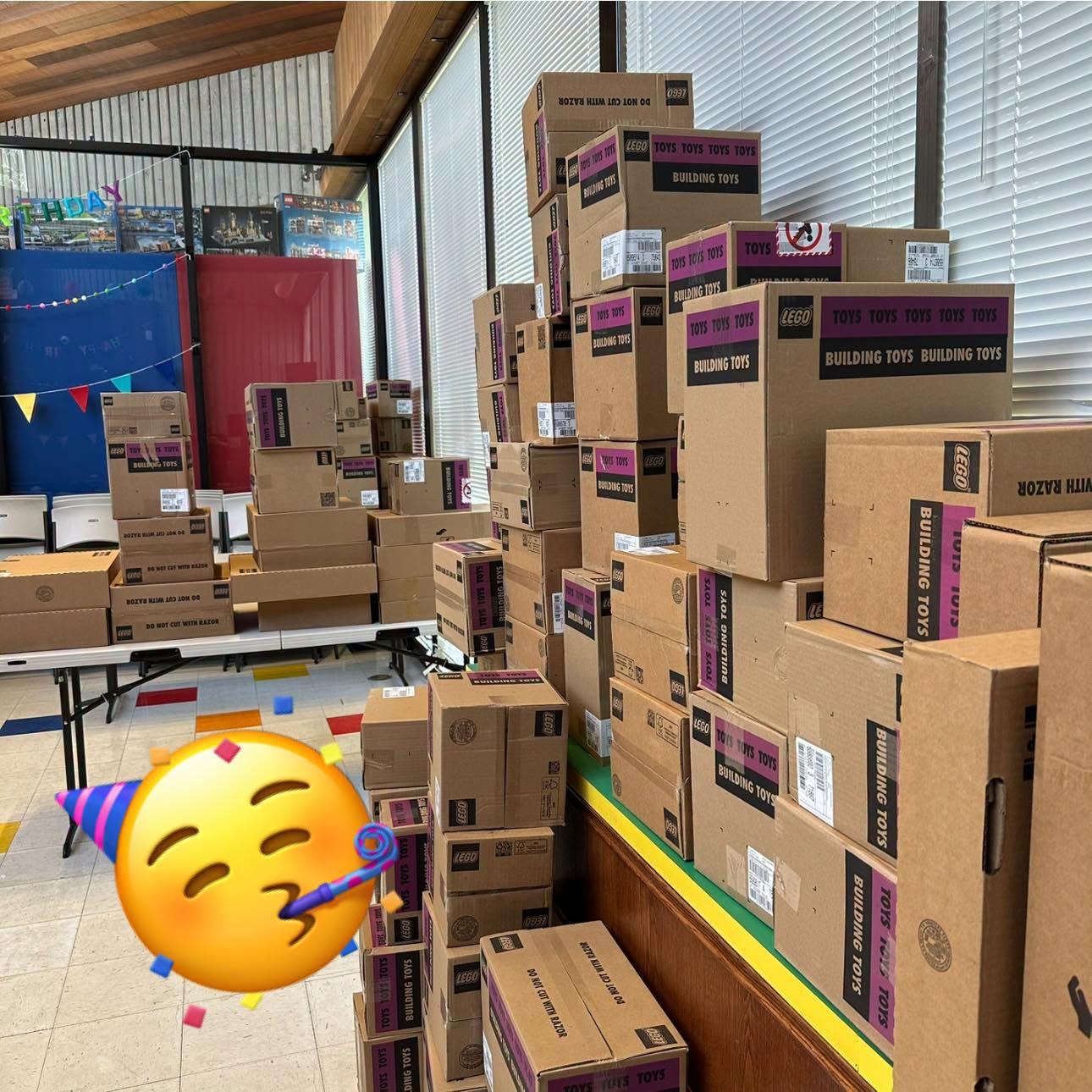
“Boise Corporate” is not fan slang. It is BAM’s own designation. The Boise store appears in every single edition of BAM’s FDD from 2017 through 2026 on the list of outlets “owned and operated by corporate and/or one or more of our officers,” with the same footnote each year: it is run by an entity in which BAM’s Chief Financial Officer is an owner. The Idaho registry puts a name on the entity, Teulu Legosy LLC, with CFO Reed Brimhall as its registered agent. Company store and CFO-family store are not competing descriptions. It is both at once.
One more publicly observable detail: on store page after store page that week, under the top posts, the same line: “Commenting has been turned off for this post.” We counted it across roughly ten stores’ pages, Boise included. The network’s customers were asking where the sets were, and the network’s pages closed the comments.
Boise is not alone on that list. The 2026 FDD counts six corporate or officer outlets against 217 franchised stores: Boise (the CFO’s family), San Ramon CA (“an entity in which our CTO is an owner”), Orem UT (the McNeff family’s own store, now held by a BAM subsidiary), Southington CT, Billings MT, and Lutz FL. And the state registries show the corporate set still growing through 2026: new BAM-managed operating companies stood up for Keizer OR, Port Charlotte FL, and a forthcoming Louisville store, plus an Oregon filing for the Eugene store that lists BAM Franchising, Inc. and its COO personally as the LLC’s initial members. The franchisor that tells regulators its stores are independently owned keeps ending up as the owner.
The witness who called it
Taveya Marconi managed the Boise store, inside the CFO’s family operation, and went on the record about it in a recorded interview published in July. Two of her statements matter here. She said owners were told a new arrangement to buy LEGO directly would begin in April 2026, an arrangement she said was conditioned on a piece of distribution infrastructure she was not sure actually existed. And she described roughly half the network’s owners as organizing toward the exits. When the August wave shipped late to the independents and on time to the store her old bosses own, she was the one the community credited for saying so first.
Inside the company’s own Slack
The stores were not only saying this in public. They were saying it straight to headquarters, in BAM’s own internal Slack, the workspace where every franchisee and the corporate team talk. We obtained those messages. We are not naming the owners who wrote them, and the messages themselves show why. What is left is the crisis in the company’s own words.
PRIMARY SOURCEReconstructed from BAM’s Slack; the posting owner’s identity is withheld. The “336 sets / 86 cases / over $10K” figures are that owner’s own tally of a single store’s missing order, not an audited total.
One owner put a number on a single store’s missing shipment: 336 sets, 86 cases, more than $10,000 of product, gone in the system with “nobody able to provide any kind of information whatsoever.” They laid out the shape of the failure, too: stores that received none of their order, stores that received part of it, and “an unknown number that received a significant amount of products they did not order.” The summary line: “Nobody knows where anything is in the system right now and there is no information available at all.”
And the executive whose job it is to fix that, BAM’s Director of Product and Logistics, Paul Hardcastle, had his Slack status set to “Unavailable until Monday, August 10th.” We do not know why, and we are not asserting it was a vacation; people set that status for planned leave, illness, or any private reason. What the channel shows is the timing: the person accountable for fulfillment was offline, by his own status, in the worst week of a fulfillment failure, and every owner could see it.
The owners could also see what happened to complaints about it.
PRIMARY SOURCEReconstructed from the same channel; owner identities withheld. The “moved to my private store channel” account and the description of that as standard practice are the owners’ own words.
When one owner asked, in the shared channel, where the logistics chief had gone, another said an earlier post on the subject had been “moved to my private store channel” on their behalf, lifted out of the room where every owner could read it. A third named the practice: shifting a complaint into an owner’s one-on-one channel with corporate and leaving it there is, they wrote, standard operating procedure. It is the same reflex as turning the comments off on a store’s Facebook post, this time aimed inward.
And for all the confusion in the channel, one owner had already named the place to look, half in frustration: Fort Worth, and FedEx.
The warehouse nobody owns
They were pointing at the right place. The infrastructure Marconi doubted is real, and it is not hard to find once you have the paperwork. We have the paperwork: a bill of lading from a shipment to the Bricks & Minifigs store in Anaheim, California, photographed on the store’s own front counter with the pallet of sealed LEGO cases it arrived with.
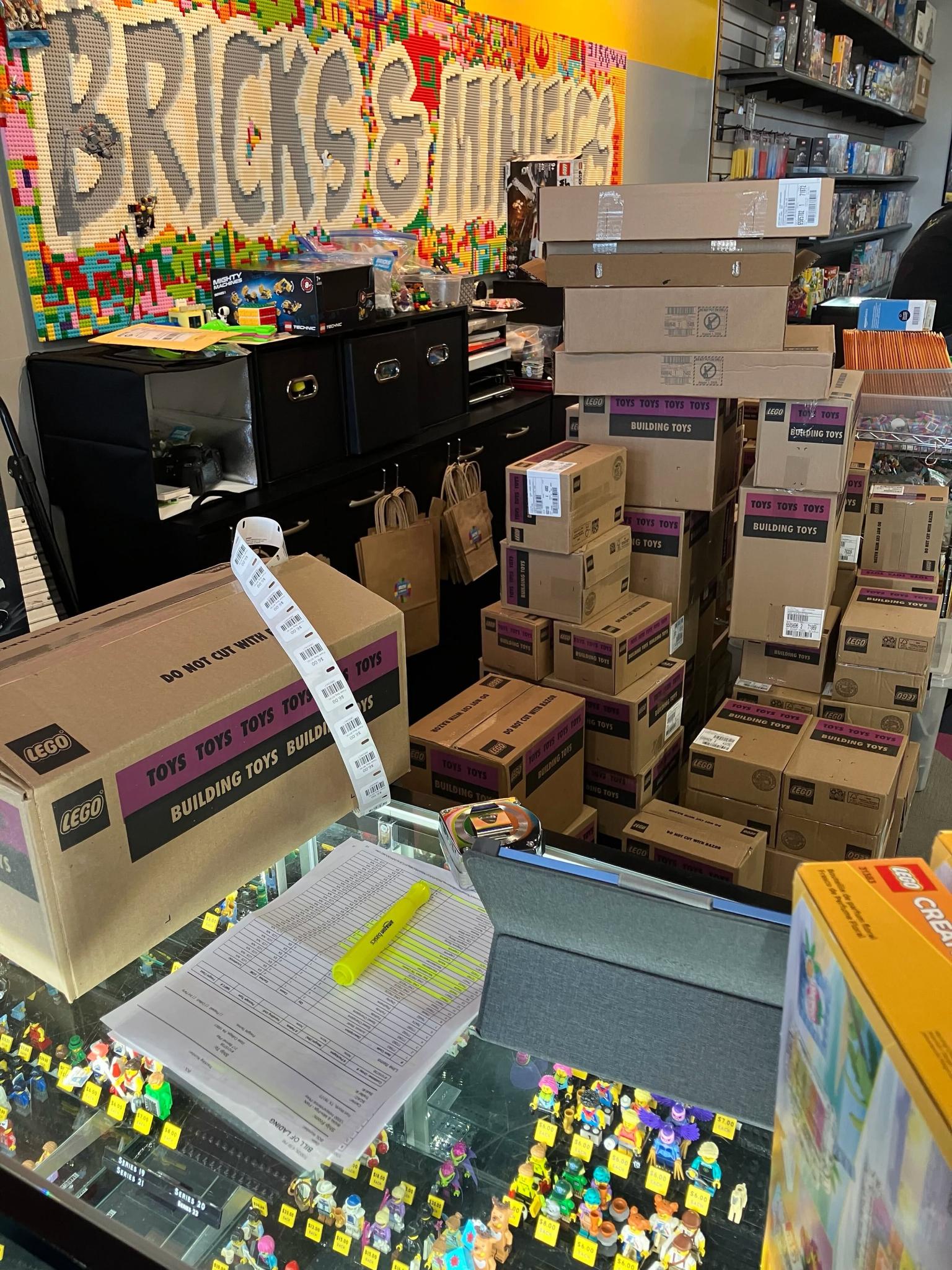
The form names the origin in plain type. “FWN” stands for Fort Worth North:
13550 Independence Pkwy
Fort Worth, TX 76177
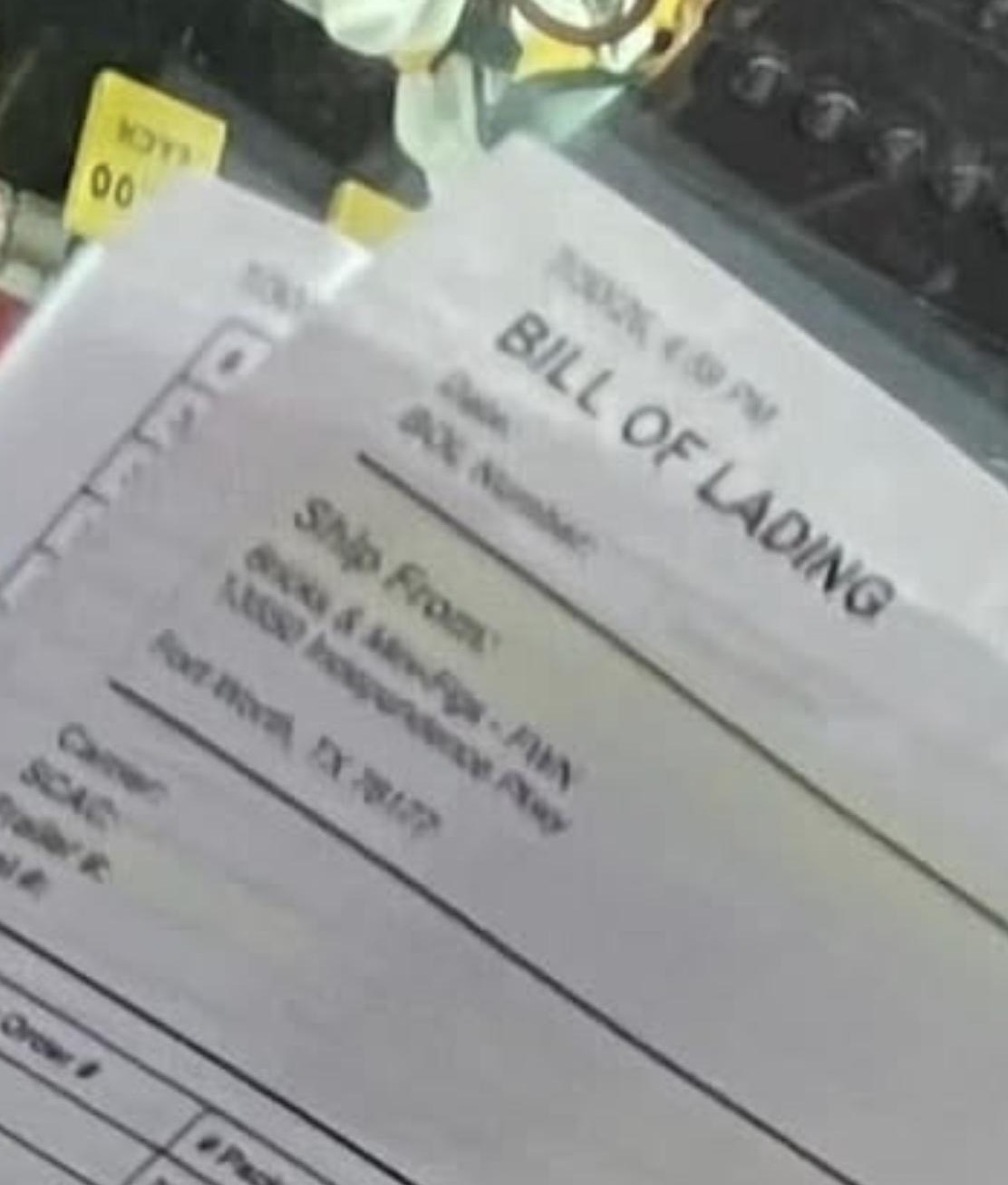
PRIMARY SOURCEBill of lading photographed with a received Bricks & Minifigs LEGO shipment; the “Ship From” block names Bricks & Minifigs - FWN at 13550 Independence Pkwy, Fort Worth, TX 76177. It is a blank stock copy, so the receiving store is not named on it. The received cartons are authentic LEGO master cases (“Building Toys,” “Do not cut with razor,” the LEGO logo).
Now look up that address, and the shape of the whole story repeats one more time. 13550 Independence Parkway is a 765,128-square-foot distribution warehouse in Alliance Gateway South, the Fort Worth industrial park developed by Ross Perot Jr.’s Hillwood. The land under it is held by a single-asset Hillwood entity. The operator on the county tax roll is FedEx Supply Chain, which claims a Texas “goods-in-transit” exemption on the inventory inside, the exemption written for product that passes through a building and ships back out of state. The warehouse is carried at $25.9 million on the 2026 roll. It is a contract logistics building: the same site laid off 280 workers in 2023, and roughly 300 more in 2025, each time because a client shifted its business to a different provider. Big third-party warehouses like this run dedicated space for one client at a time, and that space turns over.
PRIMARY SOURCETarrant Appraisal District, 2026 certified roll: a 765,128 sq ft warehouse in Alliance Gateway South; land owner a single-asset Hillwood entity; improvement labeled for FedEx Supply Chain; occupant of record FedEx Supply Chain Logistics & Electronics, Inc., filing a Freeport goods-in-transit exemption. The 2023 and 2025 layoffs are Texas Workforce Commission WARN notices, reported by the Fort Worth Report. We do not assert BAM was any departing client; the shipping record shows BAM still shipping from the site in 2026.
Now the part that matters. Search that county’s entire property roll for Bricks & Minifigs, for BAM Franchising, for any of the company’s names, and it returns nothing at all. BAM owns no building there, leases nothing in its own name, and files no business personal property. Its inventory physically sits inside FedEx’s warehouse, but FedEx is the one the county taxes on the operation. The distribution center at the center of the network’s supply is one more thing the company runs without owning, the same posture as the stores it holds through subsidiaries, the website it hosts, and the social accounts it controls. Own nothing, control everything, and route the product that every “independent” store is required to buy through a single building the company’s name never touches.
PRIMARY SOURCETarrant Appraisal District roll-wide search, 2026: zero accounts under Bricks & Minifigs, BAM Franchising, Minifigs, or Bricks by the Box. It corroborates the Texas franchise-tax record, which likewise shows no BAM entity registered in the state.
Which returns us to August. A network that funnels every store’s required inventory through one contracted warehouse has exactly one throat to choke. When the largest LEGO wave of the year moved through that single Fort Worth node, the independent stores posted apologies and waited, and the store the CFO’s family owns posted a full arrival. We are not asserting the warehouse chose whom to stock, and a single centralized pipeline can run slow for ordinary reasons. What the record supports is narrower and heavier: the choke point exists, the company built the network to run through it, and when it ran short, the company’s own store came away whole.
INFERENCEThat the single centralized Fort Worth node is why the August wave arrived unevenly is our reading of the structure, not a demonstrated cause; ordinary logistics can produce the same pattern. The primary-source facts are the one contracted warehouse, BAM’s zero ownership of it, and the stores’ own arrival posts.
What this is, and is not
To be fair, and this matters. Franchisors selling supplies to franchisees is legal and common; Item 8 exists precisely because regulators require it to be disclosed, and BAM did disclose the structure, the kickback while it ran, and the revenue line every year. A late shipment is not misconduct, and the store posts establish arrival order and completeness, not intent: two of the 22 stores in the community count were franchisees who did get their sets on time, at least one franchise store received before Boise did, and Boise itself arrived three days late. Ordinary logistics can produce a picture like that, and we are not claiming BAM diverted product to insiders; the defensible facts are narrower and they are the stores’ own words: the CFO-family store announced a full arrival while franchise stores were announcing halves and still-waiting. We are also not claiming the LEGO relationship is fake; the disclosure record cuts the other way, since BAM’s sworn description of its LEGO authorization got stronger in 2024, not weaker. The arithmetic defects may be sloppiness rather than design; but a disclosure document is the one place where sloppiness about your own take is not a small thing. The Slack messages we quote are franchisees’ own words, reproduced with their names withheld; the missing-product counts are one owner’s own tally, not an audited total; and a status set to “unavailable” is not proof of a vacation. We report what the company’s own channel shows, not a motive behind it. No one named here has been charged with anything. What the documents establish is the structure: the same company recruits the owner, finances the buildout, hosts the website, holds the social accounts, sits in the lease, approves the suppliers on criteria that include payments to itself, is itself the supplier, and owns a growing set of the “independent” stores it competes alongside. When something runs short in a structure like that, deciding who is made whole is corporate’s call to make. This month, corporate’s own store came away whole while its franchisees posted apologies. The paperwork above is how that call became corporate’s to make.
Sources: BAM Franchising FDDs, 2017 through 2026 editions, as filed with state regulators: Minnesota CARDS (incl. Doc #27859-202304-02, the marked 2023 filing preserving the struck fiscal-2021 disclosure; Doc #31301-202404-06, the marked 2024 filing preserving the kickback deletion; Doc #33584-202504-15, the 2025 edition) and California DOCQNET (2017 application 8756; 2018 application 11860); Idaho and Oregon Secretary of State registry filings; the stores’ own public posts: Boise, Aug 4, Frisco, Aug 5, Kenosha, Aug 4 (the July 30 to August 1 delay posts, since scrolled off the pages, are preserved in the archived community videos below and in our same-day captures); the Total AFOL post and the 22-store check; CNN’s launch-day coverage; the published Marconi interview (Extra Brick Nerd, July 2026); the Tarrant Appraisal District 2026 property records for 13550 Independence Parkway (parcel 10438061, owner 13550 Independence Pkwy Owner LLC c/o Hillwood, occupant FedEx Supply Chain) and the roll-wide search returning no BAM-controlled account; the Fort Worth Report’s reporting on the 2023 and 2025 FedEx Supply Chain workforce reductions at the site; and the bill of lading photographed with the received Bricks & Minifigs shipment; and messages reconstructed from BAM’s Slack, with the owners’ identities withheld. Related: the CDO who recruits the owners, one login runs every store, and what the shelves charge. Plain-language edition: read it here.
The BAM Map is independent reporting on matters of public concern. Nothing here is a finding of any person’s guilt; the criminal charges referenced are unadjudicated and every defendant is presumed innocent. Sources are linked so readers can check the record. · Home · Map · The law · Bodycam