The BJC translation
PRIMARY SOURCE
This is the plain-language edition of the supply post. Same facts, none of the citations. Every claim is stated again on the cited edition, with the disclosure documents, registry filings, and posts linked.
Every Bricks and Minifigs store tells its city it is independently owned. So here is a simple question: where does an independent store buy the LEGO on its shelves? The answer, from the company’s own required disclosure paperwork, is corporate. The owner is not allowed to buy from just anyone. The company keeps an approved list, the company decides who gets on the list, and the main approved source of the product is the company itself. Last year, corporate collected about 1.4 million dollars selling to its own store owners, roughly forty times what that line was a decade ago. Then, this month, the August LEGO shipment ran late across the whole network, and something instructive happened. The stores posting apologies to their customers were the independents. The store owned by the company CFO’s own family was photographed fully stocked.
You must buy from us
When a company sells franchises, the law makes it hand every buyer a disclosure document, and one section of that document has to answer a blunt question: what will the owner be forced to buy, and from whom? BAM’s answer, in its own words, is a list that keeps growing. The owner must use the cash-register system corporate requires. The owner must use the credit-card processor corporate designates. The owner must use the gift-card system corporate designates. And as of last year, the owner must also buy the storefront signage, the employee shirts, the nametags, and the branded shelving from corporate’s designated suppliers. Ten years ago that list was one sentence about a cash register. It has grown every few years since.
An owner who wants to buy from anyone else has to run a gauntlet. The would-be vendor fills out corporate’s form, signs corporate’s secrecy agreement, pays a hundred-dollar assessment fee per product, and covers the cost of testing, and then corporate decides, in its own words, at its own discretion, and can revoke the approval whenever it likes. And here is the detail worth reading twice. Among the factors the company says it weighs when approving a supplier is what the supplier contributes to the company itself. Whether a vendor gives corporate something is a stated part of whether that vendor gets approved. That sentence has been in the paperwork for a decade.
The paperwork also carefully notes that no company officer owns a stake in any supplier. Which is true, and beside the point. The supplier collecting the money is not some executive’s side business. It is the company itself.
The math that does not add up
Each year, the company has to disclose how much it made selling things to its own store owners. The dollar line marches straight up: from about thirty-four thousand dollars a decade ago to about 1.4 million last year. But look closely at the newest document and something is off. It says the 1.4 million was 9.68 percent of the company’s total revenue, and it prints the total revenue right there in the same sentence. Do the division yourself and you get 10.33 percent. The two numbers and the percentage between them cannot all be true at once. The year before is stranger still: the document swears its percentage was computed from the company’s audited financial statements, but the total it uses does not appear anywhere in the audited statements attached to that very same document. This is the one document whose whole legal purpose is accuracy, and the company’s arithmetic about its own take does not survive a pocket calculator.
The disclosure that vanished
For years, the same section disclosed something stranger than the store-supply business. The company was taking a cut from the credit-card processor its stores were forced to use. Not a small cut: fifteen to thirty percent of the processor’s net revenue on the stores’ card swipes, plus a twenty-five dollar bounty for every new store account opened. The stores had no choice of processor. Corporate chose the processor, and the processor paid corporate.
Then watch what happens to that disclosure over three years. First it flips to the past tense: the company switched processors, it says, and no longer receives these payments. Then, the year after that, the whole passage is deleted, and because one state requires companies to file a marked-up copy showing every change, the deletion itself is preserved in the public record, crossed out in the company’s own filing. A new franchise buyer reading today’s paperwork cannot learn the kickback ever existed. One fossil survives: the current document still promises the company receives no other rebates. Other than what? The sentence that word referred to is gone.
And this is a habit. One whole year of the company’s selling-to-owners revenue survives today only as crossed-out text in a state filing, because one edition repeated the previous year’s numbers and the next edition papered over the fix. And last year, at the same time the company was adding shirts and signage to the must-buy list, it quietly deleted a sentence that had been there for a decade, the one admitting it does not tell owners what its supplier-approval criteria actually are. More required buying, less explanation, and a history that keeps getting shorter.
Then August happened
Every August, LEGO ships its biggest wave of new sets of the year. This one was ninety-five sets, and on August first they showed up on time at LEGO’s own store, at Amazon, and at Walmart. Independent used-LEGO shops that are not part of this franchise got theirs too; one posted that both of its locations were fully stocked. The wave shipped. It just mostly did not arrive at Bricks and Minifigs stores. And the stores said so themselves, in public, one after another. Two days before release day, the Grand Rapids store told its customers the August inventory had not even shipped, and cancelled its midnight release party. On release day, the La Mesa store apologized that its shipment was delayed until the next week, and the Coeur d’Alene store posted a graphic with a clock on it that just said delayed. A fan community counted twenty-two stores that day and found exactly two that got their sets on time.
The rest trickled in late all week. One store announced its arrival two days late. Another was still telling customers on day four to come shop the used sets while you wait for the new drops. Another posted on day five that the first half of its order had just arrived. Half.
Then there is the Boise store. On day four it posted, with two laughing emoji: better late than never, the August sets have arrived, and we are getting them on shelves today. Not half a shipment, and not an apology. Arrived, in full, onto the shelves, while franchise stores that same day and the next were posting halves and still-waiting. A LEGO fan account put the contrast plainly that afternoon, over a screenshot of Boise’s own post and its wall of sealed LEGO boxes: the corporate store received its order just fine, while owners it had spoken to still had nothing and had been, in its words, left flapping in the wind.
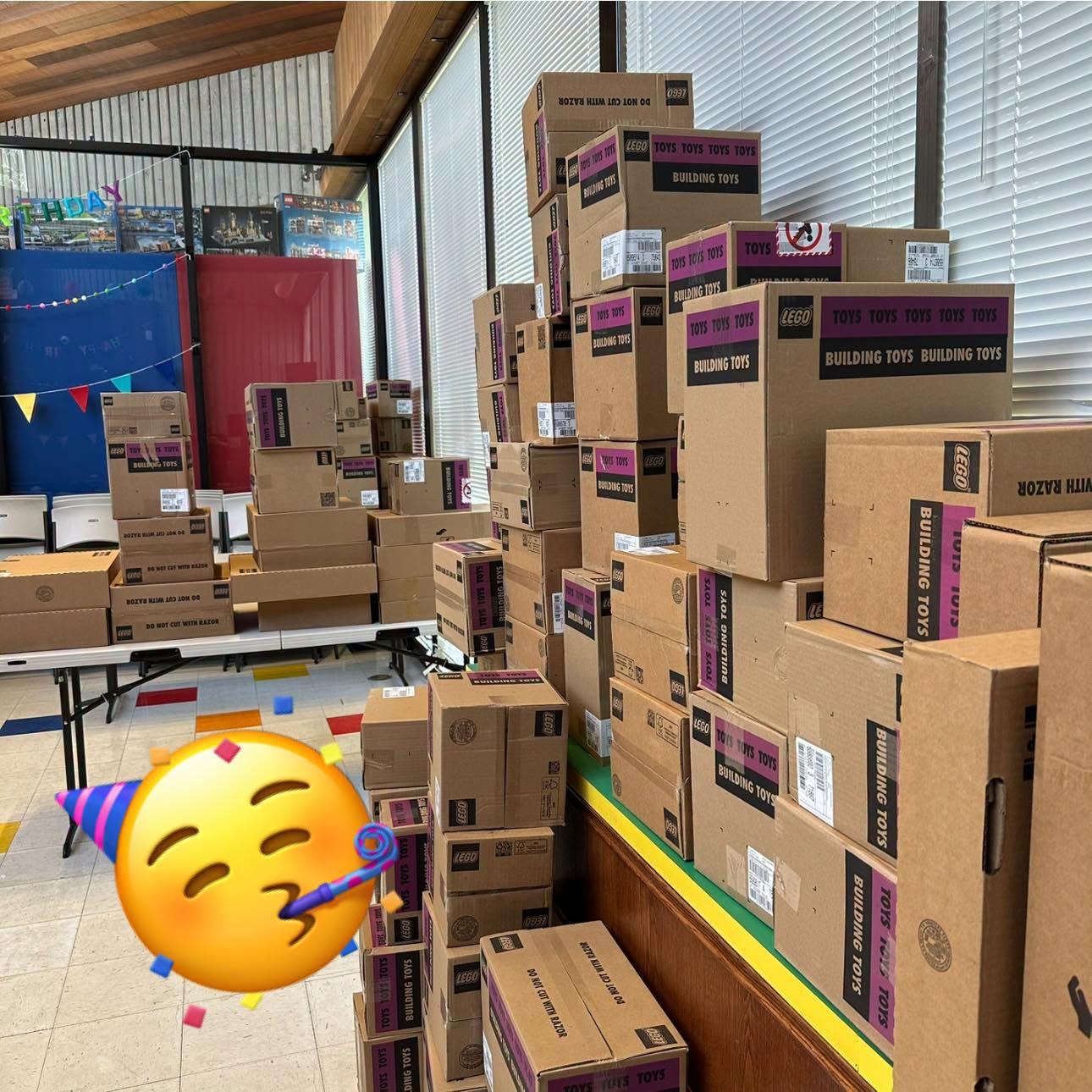
And calling Boise a corporate store is not fan slang. It is the company’s own label. In every edition of BAM’s disclosure paperwork for the last decade, the Boise store sits on the company’s own list of stores owned by corporate or its officers, with the same note each year: it belongs to a company the Chief Financial Officer has a stake in. It is a company store and it is the CFO’s family store. Both at once.
One more detail anyone can see. That week, on store page after store page, under the top posts, the same line appeared: commenting has been turned off for this post. We counted it across roughly ten stores’ pages, Boise included. Customers were asking where the sets were, and the pages closed the comments.
Boise is not the only one. The current paperwork lists six stores owned by corporate or its officers, next to more than two hundred franchised ones: the CFO’s family store in Boise, a store owned by the technology chief’s family in California, the founder family’s own store in Utah, and three more the company took back and runs itself. And the state filings show the corporate side still growing this year. For one Oregon store, the new operating company’s formation papers list the franchisor itself, and its chief operating officer personally, as the owners. The company that tells regulators its stores are independently owned keeps turning up as the owner.
The witness who called it
Taveya Marconi used to manage that Boise store, inside the CFO’s family operation, and this summer she went on the record about the company in a recorded interview, under her own name. Two things she said matter here. She said owners had been promised a new way to buy LEGO directly, starting next spring, but only if a piece of shipping infrastructure got built that she was not sure actually existed. And she said roughly half the owners in the network were organizing toward the exits. When the August wave arrived late for the independents and on time for the store her old bosses own, she was the one the community credited for saying so first.
Inside the company’s own Slack
The stores were not only saying this in public. They were saying it straight to headquarters, in the company’s own internal Slack, the chat where every owner and the corporate team talk. We have those messages. We are not naming the owners who wrote them, and the messages themselves show why. Here they are in the company’s own words.
One owner added up a single store’s missing shipment: 336 sets, 86 cases, more than ten thousand dollars of product, just gone, with no one able to say where it was. Some stores got nothing, some got part of their order, and some “received a significant amount of products they did not order.” No one, the owner wrote, knows where anything is.
And the person whose job it is to fix that, the company’s head of product and logistics, Paul Hardcastle, had set his Slack status to away until the following Monday. We don’t know why, and we are not saying it was a vacation; people mark themselves away for all kinds of private reasons. What the chat shows is the timing: the person in charge of getting stores their product was offline, by his own status, during the worst week of the shortage, and every owner could see it.
They could also see what happened to complaints about it.
When one owner asked, in the shared chat, where he had gone, another said an earlier post about it had been “moved to my private store channel” for them, taken out of the room where everyone could read it. A third said that is just what happens: a complaint gets moved into your private channel with corporate and left there. It is the same move as turning off the comments on a store’s Facebook post, aimed inward this time.
And for all the confusion, one owner had already named the place to look, half in frustration: Fort Worth, and FedEx.
The warehouse nobody owns
They were pointing at the right place. The infrastructure Marconi doubted is real, and we have the shipping paperwork that shows it. It is a bill of lading from a delivery to the Bricks and Minifigs store in Anaheim, California, photographed on the store’s front counter next to the stack of sealed LEGO boxes it came with.
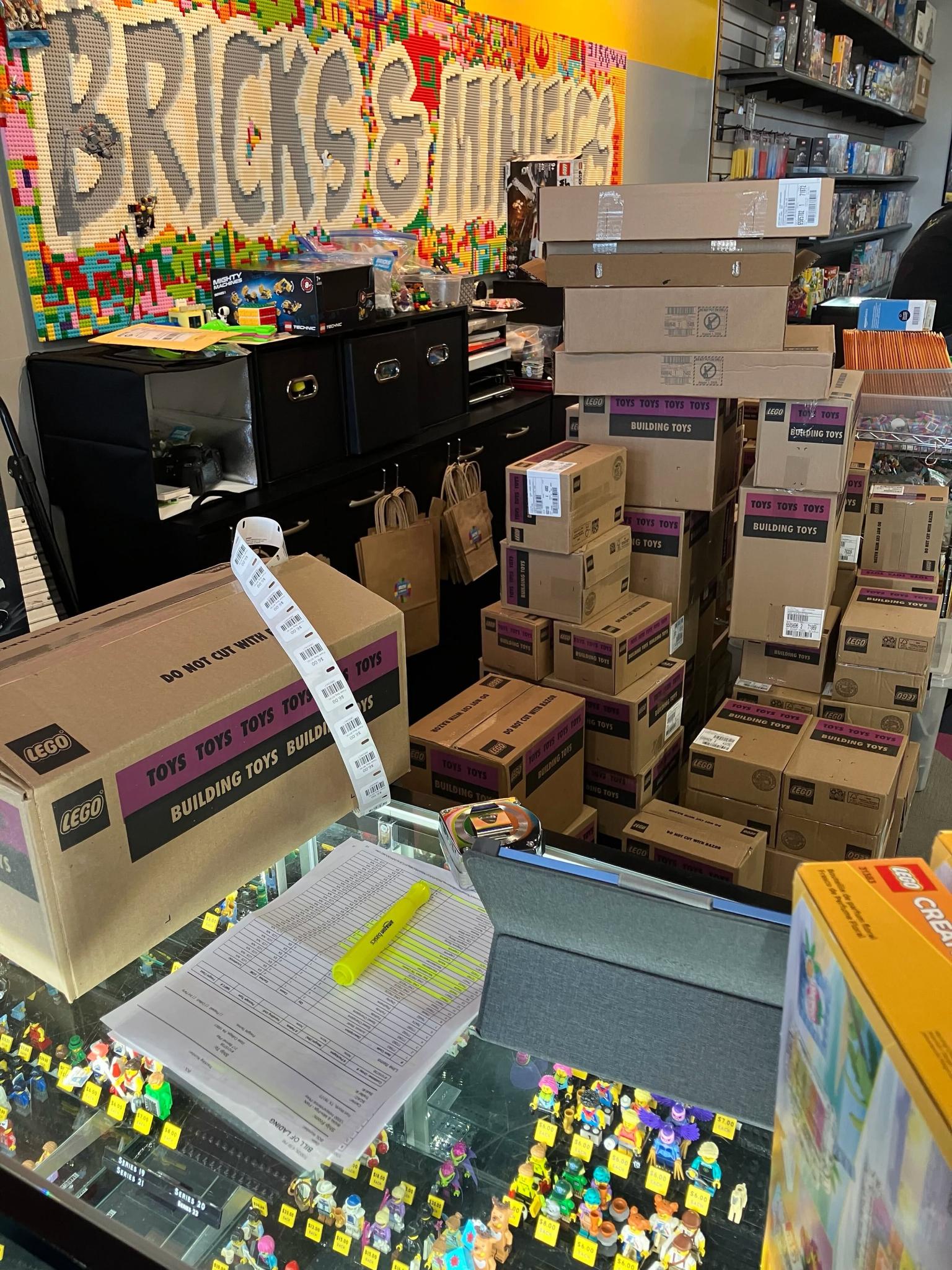
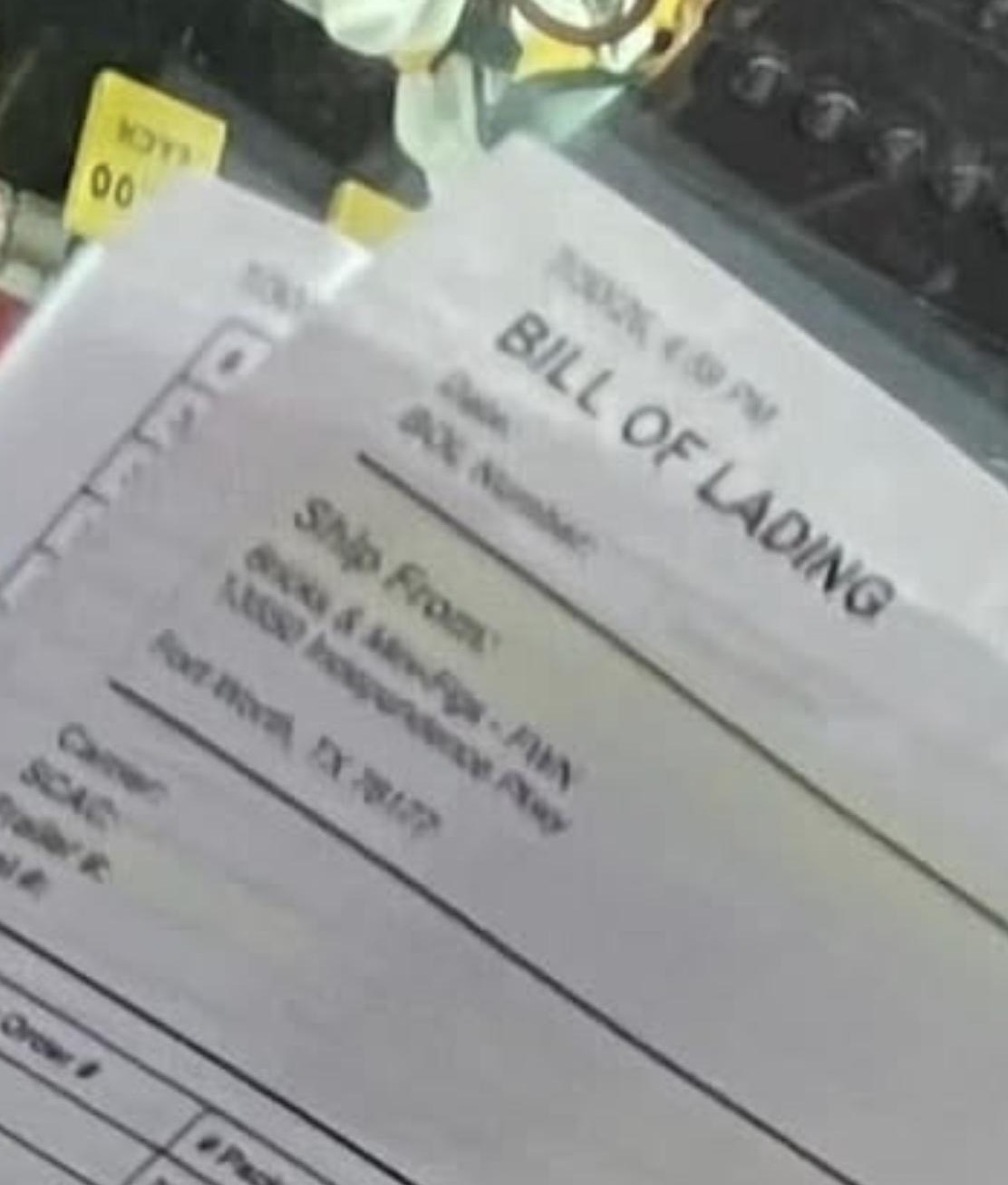
The form names where it shipped from in plain type. FWN stands for Fort Worth North:
13550 Independence Pkwy
Fort Worth, TX 76177
Look up that address, and the same shape appears one more time. It is a giant distribution warehouse, more than seven hundred thousand square feet, in an industrial park built by one of Texas’s big developers. The land under it belongs to that developer. The company that actually runs the warehouse is FedEx, which files it with the county as goods passing through on their way back out of state. The building is worth about twenty-six million dollars. It is a contract warehouse that works for one big client at a time: the same site laid off hundreds of workers twice in three years, each time because a client moved its business somewhere else. None of it is BAM’s.
Here is the part that matters. Search that county’s entire property records for Bricks and Minifigs, or for the franchise company’s name, or for any name it uses, and you get nothing at all. The company owns no building there, rents nothing in its own name, and files nothing. Its inventory sits inside FedEx’s warehouse, but FedEx is the one the county taxes for it. The distribution center that the whole network’s supply runs through is one more thing this company operates without owning, exactly like the stores it holds through other companies, the websites it hosts, and the social accounts it controls. Own nothing, control everything, and route the product every “independent” store is required to buy through one building the company’s name never touches.
Which brings us back to August. When a whole network’s required inventory runs through one warehouse, there is exactly one place for it to get stuck. When the biggest LEGO wave of the year moved through that one place, the independent stores posted apologies and waited, and the store the CFO’s family owns posted a full arrival. We are not saying the warehouse picked who got stocked, and one central pipeline can run slow for perfectly ordinary reasons. The narrower, heavier point is this: the choke point is real, the company built the whole network to run through it, and when it ran short, the company’s own store came away whole.
What this is, and is not
To be fair, and this matters. A franchise company selling supplies to its own store owners is legal and common; that is exactly why the law makes them disclose it, and BAM did disclose the structure, the processor cut while it ran, and the revenue line every year. A late shipment is not a crime. And the store posts prove arrival order, not intent: two of the twenty-two stores in that community count were regular franchisees who did get their sets on time, at least one franchise store received before Boise did, and Boise itself was three days late. Ordinary shipping mess can produce a picture like that, and we are not claiming the company steered product to insiders. The narrow facts, in the stores’ own words, are these: the CFO’s family store announced a full arrival, while franchise stores were announcing halves and still-waiting. We are not claiming the LEGO relationship is fake; if anything, the company’s own sworn description of its LEGO authorization has gotten stronger over the years, not weaker. The bad arithmetic may be sloppiness rather than design; but a disclosure document is the one place where sloppiness about your own take is not a small thing. The Slack messages we quote are the owners’ own words, printed with their names left off; the missing-product numbers are one owner’s own count, not an audited total; and marking yourself away is not proof of a vacation. Nobody named here has been charged with anything. What the company’s own paperwork establishes is the structure. The same company recruits the owner, arranges the financing, hosts the store’s website, holds its social media accounts, sits in its lease, decides which suppliers are allowed using criteria that include payments to itself, is itself the main supplier, and owns a growing set of the “independent” stores it competes alongside. In a structure like that, when something runs short, deciding who is made whole is corporate’s call. This month, corporate’s own store came away whole while its franchisees posted apologies. The paperwork is how that call became corporate’s to make. The cited edition links every document, so you can read them yourself.
The BAM Map is independent reporting on matters of public concern. Nothing here is a finding of any person’s guilt; the criminal charges referenced are unadjudicated and every defendant is presumed innocent. Sources are linked so readers can check the record. · Home · Map · The law · Bodycam