Tyler Shaw, Sheldon Norcross, Sierra Lauts and Steven Allen, represented by civil rights lawyer Solomon Radner, sued the City of American Fork and thirteen of its police officers in federal court today, alleging their civil rights were violated over four days in March.
None of the four was ever charged with a crime. Their 52-page complaint, assigned to Judge Robert J. Shelby as No. 2:26-cv-01008, runs on the police chief’s own words: the search warrant affidavit, he said after a review, was “one of the biggest places where we screwed up.” Nineteen counts: a stop for a stop-sign violation the chief now says did not happen, a two-hour stop with a drug dog after a .000 breath test, a process server trespassed from a property she never entered, a phone seized when its owner declined to talk, a warrant for “stolen merchandise, specifically Lego merchandise,” and an entry with a rifle that handcuffed everyone inside, a 16-year-old included.
PRIMARY SOURCEThe Complaint and Jury Demand, 52 pages, document 1 in Norcross v. City of American Fork, No. 2:26-cv-01008-RJS (D. Utah), filed October 14, 2026; the docket; the plaintiffs’ press release. The complaint is on this page.
AS PLEADEDEverything below about what officers did, said and wrote is the plaintiffs’ account, as their complaint states it, from the department’s own reports, affidavit, return and camera footage and from two recorded meetings between a city resident and the chief. No defendant has answered.
CONFIRMEDFour of the complaint’s facts were on this site before the suit was filed, from the department’s own release: the stop-sign claim (July 17), the affiant’s camera gap (July 15), the muted minutes (the takedown) and the entry (the bodycam).
AS REPORTEDThe press conference at 10 a.m. Mountain time, from the live stream the YouTube channel Brother Counsel carried from Spencer Fane’s office; each quotation carries its time on the stream.
The suit
Three of the plaintiffs are people the police took out of a basement rental in handcuffs on the evening of March 11; the fourth is the man whose phone two of the same officers had seized that afternoon. Two of them, Shaw and Lauts, are also the driver and the process server the officers had stopped on the three days before. The complaint calls them “four young adults who learned of the story and offered to help” a YouTuber document a dispute over an Oregon family’s LEGO collection. Shaw was 23 and lives in American Fork; Allen lives in Saratoga Springs; Lauts in Utah; Norcross in Illinois. (The press release calls them “Four Utah residents.”)
The defendants are the city and thirteen members of its police department, each sued personally: Officer Cole G. Richardson, Lieutenant Quinn Adamson, Officers S. Hawkins, K. Fraughton, R.J. Bibeau, L. Sumbot, J. Somerville, Spencer Tonga, J. Laycock and D. Gonzalez, an Officer Jensen and a Sergeant Lott whose first names the complaint does not know, and Detective W. Nicosia. The chief is not a defendant. He is the complaint’s most quoted witness.
- March 8Unreasonable seizure of Shaw, the stop-sign stop (Richardson, Tonga).
- March 9Unlawful stop and prolongation of Shaw’s second stop (Hawkins, Fraughton, Bibeau); unlawful search of his car (Hawkins, Fraughton).
- March 10Unreasonable seizure of Lauts (Sumbot, Somerville); retaliation for serving court papers (Sumbot).
- March 11, afternoonThe sign taken down for what it said (Adamson, Richardson); Norcross’s phone seized, his arrest, retaliation (Richardson, Adamson, Nicosia); a threat to arrest Allen for filming and asking questions (Adamson).
- March 11, eveningA false and misleading warrant affidavit (Richardson, Adamson); no knock, no announcement; guns pointed at compliant, unarmed people; arrest and detention without probable cause; searches of persons and property (the entry team, Lott, Adamson, Nicosia, in the combinations the complaint names).
- All four daysRetaliation against all four (Hawkins, Fraughton, Richardson, Adamson, Sumbot); supervisory liability (Adamson, Lott); the city, under Monell.
They ask for compensatory damages, punitive damages against each officer, fees, and a jury. The complaint is signed by Scott Young of Spencer Fane in Salt Lake City, with Radner, of Southfield, Michigan, “pro hac pending.” R. Scott Young of the same firm is Schneider’s counsel of record in BAM Franchising’s suit against him in the same court (September 1). Commentary channels named Radner in August as the lawyer a second man at a council hearing said he shared with Schneider; this site did not confirm it then (August 12). His name is now on a complaint, for these four.
March 8: the stop sign
Shaw was driving his Hyundai Elantra with Schneider as his passenger at about 12:50 p.m. Officer Richardson had just arrived at Joshua Johnson’s residence on a call about a package and, in his own words, “flipped [his] patrol vehicle around to try and follow the suspect and hopefully gather a license plate.” He stopped the car and wrote that he “observed the vehicle fail to stop before the stop line at a stop sign, as well as failure to come to a complete stop.” His own dash camera shows a two-second stop at a corner with no stop line (July 17).
The chief, after reviewing the footage: “I do not believe there was a stop sign violation”; “he clearly misremembered, and it was clearly not a stop sign violation.” Richardson, he said, “should have based his stop on that reasonable suspicion to begin with and not try to have drummed up some kind of other offense.” Once stopped, Richardson pursued no traffic matter. He took Shaw’s license, turned to the back-seat passenger, and held the car until Officer Tonga arrived; Tonga questioned both men about the package and “notified” them they were “trespassed” from Johnson’s property. Fifteen to twenty minutes; no citation; Richardson “took no action on the traffic offenses.”
March 9: “I was gonna scare him a little bit and let him go”
The next evening Shaw, again with Schneider in the car, stopped to pick up an acquaintance whom Officer Hawkins had just told he was trespassed from Johnson’s property. Hawkins saw the man “attempt to get into” the car and stopped it. He never told Shaw why. He opened with: “I’ll ask again because I wasn’t born yesterday. Why are we harassing people?” He and Officer Fraughton then said Shaw’s eyes “were glossy and seemed to have a red layer of tint in them.”
Before the sobriety tests, Hawkins explained the stop to another officer in his patrol car. The in-car camera recorded it. Were “these guys” good “to drive”? “Yeah, I think so. I didn’t see anything clear as day with Tyler that I noticed.” Then: “I was gonna scare him a little bit and let him go.” Asked “do we have . . . charges or are we just tired of them being annoying?”, he said he would “try to link it to” Schneider, and that “we don’t really have a harassment code in Utah.” That line was already on this site: the department’s release had muted it, and the unredacted original gave it up (the takedown).
As the sobriety tests began, Hawkins’s body camera went mute for about forty-seven minutes. His report: “From this portion on in my investigation I did not realize my body cam was muted. Therefore there will be no sound from this moment on.”

Shaw showed no clues on the eye test and none on the third; Hawkins claimed three on the walk-and-turn. The report on the tests twice calls the subject “Johnny,” a person who was not there. Shaw blew “.000 BrAc.” Hawkins told him to “wait on by the curb” and called for Fraughton’s dog, Bane. The officers said it “alerted”; the plaintiffs say it did not. The search: “nothing of note or substance was located in the vehicle.” About 6:40 to about 8:35 p.m. No citation. The chief, later: “I can’t prolong a stop just for a canine sniff unless I have something more.” And on scaring people: “There are times we will do that where we’ll go out and we’ll help somebody understand the gravity of the situation and make it appear very serious to them or as serious as it is. And then we will use our discretion and cut them loose.”
March 10: the process server
Lauts drove Schneider to a public street near Johnson’s home to serve him with the summons and complaint in the Oregon case, Marion County Circuit Court No. 26SC06134. She was over eighteen, a legal resident and not a party, so qualified to serve. She stayed in her car for about thirty minutes, waiting for him to come out. Johnson told dispatch that a woman with “long, fake, red, curly hair” had come near his door, taken pictures and left on foot; Lauts’s hair is black with blond streaks and she was in a parked car. When he called 911, the department’s own records reflect that he suggested he might shoot someone; an officer later asked him, “One of the dispatchers made a note, saying you were gonna shoot someone?”, accepted his explanation, and took no action.
Officers Sumbot and Somerville came to her car, demanded identification and an address, and asked whether she was a “legal” process server. Johnson said the papers were fake and asked that she be arrested for “impersonating a process server.” Sumbot called the Marion County court, which confirmed the case was real and that Johnson still needed to be served. Sumbot carried the papers to the door but did not deliver them; Johnson was allowed to refuse. The officers, among themselves: “I’m just gonna see if he wants the girl trespassed.” To Johnson: “So what do you want done today, do you want her trespassed?” Johnson: “no, I want them for stalking.” Sumbot told Lauts that Johnson “wanted her trespassed from the property and not to return.” She had never left the public street. Schneider was arrested that day for stalking and targeted residential picketing, the case now set for a preliminary hearing on December 16 (October 5).
March 11, afternoon: the sign and the phone
Norcross, Lauts and others went to a street near Johnson’s home to film a short video for a GoFundMe for Bryan Mansell and his father. With the fence owner’s permission they hung a sign: a caricature of a man holding cash beside an elderly man in a hospital bed, captioned “‘I stole a dying man’s life savings.’” Richardson and Adamson arrived. Richardson saw Norcross on a FaceTime call with Schneider, asked if it was “Ben,” and told him that “Ben was the one organizing all of the people to be here.” He checked with the neighbors: “All the neighbors I had spoken with told me that was okay and it was for a GOFUNDME as far as they knew.” Adamson went back to the owner anyway, told her the sign “may be de-constructive and cause problems with her neighbor,” and only then did she say she no longer wanted it. He cut it down himself. Richardson booked it as an “artificial intelligence created sign of victim.”
Richardson then went to his car “to look at the Utah Code for Stalking to see if Ben had committed a crime again,” and concluded Schneider had, “because I found Sheldon had been face timing Ben, likely because he was there on Ben’s behalf.” He ordered Norcross out of the car and read him his rights. The footage: “Okay, with these rights in mind, uh, do you still wish to talk with me?” “No.” “No? Okay. Um, and Lieutenant, Lieutenant Adamson can correct me if I’m wrong. We’re going to seize your phone right now.” The report says the same thing in one sentence.
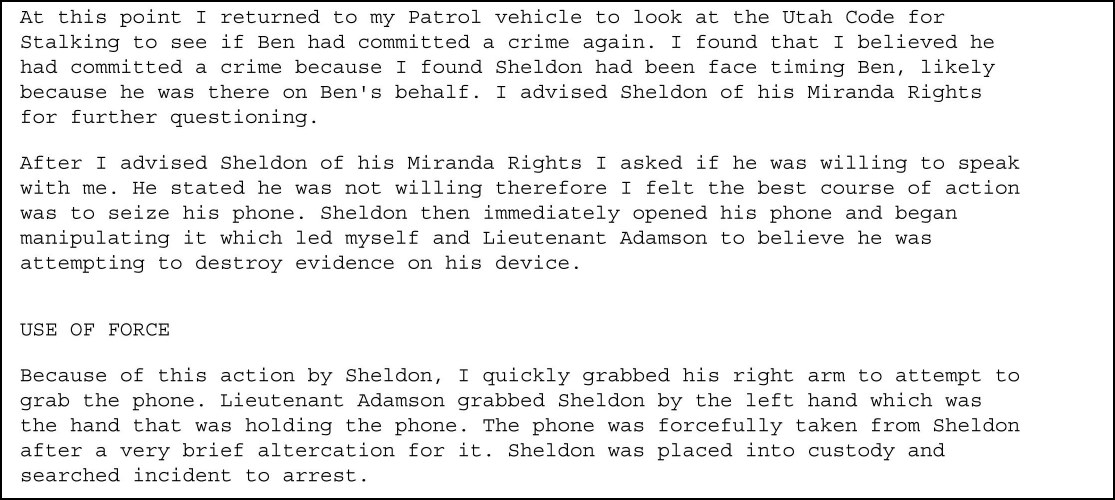
Seconds later: “Do not do that. . . . right now you’re attempting to destroy evidence. Okay, put your hands behind your back.” Norcross: “I swear, man, I was gonna give you the phone. I was just locking it. That’s all I was doing.” His Apple Wallet screen was open and he pressed the side button to lock it; locking a screen deletes nothing. The two officers’ reports disagree on the moment: Richardson wrote that Norcross “immediately opened his phone and began manipulating it”; Adamson that he had already “handed me his phone” and then “quickly pulled it away and attempted to manipulate it.” Richardson took the right arm, Adamson the left hand, and “[t]he phone was forcefully taken from Sheldon after a very brief altercation for it.” On camera: “you’re under arrest for obstruction of evidence right now,” and “if you cooperate, I think there’s a high probability we cut you a break today. Just food for thought.” The chief, later: what is written in the report “would not be a justification for seizing the phone.”
Allen had come to film. Adamson told him to leave; he did; when he came back to ask what was happening, Adamson told him “he needed to leave or I would arrest him for interfering.” Richardson ordered everyone else out of the car: “I promise none of you go to jail if you don’t be stupid like him.” Lauts answered his questions; he found no “malicious intent” and released her. Norcross rode to the station in handcuffs, where officers called it a “detention.” Detective Nicosia questioned him, switching off his own camera “to review the case and to speak with my supervisor about the case,” and had him enter his passcode to show how the wallet screen worked. Held from about 3:30 to about 8:00 p.m.; released without charges; phone returned.
March 11, 5:11 p.m.: the affidavit
After clearing the scene, Richardson learned that a fellow officer’s neighbor had “some Youtubers” renting a basement Airbnb in American Fork. Adamson and another officer watched the house from an unmarked car and saw the car associated with Schneider. Officers contacted the homeowner, who provided exterior video of Schneider entering at 3:58 p.m. No officer recorded that conversation; the chief has said every video the department has was released, so that “if something hasn’t been released, then it means [it] just does not exist.”
At 5:11 p.m. Richardson, “a POST-certified officer of roughly one year’s experience,” swore the affidavit. The only property it named was “Any stolen merchandise, specifically Lego merchandise.” For probable cause that such merchandise was inside, he swore:

“That statement was false,” the complaint says: no one inside discussed “stolen Lego toys that they had taken,” and there is no recording of what the homeowner did say. The affidavit also dated the sign incident “March 3rd of 2026,” said Schneider was “arranging various amounts of individuals to go to the victim’s residence and enter his property” when none of the plaintiffs had entered it, called the sign “defaming,” and left out that the fence owner had given permission and that Richardson had confirmed it. A Fourth District magistrate signed at 5:37 p.m. The affiant’s own body camera was off from 3:53 to 5:47 p.m., the whole window in which he swore and the judge signed (July 15).
“I will say that the search warrant affidavit presents one of the biggest places where we screwed up.” “This didn’t really have anything to do with Legos. We weren’t going in to look for Legos. We didn’t even search the residence for Legos.” “in my opinion, we should have never even put Legos in this affidavit.” The chief, as the complaint quotes him.
And: “a new officer wrote this affidavit. We have a clear directive and policy that search warrant affidavits have to be reviewed by a supervisor in our department, and in this case . . . [t]his did not get reviewed by a supervisor.” “Basically what I’m getting at is we failed here.”
March 11, 5:49 p.m.: the door
Richardson’s operations plan, in his words, was “to open the door which was presumed unlocked, and call out any present individuals one at a time, and take them into custody”: everyone inside, before anyone knew who was inside. Officer Laycock led, then Richardson, Tonga, Gonzalez, another officer and Sergeant Lott; Adamson, assigned to the perimeter, went to the door with them. Inside were Lauts, Shaw, Allen, Schneider and a 16-year-old boy. Shaw had come to help edit video; Allen had returned after being sent away from the sign; Lauts after being told she was free to go.
At about 5:49 p.m. the stack formed at the door with guns drawn; Adamson’s camera shows it at 17:49:10 and an occupant pulled out with his hands up two seconds later. The officers did not knock and did not announce and wait. Richardson’s report claims “[o]fficers announced ‘Police Search Warrant,’” but his own camera records the cue, “You ready? On you.”, followed at once by “Everybody step out. Stand up and come outside. Right now. Let’s go. Step outside. Step outside, everybody.” The chief, later: “Just because the door’s open does not allow you on a knock-and-announce warrant to just enter the premises. Like, there’s no debating that.” The department’s own transparency entry, filed with the state, classifies the warrant as “Knock and Announce Day,” records no “Force Entry,” and counts “Number of Arrests: 5.”
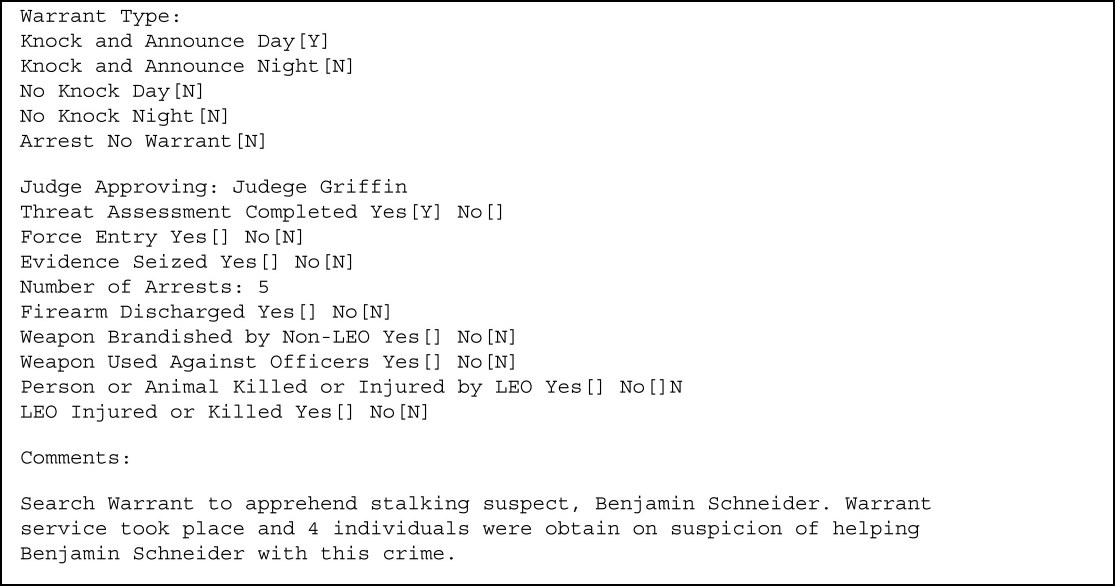
Richardson “held lethal coverage with [his] Patrol rifle” while Tonga called the occupants out one at a time and cuffed them. No one inside was armed, the complaint says; the entry’s own form records that no one but officers brandished a weapon. Tonga: “Okay, we’re gonna search you, all of you.” Each of the three plaintiffs inside was handcuffed and searched; Lauts’s bag and Shaw’s phone, identification and backpack were taken; Lott told the group “some of you may get to jail”; all three were driven to the station and put in holding cells. Lauts, who relies on an inhaler, said, “I may need it, this is a stressful situation, and that makes my breathing not great,” was told, “If you need it, I want you to tell me so I can get it for you,” and then had no one to tell, for nearly two hours. The officers did not search the apartment for LEGO: a few minutes inside, one closet, no cupboards. The return Richardson swore the next morning: “Benjamin Schneider was arrested. No items siezed.” Nicosia questioned each of the three for fifteen or twenty minutes and pressed Lauts to say the GoFundMe had been Schneider’s idea. Held from about 5:49 to about 8:05 p.m., then released. The chief, later: what the officers needed was “individualized, probable cause for all five individuals.”
The chief, three times
On May 29 the department posted a 26-minute video in which Chief Paul defended all of it: the stop, the sniff, the phone, the warrant, the entry, which he said was knocked and announced. At an August 10 meeting with the mayor and a resident, by the complaint’s account, he still called the transport of five people in handcuffs a detention (“It does not. It’s still a detention”) and said of the phone, “we detained him for stalking issues.” On September 16, after what the complaint calls an outside review, he said “the honest truth is, we didn’t do this perfectly,” that the transport “in almost every case . . . is going to turn into an arrest,” and, “If we had slowed down in a lot of this, we probably would have avoided several of the issues we’ve discussed.” “As a new Dept, we’ve got our average time on patrol right now is between one and two years.” No defendant has been disciplined, so far as the plaintiffs are aware. The ten points, graded one by one against the department’s own files, are on their own page.
The complaint also carries the department’s first account of how the unredacted footage got out: an evidence technician put it in the public folder, “a complete mistake,” the chief called it. That footage is what this site has worked from since June (the bodycam).
The city
A city is liable under § 1983 only for its own policy, custom or deliberate indifference, not for an officer’s act as such. The complaint’s nineteenth count pleads: no training on the rule that a stop cannot be prolonged for a dog sniff, which it says the canine policy omits; none on serving civil process, on phone seizures, on knocking, on detaining and transporting occupants; a written policy requiring supervisory review of every affidavit that was not followed; a custom of muting and switching off cameras, with Greenland v. Cannon, No. 2:22-cv-00137, as a prior case (June 23); force reviewed only inside the department; and ratification, the chief having reviewed the conduct, endorsed it on May 29, and imposed no discipline. Whether his later admissions help or hurt the city is the case’s question: the plaintiffs’ proof that the rules were known, or the city’s proof that it corrects itself.
At 10 a.m.
The press conference ran about fifteen minutes at Spencer Fane’s office, Radner at the podium with Young, Shaw, Norcross and Allen; Lauts, he said, “unfortunately could not be here today.” A YouTube channel, Brother Counsel, carried it live; the times are on that stream.
Radner: the plaintiffs “were not charged with any crimes for one very simple reason. They did not commit any crimes. Had they committed a crime, I assure you they would have been charged” (16:02). On March 9: “He was stopped to be scared. Not for any other reason” (18:44). On the entry, “the most dangerous, the most egregious, and the most outrageous thing that took place during this entire episode”: “This is how people can end up getting killed. This is how people do end up getting killed” (23:24). He called it a no-knock warrant; the complaint’s claim is narrower, a knock-and-announce warrant served without knocking. “We are not anti police. Nobody here is anti police,” he said; “we are anti police corruption and we are pro police transparency” (25:02). On the chief: “he admitted to some of their shortcomings,” but “not enough was done. I haven’t seen anything happen. I haven’t seen any discipline” (29:32). On the relief: “one of the things we’re seeking in this case is punitive damages. It’s the only punishment we can actually dish out” (30:23). Next: “our next step is going to be serving this lawsuit on the defendants, and hopefully none of us are going to get arrested for that” (28:32).
Norcross: “this whole thing was about getting Bryan Mansell’s Legos back” (25:33). Shaw, asked whether the footage brings the day back: “Definitely, yeah, definitely”; it “just makes me relive it,” “a weird, sick feeling to my stomach because I’ve never really dealt with police before”; and “a lot of people might think it’s like a money grab but it literally is just us wanting the police to be held accountable” (27:32). Allen gave his name and said he was there.
What was already here, and what comes next
The stop-sign dash camera (July 17); the affiant’s camera gap and the lieutenant’s calls during the raid (July 15); the muted minutes recovered (the takedown); Shaw at the council with his family (August 12), the criminal subpoena that reached him on September 21 (September 23), and his father telling the chief to “hold your people accountable for their actions” (September 23). Three of the four launched a fundraiser for this litigation in the spring; Steven Allen is named on this site for the first time. The city and the officers must be served and then have 21 days to answer or move; Radner’s admission to the district is pending. The state’s stalking case against Schneider, in which Shaw is a witness under subpoena, has its preliminary hearing on December 16; BAM Franchising’s civil suit against Schneider is before a different judge of the same court (October 9).
In order
Where this comes from
- The complaint, from the court’s public record as mirrored by the CourtListener docket, read the morning it was filed. Every quotation of an officer, a report, the affidavit, the return or the chief is from the complaint’s text and figures, with its own bracketed insertions and ellipses.
- The plaintiffs’ press release, for the press conference and the lawyers’ descriptions of themselves.
- The press conference, from the live stream the YouTube channel Brother Counsel published on October 14 (the press conference begins at about 15:25); quotations transcribed from the recording and checked against a second, independent transcription; each link opens two seconds early.
- This site’s earlier pages, linked where they are used.
In fairness. A complaint is one side’s account, written to be tested, and nothing in it has been. The City of American Fork and the thirteen officers have not answered and are presumed to have acted lawfully; no court has found any of them liable for anything described here, and the prior suit the complaint cites as pattern was an allegation too. The press conference is advocacy. The chief’s statements are presented as the complaint quotes them. Joshua Johnson is not a party, and the complaint’s account of his calls to police is the plaintiffs’. Benjamin Schneider, known as Reckless Ben, is not a plaintiff; the state’s criminal case against him is pending and he is presumed innocent; the Oregon dispute is stated here only as the complaint and the plaintiffs state it. The sixteen-year-old is not named in the complaint or here.