Lieutenant Adamson’s calls and texts during the raid
CONFIRMEDthe calls, texts, and timelineINFERENCEthe ratification argumentUNRESOLVEDthe disclosure questions
American Fork PD body cameras X60A9488Y and X60A9891Y (2026-03-11); the phone screen reconstructed from X60A9488Y, best frame per state; Axon telemetry for camera on/off times; and Fourth District Court Search Warrant No. 3352981.
On the afternoon of March 11, 2026, a judge signed a search warrant at 5:37 PM. Fourteen minutes later, a lieutenant’s phone showed a text that the team was “moving up right now.” He opened the chief of police’s contact card, called him, and reported: “five in custody.” Then he called the head of investigations and said the same. The department’s own body cameras recorded the call from two angles, and the screen of his phone is reconstructed frame by frame. Below, all three are placed on one clock. Press play, or jump to a moment.
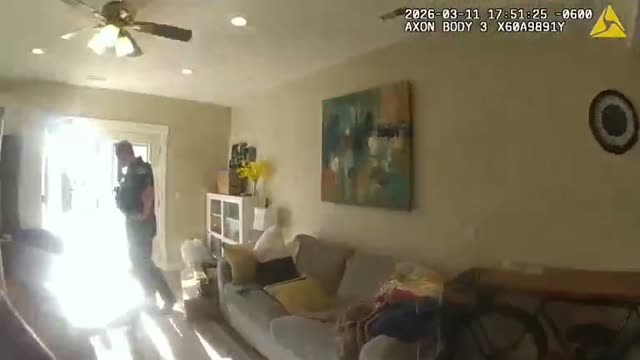
The video is Lt. Adamson’s own body camera; the phone in the corner is a frame-by-frame reconstruction of his screen, driven on the same clock. During the calls the phone is at his ear and off camera, marked as such; the audio is from his own body-worn microphone. A second officer’s camera filmed him on that call from across the room — that still is below.
What the record shows CONFIRMED
3:53–5:47 PM · the affiant’s body camera is off — a one-hour-fifty-four-minute gap (telemetry)
5:37 PM · Magistrate Roger W. Griffin signs the warrant (court file)
5:51 PM · a text to “Cameron”: “Warrants approved we’re up, I’ll give you an update shortly”; a “Greenlight for warrant they are moving up right now” thread with Sgt. Adam Stowers; the lieutenant opens Chief Cameron Paul’s contact card and places a call
5:51 PM · on his own camera, to Chief Paul: “No forced entry. Five in custody. We’ve got the main target in custody as well. I’ll coordinate with the detectives.”
5:52 PM · a second call, to Sgt. Stowers: the same, plus disposition — “holding cell … we’ll bring them down.”
The final policymaker was in the loop, in real time CONFIRMED
Cameron Paul is the chief of police. The department’s own record shows its final policymaker for police operations being told, by text, that the warrant was approved and the team was “moving up right now,” and then receiving a live telephone report of the raid’s results while it was underway. This is not a paper review days later. It is contemporaneous, two-way command communication, captured on the department’s own cameras.
Why it matters: ratification INFERENCE
A city answers under Section 1983 when a final policymaker approves both a subordinate’s act and the basis for it (City of St. Louis v. Praprotnik; Pembaur v. City of Cincinnati). The routine defense is that the chief learned of the conduct only afterward, in a review too thin to count as ratification. That defense meets a different record here: the chief authorized the operation by text and took a real-time call as it ran.
And it matters enormously who the call was to. Ratification is not something any supervisor can do. Only a municipality’s final policymaker — the single official whose decisions are the city’s own — can bind the city (Praprotnik; Jett v. Dallas Independent School District). Who that is presents a question of state law, and it is specific to the decision at issue: the Tenth Circuit, in Wulf v. City of Wichita, held a city manager — not the police chief — was the final policymaker for employment decisions. The decision here is not employment. It is the operational conduct of a law-enforcement raid, and on that decision the answer runs the other way.
The chief of police is American Fork’s final policymaker for law-enforcement operations CONFIRMED
American Fork is a Utah city of the third class, and its chief holds by statute “the same authority as the sheriff within the boundaries of the municipality” (Utah Code § 10-3-913, carried to third-class cities by § 10-3-919). How a search warrant is executed, how a raid is run, who is taken into custody — these are the core operational law-enforcement judgments the statute commits to the chief. The mayor, the city council, and the city administrator hold the ordinance, budget, and employment authority that Wulf assigns them; none of them reviews or overrides the chief’s field command of an operation. No municipal officer sits above the chief on the question of how this raid was conducted. That is what makes the chief — and only the chief — the official whose contemporaneous approval is the city’s own. The same live report made to a sergeant, a watch commander, or the head of investigations — the second call — would not support the theory, because those officers cannot ratify anything on the city’s behalf. The lieutenant did not call a peer. He opened the chief of police’s contact card and called the one person whose contemporaneous involvement the doctrine actually counts.
Brady and Giglio UNRESOLVED
Brady v. Maryland requires the state to disclose evidence favorable to the accused. Among the clips American Fork PD withheld from its public release is an interview in which a detained participant says, in his own words, that he ran the effort himself — “these guys are just doing what I said … this is my thing” — for a fundraiser, with the neighbor’s filming permission, framed as speech. That cuts against the theory that the group was directed by someone else, and it is the kind of material Brady reaches.
Giglio v. United States requires disclosure of evidence that impeaches the state’s witnesses. The affiant’s camera was off for the entire window in which he swore the affidavit and the judge signed it; the only account of that window is the paper he wrote. And the officer running the command channel is, in the federal civil complaint, the excessive-force defendant.
The caller has been sued for this exact pattern before CONFIRMED (allegations)
The lieutenant on these calls is a named defendant in a prior federal civil-rights suit, Greenland v. Cannon. The complaint there alleges he tased a kneeling, surrendering man with no warning — and that a fellow officer “turned off his audio” and “covered the camera.” That is the same concealment pattern the released footage in this case shows: muted audio, blacked video, withheld clips. Those allegations are docket-confirmed and unadjudicated; this site takes no position on their truth. But a documented, repeated pattern is exactly what matters for two doctrines the department will invoke.
Why this update matters for qualified immunity INFERENCE
To get past qualified immunity, a plaintiff must show a constitutional violation of a right that was clearly established — that a reasonable officer had fair notice the conduct was unlawful. Two things on this record speak to that. First, the concealment is not a one-time lapse: the same officer, the same “cover the camera” pattern, is already pleaded in a prior federal case — notice, in the department’s own litigation history. Second, qualified immunity shields individual officers, not the municipality: where a final policymaker ratifies the operation, the city has no immunity to invoke, and the live command channel shown above is the factual predicate for that municipal-liability path. The elements are not proven here; they are laid against the record so a reader can see why this particular footage is the kind that defeats the usual defenses.
The affidavit’s “cooperative homeowner” is the caller’s acquaintance CONFIRMED
The warrant rested in part on a “cooperative” third-party homeowner who supplied the “stolen Lego” account. On the body camera, that man is with the lieutenant — he was in the lieutenant’s own truck during the operation — and the two are known to each other from service together in a Utah National Guard exercise. A magistrate weighs an informant’s tip on the presumption that the source is a disinterested citizen. A source who is the affiant team’s own acquaintance, riding along in the truck, is not that.
The affiant’s camera was off for the warrant CONFIRMED
Warrant No. 3352981 was sworn at 5:11 PM and signed at 5:37 PM. The affiant’s body camera recorded until 3:52 PM — his last frame before the gap is him booking an earlier arrestee at the station — and not again until 5:47 PM, when the entry team formed up. No other camera in the released set was recording at 5:11 either.
Two cameras, one phone, one clock. The warrant took a judge twenty-six minutes; the affiant’s camera was off for both of them — and the chief of police was on the line.
Sources. Search Warrant No. 3352981, Fourth District Court (affidavit executed 5:11 PM; signed 5:37 PM by Magistrate Roger W. Griffin). Body cameras X60A9488Y and X60A9891Y, 2026-03-11. Phone-screen reconstruction from X60A9488Y, best frame per state, on the department’s own footage. Axon telemetry for camera on/off times. Corrections requested by any named party: none received as of this build.
The BAM Map is independent reporting on matters of public concern. Nothing here is a finding of any person’s guilt; the criminal charges referenced are unadjudicated and every defendant is presumed innocent. Sources are linked so readers can check the record. · Home · Map · The law · Bodycam