A criminal subpoena reached Tyler Shaw on September 21. He is the driver the county’s charging document calls T.S. The preliminary hearing is September 30.
The sheriff’s return of service hit the docket on September 22. BJC Live Show read it on air the next morning. The return is below, with the court’s own filings, the two statutes, and what the hearing can and cannot decide. State of Utah v. Benjamin Paul Schneider, stalking and targeted residential picketing, goes to an in-person preliminary hearing before Judge Thomas Low on September 30 at 10:30 a.m. MDT in Provo.
PRIMARY SOURCEthe return of service, Utah County Sheriff process 26-5565 in case 261401094: subpoena received September 18, served September 21, witness Tyler Matthew Shaw; hosted herePRIMARY SOURCEthe court’s filings, hosted below: the Information, both probable-cause affidavits, the hold order, the pretrial protective order, the defense discovery request, and the order that moved the waiver hearingCONFIRMEDthe public court calendar: in-person preliminary hearing, September 30, 10:30 a.m. MDT, Provo District Court, Courtroom 5B, Judge Thomas LowUNRESOLVEDwho else will be called, and whether the hearing will be streamed
The subpoena
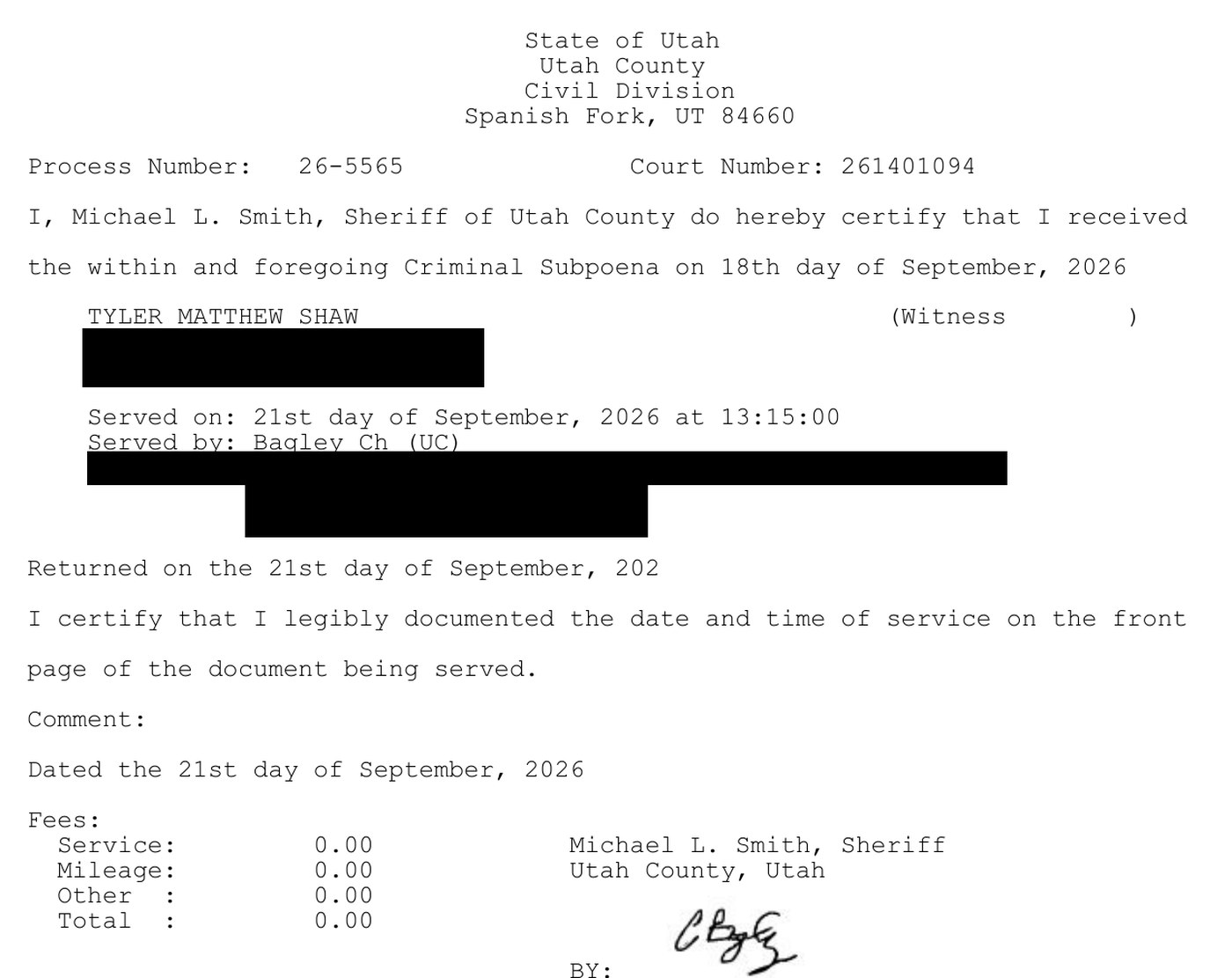
The witness line reads Tyler Matthew Shaw. The fees are zero. BJC Live Show bought the return from the docket and reported it on the morning of September 23.
Tyler Shaw is not a bystander in this case. He is the driver the Information calls T.S. On March 8, it says, the car “was stopped for traffic offenses and the driver was identified as T.S.,” with the defendant “seated in the back passenger seat, holding a camera.” Both men “were warned that they were trespassed from J.J.’s residence.” A second stop the next day “found T.S. and Defendant in the vehicle.” The same document says the man who brought a package to the door on March 8 “was later identified as T.S.” The police reports on the two stops, hosted by the independent document site Bricks and Minifigs Sucks, name him. In July this site showed that the officer’s own dash camera has the car stopping for about two seconds at a corner with no stop line.
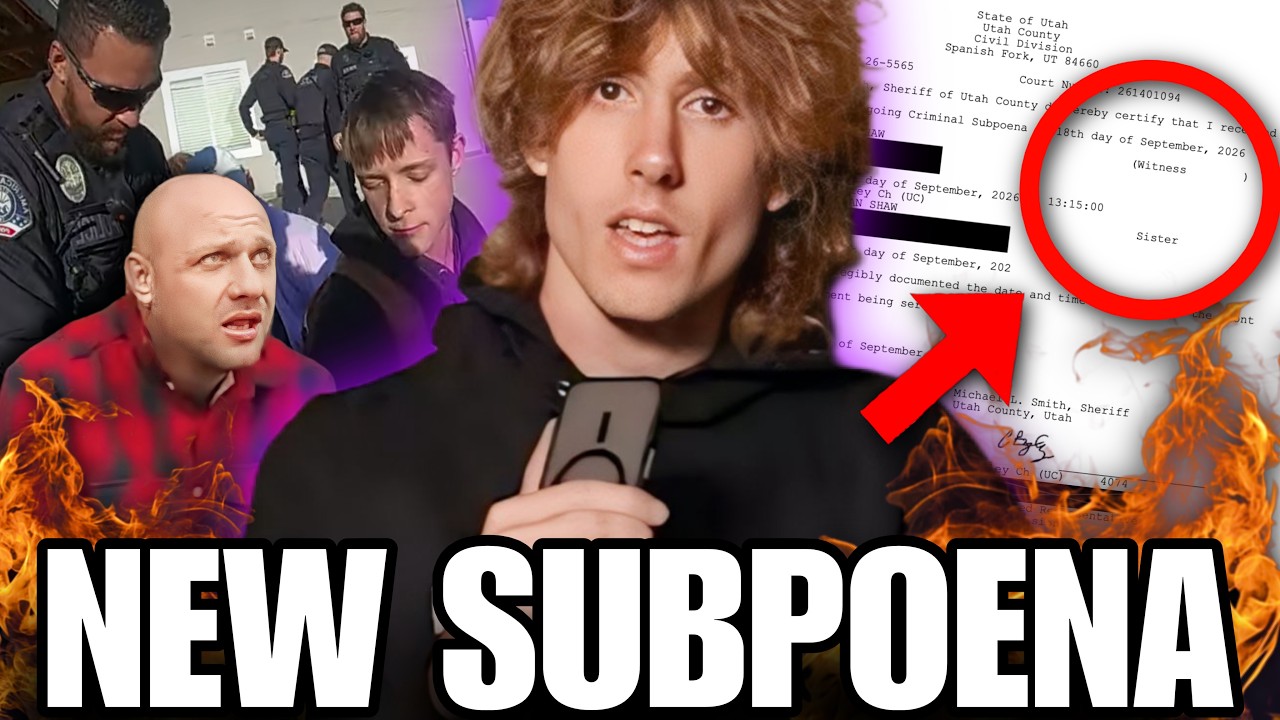
The sheriff received it Friday, served it Monday, and the court docketed it Tuesday. The hearing is on.
What the county charged
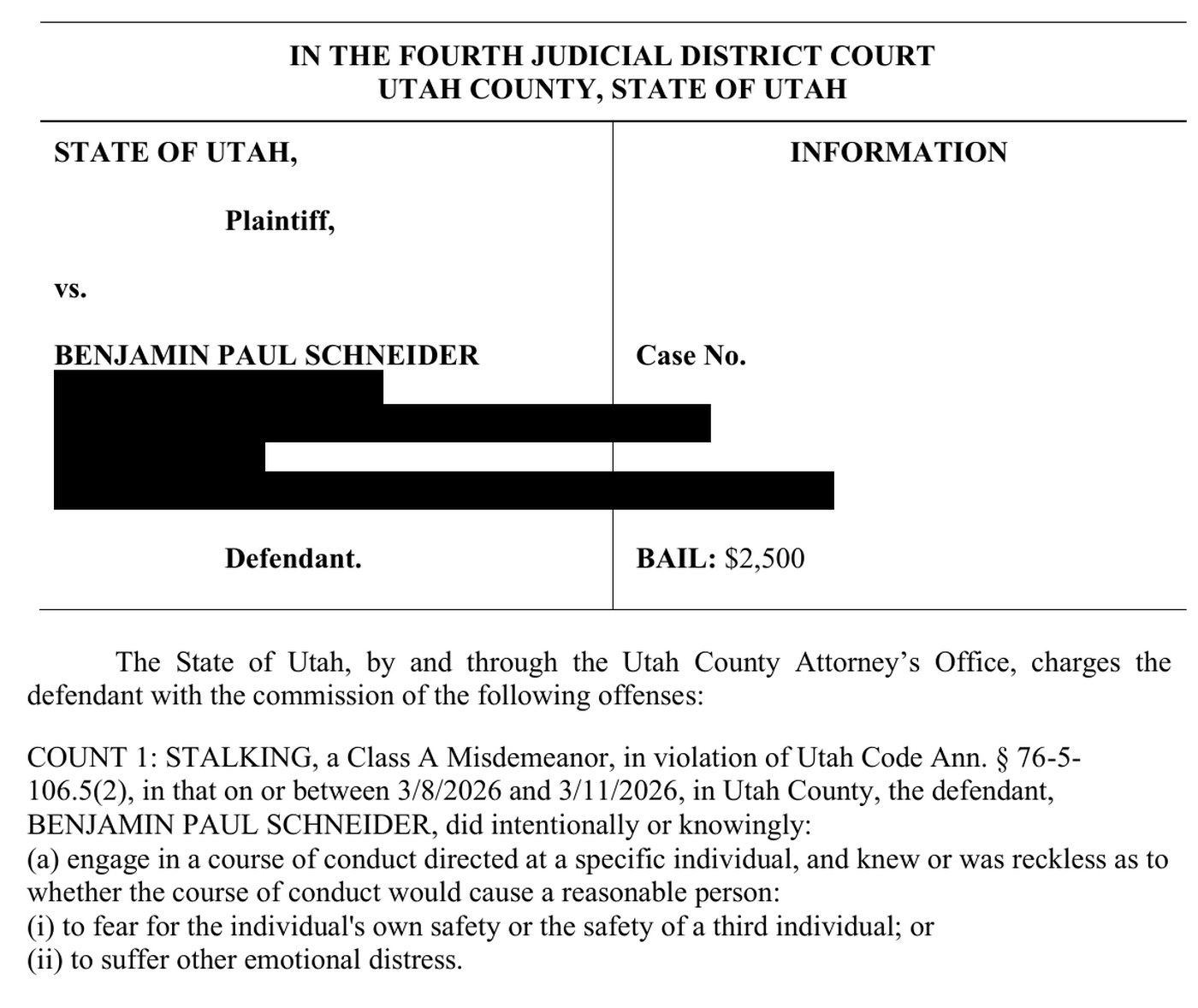
Count 1 is stalking, a Class A misdemeanor: a “course of conduct directed at a specific individual” between March 8 and March 11 that the defendant “knew or was reckless as to whether” it would cause a reasonable person “to fear for the individual’s own safety or the safety of a third individual” or “to suffer other emotional distress.” Count 2 is targeted residential picketing, a Class B misdemeanor, pleaded both ways the statute allows: picketing “specifically directed or focused toward a residence” within 100 feet of the property line, or publishing “another individual’s residential address” to bring picketers there. The evidence behind the Information came from Officer Luke Sumbot of American Fork Police.
The county’s account runs four days. March 8: a man at the door with a package, “wearing a ballcap with a UPS logo taped on it.” March 9: a “third male” in “church attire” on the front steps, who “stated that Defendant told him what to say.” March 10: a woman photographing the house, a sign in the park strip reading “I stole a dying man’s life savings,” the defendant saying “he placed the sign that morning on public property,” and an arrest. March 11: four people hanging a sign on a fence across the street, one “on a facetime call” with “Ben.” The last factual sentence is the complainant’s: “J.J. stated that this has affected him and his family and that his wife and children are scared.”
The defendant’s purpose is in the same document. He “was in Utah filming a Youtube series in regards to the civil proceedings in Oregon” and came “to collect either the property that was the subject of the Oregon dispute or to collect $100,000 from J.J.”
The county’s own papers disagree about that lawsuit. The March 10 affidavit has the officer telling the complainant the visitors “were trying to serve him civil papers,” and the complainant and his boss answering that “there were no court cases open involving the victim or the company the victim worked for.” Officer Sumbot’s own report, hosted by the same document site, says he called the Marion County Circuit Court and was told “the court case was valid and had been filed but no date had been set. Case #: 26SC06134.” That is the Oregon small-claims case the visitors were trying to serve.
The orders that govern him
The March 10 hold order set bail at $2,500. It required him to “stay at least 1000’ away from the alleged victim” and from the victim’s “residence, place of worship, employer, and school,” and to “not cause third parties to directly or indirectly violate this no contact provision.”
The pretrial protective order Judge Low signed on May 20 names Joshua Johnson as the protected person. It finds that “the defendant represents a credible threat to the physical safety of the protected person.” It orders: “You must not harass, telephone, contact, or otherwise communicate with the protected person, directly or indirectly (includes email, text, social media, social media messaging or posts, mail, or other methods of contact).” Under the penalty section it cites, violating it while a misdemeanor charge is pending is itself a Class A misdemeanor. Serving court filings on the protected person and attending hearings are allowed.
What September 30 decides
“At the preliminary examination, the state has the burden of proof and proceeds first with its case. At the conclusion of the state’s case, the defendant may testify under oath, call witnesses, and present evidence. The defendant may also cross-examine adverse witnesses.” ... “The findings of probable cause may be based, in whole or in part, on reliable hearsay. Objections to evidence on the ground that it was acquired by unlawful means are not properly raised at the preliminary examination.”
The hearing asks one thing: is there probable cause to believe the crimes were committed, and that this defendant committed them. Yes means he is bound over for trial. No means the Information is dismissed, and the rule says that does “not preclude the state from instituting a subsequent prosecution for the same offense.” The State can build its showing on reliable hearsay. Under Rule 1102 that includes what one officer told another and any sworn or recorded statement.
The rule also draws the line for the 30th. Whether the March 8 stop was lawful, and whether the March 11 search warrant was sound, are questions about how evidence was obtained. A preliminary hearing does not decide them. The dash-camera finding this site published in July is material for cross-examination that morning. It is not a way to end the case there.
The hearing asks one question: is there probable cause. It does not ask how the evidence was obtained.
What the county is carrying into the room
Provo dropped its case the day before its hearing. Utah County has not dropped American Fork’s, and the record it rests on is already public. Chief Cameron Paul went on video to tell the public the car failed to stop. The officer’s own dash camera shows a two-second stop at a corner with no stop line. The lieutenant’s calls and texts during the raid, reconstructed from his own camera, run straight to the chief. At 5:51 p.m. MDT he called him: “No forced entry. Five in custody. We’ve got the main target in custody as well.” That piece set out why a command channel like that matters when officers claim qualified immunity. The immunity shields officers, not the city, and a chief who takes that call in real time is the kind of fact a claim against the city is built on. None of it is decided on the 30th. It is what the county chose to bring into a courtroom, with a witness under subpoena.
The two statutes
Stalking needs a “course of conduct,” defined as “two or more acts directed at or toward a specific individual.” Acts count whether done “directly, indirectly, or through any third party,” and when the actor “causes someone else to engage” in approaching a person or appearing at a residence. It is no defense that the actor “was not given actual notice that the course of conduct was unwanted” or “did not intend to cause the victim fear or other emotional distress.” A first violation is a Class A misdemeanor.
Targeted residential picketing defines picketing as “the stationing or posting of one or more individuals to apprise the public, vocally or by standing or marching with signs, banners, sound amplification devices, or other means, of an opinion or a message.” It reaches picketing “specifically directed or focused toward a residence” on the sidewalk in front or “within 100 feet of the property line.” It exempts “general picketing that proceeds through residential neighborhoods or that proceeds past residences.” No reported Utah appellate decision applies it.
The record, hosted
The court’s filings. The defendant’s date of birth, address and booking numbers are blacked out, as is one private name on the return.
- Order to hold with bail, March 10, 2026
- Affidavit of probable cause, March 10
- Affidavit of probable cause, March 11
- Information, March 27
- Pretrial protective order, May 20
- Defense request for discovery, June 18
- Order moving the waiver hearing to August 12, June 26
- Return of service on the criminal subpoena, September 21
The police reports behind the charges, hosted by the independent document site Bricks and Minifigs Sucks.
This site’s reporting on the American Fork case.
- June 23: the American Fork officers, and the suit they had already seen
- June 24: the records officer who releases the footage shares a home with an AFPD sergeant
- July 11: he paid the police $1,836 for the footage of his own cases, and the department published it to the world
- July 15: Lieutenant Adamson’s calls and texts during the raid
- July 17: “fail to stop before the stop line,” the officer’s own dash camera and a corner with no stop line
- August 7: three days on which the machinery moving against the critic ran on the same clock as the seizure he was documenting
- August 12: the first man at the city’s tax hearing lives an hour away, and its police pulled him over there
- August 14: “Stop shielding the AFPD,” ten weeks of the city’s own record
- August 14: “I will, uh… traumatize him for you,” an officer on the man who called 911
- August 15: the five-sentence report behind that line
- The bodycam, camera by camera
The Provo case, which was separate.
- August 4: charged with trespassing in a hallway BAM does not own
- September 14: Provo dropped it the day before its hearing
- September 15: what the KSL report left out
The fair counterpoint. A subpoena is not a witness list. A preliminary hearing tests probable cause, a low bar, and a bindover says nothing about guilt. The county’s account is the county’s. On this docket the defense has filed a discovery request and nothing else yet. Mr. Johnson is a complaining witness under a protective order; this site reports the court’s filings about him, not his home. The right of reply is open to the Utah County Attorney, to Mr. Johnson, and to BAM.
Sources. Fourth Judicial District Court, Utah County, State of Utah v. Benjamin Paul Schneider, No. 261401094: the filings hosted above, read from the court’s copies. The Utah courts public calendar, searched by case number. BJC Live Show, “RECKLESS Ben CRIMINAL Case MOVES FORWARD!! (confirmed),” posted September 23, 2026. Utah Code 76-5-106.5 and 76-9-109, as displayed by the Legislature. Utah Rules of Criminal Procedure 7B and Utah Rules of Evidence 1102. American Fork Police reports 26AF01974, 26AF02007 and 26AF02033 and search warrant 3352981 as hosted by Bricks and Minifigs Sucks. The right of reply is open to everyone named here.