“Fail to stop before the stop line”: the officer’s own dash camera shows a two-second stop, and the corner has no stop line
CONFIRMEDthe officer’s own dash camera and its embedded GPS
American Fork Police case 26AF01974, incident report and supplemental narrative, quoted verbatim below and cited by case number; the department’s released Axon Fleet 3 front dash camera video (clock burned in, March 8, 2026, 13:13) and the GPS telemetry embedded in the released file. Unadjudicated; the officer and everyone else named or described is presumed innocent and presumed to have acted in good faith.
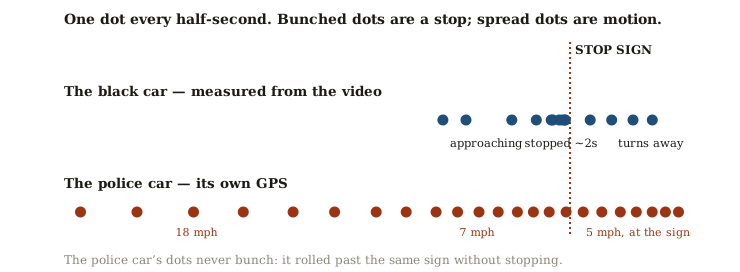
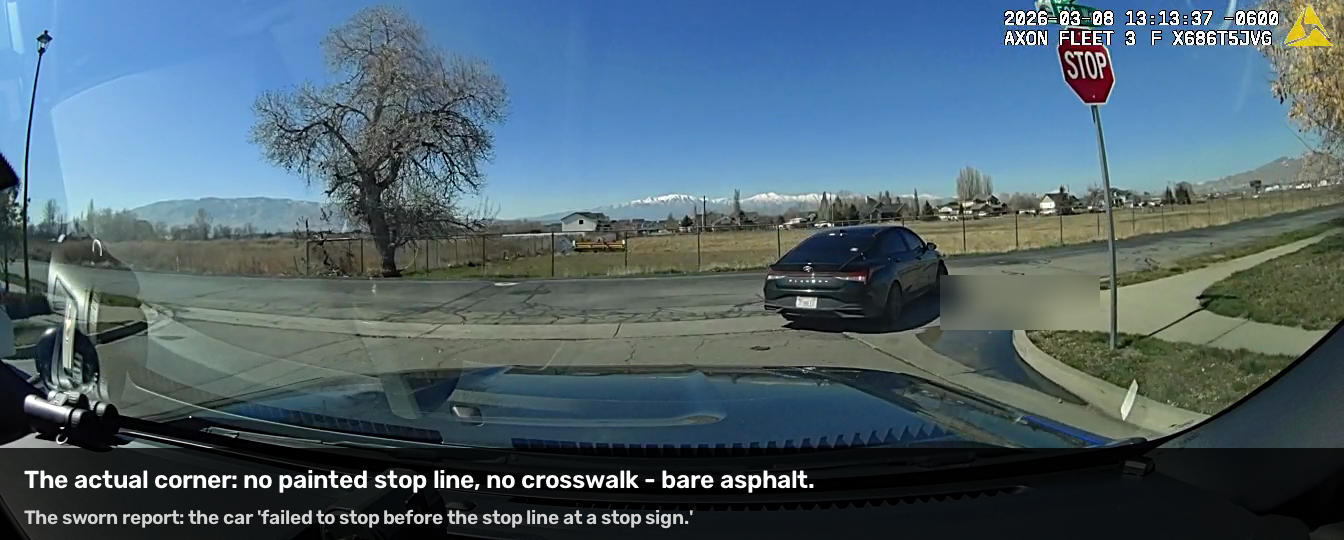
The police report that opened the department’s file on the YouTuber says the traffic stop happened because of a stop sign. The officer wrote: “I observed the vehicle fail to stop before the stop line at a stop sign.” The officer’s own dash camera recorded the moment. The black car brakes, comes to a complete stop at the sign, sits stationary for roughly two seconds, then turns right. The camera also shows the intersection has no stop line painted on it at all. The same released telemetry carries the patrol car’s own vehicle-signal log, which is examined below and, on one point, resolves in the officer’s favor.
What the report says
The supplemental narrative in case 26AF01974, written on March 16, 2026, eight days after the stop, describes the officer’s own sequence plainly. He was “immediately told that a potential suspect involved was leaving the scene in a black passenger vehicle,” and he “flipped my patrol vehicle around to try and follow the suspect and hopefully gather a license plate.” While doing so, he wrote, “I observed the vehicle fail to stop before the stop line at a stop sign,” and on that basis he made the stop. The narrative closes the loop itself: “I took no action on the traffic offenses.” The stop produced no citation. It produced identifications and trespass warnings, and the department’s file on the people in the car began there.
What the camera shows
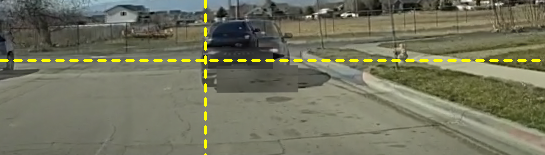
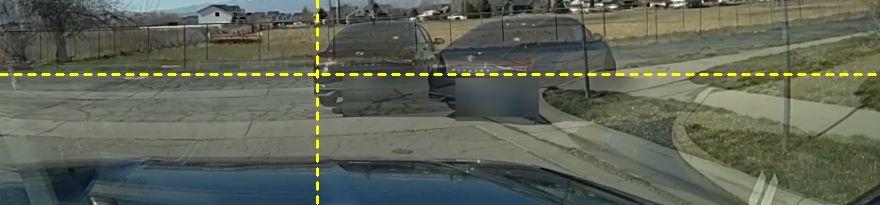
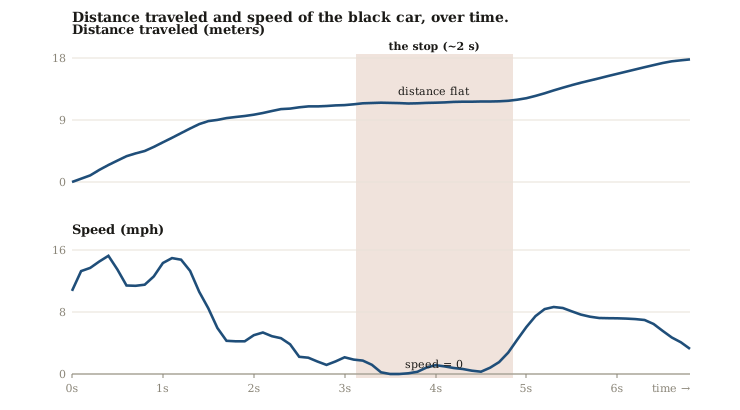
The dash camera in the officer’s own patrol car recorded the entire approach, with the time burned into the frame. Read against the video clock, the black car brakes from about eleven miles per hour, reaches the corner, and is stationary from roughly 13:13:33 to 13:13:35, about two seconds, before creeping into a right turn at one to four miles per hour. The exhibit above shows this three ways, and the two stills below are the heart of it.

How the comparison is built
The camera is mounted in a moving patrol car, so raw frames cannot be compared directly; everything in the frame moves because the camera does. The two frames in each comparison are aligned to each other using only fixed objects at the car’s own distance from the camera, the stop sign post and the curb line among them, with the car itself excluded from the alignment. The alignment residual is about one pixel. The blends are then straight fifty-fifty overlays of the aligned photographs, with no masking, no tinting, and no retouching. The red and blue outlines in the side-by-side panels trace the car in each frame and are drawn by segmentation confined to the car; the license plate is blurred throughout as a privacy measure; nothing else in any frame is altered.
The method is falsifiable on its face, which is what the control is for. Applied to two frames taken while the car was still moving, the identical construction shows the car in two different positions. Applied to the start and end of the stop, it shows one. The claim also holds numerically. The patrol car’s released video carries embedded GPS at one fix per second; integrating the patrol car’s own motion against the car’s apparent size in the frame puts the black car’s stopping position within about a meter of the stop sign, holds it stationary within measurement noise for at least a second and a half, and about two and a half seconds on the smoothed profile, before the right turn. Even the least favorable end of the calibration band puts the car under two miles per hour at the corner, braking to it from eleven. Under any reading of the same footage the officer’s camera recorded, the vehicle did not blow through the sign; it stopped at it.
There is no stop line
The sworn sentence says the vehicle failed to stop “before the stop line.” The pavement at this corner has no stop line. The dash camera’s own close pass, seconds later, shows bare asphalt: no painted bar, no crosswalk, no markings of any kind. At an unmarked intersection, Utah Code 41-6a-902 requires a driver to stop at the point nearest the intersecting roadway where the driver has a view of approaching traffic. That point is the corner. The video shows the car stopping there.
The car’s own signal log, and the patrol car’s roll
The released telemetry answers a question the front camera cannot, and it answers it against this site’s first instinct. Every Axon Fleet 3 file records three vehicle signals as a timestamped on-and-off log alongside the GPS: the light bar, the siren, and the brakes. Decoded from this recording and cross-checked across the department’s other released in-car files from the same period, the brake channel tracks the patrol car’s own braking exactly (it reads on through every deceleration), the light bar switched on at about 13:13:35, the same instant the in-car audio begins, which is the camera’s own event trigger, and the siren was never activated at any point, in this file or any other in the set.
So when the patrol car rolled the same stop sign at about five miles per hour, its own light bar was on. Under Utah Code 41-6a-212, an authorized emergency vehicle that is not in a high-speed pursuit may proceed past a stop sign, after slowing for safety, when it either displays emergency lights or sounds a siren; the light bar alone satisfies that requirement. The patrol car’s roll was therefore permitted, and the fact that the siren was never used does not change it, because outside a pursuit the siren is not required. This point resolves in the officer’s favor. It is set out here in full because the same telemetry that resolves it is the telemetry that measured the black car’s stop, and a record is only worth citing if it is cited both ways.
What this changes in the cases
ANALYSISthe video contradiction is documented above; its legal consequences are unlitigated and belong to the courts
The stop was the first domino. The identifications and trespass warnings issued at it seeded the file that produced two arrests in the following days, and the same officer swore the search warrant affidavit three days later. Three doctrines meet a record like this, and each has real limits worth stating plainly.
The basis for the stop. Under Whren v. United States, a traffic stop is lawful regardless of the officer’s motive if an actual traffic violation occurred. The report concedes the motive, a suspect hunt on the complainant’s tip, and concedes no traffic action was taken; the violation itself is the entire stated legal basis. If the camera is right that the violation did not happen, the stated basis for the seizure fails, and everything the stop directly produced, the identifications, the warnings, the statements in the encounter, was the product of an unlawful seizure.
The fruit doctrine, honestly stated. Wong Sun v. United States makes evidence derived from an unlawful seizure suppressible in a criminal prosecution. But the doctrine has three well-established outer edges that cut the other way here, and a fair reading states them. Time and intervening events attenuate the taint under Brown v. Illinois, and the arrests came two and three days later, after new encounters. A defendant’s identity is never itself suppressible under INS v. Lopez-Mendoza; the police knowing who was in the car does not get unwound. And facts the complainant reported independently of the stop are independent-source material the doctrine never touches. So the realistic scope is narrower than everything after March 8: it reaches what the stop itself yielded, the warnings that became the “he was warned” predicate among them, and it is for a suppression court, not this page, to draw that line.
The officer’s sworn word. The narrower consequence is the durable one. A sworn narrative contradicted by the officer’s own camera is impeachment material under Giglio v. United States in every matter that officer touches, and under Franks v. Delaware a warrant affidavit’s statements can be tested against what the affiant knew. The same officer’s search warrant affidavit, sworn three days after this stop, is part of the same record. None of that requires this page’s conclusion to be adopted; it requires only that the video be watched next to the report.
The fair counterpoint. The officer observed the intersection once, in real time, from a moving patrol car some distance behind a small dark car, and wrote the narrative eight days later; a rolling-stop misjudgment from that vantage is a common good-faith error, and mistaking “stop line” for an unmarked corner is the kind of boilerplate slip that appears in traffic narratives everywhere. The GPS is one fix per second and cannot resolve events shorter than about a second. The channel identifications in the signal log above are read from the data’s behavior across the whole file set, not from a printed key. The video analysis here, like any video analysis, rests on stated calibrations, and the underlying footage is public so the work can be redone by anyone. Nothing in this update has been adjudicated, no court has ruled on the stop, and the officer is presumed to have acted in good faith throughout.
Sources: American Fork Police case 26AF01974, incident report and supplemental narrative of March 16, 2026, quoted verbatim, cited by case number; the department’s released Axon Fleet 3 front camera video for that case (burned-in clock March 8, 2026, 13:13, unit and serial visible in frame) and the GPS telemetry embedded in the released file, from which every measurement above is taken; Utah Code 41-6a-902 (stopping at unmarked intersections); Utah Code 41-6a-212 (emergency vehicle exemptions). Case law named in text: Whren v. United States, 517 U.S. 806 (1996); Wong Sun v. United States, 371 U.S. 471 (1963); Brown v. Illinois, 422 U.S. 590 (1975); INS v. Lopez-Mendoza, 468 U.S. 1032 (1984); Giglio v. United States, 405 U.S. 150 (1972); Franks v. Delaware, 438 U.S. 154 (1978). Related on this site: The takedown; the bodycam player. The exhibit video and stills above are built from the released footage; added graphics are described where they appear and the license plate is blurred.
The BAM Map is independent reporting on matters of public concern. Nothing here is a finding of any person’s guilt; the criminal charges referenced are unadjudicated and every defendant is presumed innocent. Sources are linked so readers can check the record. · Home · Map · The law · Bodycam