“You provided these residents with no beneficial assistance and yet you did not refund any of their money.” North Carolina’s bar wrote that to Ammon McNeff, now BAM’s chief executive, in 2015.
In May 2015 the North Carolina State Bar’s unauthorized-practice committee wrote to Ammon McNeff as president of Legally Mine. At a seminar in the state, it found, the company held out as able to provide legal services; residents paid for them and got “no beneficial assistance” and no refund. He answered the committee, it wrote, and his response did “not dispute the factual allegations.” It found probable cause of unauthorized practice, cautioned him instead of suing, and expected the activities to stop. The letter surfaced in a Missouri class action in 2017. By BAM’s own disclosure documents he ran Legally Mine as president until 2020; he has run BAM since 2018. Everything on this page is public.
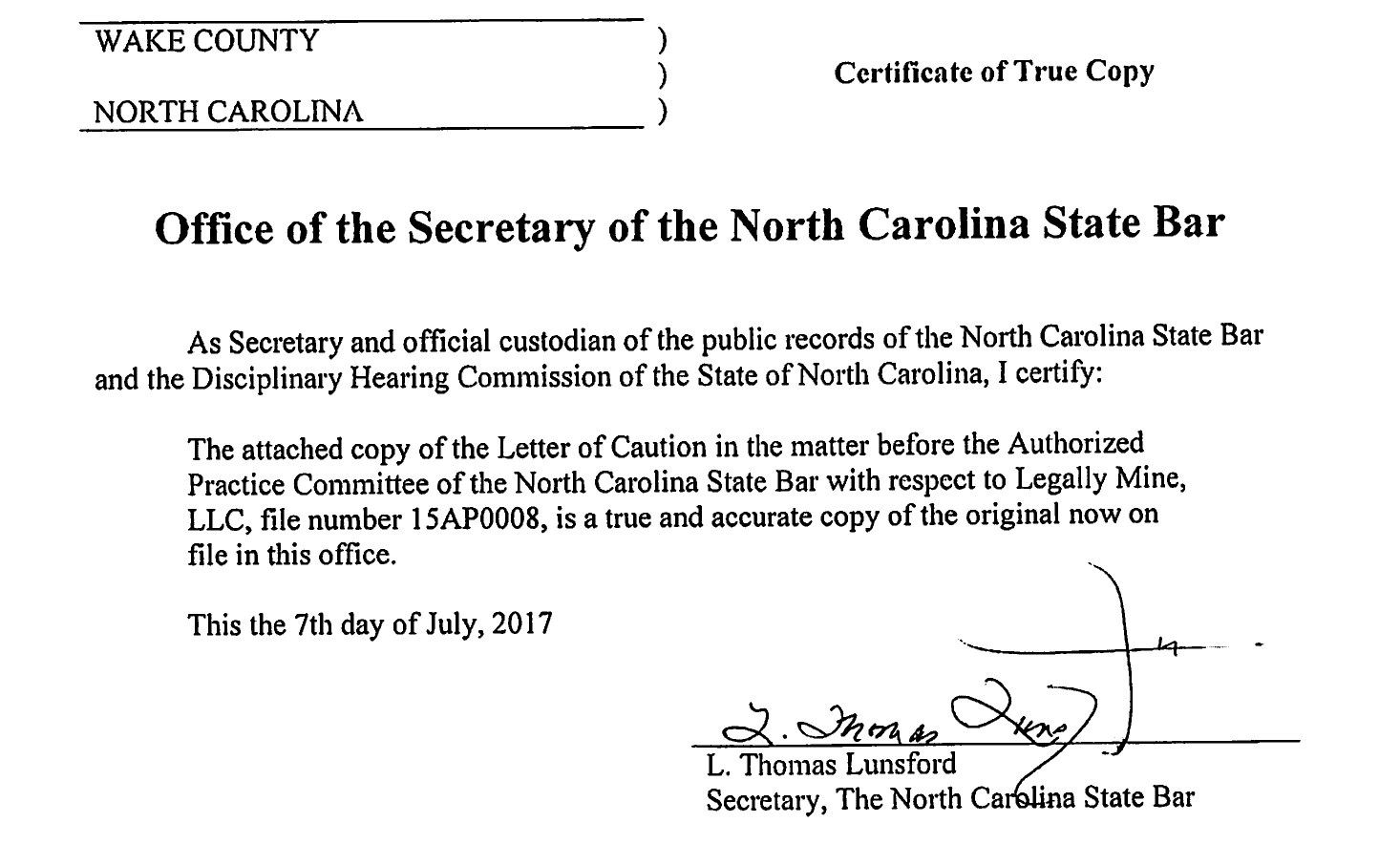
PRIMARY SOURCEThe Letter of Caution of May 1, 2015, file 15AP0008, with the State Bar secretary’s certificate of true copy of July 7, 2017, as filed that day in Beddoe v. Legally Mine, LLC, Cole County Circuit Court, Missouri, No. 17AC-CC00123. The State Bar’s rule 27 NCAC 1D .0206 and N.C. Gen. Stat. §§ 84-4, 84-5 and 84-37. BAM Franchising’s disclosure documents, Item 2, every edition from April 2018 to September 2026, and Item 3 of 2018 and 2019. The Cole County docket; the Provo dockets of Legally Mine v. John Doe; the Ohio panel report. All public.
CONFIRMEDThe addressee is the man BAM Franchising names first in Item 2: “Ammon has been our President since April 2018 and Chief Executive Officer since October 2021. He has served as President for Legally Mine, LLC in Orem, Utah since January 2011 until 2020.” The address on the letter, 225 West 520 North, Orem, is the one those documents gave as BAM’s own from 2018 through 2023.
The letter
Two pages, dated May 1, 2015, on the letterhead of the North Carolina State Bar’s Authorized Practice Committee, signed by its chair, C. Colon Willoughby, Jr., headed “LETTER OF CAUTION,” addressed to Ammon McNeff at Legally Mine, LLC, 225 W. 520 N., Orem. “Dear Mr. McNeff.”
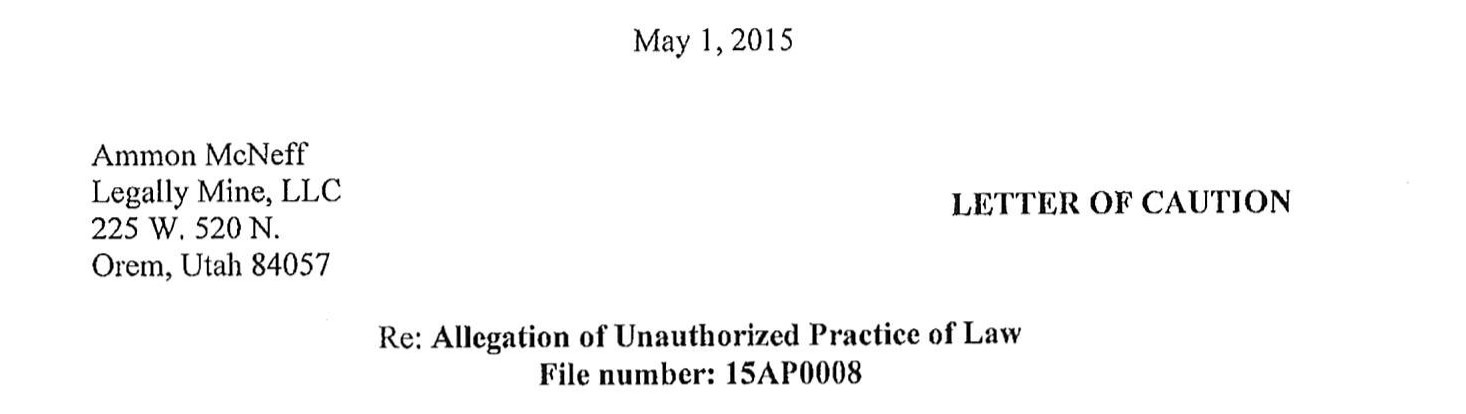
The committee met on April 15, 2015. Its account of the facts, in full:
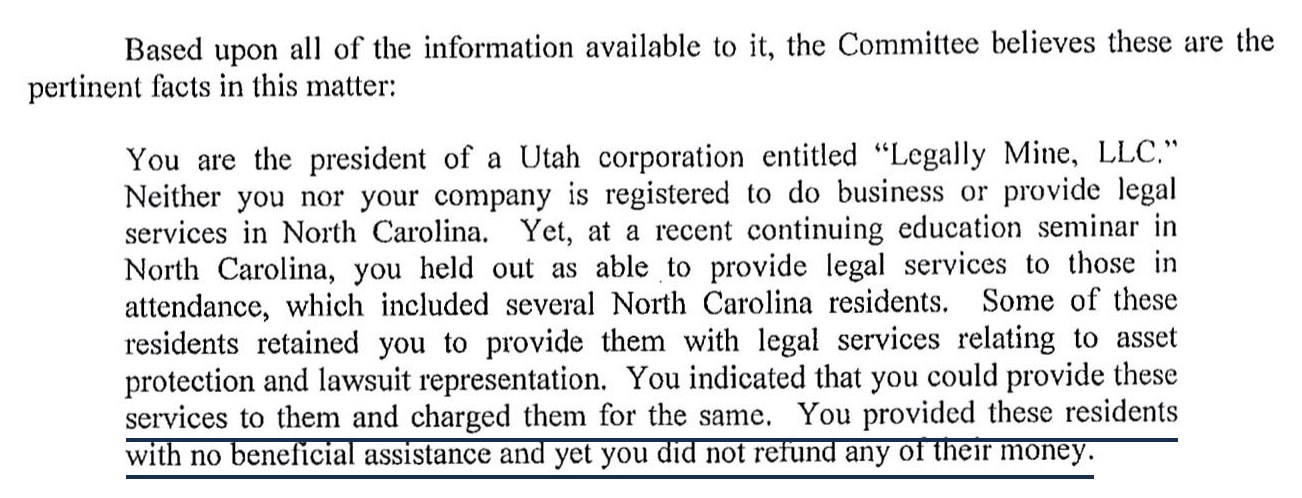
Not registered in North Carolina. At a continuing education seminar there, “you held out as able to provide legal services to those in attendance.” Residents “retained you” for “legal services relating to asset protection and lawsuit representation” and were charged. Then the sentence at the top of this page. The letter does not say when the seminar was, how many residents paid, or what.
He answered it
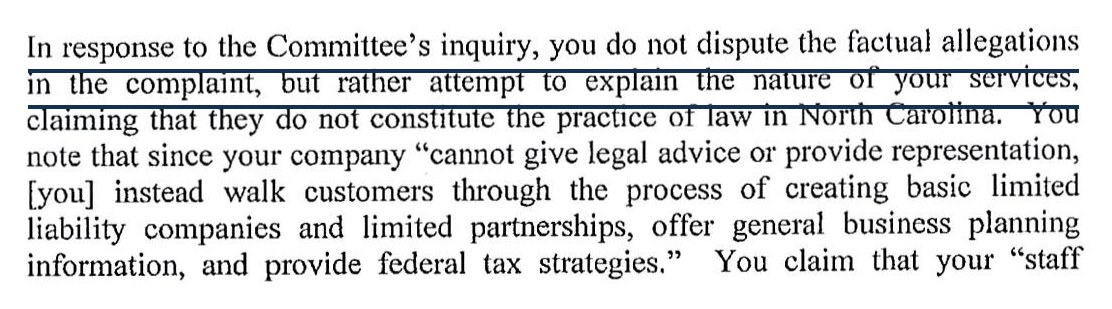
“You were informed of the allegations before the Committee and given an opportunity to respond. You responded,” the letter says, “and the Committee carefully considered both your response and the other information received by it.” What came back, in the committee’s summary: “you do not dispute the factual allegations in the complaint, but rather attempt to explain the nature of your services, claiming that they do not constitute the practice of law in North Carolina.” The company “cannot give legal advice or provide representation,” the response said; it walks customers “through the process of creating basic limited liability companies and limited partnerships,” and its “staff attorneys” “consult with [] customers . . . to ensure that any business or tax recommendations do not conflict with local laws or regulations.”
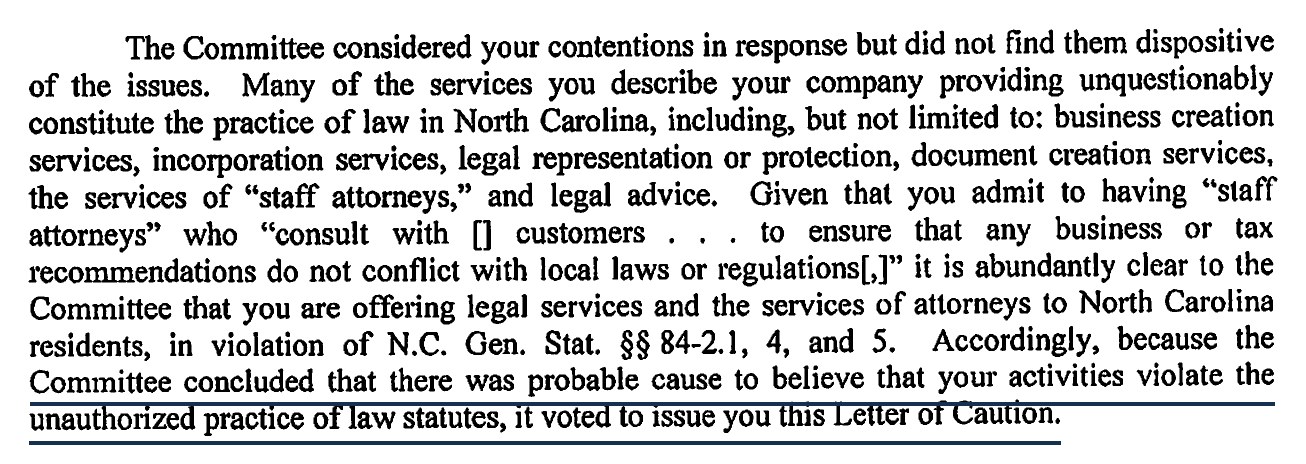
The staff attorneys were the problem, not the defense. “Many of the services you describe your company providing unquestionably constitute the practice of law in North Carolina,” the committee wrote, and “it is abundantly clear to the Committee that you are offering legal services and the services of attorneys to North Carolina residents, in violation of N.C. Gen. Stat. §§ 84-2.1, 4, and 5.” It found “probable cause to believe that your activities violate the unauthorized practice of law statutes” and “voted to issue you this Letter of Caution.”
“The Committee expects that you will stop engaging in these activities that violate the unauthorized practice of law statutes as a result of this Letter of Caution. The Committee is using its discretion not to pursue any proceedings for injunction or other action at this time but reserves its right to re-visit your conduct in the future in its discretion should you elect to continue it.”

A caution is the committee’s lightest instrument. Under the Bar’s rule it issues either where “there is probable cause to believe respondent has engaged in the unauthorized practice of law in North Carolina” and the committee thinks the letter will stop it, or where the evidence falls short and the committee cautions anyway. This letter says which. The heavier instrument, under § 84-37, is a suit to enjoin; the committee said it was not bringing one. The statutes it cites: § 84-4, § 84-5, § 84-2.1.
The company’s own words, before and after
A year before the letter, on April 14, 2014, Legally Mine posted this under a customer’s review: “Questions about how to set up an LLC require a meeting with either a paralegal or our business attorney” (October 11). Years after it, in Ohio’s proceeding, the company admitted that its marketing “implies that Legally Mine and/or its attorneys are licensed to practice law in Ohio,” and “that Legally Mine cannot legally engage in the practice of law” (October 3). The committee’s sentence in between, 2015: “A business may not offer legal services or the services of a lawyer to its customers even if those services are provided by a licensed North Carolina attorney.”
“Our business attorney,” the company wrote in 2014. “The services of attorneys,” the committee found in 2015. “Its attorneys are licensed to practice law in Ohio,” the company later admitted its marketing implied.
Who he is
BAM Franchising’s disclosure documents have said the same thing about him for eight years. The April 2018 edition, the first to name him: “Ammon has been our President since April 2018. He has served as President for Legally Mine, LLC in Orem, Utah since January 2011.” The editions since 2022: “Ammon has been our President since April 2018 and Chief Executive Officer since October 2021. He has served as President for Legally Mine, LLC in Orem, Utah since January 2011 until 2020.” The same pages name his brother Matthew, BAM’s treasurer, as Legally Mine’s vice president of marketing over the same years, and through 2020 their father Dan as its chief executive (October 3).
So by BAM’s own account its chief executive was the president of Legally Mine when the committee met, when the letter came, and for five years after. The address on the letter is the one BAM gave as its own principal business address from 2018 through 2023, and the one on the Legally Mine brochure in Ohio’s file. He certifies BAM’s disclosure documents today (October 5). Legally Mine’s own website now calls the McNeffs who went to Bricks & Minifigs “several prior employees of Legally Mine” and says any relationships with them “were ended more than five years ago (January 2021)” (July 1).
The letter is written to him in the second person: you held out, you were retained, you charged, you did not refund, you do not dispute. Whether he was in the seminar room, or any North Carolina resident ever dealt with him, it does not say. It says he was the president and that the response came from him. The Bar’s certificate calls the file one “with respect to Legally Mine, LLC.” The Missouri suit that put the letter on a docket named his father, two other Legally Mine men and the company, and not him (October 6).
2015
The letter’s year is the year Legally Mine’s legal department was suing an anonymous reviewer for writing that the company “does not deliver service” (October 11). The dates sit together. April 13: the company files its second suit against “John Doe” in Provo. April 15: the North Carolina committee meets. April 21: an Idaho court enters a $5,141.30 default judgment against the company in a client’s suit, paid by June (October 6). May 1: the letter. August 28: a Texas doctor sues under his state’s consumer law. December 4: a Provo judge signs the company’s proposed findings, “No hearing was held in this matter,” declaring the review false and awarding $400,000 against a defendant nobody identified. The company’s proof that “does not deliver service” was false was that it could not find the reviewer among its clients.
“No beneficial assistance,” a state bar committee found in May, on facts its president did not dispute. “Does not deliver service” was false, a court found in December, on the company’s own draft.
What came after
Arkansas, 2016: the state supreme court’s unauthorized-practice committee lists Legally Mine’s staff attorney, John Maddox, under cease and desist (October 6).
Missouri, 2017: Stacey Beddoe sues the company, Dan McNeff and three of its men for a class; the company moves to arbitrate. On July 7 the Bar’s secretary certifies the letter as “a true and accurate copy of the original now on file in this office,” and the plaintiff’s lawyer files it the same day in Jefferson City as “Exhibit 10 - NC Bar Letter of Caution,” beside the costs of flying to Utah to arbitrate and an order letting a class action against LegalZoom proceed on an unauthorized-practice claim. The judge compels arbitration anyway; two writs fail; the arbitration stalls; the case settles and is dismissed in January 2020 (October 6).
Ohio, 2018 to 2025: an Ohio client’s 2020 complaint says he signed at a Chicago seminar in September 2018, that the company charged his card $7,800 that day “before providing any” services, that he cancelled four days later and was promised a refund, and that “No refund came” (October 6). In July 2020 a lawyer for two other Ohio clients warns the company that it may be practicing law without a license. The Ohio State Bar Association files its complaint in November 2023. On February 20, 2025 the Supreme Court of Ohio orders Legally Mine and Dan McNeff “enjoined from engaging in the unauthorized practice of law in Ohio,” with a $5,000 penalty the state’s attorney general collects that July (June 28, October 3). The Ohio complaint puts the conduct at about 2010 to 2021.
The committee “expects that you will stop engaging in these activities,” it wrote in May 2015. On Ohio’s record the same services ran six more years, and the man the letter was addressed to ran the company, by BAM’s account, for five of them.
What franchise buyers were told
Item 3 of a disclosure document is where a franchisor lists litigation involving the company and the people in Item 2. BAM’s 2018 edition, the first to name Ammon McNeff as president, and its 2019 edition say: “No litigation is required to be disclosed in this Item.” A letter of caution is not litigation, and the committee said it was bringing none. What the letter did say about the man those editions named as president was addressed to him, at the address those editions gave as the company’s own.
In order
Where this comes from
- The letter and the certificate, three pages, as filed in Cole County on July 7, 2017: a public court record, listed on the docket as “Exhibit 10 - NC Bar Letter of Caution” and not among the exhibits marked redacted. A public records request for the State Bar’s own copy of the letter and its file, 15AP0008, has been submitted; what comes back will be added here.
- The North Carolina State Bar’s rule .0206 and its page on the unauthorized practice of law; N.C. Gen. Stat. Chapter 84 on ncleg.gov.
- BAM Franchising’s disclosure documents, 2018 through 2026, as filed with the Minnesota Department of Commerce and the Wisconsin Department of Financial Institutions (the disclosure, September 25).
- This site’s pages on the company’s suits and the regulators’ actions, linked where cited.
Nothing on this page came from a franchisee, an employee, a leaked document or a confidential source.
The fair reading, and its limit. A letter of caution is not a court’s finding, an injunction or a judgment; the committee said it was not suing, and its facts are what it “believes” after an investigation whose complaint and response this page has not seen; a public records request for the file has been submitted. The letter is written to the company’s president as the person answerable for it, the Bar’s certificate calls the file one “with respect to Legally Mine, LLC,” and nothing here says Mr. McNeff taught the seminar or took anyone’s money himself. The Utah judgment of December 2015 concerned one Ohio reviewer’s words and says nothing about North Carolina; the Ohio client of 2018 is one man’s complaint, dismissed by him. The federal disclosure rule reaches civil actions and the currently effective orders of public agencies, and a caution is neither, so nothing on this page says the letter had to be disclosed to anyone. What the fair reading does not explain is why a company whose president held this letter in May told a court in December that “does not deliver service” was false, or why, on Ohio’s record, the services the committee expected to stop ran to 2021. The right of reply is open to Legally Mine, to Ammon McNeff and to BAM Franchising.
The record
October 11: Legally Mine v. John Doe, and the $400,000 nobody collected. October 6: sued in six states, Missouri among them. October 3: Ohio’s file, and the men who ran both companies. October 5: the certification. September 25: the September 2026 disclosure document. July 1: Legally Mine’s statement, fact-checked. June 28: the Ohio order. The disclosure, Item 2.
Sources. North Carolina State Bar, Authorized Practice Committee, Letter of Caution, file 15AP0008, May 1, 2015, two pages, signed by C. Colon Willoughby, Jr., chair, with the Certificate of True Copy of L. Thomas Lunsford, Secretary, dated July 7, 2017, quoted verbatim from the copy filed July 7, 2017 as Exhibit 10 to the Declaration of Jay Barnes in Beddoe v. Legally Mine, LLC, et al., No. 17AC-CC00123, Cole County Circuit Court, Missouri; the docket of that case as read October 6, 2026 on Case.net, quoted verbatim including the clerk’s labels. 27 NCAC 1D .0206 and N.C. Gen. Stat. §§ 84-2.1, 84-4, 84-5 and 84-37, as published by the State Bar and the General Assembly. BAM Franchising, Inc., Franchise Disclosure Documents issued April 16, 2018, May 22, 2019, May 18, 2020, March 31, 2022, March 31, 2024 and the September 2026 amendment, Items 2 and 3, quoted verbatim. Fourth Judicial District Court, Provo: Legally Mine LLC v. John Doe, No. 150400521, as served October 11, 2026, and the company’s April 14, 2014 notice as quoted there. Ohio State Bar Association v. Legally Mine, LLC, Board on the Unauthorized Practice of Law, UPL 23-04, the panel report as quoted October 3. Smucker v. Legally Mine, LLC, Wood County, Ohio, 2020CV0298, the complaint as served October 6. Bonneville County, Idaho, CV-2015-1264, and Bexar County, Texas, 2015CI14364, as read October 6, 2026. Everyone named here is presumed to have acted lawfully; a letter of caution is not a finding of guilt, and this page makes none.