Legally Mine sued an anonymous complainant for defamation and won. No judgment was ever collected, and the complaint is still online today.
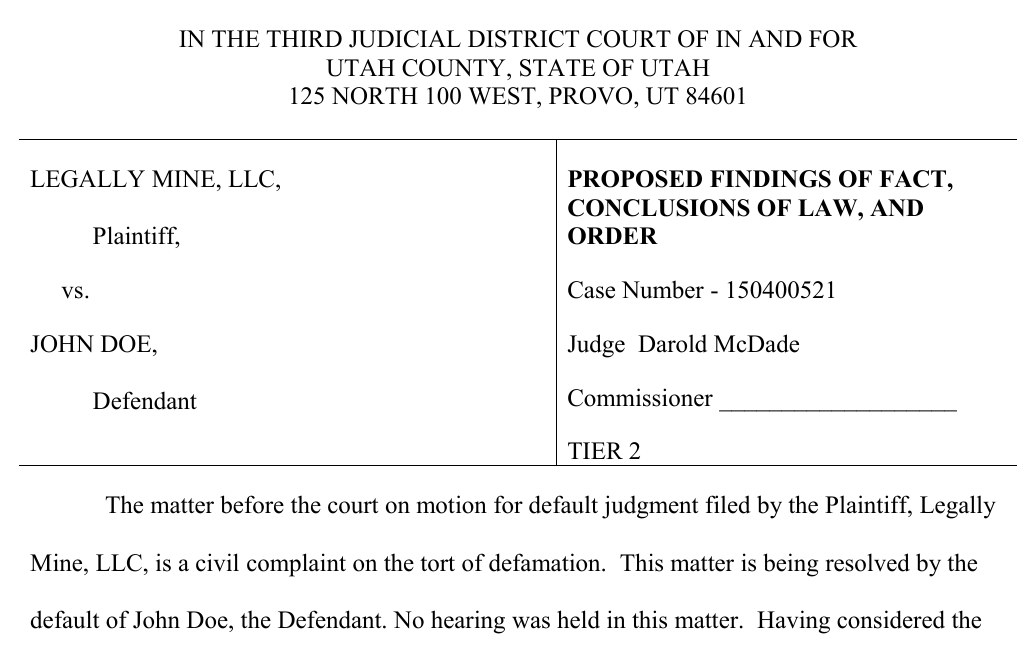
The complaint is Ripoff Report #1039422, posted March 31, 2013 by “AR” of Ohio. Legally Mine’s own legal department sued “John Doe” over it twice in Provo, under a caption naming the wrong court. The first case was dismissed. In the second, Judge Darold McDade signed the company’s proposed findings on December 4, 2015, “No hearing was held in this matter”: $400,000 and an order that the review come down. The company’s proof that the review was false was that it could not find the reviewer among its clients. Service was a posting on the company’s own website and eight newspaper notices pointing to it, none of which mentioned a lawsuit; the reply on the Ripoff Report page that the court also ordered was never posted. No step to collect appears on the docket, and the judgment ran out in December 2023. The review is online today, under the company’s own notice of the suit, beside seven other reports about Legally Mine that it never sued over in Utah’s courts.
PRIMARY SOURCEThe Provo District Court dockets in Legally Mine LLC v. John Doe, 140400754 and 150400521; the 2015 complaint with its four exhibits; the 2014 memorandum; the order for alternative service of April 15, 2015; the proof of service of June 8, 2015 with two newspaper affidavits; the Findings of Fact, Conclusions of Law and Order of December 4, 2015. Each is served below. Ripoff Report #1039422 and its list of related reports, the Utah courts’ party index, and the company’s current website, all as read October 11, 2026.
CONFIRMEDTwo suits over one review, filed by the company’s employed lawyers. The first dismissed March 18, 2015; the second filed April 13, 2015, the day the court declined to revive the first. Service by four weekly notices in The Daily Herald and four in The Plain Dealer, each sending “AR in Ohio” to the company’s own website. Findings signed December 4, 2015; judgment of $400,000 entered December 15, 2015. No subpoena to the website’s operator, no step to collect, no renewal. The review online October 11, 2026, seven other reports about the company beside it, and no suit over any of them in Utah’s courts.
CONTRADICTEDThe company’s memorandum told the court the website had replied “providing an email for Doe.” The reply, the company’s own Exhibit Two, provides none, and says nothing in it “should be construed as a promise to remove any material from the Ripoff Report website.” The order of April 15, 2015 required “a direct reply to Doe’s review on the Ripoff Report website”; the proof of service lists three publications and no reply, and the page shows none after June 19, 2014.
UNRESOLVEDWhether any part of the $400,000 was ever paid: the docket records nothing after the judgment. What the company posted at the address printed in its notices: the domain no longer answers.
How the company served a defendant it could not name
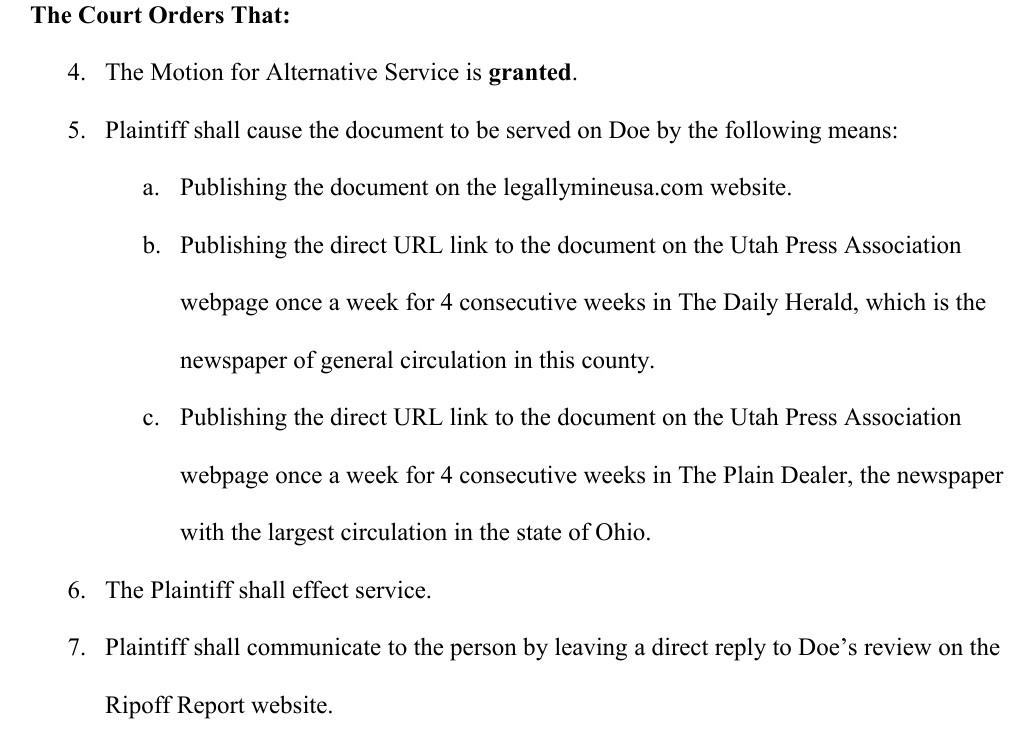
The order for alternative service is the company’s own draft. Its heading still reads “[PROPOSED] FINDINGS OF FACT, CONCLUSIONS OF LAW, AND ORDER ON MOTION FOR ALTERNATIVE SERVICE,” and the judge signed it two days after the second suit was filed. It finds “good cause to believe that the person to be served is avoiding personal service or that their whereabouts are unknown.” It orders four things: the document posted on the company’s website; a link to the document “once a week for 4 consecutive weeks in The Daily Herald,” Provo’s newspaper; the same in The Plain Dealer, “the newspaper with the largest circulation in the state of Ohio”; and a seventh paragraph of its own: the company “shall communicate to the person by leaving a direct reply to Doe’s review on the Ripoff Report website.”
The proof of service, dated June 8, 2015, reports three of the four. The notices ran as paid legal notices: in The Plain Dealer on April 26 and May 3, 10 and 17, 2015, by that newspaper’s sworn affidavit, and in The Daily Herald on May 10, 17, 24 and 31, 2015, for $78.90 in all, by the Herald’s. The Herald’s affidavit adds that the notice “was also published online at utahlegals.com” for “at least 30 days.” The Herald printed it under the header “NOTICE”: “Attn ‘AR in Ohio’ if you posted a review of Legally Mine on Ripoffreport.com, see three notices published at: http://www.legallymine.us/173-2/legal-notices.” The Plain Dealer’s text is the same but for capitals and a tag line. No court. No case number. No word that a lawsuit existed. The reader was sent to a page on the company’s own site.
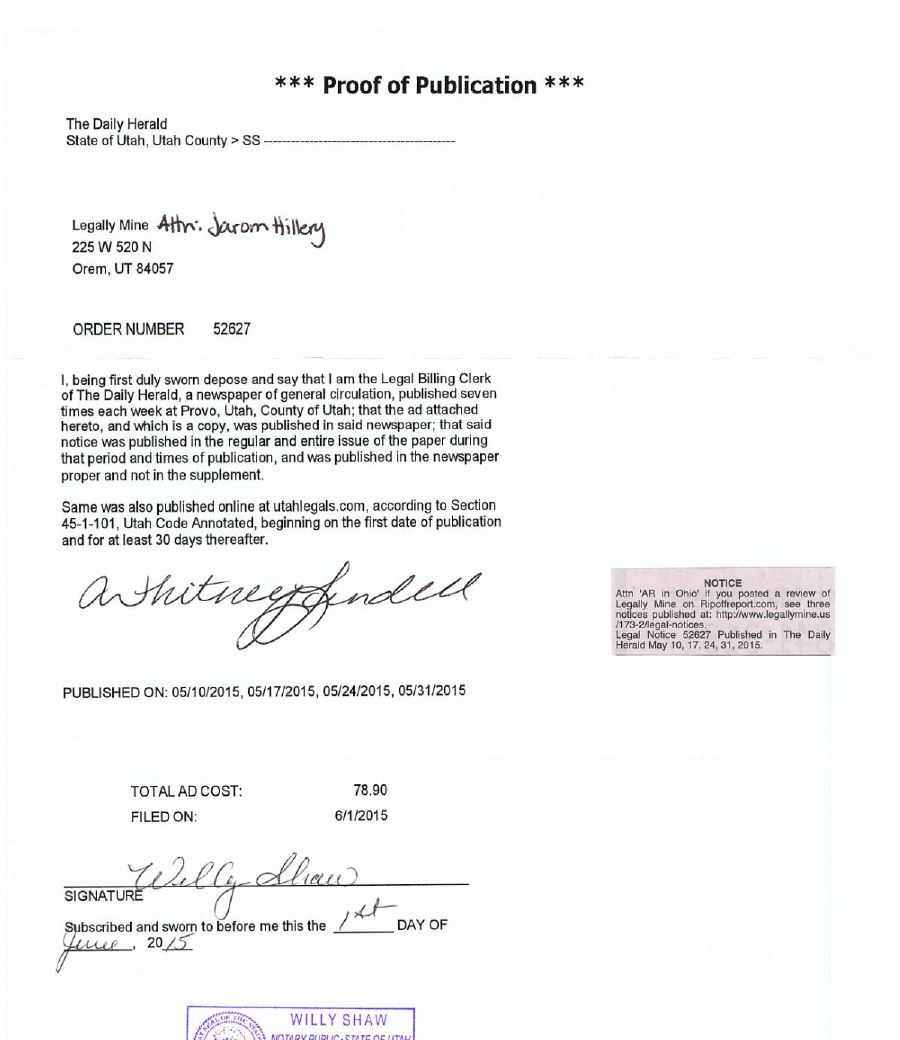
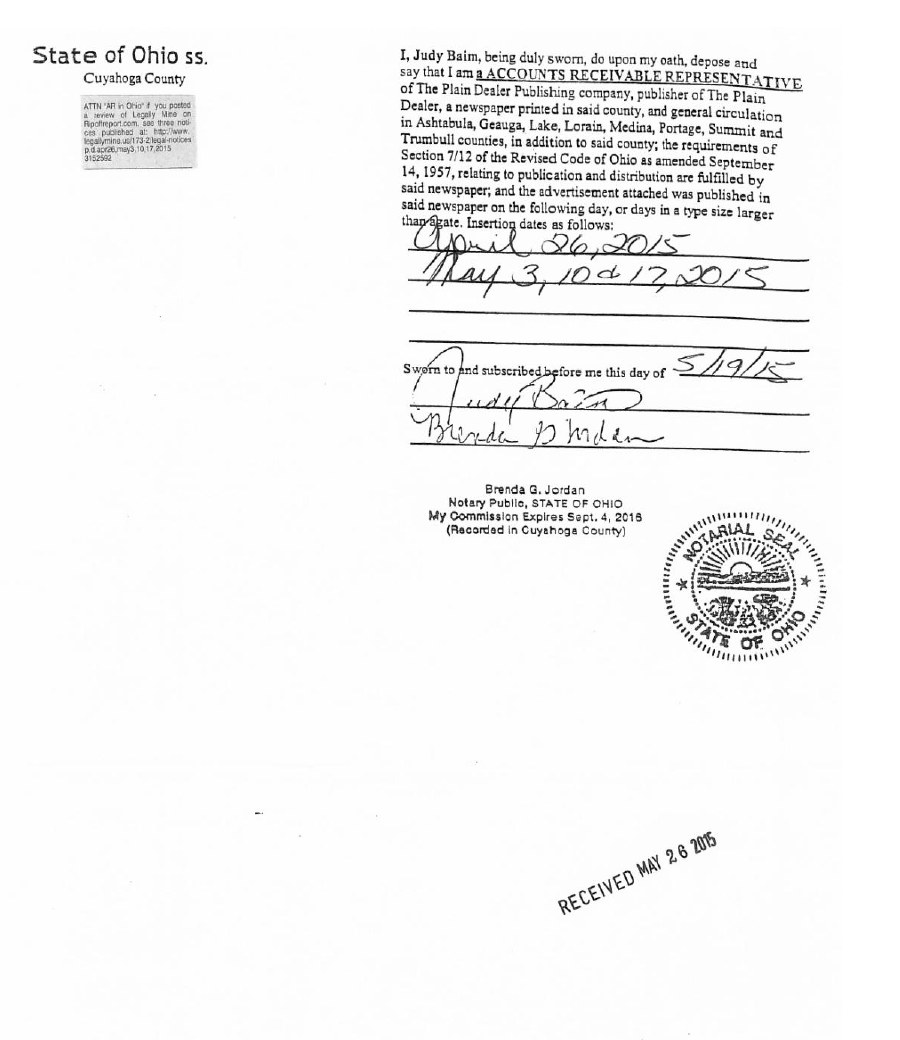
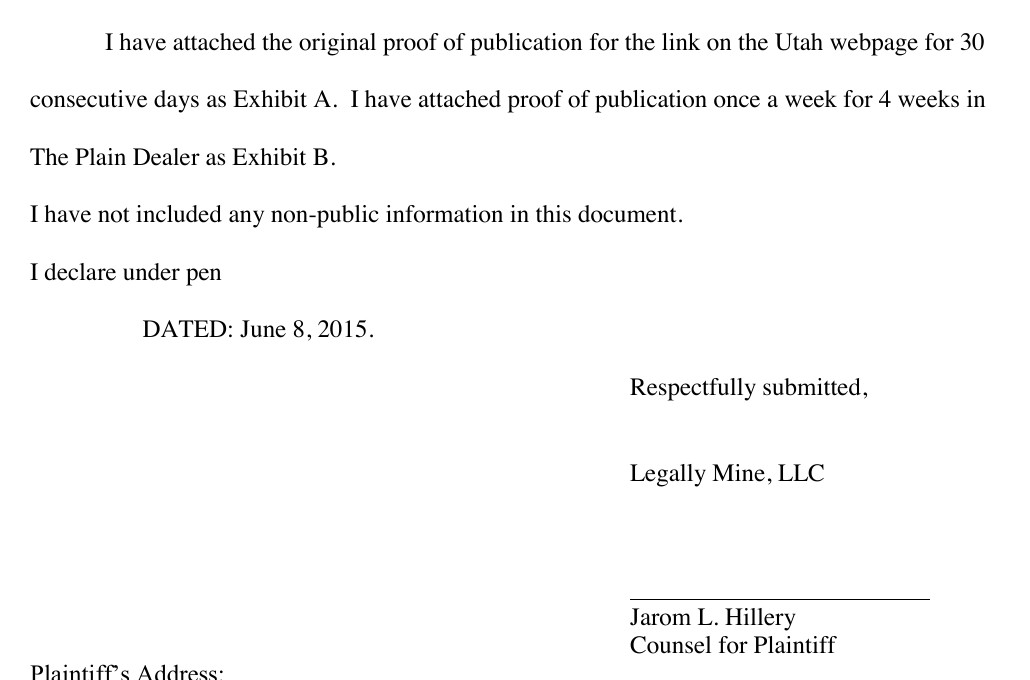
The proof says nothing about a reply on Ripoff Report, and the page carries none. The company’s last post there is dated June 19, 2014, ten months before the order. The proof describes what it served as “a copy of the Complaint and Motion for Alternative Service,” where the order had named the complaint and the motion for a restraining order. It dates the service “On May 30, 2015,” the day before the Herald’s fourth notice ran. Its declaration reads “I have not included any non-public information in this document. I declare under pen” and stops there; the date, the company’s name and a blank signature line above Hillery’s typed name follow. The court refused a first default certificate in August; a second issued November 25, and the findings followed on December 4.
The address printed in the notices no longer exists. On October 11, 2026 the domain legallymine.us did not answer at all, and the company’s current site, legallymine.com, returned “Page not found” for the same path.
The order the company drafted
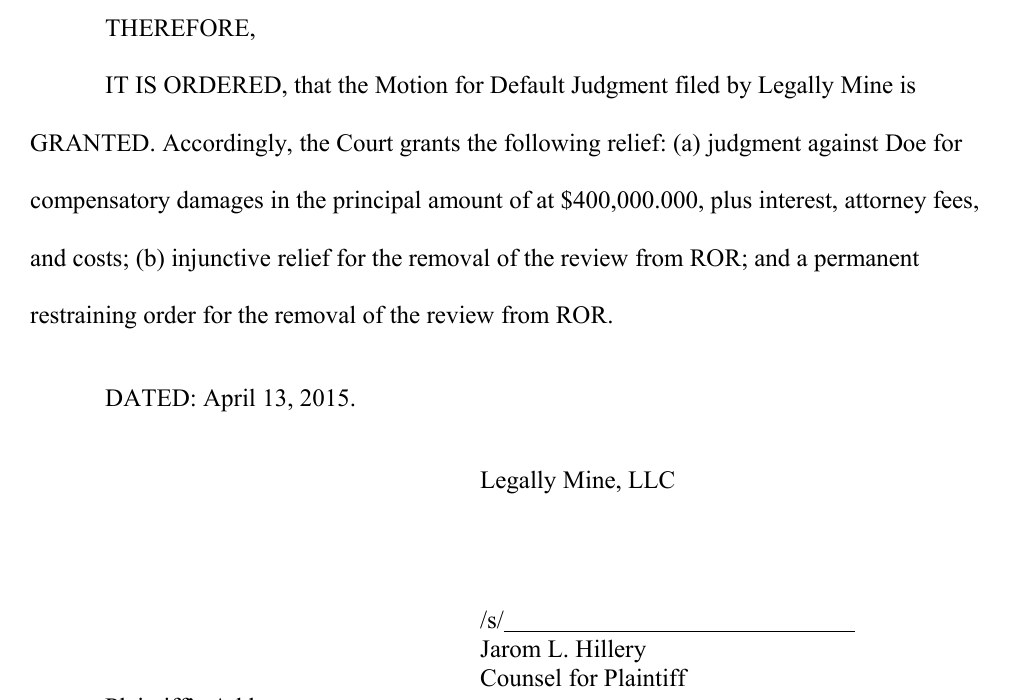
The Findings of Fact, Conclusions of Law and Order is ten pages. Its first page carries the court’s electronic signature stamp, “The Order of the Court is stated below,” dated December 4, 2015 and signed by Darold McDade as District Court Judge, above the company’s own heading, “PROPOSED FINDINGS OF FACT, CONCLUSIONS OF LAW, AND ORDER.” Its last page still reads “DATED: April 13, 2015,” over the company’s name and Jarom L. Hillery’s signature line as counsel for the plaintiff.
The findings are the complaint’s paragraphs, renumbered. Between the complaint and the conclusions the company made four edits. Three delete its own words about the author: “though LM has not yet located Doe to give direct notice,” “Even without being able to provide notice,” and “if issued.”
The findings state as fact that the review’s statements “were false” and that “as of March 31, 2013, LM had no current clients with the initials ‘AR’ residing in Ohio.” The conclusions add that the author “knows the statements to be false.” The damages rest on two figures from the complaint: the ratio of sales to the company’s events, which it said “has fallen from 5.8% to 2.2%,” and sales against the same period a year earlier, which “have gone from 185 to 129.” From those the company asked for “at least $400,000.00,” and the court entered $400,000. Conclusion 31 reads: “The enforcement of an order to remove the review would be enforceable.”
That is the whole proof of falsity in the order: the company searched its client list for the initials, found no one, and the statements were therefore false and their author knew it. The arithmetic is the company’s too. Fifty-six fewer sales and $400,000 price each missing sale at about $7,100. The enrollment form in the Ohio client’s 2020 suit charged $7,800 on the day of signing (October 6).
The relief has three parts: the money, “injunctive relief for the removal of the review from ROR,” and “a permanent restraining order for the removal of the review from ROR.” “ROR” is the website. It was never a party.

The review, and the answers that followed the company’s request
Ripoff Report is a complaints site run from Arizona. Its page on Legally Mine, report #1039422, was posted on March 31, 2013 under the initials “AR” and the location “Ohio.” The site marks the author “AUTHOR CONFIRMED.” The review, in full:
Do not trust this company! The owner, Daniel McNeff gives a great presentation regarding what his company can establish for you to protect your wealth and investments, but his company does not deliver service. His company is slow to process any paper work to establish the stated information he so elequently discusses in his presentation. His company seems to be in complete disarray, you speak with multiple people and obtain very little results for a significant expense. The paper work this company provides can easily be obtained from internet sites such as Legal Zoom. This company takes your money and provides little in return especially no follow-up services, unless you want to pay even more after being ripped off the first time, other than phone call to rate thier service. I was shock they even wanted a response! Avoid this company.
By the company’s own account the review began to appear in search results for its name on June 10, 2013, and by May 2014 it was “the fourth option when Legally Mine is searched on Google.com.” Ten days after it first ranked, the court complaint says, Legally Mine “asked clients who were pleased with the service post rebuttals.” Four “Consumer Comment” rebuttals followed between June 24 and August 29, 2013, signed “Dr Phil,” “Pat Mac,” “DR.RY” and “Dr. W.” They are still the first replies under the review.
The same page lists seven other reports about Legally Mine, posted between June 6, 2013 and February 4, 2016. Five were on the site before the company filed its first suit. The company said in its complaint why it sued over this one: it “appears in the top search results for LM on lead internet search sites such as Google, Bing, and Yahoo!” The Utah courts’ case index shows Legally Mine as a plaintiff in six cases since 2009. The only two against an unnamed defendant are these, and both are about this one review.
The company’s lawyers
Both suits were filed by two lawyers employed by Legally Mine, from the company’s own address: Jarom L. Hillery, Utah bar number 14204, whose email signature in the exhibits reads “Head of Legal Department” of Legally Mine, LLC, and Jacob Stewart, bar number 13871. The company describes itself in the complaint as “a provider of informational seminars, business consultant, and legal document provider.”
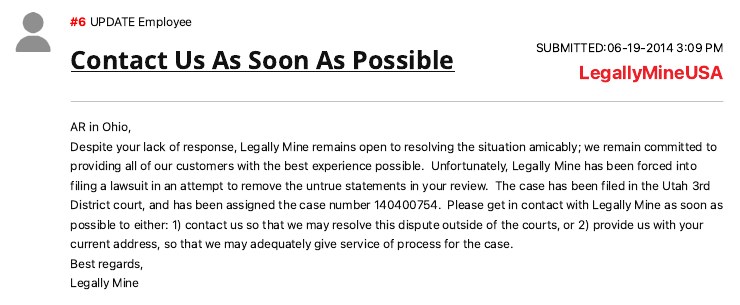
On March 4, 2014 Hillery wrote to the website that Legally Mine “is currently pursuing a lawsuit for defamation against the author of this post” and asked for the author’s name and email address. No suit had been filed; the first came twelve weeks later. The site’s reply the next day is Exhibit Two to the company’s complaint. It gives no name and no email. It sends the company a link to its published procedure, which the complaint attaches as Exhibit Three, and it says: “Nothing in this message should be construed as a promise to remove any material from the Ripoff Report website.” The procedure ends in “a subpoena directed to Xcentric Ventures, LLC from an Arizona court,” with a sworn statement of which sentences are false and why.
Seven weeks later the company’s memorandum told the court something else: that the site “replied the next day providing an email for Doe.” The reply, Exhibit Two to the complaint filed the same day, provides none. The complaint says the company had searched its own records for a client in Ohio with the initials “AR” and found none, and that the website “refused to reveal the identity of Doe until after a civil suit had been filed.” Once the suit was filed, nothing on either docket and nothing in the company’s later filings mentions a subpoena to Xcentric; the procedure called for one from an Arizona court.
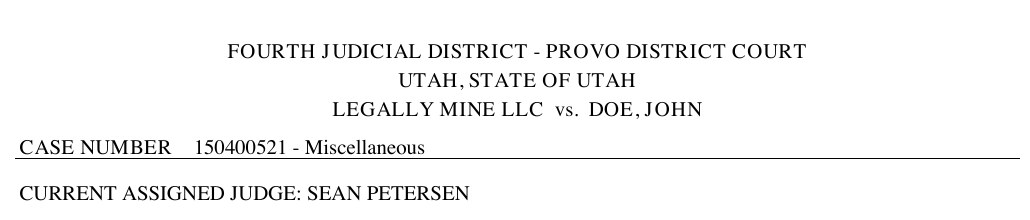
The complaints, the memorandum, the proof of service and both orders the judge signed all carry the same heading: “In the Third Judicial District Court of in and for Utah County.” Utah County is the Fourth Judicial District, and the dockets say so. The company’s own notice on the review page repeats the error: “filed in the Utah 3rd District court.”
The memorandum asked for a restraining order the day the suit was filed and conceded in the asking that “the defamation claim may have passed its statute of limitations allowance,” Utah’s being one year. No temporary order was entered in either case; the only restraining order is the one inside the final default order.
The first case sat ten months with no service and was dismissed without prejudice on March 18, 2015. The proof of service arrived six days after the dismissal. On April 13, 2015 the court declined to set the dismissal aside, and the same day the company filed the second case: the same complaint with a new date. From that filing to judgment took eight months. No one appeared for the defendant at any point. The docket’s party table prints Hillery’s name beside the defendant too, a clerical artifact.
Eight years, and nothing
After December 15, 2015 the docket is empty: no writ, no garnishment, no satisfaction, no renewal. There was no one named to collect from.
A Utah judgment “shall continue for eight years from the date of entry” unless satisfied, renewed or stayed (Utah Code 78B-5-202); renewal is a motion “filed within the original action” before the eight years run (78B-6-1802; the courts’ own page on renewing a judgment). None was filed. The eight years ran in December 2023.
The removal order was never used either. Ripoff Report calls each report “a permanent record,” the order bound a defendant and not the site, and nothing on the docket shows the order served on the site or enforced against anyone. On October 11, 2026 the review stands under its 2013 report number, “AUTHOR CONFIRMED,” with the four rebuttals that followed the company’s request and its two 2014 notices under it.
In the company’s own record
In June 2013 the company asked pleased clients to post under the review, by its complaint’s own account. In 2025 one of its three five-star Better Business Bureau reviews was signed “Karle M.” (October 5).
In 2015 the company had a court find that, as of the review’s date, it had no current client with the review’s initials in Ohio, and it placed its notices in Cleveland. In July 2020 an Ohio lawyer notified the company that it might be practicing law in Ohio without a license and complained to the state bar; the panel that heard the case recorded the company’s acknowledgment of more than fifty other Ohio clients (October 3, October 6).
In its April 14, 2014 post under the review the company wrote: “A trust document requires that you meet with our attorney who focuses on estate planning. Questions about how to set up an LLC require a meeting with either a paralegal or our business attorney.” On February 20, 2025 the Supreme Court of Ohio ordered Legally Mine and Daniel McNeff “enjoined from engaging in the unauthorized practice of law in Ohio” (October 3).
In 2015 the findings declared false the statement that the company “does not deliver service.” In 2020 an Ohio client sued it over monthly card charges after “having provided no services at all” (October 6).
Both suits were filed while Ammon McNeff was Legally Mine’s president. BAM Franchising’s own disclosure document says he “has served as President for Legally Mine, LLC in Orem, Utah since January 2011,” and its 2022 edition closes the span, “until 2020” (the disclosure document, Item 2). The same document makes him BAM Franchising’s president since April 2018; he certifies its disclosure documents today (October 5).
The fair reading, and its limit. A default judgment is a judgment, and a court entered this one. Legally Mine may have believed every word of its complaint, and the review is one reviewer’s account, never tested by an adversary either. The newspapers’ affidavits show the notices ran on the dates sworn to. What the record does not supply is any step toward the author’s identity, the reply the court ordered, any payment, any renewal, or a reason a legal-documents company captioned six papers for the wrong court and told a judge its exhibit contained an email it does not. Legally Mine can answer through this site’s right of reply.
The record
Docket, Legally Mine LLC v. John Doe, 140400754, Provo District Court, as read October 11, 2026. Memorandum in support of the motion for a temporary restraining order and preliminary injunction, May 27, 2014. Docket, Legally Mine LLC v. John Doe, 150400521, as read October 11, 2026. Complaint with Exhibits One to Four, April 13, 2015, the 2014 complaint re-dated (the exhibits are the review as filed, the company’s exchange with the website, the website’s procedure, and the company’s April 14, 2014 notice). Findings, Conclusions and Order on Motion for Alternative Service, April 15, 2015. Proof of Alternative Service with Exhibits A and B, June 8, 2015. Findings of Fact, Conclusions of Law and Order, December 4, 2015. Ripoff Report #1039422. Utah Code 78B-5-202 and 78B-6-1802. BAM Franchising’s disclosure documents, Item 2, 2019 and 2022 editions.
Sources. Fourth Judicial District Court, Provo, Utah: Legally Mine LLC v. John Doe, Nos. 140400754 (filed May 27, 2014; dismissed March 18, 2015) and 150400521 (filed April 13, 2015; judgment December 15, 2015), dockets, complaint, memorandum, the order for alternative service, the proof of service with the affidavits of The Daily Herald and The Plain Dealer, and the final order, as served above. Utah State Courts XChange, party search for Legally Mine, as read October 11, 2026: six cases with the company as plaintiff, 140400754, 150400521, 190401633, 200401232, 210401731 and 220400565. Ripoff Report, report #1039422, “Legally Mine Daniel McNeff estate planning Internet, Utah,” submitted March 31, 2013, with six updates and rebuttals and the site’s list of related reports, seven of them about Legally Mine, dated June 6, 2013 to February 4, 2016, as read October 11, 2026. The domain legallymine.us and the path 173-2/legal-notices on legallymine.com, as read October 11, 2026. Utah Code 78B-5-202 (current text; the version in force from July 2024 to May 2025 set the same eight years) and 78B-6-1802, and the Utah State Courts’ self-help page on motions to renew a judgment. BAM Franchising, Inc., Franchise Disclosure Document, Item 2, 2019 edition (“since January 2011”) and 2022 edition (“since January 2011 until 2020”). Earlier pages on this site: October 6, October 5, October 5 and October 3.