Legally Mine has been sued in Idaho, Texas, Missouri, California, Washington and Ohio since 2015. Two judgments against it were collected; the other four cases were dismissed.
The Thomases’ lawyer said on a call JEST published October 6 that Legally Mine had “been sued in Texas.” The courts’ own dockets show that suit and five more, in Idaho, Missouri, California, Washington and Ohio: two judgments collected against the company, three cases settled or stipulated away, and an Ohio fraud suit served on the day in 2020 that the Thomases’ lawyer first put the company on notice, dismissed by the plaintiff fifty-five days later. The Ohio panel later recorded that the company was “unaware of any complaint filed against Legally Mine by an Ohio client related to the services provided by Legally Mine.” While the Missouri class action naming Daniel McNeff was pending, BAM’s May 2019 disclosure document named him as its chief executive and said no litigation was required to be disclosed. Arkansas’s unauthorized-practice committee had listed the company’s own lawyer under “Cease & Desist” in 2016; a session under the company’s logo was on an accredited Little Rock program in February 2026.
PRIMARY SOURCEThe courts’ own records, served below: Bonneville County, Idaho, CV-2015-1264; Bexar County, Texas, 2015CI14364; Cole County, Missouri, 17AC-CC00123; the Northern District of California, 3:18-cv-03622; Wood County, Ohio, 2020CV0298, with the complaint and its two exhibits; the Bankruptcy Court for the Western District of Washington, adversary 19-01004, the satisfaction of judgment from the public archive. BAM’s disclosure document of May 22, 2019, Items 2 and 3. The Arkansas Supreme Court committee’s index of actions and its rules; the Ohio panel report (October 3) and the Supreme Court of Ohio’s docket.
CONFIRMEDSix suits. Judgments against the company in Idaho, $5,141.30 by default, satisfied by June 2015, and in Washington, paid in full by May 2019. Dismissals with prejudice in Texas in April 2016 by agreement, in Missouri in January 2020 after a settlement, in California in May 2021 by stipulation, and in Ohio in August 2020 by the plaintiff, fifty-five days after filing. The other five dockets show no trial; the Washington docket’s public copy shows the judgment’s satisfaction and not how it was entered.
AS REPORTEDThe Thomases’ lawyer, on JEST’s October 6 recording: Legally Mine has “been sued in Texas,” the Thomases’ money came back on his letter before any proceeding, and he “filed a complaint with the Ohio State Bar Association.” JEST’s description says “Yes, I’m undercover here” and “I am in a one-party consent state.” The record bears out the account; the opinions on the call are his.
INFERENCEThe three arbitration-association letters in the Missouri docket, labeled by the clerk as of August 7, August 23 and September 10, 2019, are the same series the California court described, dated August 6, August 22 and September 10, 2019: the association’s refusal to run Legally Mine’s consumer arbitrations reached both class actions at once. Missouri settled within weeks of the third letter; California came back to court on it and ended by stipulation. The Missouri letters are on file only at the courthouse and have not been read.
The remark, and the record behind it
On October 6 JEST, the Ohio creator of two earlier Legally Mine videos (October 3), published a seventeen-minute telephone call with Scott Sandrock, the Akron lawyer who represented Dr. Julie Thomas and her husband against Legally Mine. JEST’s description says “Yes, I’m undercover here,” that the channel is “in a one-party consent state,” and that the call “was Scott’s recollection of the case, not a court statement.”
At 13:41 he says what he knows beyond Ohio: Legally Mine has “been sued in Texas. I know that.” Asked whether that is public, he answers “Texas is public,” and that a search would turn it up.
His account of his own matter matches the Board’s file. He wrote to the company, he says, that “this is what you represented to the Thomases. I do not believe that is Ohio law. Your colleague acknowledges that no one is licensed in Ohio,” and asked for the money back. The reply, as he recalls it: “we don’t think we did anything wrong, but we don’t want to fight about it. We’ll just send you back their money.” And, he says, they did. Then: “So I filed a complaint with the Ohio State Bar Association.” The record says the same in its own words: the parties’ stipulated facts of February 29, 2024 put the date at July 2, 2020, when the Thomases’ lawyer notified the company’s general counsel, and the panel’s report says the Thomases were refunded in full.
Texas, 2015
The Texas case is Barry G. Wortham, MD v. Legally Mine LLC, No. 2015CI14364, filed August 28, 2015 in the 225th District Court in Bexar County. The clerk’s case type is “CONSUMER/DTPA,” the Deceptive Trade Practices Act. The citation went by certified mail through the Texas Secretary of State; the docket’s service line names “Trunkar Management LLC.” It was served September 8.
Legally Mine answered on October 6, 2015, subject to a motion to compel arbitration, and filed that motion on December 23. The doctor objected on January 22, 2016 and filed an affidavit three days later. On January 26 a Rule 11 agreement was filed and the hearing on the motion was dropped. On April 6 they filed an agreed motion to dismiss with prejudice, and on April 11, 2016 Judge Renee A. Yanta signed the order. The clerk’s closing line is “CASE CLOSED DISMISSED BY PLAINTIFF.” An agreed dismissal with prejudice after an arbitration fight reads as a settlement on a docket. Its terms are not there, and the petition is not online.
Idaho, 2015
Earlier that year, on March 5, 2015, Jay Marsden had sued Legally Mine in the magistrate court in Bonneville County, Idaho, CV-2015-1264, under the court’s “Other Claims” category. The papers were served on March 19 on Scott Anderson, the company’s registered agent. Legally Mine never appeared. On April 21, 2015 Judge Steven Alan Gardner entered a default judgment for $5,141.30. A writ of execution issued a week later for $5,149.07, and on June 3 the docket reads “Writ returned, Satisfied.” The complaint is not online and the claim is not described beyond the category.
Missouri, 2017 to 2020
On March 3, 2017 Stacey Beddoe filed a class action petition in the Cole County Circuit Court in Jefferson City, 17AC-CC00123, against Legally Mine, Daniel McNeff, Art McOmber, David Gibb and a fourth man whose summons came back with the note “No longer works for company.” The other four summonses were delivered to Scott Anderson, registered agent, on March 28. Legally Mine moved on May 30 to dismiss and to compel arbitration. The plaintiff’s opposition of July 7 cited the 2011 order in which a Missouri federal court let a class action go forward on the claim that LegalZoom’s online document preparation was the unauthorized practice of law in Missouri, and attached ten exhibits, the tenth listed on the docket as “NC Bar Letter of Caution.” After an evidentiary hearing on August 8, Judge Jon E. Beetem ruled on December 6, 2017.
“The Court finds that the transaction at issue involves interstate commerce, that the agreement to arbitrate ‘any and all claims’ is the ‘broadest possible language’ and that both 8th Circuit and U.S. Supreme Court law require Plaintiff’s claims to be resolved by the arbitrator. See Rent-a-Center, W., Inc., v. Jackson, 561 U.S. 63, 130 S.Ct. 2772 (2010). Accordingly, Defendant’s Motion to Compel Arbitration is sustained.”
The plaintiff took the ruling up twice, by petitions for a writ against the judge, and lost twice: the Western District of the Court of Appeals denied the writ on July 11, 2018, and the Supreme Court of Missouri on December 4, 2018. Legally Mine’s lawyer filed the opposition both times. Then the arbitration it had won stalled. On October 16, 2019 the plaintiff filed this.
“Plaintiffs Motion For Entry Of Arbitrtors Judgment Refusing Arbitration and Motion For Court To Re-take Jurisdiction; Plaintiffs Exhibit 1 - Demand For Arbitration; Plaintiffs Exhibit 2 - AAA 8719 Letter; Plaintiffs Exhibit 3 - AAA 82319 Letter; Plaintiffs Exhibit 4 - AAA 91019 Letter; Electronic Filing Certificate of Service.”
“AAA” is the American Arbitration Association, the body Legally Mine’s own enrollment form names. The clerk’s labels date the three letters August 7, August 23 and September 10, 2019. Sixteen days after the filing, on November 1, the docket reads “Case is settled.” The parties moved jointly to dismiss on December 30, and on January 2, 2020 the case was “Dismissed with Prejudice on the motion of the parties.” What the three letters say is in the courthouse file, not online. What the same association was writing to Legally Mine in those same weeks is in a federal order.
BAM’s 2019 disclosure document
While the Missouri case was pending, on May 22, 2019, BAM Franchising issued the disclosure document it gave franchise buyers that year. Its Item 2 lists “Dan McNeff, Chief Executive Officer,” who “has served as CEO for Legally Mine, LLC in Orem, Utah since January 2011.” Its Item 3 reads, in full: “No litigation is required to be disclosed in this Item.” The federal Franchise Rule requires a franchisor to disclose a pending “material civil action alleging a violation of a franchise, antitrust, or securities law, or alleging fraud, unfair or deceptive practices, or comparable allegations” against any person named in Item 2, the rule the October 3 page set beside the McNeff family’s own suit. A class action naming the chief executive was pending in Cole County when the 2019 edition issued. What it alleged is in the petition the courthouse holds, and whether it was material is a question the rule leaves to the franchisor and its regulators.
California, 2018 to 2021
Kasra Eliasieh, MD sued in the Northern District of California on June 18, 2018, for a class (October 3). The court compelled arbitration in April 2019. The association wrote on August 6, 2019 that its consumer rules applied, that Legally Mine had to register its clause and waive two terms that violated its consumer protocol, and that it had to pay its share of the fees; wrote again on August 22; and on September 10 terminated the arbitration because it had “not received the required fees from Legally Mine, LLC,” adding that it “may decline to administer future consumer arbitrations involving Legally Mine.” On April 21, 2020 Magistrate Judge Jacqueline Scott Corley held that the company had “materially breached the arbitration agreement by, at a minimum, failing to pay the arbitration fees,” put the case back on her docket, and let the doctor amend to a nationwide class. The Missouri letters, as the clerk labeled them, are dated one day after the first two California letters and the same day as the third. The same Provo lawyer, Kenneth Parkinson, appeared for Legally Mine in Missouri and in California. On May 24, 2021 the parties stipulated to dismiss the California case with prejudice, and the docket closed that day.
Washington, 2019
On January 9, 2019 the Chapter 7 trustee for a Washington couple’s bankruptcy estate sued Legally Mine in the United States Bankruptcy Court in Seattle, adversary No. 19-01004, before Judge Christopher M. Alston. The public archive holds two entries. The adversary was closed on April 1, 2019, eighty-two days after filing. On May 24 the trustee’s lawyer filed a satisfaction of judgment acknowledging “receipt of full payment of the Judgment entered against Defendant Legally Mine, LLC.” A trustee sues to bring money or property into the estate. What this one claimed, and how the judgment was entered, are in filings the archive does not hold.
Ohio, 2020: the suit the Board’s file does not mention
On June 26, 2020 Don M. Smucker of Perrysburg, Ohio sued Legally Mine in the Wood County Court of Common Pleas, 2020CV0298, for breach of contract and fraud, with a jury demand. The complaint says he attended a Legally Mine sales presentation at a Chicago seminar on September 21, 2018, where the representative said “customer satisfaction was guaranteed”; that he filled out what was presented as an initial application on his way to the airport; that the form was in fact a final sales contract, with no satisfaction guarantee and no cooling-off period; and that Legally Mine charged his card $7,800 that day for “Premium+” and “Entity Creation CAP” services before providing any. Four days later he called to cancel. A representative accepted the cancellation, said a refund would issue, and offered a $1,500 review instead. No refund came. He wrote on November 20, 2018. The charges continued.
“Despite Plaintiff’s many notices of cancellation, and having provided no services at all to Plaintiff, Defendant has repeatedly charged Plaintiff’s credit card $150 per month.”
When his lawyer called, the complaint says, Legally Mine “refused to confirm that future charges would cease and abruptly hung up the phone.” The form is Exhibit A. It is the form the Thomases signed eight months later in Canton, with the same back page: arbitration before the American Arbitration Association in Utah, no class claims, up to three times the contract price for a disputed charge, $10,000 for a bad review, and “ALL SALES ARE FINAL” above the signature line. The same paragraph has the customer agree that the transaction is “business-to-business and not consumer.” The association, the following summer, applied its consumer rules to the clause anyway.

Count two asks the court to declare that there is no agreement to arbitrate, citing the California order of two months earlier. Legally Mine was served by certified mail on July 2, 2020. That is the date on which, by the stipulated facts in the Ohio matter, the Thomases’ lawyer notified the company’s general counsel that it might be practicing law in Ohio without a license. On August 20, 2020, fifty-five days after filing, the plaintiff dismissed his case with prejudice. No answer, no motion and no order lies between.
Eighteen days after the service, with the suit pending, Daniel McNeff wrote to an arbitrator the letter about Legally Mine and BAM that the October 3 page quotes.
Nothing in the Board’s file mentions the case, and Mr. Smucker’s name is not among the Ohio clients listed in it. In the panel report of December 13, 2024, three findings below “more than fifty (50) other Ohio residents,” is this.

Nine pages later the report returns to the point, citing the decree and the parties’ stipulations.
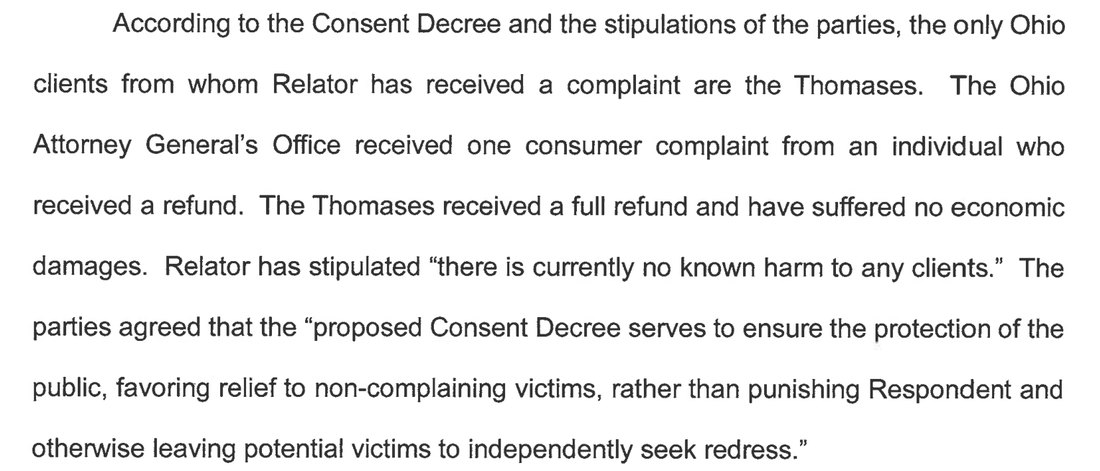
Two readings keep this short of a contradiction. “Complaint” may mean a complaint to the Bar, and the panel’s own sentence says so: clients “from whom Relator has received a complaint.” And Mr. Smucker’s pleading says Legally Mine provided him no services at all, so a complaint “related to the services provided” may be literally true of him too. Neither reading puts the Wood County suit in front of the Board, and nothing in its file does.
The panel’s footnote does describe one complaint to the Ohio Attorney General, from a person who “canceled prior to Legally Mine providing any services” and, by the report’s page 20, “received a refund.” Mr. Smucker’s pleading says he canceled before any service was provided, and that no refund had come by June 2020. Whether he is that complainant is in the Attorney General’s file, not the Board’s.
By the time the Bar’s contact brought the company Ohio counsel, in December 2021 by the stipulations, an Ohio client had already sued it for fraud in an Ohio court, and the papers had reached it on the day it was first warned.
The Supreme Court of Ohio’s docket adds two collection entries after the decree. The decree of February 20, 2025 imposed a $5,000 penalty, and the Board’s costs were $1,220. On April 10, 2025 the claim for the penalty, the costs and interest was certified to the Attorney General for collection. On July 14, 2025 the docket records $6,894.78 collected, $6,267.98 received after the Attorney General’s fee.
Arkansas, 2016, and Little Rock, 2026
The Arkansas Supreme Court’s Committee on the Unauthorized Practice of Law publishes an index of its actions on complaints, 113 rows from 2013 to 2023. Its own FAQ gives that index as “the list of reported decisions” for anyone asking how to learn whether a person “has been found to have engaged in the unauthorized practice of law.” One row.

John Maddox is Legally Mine’s own lawyer: the “Senior Staff Attorney” of the Ohio complaint, deposed in that matter as the company’s “Chief Legal Counsel” in October 2022 (October 3), and listed under Legal on the company’s team page as read October 6. The committee does not post the letter. Under its rules as they read today, which may differ from the 2016 text, the result on the index comes one of two ways.
“(B) If the respondent agrees to cease and desist from actions that appear to constitute the unauthorized practice of law, the matter may be closed by formal agreement with notification of such action given to the complainant. A formal agreement may require the respondent to pay restitution to persons from whom the respondent obtained fees. … (ii) If, following a formal proceeding under this rule, the Committee finds by a preponderance of the evidence that the activities engaged in were a blatant and intentional violation of the prohibition against the unauthorized practice of law, the respondent has a history of such activity, or such activities pose a significant threat to the public, the Committee may issue a cease and desist letter to the respondent”
One route is a finding after a formal proceeding; the other is an agreement to stop “actions that appear to constitute the unauthorized practice of law,” with no finding. The index does not say which produced the 2016 entry, and no court case followed: the state’s case search returns no party named Legally Mine. A second state’s letter sits in the Missouri docket, the “NC Bar Letter of Caution” filed as an exhibit in July 2017. Under the North Carolina State Bar’s rules a letter of caution issues where the committee finds probable cause of unauthorized practice but the respondent has agreed to stop, is unlikely to repeat it, or neither a criminal referral nor an injunction is warranted; or where the evidence falls short of probable cause and the committee cautions anyway because the conduct “could potentially lead to a violation of the law.” Whom the letter was addressed to, the docket does not say, and the letter has not been read.
In a Legally Mine seminar posted online in 2022, the presenter, identified by the opening slide as Dan McNeff, told the room what an Alaska holding company does for a client: “the judge in Utah, the judge in California, the judge in Arkansas or Texas cannot dissolve your LLC because they are bound by the Alaskan law” (24:44). And on February 28 and March 1, 2026, the Arkansas Chiropractic Physicians Association’s spring convention at a Little Rock hotel, approved for twenty hours of continuing education, carried this session.
Legally Mine’s team page lists Jason Porter under Speakers. Ten years after the committee’s entry against the company’s lawyer, a session under the company’s logo was on an accredited program in the state’s capital.
The pattern
In four of the six suits the form’s arbitration clause did the work. Texas: compelled, then dismissed by agreement. Missouri: compelled, held through two writs, then the association’s three letters, then settled. California: compelled, then terminated for unpaid fees, then “materially breached,” then dismissed by stipulation. Ohio: the plaintiff pleaded the California order against the clause and dismissed his own case with prejudice in fifty-five days. Idaho and Washington are the exceptions: a $5,141 default judgment the writ collected, and a trustee’s judgment paid in full. By January 28, 2020, the California court noted, Legally Mine had registered its clause with the association.
The fair reading, and its limit. A settlement is not a finding. Three of these six cases ended by agreement or stipulation and the Ohio case by the plaintiff’s own notice, on terms no docket states, and what Legally Mine paid or admitted, if anything, is not known; the Idaho judgment is a default on a claim the company never contested, for $5,141, and the Washington judgment’s amount and grounds are not in the public archive. The Ohio finding can be read as the Bar’s complaints, and Mr. Smucker’s own complaint says the company provided him nothing, so its words may hold. The Arkansas index gives a number, a name and a result, not the conduct or the route; the Texas petition, the Missouri petition and letters, the Washington complaint and the North Carolina letter have not been read, and two Pennsylvania entries in a court-records index are not counted until read. The disclosure question turns on what the Missouri petition alleged. The right of reply is open to Legally Mine, to Daniel McNeff, to John Maddox and to BAM Franchising.
The record
Idaho: the case details, Marsden v. Legally Mine, LLC, Bonneville County, as read October 6. Texas: the case summary, Wortham v. Legally Mine LLC, 225th District Court, Bexar County, as read October 6. Missouri: the docket entries, Beddoe v. Legally Mine, LLC et al., Cole County Circuit Court, as read October 6, from Case.net. California: the order of April 21, 2020 and the stipulated order of dismissal filed May 24, 2021, Eliasieh v. Legally Mine, LLC, No. 3:18-cv-03622 (N.D. Cal.), from the public docket archive. Washington: the satisfaction of judgment, Peterson v. Legally Mine, LLC, adversary 19-01004 (Bankr. W.D. Wash.), filed May 24, 2019, from the public docket archive. Ohio: the complaint of June 26, 2020 with Exhibits A and B, the docket as read October 6 and the notice of voluntary dismissal of August 20, 2020, Smucker v. Legally Mine, LLC, Wood County Court of Common Pleas; the Supreme Court of Ohio’s docket in 2025-0037 (as read October 6). BAM’s disclosure document of May 22, 2019, Items 2 and 3, and the Franchise Rule, 16 CFR 436.5(c) (October 3). Janson v. LegalZoom.com, Inc., 802 F. Supp. 2d 1053 (W.D. Mo. 2011). Arkansas: the committee’s index (as read October 6), its FAQ as read October 6 and its rules. North Carolina: the State Bar’s Authorized Practice Committee rules, 27 NCAC 01D. The convention page (as read October 6) and Legally Mine’s team page (as read October 6). October 3: the Ohio file. October 3: JEST’s two videos. The law. The cast.
Sources. Bonneville County Magistrate Court, Idaho, CV-2015-1264, case details as read October 6, 2026. 225th District Court, Bexar County, Texas, 2015CI14364, case summary as read October 6, 2026. Cole County Circuit Court, Missouri, 17AC-CC00123, docket entries as read October 6, 2026 on Case.net, quoted verbatim, including the clerk’s spellings; the Court of Appeals, Western District, WD81855, and the Supreme Court of Missouri, SC97402, dockets as read the same day. United States District Court for the Northern District of California, 3:18-cv-03622-JSC, docket entry 88, order of April 21, 2020, and docket entry 104-1, filed May 24, 2021, from the public docket archive. United States Bankruptcy Court for the Western District of Washington, Peterson v. Legally Mine, LLC, Adv. No. 19-01004 (main case No. 16-13864), the docket as the public archive shows it and document 9, satisfaction of judgment filed May 24, 2019. Wood County Court of Common Pleas, Ohio, 2020CV0298: complaint with jury demand filed June 26, 2020 with Exhibits A and B, docket as read October 6, 2026, and notice of voluntary dismissal with prejudice filed August 20, 2020; on the served complaint the plaintiff’s telephone numbers, email, signature and initials and the names of two junior Legally Mine employees are blacked. Supreme Court of Ohio, 2025-0037, docket as read October 6, 2026. BAM Franchising, Inc., Franchise Disclosure Document, issuance date May 22, 2019, Items 2 and 3; 16 CFR 436.5(c)(1)(i)(A) as read October 6, 2026. Janson v. LegalZoom.com, Inc., 802 F. Supp. 2d 1053 (W.D. Mo. 2011). Panel Report of December 13, 2024 in Ohio State Bar Association v. Legally Mine, LLC, Board on the Unauthorized Practice of Law, UPL 23-04, Supreme Court of Ohio 2025-0037, page 11, finding 42 and footnote 1, and page 20, shown. Arkansas Supreme Court Committee on the Unauthorized Practice of Law, Index of Actions on Complaints, FAQ, and Rules of Court Creating Committee on the Unauthorized Practice of Law, as read October 6, 2026; Arkansas Judiciary statewide case search, participant search for Legally Mine, no result, October 6, 2026. North Carolina State Bar, 27 NCAC 01D .0206, as read October 6, 2026. Arkansas Chiropractic Physicians Association, Spring Convention 2026 page, and Legally Mine’s team page, as read October 6, 2026. A recorded Legally Mine seminar posted in 2022, presenter identified by the opening slide, quoted at 24:44. JEST, “Legally Mine: Scott Sandrock, Of Counsel,” published October 6, 2026, quoted at 7:17, 7:45, 8:38 and 13:41, as reported. Everyone named here is presumed to have acted lawfully. A dismissal by agreement is not a finding, and this page reports six dockets.