BAM told franchise buyers in 2019 and 2020 that it had no parent. Its own balance sheet and Legally Mine’s own pledge show Legally Mine held two thirds of its shares.
In 2018 Legally Mine bought most of BAM Franchising from its founders, on credit. BAM’s audited statements give the share count. Legally Mine’s own filing gives the pledge. Daniel McNeff’s own letter, on a federal docket, describes the loan. A Utah court decree, on terms he signed, puts BAM “under the umbrella of Legally Mine.” The federal Franchise Rule makes a franchisor name any company that controls it. In 2019, 2020 and 2021, BAM’s disclosure documents told buyers there was none.
PRIMARY SOURCEThe decree, a public record, obtained from the Utah courts’ XChange service; Daniel McNeff’s letter of July 20, 2020, Exhibit F to the sons’ federal complaint; the UCC-1 of August 10, 2020 on The lenders; BAM’s disclosure documents of 2019, 2020 and 2021.
CONFIRMEDThe arithmetic. BAM’s balance sheets: 675,000 shares at the end of 2018, 2019 and 2020. The UCC-1: “450,000 shares of common stock of Bam Franchising, Inc.” pledged by Legally Mine. That is 66.7 percent.
AS REPORTEDWhat JEST reports from Ohio: the Board’s 350-page file, the brochure, the dinner, a customer who says he got no refund.
UNRESOLVEDWhether Legally Mine still held the shares when the April 30, 2021 edition repeated “no parents.” By the sons’ account the sellers had taken the stock back by January 2021, so this page counts 2019 and 2020 and not 2021.
The purchase, in the family’s own words
On July 20, 2020, Daniel McNeff wrote to the arbitrator who had just ruled between him and his sons over Legally Mine. He was BAM’s chief executive. The letter is Exhibit F to the complaint his sons filed in federal court six months later.
“It didn’t take long for Ammon and Matt to begin pounding on Legally Mine for funds to pay for BAM Franchising, Inc. … If Ammon and Matt have not mismanaged BAM, it should have sufficient funds to pay as Legally Mine has paid employees and my sons stopped paying rent as of February, 2020. I have in fact, been in touch with the two previous owners of BAM Franchising, Inc., who are carrying the loan on the purchase of this business. … In other words, I will not have to make back payments, they will simply have me start making payments and extend the length of the contract.”
The same point says one of the original owners “is being contacted daily by franchisees from BAM to complain about the fact that no one is doing anything for them. No one will contact them,” and puts the system at “close to 40 stores.” The sons’ complaint of January 22, 2021 gives the numbers: Legally Mine had a purchase agreement for “several million dollars’ worth of stock in BAM Franchising,” the agreement allowed the sellers to take the stock back if the monthly payments stopped, Legally Mine had “an equity position of over one million dollars in the stock,” the payments stopped around February 2020, and “the sellers of the stock have repossessed the stock due to the non-payment.” The complaint puts Legally Mine’s ownership at 79 percent Daniel, 11 percent Ammon and 10 percent Matthew.
Two thirds, in BAM’s own numbers
The balance sheet in BAM’s May 2020 disclosure document says “675,000 shares issued and outstanding.” The next edition shows the same 675,000 shares at the end of 2018, 2019 and 2020. On August 10, 2020, Legally Mine filed a UCC-1 in Utah naming John Masek and David Ortiz, the men who had sold the company to the McNeffs in 2018, as secured parties. The collateral: “450,000 shares of common stock of Bam Franchising, Inc., an Oregon corporation.” A borrower pledges what it owns. Four hundred fifty thousand of 675,000 shares is two thirds of the company. The filing lapsed on August 11, 2025 and was never terminated. BAM’s own audited note for that year says: “In 2018, the Company had an ownership change.”
The decree
The decree of divorce in Evelyn McNeff v. Daniel McNeff was entered by Judge Denise M. Porter of Utah’s Fourth District on January 21, 2021, on a stipulation the couple signed on November 30, 2020. Paragraph 10 divides thirteen businesses. Legally Mine, in which “the parties have a 79% interest,” goes to Daniel, who buys out Evelyn’s share for $500,000 at $10,000 a month and pledges his Legally Mine membership interest to secure it. Legal Bear, Procure, RHM, Dan’s Den, MediSource Marketing, Legally Mine Tax and Accounting and Andina Health go to Daniel; the names Legal Elf, Legal Bricks and Dream Elf Enterprises go to Evelyn; Bear-Elf is to be wound up. Two items are BAM’s:
“e. BAM Franchising. Daniel has an interest in BAM Franchising which is awarded to him as his sole and separate property. Daniel will assume, and hold Evelyn harmless from liability on all debt and obligation associated with said business”
“g. Bam-Vancouver. If there is any business interest remaining in BAM Franchising, it is owned under the umbrella of Legally Mine.”
Paragraph 18 has each spouse warrant “a complete accurate and current disclosure of all income, assets, and liabilities,” and says a deliberate failure “may constitute perjury.” Daniel’s counsel approved the decree as to form. Every business it names that this site could check is in a public record as the family’s; The family, The shells and the arbitration award carry them. Utah’s court rules keep a divorce petition, its financial declarations and its findings private, and make the decree public. One page of it surfaced on October 2 in a video by JEST, an Ohio creator. This site has read all of it and quotes its business terms only.
What buyers were told
A franchise disclosure document opens with Item 1, which must name the franchisor’s parents. The federal rule defines a parent as “an entity that controls another entity directly, or indirectly through one or more subsidiaries.”
“We have no parents, predecessors or affiliates that are required to be disclosed in this Disclosure Document.”
Item 3 of the same editions reads, in full: “No litigation is required to be disclosed in this Item.” By the sons’ own account, on October 16, 2019 Legally Mine, Ammon McNeff and Matthew McNeff had sued Daniel McNeff in Utah’s Fourth District “due to Dan’s improper activities, including the mishandling of taxes,” and obtained a restraining order; the case was in arbitration when the May 2020 edition issued. The three are BAM’s president, treasurer and chief executive in Item 2 of that edition. The rule reaches a pending action against an officer that alleges “fraud, unfair or deceptive practices, or comparable allegations.” Whether that suit qualified is not this site’s to decide.
BAM’s auditors came closest. A note in the statements attached to the 2020 and 2021 editions says that since 2018 the company “shares employees with the related party and reimburses the related party for the related payroll cost,” and that it owed that party $62,497 at the end of 2019. The note does not say who the party is. Daniel McNeff’s letter does: “Legally Mine has paid employees.” The 2021 edition, issued ninety-nine days after the decree, added one sentence: “Ammon and Matthew McNeff are brothers and Dan McNeff is their father.” The 2025 edition says no parent in Item 1 while its Item 2 calls the chief financial officer an officer “of the Franchisor and the Franchisor’s Parent since June 2016,” a contradiction this site noted in July. This site has separately found no hidden parent in BAM’s 2024 move to Delaware, and says so on The law. The parent here is Legally Mine, in 2018, 2019 and 2020, by BAM’s own count.
Why it matters
A parent’s name leads a buyer to its record. Legally Mine’s was public: eight federal tax lien notices recorded against it in Utah County between 2016 and 2019, later released; a California customer’s federal suits of 2018 and 2019; its own members’ suit of 2019 over “the mishandling of taxes”; the 2020 award that charged payments Legally Mine had made for two companies its founder owned personally against his equity; the sons’ 2021 counts of fraudulent concealment and “fraudulent conversion of Legally Mine”; and in 2025 the Supreme Court of Ohio’s finding that it practiced law without a license. By BAM’s own Item 20, twenty-one franchised stores opened in 2018, 2019 and 2020, each on a document that named no parent. What those owners had instead, in Daniel McNeff’s words, was a franchisor whose officers were fighting over the parent’s bank accounts while the seller fielded their calls.
The states ask the same question. Ohio’s business opportunity statute requires a document naming “the parent firm or holding company of the seller, if any,” and excuses a franchise sale only if it complied with the federal rule “in all material respects”; the Ohio page of the rights guide has the sections. The states that register franchises treat an untrue statement or omission of a material fact in the document under their own statutes; the rights guide quotes each one, and its entries for the 2019, 2020 and 2021 editions now carry this record. Whether a given sale complied is a question of fact for that sale, and the finding is a court’s to make.
From the suit to the disclosure
The company in the umbrella
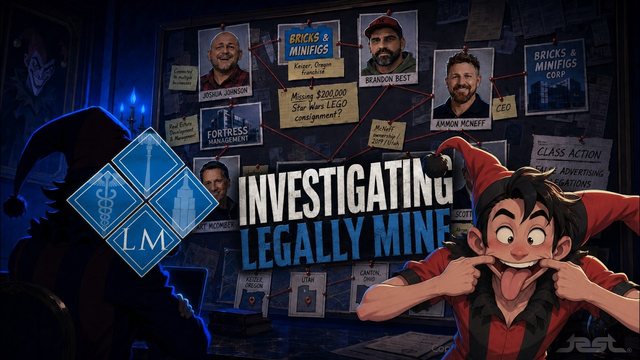
Legally Mine is the company the Supreme Court of Ohio found had practiced law without a license, in a consent decree it adopted in February 2025 with Daniel McNeff’s agreement. JEST’s two videos, which surfaced the decree’s page, found the people behind that case: Dr. Julie Thomas, the Canton dentist whose $8,100 purchase is in the Board’s report, who comes to the door of her practice and says, “Legally Mine is illegal”; and her attorney, Scott Sandrock, who describes asking a Legally Mine representative whether anyone there was licensed in Ohio, or in Alaska, and hearing no each time. In the second video he obtains the Board’s file, about 350 pages the court does not post, and hears from one customer who, by his account, never got the refund the consent decree offered. The Ohio docket shows the notices went out. It does not show the money.
The fair reading, and its limit. Two thirds of the shares is control for as long as Legally Mine held them; whether the purchase agreement withheld voting rights until the shares were paid for is a question for a document this site does not have. The decree says “if there is any business interest remaining,” and the sons say the sellers had taken the stock back by January 2021, so what the April 2021 edition owed its readers turns on dates this site does not have either. Whether Item 1 or Item 3 was wrong is a court’s finding to make, not this site’s. Daniel McNeff’s letter is one side of a family fight, quoted for what it says about the purchase, not for what it says about his sons. The public registries never showed Legally Mine as BAM’s owner; the records that do were all written by the McNeffs. Today, by BAM’s disclosures, the sons run the company and the father runs Legally Mine. The right of reply is open to BAM, to Daniel, Ammon and Matthew McNeff, to Legally Mine and to everyone named here.
The record
The decree, January 21, 2021: caption, paragraph 10 and signature page. Daniel McNeff’s letter to the arbitrator, July 20, 2020. The sons’ complaint, January 22, 2021. The arbitration award, July 6, 2020. Dan’s Den Family Limited Partnership, Utah registry record. The lenders. The shells. The family. The disclosure. The rights guide and its Ohio page. The Supreme Court of Ohio’s order, February 20, 2025. July 31: the affidavit and the notary. The enterprise. Part 1 and Part 2 on YouTube.
Sources. Decree of Divorce, Evelyn Freeman McNeff v. Daniel Jay McNeff, No. 204100226, Fourth Judicial District Court, Utah County, entered January 21, 2021 (Judge Denise M. Porter), obtained from the Utah courts’ XChange service; paragraphs 10 and 18 quoted as written; a public record under Utah Code of Judicial Administration Rule 4-202.02; the served excerpt is the caption page, paragraph 10 and the signature page. McNeff v. McNeff, No. 2:21-cv-00048 (D. Utah): the complaint of January 22, 2021, paragraphs 21, 25, 27, 28, 111, 117, 118 and 272 to 283 and the headings of its causes of action; Exhibit A, the Final Decision and Award of arbitrator Mark F. James, July 6, 2020; Exhibit F, Daniel McNeff’s letter of July 20, 2020, point 3; all as filed; the dismissal of February 10, 2021 from the docket. Utah UCC-1 financing statement 200810703927-7, filed August 10, 2020, debtor Legally Mine, LLC, secured parties John Masek and David Ortiz, collateral quoted verbatim, lapse date August 11, 2025. BAM Franchising, Inc., Franchise Disclosure Documents of May 22, 2019, May 18, 2020, April 30, 2021, March 31, 2022 and April 8, 2026: Items 1, 2 and 3 quoted verbatim; Item 20, Table 3 of the 2021 edition; Item 21, the audited financial statements: the balance sheet of December 31, 2019 (2020 edition), the statement of shareholders’ equity, Note 1 and the related-party note for 2019 and 2020 (2021 edition), and the 2024 edition’s statement of equity (926,500 shares from December 31, 2021); the 2025 edition’s Items 1 and 2 as reported on The disclosure. Utah County Recorder, notices of federal tax lien against Legally Mine LLC, 2016 to 2019, and their releases, as listed on the timeline. Eliasieh v. Legally Mine, N.D. Cal. Nos. 3:18-cv-03622 and 3:19-cv-05977, as reported on The law. 16 C.F.R. 436.1, 436.5(a) and 436.5(c). 26 U.S.C. 1361(b)(1)(B). Ohio Revised Code 1334.02(B)(1)(a) and 1334.13. Utah Division of Corporations, business information report for Dan’s Den Family Limited Partnership, printed June 16, 2026. JEST, “Bricks & Minifigs: Legally Mine’s Plaintiffs,” Parts 1 and 2, YouTube, October 2, 2026; one sentence spoken on camera is quoted, the rest is summarized. Ohio State Bar Association v. Legally Mine, LLC, Supreme Court of Ohio No. 2025-0037: the Board’s report of January 9, 2025 and the consent decree of February 20, 2025. Everyone named here is presumed to have acted lawfully; the courts’ findings are the courts’, reproduced as written.