Warned in July 2020 that it might be practicing law without a license, Legally Mine made “no significant changes” and asked Ohio’s bar not to contact its “apparently otherwise satisfied customers.”
That is the company’s own account, in a joint filing with the Ohio State Bar Association, from the 343-page file of Ohio’s Board on the Unauthorized Practice of Law that JEST obtained from the clerk and this site has now read in full. The file holds the plan itself: the blueprint Legally Mine drew for a Canton dentist, the four companies it filed for her, the partnership agreement its non-lawyers built from a form, and the contract that said “ALL SALES ARE FINAL.” The bar’s complaint concerned one couple, hers. The company acknowledged “more than 50 other Ohio clients,” whom the filing calls “non-complaining victims,” and agreed that “It is unlikely that harm would be identifiable prior to the ultimate failure of an asset protection plan.” It proposed a $5,000 penalty, a refund to one couple, and, as the Board read it, a way to keep doing business in Ohio through contracted lawyers; the Board refused that as “a facade of legality” and required that every Ohio client be offered a full refund. The clause filed with Ohio’s Secretary of State for the dentist is the one Dan McNeff told a seminar “effectively blocks the judge.” By BAM’s own disclosure documents, the men running Legally Mine through most of it, Dan, Ammon and Matthew McNeff, were running Bricks & Minifigs.
PRIMARY SOURCEThe Board’s file in UPL 23-04. The pages shown below are crops of it; the full excerpts are served as images: the blueprint chart, Exhibit C, with the family’s street addresses blacked out; the blueprint’s explanation and cost sheets; three pages of the partnership agreement, Exhibit D; the brochure, Exhibit A; the printed terms of the enrollment form, Exhibit B; three of the Secretary of State filings, Exhibit F; the first proposed consent decree of November 10, 2023; the panel’s entry of January 30, 2024; the order of July 17, 2024; the joint motion of August 28, 2024. Daniel McNeff’s home address is blacked out of the captions. Quoted and shown but not served whole: the parties’ supplement of February 29, 2024, the panel report and the complaint. BAM Franchising’s disclosure document issued April 30, 2021, Item 2, shown below.
ADJUDICATEDOhio State Bar Assn. v. Legally Mine, L.L.C., 2025-Ohio-539: on February 20, 2025 the Supreme Court of Ohio ordered “Legally Mine, L.L.C., and Daniel McNeff enjoined from engaging in the unauthorized practice of law in Ohio and civil penalty imposed.” The Florida Bar v. Mitton & Burningham, P.C., No. SC00-2171: on November 1, 2001 the Supreme Court of Florida ordered Jay W. Mitton, his firm and their foundation “permanently and perpetually enjoined from engaging in the practice of law in the State of Florida.”
INFERENCEOne sum the record does not state, computed here from the parties’ own numbers: fifty-three clients at the $7,800 on the Thomases’ enrollment form is about $413,000. The penalty was $5,000. In the parties’ own table of Ohio precedents, three of seven consent decrees imposed no penalty at all; the Board expressed no view on the amount.
UNRESOLVEDHow many Ohio clients there were. The stipulation says 53 “during Relator’s investigation,” and in the next line that the company signs “approximately 20 Ohio Clients per year” with about 25 cancellations “over the past 12 years”; twenty a year for twelve years is not 53, and the filing does not reconcile its own numbers. The certified-mail receipts on Daniel McNeff’s March 2025 affidavit went to 72 addresses. And when the company stopped signing them: the stipulation says only that it made no significant changes until it engaged Ohio counsel in December 2021; the panel recorded in December 2024 that it had “ceased soliciting or engaging Ohio clients”; its website said in April 2026 that it had “voluntarily ceased.”
In the company’s own words
In January 2024 the panel chair, Robert Gehring, asked the parties for “a clear timeline as to how long Respondent Legally Mine was engaged in these practices.” The bar association and the company answered together on February 29, 2024: registered in Utah on January 5, 2009, under the name Legally Mine, LLC from January 5, 2011; services from about 2010; 53 Ohio clients, trusts for 43 of them, the same structure for every one. Then the dates.
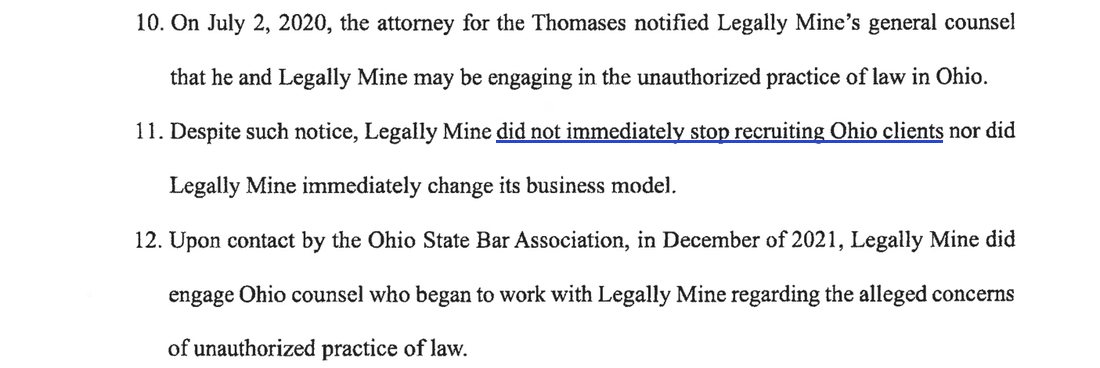
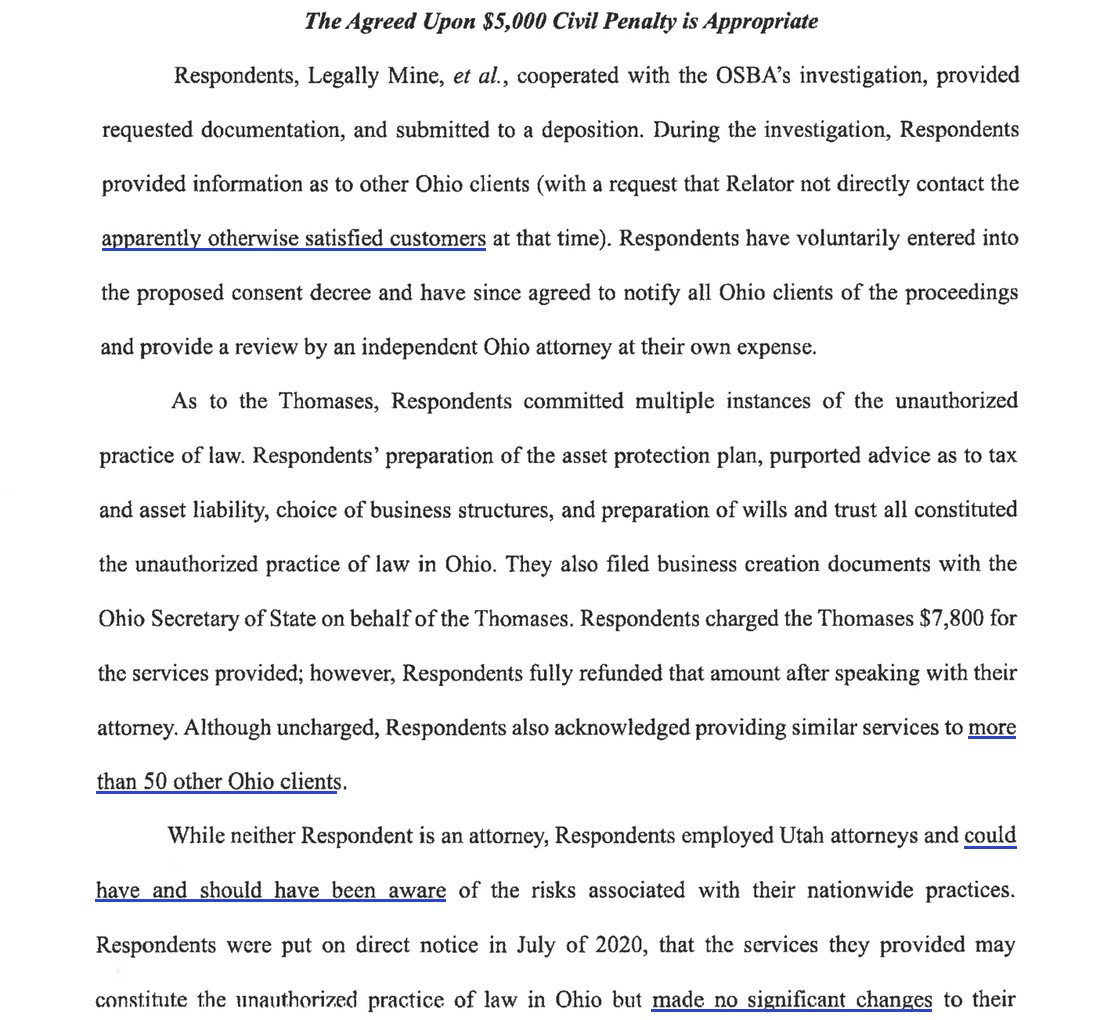
The same filing argues the penalty, and says more than the stipulation does: the company “could have and should have been aware”; it “made no significant changes to their business practices until they engaged Ohio counsel”; “Although uncharged,” it “acknowledged providing similar services to more than 50 other Ohio clients”; and it gave the bar information about them “with a request that Relator not directly contact the apparently otherwise satisfied customers at that time.” The first proposed decree put it harder: “Respondents objected to Relator initiating contact with any Ohio clients due to possible harm to its business and reputation.”
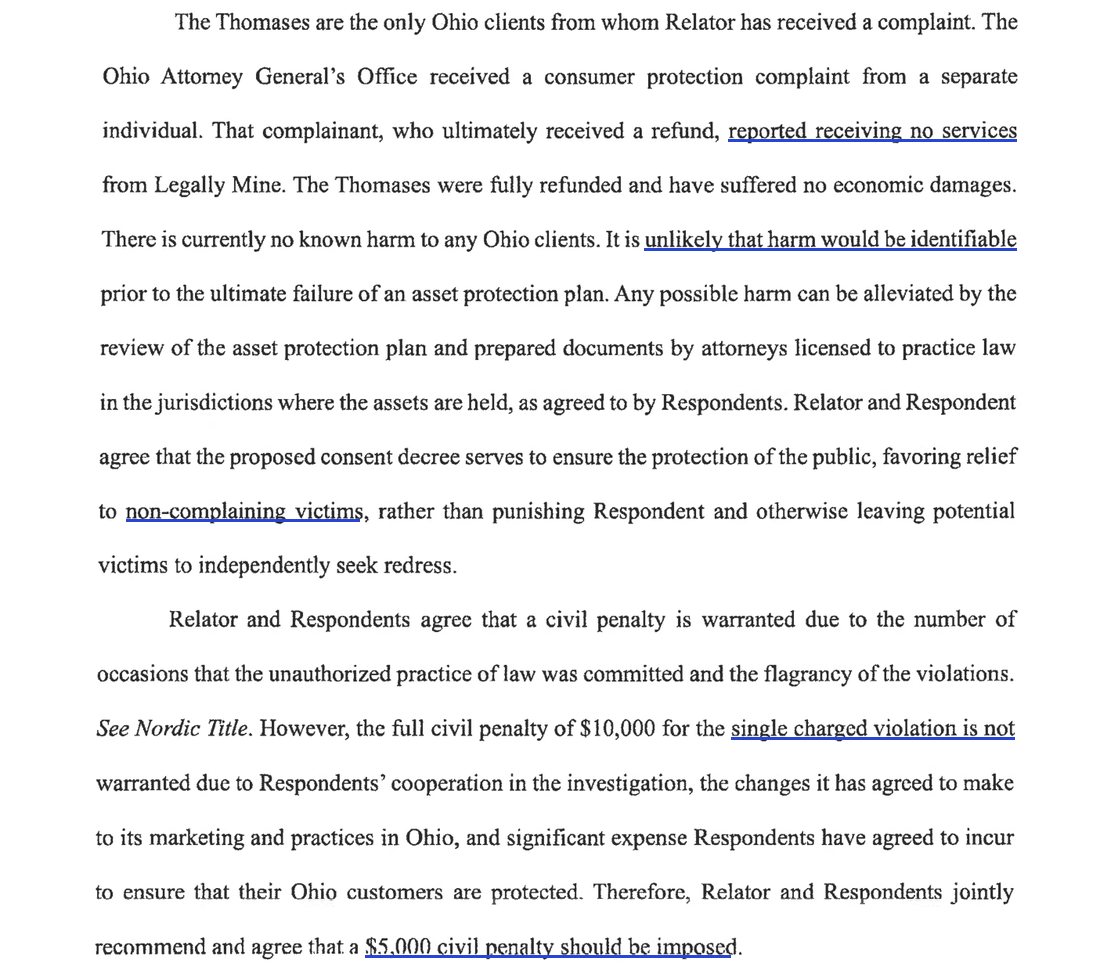
Then the filing explains why no one else had complained, and what it calls the people who had not.
The deposition the filing mentions was of the company’s Chief Legal Counsel, John Maddox, by videoconference on October 31, 2022, 84 pages of transcript, a year before the complaint was filed; the bar’s receipts are in the file. The complaint names him as the “Senior Staff Attorney” who “spoke with” the couple when they had questions about what had been prepared. The company’s staff page still listed him under Legal in June 2026. The receipts also show a videotaped interview, in June 2023, of David Monsivais, a former Legally Mine attorney. The forms, the panel found, had been written by lawyers who “no longer work for Legally Mine”; the bar found one and taped him.
Five thousand dollars
The parties wrote their own sentencing table. No penalty: an estate planner who admitted preparing company papers for a named client “and others” under an “honest but mistaken belief”; a debt firm with 3,056 Ohio customers that cooperated and “ceased operations in Ohio”; a lease negotiator with five victims and one year of conduct that stopped on contact from the bar. Ten thousand dollars: a title agency that cooperated, refunded $25,750 and still showed “a systemic failure” across 514 deeds. Twenty thousand: a man who called himself an attorney advocate for 20 students, and a man who “continued despite admonitions from attorneys and judges and even after he received a ‘cease and desist’ letter.” Having set out that table, the bar and the company agreed that a penalty was warranted for “the number of occasions” and “the flagrancy of the violations,” and that “the full civil penalty of $10,000 for the single charged violation is not warranted due to Respondents’ cooperation in the investigation,” the changes it had agreed to make, and the cost of the notices. The complaint had counted eighteen acts for one couple; the parties called them one violation. Fifty-three clients. Five thousand dollars.
The hearing panel recommended approval without a hearing. On June 12, 2024 the full Board, “by majority vote, rejected the hearing panel’s recommendation.” Its chair, David A. Kutik, signed the order on July 17. The Board took no position on the amount, noting only that the decree listed the company’s lack of prior violations “as an aggravating factor in favor of a more severe penalty, when lack of such activity is normally considered a mitigating factor.” It refused the deal on two other grounds: the refund went to the Thomases alone, and the first condition for lifting the Ohio ban, that the company “engage one or more Ohio licensed attorneys to approve or create and discuss all asset protection plans and legal documents provided to Ohio clients,” on contract.
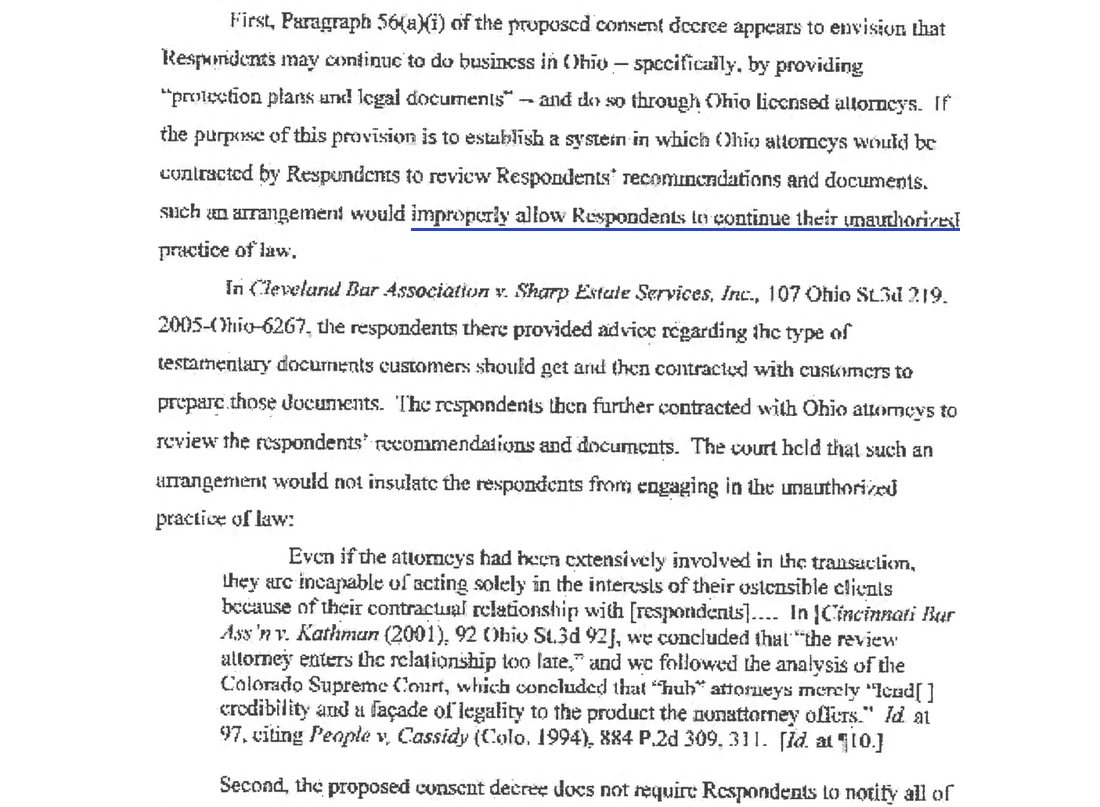
Given ten days to choose a hearing or a new deal, the parties chose the deal. Their joint motion of August 28, 2024 “eliminates any request or recommendation that Legally Mine engage Ohio Licensed Attorneys,” and “provides that Relator shall provide the option of a full refund to existing Ohio Clients.” The penalty stayed at $5,000, plus $1,219.30 in costs. The panel recommended it in December 2024; the Supreme Court of Ohio adopted it on February 20, 2025. The refund letters to every Ohio client, the ones Daniel McNeff’s affidavit says went out, exist because the Board refused the version without them.
Her plan, as delivered
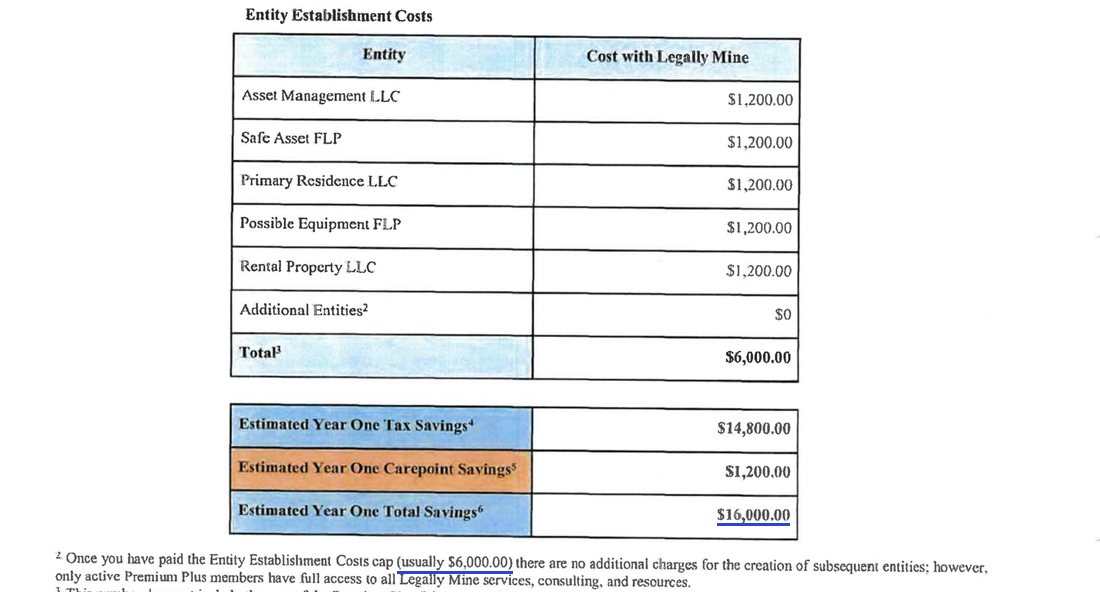
Dr. Julie Thomas enrolled at a dental trade convention in Canton in May 2019: Premium+ at $1,800 and the “Entity Creation CAP” at $6,000, “$7,800.00” “collected at event,” the entity line on the form reading “Includes Tax Savings Guarantee.” What came back is Exhibit C, a five-page “Asset Protection Blueprint for Julie & Michael Thomas,” and Exhibit D, 132 pages of documents built from it. The chart puts the couple’s existing dental practices and property companies in red and draws the new structure around them.
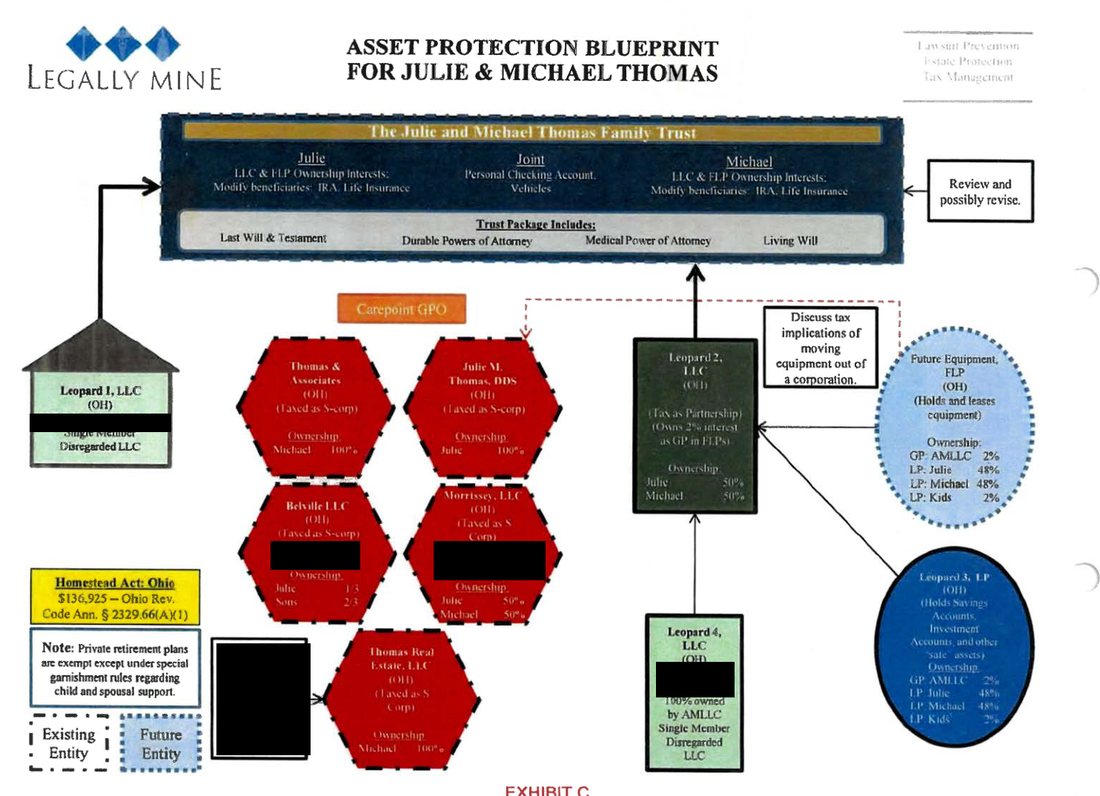
Leopard 1, a single-member company “entirely owned by the living trust,” to hold the house. Leopard 2, the “Asset Management LLC,” owned by the couple fifty-fifty, to be the two-percent general partner of the partnerships and the owner of Leopard 4. Leopard 3, a limited partnership for “Savings Accounts, Investment Accounts, and other ‘safe’ assets,” owned 48 percent by each spouse and two percent by “Kids.” Leopard 4, to take four parcels by quitclaim deed. A “Future Equipment FLP” on the same split. A family trust with two wills, two living wills and four powers of attorney. A group-purchasing membership. The yellow box gives Ohio’s homestead exemption as $136,925; that figure had expired on March 31, 2019, before she enrolled, when the statute’s adjustment raised it to $145,425. The explanation sheet says what each piece is for.
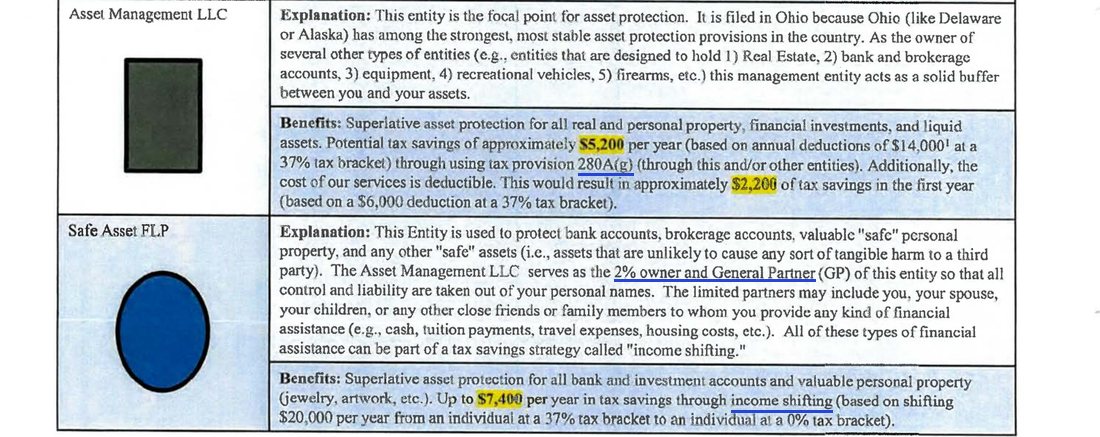
The $14,000 is $1,000 a meeting. In 2023 the Tax Court, in a case where an S corporation had paid its owners $3,000 a month to meet in their homes under the same provision, held that “the amount of rent paid for each meeting, between $3,000 and $4,000, was not reasonable” and that “$500 allowed per month is actually generous.” That ruling came four years after this sheet; it is the valuation, not the company’s knowledge, that it tests.
On September 5 and 6, 2019 the four companies were filed with the Ohio Secretary of State. The Articles give each one’s purpose.
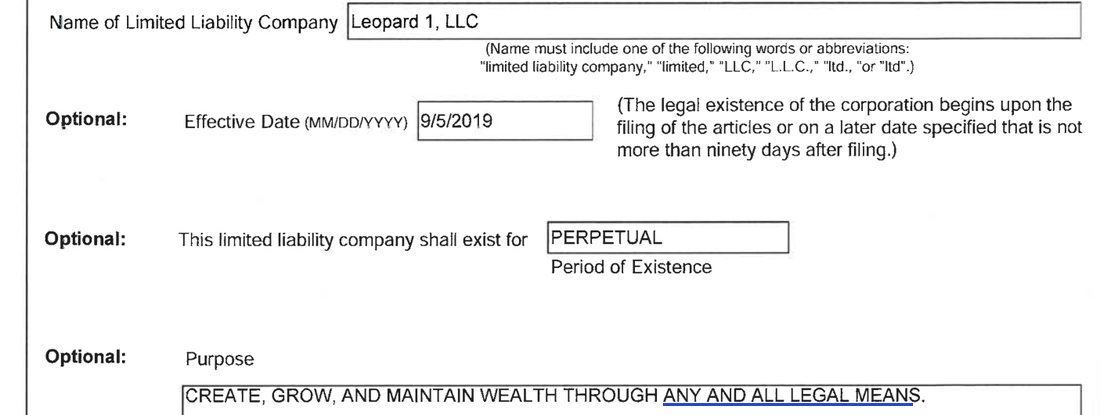
Each filing asks the state to add the same provision to the articles.

Dan McNeff explains that clause on the tape at 27:42 (quoted here on July 4): the non-pro-rata distribution clause is “what Jay Mitton created, it effectively blocks the judge,” because only the general partner can order a distribution, pro rata or not, “at his sole discretion.” The law and The machine carry the rest of that recording: the two percent, the “interest-free loan with no intention of ever paying it back,” the mechanism that, in his phrase, can “make you homeless.” The partnership agreement built from the form carries the machinery itself.
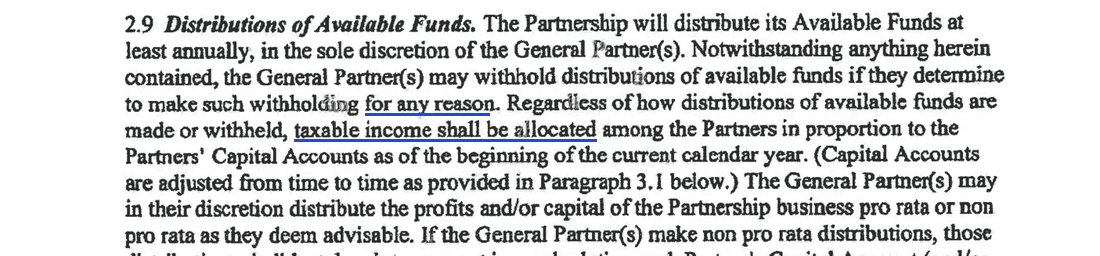
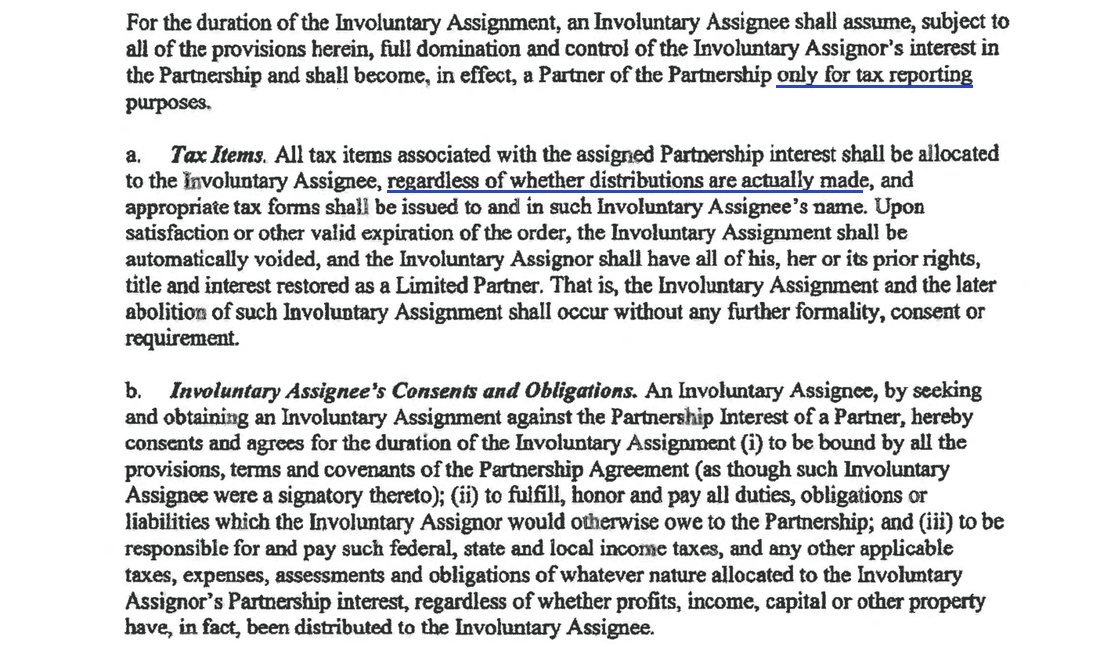
A creditor who wins a charging order becomes “a Partner of the Partnership only for tax reporting purposes,” owes the tax “regardless of whether distributions are actually made,” and the general partner may withhold distributions “for any reason.” That is the arrangement Dan McNeff describes on the tape from 32:25, the creditor who wins a million dollars and “didn’t get a dime of it” but owes the income tax, and names at 32:52: “we call that the Revenge clause.” This site took it apart in July. Anyone coming into the partnership as a substituted partner pays it “a reasonable transfer fee, not exceeding fifteen percent.” The filing for Leopard 1, the company formed to hold the house, names Dr. Thomas as its statutory agent, at the house. The deeds to move the house and the four parcels into the companies sit in the file as forms, the notary blocks blank. Ohio did not rule on any of these clauses. It ruled that the people who filled in the forms and filed them were not lawyers, that no Ohio lawyer looked at them, and that the website said otherwise. The dentist’s own lawyer told the company its products “would not achieve the promised goal”; the company “denied any wrongdoing” and refunded the $7,800.
“Not a law firm,” “with fully-licensed attorneys”
Exhibit A is the “Product and Service Brief” the dentist took home from the convention; its cover carries 225 West 520 North, Orem, the address BAM Franchising’s disclosure documents give as their own. Page four describes the entity program.
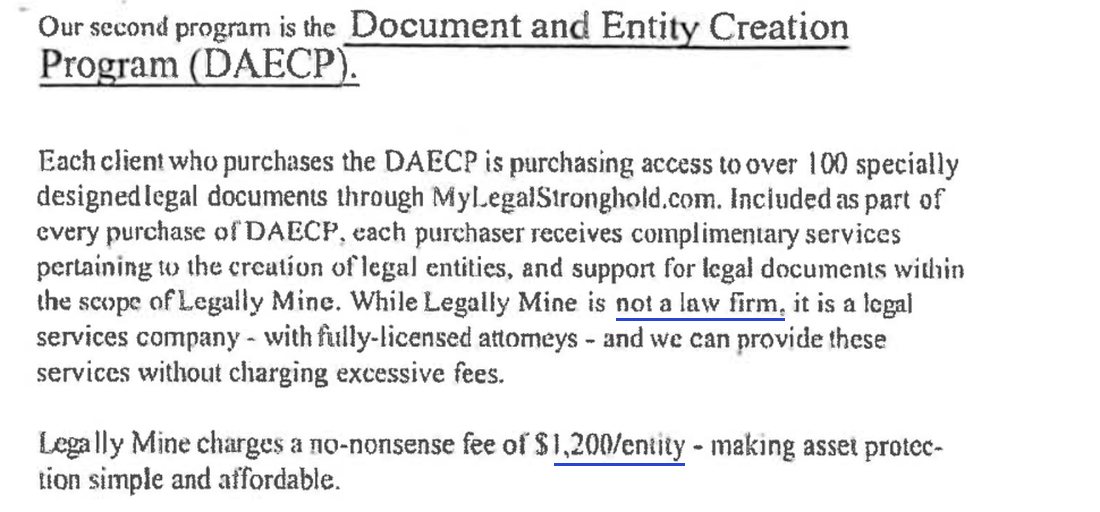
Page three sells Premium+, “$1,800/yr. OR $150/mo.,” with “No need for continued and expensive attorney fees just to amend your documents” and access “to our legal team of asset protection specialists, estate planning attorneys, tax attorneys, and paralegals.” Page five is headed “What Your Attorney Doesn’t Know May Hurt You.” The panel found what the legal team was.

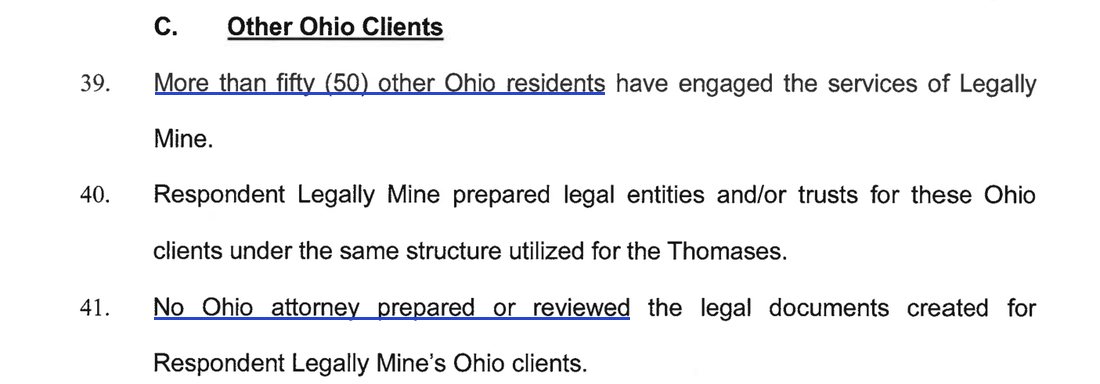
The bar’s brief puts it in one line: “Legally Mine neither employed nor contracted with Ohio attorneys.” The documents were made by “non-attorney staff in Legally Mine’s Entity Creation Department,” who “plugged” the client’s answers “into a prepared form”; the lawyers who once wrote the forms no longer worked there. The company admitted that its marketing “implies that Legally Mine and/or its attorneys are licensed to practice law in Ohio,” and “that Legally Mine cannot legally engage in the practice of law.”
The brochure also says “Legally Mine has been helping medical and business professionals protect their assets for over 40 years,” and the website, captured in Exhibit E, that it “was founded over 40 years ago by the same attorney who developed the field of asset protection.” The company was registered in 2009. Neither names the attorney. Dan McNeff does, on tape, in the seminar this site has already taken apart (and in The machine): the two-percent general partner is what “Jay Mitton discovered,” the distribution clause “what Jay Mitton created.” Florida’s Supreme Court had enjoined Mitton in 2001.
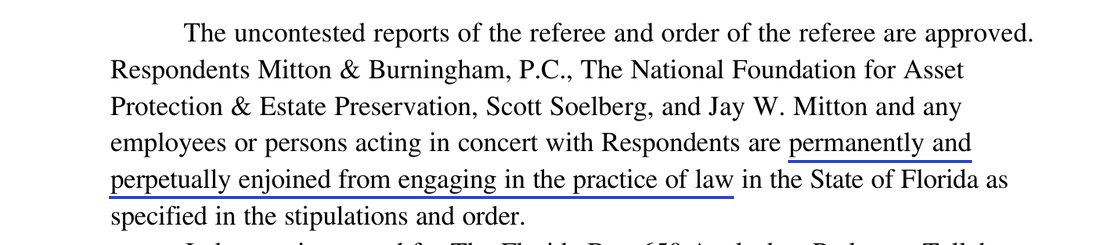
A year after Ohio’s decree, in April 2026, the company’s own pages about the Ohio case still spoke of “our firm for over 40 years” and “over 15,000 members across the country.”
The contract
Exhibit B is the enrollment form, on the company’s letterhead at 1337 East 750 North, Orem. The front, above the signature line:

The terms on the back: “all transactions related to this agreement are business-to-business and not consumer transactions”; any dispute “shall be decided exclusively in binding arbitration conducted in the state of Utah by the American Arbitration Association,” each side paying its own lawyers; “you waive any right or authority for any claims to be arbitrated as a class action”; and a customer who disputes a charge with a bank “agrees to pay up to three times the original contract amount FOR EACH DISPUTE FILED.” Then two paragraphs.
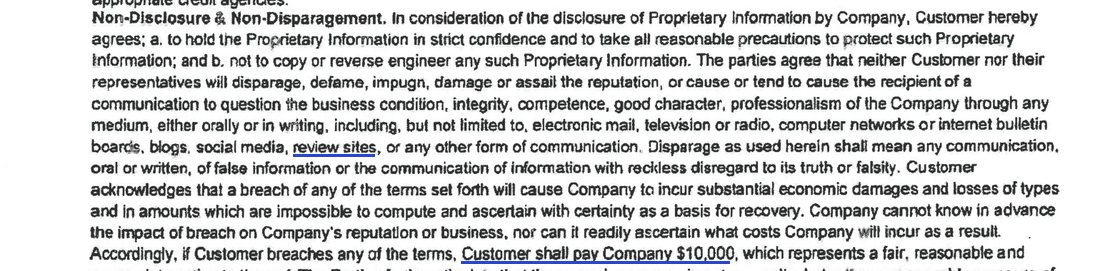

The arbitration clause had already failed. In California, in a docket the bar’s counsel pulled in February 2023, a customer who sued the company in 2018 over an asset-protection plan was ordered to arbitration under his agreement in April 2019. The American Arbitration Association ruled his agreement a consumer agreement, told Legally Mine to waive the Utah-only venue and the no-fees term as violations of its consumer due process protocol, and, when the company paid no fees, closed the case in September 2019 and asked it to “remove the AAA name from its consumer arbitration clause.” In April 2020 the court held that the company “materially breached the arbitration agreement” and “cannot compel Plaintiff to arbitrate his claims.” The form the Thomases signed in May 2019 names the same association, the same venue and the same no-fees term. The decree the Board forced offers every Ohio client the refund the form says will not be returned. The company told the bar its other clients were “apparently otherwise satisfied”; its form fines a customer $10,000 for saying otherwise on a review site. Since March 2017 a federal statute, the Consumer Review Fairness Act, has made void any term of a form contract that “imposes a penalty or fee against an individual” for a review, and has made it unlawful “to offer a form contract containing” such a term; the Federal Trade Commission and state attorneys general enforce it. The form’s answer is its line that the transaction is “business-to-business and not consumer,” the label the arbitration association rejected in California.
The men
The file never mentions Bricks & Minifigs. The panel found that Daniel McNeff, “the sole member, manager, and Chief Executive Officer of Legally Mine,” “directs and controls Legally Mine’s business model, operations, and marketing.” BAM Franchising’s disclosure documents, given to every prospective franchise buyer in 2019, 2020 and 2021, listed him and his sons.
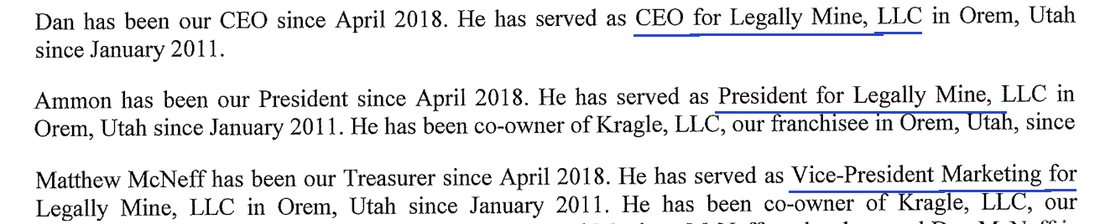
The conduct Ohio found ran, by the complaint, from about 2010 to 2021. By BAM’s own account, Legally Mine’s chief executive, president and vice president of marketing were the three McNeffs from January 2011, the month the company took its name, and from April 2018 they were also Bricks & Minifigs’ chief executive, president and treasurer. A later amended copy of the same 2021 document dates the sons’ Legally Mine offices as ending in 2020, the year before they sued their father. The 2019 brochure the dentist was handed came from the department Matthew McNeff ran. The warning of July 2, 2020 reached Legally Mine eighteen days before Daniel McNeff wrote to an arbitrator that Legally Mine was “probably the only one of its kind in the world,” while Legally Mine held two thirds of BAM’s shares and BAM’s disclosure document said it had no parent. Ammon McNeff is BAM’s chief executive today.
After the decree
The brochure promises, for “qualifying states,” registered-agent service “at no additional cost to the client, so long as they are enrolled in Premium+.” It does not name the state. The registry that holds the company’s client shells is Alaska’s, and the agent there is LMRA Services, Inc., whose director, president, secretary, treasurer and shareholder, in the state’s own officials file, are one man, Daniel J. McNeff. The dentist got Ohio instead, with herself as agent at her house. Alaska publishes its corporations file in bulk. Counting the companies that list LMRA Services as their agent, by the year they were formed:
Alaska Division of Corporations, Business and Professional Licensing, corporations and officials bulk files as downloaded June 16, 2026; entities whose current registered agent is LMRA Services, Inc., counted by formation year. A client’s plan typically has several companies, so these are companies, not clients, and they are national, not Ohio. Rust bars are the year of the decree and the year after it.
The year of the Ohio decree was the second-largest year in the agent’s history. The Utah company the bar’s investigator bought the filings of in January 2023, Legally Mine, LLC, No. 7228976, is the one the family renamed “LM OLDCO, LLC” on May 21, 2026, fifteen months after the decree (July 3); eight days later a different company, Centra Wealth Solutions, registered “Legally Mine” as its own assumed name. The filings are on The shells. What the company sold the Thomases is what the McNeffs use for their own houses, held in charging-order companies and land trusts and deeded to Evelyn McNeff in a single batch in January 2021. The tools are lawful. What Ohio found unlawful is selling them as legal services, by non-lawyers filling in forms behind a website that implied licensed attorneys, and it found that a lawyer hired to look over the forms afterward is a facade. The company said it could help customers in all fifty states. Ohio is one.
The fair reading, and its limit. The stipulations and the penalty argument are the parties’ joint statements, drafted for a settlement; they are Legally Mine’s own account of its conduct, and the Board’s order is the Board’s. The warning of July 2020 was that the company “may be” practicing law without a license, and the request not to contact clients was made “at that time,” during the investigation. The consent decree was a settlement with an admission, not a contested finding; the penalty was agreed, the Board expressed no view on the amount, and consent decrees in the parties’ own table often carried none. The sum in the INFERENCE line is this site’s arithmetic on the parties’ numbers; the panel’s report puts the Thomases’ payment at $8,100 where the form and the supplement say $7,800, and the lower figure is used. Dr. Thomas has told her story on camera to JEST, and the couple are the complainants named in the public complaint; their home and parcel addresses are blacked out of the chart, their children are not named, the front of their enrollment form is shown only for its printed authorization, and their wills, trust and powers of attorney, which fill most of Exhibit D, are neither shown nor quoted. The agreement pages shown are the form’s terms, which the stipulation says were the same for every client. The contract terms are the 2019 form’s; whether any was enforced against an Ohio client is not in the file, and whether the federal review statute reaches this form is a question for its enforcers, not this site. The Alaska counts are of companies whose agent today is LMRA Services, by formation year, from a file downloaded June 16, 2026; companies formed earlier under another agent and moved since are counted, companies moved away are not, and the 2026 bar runs only to June 12. The Florida order of 2001 runs against Jay Mitton and his firm, not against Legally Mine or Daniel McNeff; the company’s brochure does not name its founding attorney, and the identification rests on McNeff’s own attribution on the tape, quoted from captions that spell the name “Mitten.” The file concerns Legally Mine and Daniel McNeff; Ammon and Matthew McNeff are not respondents, and their offices are stated here as BAM’s own documents state them. The right of reply is open to Legally Mine, to Daniel, Ammon and Matthew McNeff, and to BAM.
The record
June 28: the Ohio order, in One lawyer, both sides. July 1: Legally Mine’s public statement, fact-checked. July 4: the seminar tape. June 22: LMRA Services and the Alaska shells. June 22: the four houses. July 3: LM OLDCO and the brand transfer. July 30: Centra. The blueprint chart, Exhibit C, addresses blacked out. The blueprint’s explanation and cost sheets. The partnership agreement: distributions and involuntary assignment. The brochure, Exhibit A. The enrollment terms, Exhibit B. The Secretary of State filings, Exhibit F. The order of July 17, 2024. The first proposed decree, November 10, 2023: the relief paragraphs. The panel’s entry of January 30, 2024. The joint motion of August 28, 2024. The Supreme Court of Ohio’s order, February 20, 2025. July 31: the affidavit and the notary. July 29: the Revenge clause. October 3: the decree, the pledge and the balance sheet. The machine. The law. The shells. The family. One office. The court’s docket, No. 2025-0037.
Sources. Board on the Unauthorized Practice of Law of the Supreme Court of Ohio, Case No. UPL 23-04, Ohio State Bar Association v. Legally Mine, LLC and Daniel McNeff: the Board’s file as released by the Clerk of the Supreme Court of Ohio (343 pages, scanned July 6, 2026), read in full; the images on this page are crops of it, with this site’s underlining added and nothing else altered except the blacked-out addresses on the chart. Quoted as written: the Formal Complaint and the proposed consent decree of November 10, 2023, with Exhibit A (the brochure, pages 97 to 102), Exhibit B (the enrollment form, pages 103 and 104; the front shown only for its printed authorization), Exhibit C (the blueprint, pages 105 to 109), Exhibit D (the clients’ documents, pages 110 to 241; shown and quoted only for the Limited Partnership Agreement of Leopard 3, pages 3, 14 and 15, and the operating agreements’ purpose and distribution clauses; the trust, wills, living wills and powers of attorney are neither shown nor quoted), Exhibit E (website captures, pages 242 to 257), Exhibit F (Ohio Secretary of State filings, pages 258 to 277; the statutory-agent pages, which carry a home address, are not shown) and Exhibit G (the relator’s costs, pages 278 to 298); the Entry of January 30, 2024 and the Supplemental Entry of February 21, 2024; the Supplement to Motion to Approve Consent Decree of February 29, 2024, stipulated facts 1 to 12, its precedent section and its penalty argument; the Order Denying Parties’ Joint Motion to Approve Consent Decree of July 17, 2024; the Joint Motion to Approve Amended Consent Decree of August 28, 2024; the Amended Consent Decree; the Panel Report of December 13, 2024, filed with the court January 9, 2025, findings 1 to 50 and the penalty section; Relator’s brief. Ohio Revised Code 2329.66(A)(1) and the adjustment table “Exemptions from Execution, Garnishment, Attachment, or Sale,” amounts for April 1, 2016 through March 31, 2019 and April 1, 2019 through March 31, 2022, as posted by the Fairborn Municipal Court. Alaska Division of Corporations, Business and Professional Licensing, bulk downloads CorporationsDownload.csv and OfficialsDownload.csv as downloaded June 16, 2026 and held by this site: entity No. 10045051, LMRA Services, Inc., officials; entities listing LMRA Services, Inc. as registered agent, by AKFORMEDDATE. Sinopoli v. Commissioner, T.C. Memo. 2023-105 (U.S. Tax Court, Aug. 14, 2023). 15 U.S.C. 45b, the Consumer Review Fairness Act of 2016, subsections (b), (c), (d) and (e). The seminar recording “Legally Mine Asset Protection and Tax Reduction (Gold),” presenter identified by its own intro slide as Dan McNeff, at 7:22 to 9:06, 27:42 to 28:05 and 32:09 to 33:12, quoted from its captions, as on this site’s pages The machine, The law and the update of July 29. The Florida Bar v. Mitton & Burningham, P.C., et al., Supreme Court of Florida No. SC00-2171, order of November 1, 2001, shown. Eliasieh v. Legally Mine, LLC, No. 18-cv-03622-JSC (N.D. Cal.), order of April 21, 2020, 2020 WL 1929244. Legally Mine’s website: the staff page as it stood June 11, 2026; the Ohio compliance page and the Ohio client guide, created April 9 and April 21, 2026, as captured by this site on July 27, 2026. BAM Franchising, Inc., Franchise Disclosure Documents of May 22, 2019, May 18, 2020 and April 30, 2021, Item 2; the 2021 entries shown from the copy filed with the Minnesota Department of Commerce in May 2021; a later amended copy of the 2021 document, which gives Ammon McNeff as chief executive “since October 2021” and the sons’ Legally Mine offices as running “until 2020,” for the end dates. McNeff v. McNeff, No. 2:21-cv-00048 (D. Utah), Exhibit F, Daniel McNeff’s letter of July 20, 2020, as served on this site’s October 3 page. Utah Division of Corporations, entity No. 7228976, amendment of May 21, 2026, and the assumed-name filings of May 29, 2026, as on this site’s page The shells. Ohio State Bar Association v. Legally Mine, LLC, Supreme Court of Ohio No. 2025-0037: the consent decree adopted February 20, 2025 and the compliance filings, as reported on this site. Everyone named here is presumed to have acted lawfully; the Board’s and the courts’ findings are theirs, reproduced as written.