Gregory Belmont has returned, and this time Magistrate Judge Pead requested that BAM respond.
Gregory Belmont is the reader in New York who asked the court on October 2 to keep the names behind this site unread until a judge rules. In June, in BAM’s case against Reckless Ben, the clerk had filed his papers with a note that no response was required unless the court ordered one; none was ordered, and Judge David Barlow denied his motion as moot on July 29 after he withdrew it. This time Magistrate Judge Dustin Pead requested BAM’s response three days after he filed. BAM’s answer, October 7: he is “not a party, a subpoena recipient, a website operator, or a source,” and if the court acts “on its own initiative” the order should leave him out. Belmont’s reply, October 8, takes that condition and attaches an order the court could enter on its own: records identifying “the operators, editors, authors, or sources of thebammap.com” would go only to BAM’s lawyers and “remain unopened unless the Court authorizes a screening procedure.” DFJ read the reply live that afternoon. The court has not ruled.
PRIMARY SOURCEBAM Franchising Inc. v. Does 1-10, No. 2:26-cv-00895, District of Utah: docket entry 10, the October 5 request; docket entry 11, BAM’s memorandum in opposition, October 7, thirteen pages; docket entries 12 and 12-1, Belmont’s reply and Exhibit A, October 8. BAM Franchising Inc. v. Schneider, No. 2:26-cv-00593: docket entries 10, 12, 24 and 26, June 29 to July 29, 2026. All are in the record below.
CONFIRMEDThe docket as read on the public mirror at 3:24 p.m. PDT on October 8 (4:24 p.m. in Utah): twelve numbered entries; no ruling on either of Belmont’s motions; nothing showing whether a subpoena has been served. BAM says it will answer the intervention motion more fully “within the time prescribed by the rules or upon order of the Court.”
CONFIRMEDThe BAM Map is not affiliated with Gregory C. Belmont in any capacity.
UNRESOLVEDwhether the court enters either proposed order, hears Belmont at all, or lets him in; whether any subpoena has gone out or anything has been produced
The first time
Belmont first came to this court in June, in BAM’s case against Reckless Ben, asking to be let in over the restraining order BAM had obtained (reported here July 6). The clerk marked his next filing “LODGED,” “per Chambers,” with a note that a person not granted leave to intervene “should not be submitting filings.” A later document got the same treatment and a further note: “lodged for reference purposes only; no response required unless specifically ordered by the court.” None was ordered. On July 29 Judge David Barlow denied the motion “without prejudice as MOOT,” because Belmont had written that he “no longer seeks to intervene at this time.” BAM never had to answer him.
This time
Belmont filed two motions in this case on October 2, one to be let in and one for a hold on the records. On October 5 Magistrate Judge Dustin Pead, by a short order on the docket, requested that BAM file “a Response or Notice of Non-Opposition” to the hold motion by October 7. BAM’s lawyers, Matthew Orme and Kyle Tucker of Dentons, filed thirteen pages on October 7. They oppose. Belmont, representing himself, replied on October 8.
What BAM says Belmont is not
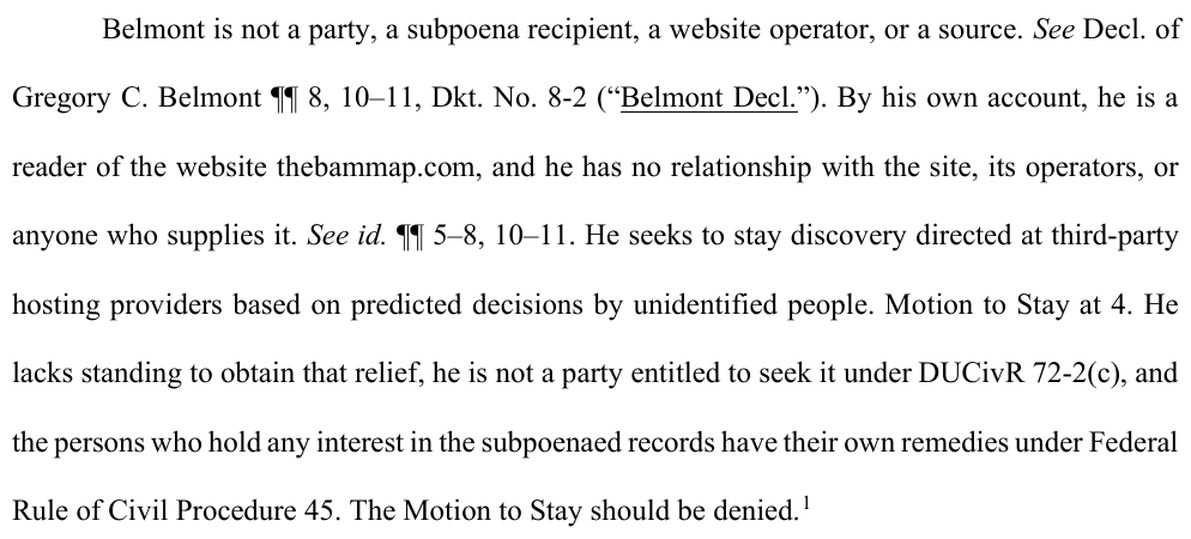
The memorandum’s first page of argument is about who may ask. Belmont, it says, “seeks relief that no party requests,” so he must show his own injury, and he has not.
The injury Belmont described, that identified sources might stop supplying the site and he would read less, “requires several contingent steps,” the memorandum says, each of which “depends on others’ independent and hypothetical choices.” A reader’s right to receive information, it argues from the Supreme Court’s 2024 decision in Murthy v. Missouri, supplies standing “only where the listener has a concrete, specific connection to the speaker,” and Belmont has none. His interest “is that of any reader of the site,” a grievance “held in common with the public at large.” Accepting it, BAM says, “would allow any reader of any publication to intervene in civil discovery whenever a party seeks records that may identify a party who breached confidentiality obligations.”
“Belmont is not a party, a subpoena recipient, a website operator, or a source.”
How BAM describes its own case
“This case is fundamentally a commercial dispute,” the memorandum begins. BAM “alleges that one or more franchisees, employees, or others bound by confidentiality obligations disclosed BAM’s Operations Manual, store-level financial analyses, and other internal franchise-system materials.” The materials “were published on third-party websites, including thebammap.com.” “Each claim is directed at the persons who owed BAM confidentiality obligations.” BAM’s investigation “has narrowed, but has not conclusively identified, the source(s).” The subpoenas, it says, “seek the hosting providers’ account, subscriber, and log records for a website.”
On what BAM knows about its own leak, the record now holds three sentences, twelve days apart. September 25, the complaint: BAM “has identified at least one current or former franchisee as a suspected source,” “based on internal investigation, including review of Google Drive audit logs.” September 30, the order: BAM “has no other means to identify defendants, having exhausted its internal investigation methods.” October 7, the memorandum: BAM’s “internal investigation has narrowed, but has not conclusively identified, the source(s).”
On urgency, it repeats the complaint: that nonpublic information “continued to reach thebammap.com after BAM’s September 8, 2026 notice to Vercel,” and that “internet service providers do not retain subscriber and activity logs indefinitely.”
The remedies BAM says exist
“A subpoena recipient may object or move to quash or modify,” the memorandum says, “and the court for the district where compliance is required must quash or modify a subpoena that requires disclosure of privileged or other protected matter.” “A person who claims a privilege in produced information may invoke the procedures of Rule 45(e)(2)(B).” The September 30 order BAM holds has no term requiring that anyone whose records are sought be told before they are handed over. Then one sentence about the site.

“Belmont, who claims no connection to the site or its operator, does not explain why the operator cannot seek relief on its own behalf.”
The anonymous-speech and reporter’s-privilege interests Belmont raised “belong, if at all, to others,” the memorandum says, and it identifies those others as “the reporter and the source.”
What Belmont answered
The reply takes BAM’s condition and builds the order around it. “Movant accepts that condition in the alternative,” it says. “Exhibit A is an alternative interim order with the same custody safeguards and without the terms that run to him.” Either order, it says, “would let the District Judge rule before any identity is read.”
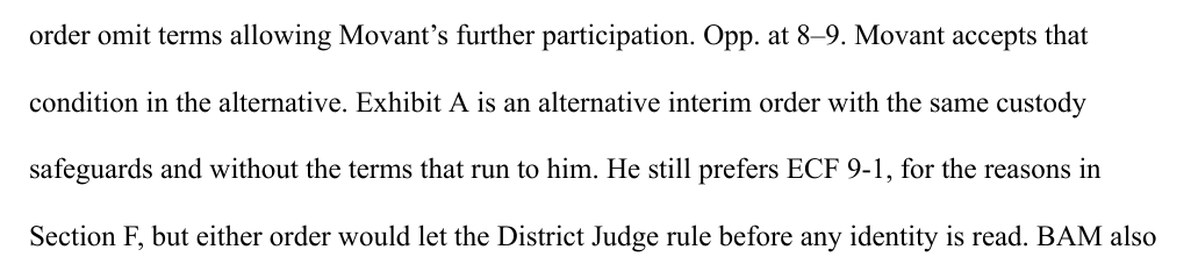
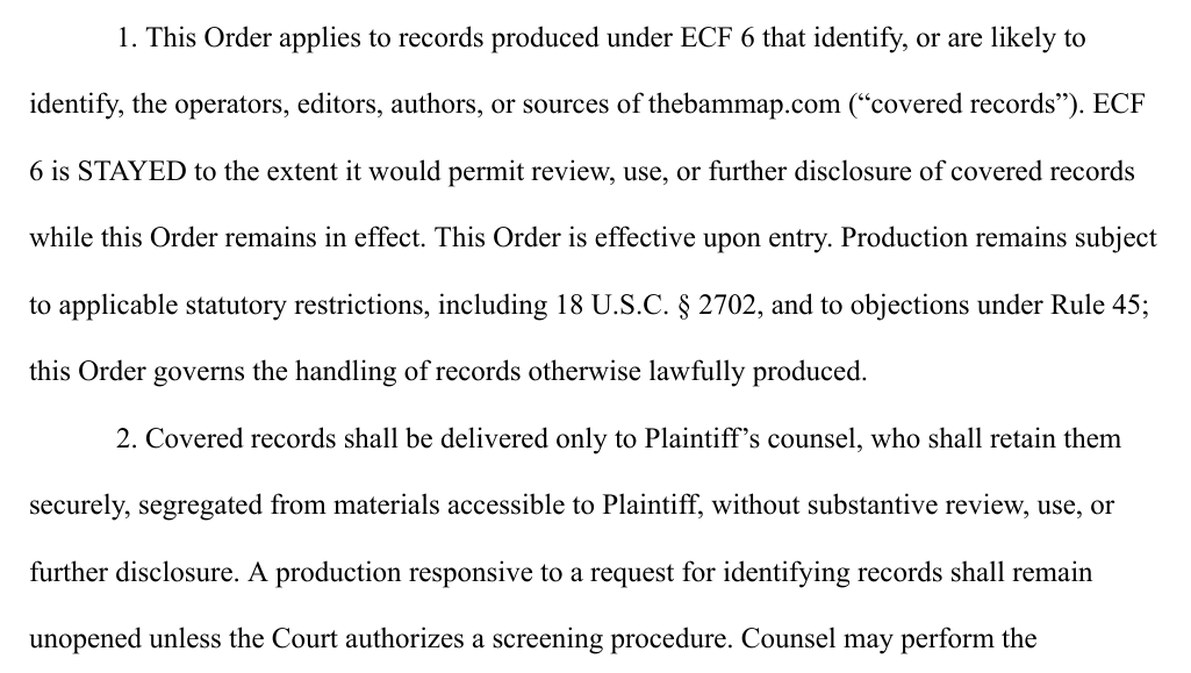
Exhibit A would apply to records produced under the September 30 order that “identify, or are likely to identify, the operators, editors, authors, or sources of thebammap.com.” Those records would be “delivered only to Plaintiff’s counsel, who shall retain them securely, segregated from materials accessible to Plaintiff, without substantive review, use, or further disclosure,” and would “remain unopened unless the Court authorizes a screening procedure.” BAM would ask the subpoena recipients “to transmit covered records inside a closed package, with neutral cover messages and file names,” and would send the order to each recipient within one business day. If any record “has already been reviewed or disclosed,” BAM’s counsel would have to tell the court, “without revealing protected identities or contents.”
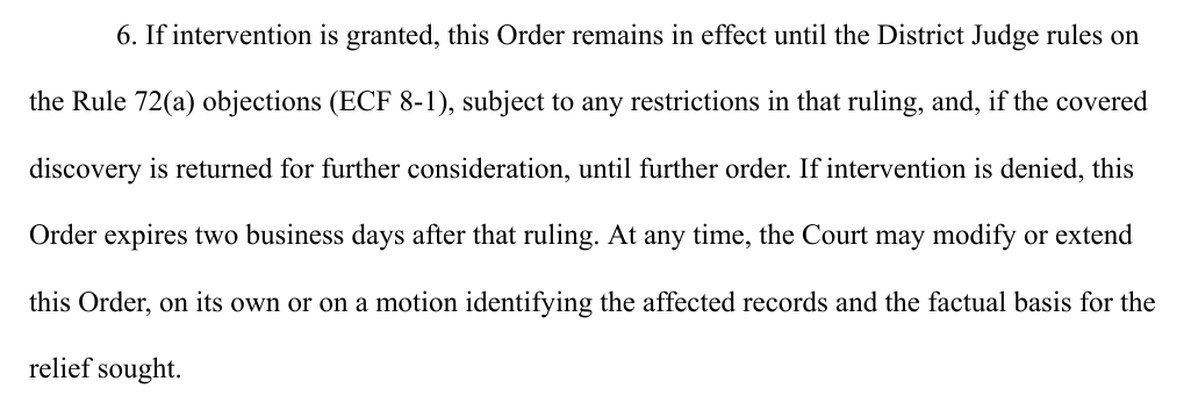
If the court lets Belmont in, the order would last until the district judge rules on his objections; if it does not, the order “expires two business days after that ruling.”
On his right to ask, Belmont says the right is his own, “to receive information,” which the First Amendment protects “to its source and to its recipients both.” He “does not assert the reporter’s privilege or the operators’ anonymity; both proposed orders preserve their opportunity to assert those protections themselves.” The “concrete, specific connection to the speaker” that the Supreme Court required, he says, is one named publication he reads regularly.
On BAM’s “chain of contingencies,” the reply says BAM “omits the subpoenas’ direct target: the people who report and publish on the site.” The subpoenas define the people whose records are sought as everyone who “operated, managed, administered, maintained, edited, authored content for, or otherwise controlled” the site, and BAM’s complaint, it notes, “describes the operators as third-party recipients of the Does’ disclosures.” The reply says that after BAM’s last order against a critic, in the Reckless Ben case, “it sent a takedown demand to his platform the next day,” citing that case’s record.
On the cost of a hold, the reply says service and production proceed and only counsel’s reading is delayed; that BAM asked Vercel to preserve the records on September 8; that BAM “still identifies no retention period that a short hold would outrun”; that the rules give BAM “until December 24, 2026, to serve”; and that BAM “pleads that injunctive relief ‘is required’ … but has not sought it.”
The reply also says BAM “does not answer several specific objections” to the September 30 order, including that “its no-other-means finding cites BAM’s identification of a suspect,” and it corrects one point in BAM’s filing: BAM wrote that Belmont “does not seek permissive intervention,” and the reply points to the first sentence of his motion, which did.
In a footnote, Belmont asks the court to take notice of five news reports, “solely for the fact of their publication”: the Wall Street Journal, the Salt Lake Tribune, ABC4, Dexerto, and Techdirt.
“either order would let the District Judge rule before any identity is read.”
Read aloud the same day
The reply was entered on the docket on October 8. At 3:05 p.m. PDT, 4:05 p.m. in Utah, DFJ went live with “Bricks & Minifigs SubpoenaGate - Gregory Belmont Responds to BAM’s Response” and read it through, with the docket linked under the video and about a hundred people watching. She had read BAM’s memorandum on her stream the day before: “It is from Gregory Belmont, the non-party. He is responding to BAM’s response, which we read yesterday.” At the sentence that either order “would let the District Judge rule before any identity is read,” she said, “I think that’s probably the key part.” At the rule that gives BAM until December 24 to serve: “The day before Christmas.” At Exhibit A: “This is just the proposed order.”
What the filings do not say
Neither says whether any subpoena has been served or anything produced. BAM’s memorandum names no one connected with the site and describes the site throughout as a third party; its fuller answer on whether Belmont may be let in is reserved. The reply says Belmont, who lives in New York, asks to appear remotely if the court sets a hearing. The court has not ruled.
The fair reading, and its limit. An opposition and a reply are each one side’s argument; the court asked for the first, and the rules allow the second. BAM holds an order that permits its subpoenas, and its position that a stranger to the case cannot stop them is the ordinary one. Belmont’s alternative order asks the court to act on its own authority rather than on his, and whether the court does so is the court’s decision. Neither filing says the records are unprotected; BAM says the people who can claim protection are the subpoena recipients and “the persons whose records are sought,” and Belmont says both his orders leave that claim to them.
The record
BAM’s memorandum in opposition, docket entry 11, October 7. Belmont’s reply, docket entry 12, October 8. Exhibit A, the alternative proposed interim order, docket entry 12-1. The docket on CourtListener. October 2: Belmont’s two motions. September 30: the order. September 28: BAM’s motion. September 26: the complaint. The Reckless Ben case docket on CourtListener. July 6: Belmont in the first case. The legal defense fund.
Sources. BAM Franchising Inc. v. Does 1-10, No. 2:26-cv-00895 (D. Utah): docket entry 11, Plaintiff’s Memorandum in Opposition to Proposed Intervenor Gregory Belmont’s Expedited Motion to Stay the Discovery Order in Part Pending Resolution of Limited Intervention and Rule 72(a) Objections, filed October 7, 2026, quoted verbatim from the court’s electronic copy; docket entry 12, Reply in Support of Expedited Motion to Stay the Discovery Order in Part, filed October 8, 2026, with docket entry 12-1, Exhibit A, quoted verbatim from the court’s electronic copy; docket entry 10, text order of Magistrate Judge Dustin B. Pead entered October 5, 2026; docket entries 8 and 9, as reported here October 2; docket entry 1, the complaint, paragraph 45, and docket entry 6, the September 30 order, as reported here September 26 and September 30; the docket as read on the public mirror October 8, 2026. BAM Franchising Inc. v. Schneider, No. 2:26-cv-00593 (D. Utah): docket entries 10 (June 29, 2026), 12 (July 1, as modified July 8), 24 (July 7, entered July 8) and 26 (July 29), quoted from the docket text as read on the public mirror October 8, 2026. DFJ’s live stream of October 8, 2026, quoted from its audio, recorded from the start of the stream. Murthy v. Missouri, 603 U.S. 43 (2024), as cited by both filings. Everyone named here is presumed to have acted lawfully. An opposition and a reply are each one side’s request, and this page reports both.