BAM is suing its franchisees to find out who runs The BAM Map.
The complaint, filed Friday afternoon in federal court in Salt Lake City, names no one. It says the defendants are “current or former franchisees, employees, or other persons” under contract with the company, and it asks for subpoenas to Vercel, Google, Slack and YouTube to learn who they are and who runs this site. This month, in the disclosure document every prospective franchisee now receives, the company explained why its case against Reckless Ben is material to a buyer even though “The named defendants are not franchisees.” On Friday it filed a case against franchisees. Its own paragraphs say it already has a suspect in its own logs. The help desk it tells the court is private is open to the public today, at the address the complaint prints. It is the fourth legal instrument aimed at this site in sixty days, and the first that asks for nothing to come down. What it asks of this site’s host is a name.
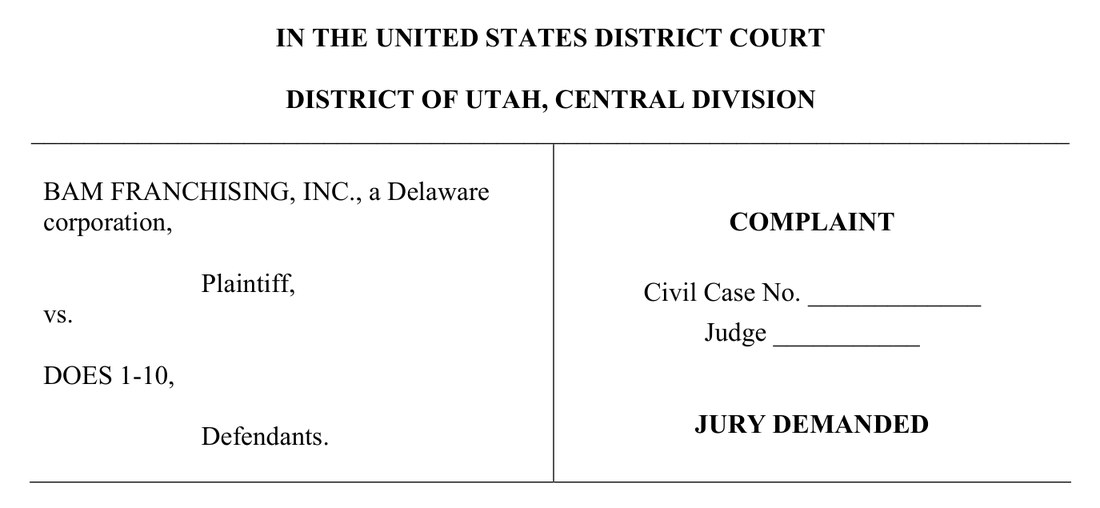
PRIMARY SOURCEBAM Franchising, Inc. v. Does 1-10, United States District Court for the District of Utah, Central Division, No. 2:26-cv-00895, complaint and civil cover sheet filed September 25, 2026 by Matthew J. Orme and Kyle K. Tucker of Dentons Durham Jones Pinegar. Both documents are hosted below as filed. The caption’s judge line is blank, and so is the cover sheet’s related-case line.
CONFIRMEDThree claims against unnamed people: breach of contract with the implied covenant, misappropriation under Utah’s trade-secrets act, and misappropriation under the federal Defend Trade Secrets Act. Damages, fees and a jury demanded; the prayer for relief asks for no injunction. Paragraphs 3 and 54 through 62 say what the case is for: third-party subpoenas, before any defendant is named, to the host of this site, the host of bamopsmanual.com, Google, Slack and YouTube.
What the company filed
The civil cover sheet describes the cause in one line: “Defendants are disclosing confidential information in violation of franchise agreement.” The defendants, the complaint says, are “current or former franchisees, employees, or other persons who obtained access to Plaintiff’s Confidential Information pursuant to contractual obligations.” The company is suing its own franchisees and employees, whoever they turn out to be, for what it says they disclosed. It has not named one. It says it cannot: “Plaintiff has been unable to identify the Defendants through its own investigation and requires third-party discovery, including subpoenas to internet service providers, hosting companies, and other entities.” Its lawyers signed the complaint under Rule 11 of the Federal Rules of Civil Procedure, which certifies to the court that its factual contentions have evidentiary support or, where it says so, will likely have it after further investigation or discovery.
The complaint, in full
The company’s own test
“The named defendants are not franchisees, nor does this action involve the franchise relationship. However, Franchisor believes that this action and the facts surrounding it is information that is material to the decision to enter into a Bricks and Minifigs franchise agreement.”
That is the company’s reasoning, certified under penalty of law and made effective by Minnesota on September 18, for putting a lawsuit in front of every prospective buyer: the case and the facts around it are material to the purchase, even when the defendants are not franchisees and the case does not involve the franchise relationship. Seven days later it filed a case against people it lists first as franchisees, over what its own cover sheet calls a “violation of franchise agreement.” Under the company’s test the new case is material to the purchase twice over.
The federal rule’s test is narrower. Item 3 requires disclosure of any material civil action “involving the franchise relationship in the last fiscal year,” defined as “contractual obligations between the franchisor and franchisee directly relating to the operation of the franchised business,” and for each one “the relationship of the opposing party to the franchisor,” for which the rule offers the words “franchisee, former franchisee, or class of franchisees.” Suits the franchisor itself brings may be grouped under one heading. Item 3 is the paragraph in which the 2024, 2025 and April 2026 editions each certified that, beyond a 2019 Washington assurance of discontinuance, “no litigation is required to be disclosed in this Item,” while suits by its own franchisees were pending, as this site reported in July.
Minnesota’s statute gives a registrant thirty days after “any material change in the information on file” to apply to amend, and the registration order Minnesota issued in July printed the rule on its face. The Minnesota file is public. If the rule reaches this case, the next document must list it and say who the people on the other side are to the company. The complaint has already said: “current or former franchisees.”
CONFIRMEDThe company’s sentence, the rule, the cover sheet and paragraph 14, each quoted from the document it sits in.INFERENCEThat a suit over the agreement’s confidentiality clause is one “directly relating to the operation of the franchised business,” and a material change the thirty-day rule reaches. The rule’s examples are royalties and training; the company will make its own argument. On the test the company applied this month, the Minnesota file answers by late October.
Who it is looking for
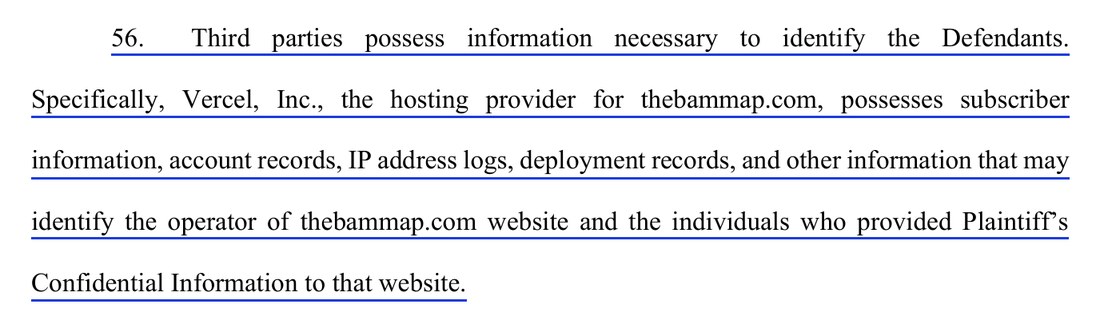
Paragraph 56 asks for Vercel’s “subscriber information, account records, IP address logs, deployment records, and other information that may identify the operator of thebammap.com website.” Paragraph 57 asks the same of whoever hosts bamopsmanual.com. Paragraph 58 asks Google for the access logs of the company’s own Drive, the record paragraph 45 says the company has already read. Paragraph 59 asks Slack for “message logs, user activity records, and access logs” of the company’s own Slack workspace. Paragraph 60 asks YouTube for the “account holder information, IP address logs, and upload records” behind the video that published an internal company communication on May 28; the complaint does not name the channel. Paragraph 18 dates the beginning there: the communication “was leaked and published in a YouTube video” on or about May 28, the day after the company sued Reckless Ben.

Eleven paragraphs before it asks for the host’s records, the company says it already knows where to look. It “has identified at least one current or former franchisee as a suspected source of the leaked Confidential Information based on internal investigation, including review of Google Drive audit logs and system access records.” Paragraph 53 adds that its investigation “has revealed evidence that one or more individuals with franchisee-level access to Plaintiff’s internal systems downloaded confidential documents from Plaintiff’s Google Drive.” A company with a suspect in its own logs does not need a court to find its leak. It needs one to get the reporter’s name.
It has a suspect in its own logs. The subpoena it wants is to the host of this site.
What it says this site did, beside the record
The complaint walks through this site’s reporting from August 11 to September 23, page by page. Each of its characterizations is quoted below, and answered from the record.
“On September 11, 2026, Vercel informed Plaintiff that the owner of the reported URLs had removed the complained-of material.”
CONFIRMEDThe wholesale copies came down on September 9, the day after the takedown notice, and the site said so the same day. Twelve days after Vercel told the company they were gone, the company filed the same form again, against the whole domain, describing three takedown notices as infringing pages. Two days after that it filed this, with the September 11 message in paragraph 30.
“On September 23, 2026, thebammap.com published the dates and specific hotel location of Plaintiff’s upcoming private owners conference. This disclosure of the nonpublic location of a future gathering … creates a significant physical-security concern.”
REFUTEDThe dates and the hotel came from the hotel. A convention hotel confirms the events it is booked for, because it sells rooms around them, and the company’s convention is booked. The site reported them on September 23 in a piece about the rebrand the company says it will unveil there. A company cannot keep a convention secret from the people it is inviting to it, or from the building it is holding it in.
“Unlike other material, the site did not claim that it discovered this workbook on a publicly exposed Plaintiff system, indicating the information was provided by an insider source.”
CONFIRMEDIn passing, paragraph 28 does not dispute that other material was found on “a publicly exposed Plaintiff system.” The complaint calls that material a trade secret in paragraphs 74 and 86, and paragraph 13 says the company “has taken reasonable efforts under the circumstances to maintain the secrecy of its Confidential Information.” The rest of paragraph 28 is an inference from a sentence this site did not write. A complaint’s sentences are certified to a court under Rule 11. A news page’s silences are certified to no one, and prove nothing but that the sentence was not written.
A complaint’s sentences are certified. This site’s silences are not.
“Plaintiff’s Brand Review presentation, which contains confidential franchise system information provided only to prospective franchisees who have signed confidentiality agreements.”
CONFIRMEDAnd it is an admission. A presentation shown to prospective buyers is exactly what the federal Franchise Rule forbids when it carries performance numbers outside Item 19, and this site reported what the Brand Review contains in July. The company has now told a federal court, in its own complaint, that the presentation exists, that prospects receive it, and that they sign for silence first.REFUTED“Only” fails against the company’s own web infrastructure. A 2022 edition of the presentation was publicly retrievable there, with no login and nothing to sign, as reported July 22. Paragraph 13(b) calls that signature a security measure. For that edition the company did not wait for it.
“Plaintiff’s Freshdesk knowledge base (bamfran.freshdesk.com) is accessible only through individual accounts created for each franchisee during their social media setup call, and contains proprietary operational articles not available to the public.”
REFUTEDThe help desk at bamfran.freshdesk.com required no login, as reported July 24 and July 25, none on August 5, as reported that day, and it is still accessible today, the day after the complaint was filed, when this site read it again: the home page, the knowledge base, and an article on creating a new user, with no account of any kind. The complaint prints the address. Paragraph 13 lists four measures the company says it takes to keep its secrets; two of the four are contradicted by the company’s own systems, one of them as of today.
“On September 17, 2026, thebammap.com disclosed that a person identifying himself or herself as a current Plaintiff franchisee had contacted the site anonymously through its right-of-reply mechanism.”
CONFIRMEDA franchisee wrote in to correct this site’s reporting, and the correction was made. The right of reply has been open to everyone named on this site since it launched. BAM has used it once, to send a cease and desist letter. It remains open to BAM and its counsel today. Paragraphs 36 and 37 offer, as evidence that someone inside the company talks to this site, a franchisee correcting it.
“The information sought from these third parties is not publicly available, is not available from any other source, and cannot be obtained without judicial process.”
REFUTEDBy paragraph 45 of the same complaint, sixteen paragraphs earlier: the company has “identified at least one current or former franchisee as a suspected source” from its own audit logs. The other source is the company’s own filing cabinet, and the company says it has already opened it.
What the complaint certifies
Paragraph 11 lists eight categories of documents as the company’s own, from the operations manual to the fifty-two help-desk articles. Paragraphs 25 and 26 name the five labels of the store-performance study: “The Impacted,” “Consistent Struggles,” “Resilient Performers,” “The Turnarounds,” and “The Bounce-Backs.” Paragraph 75 names a document the company calls its “Resolution Strategy.” The study and the franchisee script were sworn to be the company’s own on September 8, and again on September 23. The complaint makes it a third time. The two forms did it under penalty of perjury. The complaint does it under Rule 11.
CONFIRMEDEach category the complaint complains of is claimed as the company’s own, by the company, in its own filing; the study, the script and the strategy document by name.
What the lawsuit does not touch
The complaint lists the pages it objects to: the Slack reconstructions, the settlement script, the crisis plan and the town hall, the chairman’s letter, the store-performance workbook, the Tucson coach, the rebrand. Nowhere in its nineteen pages does it say that anything on them is false.
It never mentions the disclosure document, the one the company certifies to the states every year and amended this month, or the pages that have read that document beside the record since July: the certification that no litigation needed disclosing, the fund, all twenty-three Items, edition by edition. The numbers on those pages are the company’s own, filed with the states that regulate it.
CONFIRMEDThe complaint, read in full: no allegation that anything on this site is false, and no mention of the disclosure document or of any regulator.
For the franchisees it is suing
The complaint asks a jury for damages from the people it finds, exemplary damages of up to twice that amount, and attorneys’ fees, for what the company calls a breach of confidentiality, over documents the company has now certified are its own and, in two cases, served to the public from its own web infrastructure and its own help desk. Federal trade-secret law has one protection written for a person in that position, and it is narrow. Under 18 U.S.C. 1833(b), an individual “shall not be held criminally or civilly liable under any Federal or State trade secret law for the disclosure of a trade secret that” is made “in confidence to a Federal, State, or local government official, either directly or indirectly, or to an attorney” and “solely for the purpose of reporting or investigating a suspected violation of law,” or in a court filing made under seal. It says nothing about a website. The Federal Trade Commission’s 2024 policy statement on franchisors’ confidentiality clauses says such clauses may not restrict a franchisee’s communications with the Commission or any state or federal law enforcer about potential law violations; it says nothing about a reporter either, and nothing in the complaint mentions it. A franchisee with something to report has two doors the statute names, and this site is not one of them. The rights guide sets out where to file, state by state.
CONFIRMEDThe statute and the policy statement, quoted; the complaint’s demands at paragraphs 82, 83, 96 and 97.
What each attempt produced
Every move the company has made against the reporting on it has become a page on this site, because every move is a document. The four instruments of the last sixty days, and what came of each. Reader counts are multiples from this site’s own analytics as of September 23, as published September 24.
What happens next
A John Doe complaint is a request for subpoena power, and this one says so: “Plaintiff requires the ability to issue subpoenas to these third parties to obtain the information necessary to identify the Defendants and amend this Complaint to name them.” That takes a motion asking the court for leave to serve subpoenas before any defendant has been named or served. If the court allows it, each of the five third parties the complaint names receives one. Vercel’s privacy policy says it processes information “to comply with a subpoena or similar legal process.”
The company’s other federal case, against Reckless Ben, is before Judge Barlow, with BAM’s opposition to the anti-SLAPP motion due October 16 under the court’s 28-day rule for motions to dismiss. This complaint was not marked related to it on the cover sheet, though paragraph 60 seeks the records behind the May 28 video. The court’s local rule lets a party to a later-filed case move to transfer it to the judge with the earlier one, and lets the court do so on its own.
Two dates. October 16: the company’s response to the special motion in its other case. Late October: the Minnesota file, and whether this case is in it.
The company that tells every prospective buyer the facts around this story are material to the sale is now in court to learn who reports them.
The complaint objects to the company’s own documents. It says nothing about the company’s own filings with the states.
The record
The court file. BAM Franchising, Inc. v. Does 1-10, No. 2:26-cv-00895 (D. Utah, filed September 25, 2026): Document 1, the complaint; Document 1-1, the civil cover sheet. On this site. The September amendment, beside the record. The first takedown notice. The second. The cease and desist letter. The rebrand announcement. The franchisee’s correction. The Brand Review. The help desk. The law page. The rights guide.
Sources. BAM Franchising, Inc. v. Does 1-10, D. Utah No. 2:26-cv-00895, Documents 1 and 1-1, filed September 25, 2026, quoted verbatim by paragraph. BAM Franchising, Inc., Franchise Disclosure Document, September 2026 amendment, Item 3, as filed with Minnesota and quoted verbatim. 16 CFR 436.5(c) and 436.9(c). 18 U.S.C. 1833(b). Minn. Stat. 80C.07. DUCivR 83-2. Fed. R. Civ. P. 11(b)(3). bamfran.freshdesk.com, read September 26, 2026, without an account. The convention hotel, on the event and its dates. Vercel, Inc., privacy policy, as published September 26, 2026. Federal Trade Commission, Policy Statement on Franchisors’ Use of Contract Provisions, Including Non-Disparagement, Goodwill, and Confidentiality Clauses, July 12, 2024. Reader figures are multiples from this site’s own analytics as of September 23. This site is not a party to the case and no claim in it is pleaded against the site. Everyone named here is presumed to have acted lawfully; the complaint’s allegations are allegations.