BAM’s own website publicly exposes confidential brand documents
PRIMARY SOURCEthe deck, the two vendors it names, and that it was publicly retrievableINFERENCEwhat its onboarding sequence means for the federal disclosure it precedes
The document itself: Bricks & Minifigs, “Brand Review,” version 3.0.0, dated April 15, 2022, a presentation for prospective franchisees. It was publicly retrievable from the company’s own web infrastructure, with no login and no confidentiality agreement. The full copy posted here has been taken down per the demand of “BAM Franchising, Inc. and/or the applicable BAM entity that owns the copyrighted materials.” All quotations are from its slides.
A company that sells LEGO® resale franchises keeps a slide deck it calls the Brand Review, and it is built to be seen in confidence. In the company’s own eight-step path to a signed franchise agreement, step one is a confidentiality agreement and step two is this deck, shown to a prospect only after they have signed. It was not held in confidence. It was sitting on the company’s own web infrastructure, publicly retrievable, with no login and nothing to sign, and this site downloaded it.
What it shows is a franchise sales process that hands prospective owners an outside firm to run their real estate and an outside company to arrange their money, the real estate offered “at no extra cost,” and introduces both before the Franchise Disclosure Document, the federal form built to put relationships like these in writing, is ever delivered.
This download has been taken down per the demand of “BAM Franchising, Inc. and/or the applicable BAM entity that owns the copyrighted materials.”
The eight steps CONFIRMED
A slide titled “What’s Next?” and subtitled “About 2 months long” is the company’s own map of the path from a first conversation to a signature.
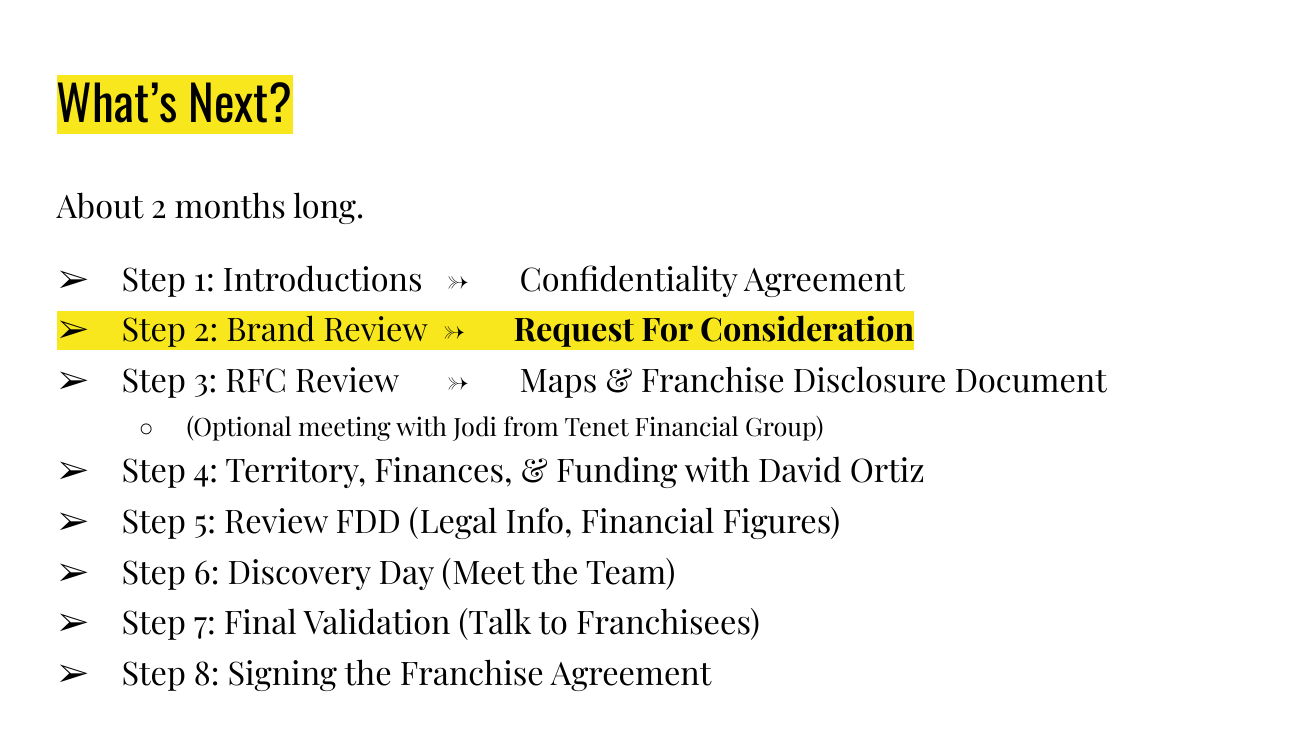
The onboarding sequence, from a slide near the end of the deck.
Step one, Introductions, ends in a Confidentiality Agreement. Step two is the Brand Review, this deck. The Franchise Disclosure Document first appears at step three, delivered with the territory maps, and is set aside for formal review at step five, “Review FDD (Legal Info, Financial Figures).” The confidentiality agreement is the price of admission to everything after it, including this deck. The federal disclosure document sits at least a step behind.
The real estate CONFIRMED
One slide is titled “Retail Locations.” It sets the footprint at 2,500 to 3,000 square feet at about twenty dollars a square foot a year, and then it hands the franchisee a firm.
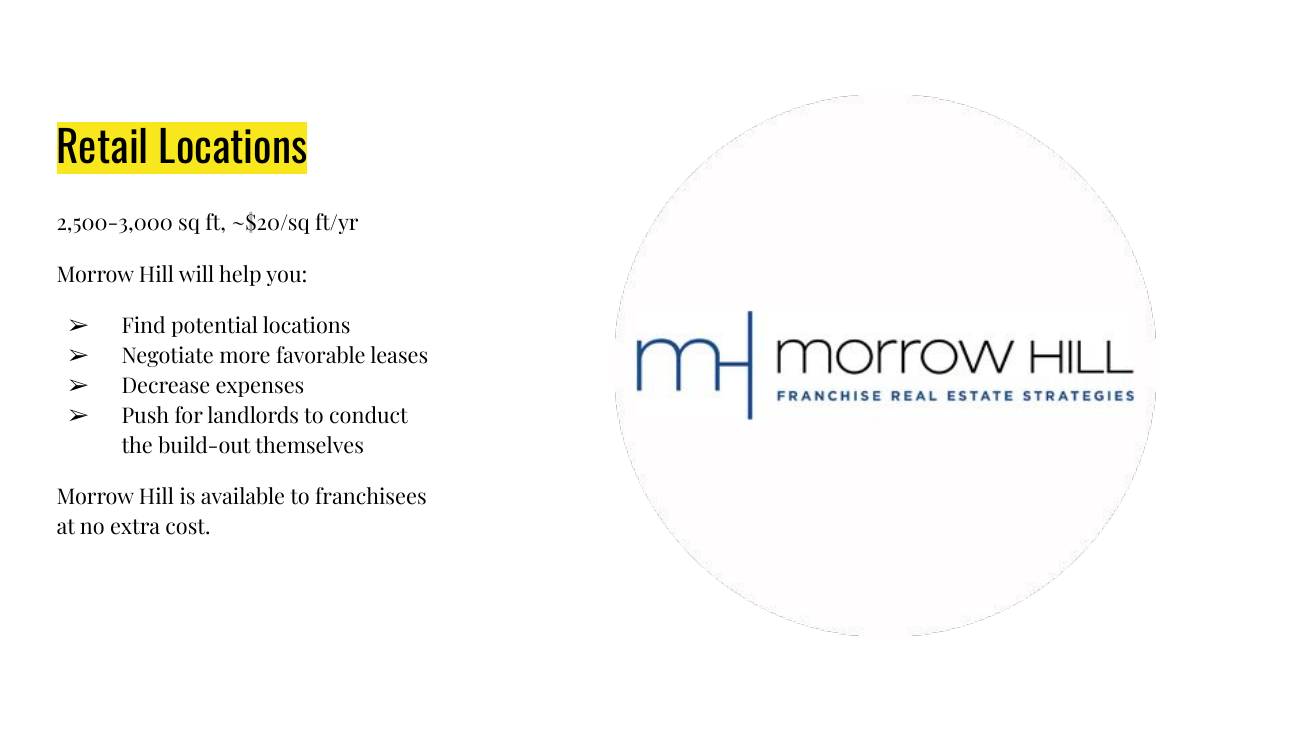
The real-estate slide, naming the firm and the terms.
“Morrow Hill will help you,” the slide reads: “Find potential locations. Negotiate more favorable leases. Decrease expenses. Push for landlords to conduct the build-out themselves.” Under that, one line: “Morrow Hill is available to franchisees at no extra cost.” The logo on the slide describes the firm in its own words, “Franchise Real Estate Strategies.” This is not a broker the franchisee found and chose. It is the one the franchisor presents, inside the franchisor’s confidential deck, to sit across the table from the franchisee’s future landlord.
The money CONFIRMED
A slide titled “Funding Resources” lists how the stores are “typically funded”: an SBA loan, a home-equity line, or a ROBS rollover, the arrangement that turns a buyer’s retirement account into startup capital for the business. Then it names a company and a contact.
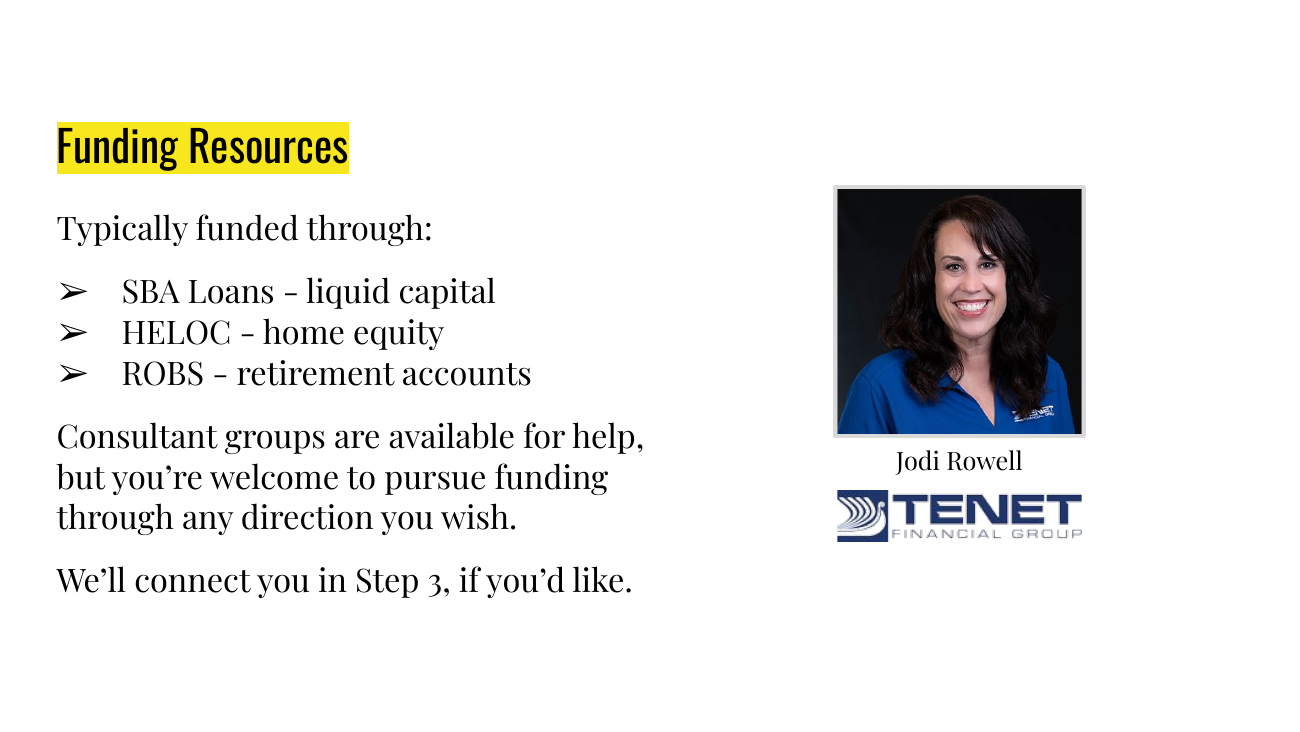
The funding slide, naming the funding company and its contact.
“Consultant groups are available for help,” the slide says, “but you’re welcome to pursue funding through any direction you wish. We’ll connect you in Step 3, if you’d like.” The company on the slide is Tenet Financial Group. Step three, on the sequence above, is where the same deck schedules the optional meeting with Tenet, in the same breath as the disclosure document. The real estate is steered on one slide, the financing on another, and both introductions land before the federal form does.
What the disclosure document is for INFERENCE
The Franchise Disclosure Document is not a courtesy the company invented; it is required by federal law and built from a fixed set of numbered items. Item 8 covers the sources of the products and services a franchisee is required or advised to use, and it requires the franchisor to disclose any recommended supplier and any consideration the franchisor or its affiliates receive in connection with those purchases. Item 10 covers financing, and requires the franchisor to disclose the terms of any financing it offers or arranges, directly or indirectly. A recommended real-estate firm and a recommended funding company, presented by a franchisor to its franchisees, are the kind of relationship Items 8 and 10 exist to put on the record.
“At no extra cost” answers one question: what the franchisee pays. It does not answer the other: what, if anything, the franchisor is paid. That second question is the one the disclosure document exists to answer, and it is the one a reader should carry from the confidential deck at step two to the federal form at step five.
In fairness: recommending a broker or a funding consultant is common in franchising and is not, by itself, improper; many franchisors do it, and a capable broker or a clean ROBS can genuinely help a first-time owner. A confidentiality agreement before a sales presentation is ordinary practice. And “at no extra cost” to the franchisee may be exactly true. Nothing on this page establishes that the franchisor is paid by either firm, or that its disclosure document omits either relationship. This page reports what the recruitment deck says, that it was publicly reachable, and what the federal form is for. What the disclosure document actually discloses is its own record, and readers can hold the two side by side.
Read the order the company wrote for itself. The confidentiality agreement is step one. The deck that names the broker and the funding company is step two. The disclosure document is delivered at step three and reviewed at step five. The document that names the vendors in confidence comes first. The document required to account for them in the open comes after. And the confidential one was sitting in the open the whole time.
Additional publicly available confidential information has been recovered.
Sources. Bricks & Minifigs, “Brand Review,” version 3.0.0, dated April 15, 2022, a franchise recruitment presentation; publicly retrievable from the company’s own web infrastructure, with no login or agreement. The full copy posted here has been taken down per the demand of “BAM Franchising, Inc. and/or the applicable BAM entity that owns the copyrighted materials.” Quotations are from its “What’s Next?”, “Retail Locations,” “Funding Resources,” and “Training & Support” slides. On the disclosure requirements, the Federal Trade Commission’s Franchise Rule: 16 C.F.R. § 436.5, Item 8, restrictions on sources of products and services, subsection (h), and Item 10, financing, subsection (j). The disclosure document itself, read across five editions, is walked in the disclosure file. The wider record: the map. Related: the average that sold the store, what the recovered deck put in front of buyers.
The BAM Map is independent reporting on matters of public concern. Nothing here is a finding of any person’s guilt; the criminal charges referenced elsewhere on this site are unadjudicated and every defendant is presumed innocent. Sources are linked so readers can check the record. · Home · Map · The law · Bodycam