A charity for underprivileged children helped fund $277,664 in ‘tuition’ for BYU football players
CONFIRMEDthe foundations’ own IRS returns and public statements
Three Utah charities share one control group, one office suite, and one accounting firm apiece. On paper they raise money for underprivileged children and for “whole-person” wellness. On their own tax returns, the money went somewhere else: in a single year, one of them paid $277,664 in what it called “tuition” to about thirty-one members of BYU’s football roster, and the return that reported it swore the recipients were “various local non-profit organizations.” Every figure below is taken from the filers’ own returns.
Who they are, first, because it is the point. Behind the three charities are the same few people. Mark Comer signs the flagship foundation’s returns. He is the man the Federal Trade Commission barred for life in 1999 from selling internet business opportunities, after iMall, the internet company he co-founded, paid four million dollars to settle false-earnings charges; and this spring his company took over the Legally Mine asset-protection brand that this site reports on elsewhere, the brand built by the McNeff family whose franchise dispute is the rest of this site. Lon Henderson and his wife, Carrie, sign the other two returns; Lon founded the for-profit wellness company, Ampelis, that one of the charities swears under oath it exists to promote. With Min Kim, Comer and Henderson also co-own a for-profit collective at the same Highland office suite the charities use. One control group, three tax-exempt foundations, and a for-profit twin, run by the men who sign the charities’ returns. Keep the four names in mind; the paperwork is theirs.
The pipeline, in three returns
The 5 Star Legacy Foundation (EIN 26-3564428) has run an annual charity golf tournament in Utah County for years. In fiscal year 2024, it reported giving $120,000 to a second charity, the Ampelis Foundation (EIN 84-6940806), for a purpose it described on its own return as “development of educational and mentoring courses, as well as technology infrastructure to support underfunded and underprivileged student-athletes,” and it certified that the grant benefited “500+” people. That grant was 77 percent of the foundation’s entire program spending for the year.
Ampelis’s own return for the same year shows what actually happened to the money. Its schedule of grants lists no courses, no infrastructure, and no organizations. It lists thirty-three individual line items, every one labeled “TUITION,” totaling $277,664. The “500+” the first foundation certified become, one return downstream, about thirty-one named individuals. And the narrative on that same Ampelis return says the foundation “contribute[d] $314,513 to various local non-profit organizations” in a year its own grant schedule shows $0 went to any organization and $277,664 went to individuals. The return contradicts itself on its face.
This site has cross-checked the thirty-three recipients against BYU’s own published football rosters. Thirty of the thirty-one are confirmed BYU football players. The recipients are treated here only as the substrate of the paperwork, not as its authors; nothing in this account is a claim against any player.
Seven years of sack lunches, then a football roster
The drift is only visible across years, and it is on the returns. For seven straight years, fiscal 2018 through 2023, every program the 5 Star Legacy Foundation reported was humanitarian relief: a school built in Peru, materials for schools in Fiji and Indonesia and Bali, sack lunches for a family shelter, Thanksgiving baskets for a food pantry in American Fork, hats and gloves for foster children. Its stated mission, unchanged to this day, is to “alleviate the suffering of under-privileged children, their families and their communities by breaking the cycle of poverty.”
In fiscal 2024 the mission text did not change. Where the money goes did. The single largest program became the pass-through to college football tuition. College athletes are not a class that appears anywhere in the foundation’s mission, or in any of its seven prior years of programs. The charitable purpose stayed the same on paper while the spending turned into something the purpose does not describe.
The amounts that match no tuition bill
If the “tuition” label were true, the amounts would be tuition amounts. They are not. This site tested all thirty-three figures against BYU’s own published tuition rates, for members and non-members, every semester and term combination across the relevant years. The two numbers a real member undergraduate tuition bill would produce in calendar 2024, $6,592 and $9,840, appear zero times in the list.
What the numbers do fit is a grid. Every one of the thirty-three amounts equals a multiple of $250, less a flat two-or-four-dollar decrement. The implied gross is $277,750, which is exactly 1,111 times $250. Walk-ons and scholarship players received identical amounts; the two athletes listed twice received two different grid figures, which is two award events, not one bill; the largest grants went to role players, not stars. The amount tracks neither any athlete’s bill nor any athlete’s need. These are designed awards wearing the word “tuition,” and the filer’s own numbers are what prove it.
The players the school already pays nothing for
About two-thirds of the recipients are walk-ons, the players a university covers no tuition for at all. A charity paying their tuition is paying them to play. And the arrangement was not even new. In 2021, before this charity structure existed, a supplement brand’s name-image-likeness deal signed the whole BYU roster and paid its thirty-six walk-ons roughly the cost of tuition, openly, taxably, and to national applause. Three years later the identical benefit reappeared inside a tax-exempt wrapper, which is the difference between an advertised booster payment and a charitable deduction. The brand was Built Bar; one of its co-founders went on to start FeastBox, which appears on the collective’s own sponsor list, the same man in the room before the payment moved inside a charity and after. And the continuity runs to the people, not just the idea: two of the very walk-ons the brand paid openly in 2021 appear again, three years later, on the charity’s “TUITION” schedule. Same school, same benefit, some of the same players. What changed is the tax character of the money.
“A corporate sponsor of BYU Athletics”
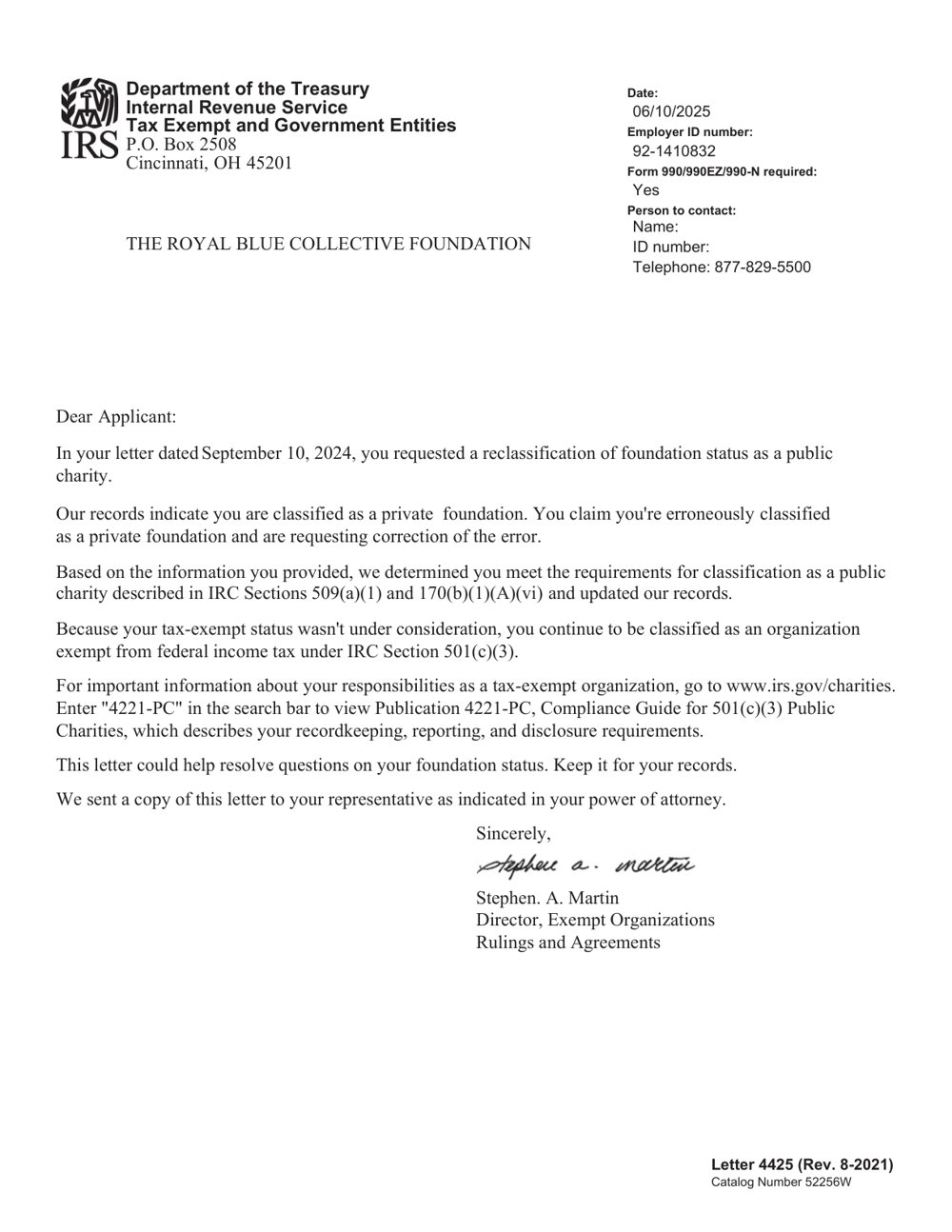
The third charity in the group, The Royal Blue Collective Foundation (EIN 92-1410832), is the athlete-payment vehicle stated most plainly. Its own website told donors they were “donating to a 501(c)(3)” and would “not get anything in return but the feel-good feeling,” while advertising that “87-95% of the funds raised will go to athletes” and are “dispersed to student-athletes in all sports.” On the day it launched, BYU’s athletic director described it, in three separate outlets, as “a corporate sponsor of BYU Athletics.” A corporate sponsor that pays the roster is not a public charity, by the collective’s own words and the athletic director’s.
The arithmetic agrees. Royal Blue’s own return reports a public-support figure of about 16 percent, which fails the one-third test that separates a public charity from a private funding vehicle. There is a paper trail behind that number: the IRS first classified Royal Blue as a private foundation; the collective told the agency it had been “erroneously classified” and asked to be treated as a public charity instead; and then its own math came back at 16 percent, failing the very test it had asked to be judged under. Even the donor list blurs from the inside: among the printed donors is Casey Adams, who sits on the collective’s own advisory board as head of its women’s volleyball committee, insider support printed as public generosity, which is precisely the kind of arithmetic the 16 percent measures. And football is only part of the spending: Royal Blue’s return reports $236,126 more to sixty-six athletes across sports the same year, alongside a women’s-volleyball push its own materials and launch coverage put at roughly $700,000. Between the two charities, roughly half a million dollars in what the group called charity reached about a hundred college athletes in a single year.
“Goes directly to help children”
CONFIRMEDthe foundation’s own archived sponsorship forms
The tournament that raised this money was sold to sponsors as a children’s cause. The 5 Star Legacy sponsorship forms, archived from the foundation’s own site, are headed “HERE’S HOW YOUR SPONSORSHIP GOES DIRECTLY TO HELP CHILDREN” and priced in children: “$12,500 = 290 Kids/Yr,” “$7,500 = 174 Kids/Yr,” “$800 = 19 Kids/Yr.” A sponsor who bought a tier bought children, and deducted the cost, in the same years the foundation routed most of its grantmaking to a football roster.

The golf was not the only rail. Synergy Worldwide, the multi-level-marketing company where the foundation’s president became a top earner, ran fundraising appeals for the foundation on its own corporate blog, the company soliciting its own sales force for its star salesman’s charity. Nu Skin, the publicly traded direct seller down the road, appears on Royal Blue’s donor roll. Utah’s marketing houses did not just sponsor the golf; they passed the hat.
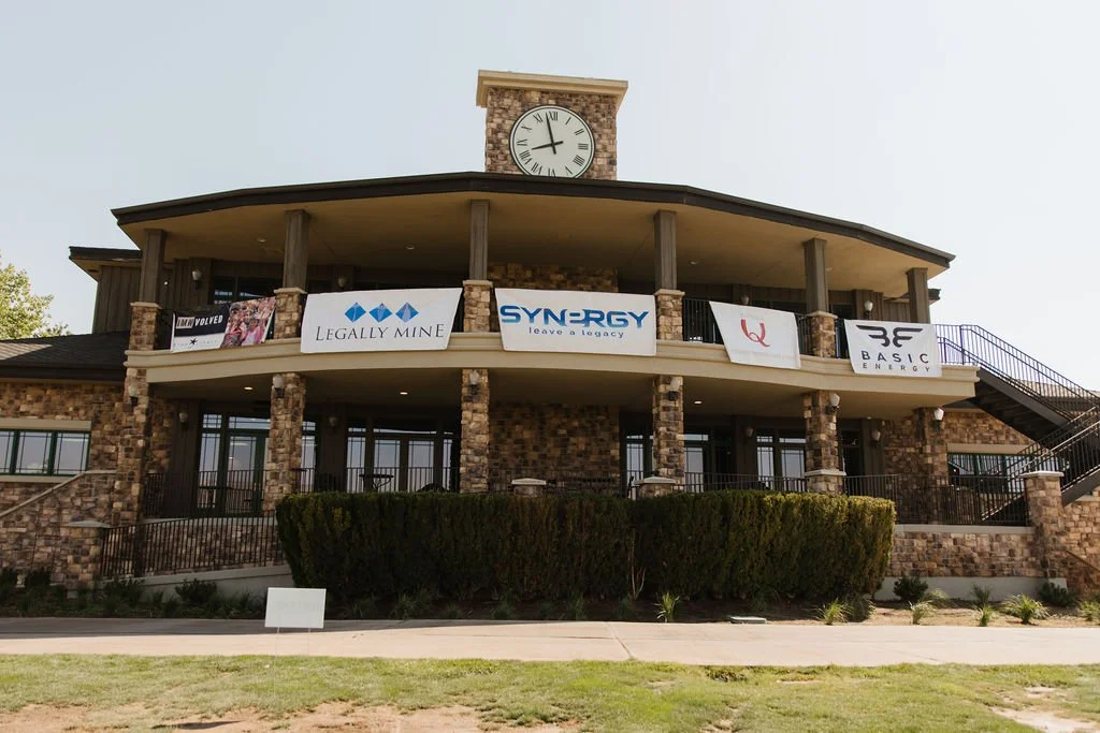
The event’s own photographs show whose banners hung on the clubhouse. One is Synergy’s. Another, on a tee sign, a clubhouse banner, and the staff shirts across the 2021 through 2024 galleries, is Legally Mine, the asset-protection company this site reports on elsewhere. In those years Legally Mine belonged to the McNeff family. In 2026 the foundation’s own president, Mark Comer, took over the Legally Mine brand through his company Centra. The company that sponsored the charity, and the man who signs the charity’s returns, ended on the same side of that brand. And it is a move with a paper trail going back two decades. Two years after the iMall settlement, the SEC filings of a Utah nutrition company, whose officers included a former iMall executive who had worked under him, record Mark Comer as a shareholder of more than five percent, lending the company money at 10.5 percent interest and then converting the debt into stock. Lend first, own after, on the public record since 2001.
The circle of partners is small enough to draw. The man who served as Synergy’s president, Daniel Norman, held a stake in a shared Utah holding company, CNJC Holdings, with Comer and with David Johnston, the wealth manager who now co-manages Centra. The executive whose company raised money for the charity, the president it was raised for, and the co-manager of the Legally Mine successor: three names on one company.
None of that is a claim that the foundations and the asset-protection company share common ownership; they do not, and the findings above rest on the charities’ own returns regardless. It is a documented overlap of the same people and the same money-protection trade, and this site develops the Legally Mine record at /the-machine and /the-lenders.
One control group, three charities
The three “independent” charities are signed by the same few people. Mark Comer signs the 5 Star Legacy return as president and is the secretary of Royal Blue. Lon Henderson signs the Royal Blue return as president and is the vice president of Ampelis. Carrie Henderson signs the Ampelis return. Royal Blue’s officers, Lon Henderson, Mark Comer, Craig Cusick, and Min Kim, are the same people who together own a for-profit company, Royal Collective, L.L.C., registered at 5255 W 11000 N Suite 225 in Highland, the same suite the Ampelis entities use. The charitable and the commercial versions of the group share an office and a roster of principals. And the only person any of the three foundations pays a salary, four thousand dollars at the flagship, is married into the president’s wife’s family, a related-party payment the same return does not disclose even as it certifies the foundation has no conflict of interest to report.
Ampelis itself points back at a business. Its sworn mission is to promote “the Ampelis methodology,” which is the brand of a live for-profit wellness company whose founder and president also sit on the foundation’s board. A foundation whose charitable purpose is to market its founders’ own company, without disclosing that company as a related party on the return, has a private-benefit problem independent of anything to do with football.
The year that is missing
CORROBORATEDthe IRS e-file index and the return’s own prior-year column
The public Ampelis return is for fiscal 2024, the wind-down year, when the foundation spent its net assets down to $621. Its own prior-year column shows the year that matters: fiscal 2023, with about $1.29 million raised and $1.39 million spent. That was the big year. There is no public Form 990 for it. The IRS bulk index and the agency’s own copies-of-returns system both return a single Ampelis filing, fiscal 2024, and nothing for fiscal 2023, while returning the expected multiple years for the sibling charities, so the absence is real rather than a lag. The recipient list for the largest funding year is disclosed nowhere, though it is hardly a secret: the collective had publicly committed to pay every one of the 123 players on that year’s BYU football roster, on a set monthly schedule, and the missing year’s $1.39 million is about the size of that promise. Skipping that return is not free, but the penalty is capped, a few percent of the money that moved; for an organization with reason to keep its biggest year off the record, that is a price, not a deterrent. The one exit from the penalty is a showing of reasonable cause, and that is a hard showing for a foundation whose very next return was prepared, on time, by a national accounting firm.
One donation into that dark year is visible from the other side. A donor-advised fund reported, on its own return, a $300,000 grant to Ampelis earmarked “BYU STUDENT ATHLETE EDUCATION.” The purpose was written in plain language by the funder, into a grant to a charity the IRS classifies as a mental-health organization. And the 5 Star Legacy Foundation itself was administratively dissolved in Utah in early 2026, while continuing to organize its tournament. It was not the foundation’s first lapse; it had already been stripped of its tax exemption once, in 2014, and reinstated.
Most of the money coming in is untraceable by design. It arrived through donor-advised funds at large Wall Street firms, Goldman Sachs, Fidelity, Schwab, which pass a gift along while keeping the individual donor anonymous; more than a million and a half dollars into the wellness charity, and hundreds of thousands more into Royal Blue, came from donors named on no public record at all. The Sterling grant is visible only because the fund that sent it wrote the purpose, and the recipient, onto its own return; the donors behind the rest are masked at the source. The few funders who can be named are telling: the family foundation behind the Utah Jazz, the Larry H. and Gail Miller Family Foundation, sent $50,000 to Royal Blue.
What the returns expose
CONFIRMEDthe false statements are on the face of the returns
Read against itself, the record is a charitable wrapper around booster payments: money raised as help for children and as wellness advocacy, spent by the group’s own returns as designed awards to a football roster, with the marquee year kept off the public record. On the civil side, what that exposes is not a close call. A charity whose money runs to a class the tax code does not treat as charitable, a college football roster picked by athletic value, loses its exemption; the private benefit is the disqualifier, and it needs no proof of anyone’s intent. And because a revoked charity’s “grants” become what they always were, compensation, the payroll taxes that were never withheld come due, with a penalty that can reach the people who ran the money personally, whatever happens on the criminal side. And if those grants were also relieving the collective of payments it had promised the players, the insiders spared that cost can be made to repay the benefit on top. None of that turns on a state of mind.
The criminal exposure is narrower, and sharper. A return signed under penalty of perjury that swears grants to individuals were contributions “to various local non-profit organizations” is a false statement on its face; the falsity and its materiality are not in dispute, because the same return’s own schedule shows the recipients were people, not organizations. The one element left open is whether the statement was made knowingly. And that question is concrete, because these returns were not kitchen-table paperwork. The Ampelis return, the one that swears the money went to organizations, was prepared by BDO USA, one of the largest accounting firms in the country; Royal Blue’s by Eide Bailly, another national firm; the flagship’s by a solo Orem practitioner. No preparer is accused of anything. But a false narrative on a professionally prepared return has exactly two candidate authors, the officer who signed it or the professional who drafted it from what the officer provided, and which one wrote the words is a question an examination can answer.
This is not this site’s reading alone. The pattern, stripped of every name, was put to four independent legal reviewers ranging from aggressive to conservative. They divided on how far a criminal case runs today; they agreed on the rest, that the loss of exemption is near-certain, that the sworn “non-profit organizations” line is the cleanest false statement on the record, and that the whole criminal question comes down to that one unanswered fact. Where it is decided is an Internal Revenue Service referral or an examination, not this page. What is already sitting on the public returns is the exposure, and it is not small.
And the tax law is not the only exposure. The donors were told their money helped children; some of them deducted it; the returns show where it went instead. Deceiving people to raise money is a fraud in its own right, a mail-and-wire case that, unlike the tax question, would not stop at the Internal Revenue Service, and the most aggressive of the four reviewers ranked exactly that second.
The end that files nothing
All of this money runs toward one place. The tuition the charities paid lands at BYU as revenue, and the athlete-payment collective signed on as, in the athletic director’s own word, a “corporate sponsor” of BYU Athletics. But BYU, by the tax code, is not an independent charity that answers for itself. It files no public tax return at all. It is treated as an arm of the Church that owns it, an integrated auxiliary, funded in the majority by tithing, governed by a board its own audited statements call “General Authorities and other officers of the Church,” and it is that tithing subsidy that lets it skip the disclosure every other charity in this story had to make. So the one end of this arrangement that could show what the school received, and on what terms, sits behind the same wall as the Church’s finances, a wall it never has to open. Nothing here shows the university or the Church directed the charities or knew how their returns were written; that is not the claim. The claim is narrower and colder: the destination of the money is the only party in this story that discloses nothing, and that does not clear it. It makes it the one part no outsider can check. And the tie is closer than a sponsorship: one of the four, the supplement magnate among them, is BYU Athletics’ own official supplier, a vendor to the school on one side and a co-owner of the collective’s for-profit twin on the other.
In fairness. Paying college athletes is legal, and in 2022 and 2023 many collectives were organized as charities before the IRS signaled, in a 2023 general counsel memorandum, that most such collectives do not qualify. The people named here appear as the signers and officers of record on public returns, or as principals and counterparties in state registry and securities filings; none is charged with anything, and the accuracy of a return, and whether any misstatement was knowing, are questions for the tax authorities to resolve, including the open question of whether the language on a given return came from an officer or from the paid preparer. Daniel Norman and David Johnston hold no role in any of the three charities and appear here only for the registered co-investment itself; Casey Adams appears only as a listed donor who also holds a listed board seat. The athletes are recipients, not participants in any misstatement, and are not named here. Mali Wellness Foundation (EIN 84-4062328), which received money from Royal Blue in the same year, is a genuine relief charity and an arm’s-length recipient, unconnected to any of this. The false statements sit on the private foundations’ own returns, signed by their own officers; the university did not file them, and nothing here shows the university or the Church directed the scheme or knew how those returns were written. That is the limit of what the record supports, in either direction, not a clean bill for the school, whose own end of the money, as noted above, files nothing and cannot be checked from the outside.
Sources. The fiscal-year-2024 Forms 990 of the 5 Star Legacy Foundation (EIN 26-3564428), the Ampelis Foundation (EIN 84-6940806), and The Royal Blue Collective Foundation (EIN 92-1410832), with schedules I, G, O, and A, retrieved from the IRS e-file record, and the returns’ preparer blocks; the foundations’ prior-year returns fiscal 2018 through 2023 from the IRS bulk e-file archive; the IRS Tax Exempt Organization Search copies-of-returns index; the 5 Star Legacy golf sponsorship forms and tournament galleries, archived; The Royal Blue Collective’s own website, its December 22, 2022 launch coverage in Deseret News (also reported same-day by KSL Sports and Sports Illustrated), and its sponsor list as reported by KSL Sports on August 30, 2023; BYU’s published tuition schedules; Utah Division of Corporations registry filings for the entities named, including CNJC Holdings, LLC (Utah entity 12508833) and Centra Wealth Solutions, LLC; SEC filings of Whole Living, Inc. (CIK 1091983); the Federal Trade Commission’s May 1999 announcement of the iMall settlement and Deseret News’s contemporaneous coverage, cited by name; and Nature’s Sunshine Products’ 2026 proxy statement (officer roles). On the exempt-status question for NIL collectives generally, see IRS general counsel memorandum AM 2023-004.
Foundation returns are public records under 26 U.S.C. 6104. Figures are taken from the returns as filed; where a figure is derived, the derivation is shown. This page states graded positions, and links to where those positions are developed at /the-machine.
The BAM Map is independent reporting on matters of public concern. Nothing here is a finding of any person’s guilt; the criminal charges referenced are unadjudicated and every defendant is presumed innocent. Sources are linked so readers can check the record. · Home · Map · The law · Bodycam