BAM asked Judge Barlow, with no one there to answer, for the names of everyone who writes for The BAM Map and the payment records on its account. Its own complaint says its logs already point to a suspect.
On Monday, three days after suing ten unnamed John Does, the company filed an ex parte motion asking Judge David Barlow for leave to subpoena Vercel, which hosts this site, and GoDaddy, its domain registrar, “including but not limited to” them. The subpoenas attached to it ask for the names, addresses and phone numbers of anyone who “edited, authored content for, or otherwise controlled” this site, the billing records and “payment information” on its account, the logs of every address used to run or post to it, and “All Communications between the Hosting Provider and the Website Operator.” They are returnable October 16. No defendant has appeared, so the motion went to the judge alone. Three days earlier its complaint had told the same court that its own audit logs had already produced a suspect, and that Google, Slack and YouTube held records that “may identify” the rest. The motion asks for none of them.
PRIMARY SOURCEBAM Franchising, Inc. v. Does 1-10, United States District Court for the District of Utah, No. 2:26-cv-00895-DBB, Document 3, “Ex Parte Motion for Expedited Discovery,” filed September 28, 2026 by Matthew J. Orme and Kyle K. Tucker of Dentons Durham Jones Pinegar, with the proposed order and both subpoenas, 22 pages. Hosted below as filed, with three of the orders it cites.
CONFIRMEDThe case now carries Judge David Barlow’s initials. Judge Barlow also presides over BAM Franchising, Inc. v. Schneider, No. 2:26-cv-00593, the company’s case against Reckless Ben.
CONFIRMEDThe order it proposes gives no one whose records are sought any notice, or any time to object. As drafted, nothing in it requires anyone to be told before the records are handed over.
What the company asked the judge to sign
The motion asks for the discovery “to help in the proper identification and service of process of the currently unknown Defendants,” and asks to subpoena “records from the third-party websites, including without limitation Vercel, Inc. and GoDaddy.com, LLC to which confidential information was leaked in order to identify the Doe Defendant(s).” The order it drafted for the judge’s signature has two paragraphs.
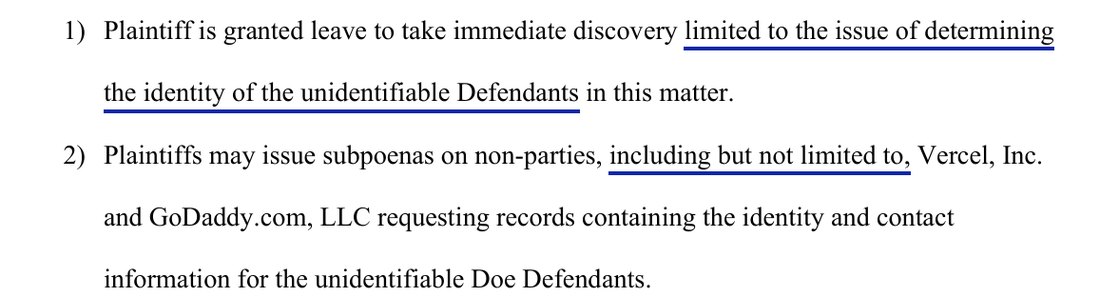
The complaint describes the Defendants as current or former franchisees, employees, or others who got access to the company’s information under contract (paragraph 14), and lists this site among the “third-party websites” (paragraph 17). The order limits the discovery to the identities of the Defendants; the subpoenas attached to the same motion ask Vercel and GoDaddy for the identity of the “Website Operator,” defined below.
Who it is looking for
The subpoenas define “Website” as thebammap.com, “including all webpages, subdomains, and content hosted thereon.” They define its operator as everyone who ever registered, ran, edited or wrote for it.

The definition describes anyone who ever wrote a line for this site. The complaint sues people under contract with the company.
The first request asks for the names and contact details of every one of them.

What the subpoenas demand
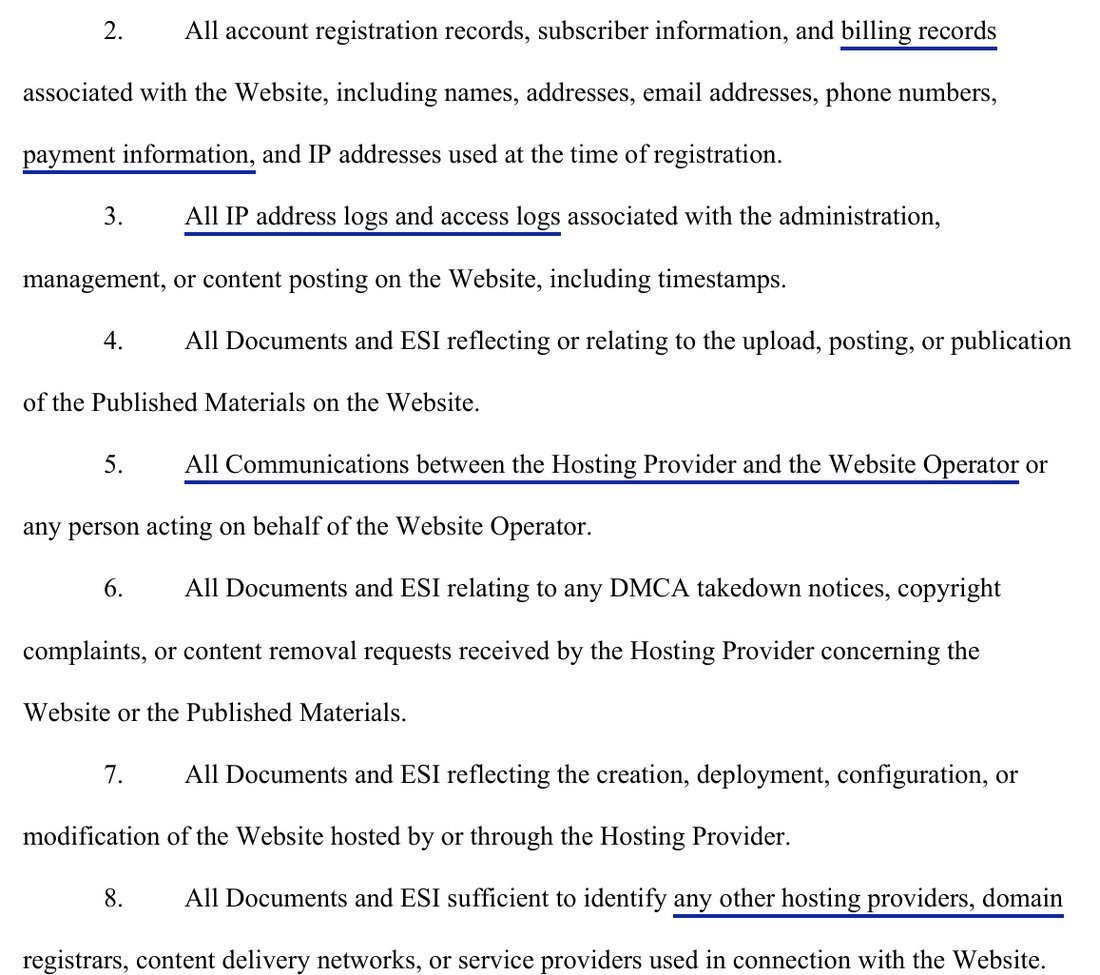
The first thing it asks the host for is names. The second is the payment details on file.
The two subpoenas carry the same eight requests. Both are dated September 28 and signed by Matthew J. Orme, and both command production by October 16, 2026 at 5:00 p.m., “Via email” to the lawyer who signed them or at the firm’s Salt Lake City office.
Request 8 asks each company to identify every other hosting provider, domain registrar, content delivery network or service provider the site uses. The order the company drafted is not confined to the two companies it names; it covers subpoenas on non-parties “including but not limited to” them. It would let the company subpoena any company it chooses next without returning to the judge.
CONFIRMEDNone of the eight requests asks for anything that would identify a franchisee, an employee or any other party to a contract with the company. Each asks about the site: its operator, its account and payment records, its logs, its uploads, its correspondence with the host, its deployments and its vendors. The complaint describes the people the company is suing as franchisees, employees and others who got its information under contract (paragraph 14), and lists this site among the “third-party websites” (paragraphs 17 and 55); the motion asks for records “from the third-party websites.”
What the motion says, beside the record
Each of the motion’s reasons for going ahead before any defendant is named is quoted below, and answered from the record.
“Additionally, Plaintiff has no alternative means to identify the Defendants, having exhausted its internal investigation methods.”
REFUTEDBy the company’s own complaint, filed three days earlier. On its internal search the complaint says what the motion says: paragraph 54, that it “has exhausted all reasonably available means to identify the Defendants through its own investigation,” which “has narrowed but not conclusively identified the source or sources of the leaks.” On “no alternative means” the complaint says the opposite. Paragraph 45 says the company “has identified at least one current or former franchisee as a suspected source” through that investigation, including its own Google Drive audit logs (reported September 26), and paragraphs 58 to 60 say Google, Slack and YouTube hold records that “may identify” the people it is suing. The motion attaches a subpoena to none of them. It attaches two, both to companies that serve this site.
It pleaded four ways to find the leakers. It asked the judge for the two that find this site.
“Finally, the evidence necessary to identify the defendants is at risk of destruction because internet service providers do not retain subscriber and activity logs indefinitely.”
CONFIRMEDThe company had already asked for those records to be kept. The takedown notice its chief operating officer swore on September 8, and filed again on September 23, asks Vercel to preserve, “pending appropriate legal process,” the “subscriber/account information,” “billing and payment information,” “IP and login records” and “deployment and upload records” for this site, and “records identifying persons who created, administered, funded, uploaded to, or controlled the relevant projects” (published here September 9 and September 24). The motion does not mention the request. The notice said disclosure of that information “may require appropriate legal process.” Twenty days later, this is the process.
“Moreover, the urgency of this matter has materially intensified.”
CONFIRMEDThe event the motion cites is the September 23 post that paragraph 43 of the complaint had already pleaded, in the same words, three days before the motion, and that this site answered beside the record on September 26.
“Here, good cause exists because the Doe Defendants are unknown and therefore cannot be served with notice of this Motion.”
CONFIRMEDThe order the company drafted gives no one whose records are sought any notice, or any time to object. Three of the four District of Utah orders the motion relies on built that time in. In Arista Records, each Doe had “an opportunity to object to the subpoena within fifteen days of notice,” and the provider ten days of its own “because this motion was brought ex-parte.” In 1524948 Alberta, the return date was “30 days from the date of service,” with motions to quash due before it. In Living Scriptures, a subpoenaed company could move to quash “within twenty (20) days of being served with it.” All three orders are hosted above.
CONFIRMEDAll four District of Utah orders the motion relies on confine the discovery to identifying the people sued. Arista Records allowed discovery “to obtain the identity of each Doe Defendant.” 1524948 Alberta allowed subpoenas for “contact and billing information” on a website whose owners and authors were the defendants. Living Scriptures allowed subpoenas “limited to the following categories of entities and information.” Crazy ATV allowed “limited discovery to identify and serve Doe Defendants.” The subpoenas attached to the company’s motion ask for the identity of the “Website Operator” and seven more categories of records about the site.
“granting expedited discovery where alleged operator of website publishing false and defamatory statement was unknown”
CONFIRMEDIt is the one case the motion cites about a website. The defendants there were the site’s “owner(s), proprietor(s), and/or author(s),” sued as John Does for defamation and trademark infringement. The company’s complaint does not say that anything on this site is false (reported September 26), and it does not sue this site.
The same judge
In July, in the company’s case against Reckless Ben, every party signed a stipulation and Judge Barlow entered the injunction, whose second paragraph says nothing in it prohibits the defendants from “engaging in investigative journalism.” The new motion, filed before the same judge, does not mention that case. October 16, the day the subpoenas are returnable, is also the day the company’s response is due to the anti-SLAPP motion in it (reported September 26).
In July the company agreed to an order that leaves “investigative journalism” alone. In September it asked the same judge for the names of everyone who writes for this site.
What the company tells buyers
“The named defendants are not franchisees, nor does this action involve the franchise relationship. However, Franchisor believes that this action and the facts surrounding it is information that is material to the decision to enter into a Bricks and Minifigs franchise agreement.”
PRIMARY SOURCEBAM Franchising, Inc., Franchise Disclosure Document, September 2026 amendment, Item 3, as filed with Minnesota and quoted verbatim.
That is what the company certifies to every prospective franchisee: the case and the facts around it are material to the purchase. The facts around it are what this site reports. On Monday the company asked the judge in that case for the names of the people who report them.
The company tells buyers the facts are material. It asked the court who writes them down.
Five times since July
Since July 28 the company has gone after the names behind this site’s reporting five times. A cease and desist letter on July 28 asked for the names of the people who supplied it; this site’s answer, published July 29, was that the request “will not be answered.” A takedown notice sworn on September 8 asked the host to preserve the records that identify who runs it, and the same notice came back on September 23. The complaint on September 25 pleaded subpoenas to the host. On September 28 the company asked the judge to let it serve them.
In July this site said the request for the names of the people who supplied it “will not be answered.” The company has now asked the site’s host and registrar for the names of the people who write it.
CONFIRMEDNone of the five says that anything on this site is false. The July letter did not (reported July 29). The notice disputes no figure and disclaims the site’s facts and analysis (September 9). The complaint does not, in nineteen pages (September 26). The motion uses the word once, describing another company’s case.
Five instruments since July 28, and the same ask each time: names. Not one says that a word on this site is false.
The record
The court file. BAM Franchising, Inc. v. Does 1-10, No. 2:26-cv-00895-DBB (D. Utah): Document 3, the motion, with the proposed order and both subpoenas; Document 1, the complaint. The orders the motion cites. Arista Records (2008). 1524948 Alberta (2010). Living Scriptures (2010). On this site. The complaint, beside the record. The first takedown notice. The second. The cease and desist letter. The injunction in the Reckless Ben case. Who it binds. The law page. The rights guide.
Sources. BAM Franchising, Inc. v. Does 1-10, D. Utah No. 2:26-cv-00895-DBB, Document 3 with its Exhibits A, B and C, filed September 28, 2026, and Document 1, filed September 25, 2026, quoted verbatim. Arista Records LLC v. Does 1-19, D. Utah No. 2:07-cv-00971, Document 8 (January 11, 2008); 1524948 Alberta Ltd. v. John Doe 1-50, D. Utah No. 2:10-cv-00900, Document 10 (September 22, 2010); Living Scriptures, Inc. v. John Doe(s), D. Utah No. 1:10-cv-00182, Document 8 (November 9, 2010); quoted verbatim. BAM Franchising, Inc. v. Schneider, D. Utah No. 2:26-cv-00593-DBB-CMR, Document 21, entered July 7, 2026. The company’s DMCA notice to Vercel, sworn September 8, 2026 and filed again September 23, 2026, published here September 9 and September 24. This site is not a party to either case, and no claim in either is pleaded against the site. Everyone named here is presumed to have acted lawfully; the complaint’s allegations are allegations.