Gregory Belmont asked BAM’s lawyers not to look at the names behind this site until a judge rules. Counsel “saw no legal basis” to agree, he swears.
Belmont is a reader in New York. He swears he has never contacted this site and does not know who runs it. On September 30, the day a magistrate judge let BAM subpoena the records behind this site, he began asking BAM’s lawyers to hold off. First he asked them to wait until noon Mountain time on October 2. They declined. Then he asked only that anything identifying the site’s “operators, editors, authors, or sources” stay unread until the court rules. That is the request counsel “saw no legal basis” to grant. On October 2 he asked the court to order it. The court has not ruled.
PRIMARY SOURCEBAM Franchising Inc. v. Does 1-10, No. 2:26-cv-00895, District of Utah: docket entries 8 and 9, filed October 2, 2026, with their exhibits. Both are in the record below.
CONFIRMEDThe docket as read on October 2: nine numbered entries, both motions referred to Magistrate Judge Dustin Pead, no order on either, no response from BAM, and no return showing a subpoena served.
CONFIRMEDThe BAM Map is not affiliated with Gregory C. Belmont in any capacity.
UNRESOLVEDwhether any subpoena has been served, and whether the court hears him
Gregory C. Belmont is, by his own oath, a reader of this site and nothing more. On October 2 he filed two motions in the federal court in Utah. One asks to be let into BAM’s suit for a single purpose, review of the September 30 order. The other asks for an order, in the meantime, on who may look at what the subpoenas bring back.
“After counsel declined”
Belmont swears that he called and wrote to BAM’s lawyers, Kyle Tucker and Matthew Orme, on the evening of September 30, the day the order was entered, and again the next afternoon.
First he asked for time: that BAM hold off serving subpoenas and “requesting, receiving, reviewing, or using identifying records through noon Mountain Time on October 2.” They declined.
Then he asked for less. BAM could serve its subpoenas, so long as any records “identifying, or likely to identify, thebammap.com’s operators, editors, authors, or sources” were secured “against review or further disclosure” until the court ruled.
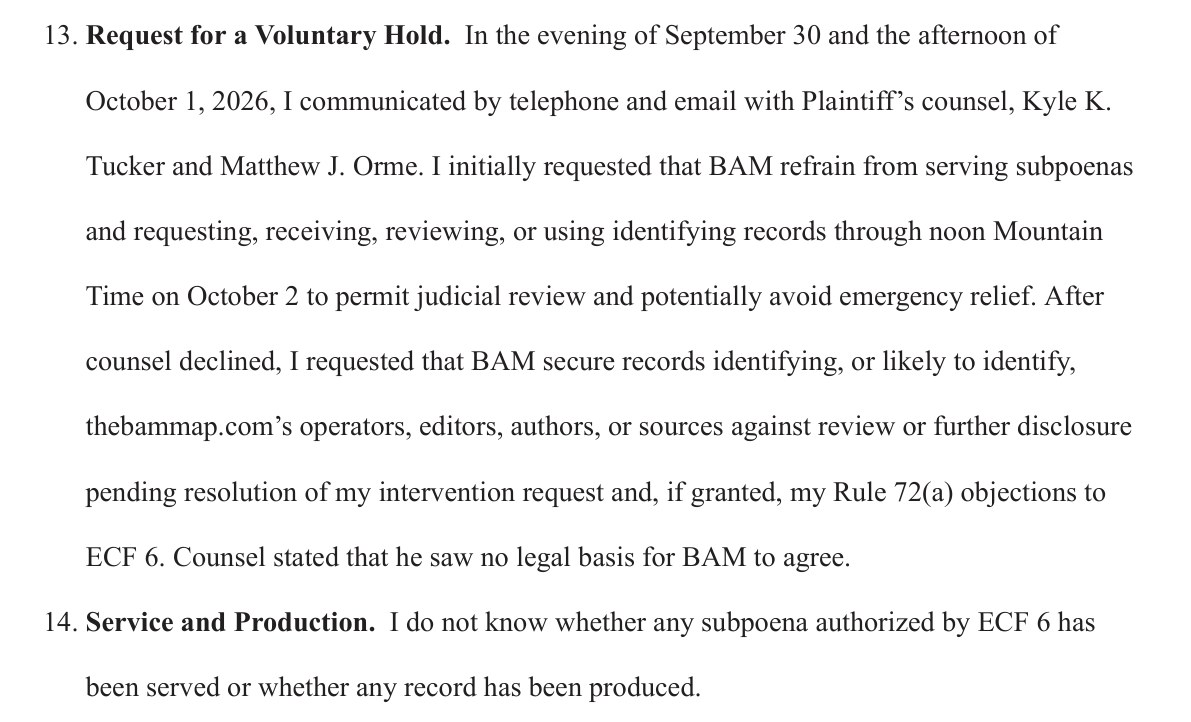
“Counsel stated that he saw no legal basis for BAM to agree.”
He does not know whether BAM has served a subpoena yet, or whether anything has come back. Nothing on the docket says.
What he asks the court to order
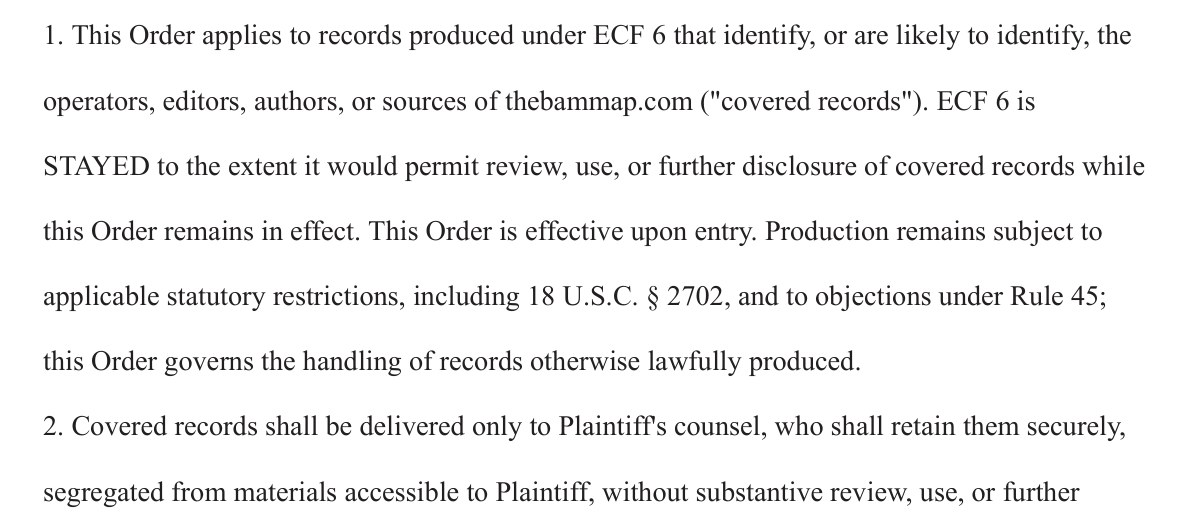
The order he proposes would not stop the subpoenas. It would decide who may look.
Records that identify, or are likely to identify, the site’s operators, editors, authors or sources would be “delivered only to Plaintiff’s counsel,” kept “segregated from materials accessible to Plaintiff, without substantive review, use, or further disclosure,” and would “remain unopened” unless the court sets up a way to screen them.
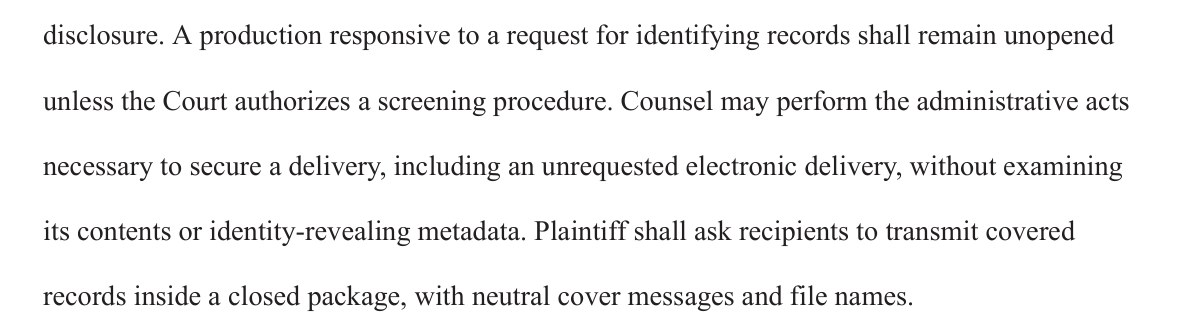
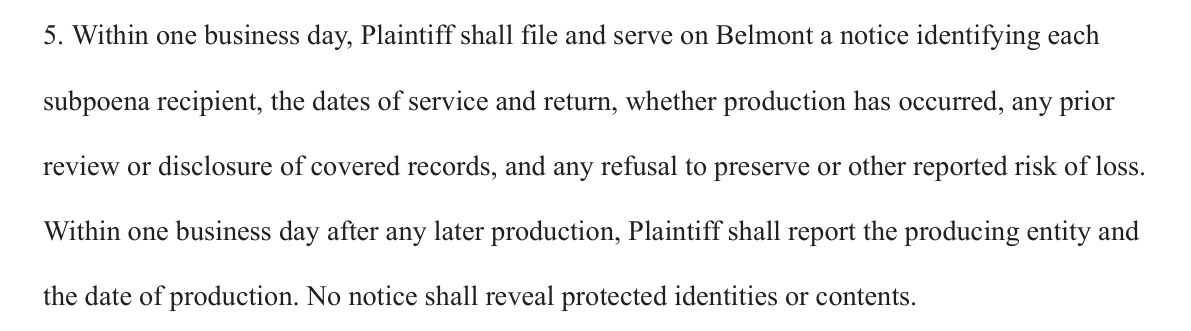
And BAM would have to say what it has done. Within one business day it would tell the court whom it has subpoenaed, when each subpoena was served and comes due, whether anything has been produced, and whether anyone has already looked.
If the court lets him in, the order would last until District Judge David Barlow rules on the objections Belmont filed with his motion. Those ask the judge to set the September 30 order aside as to identifying records, or to narrow it: a sworn statement from BAM about its own search, subpoenas that name each recipient, account and date range, notice to the account holder with twenty-one days to seek protection, and no identifying record produced without a further ruling.
BAM asked for the names before
Belmont’s motion puts one date ahead of the lawsuit. On July 28, BAM wrote to this site demanding “the identities of all persons who provided or published the materials.” This site printed the letter the next day and said the demand “will not be answered.”
The motion’s next sentence: “Two months later, BAM filed this action.”
Who he is, by his own account
Belmont represents himself and is not a party. He tells the court he has read this site since late June, learned of the suit from one of its updates and from a legal broadcast on YouTube, and follows the docket on a public website.
His motion says of himself: “He has no relationship with BAM, any BAM franchisee, or the site’s operators, and he does not know who operates or supplies it.” His declaration adds that he has never contacted, or tried to contact, anyone who does.
He has done this once before. In June he moved to intervene in BAM’s case against Reckless Ben, when an order BAM had obtained with no one on the other side restricted what Reckless Ben could publish. He withdrew the request after the parties agreed to an injunction without the speech restrictions.
His stated interest is a reader’s. If the people who supply a publication are identified to the company it reports on, he argues, they may stop, and no later ruling can undo it: “an identity, once produced, stays produced.”
Where it stands
Both motions were referred to Magistrate Judge Dustin Pead, who signed the September 30 order. As read on October 2, the docket has nine entries. There is no order on either motion, no response from BAM, and no return showing that a subpoena has been served. The subpoenas BAM attached to its own motion set October 16 as the date for the records.
The fair reading, and its limit. BAM holds a court order that allows the subpoenas, and its lawyers owe a stranger to the case nothing. A motion is a request. Belmont is not a party, and whether he may be heard is the first thing the court has to decide. The limit is what, by his sworn account, was asked and refused: not that BAM give up its subpoenas, only that the records stay unread until a judge has looked. The right of reply is open to BAM and to its counsel, Matthew Orme and Kyle Tucker.
The record
The motion to intervene, with the proposed objections, the declaration and the proposed orders, October 2. The motion to stay, with its proposed order, October 2. The docket on CourtListener. September 30: the order. September 28: BAM’s motion. September 26: the complaint. July 29: BAM’s letter. July 6: Belmont in the first case. The legal defense fund.
Sources. BAM Franchising Inc. v. Does 1-10, No. 2:26-cv-00895 (D. Utah): docket entry 8, Expedited Motion to Intervene for the Limited Purpose of Seeking a Stay and Review of Discovery Order (ECF 6), with Exhibit A (proposed objections), Exhibit B (declaration of Gregory C. Belmont, executed October 1, 2026) and Exhibits C and D (proposed orders); docket entry 9, Expedited Motion to Stay the Discovery Order in Part, with its proposed order; both filed October 2, 2026 and quoted verbatim. The docket as read on October 2, 2026. Docket entries 3 and 6, as reported here September 28 and 30. BAM Franchising, Inc. v. Schneider, No. 2:26-cv-00593 (D. Utah), as reported here July 6. Everyone named here is presumed to have acted lawfully; a motion is one person’s request, and this page reports one.