How we know · the LEGO seizure · second edition
Who actually took over the Keizer store
Bryan Mansell consigned his elderly father’s LEGO collection to a store to sell. The night it was seized, both sides were taking pictures. The first edition proved who took it and where it went. This edition adds when, and closes the record from the operators’ own documents.
How to read this investigation
Every claim is tagged with where it came from and how sure we are. Two picture records tell this story, made by opposite sides, plus the sworn paper trail:
And every finding wears its confidence:
A second edition, and why
This is the second edition of the Keizer file. The first edition (July 8, 2026) stays online as it was. Since then two documents the case turns on became readable together, the operators’ own consignment inventory and their own storefront database, and they close questions the first edition had to leave to “the sealed records.” This edition also corrects two things the first edition got wrong. Both corrections are listed plainly at the foot of the page, in the What changed box. Correcting our own record in the open is the point.
On the evening of November 14, 2024, at 7:54 PM, Chrystal Law and Benjamin Gorman stood in a Bricks & Minifigs store in Keizer, Oregon and photographed the shelves. On them sat the LEGO collection Bryan Mansell had consigned to the store to sell on his family’s behalf. In the pictures the sets are boxed, wearing the store’s yellow consignment stickers and price tags, the paper marks that said these belong to the Mansells. That same night, control of the store changed hands, and the Mansell collection was swept up with it.
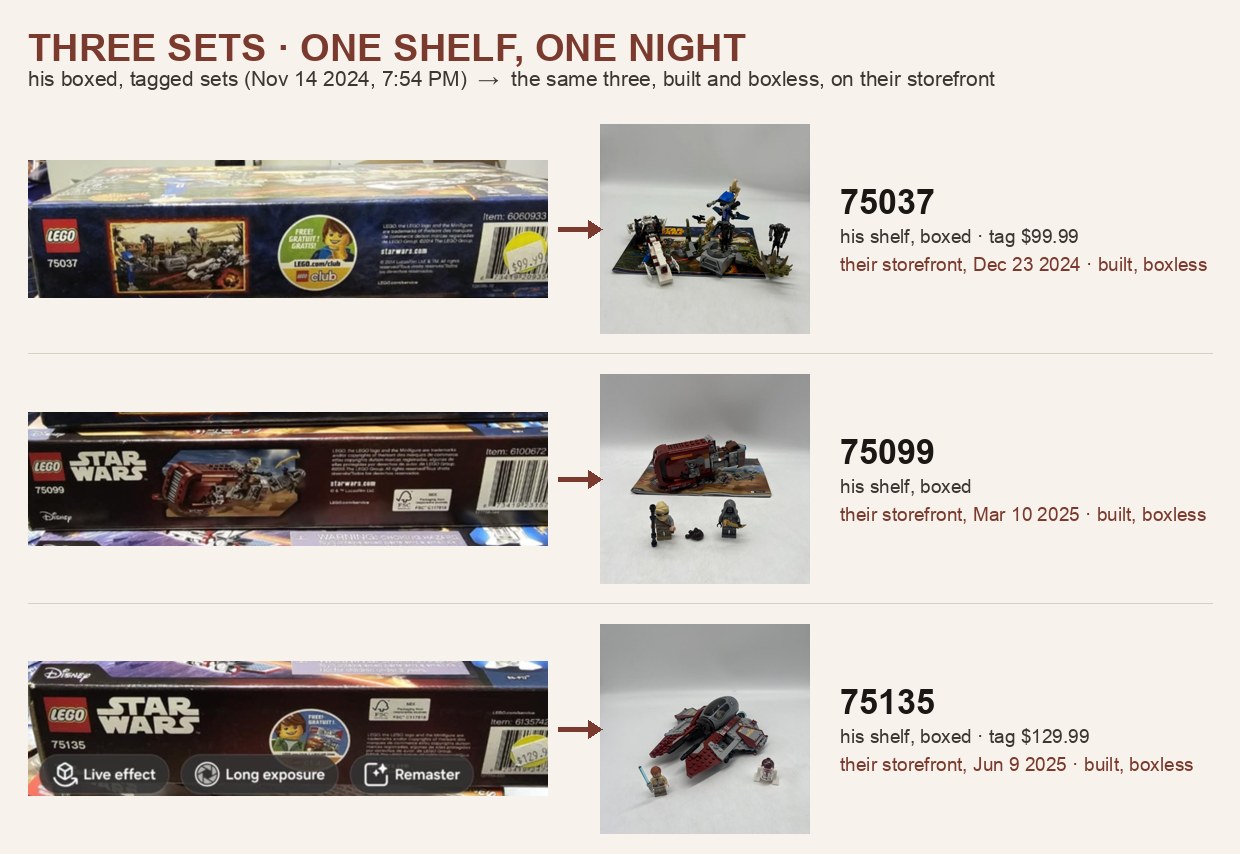
What sits between those two frames is this investigation, told in order this time: what was decided before the meeting, what the ledgers show on the night, and what became of the collection in the weeks and the year after. The whole way can be watched, because Best and Johnson kept a public record of what they sold, Law and Gorman kept a timestamped record of what was taken, and the operators’ own sworn inventory records which of it was still on the shelf when the store changed hands.
It was decided before the meeting
The morning of the takeover
In response to Chrystal Law’s inquiry, BAM scheduled a recorded meeting for the morning of Thursday, November 14, 2024. By the operators’ sworn complaint, BAM’s representatives used it to discuss a “mutual separation” in which the store would revert to corporate, and “gave no indication that it intended to seize the store hours later.” The truck used in that evening’s seizure had already been booked before the meeting began, on Brandon Best’s account, and was picked up in Eugene at 10:17 that same morning. COURT RECORD + RENTAL RECORD Confirmed
The meeting sat on top of logistics that were already in motion, and BAM has said as much itself. Three weeks earlier, on October 24, the company sent Best to the store as an unannounced secret shopper to video its condition, renting a cargo U-Haul the same day. By the CEO’s on-camera account, Best flew in overnight and a camper trailer had already been staged in Oregon “in anticipation of the…potential hostile takeover.” The four-page law-firm termination letter, dated November 14, arrived by email that night. On no account, BAM’s own included, did the seizure’s logistics wait on the meeting’s outcome; the full ordering is in The second U-Haul. BAM’S OWN ACCOUNT Confirmed
The ledger the plaintiffs kept
And why its dates can’t be moved
The consigned collection has a paper spine: the store’s own point-of-sale export of it, filed in court as Exhibit B. It lists every copy, what it cost, what it was worth, and, for each one, either the date and register-ticket number it sold on or the fact that it was still unsold. It records 743 of Mansell’s copies: 340 sold before the seizure for roughly $41,000, and 403 still unsold the night the store was taken. COURT RECORD · Exhibit B Confirmed
In plain English
Two clocks in this story cannot be run backwards. A store can type any “created” date onto a product, but it cannot edit the hidden serial number a computer assigns in order, #1, then #2, always climbing. Sort the records by that serial and check whether the typed dates ever run backwards against it. On both ledgers, they never do.
On Best and Johnson’s storefront database, the typed dates line up with the un-editable order across 19,427 products without a single reversal. On the plaintiffs’ own consignment ledger, the register-ticket numbers climb with the sale times across 340 set sales and 284 minifigure sales without one out of place, and the ledger stops clean before the seizure, its last set sale on November 12 and its last minifigure sale on the 9th. Ordered by each system’s own timestamp, three independent records, the plaintiffs’ and the defendants’, are each internally consistent, which is what makes every date on this page load-bearing. Confirmed
The clean baseline
The same ledger shows the pre-seizure store was ordinary. Localized to Oregon time, every Mansell sale falls inside normal retail hours, 9 to 7, peaking mid-afternoon, and the collection sold at proper value, with roughly one sale in seventeen below sixty percent of its book price. Before the seizure the collection was being sold, at value, in daylight, by a store whose books balance. That the ledger’s last Mansell sale falls a couple of days before the seizure is ordinary, not a gap in the record: the family’s sets were a small share of any day’s tickets, so quiet days are normal, and nothing was entered after. What is pointed is the settlement. By the consignment’s own terms the store accounted to the Mansells monthly, by the 15th, the day the consignor collected his receipts and a check; BAM seized on the 14th, one day short, so November’s sales were never reconciled or paid to the family. What happened to it after is the contrast this page measures.
How it got 65 miles to Eugene
The U-Haul, and the denial
Keizer to Eugene is 65 miles; the collection did not walk. On the night of the takeover the Keizer store’s own security camera, looking out through its storefront glass, recorded a U-Haul at the curb; that truck is contract 15284899, a 15-foot box truck rented in Eugene on Brandon Best’s account at 10:17 that morning, its drop-off odometer photo timestamped back at the Eugene lot at 12:41 AM. STORE CAMERA + RENTAL RECORD Confirmed
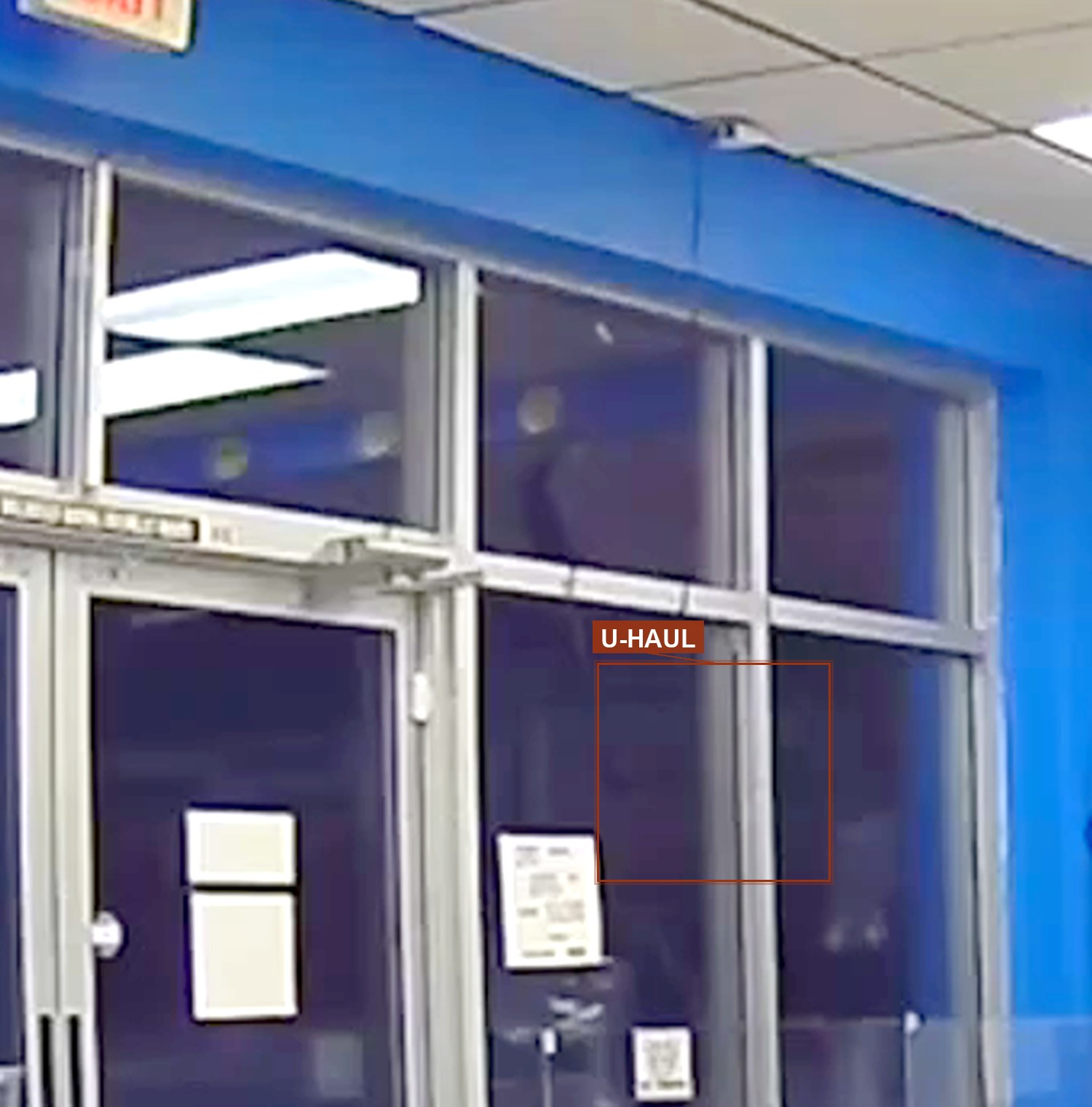
The odometer reads 128,573 at pickup and 128,759 at drop-off, and the final bill reconciles to the difference: 186 miles, a full round trip to Salem and back with roughly fifty more of local driving, not a quick errand. Confirmed That distance does not, by itself, decide whose story is true, because 186 miles fits a cargo haul and BAM’s camper account alike. What defeats the camper account is the equipment: the contract is a box truck with no tow dolly, no transport, no towing gear of any kind, on a chassis that neither can nor is permitted to pull a travel trailer of that class, so BAM’s claim that the pickup “wasn’t rated” but the box truck was is backwards. Refuted And the distance has a twin: BAM’s own admitted cargo run three weeks earlier ran about 180 miles on the same account and corridor, so by BAM’s own benchmark the November mileage is a cargo trip. Three rentals are now on the record, each dated; the full accounting is in The second U-Haul and The third.
The collection arrived all at once
Best and Johnson’s own store clock
Best and Johnson’s Eugene store lists every product publicly, and the server timestamps each one. Inside its used Star Wars sets, a normal day brings one or two. Five weeks after the seizure, on December 23 and 24, 2024, the catalog took in 23 used Star Wars sets across two mornings, and 13 of them were Bryan Mansell’s exact set numbers. The store has other heavy intake days, but no other two-day window in five years pairs a used-Star-Wars intake this size with 13 of one consignor’s exact set numbers. BEST + JOHNSON’S STORE Confirmed
Used Star Wars sets logged per day
Best & Johnson’s Eugene catalog, 2021–2026
A typical active day is a set or two. The store does have occasional heavy-intake days, so the singular thing here is not the count alone but the conjunction: this size of used-Star-Wars intake, on two mornings, carrying 13 of one consignor’s exact set numbers. Confirmed
One person, one camera, one job
The 23 were photographed one at a time over about an hour on each of the two mornings, and 21 of them at a 919×919 crop that appears on barely half a percent of the store’s catalog, two-thirds of it logged in the weeks around the takeover. A dedicated intake station, not the store’s ordinary pipeline, working through a stack by hand. Confirmed
Booked as a walk-in
The provenance, erased in the database
A used-goods store tags each listing with where it came from. New boxes carry a distributor; sets bought over the counter carry “Trade.” A consignment, someone else’s property held to sell on their behalf, is neither. Yet on the two-morning burst, 18 of the 23 sets were booked “Trade”, walk-in purchases the store now owned, against a store-wide rate of about a quarter for used sets. That is a complete inversion of the normal mix, and against random chance its odds are on the order of one in ten million. BEST + JOHNSON’S STORE Confirmed
The set-up matters because the other document names what these were. BAM’s own court-filed consignment agreement and Exhibit B record this collection as Mansell’s consignment. Logging it, at intake, as anonymous walk-in trade is the same erasure as peeling the yellow consignment sticker, done in the storefront metadata instead of on the box. What the label meant in law is for a court; that it was applied is on the record. Confirmed that the goods were booked as trade; Inference reserved on intent.
The sets did not arrive the way they left
The strip
On Mansell’s shelf the sets were boxed, wearing his sticker. On Best and Johnson’s storefront the same sets are built and boxless. Building a boxed set to sell it as used removes two things at once, the box and the consignment sticker, the one mark of whose it was. Selling used sets boxless is in fact this store’s standing habit, about 80 percent of its used stock, which is the point: the strip is not a special act done to Mansell’s sets, it is the store’s own template, so nobody can say the collection was singled out. The act of erasing the provenance is Confirmed; that it was done to conceal is an Inference the record does not settle. What it cost is measurable, in their own prices:
61 stripped sets →
The boxed copy sells higher on 179 of 251 sets they list both ways. This is a floor: it counts only packaging, not the far larger value of sets that never came back. BEST + JOHNSON’S STORE Corroborated
What BAM took, and what went dark
Two held documents, one answer
The first edition could show the high end was missing but had to send the reader to “the sealed records” for where it went. It is no longer sealed. Exhibit B says which specific copies were unsold and in the store at seizure, and the storefront database says which ones resurfaced. Those 403 unsold copies span 117 distinct set numbers; cross them against the storefront and the answer is itemized.
Of the 117 unsold at seizure, 41 resurfaced at Eugene; a grail-led tail, Cloud City first, shows no public resale; the remainder are common sets the store also stocked on its own, which we do not count as movement.
Why “no trace” means what it says
Best and Johnson’s store does not delete what it sells; a sold item stays in the database, marked unavailable. On the current catalog 99 percent of used-set listings are marked sold, still present. So a set that is absent entirely was never listed on that storefront at all, not listed-and-sold before anyone looked. On a store that keeps its sold rows, the dark grails were never put up for public sale at Eugene. Confirmed
The dark list is led by one named object, the one the first edition already centered. Mansell’s Cloud City, valued as high as $10,000, sits in the unsold column of BAM’s own ledger and never surfaced on Best and Johnson’s storefront at all, not listed and not sold. Behind it is a grail-led tail of other sets that were unsold at seizure and show no public resale of the seized copies; that tail, and its dollar figures, we hold back until a line-by-line reading of the inventory itemizes it, because at least two of the candidates also have pre-seizure store stock of the same set number, and the honest exhibit is the one object that is clean either way. The sets that did resurface carried the “Trade” walk-in label at 37 percent, well above the store’s norm. Where the high end physically went, a warehouse, a private sale, another channel, still needs the transfer records; that Cloud City left Eugene’s public storefront without a trace is on two documents the operators produced themselves. Exhibit B · Eugene catalog Confirmed on Cloud City · the tail & location reserved
The collection’s loose minifigures tell the same story, and the store’s own habit is what makes it legible. Because Best and Johnson’s storefront keeps what it sells, a figure they had resold would still be in the database; yet of the roughly three hundred individually inventoried minifigures unsold at seizure, some $18,000 on BAM’s own valuation, almost none reappears on the Eugene storefront at all, and the value that vanished sits, exactly like the sets, in a handful of high-end figures. The pattern holds across the whole collection, and it runs one direction: the high end, the flagship sets and the most valuable figures alike, is the part that left the visible record, while the ordinary middle went out the front door relabeled as trades. Exhibit B · Eugene catalog Corroborated
There is one more exit a skeptic might reach for, and the sheer weight of the thing forecloses it. Had the high-value sets been broken up and sold off by the pound as loose bricks, they would never show as sets in any catalog. But the boxed sets in Mansell’s collection that carry a listed weight come to about 160 kilograms, and that is a floor, counting only the ones the catalog weighs; everything the Eugene store has sold as bulk across its entire life, by its own listed weights, comes to about 142. The collection outweighs the whole bulk channel. It could not have been quietly dissolved into the bins. Whatever left the store left as itself, in one piece, which is exactly what a truck is for. BEST + JOHNSON’S STORE Confirmed
We looked across the whole chain, too, and here the shape of the company is the point. Of nearly three hundred Bricks & Minifigs stores, only about eight sell online through a public catalog; the rest are brick-and-mortar shops with a marketing page and nothing to buy. That is by design, not an accident of the web: BAM’s own franchise agreement reserves online selling to the franchisor and bars a franchisee from selling online without written approval. A storefront that can liquidate a collection to a national audience is therefore a scarce, company-granted thing, and we pulled every one of those catalogs we could find, more than fifty thousand listings. The ordinary mid-tier Mansell sets show up in them, the same photo files reused from store to store; not one of the dark grails does. So those eight are not a sample of the chain, they are very nearly its entire online-resale surface, and the high end is absent from all of it. That does not tell us where the grails physically are; a back room, a private buyer, or an outside marketplace like eBay would all be off BAM’s own storefronts entirely. But online, across the network, the sets that vanished from Eugene surface nowhere, and Eugene is itself one of the rare few BAM stores that sells online at all. Confirmed on the storefront count and the agreement; Corroborated on the cross-store image reuse.
The sellable middle of the collection went out the front door of a store that keeps every record, relabeled as walk-in trades. The high end went out of the record entirely.
One specific collection
The copy-count fingerprint
A shop buying from walk-ins ends up with one or two of most sets. A single collection is lopsided, many copies of a few favorites. Mansell’s was, and so is what surfaced at Best and Johnson’s store: thirty of one set, twenty-one of another, down a 71-set tail. Two independent records agree on the shape, set for set: Best and Johnson’s own public catalog on one side, BAM’s court-filed consignment ledger on the other. Walk-in buying does not hand a store one named collection’s exact shape, twice. Consignment Agreement Corroborated
The answer to the headline
Brandon Best and Josh Johnson took it over
The seizure, the store the collection surfaced in, and the resale all trace to one pair, and BAM’s own sworn filings say who they are. The “independent third-party buyers” both already worked for BAM.
Confirmed on the certified Baker Bricks filing naming both men, on BAM’s own franchise disclosure listing Johnson as its recruiter, and on that same disclosure’s Exhibit F, which lists Brandon Best as the owner of both stores at once, the Keizer store the collection was taken from and the Eugene store it was sold at. Whether the strip was meant to launder the collection stays an Inference: the record proves who, what, and when, and reserves the why.
In his own words
The buyer, on a police body camera
None of this rests on inference about who Josh Johnson is, because Johnson said it himself. On an American Fork police officer’s body camera, he explained that he was “hired by corporate, as I’m a corporate employee, to go to that location and recover it.” He described Bryan Mansell coming in to ask about his consignment, corporate’s answer, “we don’t know about any consignment,” and what was done with the family’s collection: “we set aside all of his stuff in the back.” So the “independent, arm’s-length buyer” is, by his own recorded account, a BAM corporate employee who took possession of the consigned collection and was told by his own company there was no consignment. The one word that did not hold is “set aside”: the goods he says were put away for the family surfaced for sale at his own Eugene store within weeks. POLICE BODY CAMERA Confirmed
Two regimes, one collection
Before the seizure, and after
Set the two halves of the collection’s life side by side, and the contrast is the finding. Before the seizure, the Gormans sold it at value, in daylight, on a ledger that balances and stops clean the day the store was taken. After, the same collection was photographed at a dedicated station, built out of its boxes, booked as anonymous walk-in trade, and split: the middle sold through the public storefront, the high end vanished from it. Same sets, two regimes. Exhibit B is the honest baseline that makes the second regime legible. Confirmed
The year after
The same store, a year on
Then the record goes quiet for a year and picks up in the same place. Brandon Best rented no truck for twelve months after the seizure; his next rental came in November 2025, a 15-foot U-Haul with an appliance dolly out of a Eugene lot, November 15 to 17, estimated at 140 miles and billed for about 305, two round trips to Keizer and back. In the middle of that window, on November 16, a customer at the Keizer counter filmed the man with the big truck and asked who he was; an employee answered, “that’s the owner.” What the truck carried, the cameras do not show. RENTAL RECORD + STORE VIDEO Confirmed on the rental and the owner · Inference on the cargo · The third U-Haul →
Twelve days after that truck returned to its Eugene lot, on November 29, 2025, Small Business Saturday, the Eugene store held what it called, on its own Facebook page, “OUR BIGGEST SALE OF THE YEAR”: a used-set sale, discounts climbing from 10 to 40 percent through the day, the party room “packed with used sets,” the bulk tables half off. A used-Lego store running a used-set sale is ordinary; what is worth setting down is the two facts around it. It came twelve days after the truck, and it was held at the one store in this whole story where the seized collection was catalogued and sold. THE STORE’S OWN FACEBOOK Confirmed on the sale · Inference reserved on what it moved · The Eugene sale →
BAM knew how to do it in the open
The Canby control
None of this is how a store sale has to look, and BAM proved it. Nine months earlier it sold another store, in Canby, to an outside family for $150,000, disclosed the sale in its franchise filing, and booked the gain. It knew how to report a store changing hands. For the Keizer store, sold to Best and Johnson, its own inspector and its own recruiter, the disclosure is simply not there: no reacquired outlet, no sale to a franchisee, no related-party footnote. COURT RECORD · FDD Confirmed
Then a secret warrant went after the reporter
The tell
When Ben Schneider, a YouTube journalist, began documenting the seized collection, the response ran through the criminal system, not a lawyer’s letter. On a felony theory of attempted extortion, a Provo detective obtained a secret warrant for the contents and location history of Schneider’s Google account and YouTube channel, and had it kept from him for ninety days. That theory was never filed as a charge; when the case was charged it was two misdemeanors, disorderly conduct and criminal trespass. You do not open a journalist’s account and map his movements over a civil dispute unless the reporting landed. COURT RECORD Confirmed · the full warrant story →
What would settle the rest
The records that would close it
The disposition is answered from held documents; three questions still turn on records only the other side or third parties hold, and each is a specific ask, not a mystery. Where the dark grails physically went would be answered by the transfer and shipping records. Whether they fanned out onto other stores’ shelves would be answered by the chain’s internal, store-by-store inventory; those stores sell in person, so a fanout would sit on a shelf, not a website. And the one recording that would prove or disprove BAM’s account of the morning meeting is the meeting recording BAM itself holds and has never produced, which the operators’ complaint says was made. Naming them is the point: the case is not waiting on speculation, it is waiting on paper that exists.
Check the math yourself
The data, and how to redo it
Nothing here asks for your trust. Every figure is computed from Best and Johnson’s own public store catalog and the court’s own filed exhibits, including Exhibit B. The full dataset and the scripts that produce each number are posted, so the whole investigation can be rebuilt from scratch.
The Eugene catalog scrape (every product, server-timestamped), the reconciliation tables, and the Python that produces every figure here. Re-run it and you get these numbers.
What changed in the second edition
Added: the plaintiffs’ own Exhibit B inventory (the 340/403 sold-unsold split, the status per copy); the “Trade” booking of the seized collection; the plaintiffs’ own second and third un-forgeable clocks; the retain-everything finding that upgrades the dark grails from “no surviving trace” to “never publicly listed”; the pre-seizure at-value baseline; the cross-store check. Corrected two things the first edition got wrong: the U-Haul photo was described as taken outside the Eugene store; it is the Keizer store’s own camera on seizure night. And the intake burst was described by the pace of its photo uploads (“within twelve minutes of each other”); the sharper and more accurate fact is that the sets were photographed one at a time over about an hour on each of two mornings, at a rare 919×919 crop concentrated in the takeover window. Held back on purpose: exact dollar figures for the dark tail and the precise dark count, pending a line-by-line reading of Exhibit B; any claim that a specific grail is now at a specific other store; and any claim about intent. A clean “we don’t know yet” is marked as one.
How we know everything · sources
Law/Gorman photos: the seizure-night photographs taken by the store’s operators, Chrystal Law and Benjamin Gorman, phone timestamps in each frame (Nov 14, 2024, 7:54–7:55 PM).
Best and Johnson’s catalog: their own public Bricks & Minifigs Eugene product feed, every item server-timestamped; every count, the drop, the vendor labels, the prices, and the sold/unsold status are computed from it and re-runnable. Other-location catalogs (eight held, including Eugene) are the same public feed.
The plaintiffs’ inventory: Exhibit B in the consignment case, the store’s own point-of-sale export of the Mansell collection, per copy: cost, value, and either a sold date and register ticket or an unsold flag.
The U-Haul: the Keizer store’s storefront-camera frame from seizure night, COO Matt McNeff’s on-record denial-and-reversal, and Brandon Best’s three dated rental records, detailed in The second U-Haul and The third.
The court record: BAM’s verified complaint and exhibits; the certified Baker Bricks LLC filing naming both men; BAM’s 2026 franchise disclosure; the franchise agreement filed in the Law/Gorman case, which reserves internet and e-commerce sales to the franchisor and bars a franchisee from selling online without written approval; the store locator listing every Bricks & Minifigs location (nearly 300, of which about eight expose a public online catalog); the Provo search warrant; and the American Fork police body-camera recording (case 26AF02007), a public record, in which Josh Johnson describes being “hired by corporate… to recover” the store and setting the family’s collection “aside… in the back.”
Presumption of innocence throughout. The record proves that Best and Johnson took the store, that the Mansell collection moved into their store, that its provenance was erased in their own database, and that the high end left their public storefront without a trace; it reserves where that high end physically went, and it reserves intent.