The Keizer store, in plain language
CONFIRMEDeverything below comes from the store’s own records, the company’s own filings, and the buyer’s own words on a police camera
This is the plain-language version of the Keizer file, written to be read out loud. The full page has every number and every source.
An 83-year-old man and his son spent about fifteen years building a LEGO Star Wars collection. They handed it to a Bricks & Minifigs store in Keizer, Oregon to sell for them, and to send them the money. That is called a consignment. It means the LEGO still belonged to the family. The store was just selling it for them.
One night in November 2024, the company that runs Bricks & Minifigs, BAM for short, took the store over. And the family’s LEGO got taken with it.
It was planned before the meeting
The morning of the takeover, BAM had a meeting with the owners and talked about a friendly parting of ways. But the truck used to haul things away that night was already rented before the meeting even started. Three weeks earlier the company had sent a man to secretly film the store, and by its own chief executive’s account, a trailer had already been parked in Oregon “in anticipation” of the takeover. None of it waited to see how the meeting went.
The store’s own books stop the day it was taken
The store kept a record of every sale. Before the takeover it was an ordinary store: it sold the family’s LEGO at fair prices, during normal daytime hours, and paid the family every month on the 15th. BAM took the store on the 14th, one day before that month’s payment. So the family was never paid for that last month.
The LEGO turned up 65 miles away
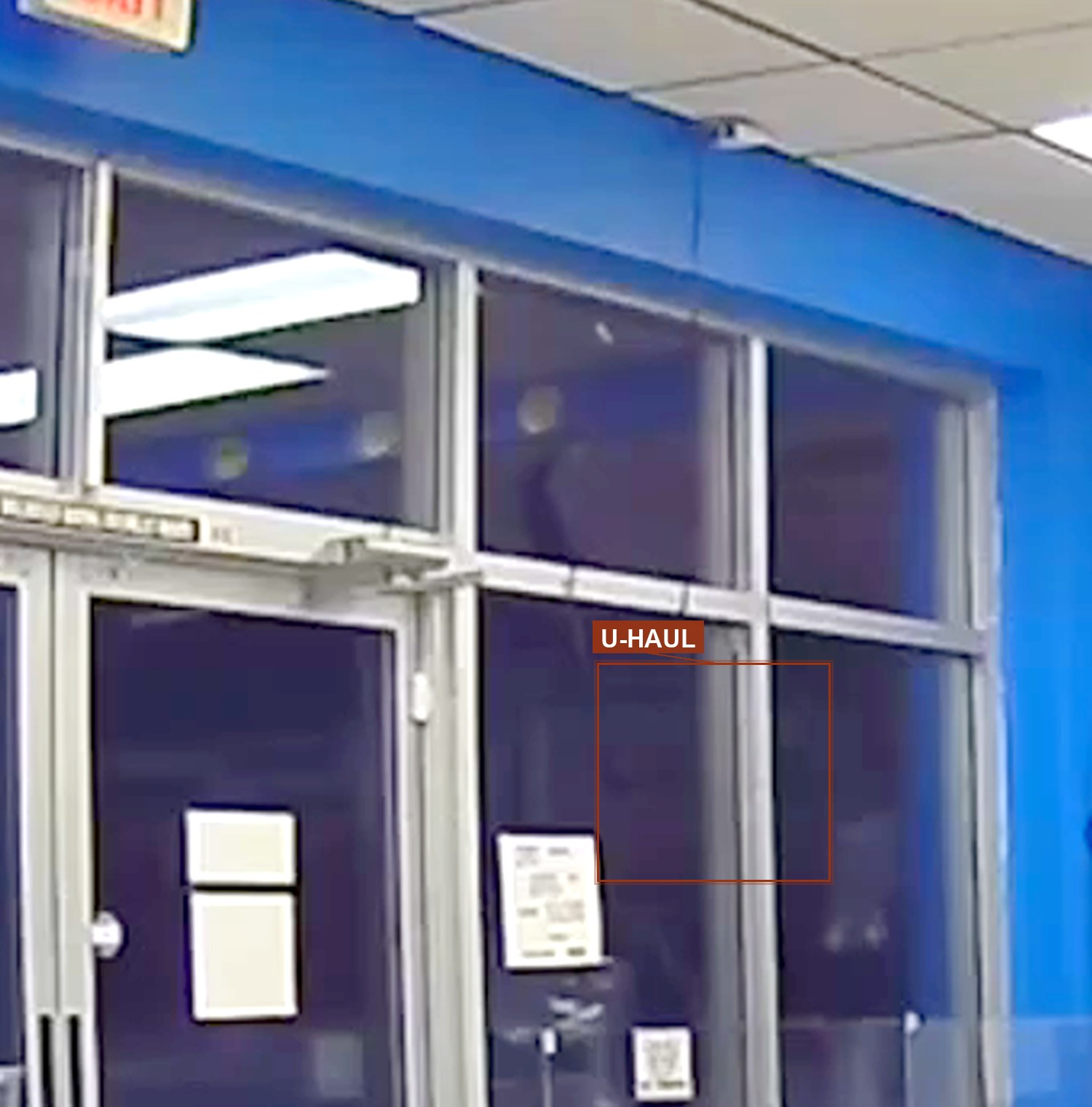
Keizer to Eugene is 65 miles, and the LEGO did not walk there. The Keizer store’s own security camera filmed a U-Haul parked outside the night of the takeover. That truck was rented that morning on the account of a man named Brandon Best, and the paperwork shows it drove 186 miles that night, a full round trip and then some.
The whole collection showed up at one store, all at once
The store the LEGO went to, in Eugene, lists everything it sells on a public website, and the website stamps the exact time each item is added. On a normal day it adds one or two used Star Wars sets. Then, five weeks after the takeover, on two mornings just before Christmas, it added 23 used Star Wars sets, and 13 of them were the exact sets from the family’s collection. There is no other two-day stretch like it in five years.
Used Star Wars sets added per day, at the Eugene store
Their own website’s clock, 2021 to 2026
A normal day is a set or two. The tall bar is the two mornings after the takeover. The dot marks how many of those were the family’s exact sets.
They were logged as if a stranger walked in and sold them
When a store buys used LEGO over the counter from a walk-in, it tags it “Trade.” A consignment is different: it is someone else’s property. But of those 23 sets, 18 were tagged “Trade,” as if the store had simply bought them from a stranger. That is the opposite of how the store normally does it. It is the same as peeling off the tag that said whose LEGO it was, only done in the computer instead of on the box.
The sets were taken apart before being sold
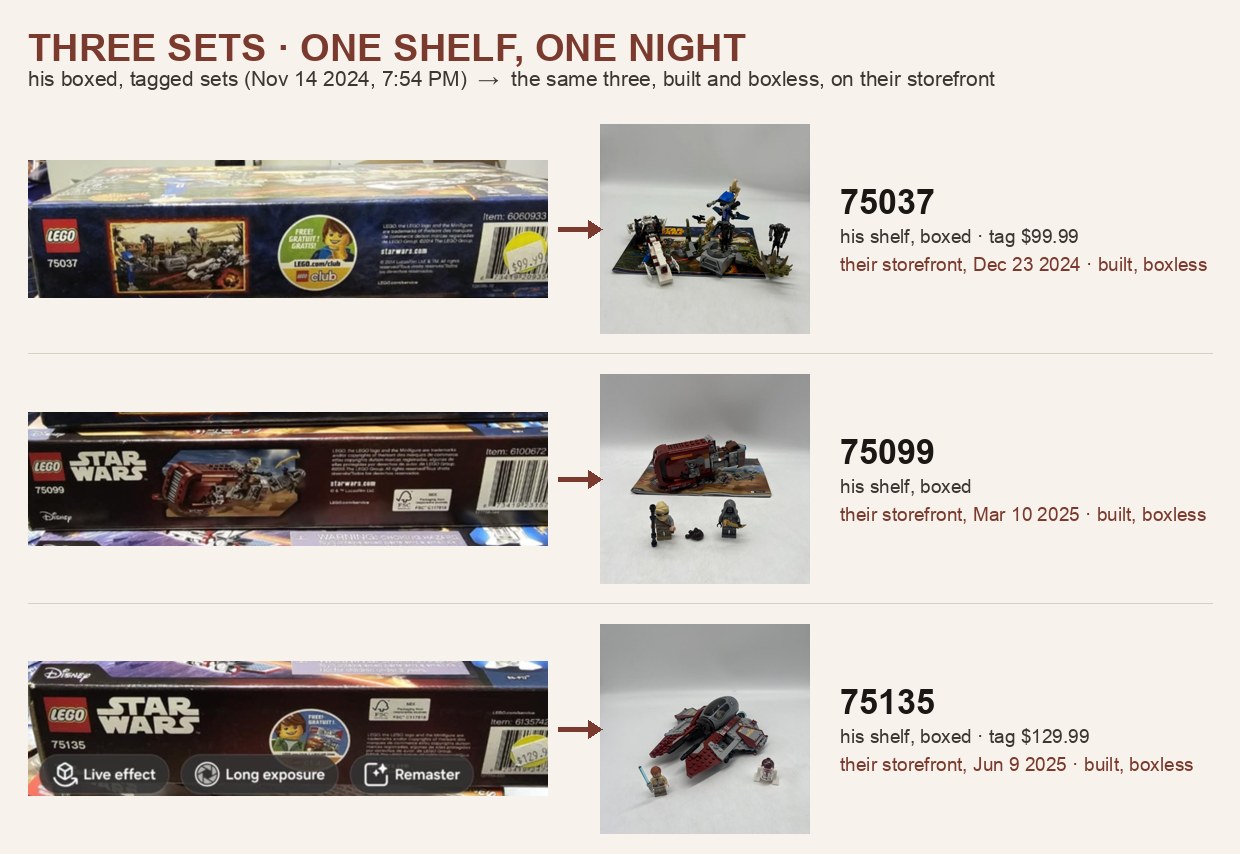
On the family’s shelf, the sets were boxed. At the Eugene store, the same sets are built and out of their boxes. Taking a boxed set apart to sell it used removes two things at once: the box, and the tag that said it belonged to the family. Even just the boxes that were thrown away were worth money, by the store’s own prices.
stripped sets →
This is only the packaging. It does not count the far bigger value of the sets that never came back at all.
The most valuable pieces simply vanished
The store keeps every sold item on its website, marked as sold. So if it had sold something, you would still see it. That is what makes the next part clear. The most valuable sets that were unsold when the store was taken, led by one called Cloud City worth as much as $10,000, never showed up on the store’s website at all. Not sold. Not listed. Just gone. About $18,000 of the family’s small LEGO figures went the same way. The ordinary, cheaper LEGO went out the front door, relabeled as trades. The expensive part disappeared from the record.
Who took it over
The people who ended up with the store were called “independent buyers” who supposedly had nothing to do with the takeover. They were not independent. One, Brandon Best, was the man BAM sent to count the store on the night it was taken, drove the truck, and set up the buying company the very next day. The other, Josh Johnson, was BAM’s own recruiter. And BAM’s own filing with the government lists Brandon Best as the owner of both stores at once, the one the LEGO was taken from and the one it was sold at.
The buyer said it himself, on a police camera
None of this is a guess. On a police body camera, Josh Johnson explained it in his own words. He said he was “hired by corporate, as I’m a corporate employee, to go to that location and recover it.” He said that when the family came in asking about their consignment, the company’s answer was “we don’t know about any consignment.” And he said what they did with the family’s LEGO: “we set aside all of his stuff in the back.” So the “independent buyer” is, in his own words, a company employee who took the family’s collection. The only part that was not true was “set aside.” The LEGO he said was put away was on sale at his own store within weeks.
A year later, the same thing
Then the record goes quiet for a year and starts again in the same place. After renting no truck for twelve months, Brandon Best rented another U-Haul in November 2025 and drove it to Keizer and back, twice. A customer at the counter filmed him and asked who he was; an employee said, “that’s the owner.” Twelve days later, the Eugene store held what it called, on its own Facebook page, “our biggest sale of the year”: a used-set sale, at the very store where the family’s collection had ended up.
What would prove the rest
The story of where the LEGO went is answered from the companies’ own papers. A few things are still held by the other side: the shipping records for where the most valuable pieces physically went, and a recording BAM made of that morning meeting and has never shown anyone. The case is not waiting on guesses. It is waiting on paper that already exists.
This is a plain-language retelling. Every number, every quote, and every source is in the full Keizer file. Nothing here is a finding of a court. The claims are part of a lawsuit BAM disputes, no court has ruled, and everyone is presumed innocent.
The BAM Map is independent reporting on matters of public concern. Nothing here is a finding of any person’s guilt; the criminal charges referenced are unadjudicated and every defendant is presumed innocent. Sources are linked so readers can check the record. · Home · Map · The law · Bodycam