Legally Mine’s answer to North Carolina’s bar, by a Utah lawyer, said “we assumed that such a practice was permitted”; the bar found probable cause against Ammon McNeff.
The file behind the May 2015 Letter of Caution, as the North Carolina State Bar produced it this month: nineteen documents. A lawyer complained for clients who run a veterinary clinic and had met Legally Mine at a seminar that carried continuing-education credit. The company’s answer, signed by a Utah lawyer, says every customer pays at least $100 a month for a plan with “access to our staff attorneys”; the committee wrote back that the company did not dispute the facts. The bar also printed McNeff’s résumé: from 2007 he booked the seminars.
PRIMARY SOURCENorth Carolina State Bar file 15AP0008, nineteen documents produced in October 2026 on a public records request: the complaint, the bar’s letters, Legally Mine’s response, the signed Letter of Caution and the investigator’s prints of a LinkedIn profile, a Better Business Bureau page, a Ripoff Report, the Utah registry and three pages of legallymineusa.com. The Utah State Bar’s directory, read October 20, 2026, and Utah’s registry record of the foundation, captured June 24, 2026.
CONFIRMEDThe signed Letter of Caution matches the Missouri exhibit copy line for line; Jarom L. Hillery and Jacob A. Stewart are Utah lawyers, admitted in 2012 and 2011; the foundation on McNeff’s profile is Utah entity 6705605-0142, formed August 3, 2007, registered agent Daniel McNeff.
AS STATEDLegally Mine’s account of its services, its 2015 website, and its claim to descend from “the same attorney who developed the field of asset protection.”
UNRESOLVEDWhether the clients got their money back. The complaint says they paid, the bar’s summary says no refund, the company did not dispute it, and the file records none.
The complaint
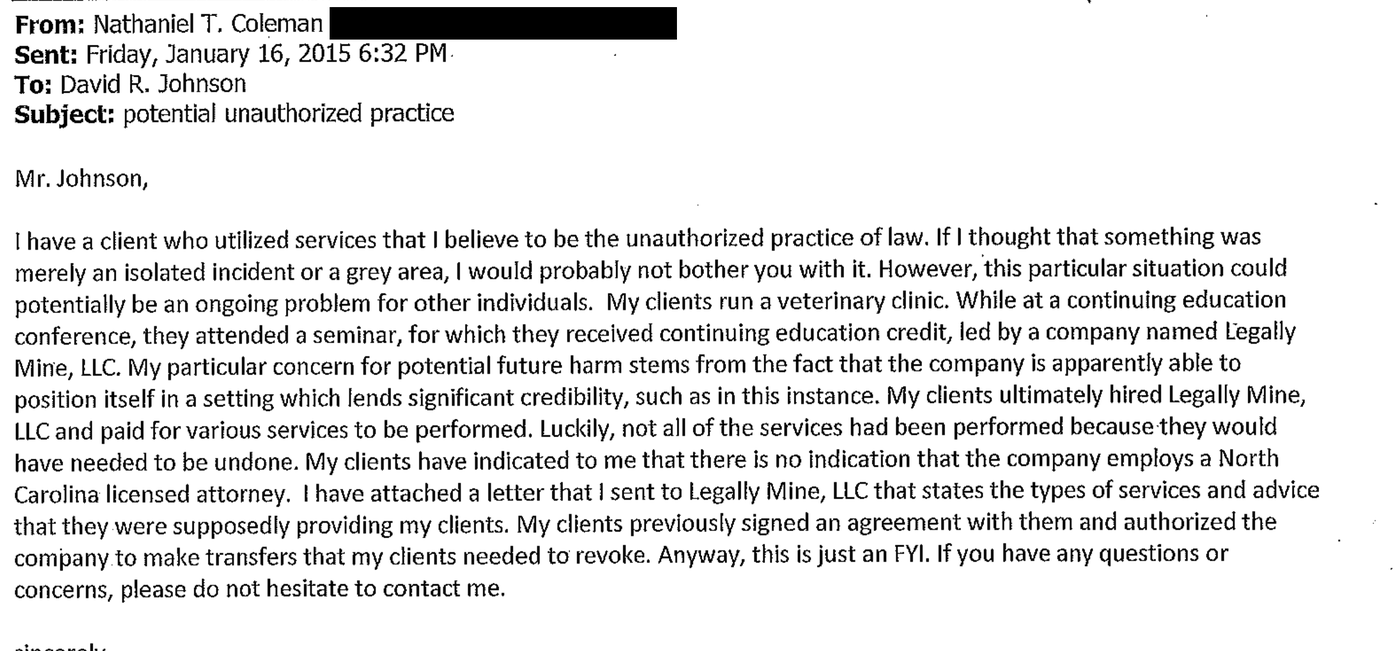
On January 16, 2015, Nathaniel Coleman, a lawyer in Burgaw, North Carolina, emailed the bar’s deputy counsel: “I have a client who utilized services that I believe to be the unauthorized practice of law.” His clients ran a veterinary clinic. “While at a continuing education conference, they attended a seminar, for which they received continuing education credit, led by a company named Legally Mine, LLC.” His worry was the setting: “the company is apparently able to position itself in a setting which lends significant credibility.” His clients had hired the company and paid. “Luckily, not all of the services had been performed because they would have needed to be undone.” They had “authorized the company to make transfers that my clients needed to revoke.” Three days earlier he had written to the company revoking its authority and demanding every dollar back.
The bar opened the file on February 5 and wrote to McNeff the same day, as president, with a Letter of Notice that put the complaint in the words the Letter of Caution would later repeat, and a warning: “authorized practice files are considered public and, upon request, individuals are allowed to review the files.”
The answer
The response is dated February 24, 2015, three pages on Legally Mine letterhead, signed not by McNeff but by Jarom L. Hillery, “Senior VP of Legal Team.” Hillery is a lawyer: Utah State Bar No. 14204, admitted October 16, 2012, active today. The “In-House Counsel/Entity Specialist” on the profile page the bar printed, Jacob Stewart, is another, admitted in 2011. Both had signed the company’s court papers against an anonymous complainant the year before, and the company refiled that suit on April 13, 2015, two days before the committee met. The “staff attorneys” of the answer were Utah lawyers.
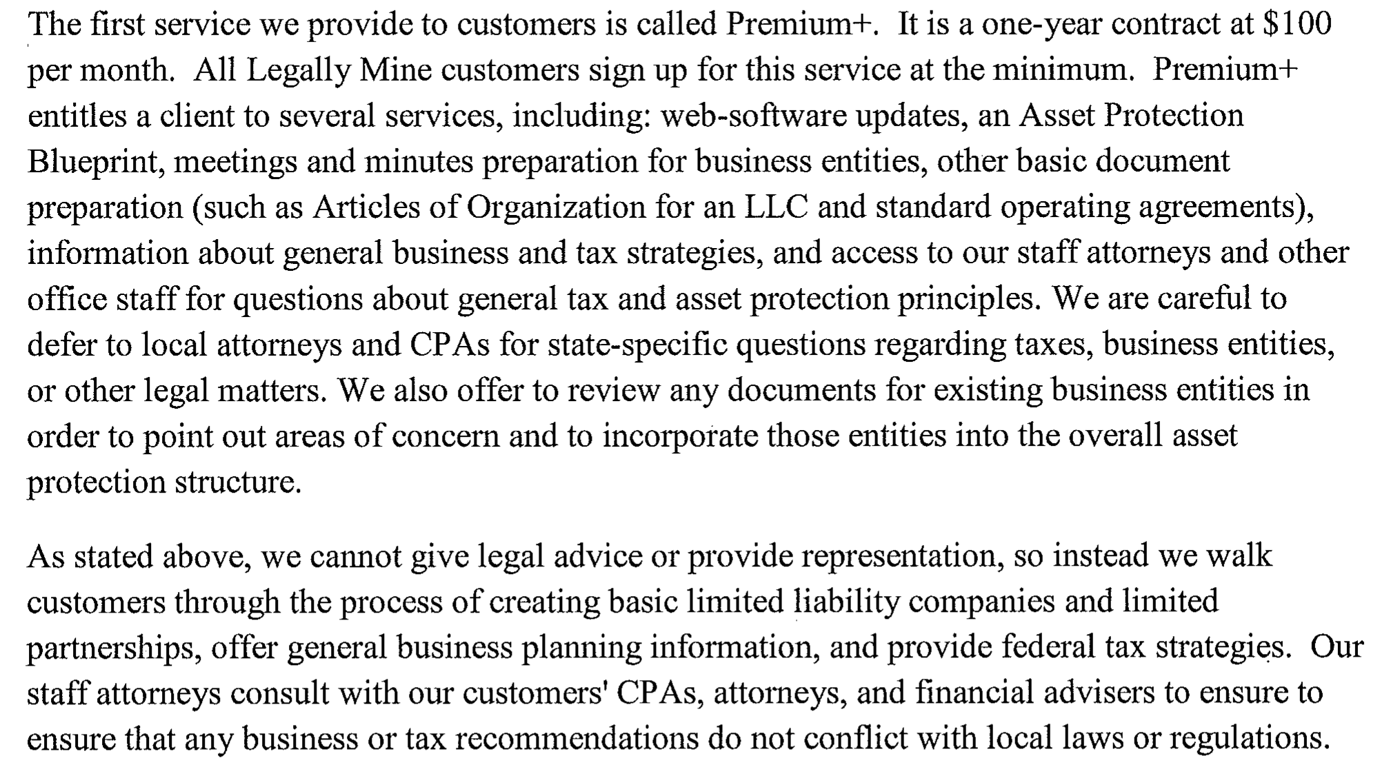
The answer’s first move is the disclaimer: “Legally Mine does not hold itself out as a law firm,” and “We train our event staff, including event speakers, to be clear on the fact that Legally Mine is not a law firm.” Then the product. “The first service we provide to customers is called Premium+. It is a one-year contract at $100 per month. All Legally Mine customers sign up for this service at the minimum.” The $1,200 buys an “Asset Protection Blueprint,” entity paperwork, “and access to our staff attorneys and other office staff for questions about general tax and asset protection principles.” The company cannot give legal advice, it says, “so instead we walk customers through the process of creating basic limited liability companies and limited partnerships,” and “Our staff attorneys consult with our customers’ CPAs, attorneys, and financial advisers to ensure to ensure that any business or tax recommendations do not conflict with local laws or regulations.”
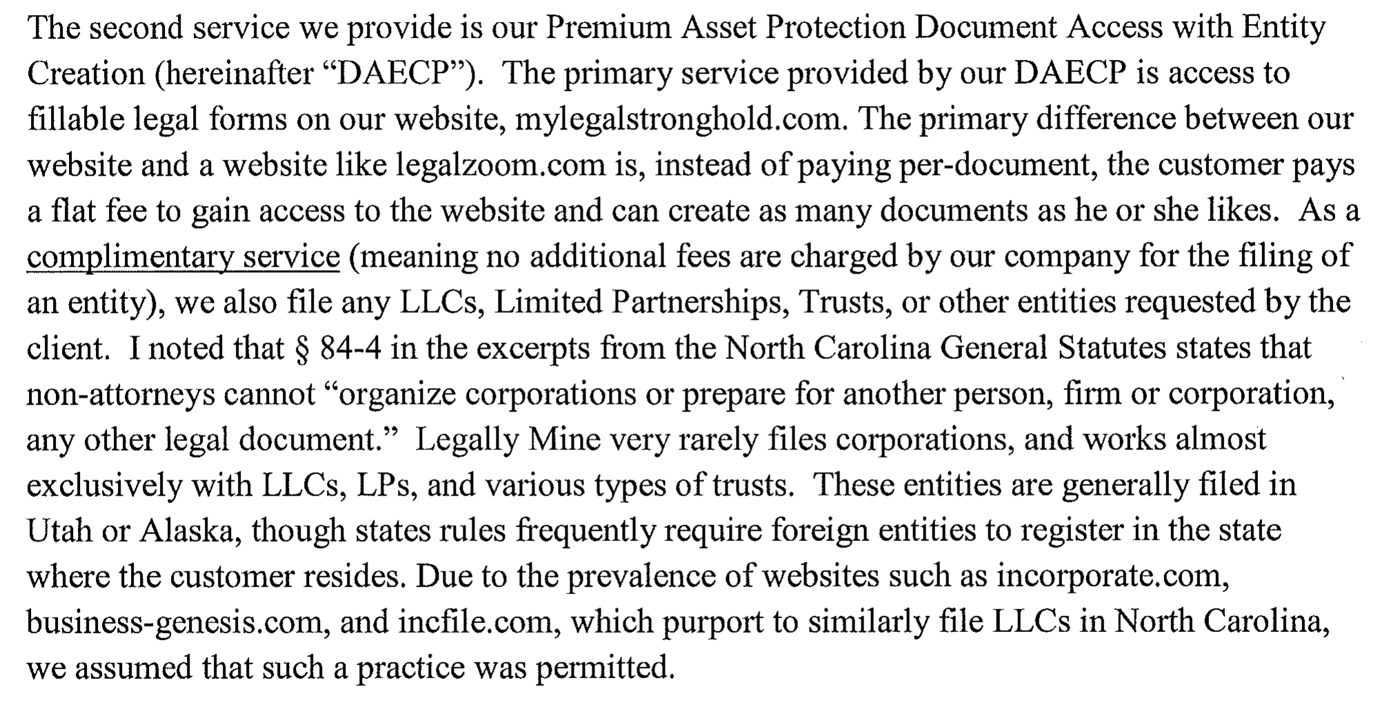
The second service is a website of fillable forms, mylegalstronghold.com, for a flat fee, and “As a complimentary service” the company files “any LLCs, Limited Partnerships, Trusts, or other entities requested by the client.” Where: “These entities are generally filed in Utah or Alaska, though states rules frequently require foreign entities to register in the state where the customer resides.” Why it thought North Carolina allowed it: “Due to the prevalence of websites such as incorporate.com, business-genesis.com, and incfile.com, which purport to similarly file LLCs in North Carolina, we assumed that such a practice was permitted.” Of the statutes the bar had enclosed: “I did not see anything in the rules you sent to us which would indicate that these services are inappropriate or otherwise conflict with North Carolina law.”
The company’s defense and the committee’s finding are the same three pages, read twice.
The finding
The committee met on April 15, 2015, in Raleigh. The Letter of Caution of May 1 begins where the answer left off: “In response to the Committee’s inquiry, you do not dispute the factual allegations in the complaint, but rather attempt to explain the nature of your services, claiming that they do not constitute the practice of law in North Carolina.” It quotes the walk-through sentence and the staff-attorneys sentence back, states the rule, “A business may not offer legal services or the services of a lawyer to its customers even if those services are provided by a licensed North Carolina attorney,” and answers: “Many of the services you describe your company providing unquestionably constitute the practice of law in North Carolina,” and, given the staff attorneys, “it is abundantly clear to the Committee that you are offering legal services and the services of attorneys to North Carolina residents.” Probable cause; the letter as the remedy; proceedings held in reserve. The bar sent the complainant a copy the same day.

Five years later Ohio’s bar warned the company it might be practicing law without a license. By its own later stipulation, it “made no significant changes to their business practices until they engaged Ohio counsel” in December 2021, and in 2025 Ohio’s Supreme Court enjoined Legally Mine and Daniel McNeff and imposed a civil penalty (October 3). North Carolina’s file is the first of the three, and the only one addressed to the son.
The résumé and the registry
Among the bar’s February 4 prints is McNeff’s LinkedIn profile. “President, Legally Mine, LLC,” since July 2010, after a year and a half as its customer service director, “Supervisor over booking and planning events for the company.” Before that, from August 2007 to January 2009, “Executive Director” of the “National Foundation for Asset Protection,” where he “Contacted professional business, medical, and dental associations and book seminars” and “Conducted sales during and post events.”
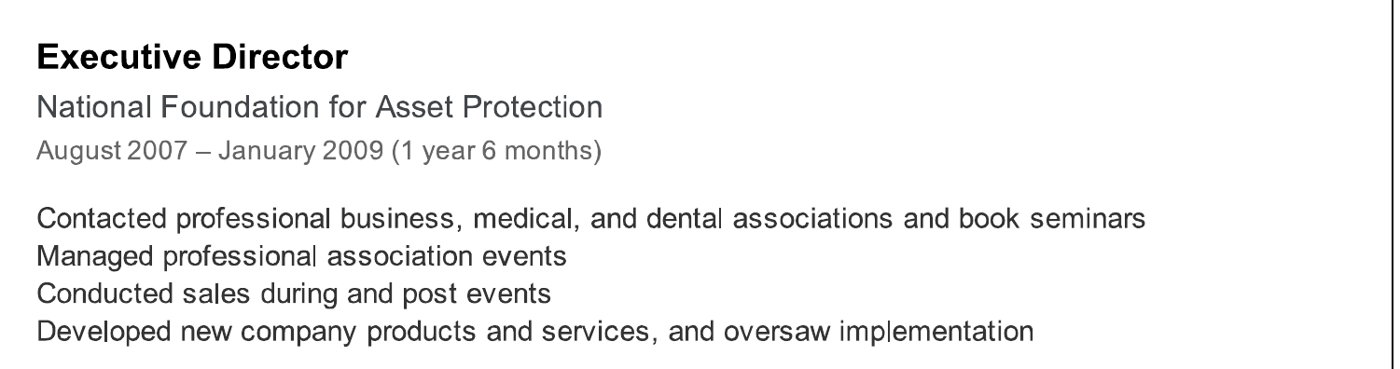
“Executive Director” was a sales title. The next line of the résumé, for 2009, makes him “Supervisor over all associate executive directors”; the foundation’s executive director, by his own account, called the associations, booked the seminars and “Conducted sales during and post events.”
The president’s job, as he described it in 2015, was the same trade at scale: “Hiring and Firing employees,” “Manage event and seminar coordination including logistics and travel arrangements,” “Create and develop marketing pieces and product materials,” “Oversee production of marketing and media.” Nothing on the profile is legal training; its first sales job, in 2006, was following up leads in American Fork for “real estate coaching services.” The lawyers who answered the bar worked for him.
Utah’s registry has that foundation: National Foundation for Asset Protection, Inc., entity 6705605-0142, a business corporation formed August 3, 2007, registered agent Daniel McNeff, now administratively dissolved. The son’s job there begins the month it was formed and ends in January 2009, the month Legally Mine, LLC was registered (January 5, 2009, on the registry page the bar printed, which lists Asset Protection Leader LLC among its former names) and the month his résumé moves to it. On the résumé the work is the same; the employer’s name is not. The Better Business Bureau’s page in the same file gives the company two dates, “Business started: 01/05/2009” and “Business incorporated: 07/01/2010,” the month the résumé makes him president; whether the July date is the change of name from Asset Protection Leader, the registry page in the file does not say.
The name itself is the Mitton name: Legally Mine’s own history traces the business to Jay Mitton, the self-styled “father of asset protection,” and the Florida Supreme Court in 2001 enjoined Mitton, his firm and a “National Foundation for Asset Protection & Estate Preservation” from practicing law in that state. Whether the Utah corporation of 2007 is that foundation or a namesake, no registry record in this file says.
The rest of the file
The Better Business Bureau’s page, printed the same day: not accredited, “41 complaints closed with BBB in last 3 years,” sixteen of them in the last twelve months, 33 of the 41 filed as “Problems with Product/Service,” three of them “not resolved.”
The same page in October 2026 shows twenty complaints in three years under an A+ rating. A Ripoff Report filed on January 2, 2014, under the company’s name and McNeff’s, by a doctor in Charlotte: “I was promised a 100% money back guarantee and I have a contract to prove it.” The report’s title names the company, McNeff and a Scott Anderson, and its tags end “bogus charging order.” The registry page the bar printed lists the company’s registered agent as Trunkar Management, LLC; the Scott A. Anderson who holds every officer seat of Trunkar Management, and whose notary commission lists his employer as Legally Mine, is the notary on the McNeff family’s 2021 deeds (June 26). Whether the report’s Scott Anderson is the same man, the file does not say. Two North Carolina customers, both about the money, in one file.
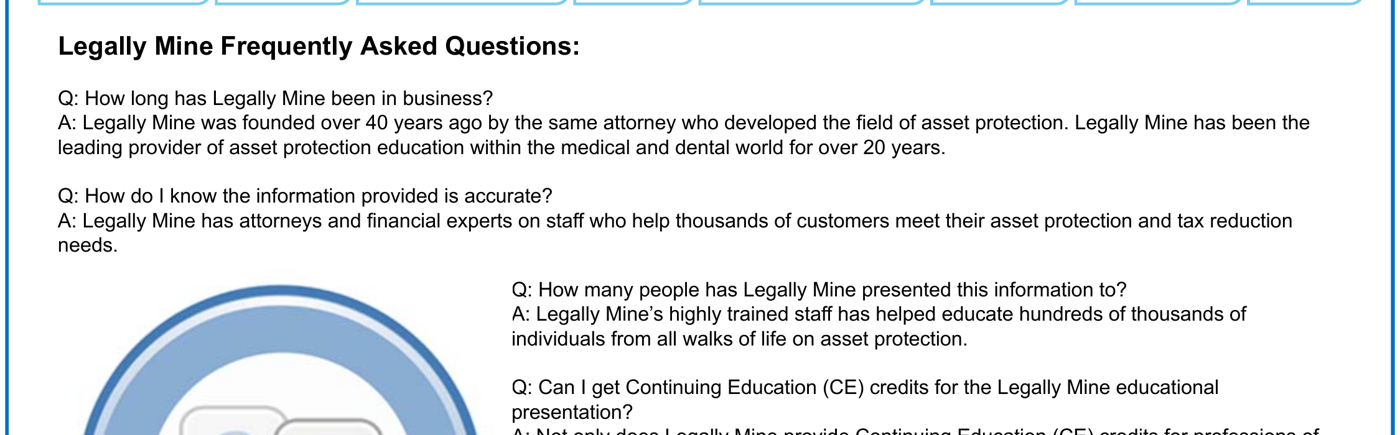
And the company’s own website, printed March 24, 2015, three weeks before the committee met. Its FAQ: “Legally Mine was founded over 40 years ago by the same attorney who developed the field of asset protection.” “Legally Mine has attorneys and financial experts on staff.” The company “is invited to present at over 250 events across the US per year.” And, on the page titled “What Attorneys won’t tell you,” the funnel in the company’s own words: “we do continuing education classes for medical, dental, optometric, legal, and other business associations.” The registry page in the same file dates the company to 2009.
The product, on the page the bar printed: “true asset protection will normally involve use of entities in multiple states and also require specialized language in those entities that will move assets out of the jurisdiction of the courts.” And the funnel again, in the FAQ: “Not only does Legally Mine provide Continuing Education (CE) credits for professions of all types, they even educate and qualify for Continuing Legal Education (CLE) credits for attorneys.”
The file, in order
The fair reading, and its limit. A letter of caution is a committee’s belief after an inquiry, not a court’s finding, and it carried no penalty. The response is Hillery’s letter, not McNeff’s, though it went out on the company’s letterhead and the committee treated it as his. The complaint says the clients got some services, and the bar’s “no beneficial assistance” is its summary of a complaint the company chose not to dispute. Filing a customer’s Utah or Alaska entity may be lawful where the customer lives; the committee said North Carolina was not such a place. The company has said since 2015 that it is not a law firm; its terms of service that year said “No attorney-client relationship or privilege is created with Legally Mine,” and its website today says “Customers of Legally Mine have no attorney-client privilege with representatives of Legally Mine.” What the reading cannot cover is the committee’s point: a company that sells residents of a state where it holds no license a monthly plan with “access to our staff attorneys” is offering the services of lawyers, licensed or not. The president it told so in 2015 runs BAM today.
Sources. North Carolina State Bar, Authorized Practice Committee, file 15AP0008, produced October 2026 on a public records request: the bar’s letters, the complaint and Legally Mine’s response, thirteen pages, with the complainant’s email address, telephone and fax numbers blacked out; the investigator’s prints of February 4 and March 24, 2015, quoted above (the complainant’s January 13 letter, which names his clients, and the certified-mail receipts are held and not served). The Letter of Caution as filed in Missouri: the October 13 update. Utah State Bar, licensee directory, read October 20, 2026: Hillery, Jarom L, No. 14204, admitted October 16, 2012; Stewart, Jacob A, No. 13871, admitted October 31, 2011. Utah Division of Corporations: National Foundation for Asset Protection, Inc., 6705605-0142, record captured June 24, 2026; Legally Mine, LLC, 7228976-0160, as printed by the bar on February 4, 2015. The North Carolina State Bar’s page on the unauthorized practice of law; N.C. Gen. Stat. §§ 84-2.1, 84-4, 84-5 and 84-37. The Florida Bar v. Mitton & Burningham, P.C., No. SC00-2171 (Fla. Nov. 1, 2001). Legally Mine’s website, legallymine.com, read October 20, 2026. Earlier: Ohio’s warning and injunction, the six states, Legally Mine v. John Doe, the Better Business Bureau page, the family, the deeds and their notary. The right of reply is open to everyone named here.