Three weeks after the Salem franchisees sued BAM, Ammon McNeff certified under penalty of law that its disclosure document, which disclosed no pending lawsuit, had no material omissions.
The court dates the suit March 27, 2026, and the federal rule asks a franchisor for exactly that date: “the initial filing date.” BAM’s amendment of September 9, the document that finally disclosed it, says April 16: the one date that puts the suit after BAM’s April 8 disclosure document and one day before McNeff certified that document complete. An earlier update repeated BAM’s date; it is corrected today.
PRIMARY SOURCEThe court’s index for BAMF Salem 1, LLC v. BAM Franchising, Inc., No. 260200029, read June 20 and October 20, with the complaint, the Acceptance of Service and BAM’s verified motion; the plaintiffs’ redline of August 14; BAM’s April 8 disclosure document and its September amendment, Item 3; the application certified at Provo on April 17; Minnesota’s order of July 1.
CONTRADICTEDThe amendment’s “On April 16, 2026, BAMF Salem 1, LLC, Chrystal Law, and Benjamin Gorman, former franchisees, filed a civil action against the Franchisor,” by the court’s filing date and by the plaintiffs’ own exhibit on the docket.
CONFIRMEDThe amended complaint’s arithmetic: the April 8 document issued “twelve days after Plaintiffs filed their executed Complaint in this action (March 27, 2026).” The same Item 3 had omitted the Cooper fraud action from the 2024 and 2025 editions (the disclosure).
CONFIRMEDApril 16 is no date in the court’s file. Nothing was filed that day; BAM’s own lawyer accepted service on April 21, “effective on the date of the acceptance,” and the acceptance was filed April 28.
INFERENCEThe September mediation did not end the case. On October 20 the plaintiffs added a second lawyer, BAM’s May motion still has no ruling, and the docket records no settlement, dismissal or order.
Three dates
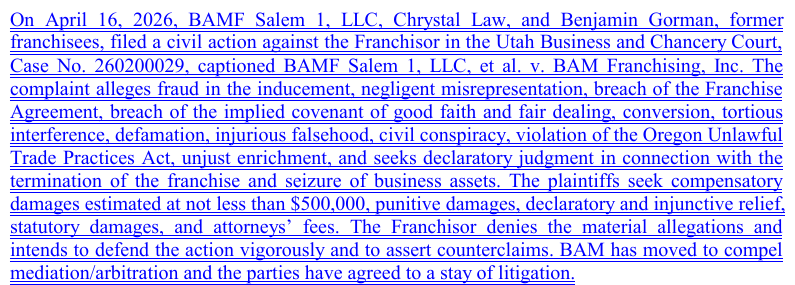
BAM’s amendment of September 9 added two paragraphs to Item 3, the litigation item. The Salem paragraph opens with a date.
“On April 16, 2026, BAMF Salem 1, LLC, Chrystal Law, and Benjamin Gorman, former franchisees, filed a civil action against the Franchisor in the Utah Business and Chancery Court, Case No. 260200029, captioned BAMF Salem 1, LLC, et al. v. BAM Franchising, Inc.”
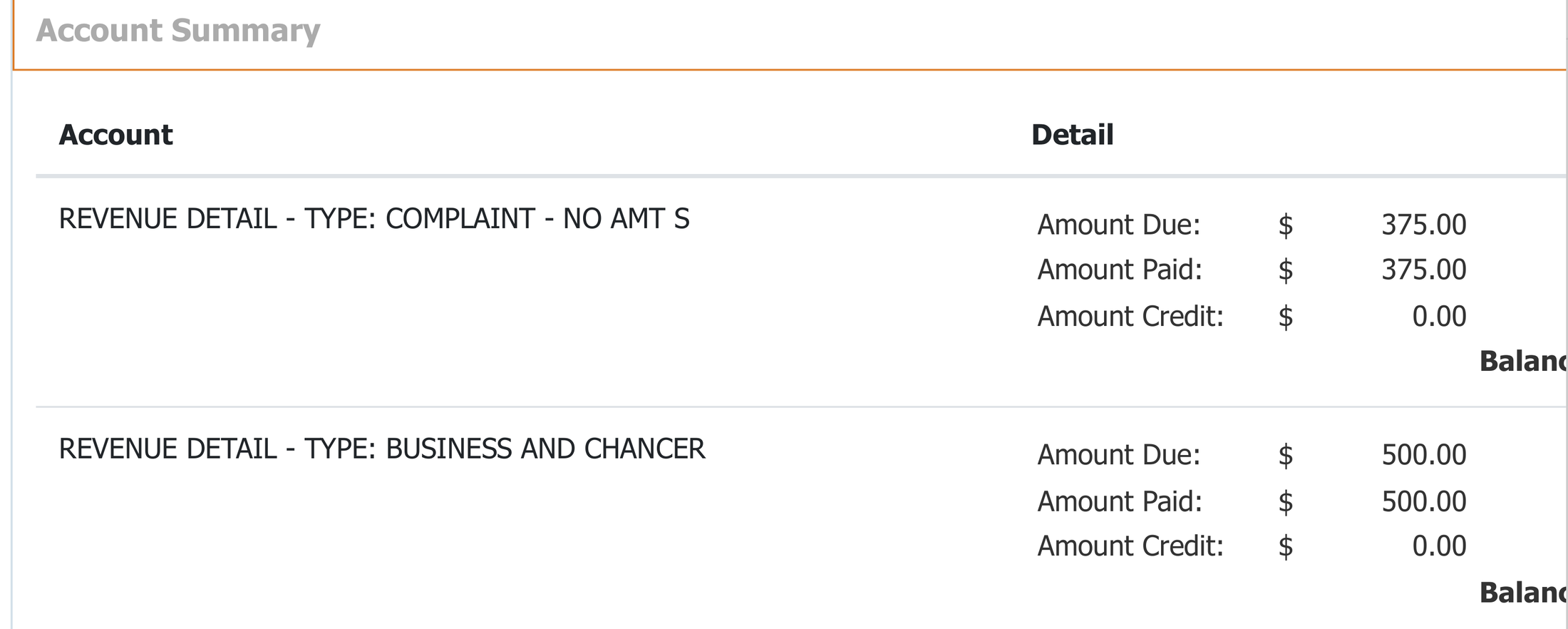
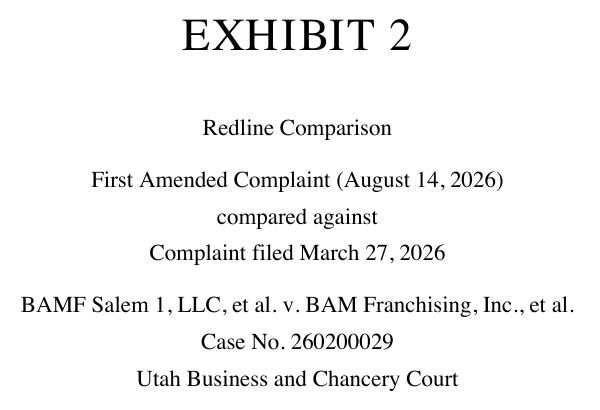
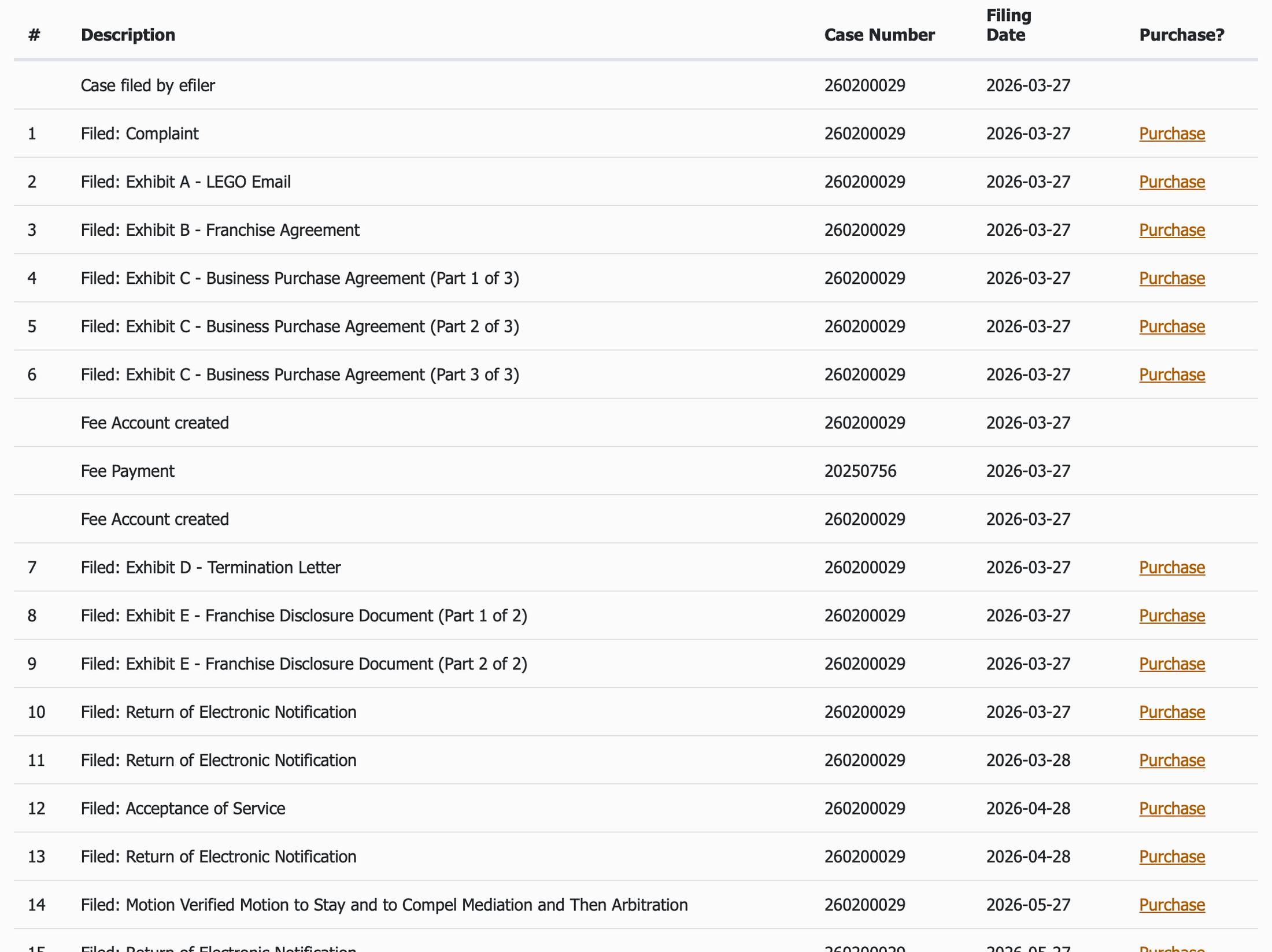
The court’s index gives the case one filing date, March 27, 2026, on the complaint and each of its eight exhibits. The plaintiffs’ own exhibit on the docket is a redline “compared against Complaint filed March 27, 2026.” The court’s fee ledger shows the $375 complaint fee paid.
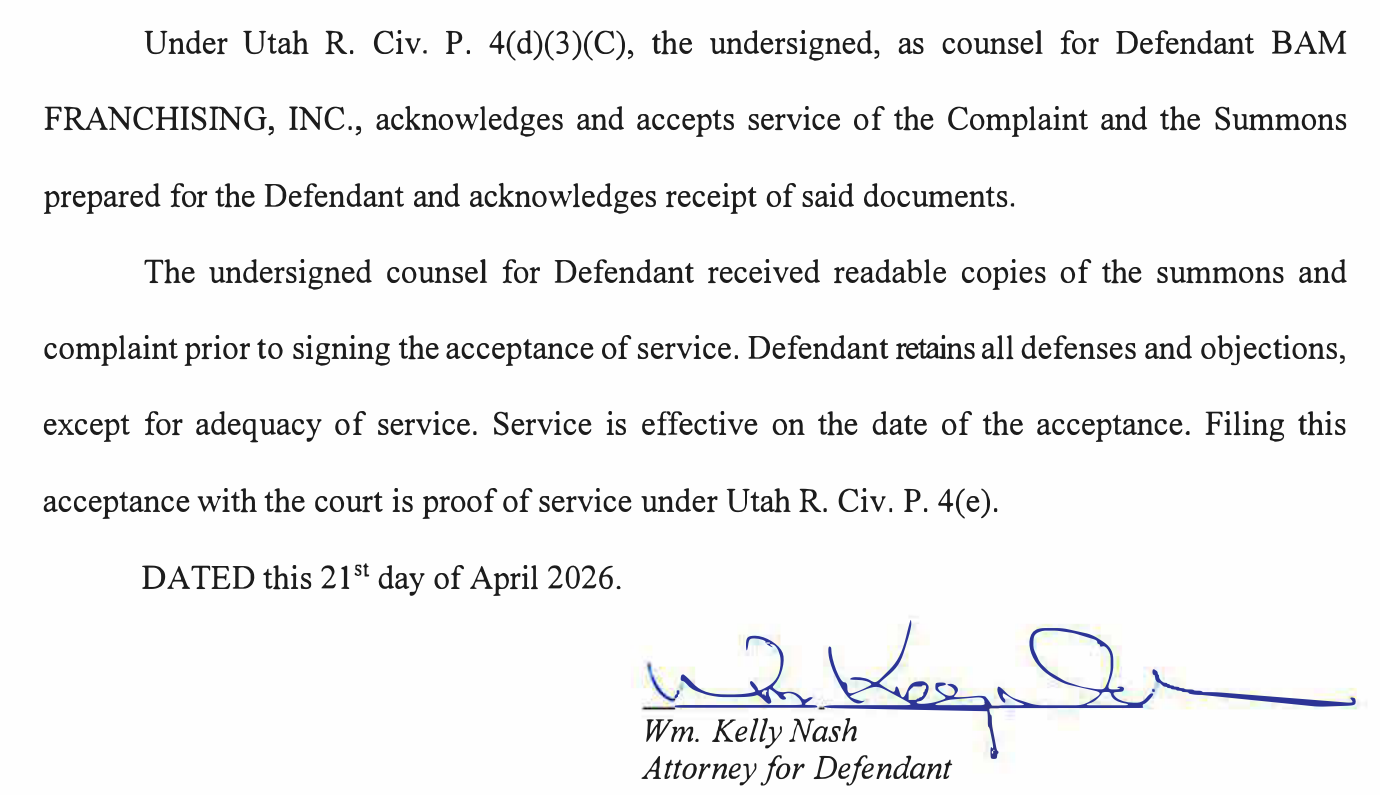
Nor is April 16 the day BAM was served. The twelfth entry on the docket is an Acceptance of Service signed by BAM’s own lawyer, Wm. Kelly Nash of Dentons, “DATED this 21st day of April 2026” and filed April 28: counsel “received readable copies of the summons and complaint prior to signing the acceptance of service,” and “Service is effective on the date of the acceptance.” Nothing in the court’s file is dated April 16.
If it is the day the complaint reached BAM’s lawyers, the amendment is BAM’s own statement that it knew of the suit the day before its president certified. If it is a slip, the slip moved the suit past April 8.
The federal rule the document is written to asks for one date for each action it lists: “the initial filing date.” The court’s record of that date is March 27. Service is not the question Item 3 asks, and April 16 is not the service date either.
What the court’s date changes
Under BAM’s date, its disclosure document went out on April 8 with nothing to disclose, because nothing had been filed. Under the court’s date, it went out twelve days after BAM’s former franchisees had sued it for fraud in the inducement, with Item 3 reading as it had for years.

On April 17, Ammon McNeff signed BAM’s Minnesota renewal at Provo: “I certify under penalty of law that I have read and know the contents of this application, including the Franchise Disclosure Document with an issuance date of April 8, 2026, attached as an exhibit, and that all material facts stated in all those documents are accurate and those documents do not contain any material omissions.” On BAM’s date the suit was one day old when he signed. On the court’s, three weeks.
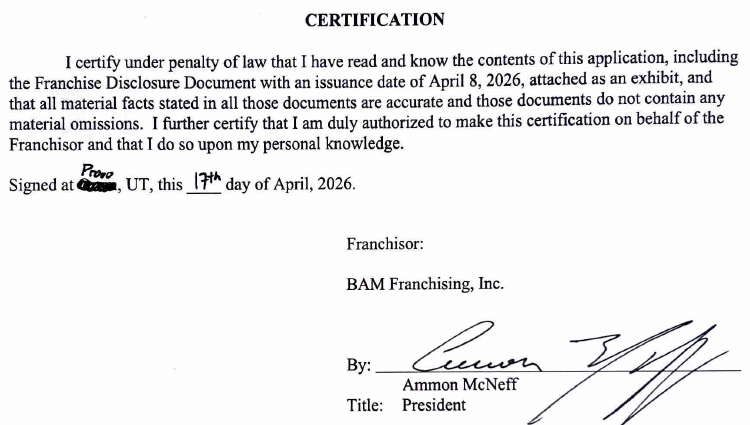
Minnesota’s rule is printed on its July 1 order: “Any franchise registration must be amended within 30 days after the occurrence of any ‘material change.’” Thirty days from the court’s date is April 26; from BAM’s own date, May 16; from the acceptance of service, May 21. The amendment that disclosed the suit was certified on September 9, day 166, and it is the document that moves the suit to April 16. On May 27, McNeff had verified BAM’s own motion in the Salem case as “true and accurate to the best of my knowledge and belief”; the amendment that told Minnesota the case existed came 105 days after that signature.
Of all the dates BAM could have written, April 16 is the one that leaves its April 8 document complete at issuance and puts the certification a single day after the suit.
It joins two other defects in BAM’s certified disclosure filings on the public record. Minnesota’s examiner caught one in September: a certification page whose issuance date did not match the document’s cover. The other is older and wider: the same Item 3 omitted the Cooper fraud action, filed in February 2024 and pending at both issuances, from the 2024 and 2025 editions (the disclosure). This is the third, in the paragraph that exists to disclose the suit.
The same amendment set BAM’s own standard. It certified that BAM “believes” its case against Reckless Ben “and the facts surrounding it is information that is material to the decision to enter into a Bricks and Minifigs franchise agreement.” Sixteen days later, BAM sued ten Does in the federal court where its Reckless Ben case now sits, over the publication of its internal records. By its own standard that suit is material, and Minnesota’s thirty days end October 25.
The year, by the court’s clock
Stayed by agreement
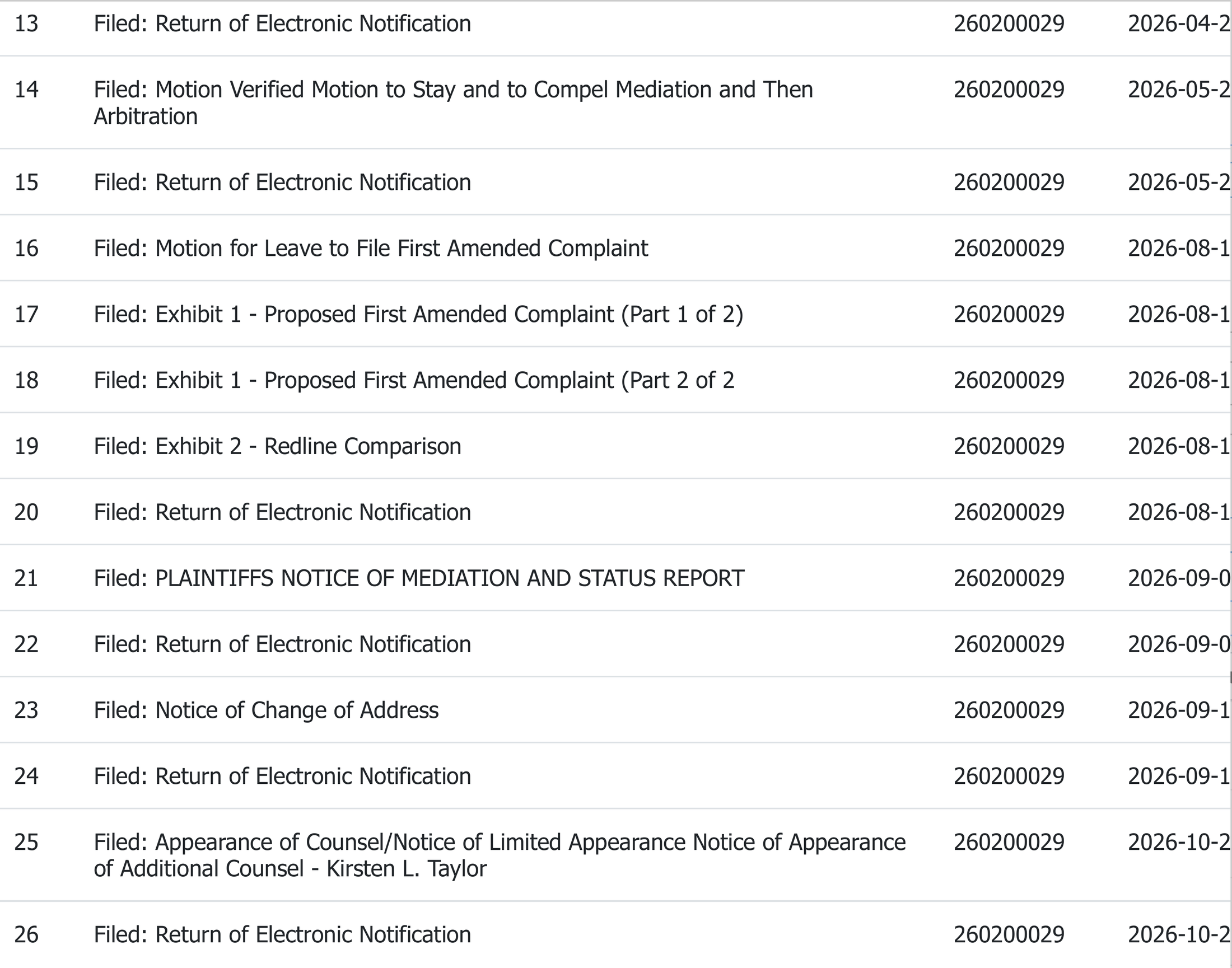
The Salem paragraph ends: “BAM has moved to compel mediation/arbitration and the parties have agreed to a stay of litigation.” The docket matches it. BAM’s May 27 motion to compel arbitration has no ruling. The franchisees’ August 14 motion to amend, which would add both McNeffs by name, has no ruling. Between them sits the plaintiffs’ September notice of mediation.
The only court in which BAM’s conduct at Salem is pleaded against it has not reached a contested question in nearly seven months, and if mediation ends the case, the public record of BAM’s conduct at Salem will be little more than the complaint and its exhibits, BAM’s verified motion, the proposed amended complaint and a status report.
On October 20, the day of the print, the plaintiffs added a lawyer. Kirsten L. Taylor of SpencerWillson, admitted to the Utah bar on October 13, entered her appearance “as additional counsel of record for Plaintiffs,” with Sarah Spencer remaining; the notice went to two Dentons lawyers for BAM, Phillip C. Kuck and Wm. Kelly Nash. Whether the mediation noticed in September has been held, the docket does not say. It records no settlement, no dismissal and no order, and a case that had ended at mediation would not be adding counsel the month after. On the docket the case is stayed, not settled.
| No. | Entry | Filed |
|---|---|---|
| 1 | Complaint | 2026-03-27 |
| 2 | Exhibit A, LEGO email | 2026-03-27 |
| 3 | Exhibit B, franchise agreement | 2026-03-27 |
| 4 | Exhibit C, business purchase agreement (part 1 of 3) | 2026-03-27 |
| 5 | Exhibit C (part 2 of 3) | 2026-03-27 |
| 6 | Exhibit C (part 3 of 3) | 2026-03-27 |
| 7 | Exhibit D, termination letter | 2026-03-27 |
| 8 | Exhibit E, franchise disclosure document (part 1 of 2) | 2026-03-27 |
| 9 | Exhibit E (part 2 of 2) | 2026-03-27 |
| 10 | Return of electronic notification | 2026-03-27 |
| 11 | Return of electronic notification | 2026-03-28 |
| 12 | Acceptance of service | 2026-04-28 |
| 13 | Return of electronic notification | 2026-04-28 |
| 14 | Verified motion to stay and to compel mediation and then arbitration (BAM) | 2026-05-27 |
| 15 | Return of electronic notification | 2026-05-27 |
| 16 | Motion for leave to file first amended complaint | 2026-08-14 * |
| 17 | Exhibit 1, proposed first amended complaint (part 1 of 2) | 2026-08-14 * |
| 18 | Exhibit 1 (part 2 of 2) | 2026-08-14 * |
| 19 | Exhibit 2, redline comparison | 2026-08-14 * |
| 20 | Return of electronic notification | 2026-08-14 * |
| 21 | Plaintiffs’ notice of mediation and status report | 2026-09-0_ |
| 22 | Return of electronic notification | 2026-09-0_ |
| 23 | Notice of change of address | 2026-09-1_ |
| 24 | Return of electronic notification | 2026-09-1_ |
| 25 | Notice of appearance of additional counsel, Kirsten L. Taylor (plaintiffs) | 2026-10-20 |
| 26 | Return of electronic notification | 2026-10-20 |
The docket, rows 1 to 26, from the court’s index as read June 20 and October 20, 2026. No order appears on either motion. The October print clips the last digit of the day at the page edge (shown as _); the rows marked * carry the date the motion and its exhibits themselves bear, August 14; rows 25 and 26 are the notice of appearance dated and served October 20.
The correction
The September 25 update repeated BAM’s date and said the suit was filed the day before McNeff certified. It now says March 27, with a dated correction at its foot. Its point stands harder: the certification came three weeks after the suit, and the April 8 document itself came after the filing.
The fair reading, and its limit. April 16 may be the day the complaint reached BAM’s lawyers. Formal service came April 21, four days after the certification. Under the federal rule a new suit may wait for the quarterly revision, due “within a reasonable time after the close of each quarter,” and a franchisor may read the duty as running from knowledge rather than filing; on that reading the April 8 document went out before BAM knew. The twenty days may be a slip in a paragraph drafted months later. BAM denies the suit’s allegations, and whether the Does suit is a material change is Minnesota’s call. What the reading cannot cover is the date itself: the rule asks for the initial filing date, and the court’s is March 27. Nor April 17: on BAM’s own date it had known of the suit for a day when its president certified, under penalty of law, that the document left nothing material out, and the amendment that said otherwise took until September. Nothing here is a finding of law.
Sources. Utah State Courts, XChange case history for No. 260200029, read June 20 and October 20, 2026. BAMF Salem 1, LLC v. BAM Franchising, Inc., Exhibit 2 to the plaintiffs’ motion for leave to amend, filed August 14, 2026 (the redline), and the proposed amended complaint, paragraph 113. The Acceptance of Service, signed April 21, 2026 and filed April 28 (docket entry 12). BAM’s Verified Motion to Stay and to Compel Mediation and Then Arbitration, May 27, 2026 (docket entry 14). Notice of Appearance of Additional Counsel, October 20, 2026 (docket entry 25). Utah State Bar, licensee directory, read October 20, 2026: Taylor, Kirsten L, No. 21031, admitted October 13, 2026. Minnesota Department of Commerce, franchise file 9006: the marked amendment, submission 37254-202609-02, Item 3; the renewal application certified April 17, 2026 (copy); the order of July 1, 2026 (copy); the deficiency notice of September 18; Minn. Stat. § 80C.07 and Minn. R. 2860.2400. Federal Trade Commission, Franchise Rule, 16 C.F.R. § 436.5(c), Item 3, and § 436.7, as of October 19, 2026. BAM Franchising, Inc., Franchise Disclosure Document issued April 8, 2026, Item 3, as filed in Minnesota and Wisconsin. BAM Franchising, Inc. v. Does 1-10, No. 2:26-cv-00895 (D. Utah), complaint of September 25, 2026 (reported September 26). Earlier: the September 25 update on the amendment, the amendment, the disclosure, Item 3. The right of reply is open to everyone named here.