The deed signed twice: mis-recorded, then quietly re-recorded
CONFIRMED (county recorder)
The most ordinary-looking page in this whole record is a quitclaim deed. Read closely, it is also one of the most telling. On January 12, 2021, as Daniel McNeff’s divorce was being finalized and his own sons were ten days from suing him in federal court, four of the family’s asset-protection shells deeded four houses into the name of his wife, Evelyn, in four consecutive recorder entries. Every one of the four was defective on its face: notarized by the family’s own in-house notary in a way that, under Utah law (Utah Code § 57-3-101), made the instrument ineligible to record at all. Seven months later, after the sons’ lawsuit had been filed and dismissed, the same four deeds were quietly re-executed and re-recorded, this time cured. The before-and-after is below, all four pairs, side by side. The proof here is visual, so read the deeds.
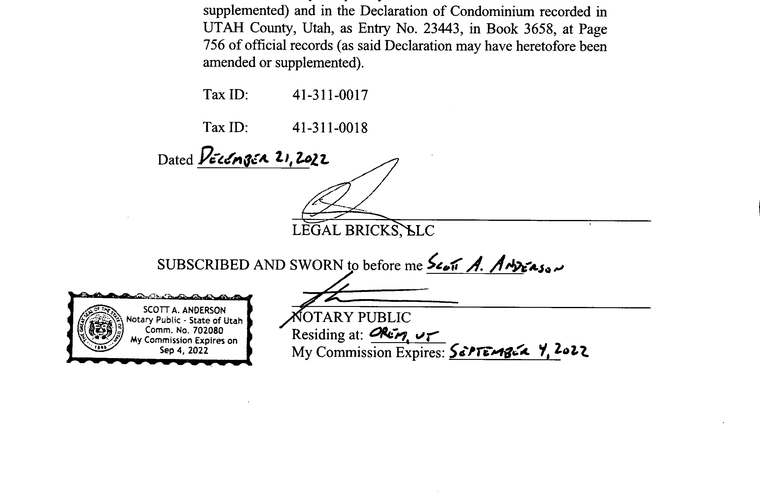
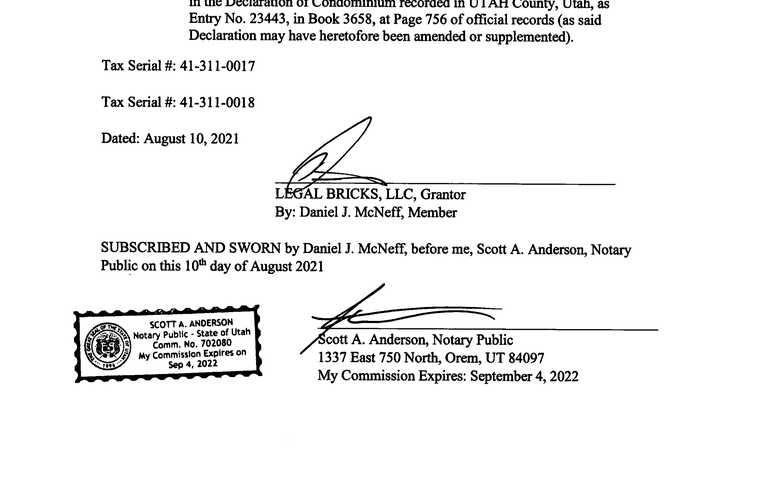
- The date. The original is hand-dated “December 21, 2022”, a date more than a year in the future relative to its own January 2021 recording. → The cure re-dates it “August 10, 2021”.
- Who signed. The grantor block is signed but names no one and states no capacity. → The cure adds “By: Daniel J. McNeff, Member”.
- The oath. “Subscribed and sworn to before me, Scott A. Anderson”, the jurat names no one as having appeared. → The cure reads “Subscribed and sworn by Daniel J. McNeff, before me, Scott A. Anderson”.
- The notary, unchanged. Scott A. Anderson, Utah commission #702080, stamps both. On the cure his “residing at” line is the network’s own hub, 1337 East 750 North, Orem.
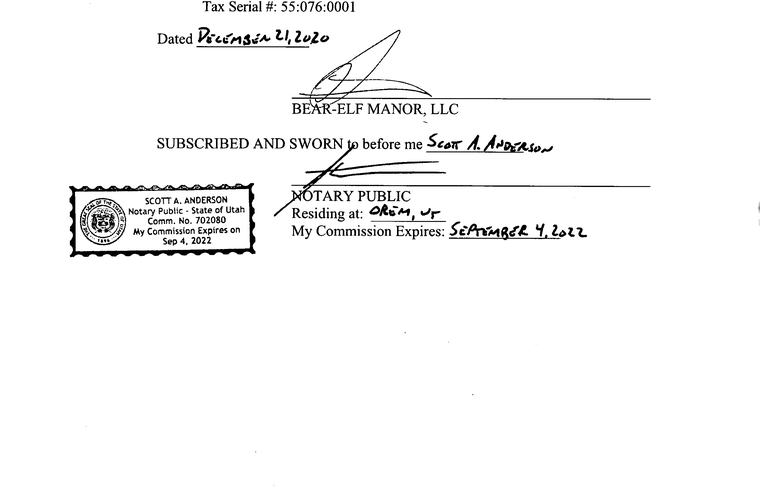
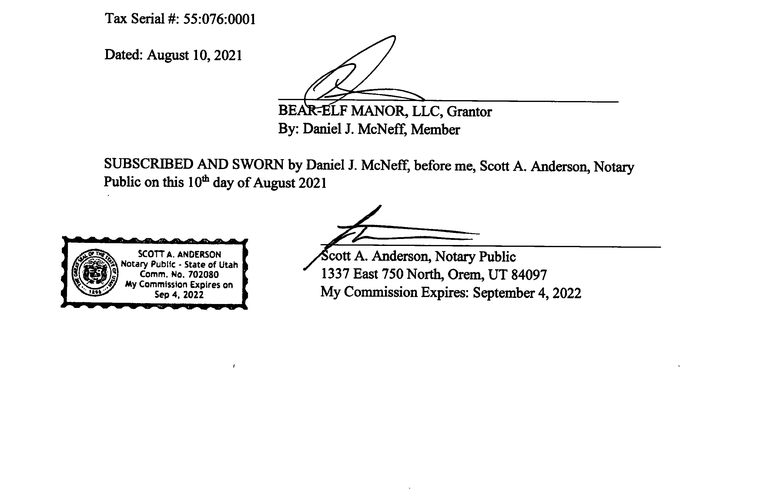
- Same defect, same cure. The original carries the identical no-signer jurat; the cure adds “Daniel J. McNeff, Member” and is re-dated to August 10, 2021.
- The notary, unchanged. Commission #702080 on both faces.
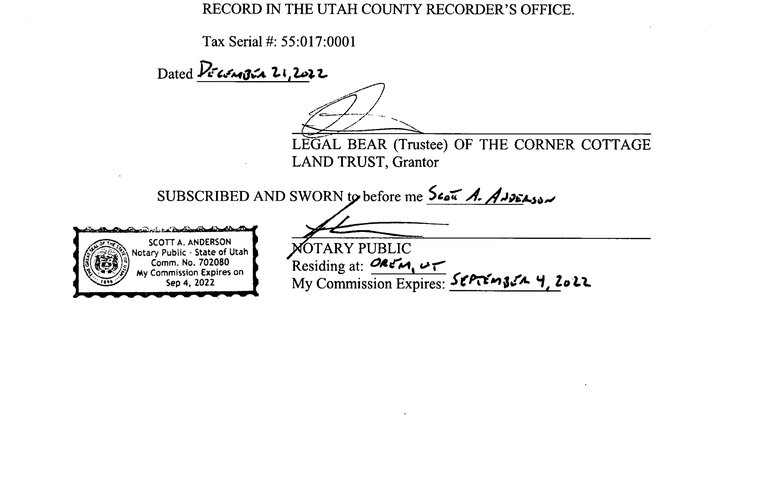
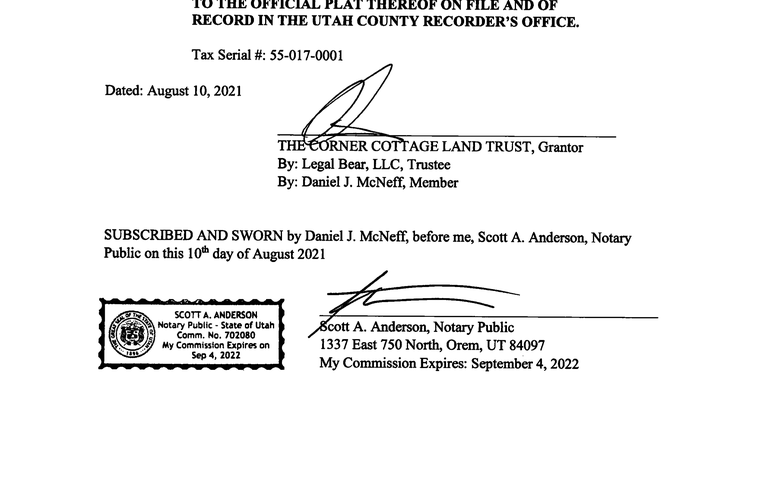
- Same defect, same cure. No-signer jurat in January; cured and re-dated to August 10, 2021 in the re-recording.
- The notary, unchanged. Commission #702080 on both faces.
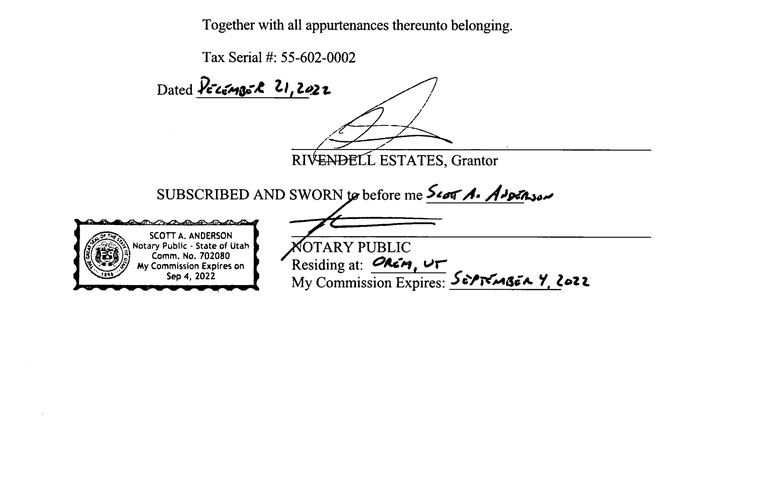
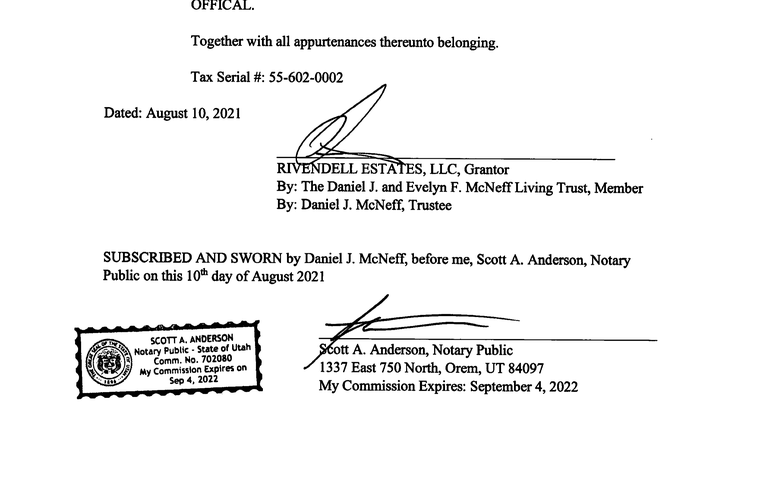
- The cure was informed, not rote. This one’s cure recites the signer as “the Daniel J. and Evelyn F. McNeff Living Trust, by Daniel J. McNeff, Trustee”, the correct capacity for this particular entity, different from the flat “Member” used on the others. Whoever re-executed the batch knew each entity’s exact structure. A clerical re-stamp does not do that.
- The notary, unchanged. Commission #702080 on both faces.
Why this is not a clerical slip. One defect, recorded four times within a minute of each other in January. One cure, re-recorded four times within a minute of each other seven months later. One notary, commission #702080, on all eight faces. A genuine typo does not replicate identically across a four-property batch and then resolve identically across a four-property fix. The recurrence is the discriminator.
The timing is the tell
Set the two recording dates against the litigation calendar. The deeds sat unperfected , giving no constructive notice to any creditor, across the exact window the divorce was finalized and the sons’ federal suit ran. The cure followed the suit’s dismissal.
What a notary is for, and what happened to it here
A notary’s entire job is to be the disinterested check that a real person really appeared and really signed. Scott A. Anderson was not disinterested. His own notary commission lists his employer as “Legally Mine,” the family’s company, and he is the same Scott Anderson who holds every officer seat of Trunkar Management, the family’s second captive registered-agent shop. The person notarizing the family’s deeds and the person operating the family’s registered-agent layer are one individual. That is not a witness the family hired; it is the family’s own people stamping the family’s own paper.
None of this, by itself, is a crime, and the honest grade matters. A defective acknowledgment is a recording defect, not a felony; the re-recording is, on its face, a correction; and no court has found that any of these transfers was a fraudulent conveyance. What the record shows is evidence, in the law of voidable transfers, a textbook badge of intent: insider transfers, for ten dollars, executed inside a closing room the transferors’ own people own, timed to the litigation calendar. The defect also has a concrete legal bite of its own: a deed that gives no constructive notice can leave a priority gap, so any lien recorded in that January-to-August window could outrank the re-recorded deeds.
Where this sits in the larger machine
These four deeds are one part of a six-part asset-protection machine the family ran on its own homes: the shells that hold value, the divorce as a hardening layer, the captive notaries shown above, a captive title-trustee, the in-house law firm that is also Daniel McNeff’s personal counsel, and the bank channel. And the technique is not unique to this family, the same self-attestation move runs along the broader asset-protection lineage these operators come from. It is, ultimately, a method these people sell, run here on themselves, with their own homes inside the structures their seminars market. The full structure, the people, and the grades are on the shells page, the connection board, and the law.
Primary sources. The eight deed faces above are Utah County Recorder entries 5830–5833 and 141977–141980 of 2021. The captive-notary identity, the family’s federal Paycheck Protection loan, and the family ties that bind the machine to the local establishment are documented at the federal SBA Paycheck Protection loan data, the Utah business registry (e.g. DDL Investments (Utah entity 12343181) and Berget & Mesh (Utah entity 11984882)), and the Heber Thompson obituary that fixes the family kinship, plus Brian Thompson’s own published biography (Bank of American Fork since 1992, senior vice president since 2012). The sons’ federal complaint (D. Utah No. 2:21-cv-00048), the source of the allegations referenced here, was voluntarily dismissed before any ruling on the merits; every allegation in it is unproven and the parties retain the presumption of innocence.
The BAM Map is independent reporting on matters of public concern. Nothing here is a finding of any person’s guilt; the criminal charges referenced are unadjudicated and every defendant is presumed innocent. Sources are linked so readers can check the record. · Home · Map · The law · Bodycam