Bricks & Minifigs Schererville leaked confidential information on Facebook while congratulating a customer for $10,000 spent. Two hours later it cropped out the margin. His name stayed up.
On October 31 the store in Schererville, Indiana, thanked a customer by name on Facebook and posted his profile from its register: $10,001.90 in twelve months, nothing returned, a sold margin of 82.6 percent. BAM’s franchise agreement counts a store’s customers and its sales and profitability as Confidential Information, not to be divulged without BAM’s written consent, and BAM’s manual tells stores never to let a customer see any personal customer information. That afternoon the store’s page cropped the margin out of the post. His name is still in the caption.
CONFIRMEDOn October 31, 2026, the store posted a customer’s name, his photo and his twelve-month register profile, margin included; about two hours later a crop showing only his spending and units was created on the post, and the full profile is no longer on the page.
CONFIRMEDBAM’s franchise agreement, in the same words in every edition from 2022 to 2026, counts the store’s customers and its sales and profitability as Confidential Information the franchisee may not divulge without BAM’s prior written consent.
INFERENCERead the way the screen’s other arrows read, the store’s average customer bought at a sold margin of 76.4 percent, so the goods cost the store 23.6 cents of each sticker dollar; read as percentage points, 74.5 and 25.5.
UNRESOLVEDWhether BAM gave written consent, whether the customer agreed in advance to his profile being posted, and whether the page banned a viewer who says they “stated it on the page” and “got banned immediately.”
“NEVER allow customers to see or come into contact with ANY personal customer information.”BAM’s operations manual, Section 9.6, among its guidelines for securing credit card information
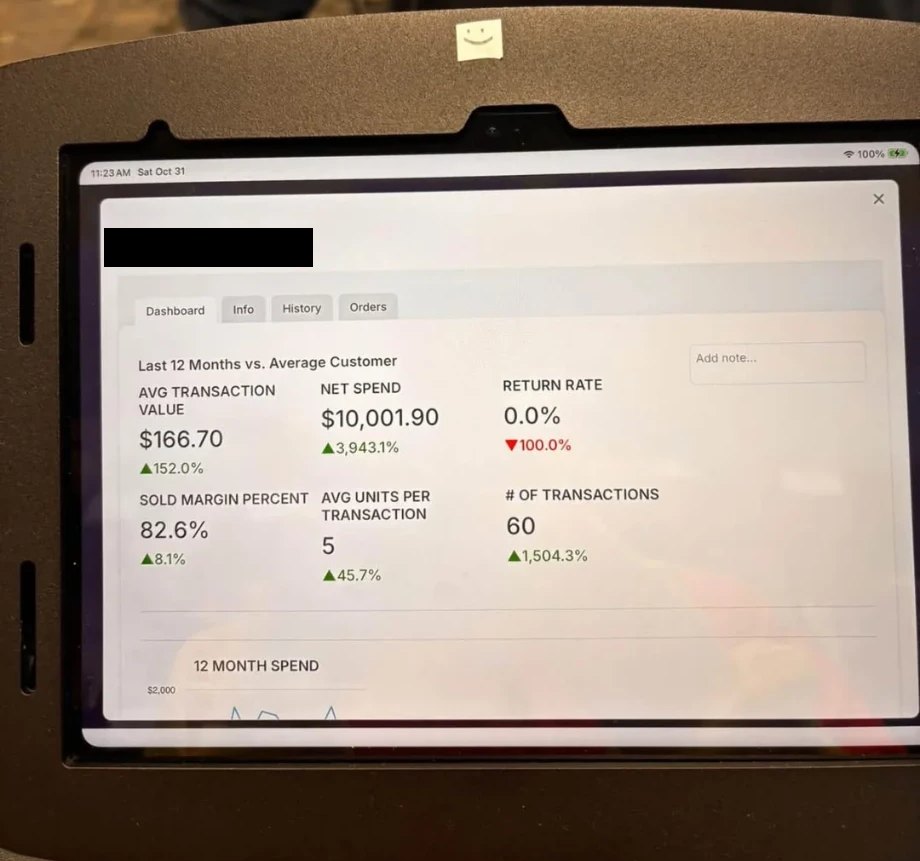
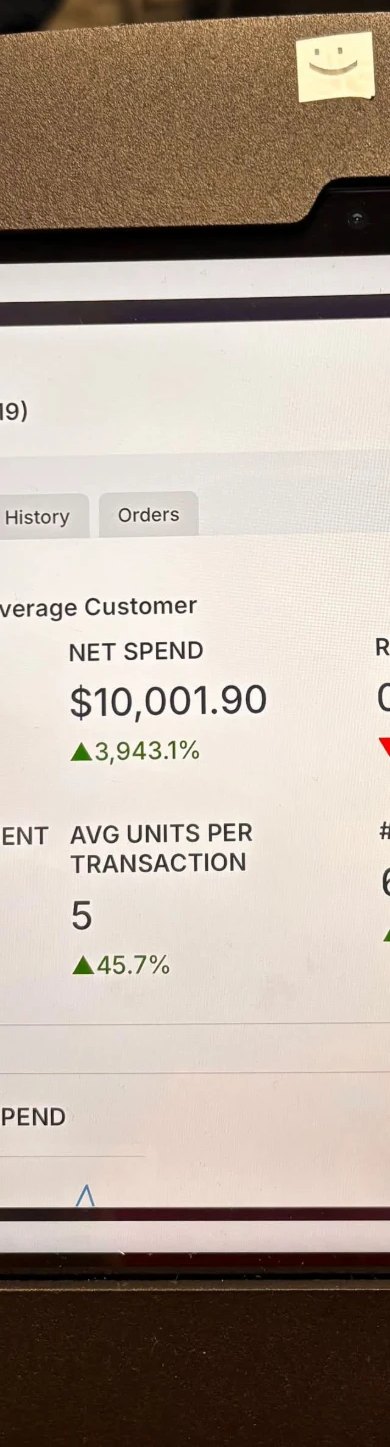
The screen
The screen sets him against the store’s average customer, and every comparison on it but the return rate can be worked back to that customer.
| On the screen | This customer | Against the average | The average customer |
|---|---|---|---|
| Net spend, last 12 months | $10,001.90 | ▲ 3,943.1% | $247.38 |
| Transactions | 60 | ▲ 1,504.3% | 3.74 |
| Average transaction value | $166.70 | ▲ 152.0% | $66.15 |
| Units per transaction | 5 | ▲ 45.7% | about 3.4 |
| Return rate | 0.0% | ▼ 100.0% | above zero |
| Sold margin | 82.6% | ▲ 8.1% | 76.4%as a ratio; 74.5% as points |
The arrows are ratios: the average customer’s $247.38 over 3.74 transactions is $66.14, the ticket arrow’s figure within a cent, so the margin arrow read the same way gives 76.4 percent. He spent 40 times what the average customer spent, in 16 times as many transactions. The store posted all of it, the arrows against its average customer included, to a page with about 5,600 followers.
What 82.6 percent means
Heartland is the only register BAM approves for its stores, barring a written exception (July 28). Its help center defines sold margin as gross sales less “the average cost your business paid for the items sold at the time of sale,” divided by gross sales, with gross sales taken at the item’s original price. In plain terms, of each sticker dollar he spent, the goods cost the store about 17 cents. It is a margin on the goods, not a profit: rent, wages and BAM’s fees come out of it.
Nothing he bought came back. If he paid sticker price, the register’s arithmetic and BAM’s fee schedule split his $10,001.90 this way. Any discount he got would raise the cost’s share.
The Schererville store is a franchise, and the royalty and brand fund are BAM’s rates in its 2025 and 2026 disclosure documents, on the store’s revenue. Rent, wages and the store’s required local advertising come out of the rest.
New sets are the thin end of a BAM store. Its manual says new boxed sets “will ALWAYS be our lowest-margin department” (August 2), and a franchisee described margins of 18 to 24 percent on Star Wars sets bought through BAM (September 2). If any new set was in his $10,001.90, the rest of what he bought carried more than 82.6 percent.
BAM draws its own sales figures from the same registers. Its help desk tells stores the register’s department field “is used by the franchise to determine sales metrics across the franchise and as a result, is standardized and not to be changed” (BAM’s help desk).
What BAM tells sellers
BAM’s website tells people how selling works: “Our team will review your collection on the spot and make a fair offer for cash or store credit.” Its operations manual gives a typical range, for used sets.
As with all other item departments, your store will have a standard amount you pay for used sets, typically between 25-50%. Use this value to determine the cost of the used sets in your store.
BAM’s own buying ledger, a store’s working copy of its calculator left on the open web, records a median payout of about a quarter of assessed value across 179 trades (August 12). The Schererville register, from the other end of the counter, puts the cost of its average customer’s goods at 23.6 cents on the sticker dollar, or 25.5 on the points reading: at or under the bottom of the manual’s band, and not for used sets alone but for whatever its customers bought. In July this site put a seller’s cash at an estimated 20 to 35 percent of a store’s shelf price and found BAM stores’ own online prices for sets running a typical 23 percent above the open market (July 20). The manual’s band, the ledger’s median and now this store’s own register point the same way: the goods its average customer bought cost the store about a quarter of their sticker price.
BAM’s own rules
Franchisee acknowledges that Confidential Information shall also include, but not limited to:
(2) Any person or entity which has, have been or becomes customers of the Bricks & Minifigs® store;
(5) The economic and financial characteristics of the System and franchisees, including without limitation: pricing policies, revenues, sales, training, profitability, earnings and losses and capital and debt structures;
During the term of this Agreement and at any time following the expiration or termination of this Agreement, Franchisee agrees not to divulge, directly or indirectly, any Confidential Information, without the prior written consent of Franchisor.
The post named a customer of the store and showed the store’s sales and margin on him, with arrows against its average customer. Read against the agreement’s list, that is items (2) and (5), on a public page. The divulge sentence allows disclosure with BAM’s prior written consent; item (5) of the covenant list that follows states the bar without that route. Whether BAM consented in writing is not known. Nothing in the visible comments shows the customer knew his register profile would be posted. By his own reply under the post, he learned it was up from his wife: when another commenter joked “Don’t tag the wife,” he wrote that “she was the one who told me about this post.”
The manual sets a related rule at the register.
As a rule, any and all customer information is to be treated in a secure manner. Credit card and personal information is entered directly into the POS so there is no written record that could be misused.
Its guidelines for securing credit card information include the line at the top of this page: never allow customers to see any personal customer information. Heartland builds a dashboard like his for every customer in a store’s customer list, to give the staff “the opportunity to make strong selling suggestions and ultimately to sell more to the customers.” It also lets an owner hide “Sold margin information from the customer history and customer dashboard” from the people using the register. On this register the margin showed, and then it showed on Facebook.
BAM is on the page by Facebook’s own account. Its transparency panel for the page reads “BAM FRANCHISING INC is responsible for this Page,” as it does for the Lexington store’s (September 15). BAM’s manual requires a corporate administrator on every store account and gives BAM the right to “delete, remove, hide, or otherwise alter posts” (July 28). The agreement, the manual and the register’s hide switch were all in place on October 31, and Facebook lists BAM as responsible for the page. The profile went up anyway, and the name is still there.
What the crop protected
A little over two hours after the post went up, the crop shown above was created on the post; the full register photo is no longer on the page. The crop keeps his $10,001.90 and his five units a transaction. It cuts his name and nearly all of his number, his average ticket, his 60 transactions, his returns, the margin and the chart. The caption that gives his full name and the photo of him holding a store bag are still up.
The number that came down was the store’s margin. The name that stayed up was his. On the same reading, what is still up falls under both items: his name in the caption, item (2), and his $10,001.90 in sales on the crop, item (5).
A viewer wrote on Reddit the next day that they saw the margin, “stated it on the page” and “got banned immediately.”
The fair reading, and its limit. The post was a thank-you to a customer who posed for it, and the crop keeps the figure the store was celebrating. BAM’s manual tells stores to photograph customers with their sets and post them: “User generated is great content to post! Make sure to use the share feature or tag them whenever possible.” The agreement’s divulge sentence allows disclosure with BAM’s prior written consent, and the customer thanked the store warmly under the post. Sold margin is the register’s arithmetic at sticker price on whatever cost the store entered for each item: an item entered at little or no cost counts as almost all margin, and the manual says tracking may be turned off for items a store does not intend to track, used sets among them. BAM’s 2026 disclosure document puts the 2025 gross margin of the 104 franchise stores that reported it reliably between 53.20 and 62.99 percent by quartile average, with single stores from 30.34 to 85.24 percent. The manual’s customer-information rule is written for the counter, and the manual leaves watching a store’s page to its owner. None of that changes what the post showed, or that his name is still up. The right of reply is open to the store and to BAM.
The record
The store’s Facebook page. BAM’s website. Heartland on its metrics. Heartland on hiding cost and margin. Heartland on the customer dashboard. The Operations Manual, Section 9. The manual on tracking used sets. BAM’s buying ledger. BAM’s markup. The lowest-margin department. Margins on sets bought through BAM. The Lexington store’s page. This site’s guide to Item 19. The 2026 disclosure document and franchise agreement, as filed in Minnesota.
Sources. Bricks & Minifigs Schererville, Facebook post of October 31, 2026, its caption, its two photos and their Facebook timestamps, its comments, and the page’s transparency panel and follower count; the post’s second photo as first published, in a copy posted to Reddit on November 1, 2026. BAM Franchising, Inc., Franchise Agreement, Section 9, 2022 to 2026 editions; Operations Manual, Sections 9.4.5, 9.6, 15.2, 17.3 and 17.4; 2025 and 2026 Franchise Disclosure Documents, Item 6; 2026 Franchise Disclosure Document, Item 19, Table 4, and Exhibit F; The Times of Northwest Indiana, November 4, 2025 and January 11, 2026; bricksandminifigs.com, home page; BAM’s help desk, Bricks & Minifigs Heartland Items Standards. Heartland Retail help center: Heartland Retail Sales Reporting Metrics Explained; How to hide item cost and margin information from certain users; Test Drive Roadmap: Customers. The customer’s name, customer number and photo are withheld.