Every option on tonight’s agenda staffs the fire station. One raises no tax.
Tonight at 7:00 the American Fork City Council fills in a resolution that arrives with blanks where the numbers go. Since the August 11 hearing, the ask has been shrinking on the city’s own paper, all the way to a drafted zero. In every version, by the city’s own table, the station is still staffed.
The ask, per month on an average home
Every reduction entered the record after the hearing, in a packet whose file was created the morning before the vote.
CONFIRMEDTonight’s 353-page agenda packet; the city’s budgets, minutes, and audited financial report; and both recordings of the August 11 hearing.
Who votes tonight
Five council members: Staci Carroll, Tim Holley, Ryan Hunter, Ernie John, Clark Taylor. Mayor Brad Frost presides, voting only to break ties.
What they vote on
Action Item 1: the property tax rate for fiscal 2027. The full increase is $660,000 a year, $33.41 on an average home, permanent.
When, where, how to speak
7:00 p.m., City Hall, 31 North Church Street. Public comment opens the meeting: twenty minutes total, two per person, in person or virtual.
The three stations
Station 51: the original, the city’s busiest. Station 52: opened 2024, built on a bond voters approved in 2019. Station 53: the one tonight’s tax would staff.
The arithmetic of participation: the record behind tonight’s decision is 353 pages, posted 35 hours before the vote. The public’s entire allotted response, everyone in the room combined, is twenty minutes.
The three motions
The packet drafts three ways to fill the blanks. Each option, according to the city, fully staffs the nine firefighters.
Option A · proposed
$2.78/mo
The full increase. $660,000 a year, rate .001516, permanent. And guaranteed: by City Administrator David Bunker’s own explanation, if home values fall the rate rises until the city collects the same dollars.
Option B · staff’s path
$1.87/mo
$435,000, rate .001475. The insurance saving and an economic-development cut cover the rest.
Option C · no increase
$0
The current rate stays (what Utah law calls the “certified” rate). Funded by deferring, in the table’s own words, “Playground replacement & Vehicle Purchases.” Staff’s printed caution: one-time money leaves next year’s deficit.
So tonight’s real choice, in the city’s own framing, is not station or no station. It is $33 a year forever, or $22, or one year of deferred playground equipment and vehicles.
What changed since the hearing
On August 11, residents spent the statutory hearing contesting the numbers, reported here. Tonight’s packet, its finance report prepared under Finance Director Anna Montoya, is the first city document since, and the ask inside it shrank twice.
“Since adopting the interim budget on June 23, 2026, the city was able to realize savings in the city’s insurance premium of $100,000… and allows the Council to reduce the proposed tax increase while maintaining the planned fire staffing.”
Then a second cut: staff “further recommends reducing the tax increase by amending the economic development budget by $125,000.” The packet does not say why the premium fell.
One thing belongs beside that premium line. At the hearing, an accountant told the council:
“Just the settlements cost $725,000. That’s not including the lawyer fees… I think police misconduct is part of the budget.”
No official record states what the claims cost; the site’s report traced where such costs live, in premiums the statements never break out. Ten days later, the first premium figure in this record surfaced, moving in the city’s favor, in the packet for the vote. The facts are CONFIRMED and dated; any connection is INFERENCE, and the packet offers none.
The paperwork leans one way
The motion menu offers
Three choices: full increase, reduced, or the certified rate with no increase. B and C carry their own budget-amendment language. Staff’s narrative recommends the smaller ask.
The documents drafted
One tax resolution, titled “approving a property tax increase above the certified tax rate,” with the finding that an increase is “necessary” already typed in, and blanks only for the amount. No certified-rate resolution exists in the packet. The budget resolution adopts the budget “based on the proposed property tax rate.”
The drafted resolution’s blanks can hold Option A’s numbers or Option B’s; both fit the document as written. Only Option C has no instrument. Choosing the zero option tonight would mean amending, from the dais, the title and the “necessary” finding of the only resolution in the packet. So the menu’s range is real between the two increases, and the option that raises nothing is the one that exists on paper with nothing drafted to execute it. CONFIRMED as to each document’s text.
Whether the three options are a real choice or the appearance of one is not something a document can prove, and there is an innocent reading: staff’s own narrative recommends B, and drafting the proposed version is ordinary practice. The test is tonight, and it is simple. If a council member moves Option C, the drafting gap becomes visible in the room in real time. If no one does, the zero option’s role in this packet was to be declined.
Tonight’s packet, two pages
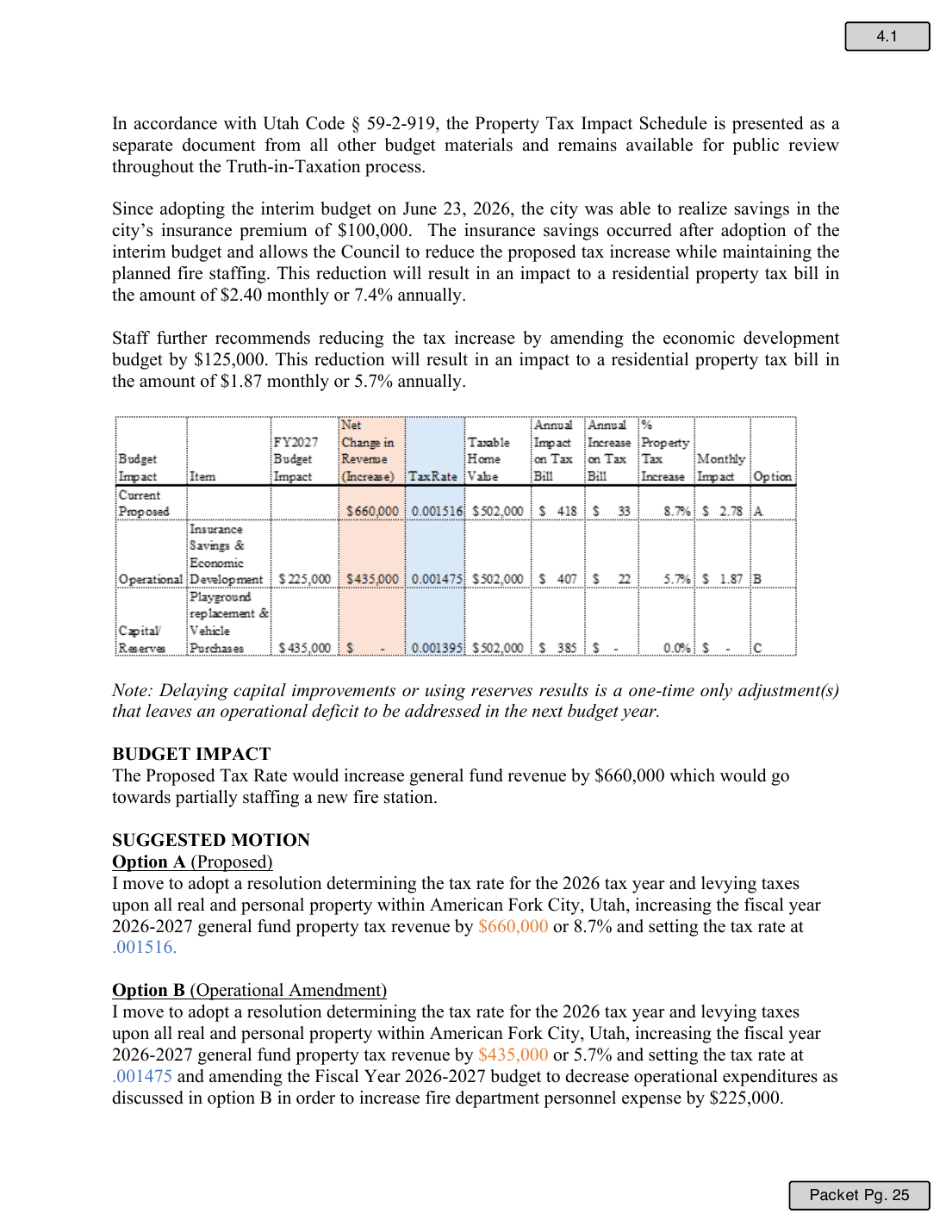
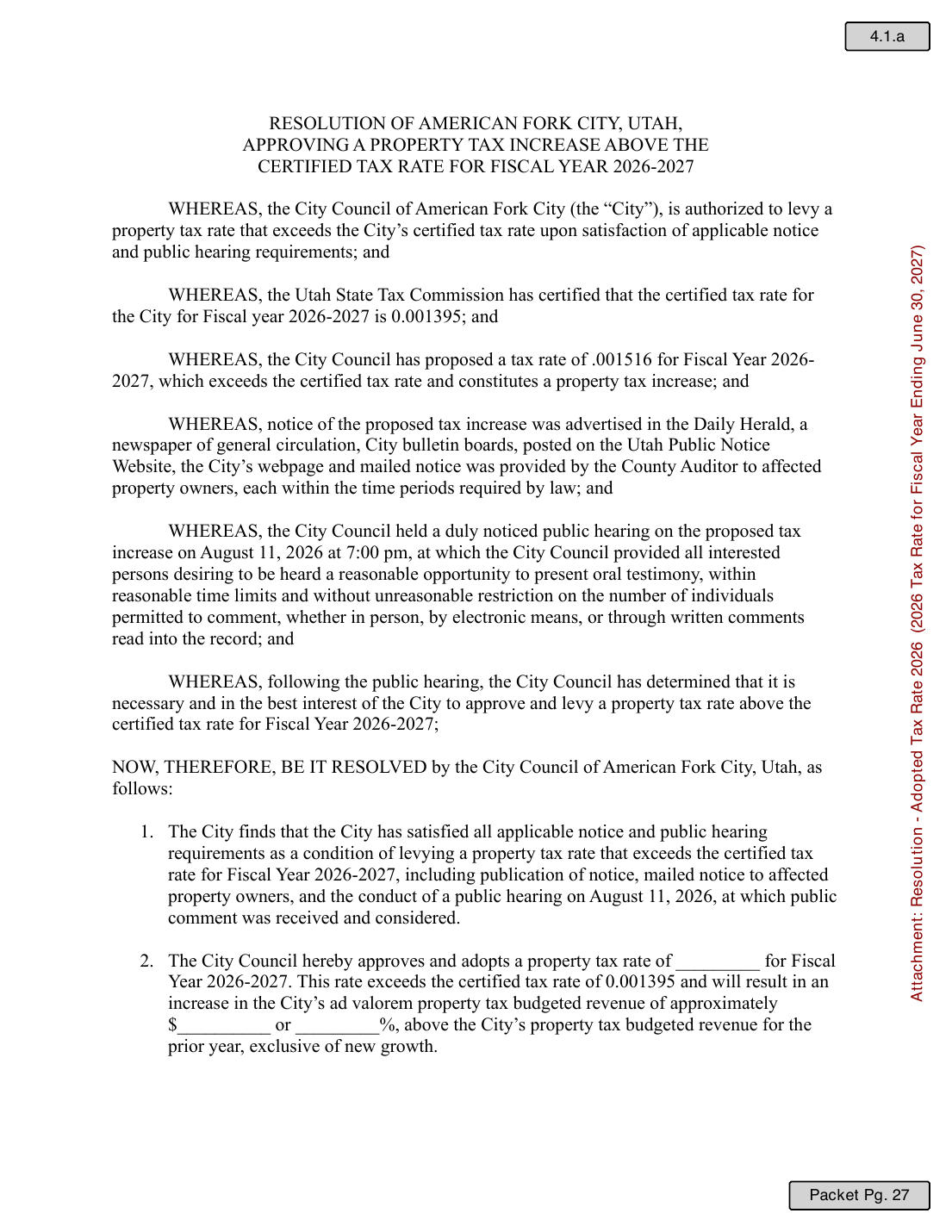
8.48 or 8.7? Both. The packet never says which is which.
The mailed notice says 8.48 percent. The staff report and the motion say 8.7. The arithmetic: the rate rises 8.67 percent (.001395 to .001516); the revenue and the bill rise 8.48 ($33.41 on $394.27). Two true numbers, two different things. The staff report attaches the rate number to the household sentence, where the bill number belongs, and Mr. Bunker said “8.7” at the podium twice. No city document distinguishes them. CONFIRMED, arithmetic shown.
The paper trail, timed
Process stepThe two that matter most
May 12The council adopts the required impact schedule and announces it intends to raise the rate.
June 9 · June 23Budget hearing; interim budget adopted, built on the full increase.
July 22The Utah County Auditor mails the official notices: 8.48 percent, $33.41.
August 11, 7 p.m.The Truth in Taxation hearing. Residents contest the numbers on the record.
August 21, 10:16 a.m.The agenda is posted for the vote, over the electronic signature of City Recorder Terilyn Lurker. The city’s own online listing titles it the “City Council Agenda and UPDATED packet” and keeps a link to the previous version.
August 24, 8:27 a.m.The 353-page packet file is generated, according to its own file properties, 35 hours before the vote. The reductions and the three options are inside.
August 25, 7 p.m.The vote. The same night’s consent agenda, adopted in one motion, approves the official minutes of the August 11 hearing.
August 26If any increase passed, the seven-day referendum window opens.
Nothing in that sequence is irregular on its face; it is how the machinery ordinarily runs.
The record of what you said
If you stood at the microphone on August 11, tonight is the night your words become the official record. The council approves the hearing’s minutes tonight as item 4 of the consent agenda, the routine block adopted in a single motion, ordinarily without discussion, minutes before the vote you were contesting.
The text of those minutes is not in the 353-page packet. The packet contains the line approving them; it does not contain them. What the official account says you said is not published for you to read before it is approved.
Two full recordings of the hearing exist, the city’s own and an attendee’s. When the approved minutes surface, this site will read them against the recordings, line by line. CONFIRMED as to the agenda, the packet’s contents, and the recordings; what the minutes say is, as of tonight, unknowable from the public record.
The station file, in the city’s own words
Blue is what the city’s paper says. Rust is what its podium said. No two audiences heard the same account.
On paperAt the podium
2019“Voters approved a bond for $8.5 million” for Station 52. “G.O. bonds are debt paid for by taxes.” The city’s own page. The last station went to a ballot.
Fiscal 2024Station 52 completed: “total construction cost… $9,356,929,” police substation and shooting range included. Audited report. Bond money; no rate change.
Jan 27, 2026Station 53’s site arrives by a $0 exchange with UDOT, budget impact zero, adopted unanimously. Reported here.
May 2026The budget: 11.25 new fire positions, “$2 million” in personnel, a “9%” increase “to partially fund” them; the impact schedule the law makes the city publish says the tax covers “4 of 9”; the minutes absorb “$755,000.” The budget.
July 2026The official notice, mailed to every property owner: 8.48 percent, $394.27 to $427.68.
Aug 11, 2026City Administrator David Bunker, at the podium: “an 8.7 tax increase”; “9 of 12” firefighters against “approximately 1.5 million”; “$840,000” absorbed; the site now “acquiring a property with a home”; the budget “zero-based,” carrying nothing forward, in the year it carries a $780,000 roundabout forward by name. “Referendum”: zero times. The hearing.
Aug 21 to 24Tonight’s packet: the ask shrinks twice; three motions, each staffing the station by the city’s table; one resolution, titled for an increase; both percentages, still unreconciled. The packet.
As of tonight$200,000 for the temporary station: approved for 2025-26, estimated spending zero, nothing proposed for 2027; reported spent in May. Station “expected to open October 2026”; as of mid-August, no deed for the land had been recorded with the county, and the annexation into the city was still pending.
Set the first entry against the last. In 2019 a fire station meant a ballot. In 2026 it means a resolution with the direction pre-typed and the amount blank. The $660,000 never moved. Everything said around it did: 9 percent became 8.48 became “8.7”; four firefighters of nine became nine of twelve; $755,000 became $840,000; a $0 land exchange became “acquiring a property with a home.” Each statement was accurate enough for the room it was said in. Tonight the file has to hold together as one document, because the blanks can only be filled once.
To be fair, and it matters. The station need is real: the city’s own budget calls Station 51 “the busiest fire station in Utah County that responds out of a single station,” and the positions are genuinely in the budget. The reductions are, on their face, the process working: staff found savings and recommended the smaller ask. Shifting numbers can be drift rather than design; drafting the proposed resolution is ordinary; nothing here was under oath; Option C’s cost is real and named, with staff’s own warning about next year’s deficit. Nothing establishes why the premium fell or connects any change to any speaker, and nothing in this report is a finding that any law was broken by anyone.
Tonight, and the seven days after
If the council adopts any rate above the current 0.001395, Utah law gives residents a purpose-built instrument to freeze it and put the question on a ballot, with a seven-day fuse that starts tomorrow: five sponsors, an application filed with the city recorder, Terilyn Lurker, then signatures. The mechanics are laid out in American Fork’s tax increase can be stopped by its residents. It would be the second time this station program faced voters. The first time, in 2019, the city put it on the ballot itself.
Sources: the city’s August 25, 2026 agenda and packet (agenda dated August 21; packet file created August 24, 8:27 a.m. per its own properties, author field “Bradley J. Frost,” generated by the city’s agenda software; the online listing is titled “City Council Agenda and UPDATED packet,” posted August 21 at 10:16 a.m., and retains a link to a previous version; the Finance Department’s report, the budget-impact table, motions A to C, the draft resolutions, and the statutory notice, packet pages 23 to 35, two reproduced above); the city’s fire-station bond page; the FY2024 audited financial report; the tentative and interim FY2027 budgets; the May 12, 2026 minutes; both recordings of the August 11 hearing, transcribed and cross-checked; the American Fork Citizen; and this site’s prior reports, the hearing and the referendum machinery.
The BAM Map is independent reporting on matters of public concern. Nothing here is a finding of any person’s guilt; every official named is presumed to have acted lawfully. Sources are linked so readers can check the record. · Home · Map · The law · Bodycam