Three candidates. One signature crew. A forgery-charged firm.
Ammon McNeff, the chief executive of Bricks & Minifigs, signed all three petitions that put one Utah County slate on the 2026 ballot. The signature is lawful, one of thousands, and it is the thread that leads here. The slate paid $143,875 to a signature firm, Gathering Inc, whose contractors the State had already charged with forging voter signatures, Benson Angilau and Kevin Jeong among them. The slate’s own petitions carry the same patterns those cases describe, and the county office that would examine them may pass in January to the candidate the signatures served.
PRIMARY SOURCEThe three candidates’ certified petitions; their Utah County campaign-finance filings; the Utah Attorney General’s charging documents in the Fourth District Court; the published results of the 2026 convention and primary.
The candidates
Corey Astill (County Clerk), Michelle Kaufusi (Commission Seat A), Isaac Paxman (Commission Seat B). All three hired Gathering Inc of Ogden, owner Tanner Leatham, to gather their nomination signatures in February 2026.
The criminal cases
In March 2025, Utah Attorney General Derek Brown’s Public Corruption Unit charged eleven 2024-cycle gatherers with forgery. Five worked for Gathering Inc. Two were charged in Utah County’s own Fourth District Court: Benson Angilau and Kevin Jeong. No disposition appears in public reporting; both are presumed innocent. The firm itself was not charged and cooperated.
The election so far
April convention: incumbent Clerk Aaron Davidson beat Astill among delegates, 58.63 to 41.36. June 23 primary: Astill beat Davidson, 55.74 to 44.07. Kaufusi won Seat A. Paxman lost Seat B. Astill and Kaufusi are on the November 3 ballot.
The office at stake
The County Clerk administers elections and verifies petition signatures. The verification that produced this page’s numbers ran under Davidson. If Astill wins in November, the office and its records become his in January.
The three campaigns, one operation
Corey Astill · County Clerk
$15,208
Lost the convention to the sitting clerk; made the primary ballot on the petitions; beat him.
Won primaryMichelle Kaufusi · Seat A
$58,333
Former Provo mayor. On to November.
Won primaryIsaac Paxman · Seat B
$70,333
Paid the firm the most of the three.
Lost primaryThe payments are one slate’s, not three campaigns’. The candidates divided other bills into equal thirds: Spencer Stokes, consultant and a Director of the Utah Republican Party, $1,667 each; one shared campaign office on Center Street, $6,200 each; even a Sam’s Club bill, $555 each. They shared a consulting shop, BCR Political and BIVIO Resources, two firms at one Provo address, about $126,000 combined. Splitting costs in exact thirds is what one operation does across three committees.
The coordination reaches a single doorstep. One circulator, David Rodabough, carried all three petitions to Ammon McNeff and gathered his signatures in one set of visits, from February 19 to 27. Signing is lawful, and thousands of residents did it. Among the Bricks & Minifigs enterprise, McNeff was the only one who signed at all: not Matthew or Daniel McNeff, not Josh Johnson. The mechanics are the point. One gatherer, three sheets, one door is one operation, not three.
The sworn word, against the county’s file
Utah’s petition system runs on one sworn sentence, and the county checks it.
What each circulator swears
The last sheet of every packet is a Circulator Verification: a signed statement that every signature was made in his presence, by the person named. Falsifying it is the crime the 2024 cases charge.
What the county’s file answers
Every signature is checked against the voter rolls. A “NotMatching” result is the county recording that the voter of record did not make that signature. Each one contradicts a sworn statement.
Across this slate’s 24,788 signatures, the contradictions take the two shapes the 2024 prosecutions describe. In 232 cases, one voter’s signature passed on one candidate’s sheet and failed on another’s, gathered by the same circulator, the conduct described in State v. Angilau. In 95 households, one spouse verified and the other did not, same day, same circulator, the method a charged gatherer admitted: one spouse signing for the other “to kill two birds with one stone.”
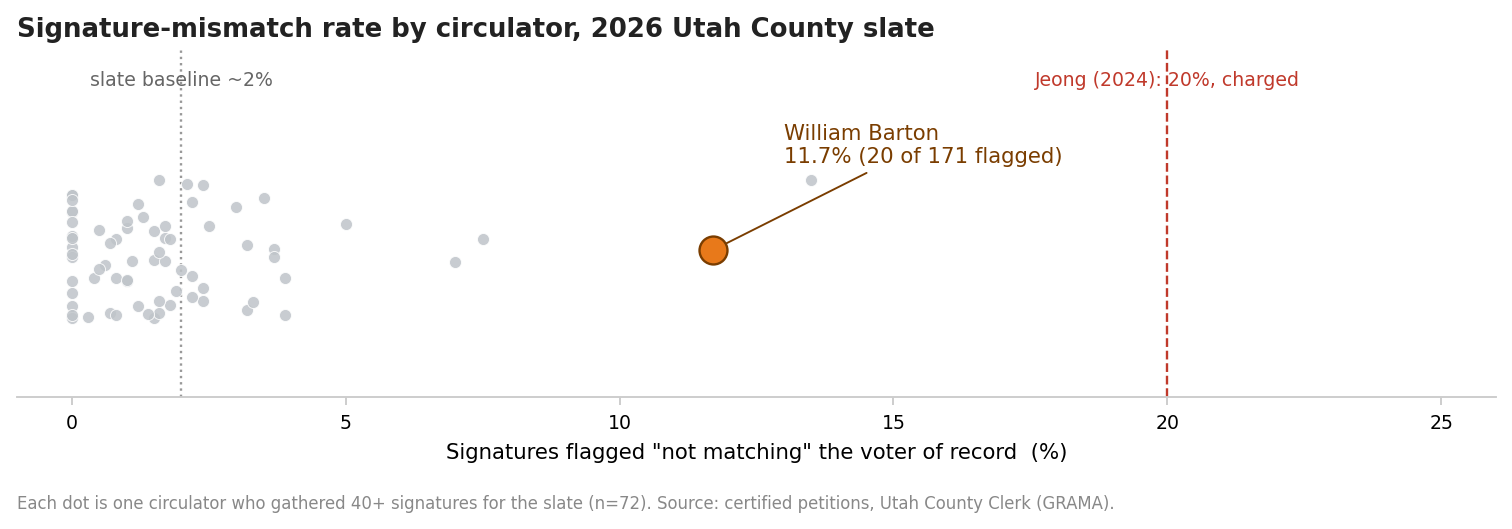
The flags concentrate. William Barton turned in 171 signatures; the county flagged 20, an 11.7 percent rate against a baseline near 2. Nine carry the copy pattern, three the spouse pattern, and they cluster in one west-side neighborhood, gathered within a few days in early February. Ordinary review error scatters. His does not.
| Gatherer | Turned in | Flagged | Rate | Status |
|---|---|---|---|---|
| Kevin Jeong, 2024 cycle | 176 | 36 | 20% | Charged with forgery |
| William Barton, 2026 cycle | 171 | 20 | 11.7% | Unexamined |
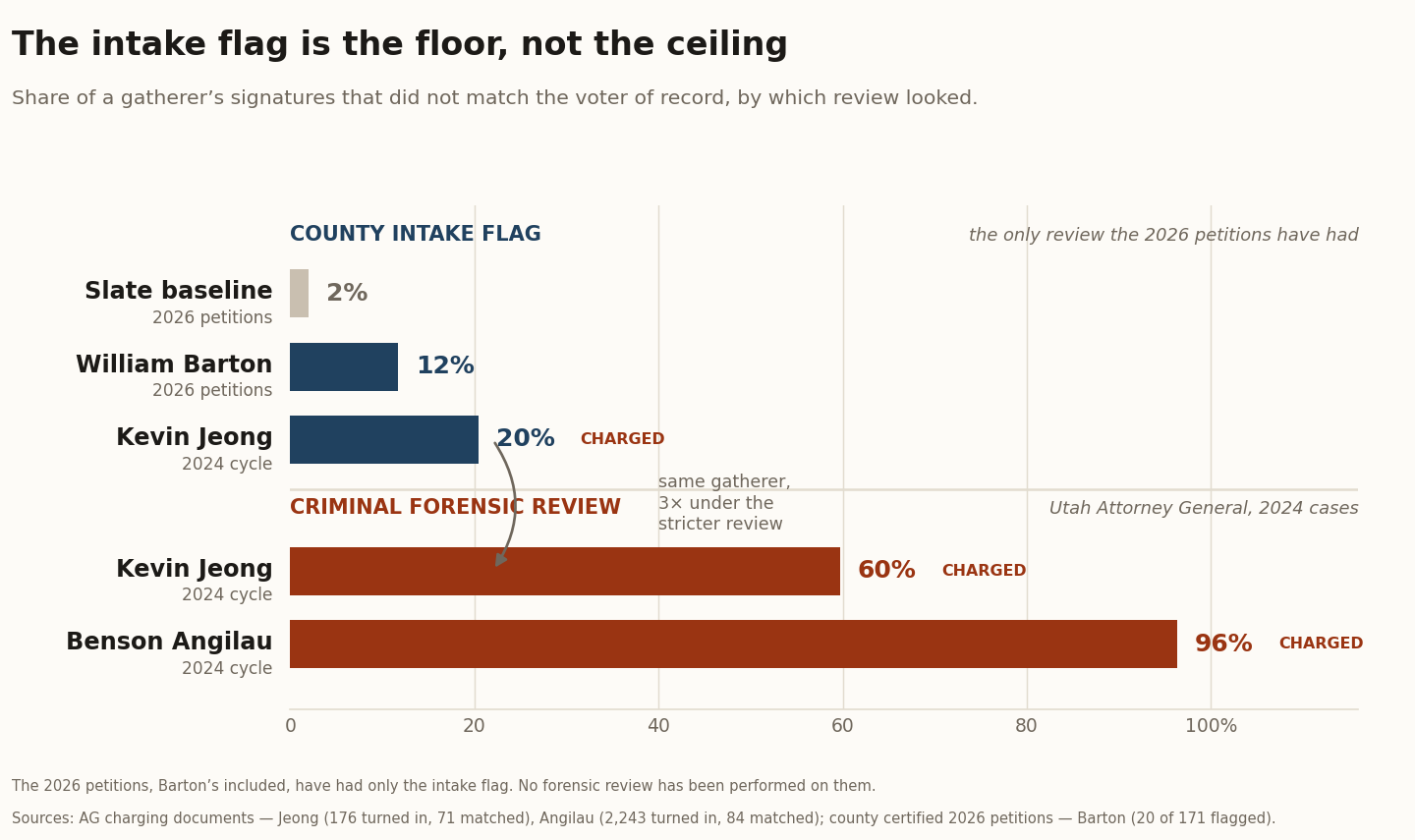
A NotMatching flag is not, by itself, proof of forgery: signatures on file age, and reviewers differ. That is exactly why the ruler matters. The 2024 cases closed the gap with GPS logs and confessions that a records review cannot supply, which is how Jeong’s 20 percent at intake became a 60 percent forensic finding and a criminal charge. The 2026 petitions have had no such review. The word “forgery” is not applied here to any 2026 signature; what the record shows is the pattern that produced eleven criminal charges, sitting in this slate’s own paperwork, on the lenient ruler, unexamined.
On the names. Circulators are named because each is printed on the public petition and personally signs the sworn verification. The voters are not named, here or in the published data.
Behind each flag is a voter
Every flagged signature is a registered Utah County voter whose name appears on a sworn sheet the county’s own file says they did not sign. Twenty of them sit in Barton’s packets alone. Nothing in the public record shows any of them was ever told.
The timeline, and where it ends
March 11, 2025Attorney General Derek Brown charges eleven gatherers with forgery; five are Gathering Inc contractors; Angilau and Jeong are filed in Utah County’s Fourth District Court, covered statewide.
February 2026Gathering Inc crews gather the slate’s petitions. The signatures the county would later flag cluster in early February.
Spring 2026The clerk’s office, under Aaron Davidson, verifies the petitions and records the flags this page reports.
April 2026At the county convention, Davidson beats Astill, 58.63 to 41.36. The petitions guarantee Astill’s primary line regardless.
June 23, 2026The primary: Astill 55.74, Davidson 44.07. Kaufusi wins Seat A. Paxman loses Seat B.
November 3, 2026The general election. Astill and Kaufusi are on the ballot.
January 2027The winner of the clerk’s race takes the office, the verification records and audit trail included.
Why the question has a date on it
The system, to a point, worked: the county’s verification flagged the signatures, under the office of the sitting clerk, Aaron Davidson. What has not happened is the step the 2024 cases took next, an examination of the flagged packets.
And the clock on who could order one is now specific. Corey Astill paid the firm that gathered the signatures, made the ballot on them, and beat the clerk whose office flagged them. If he wins in November, any later examination would be conducted by the office of the man whose campaign the signatures served. The window for an independent look closes in January.
The machine the slate sits in
The slate is not free-standing. Spencer Stokes, the shared consultant, is a Director of the Utah Republican Party and a registered lobbyist. The slate is funded in part by the realtors’ PAC, Utah Central Association of Realtors / BORPAC, which gave to Astill and Kaufusi, and which also funds the American Fork city council (Frost, Taylor, Shelton): one PAC, two surfaces. Astill’s other backers are the signature-politics establishment itself: Count My Vote, which created Utah’s signature ballot path, the Spencer Cox campaign, and the Defending Utah Values PAC. A party director, a chartered PAC, named committees.
Grades
| Finding | Grade |
|---|---|
| Astill, Kaufusi, Paxman ran as one coordinated slate | CONFIRMED |
| The slate paid Gathering Inc $143,875, eleven months after its contractors were charged | CONFIRMED |
| Gathering Inc contractors were criminally charged, two in Utah County | ADJUDICATED as filed; no disposition public; presumed innocent |
| The slate’s own petitions carry the charged failure patterns | CONFIRMED |
| Those patterns are the result of forgery | INFERENCE, unexamined |
| Astill beat the clerk whose office verified the petitions; the office may be his in January | CONFIRMED |
| The slate’s funders also fund the American Fork city council | CONFIRMED |
Three questions, answerable before January
Have the flagged 2026 packets been examined for the copy and spouse patterns the 2024 cases charged? The county’s own verification audit trail answers it. Given that the clerk’s office may pass to the candidate the signatures served, should any examination happen now, under the sitting clerk or an independent custodian? And did Gathering Inc pay its 2026 gatherers per signature with volume bonuses, the incentive the 2024 charging documents name as the motive?
Sources and data: the three candidates’ certified petitions, produced by the Utah County Clerk’s office under Utah’s public-records law; their Utah County campaign-finance filings; the charging documents in State v. Angilau (Fourth District Court 251400956) and State v. Jeong (251400932); charge coverage by Utah News Dispatch and KSL; convention and primary results via the Daily Herald (June 23). Published with this report: all 24,788 signatures (candidate, circulator, packet, party, county match-status, date; every voter a stable pseudonymous reference, no names or addresses) and all 123 circulators. Corrections requested by any candidate, by Gathering Inc, or by any person named here, as of the date of this report: none received. Corrections are published on the record.
The BAM Map is independent reporting on matters of public concern. Nothing here is a finding of any person’s guilt; every person named is presumed innocent, and no filing alleges any 2026 candidate or circulator committed a crime. Sources are linked so readers can check the record. · Home · Map · The law · Bodycam