Aaron Booker sued American Fork. The department’s own dashcam and its police chief both say Officer Bronson Kitchen got the stop wrong. His report still cites a double white line.
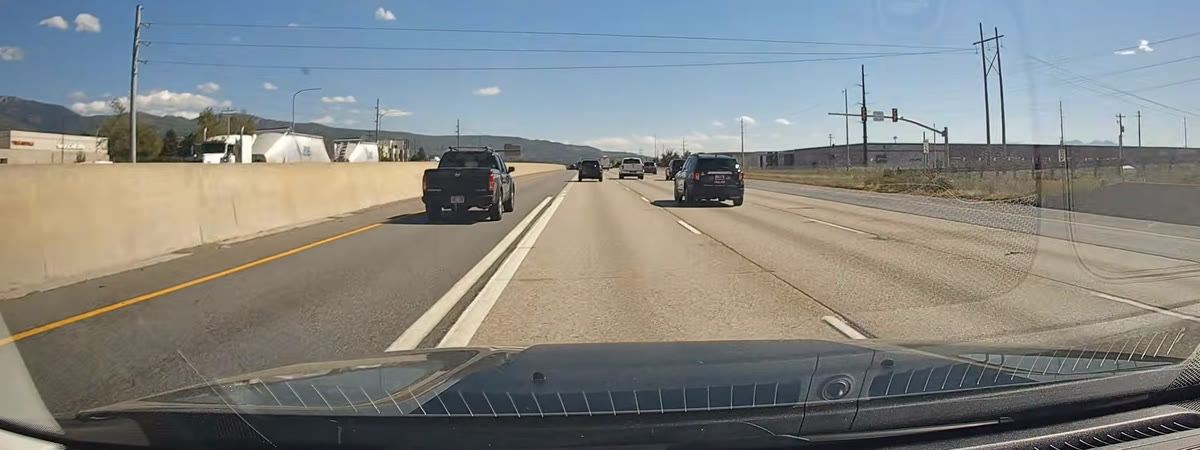
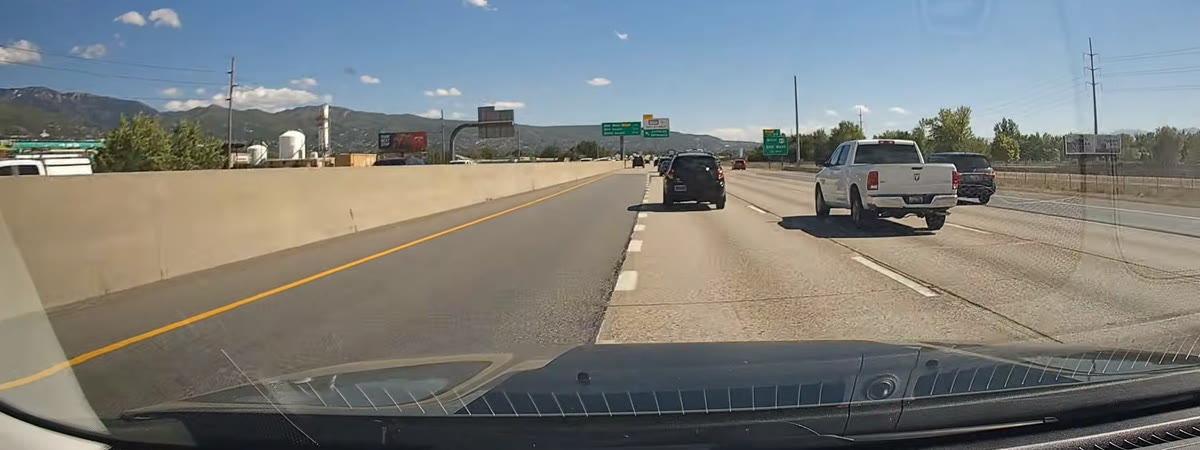
Kitchen’s report gives a double white line as the reason for the stop. On both dashcams, Booker’s and the patrol car’s, the line is broken where he changes lanes. At the roadside Kitchen gave a different reason, the carpool lane, and on a recorded call six days later he said that was wrong: “You are allowed to exit there.” Chief Cameron Paul’s own email lists the discipline: an apology, a letter of reprimand, a suspension of vehicle take-home privileges. The report was finished a week after the apology. The footage also backs the report where the complaint calls it invented: Booker’s own camera reads 74 to 82 miles an hour, and he says on it that the limit is 70. Booker filed the suit himself, without a lawyer, on November 2.
PRIMARY SOURCEComplaint and Jury Demand, Booker v. City of American Fork, No. 1:26-cv-00221 (D. Utah), filed November 2, 2026, with the incident report, the chief’s June 8 emails and the records office’s June emails among its exhibits.
CONFIRMEDBooker’s dashcam, published as his Part 1, shows the double white line beside him ending and his move into the left lane across a broken line more than 20 seconds later. The patrol car’s dashcam, as Booker published it in Part 3, shows the broken line beside his Jeep as it moves over.
CONFIRMEDThe same camera reads 74 to 82 miles an hour in the 80 seconds before Booker slows for the stop. He says on it that the limit is 70.
The footage, claim by claim
There is no body camera recording; the report says “Body Cam- No.” There are three recordings: Booker’s dashcam, with sound, which he published with his own commentary as Part 1; the patrol car’s dashcam, without sound, which the city released to Booker and he showed in Part 3; and Booker’s recording of the May 27 call. This is how the report and the complaint hold up against them.
I thought the Jeep entered the HOV lane while there was still a double white line so I intiated a traffic stop.
About a mile before the exit, Booker drives under a sign that reads “No left lanes restrictions next 1 mile for left exit 317.” Seconds later the double white line beside his lane turns into a broken line. About 23 seconds after that, roughly half a mile on, he moves into the left lane across the broken line at 80 miles an hour. On the patrol car’s own camera the line beside his Jeep is broken as he moves over.
Plaintiff had committed no traffic infraction or criminal offense.
I have video of my entire route. I sure as shit wasn’t driving aggressively. I sure as shit wasn’t following too close to people. Speeding? Yeah, sure, we all were doing that, but okay.
On Part 1 he says “the speed limit on the highway here is 70 miles an hour.” His overlay reads 82 as he comes up on the patrol car’s right, before the patrol car pulls ahead and he falls in behind it; it reads 75 to 77 when he later passes the patrol car on its left, and 80 when he moves over. The patrol car’s own overlay reads up to 84 as it closes on him. On “aggressively switching lanes” and “following too closely,” the footage does not settle the report’s words: it shows him pulling even with the patrol car on its right, falling in behind it, later passing it on its left and a pickup on its right, then moving into the left lane, and nothing that measures following distance. Speed did not come up at the stop.
Notably, at no point during this entire roadside exchange did Defendant Kitchen ever claim or accuse Plaintiff of crossing a solid double-white line; rather, Defendant Kitchen repeatedly insisted that Exit 317 itself was an HOV-only exit closed to single drivers.
Um, because you just went into the carpool lane and you are a single lane driver.
Nothing in the roadside audio mentions a double white line, speed, or the lane switching and following the report describes.
At the moment Defendant Kitchen threatened to summon the Utah Highway Patrol to shatter Plaintiff’s passenger-side window, Plaintiff was completely calm, polite, and actively holding out his credentials to hand them over.
You want me to have highway come and break this window?
Booker’s interior camera shows his arm out toward the passenger window with his papers from the moment Kitchen reaches the window. Before the threat, told to roll the window down, he had said “It’s fine” three times and “Give me my ticket,” without swearing. Calm and the papers are on the footage; “polite” is the complaint’s word. The report says the threat “escalated the situation” and that Booker then began yelling and “then handed me his registration.” The handover does come after the yelling; the report leaves out that the papers were already out.
Because Plaintiff was completely calm and cooperative at the outset and only became visibly agitated after Defendant Kitchen refused to complete the stop or release him, Plaintiff’s vocal frustration was protected speech provoked directly by Defendant Kitchen’s unconstitutional detention
Give me my ticket or fuck off. One of the two.
He is calm at the outset, and the swearing starts here, as Kitchen answers Booker’s point about the lane with “No, it’s not.” Kitchen first says “I’m not going to give you a ticket” about a minute later, and confirms that Booker is detained more than two minutes later. The complaint’s own version is that Booker became upset only after Kitchen “refused to either issue a citation or let Plaintiff go after explicitly confirming Plaintiff was detained” (paragraph 6). Before that first refusal Booker calls Kitchen a slur twice, and afterward he tells him, “This interaction will be on YouTube. And I’m coming fucking for you.” On the May 27 call he apologized for “screaming and cussing.” The report quotes some of the swearing; it leaves out the slur and the line about coming for him.
Despite confirming the detention, Defendant Kitchen refused his primary mission of issuing a citation or releasing Plaintiff to leave
Booker: Okay, sir, let me calm down. Am I detained?
Kitchen: Yes.
By then Kitchen had twice said he would not write a ticket, and he still had Booker’s military ID. He had been trying to say something Booker would not hear, “I’m just trying to talk to you for a moment”. At the end, handing the papers back, he tried again, mostly drowned out; the complaint gives his words as “What I was going to say Mr. Booker is thank you for your service” (paragraph 38), and Booker’s own caption on the video says the same.
I noticed Mr. Booker was now in lane one driving extremely slowly. Not wanting to re-engage I turned right into a parking lot to avoid his vehicle.
I start slowing down and then he slows down because he doesn’t want to get in front of me because he knows I’m getting his license plate, so then he pulls into a parking lot. I pull into the parking lot to zoom around to get it.
The footage bears out the slowing and the turn into the lot; why Kitchen turned in is his account and Booker’s, and they differ. The complaint goes straight to the red light. The report, for its part, says only that Kitchen “turned back out onto the main road.” As he drives off, the patrol car’s overlay reads up to 54 miles an hour, which Booker’s Part 3 sets beside a posted 40 sign; Booker also says Kitchen ran a red light, which the footage as published does not settle.
I rolled down my window and Mr. Booker demanded my name and badge number. I informed Mr. Booker that our interaction was over.
Our interaction is over. Thank you, Mr. Booker.
The complaint says the same (paragraph 39).
The call, then the report
On May 27, by the complaint’s account hours after the chief had called Booker himself, Sergeant Stowers called Booker and handed the phone to Kitchen. Booker’s dashcam recorded the call; he posted it in Part 2 on May 28, and LackLuster published it on May 29. Kitchen said:
The initial reason for my stop was I was under the assumption that that was an HOV exit only lane. Um, which I did explain to you, but after the fact I have found out that that’s incorrect. You are allowed to exit there.
He went on to apologize for the stop and for the threat about the window, in words quoted in August. Seven days later he finished the report, which gives the double white line as the reason. The chief put the date in writing:
I just confirmed that Officer Kitchen completed his report on June 3, 2026.
June 3 is also the day of Booker’s phone conversation with the records office, which the records specialist’s email the next day mentions. The report’s header reads “Disposition: Closed Case 06/03/26.”
I spoke to the records department on June 3rd and they told me that they were still waiting on the report from you.
No body camera, no sound
The department’s policy manual, in the edition dated July 16, 2026, says:
The portable recorder shall be activated in any of the following situations (Utah Code 77-7a-103; Utah Code 77-7a-104): (a) All enforcement and investigative contacts including stops and field interview situations (b) Traffic stops including, but not limited to, traffic violations, stranded motorist assistance and all crime interdiction stops
The Department recognizes that both uniformed and non-uniformed members may unexpectedly find themselves without a portable recorder in circumstances that would normally require activation of a portable recorder. If this occurs, the officer shall explain in his or her incident report why a portable recorder was not available at the time of the incident.
Kitchen’s report says “Body Cam- No” and gives no reason. The manual says the department equipped its marked vehicles with in-car systems that record sound, and that the audio is “subject to the same activation requirements” as the video, which “should be activated” on traffic stops. The patrol car’s video came to Booker in eight one-minute pieces, with no sound. Asked why, the records specialist, Jamie Stowers, wrote:
Unfortunately, because it is a different model of dashcam (per our phone conversation), there is no audio. The footage I sent you is the original, unredacted footage.
The stop was in Davis County, about forty miles north of American Fork. The manual, following Utah law, says officers acting outside the city “shall notify and receive approval of the local law enforcement authority, or if the prior contact is not reasonably possible, notify the local law enforcement authority as soon as reasonably possible.” The report does not say Kitchen notified anyone; its header lists the stop as officer-initiated, from 4:28 to 4:36 p.m. MDT, and nothing in it shows when that entry was made. The complaint says he never called the stop in to dispatch.
What the city did
By the complaint’s account, Sergeant Stowers called Booker on the evening of May 22 and told him the officer was a school resource officer driving back to American Fork from a school activity at Lagoon (paragraph 42), and the chief, calling on May 27, said Kitchen was in the wrong and ordered the apology (paragraph 43).
On June 8, after confirming the report’s date, the chief answered Booker’s request to “remind me what the punishment was”; Booker wrote that he already recalled the vehicle suspension. No document says when the rest was decided, and the list does not mention the report:
Apology to you (which he’s done)
Letter of reprimand in his file
Suspension of vehicle take-home privileges
Warning that any future similar conduct will result in additional discipline, including and up to termination
On August 10, in the mayor’s office in the city’s administration building, Daniel Sroka asked Mayor Brad Frost and the chief when the city learned of Booker’s complaint. The exchange, as the published transcript has it:
Sroka: In 2026, we have the Kitchen Booker complaint, Aaron Booker’s complaint against Kitchen. when did the city learn about this one probably
Mayor Frost: about real time yeah that one hit hard i mean it hit fast yeah
Booker’s complaint cites the exchange for what the city knew (paragraphs 59 and 94), as the Norcross complaint cited the same meeting. The complaint’s gloss, that the mayor learned “as soon as the video gained viral traction,” is not on the recording.
On September 16, according to the transcript Sroka made with a voice-to-text app and later corrected, the chief said he had asked the junior high’s principal whether Kitchen should stay, and that the principal answered:
We love Bronson Kitchen. The students love Bronson Kitchen. We’ve had more kids sign up for his LEO classes this next year than we’ve ever had. We do not want a change. We want him to stay here.
The complaint says the city still employs Kitchen as a school resource officer and “took no action to correct or expunge the false report or impose any discipline for untruthfulness” (paragraphs 57 and 94).
The suit
Booker does not live in American Fork. He filed the 31-page complaint pro se, as his own lawyer, in the U.S. District Court for the District of Utah, where it is No. 1:26-cv-00221, assigned to Magistrate Judge Dustin B. Pead. It names the City of American Fork; Kitchen (Detective on his report and on the call, Officer in the chief’s email), “in his individual capacity” (the cover sheet says “individual and official capacities”); and ten unnamed supervisory officials, officers or employees of the department who, it says, “participated in, authorized, ratified, or failed to prevent” the violations, “including the review, approval, and retention” of Kitchen’s report.
- Count IUnlawful seizure, unlawfully prolonged detention and violation of the right to remain silent (Fourth, Fifth and Fourteenth Amendments), against Kitchen.
- Count IIFirst Amendment retaliation, against Kitchen.
- Count IIIUnlawful threat of excessive force and unreasonable seizure escalation (Fourth and Fourteenth Amendments), against Kitchen.
- Count IVFabrication of evidence and falsification of an official police report (Fourth and Fourteenth Amendments, due process), against Kitchen and the unnamed defendants.
- Count VMunicipal liability for custom, policy, ratification and failure to train and supervise, against the city.
He asks for a declaration that his rights were violated; a jury trial; compensatory, nominal and punitive damages, the punitive damages against Kitchen and the unnamed defendants; and an order requiring the city to expunge, retract or correct the report, to require body camera activation, dashcam audio, dispatch logging and officer self-identification “for all extraterritorial and municipal traffic stops,” and to document the stop, the threat and the report for Brady/Giglio compliance.
No lawyer signs the complaint; it asks for attorney’s fees only “in the event Plaintiff retains legal counsel during the pendency of this action.” In August, Booker told the council he would sue with “the same attorney as Mr. Benjamin Schneider, and others.” His civil cover sheet lists one related case by number, 2:26-cv-01008, which is Norcross v. City of American Fork, the suit Tyler Shaw, Sheldon Norcross, Sierra Lauts and Steven Allen filed on October 14, assigned to Judge Robert J. Shelby. Booker’s complaint cites it as evidence of a pattern.
How it got here
The fair reading, and its limit. A complaint is one side’s account, and the city and Kitchen have not answered. On the footage the report is right about Booker’s speed, his refusals to lower the window, the swearing, his turn into the parking lot after Kitchen and Kitchen’s answer at the red light, and the complaint overstates his calm. Utah law lets an officer act outside his city when an offense happens in his presence, if he notifies the local police and, where he can, gets their approval first. Within a week the chief had called Booker and had Kitchen apologize. What the footage does not support is the reason the report gives for the stop, a double white line that had already ended, or its silence about the papers Booker was holding out. The manual quoted is the July 2026 edition; the edition in force in May is not in the record. The right of reply is open to the city, Mayor Frost, Chief Paul, Kitchen and Booker.
The record
CourtListener docket. Complaint. Civil cover sheet. The report (redacted copy, same narrative as Exhibit A). Exhibit B. Exhibit C. The AFPD Accountability Project, on the stop. AFPD Policy Manual. Utah Code 77-9-3. Booker, Part 1. Part 2. Part 3. LackLuster, May 22. May 29. June 12.
Sources. Complaint and Jury Demand and Civil Cover Sheet, Booker v. City of American Fork, No. 1:26-cv-00221 (D. Utah), documents 1 and 1-6, filed November 2, 2026, with Exhibits A to D (documents 1-2 to 1-5): American Fork Police Department Incident Report 26AF04748; emails from Chief Cameron Paul of June 8, 2026; emails from the city’s records office of June 4 to June 9, 2026; and the notice of manual filing. Aaron Booker, Parts 1 to 3, posted May 21, May 28 and June 9, 2026, as published on YouTube: his dashcam footage with sound and overlay, and excerpts of the patrol car’s dashcam footage as he published them; quotations from the footage transcribed and checked against a second transcription; each link opens two seconds early. LackLuster, videos of May 22, May 29 and June 12, 2026. American Fork Police Department Policy Manual, edition dated July 16, 2026, sections 100.2.2, 419.1, 419.4.1 and 421.5. Utah Code 77-9-3. The recording of the August 10, 2026 meeting and the transcript of the September 16, 2026 meeting, as published on October 16 and October 19.