Update · August 18, 2026
The Output Machine
Asked on a podcast in April to name his greatest strength, the chief executive of Bricks & Minifigs said he does not see the people who work for him as human. He sees them as “output machines.” Since August 2024, his company has paid one engineer, full time, to build one.
The robot is being built to sort used LEGO, the work the brand’s “independently owned” stores do by hand. It sits in the basement of a building held through a Wyoming shell. The fee that would bill the owners for it, and the clause that would make them buy from it, are already in their contracts. An owner asked, in the brand’s own Slack, why corporate employs a mechanical engineer. No one answered. This entry answers it.
Ammon McNeff, CEO of BAM Franchising, on the Franchise Empires podcast, April 2026. The passage in full is in “I tend to not see people as humans.”
PRIMARY SOURCE The quotes and figures below come from BAM’s own records: its disclosure documents as filed with state regulators, its audited financial statements, its operations manual, its CEO’s recorded interview, and its engineer’s public LinkedIn. One location fact is this site’s own confirmation, and is marked where it appears.
The machine
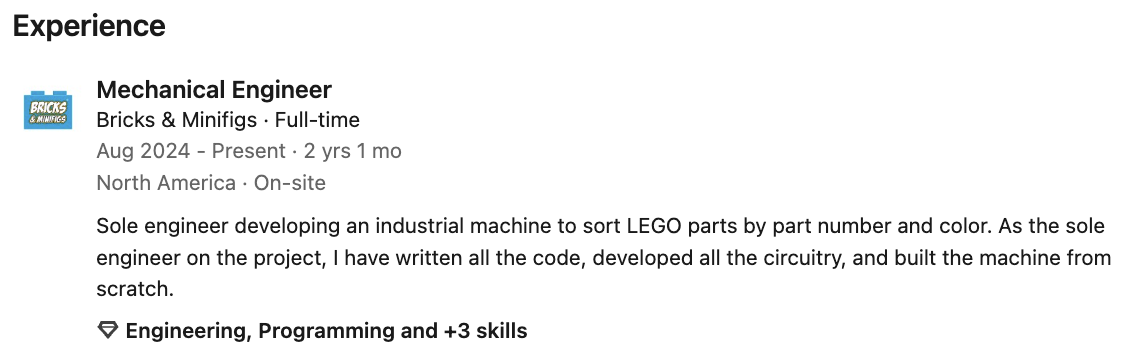
He lists it himself: Mechanical Engineer, Bricks & Minifigs, August 2024 – present. “Sole engineer developing an industrial machine to sort LEGO parts by part number and color… written all the code, developed all the circuitry, and built the machine from scratch.”
Two years, by the dates. Present tense, by the verb: developing. Color, by his own listing, is a goal not yet reached. He is a computer-vision engineer: his 2023 BYU master’s thesis, in the university’s open archive, develops methods for a camera to track features, predict depth, and estimate a moving target, the same machine-vision problem as sorting a used part by shape and color.
CONFIRMED BAM’s operations manual gives one address for its in-house parts operation, “BAM Custom Printing”: 225 W 520 N, Orem. On the county rolls that is Holland Square, units 17 and 18, two adjoining office condos with finished basements. The sorting robot is in the finished basement of that building. This site has confirmed the location.
The building has a past on BAM’s own paper. Item 2 of the disclosure document lists the chief executive, Ammon McNeff, as president of Legally Mine, an asset-protection company, from 2011 to 2020, and the chief operating officer, Matthew McNeff, as that company’s vice-president of marketing; for years Legally Mine and the franchisor shared this address, the record is in One office. The company moved its headquarters out in 2024, on a new $1,135,107 lease. It did not take the building. The units are held by Phoenix Keep LLC, whose sole member of record is Knight’s Vault, LLC, a Wyoming company in a state that does not disclose owners; the chain is in The shells. The audited statements list the company’s leases: the new office, two stores, a subscription-box space. The building that houses the robot is on none of them.
What it has cost
Total “Equipment” on BAM Franchising’s books, at cost, each year-end · gray marks what was added that year
CONFIRMED For years the franchisor carried almost no equipment: $22,474, unchanged. Then $74,651 of additions by the end of 2023, $79,502 more in 2024, and nothing added in 2025. The statements do not say what the equipment is.
The additions ran while the company’s audited net worth was negative. It closed 2024, the year the equipment line peaked, at −$492,495, and 2025 at −$621,091. In that same 2024 it finalized 68 new franchise agreements.
Equipment is stated at cost; labor is not in it. The builder is a full-time employee. Federal labor data puts the median mechanical-engineer salary near $100,000 a year; two years of it, roughly $200,000, sits in payroll, not in the equipment line. The building is not in it either. The $154,153 is a floor.
INFERENCE Store acquisitions sit in goodwill; the office move sits in leasehold improvements. Equipment is its own line, and its two years of growth are the two years the engineer lists. How much of it is the robot, the statements do not say.
What it is for
Item 8 of the disclosure document: “We are an approved supplier, but not the only approved supplier, of certain inventory for your Store. If we develop proprietary products or software in the future, you must purchase such items from… us.” The history of the required-purchase terms is in ‘Independently owned.’ Required to buy from corporate.

Added to the fee table in 2025: a Technology Fund of “up to 1% of Gross Revenue for technological innovation and development,” with the remark “We do not currently have a Technology Fund, but may institute in our discretion.” The franchise agreement provides 30 days’ notice before payment is required.
CTO 2023. Engineer 2024. Fee 2025.
Item 2 added a chief technology officer, Mike Wu, in October 2023. The engineer’s listing begins August 2024. The technology fee entered the fee table in 2025. Each step is on BAM’s own paper. None of the paper names the robot.
The build, on BAM’s own paper
The job it takes
A store’s stock is used LEGO bought from the public over its own counter. The manual walks owners through the rest by hand: complete the set, or “turn it into bulk or grab bags”; sell the loose pieces from “bulk tables, clam-packs, bulk bins.” That sorting is the store’s own work, and the margin on it is the store’s own.
On one kind of sorting the manual tells owners to stop. “We do NOT sort into colors,” it reads; “stores rarely actually sort for color because it is not cost effective.” The machine the engineer describes sorts “by part number and color.”
Corporate sells used LEGO to the public too. One line of its ledger reads “4310 Merchandise Sales (Shopify) $599,654.09.” Its affiliate Bricks by the Box, LLC is described in the disclosure document as “a LEGO®-themed subscription box reseller and fulfillment company,” formed June 2023, at the corporate address.
The machine is being built to sort used LEGO by part and color, the color sort the manual tells owners not to do. Corporate is the approved supplier. Corporate sells to the public. Corporate is building the sorter.
“Anyone know why there is a mechanical engineer working for corporate?”
The 2025 and 2026 disclosure editions were issued after the build began; neither names it. The brand’s public channels do not. The operations manual sends owners to BrickLink to price a part and to corporate to buy it; it does not name it. The terms are disclosed. The machine is not.
It surfaced once, on the same April recording, as a joke. The host wished aloud for a LEGO vacuum for his playroom. Matt McNeff, BAM’s COO, answered: “We have some engineers on staff that can do some amazing things.” The engineer’s listing was, by then, in its twentieth month.
Already built, by an amateur, out of LEGO
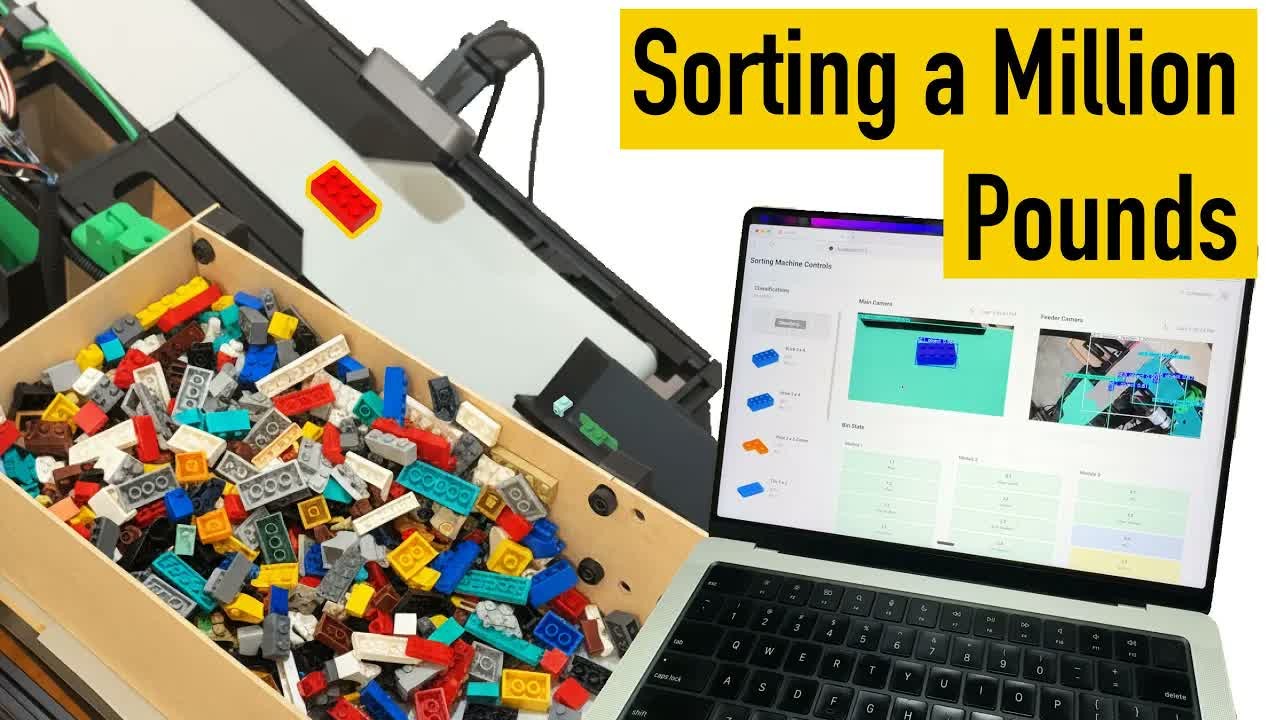
CONFIRMED In 2019 a software engineer, Daniel West, built the “world’s first universal LEGO sorting machine” from about 10,000 LEGO bricks and a Raspberry Pi camera, trained a neural network to recognize any part ever made, and published how. A hobbyist made a working, reproducible one in about six months, from “the cheapest servo motors you can buy online,” and put the plans on GitHub. A funded company, Sort A Brick, does it commercially by the ton.
BAM’s is being built by one full-time employee, over two years and counting, unpublished, in a building held outside the company, and unnamed to the owners contracted to buy what it makes. By the engineer’s own listing it is still in development. It has filed no patent.
What the law asks
Two rules of law bear here. The Federal Trade Commission’s Franchise Rule requires a franchisor to disclose the sources a franchisee must use, and any benefit it draws from them, in Item 8, and its fees in Item 6. And antitrust law has a name for what happens when a company with little power in an open market gains power over customers locked in by money they have already spent: aftermarket power (Eastman Kodak Co. v. Image Technical Services, 1992). A franchisee who has signed, built out a store, and cannot cheaply leave is locked in.
Output machines
Asked for his strength, the chief executive said he tends not to see people as human. He sees them by whether they help accomplish the thing, and if they cannot, “we need a different… machine in there.” On the same recording he put it another way: people “expire,” he said, and you have to know when their time is up.
His company is building an output machine of its own. Its job, by camera and circuitry, is the sorting his store owners do by hand.
Sources. BAM’s 2017–2026 Franchise Disclosure Documents and the audited financial statements filed with them, walked against themselves in the disclosure file (Items 6, 8 and 21; the equipment note); the operations manual; the engineer’s public LinkedIn, shown above; the April 2026 recording, hosted with the earlier report; and Utah County and Wyoming registries. Related: required to buy from corporate, the shared building, the shell chain, the enterprise, the map, and the timeline.
The BAM Map is independent reporting on matters of public concern. Nothing here is a finding of any person’s guilt; the civil allegations described are unadjudicated, and every defendant is presumed innocent. Sources are linked so readers can check the record. · Home · Map