Legally Mine’s Operating Agreement
CONFIRMEDThe instrument, its clauses, and the two-document composite: all from the court file in Utah Fourth District case 200401232, hosted in full below.ANALYSISWhat Utah law does with clauses like these, with the authority linked. General information about the law, not legal advice.
Legally Mine sells legal structures marketed to put property beyond the reach of lawsuits and creditors, the asset-protection business this site reports is the machine behind the BAM franchise. Its own operating agreement is a public record, and not because anyone leaked it. In 2020, founder Daniel McNeff and the company petitioned a Utah court to overturn the arbitration award in his fight with his sons, and their own lawyers filed the company’s governing document as Exhibit B. The product, applied to the company that sells it, is on the docket for anyone to read. It is hosted in full at the bottom of this page.
Three things are in it. The exact walls the company markets, written for itself. A judge, on the record, describing what the arbitration wall did to his own jurisdiction. And a documentary seam: the exhibit is two agreements spliced together, and the version that actually governs, the one with the ownership split, is the one nobody notarized.
Public, and built not to be
Be clear about what this page hosts: a public court record. The memorandum and its exhibits were filed on the open docket of a Utah state court, unsealed, by the company’s own counsel, and anyone may buy them from the court’s records system. Reporting them is what public court records exist for.
Public does not mean easy to find. The filing is reachable through the courts’ paid records system, one purchased document at a time, inside a case most readers would never know to search, as an exhibit buried in an opposition brief. Public, in practice, means available to someone who already knows exactly what to ask for. That is why it is hosted here in full.
And the document itself is built to keep documents like it out of sight. Its arbitration clause bars any “civil action” in any court, which is how the family’s 2019 case actually ended, dismissed into a private forum. Its confidentiality clauses gag current and former members from disclosing “any information relating to the Company,” down to its business plans, financial statements and tax returns. The operating agreement is itself information relating to the company; under its own terms, no member could simply hand it to the public. It is public anyway for one reason: the founder needed it in court, to fight the award his company’s own arbitration clause produced. The next dispute this agreement governs is designed to leave no public record at all.
What the walls say
Paragraph 1.04(m) defines the thing the agreement restricts, a “Transfer.” It is written to include “any change of ownership incident to any divorce, whether or not for value,” and to exclude a change “made solely on account of a court order or by operation of law.” A divorcing spouse’s claim is swept into the restrictions; a creditor’s court order is defined out, so it cannot make anyone a member.
Paragraph 5.01 builds the wall itself. No member may sell, assign, give or convey an interest, “whether voluntarily or involuntarily,” without majority consent. A recipient or lien holder who lacks that consent gets money rights only: no right to vote, no right “to require any information,” none “to inspect the Company’s books and records.” A judgment creditor ends where the paper puts him, holding a share of profits with no control, no say, and no view inside.
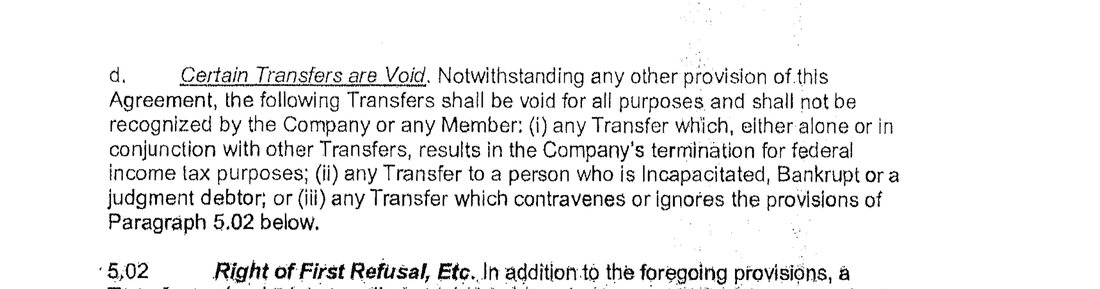
Paragraph 5.01(d) goes further. A transfer “to a person who is Incapacitated, Bankrupt or a judgment debtor” is “void for all purposes.” The agreement does not merely restrict a creditor’s path. It declares the path void on arrival, by name.
Then the cash tap. Under paragraph 2.09 the members may distribute profits or “withhold any or all distributions, as they deem advisable,” in their sole discretion. So the money rights a creditor is left holding attach to distributions the members may simply decline to make.
Then the exit price. If a member is bought out, paragraph 5.04 sets the value by the company’s CPA using “all discounts, premiums and principles applicable to valuations for federal estate tax purposes,” payable 10 percent in cash and the rest in equal annual installments over 15 years at the “then lowest permissible” federal rate. Estate-tax discounting exists to shrink stated values. Here it prices what a departing member’s interest, and anyone standing behind it, would actually receive.
And the door. Paragraph 7.06: “No civil action concerning any dispute arising under this Agreement shall be instituted before any court.” Every dispute goes to a single private arbitrator, the prevailing party is awarded “100% of their reasonable costs and attorneys’ fees,” and the members are bound to confidentiality. Disputes leave the public record, the loser pays for both sides, and the people who know are gagged.
A judge, reading the same agreement
The clauses are not theory. When the sons first sued their father in 2019, case 190401633, and won a temporary restraining order, Judge James Taylor dissolved it on November 6, 2019, and told the parties on the record what the agreement left him: “I think the limits of this Court’s jurisdiction are until you can get to arbitration as is provided in the corporate agreement, and I think you’re required to go there first.” And then: “My authority is limited to bridging the gap.”
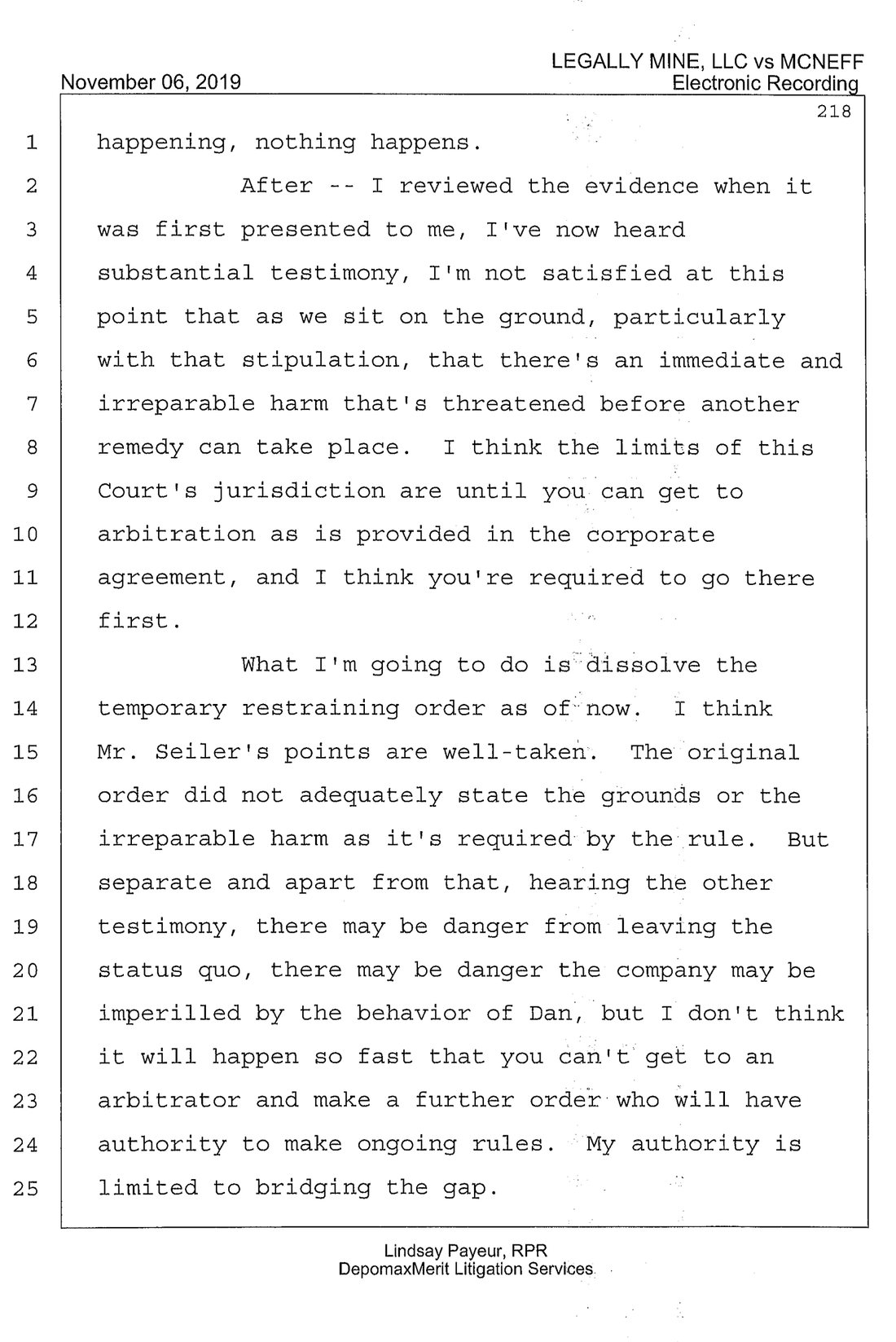
Sixteen days later the court’s minute entry, quoted in the hosted memorandum, reads: “Based on counsel[’s] decision and stipulation to obtain an arbitrator, [the] court orders this case be dismissed.” The public case ended there. What followed, by the memorandum’s own account, was a six day arbitration trial in May and June 2020, in private. The dispute surfaces in the public record again only because the founder and the company challenged the result, and their briefing recites what happened inside: the arbitrator awarded attorneys’ fees against Legally Mine and removed the founder, in his own lawyers’ words, “as the Member Manager of Legally Mine.” The company’s own clause ran its course on the company’s own founder.
The same door is in the BAM franchise agreement: one clause, and a franchisee’s suit, elder-abuse claims included, went to confidential arbitration.
Two agreements in one exhibit
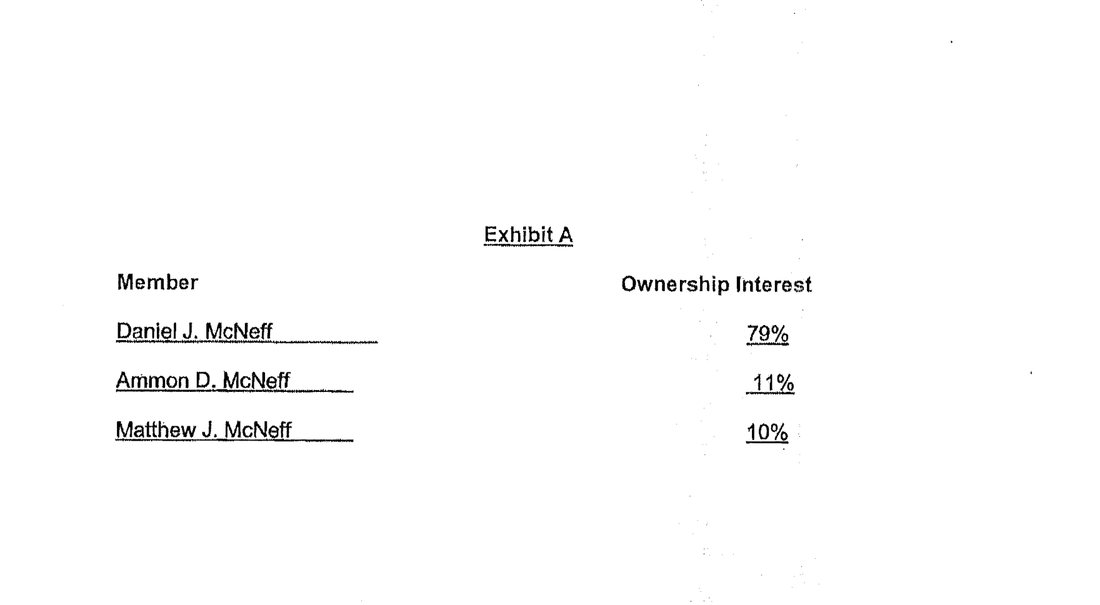
The memorandum dates the operative agreement plainly: “In January, 2019, Dan and his sons, Ammon and Matt, entered into the Amended and Restated Operating Agreement of Legally Mine, LLC,” attached “as Exhibit B.” The attached document says something else. Its date line reads January 12, 2015. Its first page names two members, Daniel and Ammon. Its pages run “Page 1 of 17” through “Page 16 of 17,” and page 16 is a two-member signature page bearing a notary stamp: Scott Alan Anderson, commission 676499, expiring April 25, 2018. Then the numbering changes. The next page is “Page 17 of 18,” a three-member signature page adding Matthew, with no notarization at all. The last page, “Page 18 of 18,” is the ownership schedule: Daniel 79 percent, Ammon 11, Matthew 10.
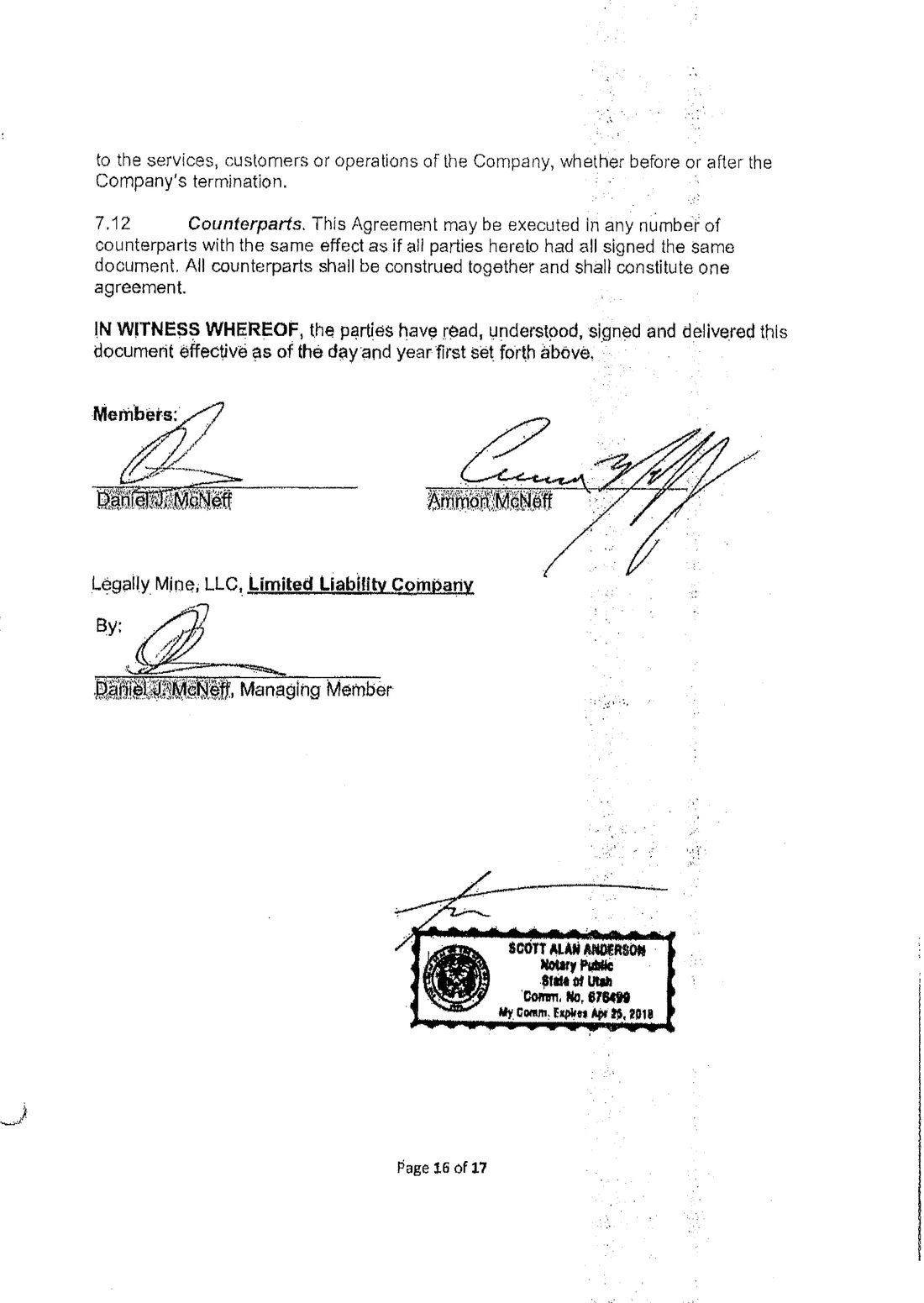
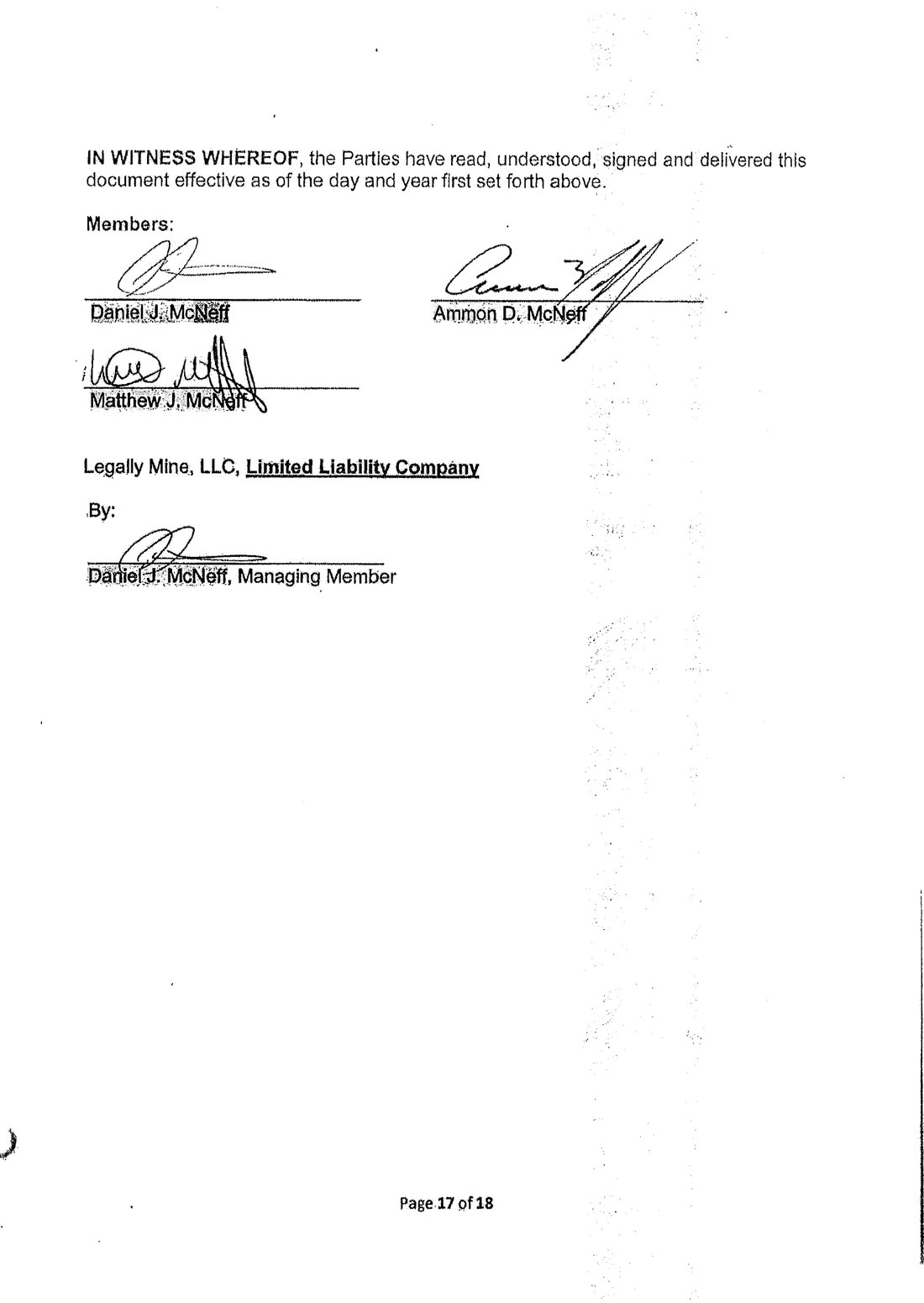
Two different page counts is two different documents. The notarized signatures belong to the 2015 two-member agreement. The January 2019 restatement, the one that adds the third member and sets the 79/11/10 split, carries no notary at all, and the commission on the older page’s stamp had expired the previous April. The 2015 agreement’s own ownership schedule, whatever the split was before 2019, is not in the filing.
A notary of the same name stamps the four McNeff family deeds this site documented in The deed signed twice, at his next commission number, 702080, on deeds recorded defective and later quietly cured. The name on this stamp is the same. The commission is the earlier one.
What Utah law says about walls like these
The clauses are real drafting, and some track real Utah law. The limits are also real law, and they are not in the marketing.
The charging order is genuine. Utah Code 48-3a-503 makes the charging order a creditor’s exclusive remedy against a member’s interest in a multi-member LLC. The agreement’s charging-order-only outcome tracks the Legislature’s own rule.
It has a known edge. The leading bankruptcy case, In re Albright (Bankr. D. Colo. 2003), reasoned that charging-order protection exists to protect the other members from a stranger in their business. Where an LLC has only one member, there is no one else to protect, and the court let the bankruptcy trustee take control outright. Single-member companies are a common configuration in asset protection generally.
Divorce is different too. In Dahl v. Dahl, 2015 UT 23, the Utah Supreme Court reached assets held in a family trust drafted to be untouchable and valued closely held family interests in the marital estate. An operating agreement can define divorce as a restricted transfer between its members. It does not repeal the divorce court’s equitable powers over marital property.
The badge list. Utah’s voidable-transactions act, Utah Code 25-6-202, lists what courts weigh as evidence a transfer was made to hinder, delay, or defraud a creditor: a transfer to an insider, control retained after the transfer, a suit threatened or pending, a transfer of substantially all assets. Whether any particular transfer crosses the line is decided case by case, and no court has decided that about anything here. But the statute is the lens a court reads a structure through, and Utah courts look to substance over form (Ockey v. Lehmer, 2008 UT 37). A clause that voids transfers to “a judgment debtor” names its concern on its face.
Arbitration binds the people who signed. Utah enforces arbitration clauses between their parties (Central Florida Investments v. Parkwest Associates, 2002 UT 3). A creditor, a bankruptcy trustee, a spouse, anyone who never signed the agreement, is not a party to it. The clause moved the family’s war into a private room. It does not close the public courthouse to people outside the paper.
Every wall in this document faces inward. The agreement bound the family that signed it, exactly as written: the founder was removed under its own expulsion clause, in the private forum its own arbitration clause required, at the fee shift its own text set. What the walls cannot do, under the authority above, is bind the people who never signed them.
The fair counterpoint: provisions like these are standard in closely held companies, and charging-order protection is the Utah Legislature’s own policy, not a trick. Utah law does not require an operating agreement to be notarized to bind its members (Utah Code 48-3a-112), a composite exhibit can be assembled innocently from a base agreement and a later amendment, and nothing on this page says the agreement is invalid or that any transfer broke any rule. No court has decided any of it, and everyone named is presumed innocent.
Sources, public records: Memorandum in Opposition with Exhibits A and B, filed September 24, 2020, in Daniel McNeff and Legally Mine, LLC v. McNeff, Utah Fourth District case 200401232, hosted here in full (the operating agreement begins at the page headed “Amended and Restated Operating Agreement”); hearing transcript of November 6, 2019, case 190401633, within the same filing; Utah Code 48-3a-503, 48-3a-112 and 25-6-202; the opinions linked above at CourtListener. The machine behind the franchise is in The machine; the notary pattern is in The deed signed twice; the franchise arbitration door is in How the disputes disappear.
The BAM Map is independent reporting on matters of public concern. Nothing here is a finding of any person’s guilt; the claims referenced are unadjudicated and every defendant is presumed innocent. Sources are linked so readers can check the record. · Home · Map · The law · Bodycam